

Cell-to-cell spread and massive vacuole formation after Cryptococcus neoformans infection of murine macrophages
Open accessThe DOI matches its Crossref record; 18 of the 18 references it cites were found in a registry or an index.
Abstract
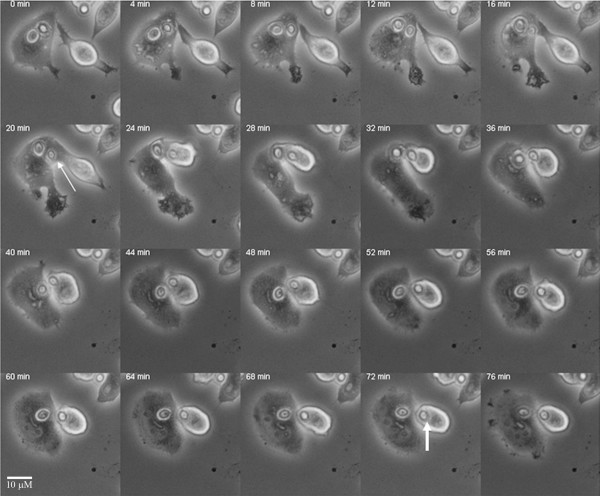
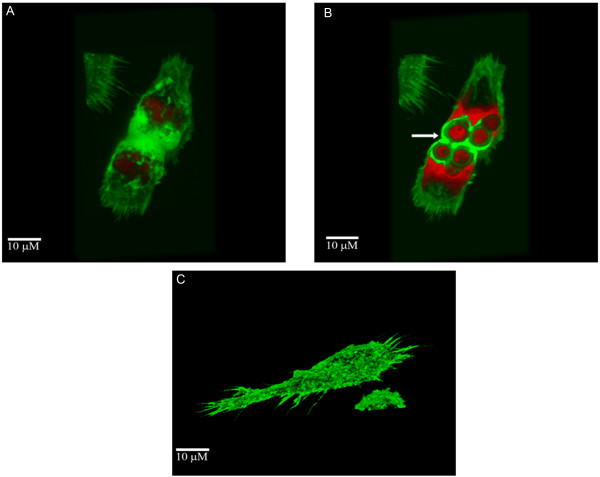
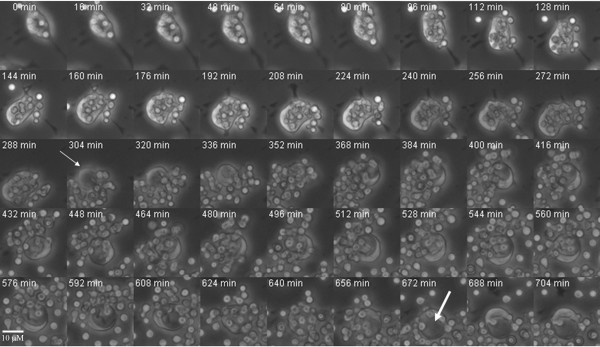
BACKGROUND: The interaction between macrophages and Cryptococcus neoformans (Cn) is critical for containing dissemination of this pathogenic yeast. However, Cn can either lyse macrophages or escape from within them through a process known as phagosomal extrusion. Both events result in live extracellular yeasts capable of reproducing and disseminating in the extracellular milieu. Another method of exiting the intracellular confines of cells is through host cell-to-cell transfer of the pathogen, and this commonly occurs with the human immuno-deficiency virus (HIV) and CD4+ T cells and macrophages. In this report we have used time-lapse imaging to determine if this occurs with Cn. RESULTS: Live imaging of Cryptococcus neoformans interactions with murine macrophages revealed cell-to-cell spread of yeast cells from infected donor cells to uninfected cells. Although this phenomenon was relatively rare its occurrence documents a new capacity for this pathogen to infect adjacent cells without exiting the intracellular space. Cell-to-cell spread appeared to be an actin-dependent process. In addition, we noted that cryptococcal phagosomal extrusion was followed by the formation of massive vacuoles suggesting that intracellular residence is accompanied by long lasting damage to host cells. CONCLUSION: C. neoformans can escape the intracellular confines of macrophages in an actin dependent manner by cell-to-cell transfer of the yeast leading to infection of adjacent cells. In addition, complete extrusion of internalized Cn cells can lead to the formation of a massive vacuole which may be a sign of damage to the host macrophage. These observations document new outcomes for the interaction of C. neoformans with host cells that provide precedents for cell biological effects that may contribute to the pathogenesis of cryptococcal infections.
Overview
The claims and statistics of this paper haven’t been checked yet.
Free: it reads the open-access text and checks the first 5 claims that cite a source we can check. Create a free account to check every claim.
Integrity signals
Registry
Cites
Statistics
Figures
Verification
Claims the paper makes
The claims and statistics of this paper haven’t been checked yet.
Free: it reads the open-access text and checks the first 5 claims that cite a source we can check. Create a free account to check every claim.
Claims other papers make about this one
Each is checked against this paper’s own text: does it say what the citing paper says it does?
In the citing paper
“This cell-to-cell spread, known as lateral transfer or dragotcytosis, is an actin-dependent process that requires donor and acceptor cells be in physical contact [124–126].”
From Mechanisms of fungal dissemination (2021) · cites this paper as [125]
Self-check
Percentages, sums and reported differences re-computed from the paper’s own numbers.
The self-check needs the paper’s full text.
Citations
Cites
HIV-1 Cell to Cell Transfer across an Env-induced, Actin-dependent Synapse
Jolly, C., Kashefi, K., Hollinshead, M., & Sattentau, Q. J. (2004) · The Journal of Experimental Medicine · doi:10.1084/jem.20030648 · Cited by 623
Actin-based motility of vaccinia virus
Cudmore, S., Cossart, P., Griffiths, G., & Way, M. (1995) · Nature · doi:10.1038/378636a0 · Cited by 425
Cryptococcus neoformans Is a Facultative Intracellular Pathogen in Murine Pulmonary Infection
Feldmesser, M., Kress, Y., Novikoff, P., & Casadevall, A. (2000) · Infection and Immunity · doi:10.1128/iai.68.7.4225-4237.2000 · Cited by 423
Self-citationReticulum Cell Sarcoma: An Effector Cell in Antibody-Dependent Cell-Mediated Immunity
Ralph, P., Prichard, J., & Cohn, M. (1975) · The Journal of Immunology · doi:10.4049/jimmunol.114.2_part_2.898 · Cited by 420
Phagosome Extrusion and Host-Cell Survival after Cryptococcus neoformans Phagocytosis by Macrophages
Alvarez, M., & Casadevall, A. (2006) · Current Biology · doi:10.1016/j.cub.2006.09.061 · Cited by 414 · cited 3×
“Phagocytosis assays were done as previously described [5,7].”
BackgroundMethodSelf-citationEffects of cytochalasin, phalloidin and pH on the elongation of actin filaments
Sampath, P., & Pollard, T. D. (1991) · Biochemistry · doi:10.1021/bi00221a034 · Cited by 329
Expulsion of Live Pathogenic Yeast by Macrophages
Ma, H., Croudace, J. E., Lammas, D. A., & May, R. C. (2006) · Current Biology · doi:10.1016/j.cub.2006.09.032 · Cited by 310
Tucker, S. C., & Casadevall, A. (2002) · Proceedings of the National Academy of Sciences · doi:10.1073/pnas.052702799 · Cited by 306 · cited 2×
“Phagocytosis assays were done as previously described [5,7].”
BackgroundMethodSelf-citationDirected Egress of Animal Viruses Promotes Cell-to-Cell Spread
Johnson, D. C., & Huber, M. T. (2002) · Journal of Virology · doi:10.1128/jvi.76.1.1-8.2002 · Cited by 257
Osteoclasts and giant cells: macrophage–macrophage fusion mechanism
Vignery, A. (2000) · International Journal of Experimental Pathology · doi:10.1111/j.1365-2613.2000.00164.x · Cited by 254
The origin and maintenance of virulence for the human pathogenic fungus Cryptococcus neoformans
Steenbergen, J. N., & Casadevall, A. (2003) · Microbes and Infection · doi:10.1016/s1286-4579(03)00092-3 · Cited by 183
Self-citationInteractions of fungi with phagocytes
Mansour, M. K., & Levitz, S. M. (2002) · Current Opinion in Microbiology · doi:10.1016/s1369-5274(02)00342-9 · Cited by 132
Shao, X., Mednick, A., Alvarez, M., van Rooijen, N., Casadevall, A., & Goldman, D. L. (2005) · The Journal of Immunology · doi:10.4049/jimmunol.175.5.3244 · Cited by 124
Self-citationDirect cell-to-cell spread of a pathogenic yeast
Ma, H., Croudace, J. E., Lammas, D. A., & May, R. C. (2007) · BMC Immunology · doi:10.1186/1471-2172-8-15 · Cited by 96 · cited 1×
“Note added in proof This publication of this article was coordinated with the publication of the article 'Direct Cell-to-Cell Spread of a Pathogenic Yeast' by Ma et al in BMC Immunology [ 19 ].”
BackgroundCryptococcus neoformans survive and replicate in human microglia.
Lee, S. C., Kress, Y., Zhao, M., Dickson, D. W., & Casadevall, A. (1995) · PubMed · Cited by 91
Self-citationMukherjee, S., Feldmesser, M., & Casadevall, A. (1996) · Journal of Infectious Diseases · doi:10.1093/infdis/173.5.1222 · Cited by 61
Self-citationCarlsson, F., & Brown, E. J. (2006) · Journal of Cellular Physiology · doi:10.1002/jcp.20721 · Cited by 39
Chang, Z. L., Netski, D., Thorkildson, P., & Kozel, T. R. (2006) · Infection and Immunity · doi:10.1128/iai.74.1.144-151.2006 · Cited by 32
Cited by
Cryptococcus: from environmental saprophyte to global pathogen
May, R. C., Stone, N. R. H., Wiesner, D. L., Bicanic, T., & Nielsen, K. (2016) · Nature Reviews Microbiology · doi:10.1038/nrmicro.2015.6 · Cited by 541
Chapter 4 The Capsule of the Fungal Pathogen Cryptococcus neoformans
Zaragoza, O., Rodrigues, M. L., De Jesus, M., Frases, S., Dadachova, E., & Casadevall, A. (2009) · Advances in Applied Microbiology · doi:10.1016/s0065-2164(09)01204-0 · Cited by 457
Self-citationExpanding fungal pathogenesis: Cryptococcus breaks out of the opportunistic box
Kronstad, J. W., Attarian, R., Cadieux, B., Choi, J., D'Souza, C. A., Griffiths, E. J., Geddes, J. M. H., Hu, G., Jung, W. H., Kretschmer, M., et al. (2011) · Nature Reviews Microbiology · doi:10.1038/nrmicro2522 · Cited by 340
Fungal cell gigantism during mammalian infection
Zaragoza, O., García-Rodas, R., Nosanchuk, J. D., Cuenca-Estrella, M., Rodríguez-Tudela, J. L., & Casadevall, A. (2010) · PLoS Pathogens · doi:10.1371/journal.ppat.1000945 · Cited by 311
“neoformans cells, as described previously [39,40,41,42,43] and shown in supporting”
BackgroundSelf-citationExtracellular Vesicles from Cryptococcus neoformans Modulate Macrophage Functions
Oliveira, D. L., Freire-de-Lima, C. G., Nosanchuk, J. D., Casadevall, A., Rodrigues, M. L., & Nimrichter, L. (2010) · Infection and Immunity · doi:10.1128/iai.01171-09 · Cited by 257
Self-citation
Metadata
- Authors
- Alvarez, M., & Casadevall, A.
- Affiliations
- Albert Einstein College of Medicine (US)
- Corresponding author
- Casadevall, Arturo
- ORCID
- Casadevall, Arturo
- Venue
- BMC Immunology
- Published
- 2007
- Volume
- 8
- Issue
- 1
- Pages
- 16
- ISSN
- 1471-2172 (ISSN-L)
- PMC
- PMC1988836
- OpenAlex
- W2158576875
- Cited by
- 131
- References
- 18
- Citations by year
- 2026: 2 · 2025: 3 · 2024: 4 · 2023: 7 · 2022: 5 · 2021: 4 · 2020: 8 · 2019: 7 · 2018: 10 · 2017: 4 · 2016: 5 · 2015: 8 · 2014: 8 · 2013: 7 · 2012: 10
- FWCI
- 6.42
- Type
- journal article
- Language
- en
- Open access
- gold
- doi.org
- Licence
- cc-by
- Locations
- BMC Immunology (publishedVersion, cc-by)
- PubMed Central (publishedVersion, cc-by)
- PubMed (publishedVersion)
- DOAJ (DOAJ: Directory of Open Access Journals) (submittedVersion, cc-by-sa)
- Funders
- National Institutes of Health (5r01hl059842-23, AI033142, HL059842-08, HL059842, 5r37ai033142-24)
- National Heart, Lung, and Blood Institute (R01-HL059842, HL059842-08)
- National Institute of Allergy and Infectious Diseases (R01AI033142, AI033774-11, R37-AI033142, R01AI033774, AI033142-11)
- Topics
- Health Sciences › Medicine › Infectious Diseases › Fungal Infections and Studies
- Life Sciences › Immunology and Microbiology › Microbiology › Bacterial Infections and Vaccines
- Life Sciences › Biochemistry, Genetics and Molecular Biology › Endocrinology › Legionella and Acanthamoeba research
- Keywords
- Cryptococcus neoformans, macrophages, cell-to-cell transmission, vacuole formation, host cell damage, fungal pathogenesis
- MeSH terms
- Animals, Cryptococcus neoformans, Female, Macrophages, Phagocytosis, Vacuoles, Macrophages, Peritoneal, Microscopy, Confocal, Cell Line, Tumor, Mice
About these checks
Registry, retraction, Cites and statistics results are computed, not judged, with one exception: a printed reference that no index lists is read once by a model before it counts as a citation error. Claims are extracted by a model and kept only when their quote appears verbatim in the text; each cited source is then checked, with a model’s help, for whether it says what the claim relies on. Those verdicts can be wrong — read the claim’s quote and the cited source before relying on one.
Statistics and arithmetic are recomputed, not judged.
Confidence bands are shown only for fields calibrated on our annotated test set. None is calibrated yet, so no band is shown.
What counts as a claim ›How we measure confidence ›How we check this ›
Are you an author, or do you see a problem with this page? Request a review
Data sources
Bibliographic data: Semantic Scholar, OpenAlex, Crossref.
Contains information from the Semantic Scholar Academic Graph Datasets, made available under the ODC Attribution License (ODC-BY 1.0).
Semantic Scholar’s data is described in: Kinney, R., et al. (2023). The Semantic Scholar Open Data Platform. arXiv:2301.10140.
