

Intestinal dysbiosis and reduced immunoglobulin-coated bacteria associated with coeliac disease in children
Open accessThe DOI matches its Crossref record; 34 of the 34 references it cites were found in a registry or an index.
Abstract
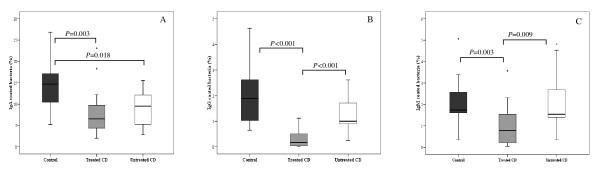
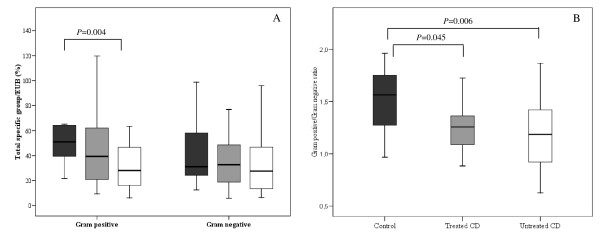
Background: Coeliac disease is a chronic intestinal inflammatory disorder due to an aberrant immune response to dietary gluten proteins in genetically predisposed individuals. Mucosal immune response through IgA secretion constitutes a first line of defence responsible for neutralizing noxious antigens and pathogens. The aim of this study was the characterization of the relationships between immunoglobulin-coated bacteria and bacterial composition of faeces of coeliac disease (CD) patients, untreated and treated with a gluten-free diet (GFD) and healthy controls. Results: IgA-coated faecal bacterial levels were significantly lower in both untreated and treated CD patients than in healthy controls. IgG and IgM-coated bacterial levels were also significantly lower in treated CD patients than in untreated CD patients and controls. Gram-positive to Gram-negative bacteria ratio was significantly reduced in both CD patients compared to controls. Bifidobacterium , Clostridium histolyticum , C. lituseburense and Faecalibacterium prausnitzii group proportions were less abundant ( P < 0.050) in untreated CD patients than in healthy controls. Bacteroides-Prevotella group proportions were more abundant ( P < 0.050) in untreated CD patients than in controls. Levels of IgA coating the Bacteroides-Prevotella group were significantly reduced ( P < 0.050) in both CD patients in comparison with healthy controls. Conclusions: In CD patients, reduced IgA-coated bacteria is associated with intestinal dysbiosis, which altogether provide new insights into the possible relationships between the gut microbiota and the host defences in this disorder.
Overview
The claims and statistics of this paper haven’t been checked yet.
Free: it reads the open-access text and checks the first 5 claims that cite a source we can check. Create a free account to check every claim.
Integrity signals
Registry
Cites
Statistics
Figures
Verification
Claims the paper makes
The claims and statistics of this paper haven’t been checked yet.
Free: it reads the open-access text and checks the first 5 claims that cite a source we can check. Create a free account to check every claim.
Claims other papers make about this one
Each is checked against this paper’s own text: does it say what the citing paper says it does?
The cited source says what the claim attributes to it.
In the citing paper
“Chronic autoimmune inflammatory diseases, including celiac disease,17 type 2 diabetes18 and obesity19 are associated with intestinal dysbiosis.”
From Probiotics and the gut microbiota in intestinal health and disease (2010) · cites this paper as [17]
Self-check
Percentages, sums and reported differences re-computed from the paper’s own numbers.
The self-check needs the paper’s full text.
Citations
Cites
Amann, R. I., Binder, B. J., Olson, R. J., Chisholm, S. W., Devereux, R., & Stahl, D. A. (1990) · Applied and Environmental Microbiology · doi:10.1128/aem.56.6.1919-1925.1990 · Cited by 4,021 · cited 1×
“The EUB 338 probe, targeting a conserved region within the bacterial domain, was used as a positive control [22] and the NON 338 probe was used as a negative control to eliminate background fluorescence [23].”
MethodGreen, P. H. R., & Jones, R. (2006) · Cited by 2,453
Reduced diversity of faecal microbiota in Crohn’s disease revealed by a metagenomic approach
Manichanh, C., Rigottier-Gois, L., Bonnaud, E., Gloux, K., Pelletier, E., Frangeul, L., Nalin, R., Jarrin, C., Chardon, P., Marteau, P., et al. (2006) · Gut · doi:10.1136/gut.2005.073817 · Cited by 2,277 · cited 1×
“Comparative analysis of biopsy and faecal samples of IBD patients, based on genomiclibrary sequencing analysis, also showed reductions in Firmicutes belonging to the class Clostridia in active and in remission Crohn’s disease patients as compared to healthy or ulcerative colitis groups [19,20].”
ResultWallner, G., Amann, R., & Beisker, W. (1993) · Cytometry · doi:10.1002/cyto.990140205 · Cited by 1,212 · cited 1×
“The EUB 338 probe, targeting a conserved region within the bacterial domain, was used as a positive control [22] and the NON 338 probe was used as a negative control to eliminate background fluorescence [23].”
MethodManz, W., Amann, R., Ludwig, W., Vancanneyt, M., & Schleifer, K.-H. (1996) · Microbiology · doi:10.1099/13500872-142-5-1097 · Cited by 1,175 · cited 1×
“Eub 338 Domain bacteria GCT GCC TCC CGT AGG AGT 50 [13] Non 338 Negative control ACA TCC TAC GGG AGG C 50 [14] Bif 164 Bifidobacterium CAT CCG GCA TTA CCA CCC 50 [24] Lab 158 Lactobacillus/Enterococcus GGT ATT AGC A(C/T)C TGT TTC CA 45 [25] Bac 303 Bacteroides/Prevotella CCA ATG TGG GGG ACC TT 45 [ 26 ] Ecol 1513 Esch…”
MethodFranks, A. H., Harmsen, H. J. M., Raangs, G. C., Jansen, G. J., Schut, F., & Welling, G. W. (1998) · Applied and Environmental Microbiology · doi:10.1128/aem.64.9.3336-3345.1998 · Cited by 1,056 · cited 2×
“... control ACA TCC TAC GGG AGG C 50 [14] Bif 164 Bifidobacterium CAT CCG GCA TTA CCA CCC 50 [24] Lab 158 Lactobacillus/Enterococcus GGT ATT AGC A(C/T)C TGT TTC CA 45 [25] Bac 303 Bacteroides/Prevotella CCA ATG TGG GGG ACC TT 45 [26] Ecol 1513 Escherichia coli CAC CGT AGT GCC TCG TCA TCA 50 [27] Chis 150 Clostridium h…”
MethodLangendijk, P. S., Schut, F., Jansen, G. J., Raangs, G. C., Kamphuis, G. R., Wilkinson, M. H., & Welling, G. W. (1995) · Applied and Environmental Microbiology · doi:10.1128/aem.61.8.3069-3075.1995 · Cited by 975
VSL#3 Probiotic-Mixture Induces Remission in Patients with Active Ulcerative Colitis
Bibiloni, R., Fedorak, R. N., Tannock, G. W., Madsen, K. L., Gionchetti, P., Campieri, M., De Simone, C., & Sartor, R. B. (2005) · The American Journal of Gastroenterology · doi:10.1111/j.1572-0241.2005.41794.x · Cited by 744 · cited 8×
“In contrast, IBD patients displayed a higher percentage of immunoglobulincoated faecal bacteria in active disease and shortly after remission, supporting the concept that the mucosal tolerance to the gut microbiota is deregulated in these patients [5].”
BackgroundInfluentialGophna, U., Sommerfeld, K., Gophna, S., Doolittle, W. F., & Veldhuyzen van Zanten, S. J. O. (2006) · Journal of Clinical Microbiology · doi:10.1128/jcm.01004-06 · Cited by 550 · cited 3×
“These components of the microbiota are producers of butyrate, which is an important energy source for colonocytes and exerts anti-inflammatory effects, for instance by inhibiting the lipopolysaccharide-induced cytokine response [19].”
BackgroundResultDrago, S., El Asmar, R., Di Pierro, M., Grazia Clemente, M., Sapone, A. T. A., Thakar, M., Iacono, G., Carroccio, A., D'Agate, C., Not, T., et al. (2006) · Scandinavian Journal of Gastroenterology · doi:10.1080/00365520500235334 · Cited by 502 · cited 2×
“Gliadin also activates the zonulin pathway leading to an increase in intestinal permeability [1].”
BackgroundThe first large population based twin study of coeliac disease
Greco, L., Romino, R., Coto, I., Di Cosmo, N., Percopo, S., Maglio, M., Paparo, F., Gasperi, V, Limongelli, M. G., Cotichini, R., et al. (2002) · Gut · doi:10.1136/gut.50.5.624 · Cited by 465 · cited 1×
“Studies of identical twins have also shown that one twin did not develop CD in 25% of the cases studied [4], supporting the role played by environmental factors in the aetiology of this disorder.”
BackgroundFluorescent In Situ Hybridization Allows Rapid Identification of Microorganisms in Blood Cultures
Kempf, V. A. J., Trebesius, K., & Autenrieth, I. B. (2000) · Journal of Clinical Microbiology · doi:10.1128/jcm.38.2.830-838.2000 · Cited by 405
Imbalance in the composition of the duodenal microbiota of children with coeliac disease
Nadal, I., Donant, E., Ribes-Koninckx, C., Calabuig, M., & Sanz, Y. (2007) · Journal of Medical Microbiology · doi:10.1099/jmm.0.47410-0 · Cited by 396
Self-citationHermie J. M. Harmsen, P. E. (1999) · Microbial Ecology in Health and Disease · doi:10.1080/089106099435862 · Cited by 369
Specific duodenal and faecal bacterial groups associated with paediatric coeliac disease
Collado, M. C., Donat, E., Ribes-Koninckx, C., Calabuig, M., & Sanz, Y. (2009) · Journal of Clinical Pathology · doi:10.1136/jcp.2008.061366 · Cited by 354 · cited 1×
“The combination of an increased proportion of BacteroidesPrevotella group in faecal samples of CD patients together with a weaker defensive IgA response could explain the recurrent relationship found between Bacteroides and inflamed gut mucosa in CD [12,21], although more direct evidence is needed to confirm this hypo…”
ResultSelf-citationHeimesaat, M. M., Bereswill, S., Fischer, A., Fuchs, D., Struck, D., Niebergall, J., Jahn, H.-K., Dunay, I. R., Moter, A., Gescher, D. M., et al. (2006) · The Journal of Immunology · doi:10.4049/jimmunol.177.12.8785 · Cited by 344
Takaishi, H., Matsuki, T., Nakazawa, A., Takada, T., Kado, S., Asahara, T., Kamada, N., Sakuraba, A., Yajima, T., Higuchi, H., et al. (2008) · International Journal of Medical Microbiology · doi:10.1016/j.ijmm.2007.07.016 · Cited by 325 · cited 5×
“leptum groups were lower in faeces of Crohn’s disease and ulcerative colitis patients when determined by real-time PCR [16].”
BackgroundMethodInfluentialSwidsinski, A., Loening-Baucke, V., Vaneechoutte, M., & Doerffel, Y. (2008) · Inflammatory Bowel Diseases · doi:10.1002/ibd.20330 · Cited by 276 · cited 1×
“prausnitzii population in faecal mucus of active Crohn’s disease, but not in ulcerative colitis, has also been detected [18].”
BackgroundSerum lipopolysaccharide-binding protein in endotoxemic patients with inflammatory bowel disease
Rojo, Ó. P., Román, A. L. S., Arbizu, E. A., de la Hera Martínez, A., Sevillano, E. R., & Martínez, A. A. (2007) · Inflammatory Bowel Diseases · doi:10.1002/ibd.20019 · Cited by 230
In vivo IgA coating of anaerobic bacteria in human faeces.
van der Waaij, L. A., Limburg, P. C., Mesander, G., & van der Waaij, D. (1996) · Gut · doi:10.1136/gut.38.3.348 · Cited by 220 · cited 2×
“A considerable percentage of faecal bacteria was coated with IgA (14.71%) in healthy individuals, whereas a lower bacterial percentage was coated with IgG and IgM, and a similar trend was observed in CD patients, as reported in other subjects [ 13 ].”
MethodResultInfluentialSuau, A., Rochet, V., Sghir, A., Gramet, G., Brewaeys, S., Sutren, M., Rigottier-Gois, L., & Doré, J. (2001) · Systematic and Applied Microbiology · doi:10.1078/0723-2020-00015 · Cited by 195 · cited 1×
“... TTA CCA CCC 50 [24] Lab 158 Lactobacillus/Enterococcus GGT ATT AGC A(C/T)C TGT TTC CA 45 [25] Bac 303 Bacteroides/Prevotella CCA ATG TGG GGG ACC TT 45 [26] Ecol 1513 Escherichia coli CAC CGT AGT GCC TCG TCA TCA 50 [27] Chis 150 Clostridium histolyticum TTA TGC GGT ATT AAT CT(C/T) CCT TT 50 [28] C Lis 135 Clostridi…”
MethodPoulsen, L. K., Lan, F., Kristensen, C. S., Hobolth, P., Molin, S., & Krogfelt, K. A. (1994) · Infection and Immunity · doi:10.1128/iai.62.11.5191-5194.1994 · Cited by 192 · cited 1×
“Eub 338 Domain bacteria GCT GCC TCC CGT AGG AGT 50 [13] Non 338 Negative control ACA TCC TAC GGG AGG C 50 [14] Bif 164 Bifidobacterium CAT CCG GCA TTA CCA CCC 50 [24] Lab 158 Lactobacillus/Enterococcus GGT ATT AGC A(C/T)C TGT TTC CA 45 [25] Bac 303 Bacteroides/Prevotella CCA ATG TGG GGG ACC TT 45 [26] Ecol 1513 Escher…”
MethodSanz, Y., Sánchez, E., Marzotto, M., Calabuig, M., Torriani, S., & Dellaglio, F. (2007) · FEMS Immunology & Medical Microbiology · doi:10.1111/j.1574-695x.2007.00337.x · Cited by 173 · cited 1×
“Moreover, alterations in the intestinal microbiota composition of CD children in comparison with that of healthy controls, as well as changes in the metabolites derived from the gut microbial activity have been recently reported [9-12].”
BackgroundSelf-citationGreen, P. H. R., & Jabri, B. (2006) · Annual Review of Medicine · doi:10.1146/annurev.med.57.051804.122404 · Cited by 154
Differences between the fecal microbiota of coeliac infants and healthy controls.
Collado, M. C., Calabuig, M., & Sanz, Y. (2007) · PubMed · Cited by 144
Self-citationGut Microflora Associated Characteristics in Children with Celiac Disease
Tjellstrom, B., Stenhammar, L., Hogberg, L., Falth-Magnusson, K., Magnusson, K.-E., Midtvedt, T., Sundqvist, T., & Norin, E. (2005) · The American Journal of Gastroenterology · doi:10.1111/j.1572-0241.2005.00313.x · Cited by 137 · cited 1×
“Moreover, alterations in the intestinal microbiota composition of CD children in comparison with that of healthy controls, as well as changes in the metabolites derived from the gut microbial activity have been recently reported [9-12].”
BackgroundCoeliac disease: is it time for mass screening?
Mearin, M. L., Ivarsson, A., & Dickey, W. (2005) · Best Practice & Research Clinical Gastroenterology · doi:10.1016/j.bpg.2005.02.004 · Cited by 123 · cited 1×
“Approximately 95% of the patients inherit the alleles encoding for the HLA-DQ2 and HLA-DQ8 molecules, but only a small percentage develops CD [3].”
BackgroundCatassi, C., & Fasano, A. (2008) · Elsevier eBooks · doi:10.1016/b978-012373739-7.50003-4 · Cited by 120
Immunoglobulin coating of faecal bacteria in inflammatory bowel disease
van der Waaij, L. A., Kroese, F. G., Visser, A., Nelis, G. F., Westerveld, B. D., Jansen, P. L., & Hunter, J. O. (2004) · European Journal of Gastroenterology & Hepatology · doi:10.1097/01.meg.0000108346.41221.19 · Cited by 111
Bullock, N. R., Booth, J., & Gibson, G. R. (2004) · PubMed · Cited by 92
Mulder, S. J., & Mulder-Bos, G. C. (2006) · Medical Hypotheses · doi:10.1016/j.mehy.2005.09.050 · Cited by 16 · cited 1×
“In fact, malfunction of immune cell so f Peyer Patches in production of secretory IgA has been considered a risk factor for CD development [ 6 ].”
BackgroundOverton, L. T., & Ewente, M. R. (2008) · Cited by 9
Role of gut microbiota in the pathogenesis of celiac disease
Barbato, M., Iebba, V., Conte, M. P., Schippa, S., Borrelli, O., Maiella, G., Longhi, C., Totino, V., Viola, F., & Cucchiara, S. (2008) · Digestive and Liver Disease · doi:10.1016/j.dld.2008.07.176 · Cited by 2 · cited 1×
“It has also been speculated that a transient infection could promote inflammation and increase permeability of the mucosa to antigens by activating a Th1 response with secretion of IFN-g, the major pro-inflammatory cytokine in CD patients [7,8].”
BackgroundIndigenous gut microbiota and probiotics in paediatric coeliac disease
Sanz, Y., Eyre, E., Palma, G. D., Medina, M., Marcos, A., & Nova, E. (2008) · CONICET Digital (CONICET) · Cited by 1
Self-citation
Cited by
Rinninella, E., Raoul, P., Cintoni, M., Franceschi, F., Miggiano, G. A. D., Gasbarrini, A., & Mele, M. C. (2019) · Microorganisms · doi:10.3390/microorganisms7010014 · Cited by 3,462
Dysbiosis of the gut microbiota in disease
Carding, S., Verbeke, K., Vipond, D. T., Corfe, B. M., & Owen, L. J. (2015) · Microbial Ecology in Health & Disease · doi:10.3402/mehd.v26.26191 · Cited by 1,710
“Coeliac disease and CRC have also been associated with alterations in microbiota composition with increased diversity and richness observed compared to control subjects (41, 42).”
BackgroundFaecalibacterium prausnitzii and human intestinal health
Miquel, S., Martín, R., Rossi, O., Bermúdez-Humarán, L., Chatel, J., Sokol, H., Thomas, M., Wells, J., & Langella, P. (2013) · Current Opinion in Microbiology · doi:10.1016/j.mib.2013.06.003 · Cited by 1,228
“prausnitzii has been shown to be significantly reduced in patients [34] and after a gluten-free diet in healthy adults [35].”
BackgroundThe Human Gut Microbiome – A Potential Controller of Wellness and Disease
Kho, Z. Y., & Lal, S. K. (2018) · Frontiers in Microbiology · doi:10.3389/fmicb.2018.01835 · Cited by 1,104
Enterotypes in the landscape of gut microbial community composition
Costea, P. I., Hildebrand, F., Arumugam, M., Bäckhed, F., Blaser, M. J., Bushman, F. D., de Vos, W. M., Ehrlich, S. D., Fraser, C. M., Hattori, M., et al. (2017) · Nature Microbiology · doi:10.1038/s41564-017-0072-8 · Cited by 1,138
Metadata
- Authors
- De Palma, G., Nadal, I., Medina, M., Donat, E., Ribes-Koninckx, C., Calabuig, M., & Sanz, Y.
- Affiliations
- Consejo Superior de Investigaciones Científicas (ES)
- Hospital Universitari i Politècnic La Fe (ES)
- Hospital General Universitario De Valencia (ES)
- Corresponding author
- Sanz, Yolanda
- Venue
- BMC Microbiology
- Published
- 2010-02-24
- Volume
- 10
- Issue
- 1
- Pages
- 63-63
- ISSN
- 1471-2180 (ISSN-L)
- PMC
- PMC2843610
- OpenAlex
- W2092648379
- Cited by
- 330
- References
- 34
- Citations by year
- 2026: 3 · 2025: 15 · 2024: 23 · 2023: 20 · 2022: 20 · 2021: 45 · 2020: 20 · 2019: 25 · 2018: 22 · 2017: 18 · 2016: 21 · 2015: 20 · 2014: 24 · 2013: 23 · 2012: 11
- FWCI
- 6.77
- Type
- journal article
- Language
- en
- Open access
- gold
- doi.org
- Licence
- cc-by
- Locations
- BMC Microbiology (publishedVersion, cc-by)
- PubMed Central (publishedVersion, cc-by)
- PubMed (publishedVersion)
- Americanae (AECID Library) (submittedVersion, cc-by-nc-sa)
- DIGITAL.CSIC (Spanish National Research Council (CSIC)) (submittedVersion)
- DOAJ (DOAJ: Directory of Open Access Journals) (submittedVersion)
- Hispana (submittedVersion)
- LA Referencia (Red Federada de Repositorios Institucionales de Publicaciones Científicas) (submittedVersion, cc-by-nc-sa)
- Funders
- Ministerio de Ciencia e Innovación (CSD2007-00063)
- Topics
- Life Sciences › Biochemistry, Genetics and Molecular Biology › Molecular Biology › Gut microbiota and health
- Health Sciences › Medicine › Gastroenterology › Celiac Disease Research and Management
- Health Sciences › Medicine › Gastroenterology › Gastrointestinal motility and disorders
- Keywords
- celiac disease, gut dysbiosis, IgA, gut microbiota, fecal bacteria, gluten-free diet, Faecalibacterium prausnitzii, Clostridium, Bifidobacterium, Gram-positive to Gram-negative ratio, mucosal immunity, children
- MeSH terms
- Antibodies, Bacterial, Bacteria, Celiac Disease, Child, Child, Preschool, Feces, Humans, Immunoglobulins, Infant, Case-Control Studies, Statistics, Nonparametric, Metagenome
About these checks
Registry, retraction, Cites and statistics results are computed, not judged, with one exception: a printed reference that no index lists is read once by a model before it counts as a citation error. Claims are extracted by a model and kept only when their quote appears verbatim in the text; each cited source is then checked, with a model’s help, for whether it says what the claim relies on. Those verdicts can be wrong — read the claim’s quote and the cited source before relying on one.
Statistics and arithmetic are recomputed, not judged.
Confidence bands are shown only for fields calibrated on our annotated test set. None is calibrated yet, so no band is shown.
What counts as a claim ›How we measure confidence ›How we check this ›
Are you an author, or do you see a problem with this page? Request a review
Data sources
Bibliographic data: Semantic Scholar, OpenAlex, Crossref.
Contains information from the Semantic Scholar Academic Graph Datasets, made available under the ODC Attribution License (ODC-BY 1.0).
Semantic Scholar’s data is described in: Kinney, R., et al. (2023). The Semantic Scholar Open Data Platform. arXiv:2301.10140.
