

Comprehensive annotation of secondary metabolite biosynthetic genes and gene clusters of Aspergillus nidulans, A. fumigatus, A. niger and A. oryzae
Open accessThe DOI matches its Crossref record; 59 of the 59 references it cites were found in a registry or an index.
Abstract
Background: Secondary metabolite production, a hallmark of filamentous fungi, is an expanding area of research for the Aspergilli. These compounds are potent chemicals, ranging from deadly toxins to therapeutic antibiotics to potential anti-cancer drugs. The genome sequences for multiple Aspergilli have been determined, and provide a wealth of predictive information about secondary metabolite production. Sequence analysis and gene overexpression strategies have enabled the discovery of novel secondary metabolites and the genes involved in their biosynthesis. The Aspergillus Genome Database (AspGD) provides a central repository for gene annotation and protein information for Aspergillus species. These annotations include Gene Ontology (GO) terms, phenotype data, gene names and descriptions and they are crucial for interpreting both small- and large-scale data and for aiding in the design of new experiments that further Aspergillus research. Results: We have manually curated Biological Process GO annotations for all genes in AspGD with recorded functions in secondary metabolite production, adding new GO terms that specifically describe each secondary metabolite. We then leveraged these new annotations to predict roles in secondary metabolism for genes lacking experimental characterization. As a starting point for manually annotating Aspergillus secondary metabolite gene clusters, we used antiSMASH (antibiotics and Secondary Metabolite Analysis SHell) and SMURF (Secondary Metabolite Unknown Regions Finder) algorithms to identify potential clusters in A. nidulans , A. fumigatus, A. niger and A. oryzae , which we subsequently refined through manual curation. Conclusions: This set of 266 manually curated secondary metabolite gene clusters will facilitate the investigation of novel Aspergillus secondary metabolites.
Overview
The claims and statistics of this paper haven’t been checked yet.
Free: it reads the open-access text and checks the first 5 claims that cite a source we can check. Create a free account to check every claim.
Integrity signals
Registry
Cites
Statistics
Figures
Verification
Claims the paper makes
The claims and statistics of this paper haven’t been checked yet.
Free: it reads the open-access text and checks the first 5 claims that cite a source we can check. Create a free account to check every claim.
Claims other papers make about this one
Each is checked against this paper’s own text: does it say what the citing paper says it does?
The cited source says what the claim attributes to it.
In the citing paper
“Thirty-nine clusters (https//www.jcvi.org/smurf) have been identified (435), and the production of most secondary metabolites is controlled by LaeA, a central transcriptional regulator acting on chromatin structure.”
From Aspergillus fumigatus and Aspergillosis in 2019 (2019) · cites this paper as [435]
Self-check
Percentages, sums and reported differences re-computed from the paper’s own numbers.
The self-check needs the paper’s full text.
Citations
Cites
The Gene Ontology (GO) database and informatics resource
Gene Ontology Consortium (2004) · Nucleic Acids Research · doi:10.1093/nar/gkh036 · Cited by 4,579 · cited 1×
“GO terms describe the activity of a gene product (Molecular Function; MF) within the cell, the biological process (Biological Process; BP) in which a gene product is involved and the location within the cell (Cellular Component; CC) where the gene product is observed [28].”
BackgroundInterProScan – an integration platform for the signature-recognition methods in InterPro
Zdobnov, E. M., & Apweiler, R. (2001) · Bioinformatics · doi:10.1093/bioinformatics/17.9.847 · Cited by 2,939 · cited 1×
“IprScan predicts InterPro domains based on protein sequences [56].”
BackgroundMedema, M. H., Blin, K., Cimermancic, P., de Jager, V., Zakrzewski, P., Fischbach, M. A., Weber, T., Takano, E., & Breitling, R. (2011) · Nucleic Acids Research · doi:10.1093/nar/gkr466 · Cited by 2,006 · cited 4×
“1 of the antiSMASH program [39] was downloaded from (http://antismash.”
MethodInfluentialAutomatic clustering of orthologs and in-paralogs from pairwise species comparisons
Remm, M., Storm, C. E. V., & Sonnhammer, E. L. L. (2001) · Journal of Molecular Biology · doi:10.1006/jmbi.2000.5197 · Cited by 1,174 · cited 1×
“Orthologous protein predictions between Saccharomyces cerevisiae, Schizosaccharomyces pombe and the Aspergillus protein sets were made by pair-wise comparisons using the InParanoid software [54].”
MethodSMURF: Genomic mapping of fungal secondary metabolite clusters
Khaldi, N., Seifuddin, F. T., Turner, G., Haft, D., Nierman, W. C., Wolfe, K. H., & Fedorova, N. D. (2010) · Fungal Genetics and Biology · doi:10.1016/j.fgb.2010.06.003 · Cited by 771 · cited 10×
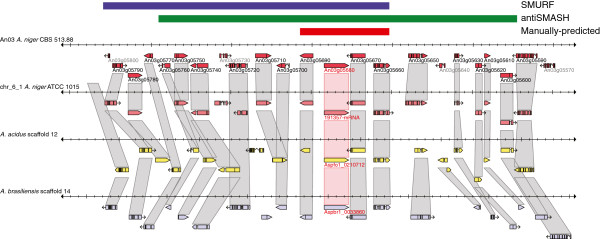
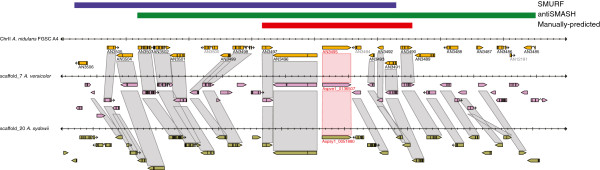
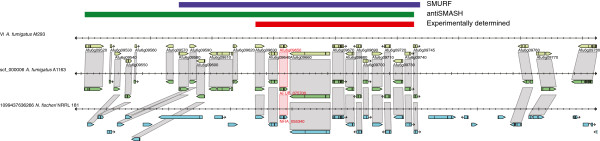
“oryzae 4 3 Manual annotation of computationally predicted gene clusters Algorithms such as SMURF [38] and antiSMASH (antibiotics and Secondary Metabolite Analysis SHell) [39] can be used to predict fungal secondary metabolite gene clusters.”
MethodResultInfluentialWormBase: a multi-species resource for nematode biology and genomics
Harris, T. W. (2004) · Nucleic Acids Research · doi:10.1093/nar/gkh066 · Cited by 715
Genomics-driven discovery of PKS-NRPS hybrid metabolites from Aspergillus nidulans
Bergmann, S., Schümann, J., Scherlach, K., Lange, C., Brakhage, A. A., & Hertweck, C. (2007) · Nature Chemical Biology · doi:10.1038/nchembio869 · Cited by 594 · cited 1×
“nidulans Cluster Summary Backbone enzyme SMURF antiSMASH Manual/experimental Boundary 1 Boundary 2 Reference Asperfuranone (afo) cluster AN1036 AN1029 - AN11288 AN1026 - AN1040 AN1029 - AN1036 ED ED [40] Asperthecin (apt) cluster AN6000 AN5989 - AN6007 AN5991 - AN6009 AN6000 - AN6002* ED, EP ED, EP [30] Aspyridone (as…”
Gene Ontology Annotations and Resources
The Gene Ontology Consortium (2012) · Nucleic Acids Research · doi:10.1093/nar/gks1050 · Cited by 553
Twenty-five coregulated transcripts define a sterigmatocystin gene cluster in Aspergillus nidulans.
Brown, D. W., Yu, J. H., Kelkar, H. S., Fernandes, M., Nesbitt, T. C., Keller, N. P., Adams, T. H., & Leonard, T. J. (1996) · Proceedings of the National Academy of Sciences · doi:10.1073/pnas.93.4.1418 · Cited by 507 · cited 2×
“parasiticus proteins involved in AF production, for which ST is a precursor [46].”
BackgroundPhylogenetic and Functional Assessment of Orthologs Inference Projects and Methods
Altenhoff, A. M., & Dessimoz, C. (2009) · PLoS Computational Biology · doi:10.1371/journal.pcbi.1000262 · Cited by 420 · cited 1×
“InParanoid was chosen based on compatibility with the existing ortholog analysis pipeline at AspGD, and comparable accuracy when compared with alternative methods [55].”
Method
Cited by
antiSMASH 5.0: updates to the secondary metabolite genome mining pipeline
Blin, K., Shaw, S., Steinke, K., Villebro, R., Ziemert, N., Lee, S. Y., Medema, M. H., & Weber, T. (2019) · Nucleic Acids Research · doi:10.1093/nar/gkz310 · Cited by 2,907
“Amongst its wide range of uses, the GO has been used to predict gene clusters in eukaryotes and bacteria (35) and, in conjunction with antiSMASH, to refine cluster boundaries in antiSMASH output for Aspergillus species (36).”
MethodFungal secondary metabolism: regulation, function and drug discovery
Keller, N. P. (2019) · Nature Reviews Microbiology · doi:10.1038/s41579-018-0121-1 · Cited by 1,390
Aspergillus fumigatus and Aspergillosis in 2019
Latgé, J.-P., & Chamilos, G. (2019) · Clinical Microbiology Reviews · doi:10.1128/cmr.00140-18 · Cited by 1,400
Frisvad, J. C., Hubka, V., Ezekiel, C. N., Hong, S.-B., Nováková, A., Chen, A. J., Arzanlou, M., Larsen, T. O., Sklenář, F., Mahakarnchanakul, W., et al. (2019) · Studies in Mycology · doi:10.1016/j.simyco.2018.06.001 · Cited by 566
“The genomes of A. oryzae RIB 40 (Machida et al. 2005, Galagan et al. 2005, Inglis et al. 2013, Umemura et al. 2013a,b), and other strains of A. oryzae (Zhao et al.2012, 2013, 2014), A. flavus NRRL 3357 (= ATCC 200026) (Payne et al. 2006, Fedorova et al. 2008, Nierman et al. 2015), ATCC 2 MYA384 (=…”
de Vries, R. P., Riley, R., Wiebenga, A., Aguilar-Osorio, G., Amillis, S., Uchima, C. A., Anderluh, G., Asadollahi, M., Askin, M., Barry, K., et al. (2017) · Genome Biology · doi:10.1186/s13059-017-1151-0 · Cited by 489
Self-citation
Metadata
- Authors
- Inglis, D. O., Binkley, J., Skrzypek, M. S., Arnaud, M. B., Cerqueira, G. C., Shah, P., Wymore, F., Wortman, J. R., & Sherlock, G.
- Affiliations
- Stanford Medicine (US)
- Broad Institute (US)
- Corresponding author
- Sherlock, Gavin
- Venue
- BMC Microbiology
- Published
- 2013-04-26
- Volume
- 13
- Issue
- 1
- Pages
- 91-91
- ISSN
- 1471-2180 (ISSN-L)
- PMC
- PMC3689640
- OpenAlex
- W1985653548
- Cited by
- 293
- References
- 59
- Citations by year
- 2026: 13 · 2025: 15 · 2024: 18 · 2023: 17 · 2022: 24 · 2021: 25 · 2020: 34 · 2019: 20 · 2018: 36 · 2017: 21 · 2016: 25 · 2015: 23 · 2014: 16 · 2013: 5
- FWCI
- 16.89
- Type
- journal article
- Language
- en
- Open access
- gold
- doi.org
- Licence
- cc-by
- Locations
- BMC Microbiology (publishedVersion, cc-by)
- Europe PMC (PubMed Central) (publishedVersion, cc-by)
- PubMed Central (publishedVersion, cc-by)
- PubMed (publishedVersion)
- Funders
- National Institutes of Health
- National Institute of Allergy and Infectious Diseases (R01AI077599)
- Topics
- Life Sciences › Immunology and Microbiology › Applied Microbiology and Biotechnology › Microbial Natural Products and Biosynthesis
- Life Sciences › Biochemistry, Genetics and Molecular Biology › Molecular Biology › Fungal and yeast genetics research
- Life Sciences › Biochemistry, Genetics and Molecular Biology › Biotechnology › Microbial Metabolism and Applications
- Keywords
- secondary metabolite biosynthesis, secondary metabolite gene clusters, Aspergillus nidulans, Aspergillus fumigatus, Aspergillus niger, Aspergillus oryzae, gene ontology annotation, antiSMASH, SMURF, fungal secondary metabolites, genome annotation
- MeSH terms
- Aspergillus, Biological Products, Genes, Fungal, Multigene Family, Humans, Computational Biology, Biosynthetic Pathways
About these checks
Registry, retraction, Cites and statistics results are computed, not judged, with one exception: a printed reference that no index lists is read once by a model before it counts as a citation error. Claims are extracted by a model and kept only when their quote appears verbatim in the text; each cited source is then checked, with a model’s help, for whether it says what the claim relies on. Those verdicts can be wrong — read the claim’s quote and the cited source before relying on one.
Statistics and arithmetic are recomputed, not judged.
Confidence bands are shown only for fields calibrated on our annotated test set. None is calibrated yet, so no band is shown.
What counts as a claim ›How we measure confidence ›How we check this ›
Are you an author, or do you see a problem with this page? Request a review
How to cite
Cite CoChat for the checks on this page, and the paper for its own findings.
- This page
- CoChat. (2026). Citation check: Comprehensive annotation of secondary metabolite biosynthetic genes and gene clusters of Aspergillus nidulans, A. fumigatus, A. niger and A. oryzae. https://app.cochat.ai/papers/10.1186/1471-2180-13-91
- The paper
- Inglis, D. O., Binkley, J., Skrzypek, M. S., Arnaud, M. B., Cerqueira, G. C., Shah, P., Wymore, F., Wortman, J. R., & Sherlock, G. (2013). Comprehensive annotation of secondary metabolite biosynthetic genes and gene clusters of Aspergillus nidulans, A. fumigatus, A. niger and A. oryzae. BMC Microbiology. https://doi.org/10.1186/1471-2180-13-91
Data sources
Bibliographic data: Semantic Scholar, OpenAlex, Crossref.
Contains information from the Semantic Scholar Academic Graph Datasets, made available under the ODC Attribution License (ODC-BY 1.0).
Semantic Scholar’s data is described in: Kinney, R., et al. (2023). The Semantic Scholar Open Data Platform. arXiv:2301.10140.
