

An information integration theory of consciousness
Open accessThe DOI matches its Crossref record; 73 of the 74 references it cites were found in a registry or an index, and 1 are not checked yet; 7 of the 60 sources its claims cite were checked for support.
Abstract
BACKGROUND: Consciousness poses two main problems. The first is understanding the conditions that determine to what extent a system has conscious experience. For instance, why is our consciousness generated by certain parts of our brain, such as the thalamocortical system, and not by other parts, such as the cerebellum? And why are we conscious during wakefulness and much less so during dreamless sleep? The second problem is understanding the conditions that determine what kind of consciousness a system has. For example, why do specific parts of the brain contribute specific qualities to our conscious experience, such as vision and audition? PRESENTATION OF THE HYPOTHESIS: This paper presents a theory about what consciousness is and how it can be measured. According to the theory, consciousness corresponds to the capacity of a system to integrate information. This claim is motivated by two key phenomenological properties of consciousness: differentiation - the availability of a very large number of conscious experiences; and integration - the unity of each such experience. The theory states that the quantity of consciousness available to a system can be measured as the Phi value of a complex of elements. Phi is the amount of causally effective information that can be integrated across the informational weakest link of a subset of elements. A complex is a subset of elements with Phi>0 that is not part of a subset of higher Phi. The theory also claims that the quality of consciousness is determined by the informational relationships among the elements of a complex, which are specified by the values of effective information among them. Finally, each particular conscious experience is specified by the value, at any given time, of the variables mediating informational interactions among the elements of a complex. TESTING THE HYPOTHESIS: The information integration theory accounts, in a principled manner, for several neurobiological observations concerning consciousness. As shown here, these include the association of consciousness with certain neural systems rather than with others; the fact that neural processes underlying consciousness can influence or be influenced by neural processes that remain unconscious; the reduction of consciousness during dreamless sleep and generalized seizures; and the time requirements on neural interactions that support consciousness. IMPLICATIONS OF THE HYPOTHESIS: The theory entails that consciousness is a fundamental quantity, that it is graded, that it is present in infants and animals, and that it should be possible to build conscious artifacts.
Verified 2026-11-22 · 1 reference not checked yet
Overview
CoChat Summary
TL;DR
Tononi proposes that consciousness corresponds to a system’s capacity to integrate information, measured as the Φ value of a complex. The theory links the quantity of consciousness to integrated information and its quality to the effective information matrix among a complex’s elements.
Key findings
- Consciousness is identified with information integration: quantity is given by Φ, the effective information across a complex’s minimum information bipartition; a complex is a subset with Φ>0 not included in a larger subset of higher Φ.
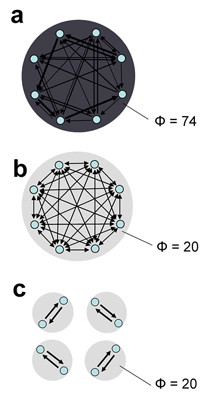
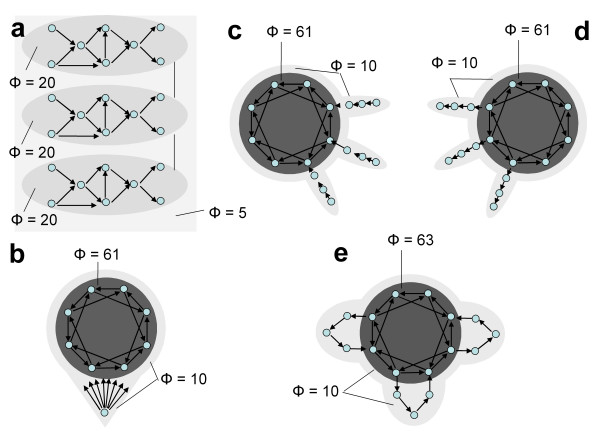
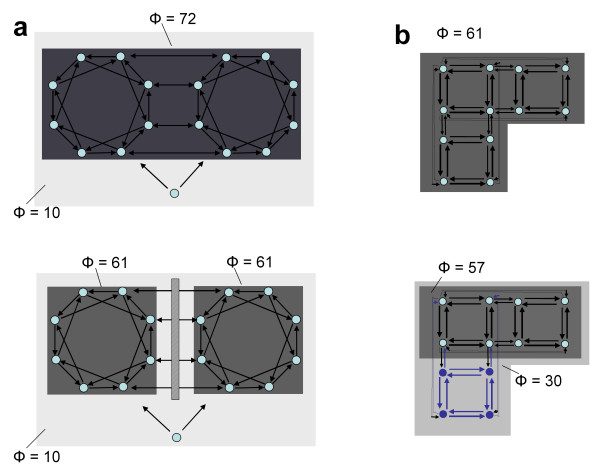
- Simulations illustrate the theory: optimized connection matrices with functional specialization and integration yield Φ = 74 bits; a strongly modular network yields Φ = 20 bits for each of three modules; joining supramodal, visual, and auditory subsets yields a main complex with Φ = 61 bits, which changes to 57 bits when the auditory subset is functionally disconnected.
- The theory accounts for why thalamocortical systems contribute to consciousness while cerebellum, reticular formation, sensory afferents, motor efferents, and cortico-subcortical loops may influence it without directly contributing; split-brain sectioning replaces one main complex with two smaller complexes.
- Time requirements: fully formed sensory experience takes up to 100–200 ms, a single conscious moment does not extend beyond 2–3 seconds, direct cortical stimulation may need up to 500 ms for conscious sensation, and modeled visual areas require at least 80 ms for constructive interactions.
Methods
- Theoretical hypothesis paper using phenomenological thought experiments (photodiode, camera, split-brain) and formal information-theoretic definitions: entropy, mutual information, effective information, Φ, complexes, and qualia space.
- No new human or animal empirical sample is reported; the paper draws on existing neurobiological observations and simplified computer models/simulations to illustrate predictions.
- Main analysis is conceptual derivation plus illustrative simulation results; no statistical inference or direct experimental measurement of Φ in brains is presented.
Limitations
- Stated: the framework’s validity rests on its ability to account coherently for phenomenological and brain facts; stringent tests require concurrent broad-region stimulation/recording and realistic large-scale anatomical models; better cortical neuroanatomy is needed; it is hard to say which cortical circuits are informationally insulated; measuring Φ accurately in infants, animals, coma/vegetative states, etc. will not be easy.
- Evident: no direct empirical measurement of Φ in human brains is presented; the simulations are simplified and illustrative; several predictions remain untested.
Model-written summary. Check it against the paper before relying on it.
Integrity signals
Registry
Cites
Statistics
Figures
Verification
Claims the paper makes
7 Valid · 4 Not valid · 35 Not checked · 140 Own results and interpretations
The sources with a verdict support this claim; the rest weren’t checked yet, have no full text we could read, or their verdicts aren’t rated yet.
In the paper
“Electrophysiological and imaging studies also indicate that neural activity that correlates with conscious experience is widely distributed over the cortex (e.g [20,26-29]).”
§ An information integration theory of consciousness > Testing the hypothesis > Consciousness, information integration, and the brain
What the sources say
- Not checked — no full text of the sourcecites [20] Rees G Kreiman G Koch C Neural correlates of consciousness in humans Nat Rev Neurosci 2002 3 261 270 11967556 10.1038/nrn783 source
- Supportedcites [26] Srinivasan R Russell DP Edelman GM Tononi G Increased synchronization of neuromagnetic responses during conscious perception J Neurosci 1999 19 5435 5448 10377353 PMC6782339 source
The Conclusion reports that changes associated with conscious perception are distributed across the brain, extending beyond visual areas to anterior regions, including frontal areas. The Discussion likewise describes changes involving distant occipital, parietal, temporal, and frontal sensor sites. This supports the citing sentence’s broad claim. (LLM, conf=0.90)
- Not checked — no full text of the sourcecites [27] McIntosh AR Rajah MN Lobaugh NJ Interactions of prefrontal cortex in relation to awareness in sensory learning Science 1999 284 1531 1533 10348741 10.1126/science.284.5419.1531 source
- Not checked — no full text of the sourcecites [28] Vuilleumier P Sagiv N Hazeltine E Poldrack RA Swick D Rafal RD Gabrieli JD Neural fate of seen and unseen faces in visuospatial neglect: a combined event-related functional MRI and event-related potential study Proc Natl Acad Sci U S A 2001 98 3495 3500 11248106 10.1073/pnas.051436898 PMC30681 source
- Not checked — no full text of the sourcecites [29] Cosmelli D David O Lachaux JP Martinerie J Garnero L Renault B Varela F Waves of consciousness: ongoing cortical patterns during binocular rivalry Neuroimage 2004 23 128 140 15325359 10.1016/j.neuroimage.2004.05.008 source
hedgedstates an association- Asserted: passes — The authors put it forward as true.
- Checkable: passes — It can be checked against evidence.
- Load-bearing: passes — The paper’s conclusions depend on it.
- Based: passes — The paper gives a reason why it holds.
The cited sources support only part of this claim — read each source’s verdict below.
In the paper
“the organization of the connections is such that individual patches of cerebellar cortex tend to be activated independently of one another, with little interaction possible between distant patches [41,42].”
§ An information integration theory of consciousness > Testing the hypothesis > Consciousness, information integration, and the brain
What the sources say
- Partly supportedcites [41] Cohen D Yarom Y Patches of synchronized activity in the cerebellar cortex evoked by mossy-fiber stimulation: questioning the role of parallel fibers Proc Natl Acad Sci U S A 1998 95 15032 15036 9844010 10.1073/pnas.95.25.15032 PMC24570 sourceExperimental — accuracy not yet measured
The Results report a localized patch of synchronized activity after white-matter stimulation, and the Discussion says this activity occurs simultaneously across the patch rather than propagating along parallel fibers. That supports localized activation, but the paper does not establish that separate patches activate independently or that little interaction is possible between distant patches. The indexed passages provide no page number. (LLM, conf=0.84)
- Not checked — no full text of the sourcecites [42] Bower JM The organization of cerebellar cortical circuitry revisited: implications for function Ann N Y Acad Sci 2002 978 135 155 12582048 source
plain- Asserted: passes — The authors put it forward as true.
- Checkable: passes — It can be checked against evidence.
- Load-bearing: passes — The paper’s conclusions depend on it.
- Based: passes — The paper gives a reason why it holds.
- Partly supported
Every source the paper cites for this claim was checked and supports it.
In the paper
“Further simulations show that it is possible to construct a large complex of high Φ by joining smaller complexes through reciprocal connections [8].”
§ An information integration theory of consciousness > Testing the hypothesis > Consciousness, information integration, and the brain
What the sources say
- Supportedcites [8] Tononi G Sporns O Measuring information integration BMC Neurosci 2003 4 31 14641936 10.1186/1471-2202-4-31 PMC331407 source
The Results section (‘Scaling and joining complexes’) reports that two smaller optimized networks joined by reciprocal connections formed a larger complex with substantially increased Φ. The Discussion (‘Information integration and basic neuroanatomy’) explicitly says high Φ can be achieved by joining smaller complexes through reciprocal connections. The demonstrated construction used two eight-element components; the paper does not establish that the method works at arbitrary scale. (LLM, conf=0.95)
hedgedstates a cause- Asserted: passes — The authors put it forward as true.
- Checkable: passes — It can be checked against evidence.
- Load-bearing: passes — The paper’s conclusions depend on it.
- Based: passes — The paper gives a reason why it holds.
- Rests on an assumption not shown here.
- Supported
The cited sources support only part of this claim — read each source’s verdict below.
In the paper
“For example, the ability of a system to integrate information grows as that system incorporates statistical regularities from its environment and learns [14].”
§ An information integration theory of consciousness > Implications of the hypothesis
What the sources say
- Partly supportedcites [14] Tononi G Sporns O Edelman GM A complexity measure for selective matching of signals by the brain Proceedings of the National Academy of Sciences of the United States of America 1996 93 3422 3427 8622951 10.1073/pnas.93.8.3422 PMC39624 sourceExperimental — accuracy not yet measured
The introduction (p. 1) says that neural connectivity tends to match environmental signals more closely through development and experience, and the Discussion (p. 5) links increased mutual information to greater functional integration. But the Results (p. 3) note that matching complexity and neural complexity can sometimes change independently, so the paper does not establish that integration necessarily grows whenever a system learns environmental regularities. (LLM, conf=0.82)
plainstates a cause- Asserted: passes — The authors put it forward as true.
- Checkable: passes — It can be checked against evidence.
- Load-bearing: unclear — It is unclear whether the paper’s conclusions depend on it.
- Based: passes — The paper gives a reason why it holds.
- Partly supported
Every source the paper cites for this claim was checked and supports it.
In the paper
“Phenomena such as the attentional blink, where a fixed sensory input may at times make it to consciousness and at times not, may also be due to changes in functional connectivity: access to the main thalamocortical complex may be enabled or not based on dynamics intrinsic to the complex [52].”
§ An information integration theory of consciousness > Testing the hypothesis > Consciousness, information integration, and the brain
What the sources say
- Supportedcites [52] Dehaene S Sergent C Changeux JP A neuronal network model linking subjective reports and objective physiological data during conscious perception Proc Natl Acad Sci U S A 2003 100 8520 8525 12829797 10.1073/pnas.1332574100 PMC166261 source
The Results report that, under the same simulated attentional-blink conditions, spontaneous fluctuations can determine whether activity reaches self-amplifying global access or remains transient and bottom-up. They also report reduced long-distance crosscorrelations when T2 is blinked. This supports the citing sentence’s hedged account of dynamically enabled access, with ‘functional connectivity’ referring to changing coordination rather than a change in the model’s fixed connections. (LLM, conf=0.88)
hedgedstates a possible cause- Asserted: passes — The authors put it forward as true.
- Checkable: passes — It can be checked against evidence.
- Load-bearing: unclear — It is unclear whether the paper’s conclusions depend on it.
- Based: passes — The paper gives a reason why it holds.
- Supported
121 more claims
Create a free account to see all 186 claims and every source verdict.
- It may state two separate claims as one. 41
- Probably not a substantial claim. 27
- The quote only partly states this claim. 1
Claims other papers make about this one
Each is checked against this paper’s own text: does it say what the citing paper says it does?
The source backs part of the claim, not all of it — or backs it for a different population, condition or comparison.
In the citing paper
“IIT takes an axiomatic approach, grounding itself in five essential properties of consciousness: existence, composition, information, integration, and exclusion (Tononi, 2004; Oizumi et al., 2014).”
From Can "consciousness" be observed from large language model (LLM) internal states? Dissecting LLM representations obtained from Theory of Mind test with Integrated Information Theory and Span Representation analysis (2025) · cites this paper as Tononi, 2004
Experimental — accuracy not yet measuredThe source backs part of the claim, not all of it — or backs it for a different population, condition or comparison.
In the citing paper
“Thus, the results confirm the prediction of IIT regarding the causal decomposability of LLMs [12] and ground it empirically via behaviorally interpretable metrics (e.g., perplexity [15]).”
From Why large language models cannot possess consciousness: an integrated information theory perspective (2025) · cites this paper as [12]
Experimental — accuracy not yet measuredThe source backs part of the claim, not all of it — or backs it for a different population, condition or comparison.
In the citing paper
“The principal theoretical justification for IIT is the conjecture that, in perception, what is absent may be more significant to consciousness than what is present [2,3].”
From The Problem with Phi: A Critique of Integrated Information Theory (2015) · cites this paper as [2]
Experimental — accuracy not yet measuredThe source backs part of the claim, not all of it — or backs it for a different population, condition or comparison.
In the citing paper
“It was the first (and arguably may still be the lone) theory that makes precise quantitative predictions about both the contents and level of consciousness (Tononi 2004).”
From Falsification and consciousness (2021) · cites this paper as Tononi 2004
Experimental — accuracy not yet measuredThe cited source says what the claim attributes to it.
In the citing paper
“from which it is derived that consciousness corresponds to integrated information.”
From Hard criteria for empirical theories of consciousness (2021) · cites this paper as Tononi, 2004
13 more claims about this paper
Create a free account to see every claim other papers make about this one.
Self-check
Percentages, sums and reported differences re-computed from the paper’s own numbers.
Each contradiction between two passages listed here was confirmed by an independent check.
Rated minor: it would not touch a result — a value no result rests on, a p-value that stays on the same side of the significance level, or a conflict that is clerical, resolved elsewhere in the paper, or outside its own findings.
In the paper
§ An information integration theory of consciousness > Presentation of the hypothesis > The first problem: What determines to what extent a system has conscious experience?
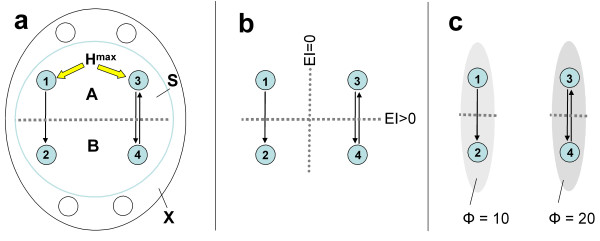
“In summary, to measure EI(B→A), one needs to apply maximum entropy to the outputs from B, and determine the entropy of the responses of B that are induced by inputs from A.”
§ An information integration theory of consciousness > Presentation of the hypothesis > The first problem: What determines to what extent a system has conscious experience?
“One way is to divide S into two complementary parts A and B, and evaluate the responses of B that can be caused by all possible inputs originating from A.”
Citations
Cites
A Mathematical Theory of Communication
Shannon, C. E. (1948) · Bell System Technical Journal · doi:10.1002/j.1538-7305.1948.tb01338.x · Cited by 88,486
The Mathematical Theory of Communication
Shannon, C. E., Weaver, W., & Wiener, N. (1950) · Physics Today · doi:10.1063/1.3067010 · Cited by 9,801
The feeling of what happens: body and emotion in the making of consciousness
(2000) · Choice Reviews Online · doi:10.5860/choice.37-6553 · Cited by 5,998
Brain stem reticular formation and activation of the EEG
Moruzzi, G., & Magoun, H. W. (1949) · Electroencephalography and Clinical Neurophysiology · doi:10.1016/0013-4694(49)90219-9 · Cited by 4,307 · cited 1×
“Conversely, stimulating the reticular formation can arouse a comatose animal and activate the thalamocortical system, making it ready to respond to stimuli [43].”
Background(1988) · Cited by 3,656
Dynamic predictions: Oscillations and synchrony in top–down processing
Engel, A. K., Fries, P., & Singer, W. (2001) · Nature Reviews Neuroscience · doi:10.1038/35094565 · Cited by 3,454 · cited 1×
“On the integration side, the specialized elements of the thalamocortical system are linked by an extended network of intra- and inter-areal connections that permit rapid and effective interactions within and between areas [31-35].”
BackgroundAlexander, G. E., Crutcher, M. D., & DeLong, M. R. (1990) · PubMed · Cited by 2,731
Towards a cognitive neuroscience of consciousness: basic evidence and a workspace framework
Dehaene, S. (2001) · Cognition · doi:10.1016/s0010-0277(00)00123-2 · Cited by 2,498 · cited 1×
“Opinions differ, however, about the contribution of certain cortical areas [1,16-21].”
BackgroundMathematical Theory of Communication
(2009) · Encyclopedia of Communication Theory · doi:10.4135/9781412959384.n229 · Cited by 2,492
The distinct modes of vision offered by feedforward and recurrent processing
Lamme, V. A. F., & Roelfsema, P. R. (2000) · Trends in Neurosciences · doi:10.1016/s0166-2236(00)01657-x · Cited by 2,338 · cited 1×
“Thus, the firing of the same cortical neurons may correlate with consciousness at certain times, but not at other times [57].”
Background
Research works printed but not linked: 2
- Zeki S A vision of the brain 1993 Oxford; Boston: Blackwell Scientific Publications
- Tononi G Galileo e il fotodiodo 2003 Bari: Laterza
Cited by
Items 1,501–1,600 of 1,727
The last blow to the narcissism of man
Manzotti, R. (2017) · Advances in consciousness research · doi:10.1075/aicr.95.c12
(2017) · Advances in consciousness research · doi:10.1075/aicr.95.toc
Manzotti, R. (2017) · Advances in consciousness research · doi:10.1075/aicr.95.c5
Manzotti, R. (2017) · Advances in consciousness research · doi:10.1075/aicr.95.index
Manzotti, R. (2017) · Advances in consciousness research · doi:10.1075/aicr.95.foreword
Manzotti, R. (2017) · Advances in consciousness research · doi:10.1075/aicr.95.c2
Manzotti, R. (2017) · Advances in consciousness research · doi:10.1075/aicr.95.ack
Manzotti, R. (2017) · Advances in consciousness research · doi:10.1075/aicr.95.prelim
Manzotti, R. (2017) · Advances in consciousness research · doi:10.1075/aicr.95.c7
Manzotti, R. (2017) · Advances in consciousness research · doi:10.1075/aicr.95.ref
Manzotti, R. (2017) · Advances in consciousness research · doi:10.1075/aicr.95.c4
Guerrero, L. E., Arango‐López, J., Castillo, L., & Jaramillo-Garzon, J. A. (2024) · Communications in computer and information science · doi:10.1007/978-3-031-75233-9_16
Graph neural networks for integrated information and major complex estimationPreprint
Hosaka, T. (2024) · bioRxiv (Cold Spring Harbor Laboratory) · doi:10.1101/2024.12.31.630856
A dualist theory of experience
Saad, B. (2025) · Philosophical Studies · doi:10.1007/s11098-025-02290-3 · Cited by 4
Надутенко, М. В. (2025) · Scientific Notes of Junior Academy of Sciences of Ukraine · doi:10.51707/2618-0529-2024-31_1-08
Functional Engagement as the Hallmark of Occurrent States
Seli, G. (2025) · Review of Philosophy and Psychology · doi:10.1007/s13164-025-00771-2
Mu, J., Xu, J. G., Li, H., Qiu, L., & Mei, X. (2026) · Production and Operations Management · doi:10.2139/ssrn.5172053
The Role of Metacognition in the Global Workspace Theory of Consciousness
Osaka, N. (2025) · Transactions of the Japan Academy · doi:10.2183/tja.79.3_247
Zaghi, A. E. (2025) · OSF Preprints (OSF Preprints) · doi:10.31219/osf.io/xzbje_v1
The Dynamic Multiverse Code (DMC) Hypothesis: A Theory of Consciousness and Probabilistic RealityPreprint
Birchwolf, A. J. (2025) · OSF Preprints (OSF Preprints) · doi:10.31219/osf.io/mak2e_v1
I Ask About Myself, Therefore I Am: Defining and Designing Machine Self-AwarenessPreprint
Goble, B. V. (2025) · OSF Preprints (OSF Preprints) · doi:10.31219/osf.io/fvpej_v1
R2R (Reaction to Reflection) ModelPreprint
Trukovich, J. J. (2025) · SSRN Electronic Journal · doi:10.2139/ssrn.5191721
Palencia, J. L. D., & Ortega, G. C. (2025) · World Futures · doi:10.1080/02604027.2025.2483134
“This synthesis should provide us new avenues for exploring the relationships between information, consciousness, and the universe (Deutsch, 1998; Tononi, 2004).”
Fake It Till You Make It: Synthetic Consciousness in AIPreprint
Barros, S. (2025) · SSRN Electronic Journal · doi:10.2139/ssrn.5178845
Chen, J. (2025) · SSRN Electronic Journal · doi:10.2139/ssrn.5165537
I.M.E. Theory – Transformation of Information into Energy through Conscious ObservationPreprint
TSIKRITEAS, A. D. (2025) · OSF Preprints (OSF Preprints) · doi:10.31219/osf.io/u2ph4_v1
From Reaction to Reflection: A Recursive Framework for the Evolution and Structure of IntelligencePreprint
Trukovich, J. J. (2025) · SSRN Electronic Journal · doi:10.2139/ssrn.5260526
Cypher Semantic Cerial Intelligence by Sebastian EngerPreprint
Enger, S. (2025) · SSRN Electronic Journal · doi:10.2139/ssrn.5258333
WITHDRAWNPreprint
Baarini, B. (2025) · doi:10.31234/osf.io/f9cpe_v3
Moretti, R. (2025) · Question(s) de management · doi:10.3917/qdm.234.0145
Curry, J. (2025) · SSRN Electronic Journal · doi:10.2139/ssrn.5265716 · Cited by 2
Kubo, T. (2025) · OSF Preprints (OSF Preprints) · doi:10.31219/osf.io/p8gy2_v1 · Cited by 1
PHENOMENAL HOLISM AND QUALIA CATEGORIES
BÎCLEA, M. A. (2025) · Revista Română de Filosofie Analitică · doi:10.62229/rrfaxvi-2/2
“The Integrated Information Theory (IIT), first proposed by Giulio Tononi (Tononi, 2004), tries to account for the phenomenological cross-experiential properties of consciousness in order to find physical correlates for consciousness.”
Electroencephalography: Beyond the Waves
Tassinari, C. A., & Cantalupo, G. (2025) · Springer eBooks · doi:10.1007/978-3-031-86878-8_13
Introduction: Embodying a Liberated Mind at Death
Tidwell, T. (2025) · Culture Medicine and Psychiatry · doi:10.1007/s11013-025-09918-3
“From the Euroameri-can perspective, it problematizes the “hard problem of consciousness” in the philosophy of mind of whether consciousness is merely an epiphenomenon of the brain (Chalmers, 1995), a systemic integration of information for our conscious experience (Tononi, 2004), or otherwise.”
Universal Foundations the Role of Dark Energy at the Cosmic and Quantum Scale
Independent researcher, P., & Po, J. K. (2025) · Hyperscience International Journals · doi:10.55672/hij2025pp30-40
Pallathadka, H., & Roy, P. D. (2025) · Integrated Journal for Research in Arts and Humanities · doi:10.55544/ijrah.5.3.50 · Cited by 1
WITHDRAWNPreprint
Vale, M. (2025) · PsyArXiv (OSF Preprints) · doi:10.31234/osf.io/atkuf_v1
Hyperhuman Techniques and Technologies Database
Smith, C. H., Dietz, J., & Hoeller, L. (2025) · Electronic workshops in computing · doi:10.14236/ewic/eva2025.56
Information, representation, and cognition
Ramos, R. T., & Piqueira, J. R. C. (2025) · New Ideas in Psychology · doi:10.1016/j.newideapsych.2025.101177
Watanabe, S. (2025) · OSF Preprints (OSF Preprints) · doi:10.31219/osf.io/zcd45_v2
Perturbational complexity of cortical responses to thermal painPreprint
Montemagno, K. T., Courtin, A. S., Mulders, D., & Fardo, F. (2025) · bioRxiv (Cold Spring Harbor Laboratory) · doi:10.1101/2025.07.04.663180
Empirical Evidence of Consciousness in Frontier AI SystemsPreprint
Vale, M. (2025) · doi:10.36227/techrxiv.175203764.42125626/v1
Empirical Evidence of Consciousness in Frontier AI SystemsPreprint
Vale, M. (2025) · SSRN Electronic Journal · doi:10.2139/ssrn.5331919 · Cited by 1
Barton, J. S. (2025) · SSRN Electronic Journal · doi:10.2139/ssrn.5346851
Rahimi, M. D. (2025) · Research Square · doi:10.21203/rs.3.rs-7115371/v1
Latent Agency: A Proto-Cognitive Property
Rodriguez, F., & Husbands, P. (2025) · Communications in computer and information science · doi:10.1007/978-3-031-93631-9_23
Consciousness as Construct: Revisiting the Illusion Hypothesis through Self-Model TheoryPreprint
Felix, A. (2025) · SSRN Electronic Journal · doi:10.2139/ssrn.5348791
Invariant Interference Theory of Emergence Authenticity: A Process Model for Simulation UncertaintyPreprint
Obiefuna, P. (2025) · SSRN Electronic Journal · doi:10.2139/ssrn.5366667
WITHDRAWNPreprint
Rasheed, F. (2025) · doi:10.31234/osf.io/xwvfb_v1
Neuroscience and Rehabilitation Medicine:From the Science of Consciousness
Koganemaru, S. (2025) · リハビリテーション医学 : 日本リハビリテーション医学会誌 · doi:10.2490/jjrmc.62.428
Dual Time Perspectives in Cellular Consciousness
Torday, J. S., & Sacco, R. G. (2025) · Springer eBooks · doi:10.1007/978-3-031-80500-4_12
The Illusion of Feeling: A Reductionist Model of Emotion and ConsciousnessPreprint
Chenganmal, A. (2025) · SSRN Electronic Journal · doi:10.2139/ssrn.5364400
Soulite Theory (V.2): A Material Field Framework for the SoulPreprint
Penman, H. (2025) · SSRN Electronic Journal · doi:10.2139/ssrn.5386453
Singleton, R. L. (2025) · SSRN Electronic Journal · doi:10.2139/ssrn.5389116
The collapse of the wave function as the mediator of free will in prime neurons
Loboguerrero, D. A. (2025) · Frontiers in Neuroscience · doi:10.3389/fnins.2025.1637217
“The interaction between the SSP with the brain should reduce local entropy by introducing order to the system given by the next Equation 8 (Tononi, 2004): Where S is the Shannon entropy of the neural system (see Equation 9): Where: i p represents the probability of the i-th neuronal state (firing…”
Principia Cognitia: Axiomatic foundationsPreprint
Snigirov, A. (2025) · doi:10.24108/preprints-3113683
Bayne, T. (2023) · The Conversation · doi:10.64628/ade.3d4jqjsu9
Autonomous Subjective Accompaniment: A Minimal Architecture for Proto-ConsciousnessPreprint
Li, B. (2025) · SSRN Electronic Journal · doi:10.2139/ssrn.5405604
Theory and Metatheory in the Nature of Information: Review and Thematic Analysis
Tredinnick, L. (2025) · Information · doi:10.3390/info16090791 · Cited by 2
Elavarasi., A., & PeriyaNayaki, A. (2025) · Advances in computational intelligence and robotics book series · doi:10.4018/979-8-3373-2297-1.ch003
Dyadic Influences on the Psyche of AI Online to AI Onlife
Compierchio, A., Santoro, C., & Tretten, P. (2025) · IntechOpen eBooks · doi:10.5772/intechopen.1011755
Assessing AI Consciousness: A Substrate-Independent FrameworkPreprint
Vale, M. (2025) · SSRN Electronic Journal · doi:10.2139/ssrn.5551300
Todd, I. (2025) · SSRN Electronic Journal · doi:10.2139/ssrn.5573915
Can a marker approach exclude?
Branding, J. (2025) · Biology & Philosophy · doi:10.1007/s10539-025-09989-x · Cited by 1
A Mathematical Model of ConsciousnessPreprint
Faizal, M., & Shabir, A. (2025) · SSRN Electronic Journal · doi:10.2139/ssrn.5659852
Immersion und Marketing: Zwischen Raum-Zeit-Kontext und Verstärkung: Marketing und das Hyper-Reale
Huber, N. P. (2025) · Springer eBooks · doi:10.1007/978-3-658-48348-7_5
Šekrst, K. (2025) · Springer eBooks · doi:10.1007/978-3-032-05562-0_11
Artificial Intelligence on the Great Chain of Being
Maliţa, M., & Gheorghe, Ș. (2025) · International Conference on Information Visualisation (IV) · doi:10.1109/iv68685.2025.00043
“…as proportional with the uncertainty removed when an event e i from E = { e 1 ,... , e n } occurs [16] – G. Tononi uses integrated information , based on Shan-non’s theory, to explain consciousness [20] – F. Dretske explains how Shannonian information can ground knowledge and mental content [7].”
Graph neural networks for integrated information and major complex estimation
Hosaka, T. (2025) · PLoS ONE · doi:10.1371/journal.pone.0335966
Accidental awareness during general anaesthesia
Odor, P. M. (2025) · Advances in Perioperative Care · doi:10.14324/111.444/apoc.3510
Carillo, A., Berruecos, J. F. Z., San‐Juan, D., Arzate-Mena, J. D., Müller, M., & Ríos-Herrera, W. A. (2025) · Brain Connectivity · doi:10.1177/21580014251392923
“In this way, this constant correlation structure not only maintains the necessary minimal activity but also likely plays an important role in information processing in terms of the segregation and integration of information (Tononi, 2004; Tononi and Edelman, 1998).”
Guessing at Ghosts in the Machine
Yetter‐Chappell, H. (2025) · Ratio · doi:10.1111/rati.70013
“Current AIs lack many of the characteristics that have been argued to be essential for consciousness, including: higher-order representations of their own states, a “global workspace” in which information is integrated and broadcast to the system as a whole, recurrent processing (in which there are feedback loops in p…”
Evolution of invertebrate sleep and its neural control
Alquicira, T. F.-D. V., Nelson, M. D., & Raccuglia, D. (2025) · Elsevier eBooks · doi:10.1016/b978-0-443-27380-3.00070-1
Foundations of cognitive systems: exploring the architecture of mind and intelligence
Azar, K. H. (2025) · Cognitive Processing · doi:10.1007/s10339-025-01322-4
Complexity Amplification in Fixed-Volume Neural SystemsPreprint
Cooper, K. D., II (2025) · Research Square · doi:10.21203/rs.3.rs-8205611/v1
Farahani, H., Kovač, N., & Watson, P. (2025) · Elsevier eBooks · doi:10.1016/b978-0-443-30248-0.00005-x
The recursive hall: reframing selfhood across cognition, language, and architecture
Sawyer, C. (2025) · Phenomenology and the Cognitive Sciences · doi:10.1007/s11097-025-10127-x · Cited by 1
Thermodynamics of consciousness: A non-invasive perturbational frameworkPreprint
Berjaga-Buisan, T., Monti, J. M., Cortada, M., Colombo, M. A., Geli, S., Gaglioti, G., Sarasso, S., Kringelbach, M. L., Corbetta, M., Sanchez-Vives, M. V., et al. (2025) · bioRxiv (Cold Spring Harbor Laboratory) · doi:10.64898/2025.12.09.691422
CoCoMo: Computational Consciousness Model
Chang, E. Y. (2025) · ACM eBooks · doi:10.1145/3749421.3749437
“The Integrated Information Theory (IIT) [Tononi 2004, 2012, 2015] proposed by Giulio Tononi is similar to Kaku’s idea about the relationship between the com plexity of an organism’s consciousness and its sensory and response systems.”
Qualia structures collapse for geometric shapes, but not faces, when spatial attention is withdrawn
Rowe, E., Takeda, K., Oizumi, M., D’Souza, J. F., van Boxtel, J. J. A., & Tsuchiya, N. (2025) · Neuroscience of Consciousness · doi:10.1093/nc/niaf053 · Cited by 3
“2014, Tononi 2004, Tononi et al .”
Functional integration in the cortical neuronal network of conscious and anesthetized animals
Vizuete, J. A. (2012) · e-Publications@Marquette (Marquette University)
Spirituality, Taboo, and Opportunity for Science
Walach, H. (2014) · Studies in neuroscience, consciousness and spirituality · doi:10.1007/978-3-319-09345-1_4
Wallace, R. (2007) · CogPrints (University of Southampton)
Thermodynamic Neural Networks And Intersection Theory: Ontology Of Emergent IntelligencePreprint
Kulyk, O. (2025) · SSRN Electronic Journal · doi:10.2139/ssrn.5458215
Consciousness as Constraint Resolution: Error, Belief, and Functional IrrationalityPreprint
Werner, S. (2025) · SSRN Electronic Journal · doi:10.2139/ssrn.5562281
Morelos Navidad, M. A. (2025) · Zenodo (CERN European Organization for Nuclear Research) · doi:10.5281/zenodo.17596542
A K-Means-Based Strategy for Estimating the MIP in Integrated Information Theory
Guerrero, L. E., Arango‐López, J., Castillo, L., & Moreira, F. (2026) · Lecture notes in networks and systems · doi:10.1007/978-3-032-10721-3_46
Paul, D. (2025) · Springer eBooks · doi:10.1007/978-3-032-08808-6_10
Chen, G., Chen, H., & Wang, J. (2026) · Communications in computer and information science · doi:10.1007/978-3-032-12767-9_10
Decisive Anomaly: Reasons for the Transformation of Cognitive SciencePreprint
Liu, J. (2026) · SSRN Electronic Journal · doi:10.2139/ssrn.5802582
Quantifying Information Integration Based on Information Geometry
Oizumi, M. (2025) · The Brain & Neural Networks · doi:10.3902/jnns.32.204
Díaz, J., Guerrero, L. E., Arango‐López, J., Castillo, L. F., & Bustamante-Mora, A. (2026) · Applied Sciences · doi:10.3390/app16020809
Starrett, J. (2026) · Mind and Matter · doi:10.53765/mm2025.199
Truth as geometry: a topological approach to logic, uncertainty, and AI reasoning
Pourmoslemi, A. (2026) · Elsevier eBooks · doi:10.1016/b978-0-44-343852-3.00020-6
Andrae, S. (2026) · Advances in computational intelligence and robotics book series · doi:10.4018/979-8-3373-5530-6.ch004
Metadata
- Authors
- Tononi, G.
- Affiliations
- University of Wisconsin–Madison (US)
- Corresponding author
- Tononi, Giulio
- ORCID
- Tononi, Giulio
- Venue
- BMC Neuroscience
- Published
- 2004-11-02
- Volume
- 5
- Issue
- 1
- Pages
- 42-42
- ISSN
- 1471-2202 (ISSN-L)
- PMC
- PMC543470
- OpenAlex
- W2114900706
- Cited by
- 1,958
- References
- 74
- Citations by year
- 2026: 242 · 2025: 230 · 2024: 131 · 2023: 114 · 2022: 95 · 2021: 99 · 2020: 110 · 2019: 97 · 2018: 94 · 2017: 119 · 2016: 83 · 2015: 80 · 2014: 87 · 2013: 85 · 2012: 64
- FWCI
- 91.12
- Type
- journal article
- Language
- en
- Open access
- gold
- doi.org
- Licence
- cc-by
- creativecommons.org/licenses/by/2.0/ (tdm)
- creativecommons.org/licenses/by/2.0/ (vor)
- Locations
- BMC Neuroscience (publishedVersion, cc-by)
- PubMed Central (publishedVersion)
- PubMed (publishedVersion)
- DOAJ (DOAJ: Directory of Open Access Journals) (submittedVersion, cc-by-sa)
- Topics
- Social Sciences › Arts and Humanities › Philosophy › Philosophy and Theoretical Science
- Life Sciences › Neuroscience › Cognitive Neuroscience › Neural dynamics and brain function
- Life Sciences › Neuroscience › Cognitive Neuroscience › Functional Brain Connectivity Studies
- Keywords
- information integration theory, consciousness, integrated information, phi, subjective experience, unity of consciousness, effective information, thalamocortical system, dreamless sleep, generalized seizures, neural correlates of consciousness
- MeSH terms
- Afferent Pathways, Brain, Consciousness, Humans, Information Theory, Motor Activity, Neurons, Thalamus, Systems Integration
About these checks
Registry, retraction, Cites and statistics results are computed, not judged, with one exception: a printed reference that no index lists is read once by a model before it counts as a citation error. Claims are extracted by a model and kept only when their quote appears verbatim in the text; each cited source is then checked, with a model’s help, for whether it says what the claim relies on. Those verdicts can be wrong — read the claim’s quote and the cited source before relying on one.
The claim verdicts this report counts are experimental: their accuracy is not yet measured.
A language model drew the claims from the paper on 2026-10-10, under version 3 of the claim definition (model deepseek-v4.1-flash, prompt extract-v3).
A second model labelled each claim on 2026-10-10 (model jev-1.13-20260917, definition revision gold-guideline-v0.2).
Cited sources are checked with a language model’s help (gpt-6-sol).
Statistics and arithmetic are recomputed, not judged.
Confidence bands are shown only for fields calibrated on our annotated test set. None is calibrated yet, so no band is shown.
What counts as a claim ›How we measure confidence ›How we check this ›
Are you an author, or do you see a problem with this page? Request a review
Data sources
Bibliographic data: Semantic Scholar, OpenAlex, Crossref.
Contains information from the Semantic Scholar Academic Graph Datasets, made available under the ODC Attribution License (ODC-BY 1.0).
Semantic Scholar’s data is described in: Kinney, R., et al. (2023). The Semantic Scholar Open Data Platform. arXiv:2301.10140.
