

An information integration theory of consciousness
Open accessThe DOI matches its Crossref record; 73 of the 74 references it cites were found in a registry or an index, and 1 are not checked yet; 7 of the 60 sources its claims cite were checked for support.
Abstract
BACKGROUND: Consciousness poses two main problems. The first is understanding the conditions that determine to what extent a system has conscious experience. For instance, why is our consciousness generated by certain parts of our brain, such as the thalamocortical system, and not by other parts, such as the cerebellum? And why are we conscious during wakefulness and much less so during dreamless sleep? The second problem is understanding the conditions that determine what kind of consciousness a system has. For example, why do specific parts of the brain contribute specific qualities to our conscious experience, such as vision and audition? PRESENTATION OF THE HYPOTHESIS: This paper presents a theory about what consciousness is and how it can be measured. According to the theory, consciousness corresponds to the capacity of a system to integrate information. This claim is motivated by two key phenomenological properties of consciousness: differentiation - the availability of a very large number of conscious experiences; and integration - the unity of each such experience. The theory states that the quantity of consciousness available to a system can be measured as the Phi value of a complex of elements. Phi is the amount of causally effective information that can be integrated across the informational weakest link of a subset of elements. A complex is a subset of elements with Phi>0 that is not part of a subset of higher Phi. The theory also claims that the quality of consciousness is determined by the informational relationships among the elements of a complex, which are specified by the values of effective information among them. Finally, each particular conscious experience is specified by the value, at any given time, of the variables mediating informational interactions among the elements of a complex. TESTING THE HYPOTHESIS: The information integration theory accounts, in a principled manner, for several neurobiological observations concerning consciousness. As shown here, these include the association of consciousness with certain neural systems rather than with others; the fact that neural processes underlying consciousness can influence or be influenced by neural processes that remain unconscious; the reduction of consciousness during dreamless sleep and generalized seizures; and the time requirements on neural interactions that support consciousness. IMPLICATIONS OF THE HYPOTHESIS: The theory entails that consciousness is a fundamental quantity, that it is graded, that it is present in infants and animals, and that it should be possible to build conscious artifacts.
Verified 2026-11-22 · 1 reference not checked yet
Overview
CoChat Summary
TL;DR
Tononi proposes that consciousness corresponds to a system’s capacity to integrate information, measured as the Φ value of a complex. The theory links the quantity of consciousness to integrated information and its quality to the effective information matrix among a complex’s elements.
Key findings
- Consciousness is identified with information integration: quantity is given by Φ, the effective information across a complex’s minimum information bipartition; a complex is a subset with Φ>0 not included in a larger subset of higher Φ.
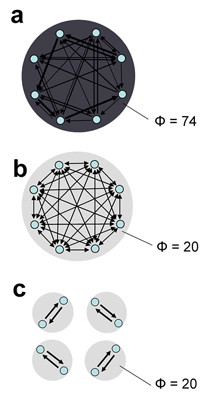
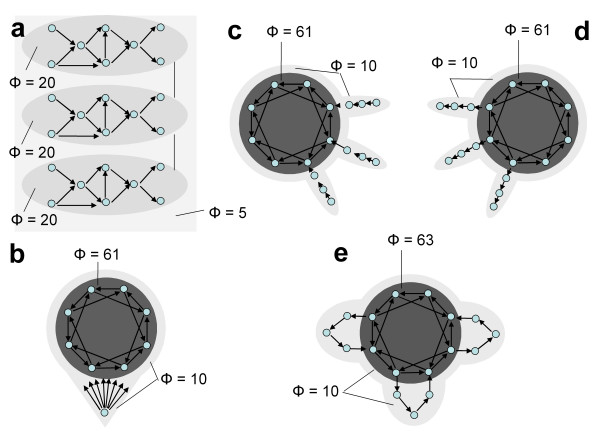
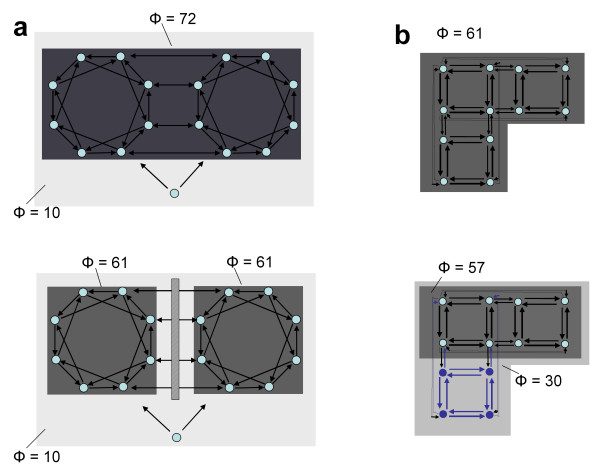
- Simulations illustrate the theory: optimized connection matrices with functional specialization and integration yield Φ = 74 bits; a strongly modular network yields Φ = 20 bits for each of three modules; joining supramodal, visual, and auditory subsets yields a main complex with Φ = 61 bits, which changes to 57 bits when the auditory subset is functionally disconnected.
- The theory accounts for why thalamocortical systems contribute to consciousness while cerebellum, reticular formation, sensory afferents, motor efferents, and cortico-subcortical loops may influence it without directly contributing; split-brain sectioning replaces one main complex with two smaller complexes.
- Time requirements: fully formed sensory experience takes up to 100–200 ms, a single conscious moment does not extend beyond 2–3 seconds, direct cortical stimulation may need up to 500 ms for conscious sensation, and modeled visual areas require at least 80 ms for constructive interactions.
Methods
- Theoretical hypothesis paper using phenomenological thought experiments (photodiode, camera, split-brain) and formal information-theoretic definitions: entropy, mutual information, effective information, Φ, complexes, and qualia space.
- No new human or animal empirical sample is reported; the paper draws on existing neurobiological observations and simplified computer models/simulations to illustrate predictions.
- Main analysis is conceptual derivation plus illustrative simulation results; no statistical inference or direct experimental measurement of Φ in brains is presented.
Limitations
- Stated: the framework’s validity rests on its ability to account coherently for phenomenological and brain facts; stringent tests require concurrent broad-region stimulation/recording and realistic large-scale anatomical models; better cortical neuroanatomy is needed; it is hard to say which cortical circuits are informationally insulated; measuring Φ accurately in infants, animals, coma/vegetative states, etc. will not be easy.
- Evident: no direct empirical measurement of Φ in human brains is presented; the simulations are simplified and illustrative; several predictions remain untested.
Model-written summary. Check it against the paper before relying on it.
Integrity signals
Registry
Cites
Statistics
Figures
Verification
Claims the paper makes
7 Valid · 4 Not valid · 35 Not checked · 140 Own results and interpretations
The sources with a verdict support this claim; the rest weren’t checked yet, have no full text we could read, or their verdicts aren’t rated yet.
In the paper
“Electrophysiological and imaging studies also indicate that neural activity that correlates with conscious experience is widely distributed over the cortex (e.g [20,26-29]).”
§ An information integration theory of consciousness > Testing the hypothesis > Consciousness, information integration, and the brain
What the sources say
- Not checked — no full text of the sourcecites [20] Rees G Kreiman G Koch C Neural correlates of consciousness in humans Nat Rev Neurosci 2002 3 261 270 11967556 10.1038/nrn783 source
- Supportedcites [26] Srinivasan R Russell DP Edelman GM Tononi G Increased synchronization of neuromagnetic responses during conscious perception J Neurosci 1999 19 5435 5448 10377353 PMC6782339 source
The Conclusion reports that changes associated with conscious perception are distributed across the brain, extending beyond visual areas to anterior regions, including frontal areas. The Discussion likewise describes changes involving distant occipital, parietal, temporal, and frontal sensor sites. This supports the citing sentence’s broad claim. (LLM, conf=0.90)
- Not checked — no full text of the sourcecites [27] McIntosh AR Rajah MN Lobaugh NJ Interactions of prefrontal cortex in relation to awareness in sensory learning Science 1999 284 1531 1533 10348741 10.1126/science.284.5419.1531 source
- Not checked — no full text of the sourcecites [28] Vuilleumier P Sagiv N Hazeltine E Poldrack RA Swick D Rafal RD Gabrieli JD Neural fate of seen and unseen faces in visuospatial neglect: a combined event-related functional MRI and event-related potential study Proc Natl Acad Sci U S A 2001 98 3495 3500 11248106 10.1073/pnas.051436898 PMC30681 source
- Not checked — no full text of the sourcecites [29] Cosmelli D David O Lachaux JP Martinerie J Garnero L Renault B Varela F Waves of consciousness: ongoing cortical patterns during binocular rivalry Neuroimage 2004 23 128 140 15325359 10.1016/j.neuroimage.2004.05.008 source
hedgedstates an association- Asserted: passes — The authors put it forward as true.
- Checkable: passes — It can be checked against evidence.
- Load-bearing: passes — The paper’s conclusions depend on it.
- Based: passes — The paper gives a reason why it holds.
The cited sources support only part of this claim — read each source’s verdict below.
In the paper
“the organization of the connections is such that individual patches of cerebellar cortex tend to be activated independently of one another, with little interaction possible between distant patches [41,42].”
§ An information integration theory of consciousness > Testing the hypothesis > Consciousness, information integration, and the brain
What the sources say
- Partly supportedcites [41] Cohen D Yarom Y Patches of synchronized activity in the cerebellar cortex evoked by mossy-fiber stimulation: questioning the role of parallel fibers Proc Natl Acad Sci U S A 1998 95 15032 15036 9844010 10.1073/pnas.95.25.15032 PMC24570 sourceExperimental — accuracy not yet measured
The Results report a localized patch of synchronized activity after white-matter stimulation, and the Discussion says this activity occurs simultaneously across the patch rather than propagating along parallel fibers. That supports localized activation, but the paper does not establish that separate patches activate independently or that little interaction is possible between distant patches. The indexed passages provide no page number. (LLM, conf=0.84)
- Not checked — no full text of the sourcecites [42] Bower JM The organization of cerebellar cortical circuitry revisited: implications for function Ann N Y Acad Sci 2002 978 135 155 12582048 source
plain- Asserted: passes — The authors put it forward as true.
- Checkable: passes — It can be checked against evidence.
- Load-bearing: passes — The paper’s conclusions depend on it.
- Based: passes — The paper gives a reason why it holds.
- Partly supported
Every source the paper cites for this claim was checked and supports it.
In the paper
“Further simulations show that it is possible to construct a large complex of high Φ by joining smaller complexes through reciprocal connections [8].”
§ An information integration theory of consciousness > Testing the hypothesis > Consciousness, information integration, and the brain
What the sources say
- Supportedcites [8] Tononi G Sporns O Measuring information integration BMC Neurosci 2003 4 31 14641936 10.1186/1471-2202-4-31 PMC331407 source
The Results section (‘Scaling and joining complexes’) reports that two smaller optimized networks joined by reciprocal connections formed a larger complex with substantially increased Φ. The Discussion (‘Information integration and basic neuroanatomy’) explicitly says high Φ can be achieved by joining smaller complexes through reciprocal connections. The demonstrated construction used two eight-element components; the paper does not establish that the method works at arbitrary scale. (LLM, conf=0.95)
hedgedstates a cause- Asserted: passes — The authors put it forward as true.
- Checkable: passes — It can be checked against evidence.
- Load-bearing: passes — The paper’s conclusions depend on it.
- Based: passes — The paper gives a reason why it holds.
- Rests on an assumption not shown here.
- Supported
The cited sources support only part of this claim — read each source’s verdict below.
In the paper
“For example, the ability of a system to integrate information grows as that system incorporates statistical regularities from its environment and learns [14].”
§ An information integration theory of consciousness > Implications of the hypothesis
What the sources say
- Partly supportedcites [14] Tononi G Sporns O Edelman GM A complexity measure for selective matching of signals by the brain Proceedings of the National Academy of Sciences of the United States of America 1996 93 3422 3427 8622951 10.1073/pnas.93.8.3422 PMC39624 sourceExperimental — accuracy not yet measured
The introduction (p. 1) says that neural connectivity tends to match environmental signals more closely through development and experience, and the Discussion (p. 5) links increased mutual information to greater functional integration. But the Results (p. 3) note that matching complexity and neural complexity can sometimes change independently, so the paper does not establish that integration necessarily grows whenever a system learns environmental regularities. (LLM, conf=0.82)
plainstates a cause- Asserted: passes — The authors put it forward as true.
- Checkable: passes — It can be checked against evidence.
- Load-bearing: unclear — It is unclear whether the paper’s conclusions depend on it.
- Based: passes — The paper gives a reason why it holds.
- Partly supported
Every source the paper cites for this claim was checked and supports it.
In the paper
“Phenomena such as the attentional blink, where a fixed sensory input may at times make it to consciousness and at times not, may also be due to changes in functional connectivity: access to the main thalamocortical complex may be enabled or not based on dynamics intrinsic to the complex [52].”
§ An information integration theory of consciousness > Testing the hypothesis > Consciousness, information integration, and the brain
What the sources say
- Supportedcites [52] Dehaene S Sergent C Changeux JP A neuronal network model linking subjective reports and objective physiological data during conscious perception Proc Natl Acad Sci U S A 2003 100 8520 8525 12829797 10.1073/pnas.1332574100 PMC166261 source
The Results report that, under the same simulated attentional-blink conditions, spontaneous fluctuations can determine whether activity reaches self-amplifying global access or remains transient and bottom-up. They also report reduced long-distance crosscorrelations when T2 is blinked. This supports the citing sentence’s hedged account of dynamically enabled access, with ‘functional connectivity’ referring to changing coordination rather than a change in the model’s fixed connections. (LLM, conf=0.88)
hedgedstates a possible cause- Asserted: passes — The authors put it forward as true.
- Checkable: passes — It can be checked against evidence.
- Load-bearing: unclear — It is unclear whether the paper’s conclusions depend on it.
- Based: passes — The paper gives a reason why it holds.
- Supported
121 more claims
Create a free account to see all 186 claims and every source verdict.
- It may state two separate claims as one. 41
- Probably not a substantial claim. 27
- The quote only partly states this claim. 1
Claims other papers make about this one
Each is checked against this paper’s own text: does it say what the citing paper says it does?
The source backs part of the claim, not all of it — or backs it for a different population, condition or comparison.
In the citing paper
“IIT takes an axiomatic approach, grounding itself in five essential properties of consciousness: existence, composition, information, integration, and exclusion (Tononi, 2004; Oizumi et al., 2014).”
From Can "consciousness" be observed from large language model (LLM) internal states? Dissecting LLM representations obtained from Theory of Mind test with Integrated Information Theory and Span Representation analysis (2025) · cites this paper as Tononi, 2004
Experimental — accuracy not yet measuredThe source backs part of the claim, not all of it — or backs it for a different population, condition or comparison.
In the citing paper
“Thus, the results confirm the prediction of IIT regarding the causal decomposability of LLMs [12] and ground it empirically via behaviorally interpretable metrics (e.g., perplexity [15]).”
From Why large language models cannot possess consciousness: an integrated information theory perspective (2025) · cites this paper as [12]
Experimental — accuracy not yet measuredThe source backs part of the claim, not all of it — or backs it for a different population, condition or comparison.
In the citing paper
“The principal theoretical justification for IIT is the conjecture that, in perception, what is absent may be more significant to consciousness than what is present [2,3].”
From The Problem with Phi: A Critique of Integrated Information Theory (2015) · cites this paper as [2]
Experimental — accuracy not yet measuredThe source backs part of the claim, not all of it — or backs it for a different population, condition or comparison.
In the citing paper
“It was the first (and arguably may still be the lone) theory that makes precise quantitative predictions about both the contents and level of consciousness (Tononi 2004).”
From Falsification and consciousness (2021) · cites this paper as Tononi 2004
Experimental — accuracy not yet measuredThe cited source says what the claim attributes to it.
In the citing paper
“from which it is derived that consciousness corresponds to integrated information.”
From Hard criteria for empirical theories of consciousness (2021) · cites this paper as Tononi, 2004
13 more claims about this paper
Create a free account to see every claim other papers make about this one.
Self-check
Percentages, sums and reported differences re-computed from the paper’s own numbers.
Each contradiction between two passages listed here was confirmed by an independent check.
Rated minor: it would not touch a result — a value no result rests on, a p-value that stays on the same side of the significance level, or a conflict that is clerical, resolved elsewhere in the paper, or outside its own findings.
In the paper
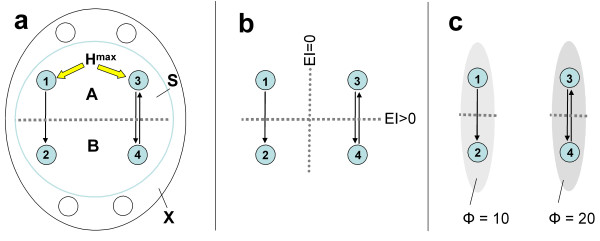
§ An information integration theory of consciousness > Presentation of the hypothesis > The first problem: What determines to what extent a system has conscious experience?
“In summary, to measure EI(B→A), one needs to apply maximum entropy to the outputs from B, and determine the entropy of the responses of B that are induced by inputs from A.”
§ An information integration theory of consciousness > Presentation of the hypothesis > The first problem: What determines to what extent a system has conscious experience?
“One way is to divide S into two complementary parts A and B, and evaluate the responses of B that can be caused by all possible inputs originating from A.”
Citations
Cites
A Mathematical Theory of Communication
Shannon, C. E. (1948) · Bell System Technical Journal · doi:10.1002/j.1538-7305.1948.tb01338.x · Cited by 88,486
The Mathematical Theory of Communication
Shannon, C. E., Weaver, W., & Wiener, N. (1950) · Physics Today · doi:10.1063/1.3067010 · Cited by 9,801
The feeling of what happens: body and emotion in the making of consciousness
(2000) · Choice Reviews Online · doi:10.5860/choice.37-6553 · Cited by 5,998
Brain stem reticular formation and activation of the EEG
Moruzzi, G., & Magoun, H. W. (1949) · Electroencephalography and Clinical Neurophysiology · doi:10.1016/0013-4694(49)90219-9 · Cited by 4,307 · cited 1×
“Conversely, stimulating the reticular formation can arouse a comatose animal and activate the thalamocortical system, making it ready to respond to stimuli [43].”
Background(1988) · Cited by 3,656
Dynamic predictions: Oscillations and synchrony in top–down processing
Engel, A. K., Fries, P., & Singer, W. (2001) · Nature Reviews Neuroscience · doi:10.1038/35094565 · Cited by 3,454 · cited 1×
“On the integration side, the specialized elements of the thalamocortical system are linked by an extended network of intra- and inter-areal connections that permit rapid and effective interactions within and between areas [31-35].”
BackgroundAlexander, G. E., Crutcher, M. D., & DeLong, M. R. (1990) · PubMed · Cited by 2,731
Towards a cognitive neuroscience of consciousness: basic evidence and a workspace framework
Dehaene, S. (2001) · Cognition · doi:10.1016/s0010-0277(00)00123-2 · Cited by 2,498 · cited 1×
“Opinions differ, however, about the contribution of certain cortical areas [1,16-21].”
BackgroundMathematical Theory of Communication
(2009) · Encyclopedia of Communication Theory · doi:10.4135/9781412959384.n229 · Cited by 2,492
The distinct modes of vision offered by feedforward and recurrent processing
Lamme, V. A. F., & Roelfsema, P. R. (2000) · Trends in Neurosciences · doi:10.1016/s0166-2236(00)01657-x · Cited by 2,338 · cited 1×
“Thus, the firing of the same cortical neurons may correlate with consciousness at certain times, but not at other times [57].”
Background
Research works printed but not linked: 2
- Zeki S A vision of the brain 1993 Oxford; Boston: Blackwell Scientific Publications
- Tononi G Galileo e il fotodiodo 2003 Bari: Laterza
Cited by
Items 801–900 of 1,727
Consciousness as inference in time : a commentary on Victor Lamme
Melloni, L. (2015) · Gutenberg Open Science · doi:10.25358/openscience-673 · Cited by 11
Assessing and Characterizing the Cognitive Power of Machine Consciousness Implementations.
Moreno, R. A., Ledezma, A., & Sanchis, A. (2009) · Biologically Inspired Cognitive Architectures · Cited by 7
Consciousness and Object: A mind-object identity physicalist theory
Manzotti, R. (2017) · Cited by 14
Investigations of an Adaptive and Autonomous Sensorimotor Individual
Egbert, M. D. (2018) · Conference on Artificial Life (ALIFE) · doi:10.1162/isal_a_00065 · Cited by 11
“…mental phenomena are seen as outside the realm of scientific explanation (Chalmers, 1997); and panpsy-chist theories that suggest, for instance, that everything is conscious, but varies in the extent to which it is conscious depending upon the amount of ‘integrated informa-tion’ (Tononi, 2004).”
BackgroundDaini, R. (2019) · Frontiers in Psychology · doi:10.3389/fpsyg.2019.00349 · Cited by 10
“Two main mechanisms have been described in consciousness: synchronization (Engel and Singer, 2001) and integration (e.g., Tononi, 2004).”
BackgroundSystems of Oscillators Designed for a Specific Conscious Percept
Kraikivski, P. (2019) · New Mathematics and Natural Computation · doi:10.1142/s1793005720500052 · Cited by 9
Consciousness as a logically consistent and prognostic model of reality
Vityaev, E. E. (2019) · Cognitive Systems Research · doi:10.1016/j.cogsys.2019.09.021 · Cited by 8
“Therefore, this measure is very close in meaning to entropy measure of integrated information in (Tononi, 2004).”
BackgroundInfluentialWhat Is Consciousness? Integrated Information vs. Inference
Cooke, J. E. (2021) · Entropy · doi:10.3390/e23081032 · Cited by 10
Sleep Treatments in Disorders of Consciousness: A Systematic Review
Cacciatore, M., Magnani, F. G., Leonardi, M., Sebastiano, D. R., & Sattin, D. (2021) · Diagnostics · doi:10.3390/diagnostics12010088 · Cited by 8
“Similarly, Integrated Information Theory (IIT) is grounded on two key properties of consciousness: integration, and differentiation (or segregation) [10].”
BackgroundPedunculopontine-induced cortical decoupling as the neurophysiological locus of dissociation.
Smith, D. M., & Terhune, D. B. (2023) · Psychological Review · doi:10.1037/rev0000353 · Cited by 6
A Dynamic Mechanistic Model of Perceptual Binding
Kraikivski, P. (2022) · Mathematics · doi:10.3390/math10071135 · Cited by 7
Memory for the Future: Psychodynamic Approach to Time and Self Through the Default Network
Cieri, F. (2022) · Frontiers in Human Neuroscience · doi:10.3389/fnhum.2022.885315 · Cited by 10
“In fact, bilateral lesions to these areas are related to a virtual breakdown of information integration in the thalamocortical system (Tononi, 2004).”
BackgroundLiu, J., Dong, K., Low, S. S., Wei, Q., Wang, G., Huang, F., Chen, X., Muhammad, K. G., & Zhang, D. (2022) · Neuroscience Research · doi:10.1016/j.neures.2022.09.002 · Cited by 9
Golden rhythms as a theoretical framework for cross-frequency organization
Kramer, M. (2022) · Neurons Behavior Data analysis and Theory · doi:10.51628/001c.38960 · Cited by 11
“Effective function relies on dynamic coordination between brain regions, in response to a changing environment, on an essentially fixed and limited anatomical substrate [8, 9, 10, 11].”
BackgroundExploring the Temporal Patterns of Dynamic Information Flow during Attention Network Test (ANT)
Duan, K., Xie, S., Zhang, X., Xie, X., Cui, Y., Liu, R., & Xu, J. (2023) · Brain Sciences · doi:10.3390/brainsci13020247 · Cited by 9
“This integrati n to a large-scale complex extending across br in are has been posited to be consciou ness [91].”
BackgroundIovane, G., & Landi, R. E. (2023) · Cognitive Systems Research · doi:10.1016/j.cogsys.2023.05.003 · Cited by 10
Freedom and self-ownership: An emergence theory of free will
Coburn, W. J. (2023) · Psychoanalysis Self and Context · doi:10.1080/24720038.2023.2281404 · Cited by 10
“This is the subject matter of what is referred to as integrative information theory (Tononi, 2004), in which experience is thought to arise not from experience itself but from neuronal interactions that, themselves, have no resemblance to the experience being produced.”
BackgroundA philosophical assessment of computational models of consciousness
Gök, S. E., & Sayan, E. (2011) · Cognitive Systems Research · doi:10.1016/j.cogsys.2011.11.001 · Cited by 8
Unconscious Representations 1: Belying the Traditional Model of Human Cognition
Augusto, L. M. (2013) · Axiomathes · doi:10.1007/s10516-012-9206-z · Cited by 11
Cortical sources of visual evoked potentials during consciousness of executive processes
Babiloni, C., Vecchio, F., Iacoboni, M., Buffo, P., Eusebi, F., & Rossini, P. M. (2008) · Human Brain Mapping · doi:10.1002/hbm.20567 · Cited by 6
“Rather, it reasonably emerges from relatively long integrative neural processes (i.e. hundreds of milliseconds), implying reciprocal information flux and temporal synchronization among different brain regions [Tononi, 2001, 2004].”
BackgroundCrisis in science: In search for new theoretical foundations
Schroeder, M. J. (2013) · Progress in Biophysics and Molecular Biology · doi:10.1016/j.pbiomolbio.2013.03.003 · Cited by 9
“(Tononi, 2004).”
BackgroundMultiscale Enaction Model (MEM): the case of complexity and “context-sensitivity” in vision
Laurent, É. (2014) · Frontiers in Psychology · doi:10.3389/fpsyg.2014.01425 · Cited by 8
“A major conclusion of these analyses is that the brain is a highly integrative system (Tononi et al., 1998; Tononi, 2004).”
BackgroundAdvanced Models of Cortical Dynamics in Perception
Freeman, W. J., Kozma, R., Li, G., Quiroga, R. Q., Vitiello, G., & Zhang, T. (2014) · Advances in cognitive neurodynamics · doi:10.1007/978-94-017-9548-7_17 · Cited by 7
“Examples are the Hebbian nerve cell assembly [1], the ‘cognit’ of Fuster and Bressler [2], the ‘bubbles’ of Taylor [3] and the ‘IIT’ of Tononi [4].”
BackgroundLångsjö, J., Lehtimäki, K. A., Ruohonen, J., Sajanti, A., Sandell, S., Heikkilä, H., Brander, A., Saarinen, K., & Herrala, L. (2016) · Brain Injury · doi:10.1080/02699052.2016.1199908 · Cited by 10
Introspective disputes deflated: the case for phenomenal variation
Fink, S. B. (2017) · Philosophical Studies · doi:10.1007/s11098-017-1000-8 · Cited by 11
Sitaram, R., Yu, T., Halsband, U., Vogel, D., Müller, F., Lang, S., Birbaumer, N., & Kotchoubey, B. (2018) · Brain and Cognition · doi:10.1016/j.bandc.2018.11.007 · Cited by 7
“In other words, the impairment of consciousness seems to be related to a decreased ability to recruit proper specialized subsystems (Bodart et al., 2018; Rosanova et al., 2012) and to synchronize their neuronal activity accurately (Tononi, 2004, 2008).”
CHAPTER 24 – The Hippocampus, Memory, and Consciousness
Postle, B. (2009) · Elsevier eBooks · doi:10.1016/b978-0-12-374168-4.00024-1 · Cited by 6
Probing the circuits of conscious perception with magnetophosphenes
Modolo, J., Hassan, M., Ruffini, G., & Legros, A. G. (2020) · Journal of Neural Engineering · doi:10.1088/1741-2552/ab97f7 · Cited by 7
Whole-Brain Models to Explore Altered States of Consciousness from the Bottom Up
Cofré, R., Herzog, R. A., Mediano, P. A. M., Piccinini, J., Rosas, F. E., Perl, Y. S., & Tagliazucchi, E. (2020) · Brain Sciences · doi:10.3390/brainsci10090626 · Cited by 90
“On the contrary, integrated information theory (IIT) [50–52] is based on certain first-person qualities of subjective experience, which are accessed by introspection and can be taken as "postulates" or "axioms" for the theory [52].”
BackgroundAnalyzing the etiological functions of consciousness
Black, D. (2020) · Phenomenology and the Cognitive Sciences · doi:10.1007/s11097-020-09693-z · Cited by 9
What is neurophilosophy: Do we need a non-reductive form?
Klar, P. (2020) · Synthese · doi:10.1007/s11229-020-02907-6 · Cited by 9
“Such ecological view of the brain contradicts a brain-reductive stance, as the latter claims that consciousness, the self, and mental features are reducible to and especially caused by the brain’s neuronal activity, which is still commonly presupposed in theories about consciousness by empirical neuroscience, as seen…”
BackgroundSingularity and consciousness: A neuropsychological contribution
de Haan, E. H. F., Scholte, H. S., Pinto, Y., Foschi, N., Polonara, G., & Fabri, M. (2021) · Journal of Neuropsychology · doi:10.1111/jnp.12234 · Cited by 9
“However, when the integration within a subsystem is larger than the connection between subsystems, consciousnesswill arise as a function of the subsystem rather than of the system as a whole (Tononi, 2004, 2005).”
BackgroundInformational analysis: a Shannon theoretic approach to measure the performance of a diagnostic test
Girometti, R., & Fabris, F. (2015) · Medical & Biological Engineering & Computing · doi:10.1007/s11517-015-1294-7 · Cited by 7
Cui, Y., Li, M., Biswal, B. B., Jing, W., Zhou, C., Liu, H., Guo, D., Xia, Y., & Yao, D. (2021) · Brain Connectivity · doi:10.1089/brain.2020.0827 · Cited by 6
“Accordingly, the identified balance of DMN dynamics might be a competitive product between the integration and differentiation of DMN activity in maintaining consciousness during wakefulness(Cavanna, Vilas, Palmucci, & Tagliazucchi, 2018; Tononi, 2004; Tononi, Boly, Massimini, & Koch, 2016).”
BackgroundInfluentialToward a General Theory of Unconscious Processes in Psychoanalysis and Anesthesiology
Mashour, G. A. (2008) · Journal of the American Psychoanalytic Association · doi:10.1177/0003065108315692 · Cited by 9
Aleksander, I. (2009) · Cognitive Computation · doi:10.1007/s12559-009-9008-9 · Cited by 9
“7 Tononi [17] has developed a set of necessary ‘information integration’ measures that are meant to be necessary for consciousness.”
BackgroundAN ERGODIC THEORY OF CONSCIOUSNESS
Boyarsky, A., & Góra, P. (2009) · International Journal of Bifurcation and Chaos · doi:10.1142/s0218127409023731 · Cited by 7
“It is of interest to note that in [Tononi & Sporns, 2003; Tononi, 2004] an information theoretic method is developed which describes consciousness and how it may be measured.”
BackgroundThe collective brain is criticalPreprint
Tagliazucchi, E., & Chialvo, D. R. (2011) · arXiv (Cornell University) · doi:10.48550/arxiv.1103.2070 · Cited by 13
“[55] G.”
Superconducting Optoelectronic Neurons I: General PrinciplesPreprint
Shainline, J. M., Buckley, S. M., McCaughan, A. N., Chiles, J., Mirin, R. P., & Nam, S. W. (2018) · arXiv (Cornell University) · doi:10.48550/arxiv.1805.01929 · Cited by 12
Panda, R., López‐González, A., Gilson, M., Gosseries, O., Thibaut, A., Frasso, G., Cecconi, B., Escrichs, A., GIGA group Collaborators, Deco, G., et al. (2021) · bioRxiv (Cold Spring Harbor Laboratory) · doi:10.1101/2021.11.08.467694 · Cited by 7
“…of local, naturally occurring events into the entire network is affected by reduced states of consciousness and shares similarities with both information integration theory (Tononi, 2004; Tononi et al., 2016) and global neuronal workspace theory (Dehaene et al., 2011; Mashour et al., 2020).”
BackgroundInfluentialA Synergistic Workspace for Human Consciousness Revealed by Integrated Information DecompositionPreprint
Luppi, A. I., Mediano, P. A. M., Rosas, F. E., Allanson, J. E., Pickard, J. D., Carhart-Harris, R. L., Williams, G. B., Craig, M. M., Finoia, P., Owen, A. M., et al. (2023) · eLife · doi:10.7554/elife.88173.1 · Cited by 7
Extracting interpretable signatures of whole-brain dynamics through systematic comparisonPreprint
Bryant, A. G., Aquino, K. M., Parkes, L., et al. (2024) · bioRxiv (Cold Spring Harbor Laboratory) · doi:10.1101/2024.01.10.573372 · Cited by 7
“This cluster also included Φ ∗ —an estimate for the extent of integrated information [72, 73] between the corresponding pair of regions—which was the only SPI to significantly distinguish cases from controls across all four disorders, although all balanced accuracy averages were below 60%.”
Consciousness driven Spike Timing Dependent Plasticity
Yadav, S., Chaudhary, S., Kumar, R., & Nkomozepi, P. (2025) · Expert Systems with Applications · doi:10.1016/j.eswa.2025.126490 · Cited by 6
“In [10] Integrated Information Theory (IIT) developed by neu-roscientist Giulio Tononi, proposes that consciousness arises from the integration of information within the brain.”
BackgroundA two-system theory of sensory-evoked brain responses
Somervail, R., Perovic, S., Bufacchi, R. J., Caminiti, R., & Iannetti, G. D. (2025) · Brain · doi:10.1093/brain/awaf402 · Cited by 15
“…This is a relevant issue given that many influential theories of consciousness posit that widespread cortical integration is itself the neural basis of consciousness, 129,147-149 a notion that might have been prompted by the large and widespread cortical responses mistakenly interpreted as NCCs.”
Why does time feel the way it does? Toward a principled account of temporal experience
Comolatti, R., Grasso, M., & Tononi, G. (2025) · iScience · doi:10.1016/j.isci.2025.113434 · Cited by 26
Self-citationRevach, D., & Salti, M. (2021) · Consciousness and Cognition · doi:10.1016/j.concog.2021.103229 · Cited by 9
Dimensions of corvid consciousness
Veit, W., Browning, H., Garcia‐Pelegrin, E., Davies, J. R., DuBois, J. G., & Clayton, N. S. (2025) · Animal Cognition · doi:10.1007/s10071-025-01949-y · Cited by 12
“…of consciousness, with proponents of the Integrated Information Theory of consciousness (IIT), even making it the defining feature of consciousness (see Tononi 2004, 2005, 2008, 2010, 2012a, b, 2015; Balduzzi and Tononi 2008, 2009; Tononi and Koch 2008; Tononi et al. 2016; Koch and Tononi 2011).”
Intrinsic units: identifying a system’s causal grain
Marshall, W., Findlay, G., Albantakis, L., & Tononi, G. (2024) · bioRxiv · doi:10.1093/nc/niag013 · Cited by 16
Self-citationPhysical integration: A causal account for consciousness
Manzotti, R., & Chella, A. (2014) · Journal of Integrative Neuroscience · doi:10.1142/s0219635214400044 · Cited by 7
Weinbaum, D. R., & Veitas, V. (2016) · Lecture notes in computer science · doi:10.1007/978-3-319-41649-6_5 · Cited by 6
Neural Binding, Consciousness, and Mental Disorders: Complexity as a Common Element
Assis, L. P. G. D. (2015) · Activitas Nervosa Superior · doi:10.1007/bf03379943 · Cited by 9
“Tononi, G. (2008). Consciousness as integrated information: a provisional manifesto.”
BackgroundCAN QUALITATIVE BIOPHYSICS SOLVE THE HARD PROBLEM?
Pereira, A., Vimal, R. L. P., & Pregnolato, M. (2016) · WORLD SCIENTIFIC eBooks · doi:10.1142/9789814644266_0005 · Cited by 7
Information integration in a globally coupled chaotic system
Hiroki, M. O. R. I., & Oizumi, M. (2018) · Conference on Artificial Life (ALIFE) · doi:10.1162/isal_a_00074 · Cited by 6
“Integrated Information Theory of consciousness (IIT) hypothesizes that the amount of information integrated by the interactions within a system, called “integrated information (Φ)”, corresponds to the level of consciousness (Tononi, 2004).”
BackgroundSynthetic cognitive development: Where intelligence comes from
Weinbaum, D. R., & Veitas, V. (2016) · The European Physical Journal Special Topics · doi:10.1140/epjst/e2016-60088-2 · Cited by 6
“rgent agent is adaptive and subject to changes. We follow the work of Gulio Tononi and his concept of information integration to formally dene coordinated clusters in networks of interacting agents (Tononi, 2004, 2008; Edelman and Tononi, 2000). The reasoning behind the 17 concept is that if we examine a population P…”
BackgroundDiscrete spectral eigenmode-resonance network of brain dynamics and connectivity
Robinson, P. A. (2021) · Physical review. E · doi:10.1103/physreve.104.034411 · Cited by 6
Non-Separability of Physical Systems as a Foundation of Consciousness
Arkhipov, A. S. (2022) · Entropy · doi:10.3390/e24111539 · Cited by 12
Neuner, B., Wolter, S., McCarthy, W. J., Spies, C., Cunningham, C. M., Radtke, F. M., Franck, M., & Koenig, T. W. (2023) · Brain Communications · doi:10.1093/braincomms/fcad270 · Cited by 8
“…whole-brain pattern of electrical activity—detectable through multichannel EEG recordings—not only co-varies with the functional state of the healthy brain 17 and with different states of consciousness 18,19 but likewise with disease conditions affecting cognitive and other higher brain functions.”
BackgroundWolff, H. (2024) · Neuroethics · doi:10.1007/s12152-023-09541-2 · Cited by 6
“40 The “theoretical approach” identifies certain properties from ethical considerations to attach moral status (theoretical significance).”
Variability of large timescale functional networks in patients with disorders of consciousness
Gong, A., Wang, Q., Guo, Q., Yang, Y., Chen, X., Hu, X., & Zhang, Y. (2024) · Frontiers in Neurology · doi:10.3389/fneur.2024.1283140 · Cited by 6
“The large-scale impairment of neural circuits blocked the information interaction among local neuro groups, which caused more neuro islands and decreased information integration in the brain (46).”
BackgroundSpatio-temporally Graded Causality: A Model
Jura, B. (2024) · Foundations of Physics · doi:10.1007/s10701-024-00761-x · Cited by 11
“…integration theory of consciousness (IIT), which posits that the integration of information (within temporal windows of certain duration), as determined by a particular structure of the cause-effect chain of an underlying physical system, gives rise to a unified subjective experience [4,5].”
Answering questions about consciousness by modeling perception as covert behavior
Markkula, G. M. (2015) · Frontiers in Psychology · doi:10.3389/fpsyg.2015.00803 · Cited by 11
Non-Conceptual Content and the Subjectivity of Consciousness
Schlicht, T. (2011) · International Journal of Philosophical Studies · doi:10.1080/09672559.2011.595197 · Cited by 12
“Tononi has developed this theory further into what he has called the ‘information integration theory of consciousness’ (Tononi 2004).”
BackgroundManganotti, P., & Felice, A. D. (2013) · PubMed · doi:10.3233/ben-2012-120263 · Cited by 6
“The information integration theory of consciousness (IITC) argues that consciousness is an integrated information state and that the brain should be able to generate consciousness to the extent that it has a large series of available states (information), yet it cannot be decomposed into a collection of causally indep…”
BackgroundChaos and Chaos; Complexity and Hierarchy
Cottam, R., Ranson, W., & Vounckx, R. A. (2014) · Systems Research and Behavioral Science · doi:10.1002/sres.2288 · Cited by 9
“This makes a digital computer incapable of generating any of the informationally-integrative features of intelligence or consciousness (Schroeder, 2012; Tononi, 2004).”
BackgroundLeón‐Carrión, J., León-Domínguez, U., Halper, J., Pollonini, L., Zouridakis, G., & Domínguez-Morales, M. D. R. (2013) · Current Pharmaceutical Design · doi:10.2174/13816128113196660651 · Cited by 7
“According to one theory of consciousness, the brain’s level of consciousness corresponds to its capacity to integrate information [3].”
BackgroundMachine Consciousness: A Modern Approach
Manzotti, R. (2013) · Cited by 6
Linking Structure and Function of Complex Cortical Networks
Potsdam, & Zamora‐López, G. (2008) · Cited by 9
Subjectivity: A Case of Biological Individuation and an Adaptive Response to Informational Overflow
Jonkisz, J. (2016) · Frontiers in Psychology · doi:10.3389/fpsyg.2016.01206 · Cited by 9
Shigeno, S. (2017) · Diversity and Commonality in Animals · doi:10.1007/978-4-431-56469-0_19 · Cited by 6
Can artificially intelligent agents really be conscious?
Pandey, S. C. (2018) · Sadhana · doi:10.1007/s12046-018-0887-x · Cited by 7
“Further, in [81] it is suggested that a human level of cognitive autonomy is also associated with consciousness.”
BackgroundUnitas Multiplex. Biological architectures of consciousness
Maldonato, N. M., Muzii, B., Bottone, M., Sperandeo, R., Corrado, D. D., Continisio, G. I., Rea, T., & Esposito, A. A. (2020) · Híradástechnika/Infocommunications journal · doi:10.36244/icj.2020.1.2 · Cited by 6
Classical-quantum interfaces in living neural tissue supporting conscious functions
(2020) · Advances in Quantum Chemistry · doi:10.1016/bs.aiq.2020.08.002 · Cited by 6
Hierarchical Graph Convolutional Network for Data Evaluation of Dynamic Graphs
Wang, B., Hayashi, T., & Ohsawa, Y. (2020) · IEEE International Conference on Big Data (BigData) · doi:10.1109/bigdata50022.2020.9377789 · Cited by 7
“The reason why our proposed model performs well is that it can integrate information from rich dimensions [43].”
BackgroundMinimal Sense of Self, Temporality and the Brain
Kiverstein, J. D. (2009) · PSYCHE: An Interdisciplinary Journal of Research On Consciousness · Cited by 11
A Way of Integration: The Relationship between Conscious and Unconscious Processes
Tu, S. (2014) · Advances in Psychology · doi:10.12677/ap.2014.43065 · Cited by 7
A Modal Approach to Consciousness of Agents
Yifeng, C., & Sanders, J. W. (2022) · Lecture notes in computer science · doi:10.1007/978-3-031-19759-8_9 · Cited by 6
Velázquez, J. L. P., Mateos, D. M., & Erra, R. G. (2023) · Heliyon · doi:10.1016/j.heliyon.2023.e15005 · Cited by 6
Replication of the hard problem of consciousness in AI and Bio-AI: An early conceptual framework
Boltuc, N., & Bołtuć, P. (2007) · National Conference on Artificial Intelligence · Cited by 6
Synthetic Modeling of Autonomous Learning with a Chaotic Neural Network
Funabashi, M. (2015) · International Journal of Bifurcation and Chaos · doi:10.1142/s0218127415500546 · Cited by 6
“In the integrated information theory of consciousness (IIT), the system decomposition is axiomatically defined as the basic element of the integrated information [Tononi, 2004; Oizumi et al., 2014].”
BackgroundAlmeida, R. D. A., & Carvalho, P. G. D. S. (2017) · World sustainability series · doi:10.1007/978-3-319-69474-0_18 · Cited by 8
The biological cost of consciousnessPreprint
Baars, B. J., & Baars, B. (2012) · Nature Precedings · doi:10.1038/npre.2012.6775.1 · Cited by 8
“(Tononi, 2004).”
Detecting emergent processes in cellular automata with excess informationPreprint
Balduzzi, D. (2011) · arXiv (Cornell University) · doi:10.48550/arxiv.1105.0158 · Cited by 9
“Conscious percepts take 100-200ms to arise and brain activity is (presumably) better expressed as comparatively leisurely interactions between neurons or neuronal assemblies rather than much faster interactions between atoms or molecules (Tononi, 2004).”
BackgroundGrowing Evidence for Separate Neural Mechanisms for Attention and ConsciousnessPreprint
Maier, A., & Tsuchiya, N. (2020) · doi:10.31234/osf.io/cs8f4 · Cited by 6
Seedat, A., Lepauvre, A., Jeschke, J., Górska, U., Armendáriz, M., Bendtz, K., Henin, S. E., Hirschhorn, R., Brown, T., Jensen, E., et al. (2025) · Scientific Data · doi:10.1038/s41597-025-04833-z · Cited by 9
“…paradigm and associated data shared here were collected as part of a large-scale international adversarial collaboration testing key contradictory predictions of two prominent theories of Consciousness: 14 Global Neuronal Workspace Theory (GNWT) 15–19 and Integrated Information Theory (IIT) 20–23 .”
Liang, Z., Fan, L., Zhang, B., Shu, W., Li, D., Li, X., & Yu, T. (2025) · NeuroImage · doi:10.1016/j.neuroimage.2025.121193 · Cited by 6
“The current mainstream theories of consciousness, such as the dynamic core hypothesis and integrated information theory, highlight the dynamic interplay between functional integration and differentiation as central to understanding consciousness (Tononi, 2004; Tononi and Edelman, 1998).”
Yapay Zeka ve Bilinç: Anlamsal ve Duygusal/Heyecansal Boyutları Üzerinden Bir Değerlendirme
Karslı, T. A. (2024) · İnsan ve Toplum Bilimleri Araştırmaları Dergisi · doi:10.15869/itobiad.1517371 · Cited by 7
Better bridges: Integrating the neuroscience and philosophy of consciousness
Kozuch, B. (2024) · Consciousness and Cognition · doi:10.1016/j.concog.2024.103774 · Cited by 6
The Unity of Consciousness and the Practical Ethics of Neural Organoid Research
Hayashi, Y., & Sato, R. (2024) · Neuroethics · doi:10.1007/s12152-024-09574-1 · Cited by 5
“2 IIT involves observing the characteristics of consciousness and postulating some of them as “axioms,” such as the unity of consciousness [21–23].”
Heavy‐duty conceptual engineering
Koch, S., & Ohlhorst, J. (2024) · Noûs · doi:10.1111/nous.12538 · Cited by 7
Biological arrow of time: emergence of tangled information hierarchies and self-modelling dynamics
Prokopenko, M., Davies, P. C. W., Harré, M., Heisler, M. G., Kuncic, Z., Lewis, G. F., Livson, O., Lizier, J. T., & Rosas, F. E. (2025) · Journal of Physics Complexity · doi:10.1088/2632-072x/ad9cdc · Cited by 19
“We identified open-ended meta-simulation as a common thread across all these phenomena, where lower-order systems find ways to incorporate environmental (external) feedback in their self-modelling dynamics, thus supporting “information self-creation” [41] and “information integration” [103].”
Mayner, W. G. P., Marshall, W., Billeh, Y. N., Gandhi, S. R., Caldejon, S., Cho, A., Griffin, F., Hancock, N., Lambert, S., Lee, E., et al. (2022) · eNeuro · doi:10.1523/eneuro.0280-21.2021 · Cited by 10
“…theoretical framework predicts that consciousness requires the joint presence of integration and differentiation: that is, a system is conscious if it is causally irreducible to its parts and possesses a rich dynamical repertoire of states (Tononi, 2004; Oizumi et al., 2014; Tononi et al., 2016).”
BackgroundResultSelf-citationElectromagnetic characteristics of in vivo nerve fibers at the terahertz-far-infrared band
Guo, L., Xu, D., Wang, K., Sun, Y., Zhang, Q., Ning, H., Lu, C., Wang, S., & Gong, Y. (2022) · Frontiers in Bioengineering and Biotechnology · doi:10.3389/fbioe.2022.1055232 · Cited by 6
“Electrochemical theory played a leading role in the early studies, although it could not perfectly explain many underlying problems, such as the generation and origin of consciousness (Tononi, 2004; Tegmark, 2015).”
BackgroundThe genesis of the minimal mind: elements of a phenomenological and functional account
Marosán, B. P. (2023) · Phenomenology and the Cognitive Sciences · doi:10.1007/s11097-023-09946-7 · Cited by 5
Bacigalupi, J. A., & Favareau, D. F. (2023) · The Journal of Physiology · doi:10.1113/jp284418 · Cited by 9
The cognitive reality monitoring network and theories of consciousness
Cortese, A., & Kawato, M. (2024) · Neuroscience Research · doi:10.1016/j.neures.2024.01.007 · Cited by 8
“Integrated Information Theory (IIT) instead has the form of a mathematical theory (Oizumi et al., 2014; Tononi, 2004) but is far removed from David Marr ’ s three levels of understanding.”
BackgroundVelázquez, J. L. P., Mateos, D. M., Guevara, R., & Erra, R. G. (2024) · Frontiers in Systems Neuroscience · doi:10.3389/fnsys.2024.1426986 · Cited by 9
“According to this theory, consciousness is integrated information (Tononi, 2004).”
BackgroundConsciousness as Inference in Time
Melloni, L. (2015) · doi:10.15502/9783958570566 · Cited by 7
A new measure based on degree distribution that links information theory and network graph analysis
Hadley, M. W., McGranaghan, M. F., Willey, A., Liew, C. W., & Reynolds, E. (2012) · Neural Systems & Circuits · doi:10.1186/2042-1001-2-7 · Cited by 6
“EI is a directional measure of the causal influences between subsets of a network, and thus the minimum EI reflects a system ’ s capacity to integrate information [13,14].”
BackgroundPalmer, S., & Mattler, U. (2013) · Consciousness and Cognition · doi:10.1016/j.concog.2013.03.002 · Cited by 6
Discrimination of dynamic change and constancy over time by pigeons
Hagmann, C. E., & Cook, R. G. (2011) · Psychonomic Bulletin & Review · doi:10.3758/s13423-011-0094-9 · Cited by 6
“builds the continuous experience of reality across time (James, 1890; Metzinger, 2003; Tononi, 2004).”
Background
Metadata
- Authors
- Tononi, G.
- Affiliations
- University of Wisconsin–Madison (US)
- Corresponding author
- Tononi, Giulio
- ORCID
- Tononi, Giulio
- Venue
- BMC Neuroscience
- Published
- 2004-11-02
- Volume
- 5
- Issue
- 1
- Pages
- 42-42
- ISSN
- 1471-2202 (ISSN-L)
- PMC
- PMC543470
- OpenAlex
- W2114900706
- Cited by
- 1,958
- References
- 74
- Citations by year
- 2026: 242 · 2025: 230 · 2024: 131 · 2023: 114 · 2022: 95 · 2021: 99 · 2020: 110 · 2019: 97 · 2018: 94 · 2017: 119 · 2016: 83 · 2015: 80 · 2014: 87 · 2013: 85 · 2012: 64
- FWCI
- 91.12
- Type
- journal article
- Language
- en
- Open access
- gold
- doi.org
- Licence
- cc-by
- creativecommons.org/licenses/by/2.0/ (tdm)
- creativecommons.org/licenses/by/2.0/ (vor)
- Locations
- BMC Neuroscience (publishedVersion, cc-by)
- PubMed Central (publishedVersion)
- PubMed (publishedVersion)
- DOAJ (DOAJ: Directory of Open Access Journals) (submittedVersion, cc-by-sa)
- Topics
- Social Sciences › Arts and Humanities › Philosophy › Philosophy and Theoretical Science
- Life Sciences › Neuroscience › Cognitive Neuroscience › Neural dynamics and brain function
- Life Sciences › Neuroscience › Cognitive Neuroscience › Functional Brain Connectivity Studies
- Keywords
- information integration theory, consciousness, integrated information, phi, subjective experience, unity of consciousness, effective information, thalamocortical system, dreamless sleep, generalized seizures, neural correlates of consciousness
- MeSH terms
- Afferent Pathways, Brain, Consciousness, Humans, Information Theory, Motor Activity, Neurons, Thalamus, Systems Integration
About these checks
Registry, retraction, Cites and statistics results are computed, not judged, with one exception: a printed reference that no index lists is read once by a model before it counts as a citation error. Claims are extracted by a model and kept only when their quote appears verbatim in the text; each cited source is then checked, with a model’s help, for whether it says what the claim relies on. Those verdicts can be wrong — read the claim’s quote and the cited source before relying on one.
The claim verdicts this report counts are experimental: their accuracy is not yet measured.
A language model drew the claims from the paper on 2026-10-10, under version 3 of the claim definition (model deepseek-v4.1-flash, prompt extract-v3).
A second model labelled each claim on 2026-10-10 (model jev-1.13-20260917, definition revision gold-guideline-v0.2).
Cited sources are checked with a language model’s help (gpt-6-sol).
Statistics and arithmetic are recomputed, not judged.
Confidence bands are shown only for fields calibrated on our annotated test set. None is calibrated yet, so no band is shown.
What counts as a claim ›How we measure confidence ›How we check this ›
Are you an author, or do you see a problem with this page? Request a review
Data sources
Bibliographic data: Semantic Scholar, OpenAlex, Crossref.
Contains information from the Semantic Scholar Academic Graph Datasets, made available under the ODC Attribution License (ODC-BY 1.0).
Semantic Scholar’s data is described in: Kinney, R., et al. (2023). The Semantic Scholar Open Data Platform. arXiv:2301.10140.
