

External validation of multivariable prediction models: a systematic review of methodological conduct and reporting
Open accessThe DOI matches its Crossref record; 70 of the 70 references it cites were found in a registry or an index.
Abstract
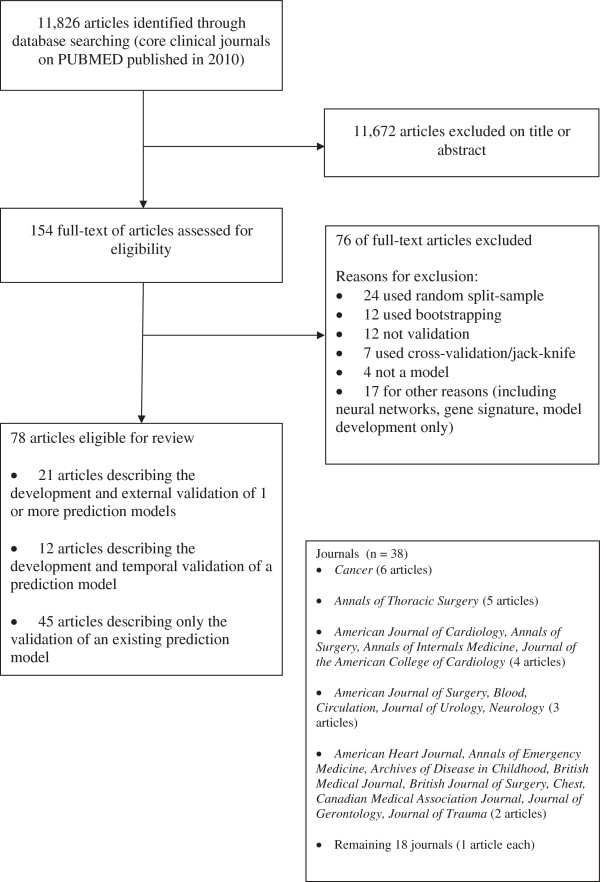
BACKGROUND: Before considering whether to use a multivariable (diagnostic or prognostic) prediction model, it is essential that its performance be evaluated in data that were not used to develop the model (referred to as external validation). We critically appraised the methodological conduct and reporting of external validation studies of multivariable prediction models. METHODS: We conducted a systematic review of articles describing some form of external validation of one or more multivariable prediction models indexed in PubMed core clinical journals published in 2010. Study data were extracted in duplicate on design, sample size, handling of missing data, reference to the original study developing the prediction models and predictive performance measures. RESULTS: 11,826 articles were identified and 78 were included for full review, which described the evaluation of 120 prediction models. in participant data that were not used to develop the model. Thirty-three articles described both the development of a prediction model and an evaluation of its performance on a separate dataset, and 45 articles described only the evaluation of an existing published prediction model on another dataset. Fifty-seven percent of the prediction models were presented and evaluated as simplified scoring systems. Sixteen percent of articles failed to report the number of outcome events in the validation datasets. Fifty-four percent of studies made no explicit mention of missing data. Sixty-seven percent did not report evaluating model calibration whilst most studies evaluated model discrimination. It was often unclear whether the reported performance measures were for the full regression model or for the simplified models. CONCLUSIONS: The vast majority of studies describing some form of external validation of a multivariable prediction model were poorly reported with key details frequently not presented. The validation studies were characterised by poor design, inappropriate handling and acknowledgement of missing data and one of the most key performance measures of prediction models i.e. calibration often omitted from the publication. It may therefore not be surprising that an overwhelming majority of developed prediction models are not used in practice, when there is a dearth of well-conducted and clearly reported (external validation) studies describing their performance on independent participant data.
Overview
The claims and statistics of this paper haven’t been checked yet.
Free: it reads the open-access text and checks the first 5 claims that cite a source we can check. Create a free account to check every claim.
Integrity signals
Registry
Cites
Statistics
Figures
Verification
Claims the paper makes
The claims and statistics of this paper haven’t been checked yet.
Free: it reads the open-access text and checks the first 5 claims that cite a source we can check. Create a free account to check every claim.
Claims other papers make about this one
Each is checked against this paper’s own text: does it say what the citing paper says it does?
The source backs part of the claim, not all of it — or backs it for a different population, condition or comparison.
In the citing paper
“For instance, validation studies rarely present information on the calibration intercept and slope, or different studies report estimates for different risk strata or time horizons.”
From A framework for meta-analysis of prediction model studies with binary and time-to-event outcomes (2019) · cites this paper as [11]
Experimental — accuracy not yet measuredThe cited source says what the claim attributes to it.
In the citing paper
“Furthermore, because validation studies are often conducted using small and local data sets,11 they rarely provide evidence about a model’s potential generalizability across different settings and populations.”
From A framework for meta-analysis of prediction model studies with binary and time-to-event outcomes (2019) · cites this paper as [11]
The cited source says what the claim attributes to it.
In the citing paper
“Unfortunately, extraction of calibration measures is often hampered by poor assessment and reporting.11,16”
From A framework for meta-analysis of prediction model studies with binary and time-to-event outcomes (2019) · cites this paper as [11]
The cited source says what the claim attributes to it.
In the citing paper
“Despite the significant potential demonstrated by extant studies in the application of machine learning for multidimensional data processing and risk prediction, the lack of external validation using completely independent datasets remains a major methodological issue in risk prediction model research (64, 65).”
From Machine learning-based risk predictive models for diabetic kidney disease in type 2 diabetes mellitus patients: a systematic review and meta-analysis (2025) · cites this paper as [64]
In the citing paper
“In a meta-analysis without access to individual participant data (IPD), we are reliant on extracting these performance measures from study publications. However, they are often poorly reported.”
From A framework for meta-analysis of prediction model studies with binary and time-to-event outcomes (2019) · cites this paper as [11]
Self-check
Percentages, sums and reported differences re-computed from the paper’s own numbers.
The self-check needs the paper’s full text.
Citations
Cites
Multiple imputation using chained equations: Issues and guidance for practice
White, I. R., Royston, P., & Wood, A. M. (2011) · Statistics in Medicine · doi:10.1002/sim.4067 · Cited by 9,792 · cited 1×
“If those with missing values were retained in the analyses, then it is important for the reader to know how they were handled in the analysis, including whether methods such as multiple imputation were used [31].”
MethodEuropean Guidelines on cardiovascular disease prevention in clinical practice (version 2012)
Authors/Task Force Members:, Perk, J., De Backer, G., Gohlke, H., Graham, I., Reiner, Ž., Verschuren, M., Albus, C., Benlian, P., Boysen, G., et al. (2012) · European Heart Journal · doi:10.1093/eurheartj/ehs092 · Cited by 8,490
Sterne, J. A. C., White, I. R., Carlin, J. B., Spratt, M., Royston, P., Kenward, M. G., Wood, A. M., & Carpenter, J. R. (2009) · BMJ · doi:10.1136/bmj.b2393 · Cited by 7,299 · cited 1×
“The majority (64%) of studies were assumed to have conducted complete-case analyses to handle missing values, despite methodological guidance to do the contrary [40-44].”
BackgroundDecision curve analysis: a novel method for evaluating prediction models
Vickers, A. J., & Elkin, E. B. (2006) · Medical Decision Making · doi:10.1177/0272989x06295361 · Cited by 6,341 · cited 2×
“New methods based on decision curve analysis (net benefit) [50] and relative utility [51] have recently been introduced.”
MethodAssessing the Performance of Prediction Models: A Framework for Traditional and Novel Measures
Steyerberg, E. W., Vickers, A. J., Cook, N. R., Gerds, T., Gonen, M., Obuchowski, N., Pencina, M. J., & Kattan, M. W. (2010) · Epidemiology · doi:10.1097/ede.0b013e3181c30fb2 · Cited by 5,170 · cited 3×
“Performance is typically characterised by evaluating a model’s calibration and discrimination [15].”
BackgroundClinician’s Guide to Prevention and Treatment of Osteoporosis
Cosman, F., de Beur, S. J., LeBoff, M. S., Lewiecki, E. M., Tanner, B., Randall, S., & Lindsay, R. (2014) · Osteoporosis International · doi:10.1007/s00198-014-2794-2 · Cited by 4,149
Authors/Task Force Members, Graham, I., Atar, D., Borch-Johnsen, K., Boysen, G., Burell, G., Cifkova, R., Dallongeville, J., De Backer, G., Ebrahim, S., et al. (2007) · European Heart Journal · doi:10.1093/eurheartj/ehm316 · Cited by 3,753
Clinical Prediction Models: A Practical Approach to Development, Validation, and Updating
Steyerberg, E. W. (2019) · Statistics for Biology and Health · doi:10.1007/978-3-030-16399-0 · Cited by 3,281
Internal validation of predictive models
Steyerberg, E. W., Harrell, F. E., Borsboom, G. J. J. M., Eijkemans, M. J. C., Vergouwe, Y., & Habbema, J. D. F. (2001) · Journal of Clinical Epidemiology · doi:10.1016/s0895-4356(01)00341-9 · Cited by 2,746
Avoidable waste in the production and reporting of research evidence
Chalmers, I., & Glasziou, P. (2009) · The Lancet · doi:10.1016/s0140-6736(09)60329-9 · Cited by 2,208
Graham (2007) · doi:10.1097/01.hjr.0000277983.23934.c9 · Cited by 1,647
Increasing value and reducing waste in research design, conduct, and analysis
Ioannidis, J. P. A., Greenland, S., Hlatky, M. A., Khoury, M. J., Macleod, M. R., Moher, D., Schulz, K. F., & Tibshirani, R. (2014) · The Lancet · doi:10.1016/s0140-6736(13)62227-8 · Cited by 1,597 · cited 1×
“Replicating findings obtained during the original development of the prediction model in different data but from the same underlying target population is key [19-21].”
BackgroundPrognosis Research Strategy (PROGRESS) 3: Prognostic Model Research
Steyerberg, E. W., Moons, K. G. M., van der Windt, D. A., Hayden, J. A., Perel, P., Schroter, S., Riley, R. D., Hemingway, H., Altman, D. G., & for the PROGRESS Group (2013) · PLoS Medicine · doi:10.1371/journal.pmed.1001381 · Cited by 1,508 · cited 1×
“Before considering whether to use a clinical prediction model, it is essential that its predictive performance be empirically evaluated in datasets that were not used to develop the model [11-13].”
MethodSelf-citationSteyerberg, E. W. (2009) · Statistics for Biology and Health · doi:10.1007/978-0-387-77244-8 · Cited by 1,491
The clinician's guide to prevention and treatment of osteoporosis
LeBoff, M. S., Greenspan, S. L., Insogna, K. L., Lewiecki, E. M., Saag, K. G., Singer, A. J., & Siris, E. S. (2022) · Osteoporosis International · doi:10.1007/s00198-021-05900-y · Cited by 1,487
Prognosis and prognostic research: validating a prognostic model
Altman, D. G., Vergouwe, Y., Royston, P., & Moons, K. G. M. (2009) · BMJ · doi:10.1136/bmj.b605 · Cited by 1,436
Self-citationKanis, J. A., Oden, A., Johnell, O., Johansson, H., De Laet, C., Brown, J., Burckhardt, P., Cooper, C., Christiansen, C., Cummings, S., et al. (2007) · Osteoporosis International · doi:10.1007/s00198-007-0343-y · Cited by 1,224 · cited 1×
“A good example of a prediction model that has been inadequately reported, making evaluations by independent investigators impossible [36,37], yet appears in numerous clinical guidelines [4,38] is the FRAX model for predicting the risk of osteoporotic fracture [39].”
MethodRisk prediction models: II. External validation, model updating, and impact assessment
Moons, K. G. M., Kengne, A. P., Grobbee, D. E., Royston, P., Vergouwe, Y., Altman, D. G., & Woodward, M. (2012) · Heart · doi:10.1136/heartjnl-2011-301247 · Cited by 1,195 · cited 4×
“Key characteristics, such as calibration and discrimination, are widely recommended aspects to evaluate [9,12-15,26,45,46].”
BackgroundMethodInfluentialSelf-citationPrognosis and prognostic research: application and impact of prognostic models in clinical practice
Moons, K. G. M., Altman, D. G., Vergouwe, Y., & Royston, P. (2009) · BMJ · doi:10.1136/bmj.b606 · Cited by 934 · cited 1×
“Whilst a formal evaluation of clinical usefulness in terms of improving patients outcomes or changing clinician behavior [26,49] are not part of external validation, indicating the potential clinical utility can be determined.”
BackgroundSelf-citationExternal validation of a Cox prognostic model: principles and methods
Royston, P., & Altman, D. G. (2013) · BMC Medical Research Methodology · doi:10.1186/1471-2288-13-33 · Cited by 911 · cited 1×
“The two key components characterising the performance of a prediction model are calibration and discrimination [14,15,34].”
BackgroundSelf-citationMoons, K. G. M., Kengne, A. P., Woodward, M., Royston, P., Vergouwe, Y., Altman, D. G., & Grobbee, D. E. (2012) · Heart · doi:10.1136/heartjnl-2011-301246 · Cited by 889 · cited 1×
“Key characteristics, such as calibration and discrimination, are widely recommended aspects to evaluate [9,12-15,26,45,46].”
BackgroundSelf-citationKramer, A. A., & Zimmerman, J. E. (2007) · Critical Care Medicine · doi:10.1097/01.ccm.0000275267.64078.b0 · Cited by 886 · cited 1×
“to calibration, preference should be to present a calibration plot, possibly with the calibration slope and intercept in rather than the Hosmer-Lemeshow test, which has a number of known weaknesses related to sample size [48].”
BackgroundBoutron, I. (2010) · JAMA · doi:10.1001/jama.2010.651 · Cited by 842 · cited 1×
“A clear distinction should also be made between estimating a model’s external performance done by the authors who developed the prediction model and done by independent investigators [16], thereby reducing inflated findings and spin [17,18].”
BackgroundExternal validation is necessary in prediction research:
Bleeker, S. E., Moll, H. A., Steyerberg, E. W., Donders, A. R. T., Derksen-Lubsen, G., Grobbee, D. E., & Moons, K. G. M. (2003) · Journal of Clinical Epidemiology · doi:10.1016/s0895-4356(03)00207-5 · Cited by 710
Self-citationEuropean Guidelines on cardiovascular disease prevention in clinical practice (version 2012)
Perk, J., De Backer, G., Gohlke, H., Graham, I., Reiner, Ž., Verschuren, W. M. M., Albus, C., Benlian, P., Boysen, G., Cifkova, R., et al. (2012) · Atherosclerosis · doi:10.1016/j.atherosclerosis.2012.05.007 · Cited by 691
Vergouwe, Y., Steyerberg, E. W., Eijkemans, M. J. C., & Habbema, J. D. F. (2005) · Journal of Clinical Epidemiology · doi:10.1016/j.jclinepi.2004.06.017 · Cited by 636
Reporting and Methods in Clinical Prediction Research: A Systematic Review
Bouwmeester, W., Zuithoff, N. P. A., Mallett, S., Geerlings, M. I., Vergouwe, Y., Steyerberg, E. W., Altman, D. G., & Moons, K. G. M. (2012) · PLoS Medicine · doi:10.1371/journal.pmed.1001221 · Cited by 600 · cited 4×
“Both components are extremely important and should be reported for all studies evaluating the performance of a prediction model, yet calibration, which assesses how close the prediction for an individual is to their true risk, is inexplicably rarely reported, as observed in this and other reviews [1,23,47].”
BackgroundMethodResultInfluentialSelf-citationAvoidable Waste in the Production and Reporting of Research Evidence
Chalmers, I., & Glasziou, P. (2009) · Obstetrics & Gynecology · doi:10.1097/aog.0b013e3181c3020d · Cited by 600 · cited 1×
“This clearly points to considerable waste in research (including monetary and scientific) [10].”
BackgroundMissing covariate data in medical research: To impute is better than to ignore
Janssen, K. J. M., Donders, A. R. T., Harrell, F. E., Vergouwe, Y., Chen, Q., Grobbee, D. E., & Moons, K. G. M. (2010) · Journal of Clinical Epidemiology · doi:10.1016/j.jclinepi.2009.12.008 · Cited by 592 · cited 1×
“Of particular concern is if those omitted are not representative of the whole population, that is the reason for the missingness is not completely at random [30].”
BackgroundSelf-citationJellinger, P. S., Smith, D. A., Mehta, A. E., Ganda, O., Handelsman, Y., Rodbard, H. W., Shepherd, M. D., & Seibel, J. A. (2012) · Endocrine Practice · doi:10.4158/ep.18.s1.1 · Cited by 533
Collins, G. S., Mallett, S., Omar, O., & Yu, L.-M. (2011) · BMC Medicine · doi:10.1186/1741-7015-9-103 · Cited by 484 · cited 8×
“Systematic reviews of studies developing prediction models have identified numerous models for predicting the same or similar outcome [1,56-59].”
BackgroundMethodResultInfluentialSelf-citationTang, E. W., Wong, C.-K., & Herbison, P. (2007) · American Heart Journal · doi:10.1016/j.ahj.2006.10.004 · Cited by 427 · cited 1×
“Similarly, a model developed to predict an outcome at one particular time point may be evaluated to see if it is also predictive at a different time point [33].”
Dealing With Missing Outcome Data in Randomized Trials and Observational Studies
Groenwold, R. H. H., Donders, A. R. T., Roes, K. C. B., Harrell, F. E., & Moons, K. G. M. (2012) · American Journal of Epidemiology · doi:10.1093/aje/kwr302 · Cited by 398 · cited 1×
“The majority (64%) of studies were assumed to have conducted complete-case analyses to handle missing values, despite methodological guidance to do the contrary [40-44].”
BackgroundSelf-citationGeersing, G.-J., Bouwmeester, W., Zuithoff, P., Spijker, R., Leeflang, M., & Moons, K. (2012) · PLoS ONE · doi:10.1371/journal.pone.0032844 · Cited by 350 · cited 1×
“Search strings developed to identify prediction modelling studies [53-55] inevitably result in a large number of false-positives, as demonstrated in this review.”
BackgroundSelf-citationDevelopment and validation of a patient self-assessment score for diabetes risk
Bang, H., Edwards, A. M., Bomback, A. S., Ballantyne, C. M., Brillon, D., Callahan, M. A., Teutsch, S. M., Mushlin, A. I., & Kern, L. M. (2009) · Annals of Internal Medicine · doi:10.7326/0003-4819-151-11-200912010-00005 · Cited by 333 · cited 1×
“diabetes determined from using a oral glucose tolerance test or self-report [32]).”
MethodAn updated catalog of prostate cancer predictive tools
Shariat, S. F., Karakiewicz, P. I., Roehrborn, C. G., & Kattan, M. W. (2008) · Cancer · doi:10.1002/cncr.23908 · Cited by 264 · cited 1×
“Published in ever increasing numbers, prediction models are now being developed in virtually all medical domains and settings [1-3].”
BackgroundComparisons of nomograms and urologists' predictions in prostate cancer
Ross, P. L., Gerigk, C., Gonen, M., Yossepowitch, O., Cagiannos, I., Sogani, P. C., Scardino, P. T., & Kattan, M. W. (2002) · Seminars in Urologic Oncology · doi:10.1053/suro.2002.32490 · Cited by 247 · cited 1×
“Studies have shown prediction models provide more accurate and less variable estimates of risk compared to more subjectively made predictions [7,8].”
ResultImproving Validation Practices in “Omics” Research
Ioannidis, J. P. A., & Khoury, M. J. (2011) · Science · doi:10.1126/science.1211811 · Cited by 246
Risk Prediction Models for Patients With Chronic Kidney Disease: A Systematic Review
Tangri, N., Kitsios, G. D., Inker, L. A., Griffith, J., Naimark, D. M., Walker, S., Rigatto, C., Uhlig, K., Kent, D. M., & Levey, A. S. (2013) · Annals of Internal Medicine · doi:10.7326/0003-4819-158-8-201304160-00004 · Cited by 226 · cited 1×
“Both components are extremely important and should be reported for all studies evaluating the performance of a prediction model, yet calibration, which assesses how close the prediction for an individual is to their true risk, is inexplicably rarely reported, as observed in this and other reviews [1,23,47].”
BackgroundBurton, A., & Altman, D. G. (2004) · British Journal of Cancer · doi:10.1038/sj.bjc.6601907 · Cited by 219 · cited 1×
“Missing data is common in all types of medical research, including prediction modelling studies [1,22,29].”
Self-citationDebray, T. P. A., Moons, K. G. M., Ahmed, I., Koffijberg, H., & Riley, R. D. (2013) · Statistics in Medicine · doi:10.1002/sim.5732 · Cited by 212 · cited 1×
“Recently, developments have been made that combine existing prediction models, thereby improving the generalisability, but importantly not wasting existing research [60,61].”
BackgroundSelf-citationReporting methods in studies developing prognostic models in cancer: a review
Mallett, S., Royston, P., Dutton, S., Waters, R., & Altman, D. G. (2010) · BMC Medicine · doi:10.1186/1741-7015-8-20 · Cited by 206 · cited 3×
“The data extraction form for this review was based largely on previous systemic reviews of studies describing the development of multivariable prediction models [1,2,22,23,27] and can be found in Additional file 2.”
BackgroundMethodResultSelf-citationRisk Models to Predict Chronic Kidney Disease and Its Progression: A Systematic Review
Echouffo-Tcheugui, J. B., & Kengne, A. P. (2012) · PLoS Medicine · doi:10.1371/journal.pmed.1001344 · Cited by 200 · cited 1×
“Systematic reviews of studies developing prediction models have identified numerous models for predicting the same or similar outcome [1,56-59].”
BackgroundReporting performance of prognostic models in cancer: a review.
Mallett, S., Royston, P., Waters, R., Dutton, S., & Altman, D. G. (2010) · BMC Medicine · doi:10.1186/1741-7015-8-21 · Cited by 195 · cited 2×
“The data extraction form for this review was based largely on previous systemic reviews of studies describing the development of multivariable prediction models [1,2,22,23,27] and can be found in Additional file 2.”
MethodResultSelf-citationCollins, G. S., Omar, O., Shanyinde, M., & Yu, L.-M. (2013) · Journal of Clinical Epidemiology · doi:10.1016/j.jclinepi.2012.06.020 · Cited by 192
Self-citationClinical Prediction Models for Aneurysmal Subarachnoid Hemorrhage: A Systematic Review
Jaja, B. N. R., Cusimano, M. D., Etminan, N., Hanggi, D., Hasan, D., Ilodigwe, D., Lantigua, H., Le Roux, P., Lo, B., Louffat-Olivares, A., et al. (2013) · Neurocritical Care · doi:10.1007/s12028-012-9792-z · Cited by 185 · cited 1×
“Systematic reviews evaluating the methodological conduct and reporting of studies developing prediction models all conclude that these studies are characterised by deficiencies in study design, inadequate statistical methodology, and poor reporting [1,22-24].”
BackgroundSearching for Clinical Prediction Rules in MEDLINE
Ingui, B. J., & Rogers, M. A. M. (2001) · Journal of the American Medical Informatics Association · doi:10.1136/jamia.2001.0080391 · Cited by 184
Alonzo, T. A. (2009) · American Journal of Epidemiology · doi:10.1093/aje/kwp129 · Cited by 182
Overinterpretation and Misreporting of Diagnostic Accuracy Studies: Evidence of “Spin”
Ochodo, E. A., de Haan, M. C., Reitsma, J. B., Hooft, L., Bossuyt, P. M., & Leeflang, M. M. G. (2013) · Radiology · doi:10.1148/radiol.12120527 · Cited by 158 · cited 1×
“A clear distinction should also be made between estimating a model’s external performance done by the authors who developed the prediction model and done by independent investigators [16], thereby reducing inflated findings and spin [17,18].”
BackgroundUsing Relative Utility Curves to Evaluate Risk Prediction
Baker, S. G., Cook, N. R., Vickers, A., & Kramer, B. S. (2009) · Journal of the Royal Statistical Society Series A: Statistics in Society · doi:10.1111/j.1467-985x.2009.00592.x · Cited by 142 · cited 1×
“New methods based on decision curve analysis (net benefit) [50] and relative utility [51] have recently been introduced.”
MethodIssues in multiple imputation of missing data for large general practice clinical databases
Marston, L., Carpenter, J. R., Walters, K. R., Morris, R. W., Nazareth, I., & Petersen, I. (2010) · Pharmacoepidemiology and Drug Safety · doi:10.1002/pds.1934 · Cited by 132 · cited 1×
“The majority (64%) of studies were assumed to have conducted complete-case analyses to handle missing values, despite methodological guidance to do the contrary [40-44].”
BackgroundEttema, R. G. A., Peelen, L. M., Schuurmans, M. J., Nierich, A. P., Kalkman, C. J., & Moons, K. G. M. (2010) · Circulation · doi:10.1161/circulationaha.109.926808 · Cited by 130 · cited 1×
“Systematic reviews of studies developing prediction models have identified numerous models for predicting the same or similar outcome [1,56-59].”
BackgroundSelf-citationJellinger, P. S., Smith, D. A., Mehta, A., Ganda, O. P., Handelsman, Y., Rodbard, H. W., Shepherd, M. D., Seibel, J. A., Kreisberg, R. A., & Goldberg, R. B. (2012) · Endocrine Practice · doi:10.4158/ep.18.2.269 · Cited by 125 · cited 1×
“This is illustrated by their increasing inclusion in clinical guidelines and recommendation by national bodies [4-6].”
BackgroundCollins, G. S., Mallett, S., & Altman, D. G. (2011) · BMJ · doi:10.1136/bmj.d3651 · Cited by 114 · cited 1×
“A good example of a prediction model that has been inadequately reported, making evaluations by independent investigators impossible [36,37], yet appears in numerous clinical guidelines [4,38] is the FRAX model for predicting the risk of osteoporotic fracture [39].”
Self-citationEverything you always wanted to know about evaluating prediction models (but were too afraid to ask)
Vickers, A. J., & Cronin, A. M. (2010) · Urology · doi:10.1016/j.urology.2010.06.019 · Cited by 112 · cited 2×
“Key characteristics, such as calibration and discrimination, are widely recommended aspects to evaluate [9,12-15,26,45,46].”
BackgroundPrediction models in cancer care
Vickers, A. J. (2011) · CA: A Cancer Journal for Clinicians · doi:10.3322/caac.20118 · Cited by 111 · cited 1×
“Key characteristics, such as calibration and discrimination, are widely recommended aspects to evaluate [9,12-15,26,45,46].”
BackgroundWilczynski, N. L., & Haynes, R. B. (2005) · Journal of the American Medical Informatics Association · doi:10.1197/jamia.m1752 · Cited by 99
Scientific inbreeding and same-team replication: Type D personality as an example
Ioannidis, J. P. A. (2012) · Journal of Psychosomatic Research · doi:10.1016/j.jpsychores.2012.09.014 · Cited by 94 · cited 1×
“Replicating findings obtained during the original development of the prediction model in different data but from the same underlying target population is key [19-21].”
BackgroundInventory of prostate cancer predictive tools
Shariat, S. F., Karakiewicz, P. I., Margulis, V., & Kattan, M. W. (2008) · Current Opinion in Urology · doi:10.1097/mou.0b013e3282f9b3e5 · Cited by 82 · cited 1×
“Systematic reviews of studies developing prediction models have identified numerous models for predicting the same or similar outcome [1,56-59].”
BackgroundVickers, A. J., Cronin, A. M., Aus, G., Pihl, C., Becker, C., Pettersson, K. S. I., Scardino, P. T., Hugosson, J., & Lilja, H. G. (2010) · Cancer · doi:10.1002/cncr.25010 · Cited by 78 · cited 1×
“Only one study in our review attempted to evaluate impact on using a model [52], which included an author who developed the particular methodology [50].”
Risk assessment of fragility fractures: summary of NICE guidance
Rabar, S., Lau, R., O'Flynn, N., Li, L., Barry, P., & on behalf of the Guideline Development Group (2012) · BMJ · doi:10.1136/bmj.e3698 · Cited by 74
Debray, T. P. A., Koffijberg, H., Vergouwe, Y., Moons, K. G. M., & Steyerberg, E. W. (2012) · Statistics in Medicine · doi:10.1002/sim.5412 · Cited by 59 · cited 1×
“Recently, developments have been made that combine existing prediction models, thereby improving the generalisability, but importantly not wasting existing research [60,61].”
BackgroundSelf-citationKattan, M. W., Yu, C., Stephenson, A. J., Sartor, O. A., & TOMBAL, B. F. (2013) · Urology · doi:10.1016/j.urology.2012.12.010 · Cited by 58 · cited 1×
“Studies have shown prediction models provide more accurate and less variable estimates of risk compared to more subjectively made predictions [7,8].”
ResultFracture Risk Assessment: State of the Art, Methodologically Unsound, or Poorly Reported?
Collins, G. S., & Michaëlsson, K. (2012) · Current Osteoporosis Reports · doi:10.1007/s11914-012-0108-1 · Cited by 51 · cited 1×
“A good example of a prediction model that has been inadequately reported, making evaluations by independent investigators impossible [36,37], yet appears in numerous clinical guidelines [4,38] is the FRAX model for predicting the risk of osteoporotic fracture [39].”
MethodSelf-citationOmar, R. (2010) · Biometrics · doi:10.1111/j.1541-0420.2010.01431.x · Cited by 51
Missing Data and Imputation: A Practical Illustration in a Prognostic Study on Low Back Pain
Vergouw, D., Heymans, M. W., van der Windt, D., Foster, N. E., Dunn, K. M., van der Horst, H. E., & de Vet, H. C. W. (2012) · Journal of Manipulative and Physiological Therapeutics · doi:10.1016/j.jmpt.2012.07.002 · Cited by 26 · cited 1×
“The majority (64%) of studies were assumed to have conducted complete-case analyses to handle missing values, despite methodological guidance to do the contrary [40-44].”
BackgroundCasarett, D., Farrington, S., Craig, T. R., Slattery, J., Harrold, J. K., Oldanie, B., Roy, J., Biehl, R. E., & Teno, J. M. (2012) · Journal of Palliative Medicine · doi:10.1089/jpm.2011.0531 · Cited by 22
Steurer, J., Haller, C., Häuselmann, H., Brunner, F., & Bachmann, L. M. (2011) · PLoS ONE · doi:10.1371/journal.pone.0019994 · Cited by 21 · cited 1×
“Systematic reviews of studies developing prediction models have identified numerous models for predicting the same or similar outcome [1,56-59].”
BackgroundStriving for a More Perfect Peer Review
Kuehn, B. M. (2013) · JAMA · doi:10.1001/jama.2013.280660 · Cited by 9 · cited 1×
“A clear distinction should also be made between estimating a model’s external performance done by the authors who developed the prediction model and done by independent investigators [16], thereby reducing inflated findings and spin [17,18].”
BackgroundWhat do we mean by validating a prognostic model?
(2000) · doi:10.1002/(sici)1097-0258(20000229)19:4<453::aid-sim350>3.0.co;2-5 · cited 6×
“This is often referred to as external validation [13,14].”
BackgroundMethodInfluentialSelf-citation
Cited by
Moons, K. G. M., Altman, D. G., Reitsma, J. B., Ioannidis, J. P. A., Macaskill, P., Steyerberg, E. W., Vickers, A. J., Ransohoff, D. F., & Collins, G. S. (2015) · Annals of Internal Medicine · doi:10.7326/m14-0698 · Cited by 5,147
Self-citationCollins, G. S., Moons, K. G. M., Dhiman, P., Riley, R. D., Beam, A. L., Van Calster, B., Ghassemi, M., Liu, X., Reitsma, J. B., van Smeden, M., et al. (2024) · BMJ · doi:10.1136/bmj-2023-078378 · Cited by 4,718
Self-citationCollins, G. S., Reitsma, J. B., Altman, D. G., & Moons, K. G. M. (2015) · BMJ · doi:10.1136/bmj.g7594 · Cited by 4,388
“Several reviews have evaluated the quality of published reports that describe the development or validation prediction models [23-28].”
Self-citationCollins, G. S., Reitsma, J. B., Altman, D. G., & Moons, K. G. M. (2015) · British Journal of Cancer · doi:10.1038/bjc.2014.639 · Cited by 3,293
“…have showed that the quality of reporting in published articles describing the development or validation of multivariable prediction models in medicine is poor (Laupacis et al, 1997; Ettema et al, 2010; Mallett et al, 2010; Collins et al, 2011; Bouwmeester et al, 2012; Collins et al, 2013, 2014).”
InfluentialSelf-citationCollins, G. S., Reitsma, J. B., Altman, D. G., & Moons, K. G. M. (2015) · Annals of Internal Medicine · doi:10.7326/m14-0697 · Cited by 3,267
Self-citation
Metadata
- Authors
- Collins, G. S., de Groot, J. A., Dutton, S., Omar, O., Shanyinde, M., Tajar, A., Voysey, M., Wharton, R., Yu, L.-M., Moons, K. G., & Altman, D. G.
- Affiliations
- University of Oxford (GB)
- University Medical Center Utrecht (NL)
- ORCID
- Venue
- BMC Medical Research Methodology
- Published
- 2014-03-19
- Volume
- 14
- Issue
- 1
- Pages
- 40-40
- ISSN
- 1471-2288 (ISSN-L)
- PMC
- PMC3999945
- OpenAlex
- W2084164487
- Cited by
- 729
- References
- 70
- Citations by year
- 2026: 61 · 2025: 61 · 2024: 75 · 2023: 86 · 2022: 88 · 2021: 80 · 2020: 68 · 2019: 40 · 2018: 41 · 2017: 47 · 2016: 34 · 2015: 41 · 2014: 7
- FWCI
- 5.44
- Type
- journal article
- Language
- en
- Open access
- gold
- doi.org
- Licence
- Locations
- BMC Medical Research Methodology (publishedVersion, cc-by)
- Europe PMC (PubMed Central) (publishedVersion, cc-by)
- PubMed Central (publishedVersion, cc-by)
- PubMed (publishedVersion)
- University of Birmingham Research Portal (University of Birmingham) (submittedVersion)
- Funders
- Cancer Research UK (16895)
- National Institute for Health and Care Research (NF-SI-0508-10259)
- Nederlandse Organisatie voor Wetenschappelijk Onderzoek (91208004, 918.10.615, project 9120.8004)
- Medical Research Council (MR/K006584/1, G1100513)
- Topics
- Physical Sciences › Mathematics › Statistics and Probability › Statistical Methods in Epidemiology
- Social Sciences › Decision Sciences › Statistics, Probability and Uncertainty › Meta-analysis and systematic reviews
- Health Sciences › Health Professions › Health Information Management › Artificial Intelligence in Healthcare
- Keywords
- external validation, multivariable prediction models, reporting quality, model calibration, model discrimination, missing data, simplified scoring system, prognostic model, diagnostic model
- MeSH terms
- Data Interpretation, Statistical, Humans, Prognosis, Reproducibility of Results, Outcome Assessment, Health Care, Validation Studies as Topic
About these checks
Registry, retraction, Cites and statistics results are computed, not judged, with one exception: a printed reference that no index lists is read once by a model before it counts as a citation error. Claims are extracted by a model and kept only when their quote appears verbatim in the text; each cited source is then checked, with a model’s help, for whether it says what the claim relies on. Those verdicts can be wrong — read the claim’s quote and the cited source before relying on one.
Statistics and arithmetic are recomputed, not judged.
Confidence bands are shown only for fields calibrated on our annotated test set. None is calibrated yet, so no band is shown.
What counts as a claim ›How we measure confidence ›How we check this ›
Are you an author, or do you see a problem with this page? Request a review
Data sources
Bibliographic data: Semantic Scholar, OpenAlex, Crossref.
Contains information from the Semantic Scholar Academic Graph Datasets, made available under the ODC Attribution License (ODC-BY 1.0).
Semantic Scholar’s data is described in: Kinney, R., et al. (2023). The Semantic Scholar Open Data Platform. arXiv:2301.10140.
