

External validation of multivariable prediction models: a systematic review of methodological conduct and reporting
Open accessThe DOI matches its Crossref record; 70 of the 70 references it cites were found in a registry or an index.
Abstract
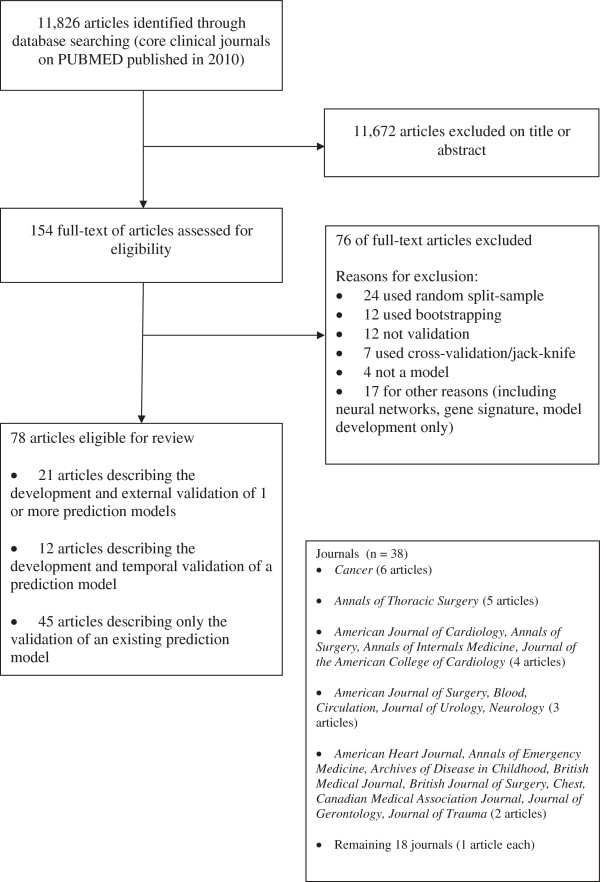
BACKGROUND: Before considering whether to use a multivariable (diagnostic or prognostic) prediction model, it is essential that its performance be evaluated in data that were not used to develop the model (referred to as external validation). We critically appraised the methodological conduct and reporting of external validation studies of multivariable prediction models. METHODS: We conducted a systematic review of articles describing some form of external validation of one or more multivariable prediction models indexed in PubMed core clinical journals published in 2010. Study data were extracted in duplicate on design, sample size, handling of missing data, reference to the original study developing the prediction models and predictive performance measures. RESULTS: 11,826 articles were identified and 78 were included for full review, which described the evaluation of 120 prediction models. in participant data that were not used to develop the model. Thirty-three articles described both the development of a prediction model and an evaluation of its performance on a separate dataset, and 45 articles described only the evaluation of an existing published prediction model on another dataset. Fifty-seven percent of the prediction models were presented and evaluated as simplified scoring systems. Sixteen percent of articles failed to report the number of outcome events in the validation datasets. Fifty-four percent of studies made no explicit mention of missing data. Sixty-seven percent did not report evaluating model calibration whilst most studies evaluated model discrimination. It was often unclear whether the reported performance measures were for the full regression model or for the simplified models. CONCLUSIONS: The vast majority of studies describing some form of external validation of a multivariable prediction model were poorly reported with key details frequently not presented. The validation studies were characterised by poor design, inappropriate handling and acknowledgement of missing data and one of the most key performance measures of prediction models i.e. calibration often omitted from the publication. It may therefore not be surprising that an overwhelming majority of developed prediction models are not used in practice, when there is a dearth of well-conducted and clearly reported (external validation) studies describing their performance on independent participant data.
Overview
The claims and statistics of this paper haven’t been checked yet.
Free: it reads the open-access text and checks the first 5 claims that cite a source we can check. Create a free account to check every claim.
Integrity signals
Registry
Cites
Statistics
Figures
Verification
Claims the paper makes
The claims and statistics of this paper haven’t been checked yet.
Free: it reads the open-access text and checks the first 5 claims that cite a source we can check. Create a free account to check every claim.
Claims other papers make about this one
Each is checked against this paper’s own text: does it say what the citing paper says it does?
The source backs part of the claim, not all of it — or backs it for a different population, condition or comparison.
In the citing paper
“For instance, validation studies rarely present information on the calibration intercept and slope, or different studies report estimates for different risk strata or time horizons.”
From A framework for meta-analysis of prediction model studies with binary and time-to-event outcomes (2019) · cites this paper as [11]
Experimental — accuracy not yet measuredThe cited source says what the claim attributes to it.
In the citing paper
“Furthermore, because validation studies are often conducted using small and local data sets,11 they rarely provide evidence about a model’s potential generalizability across different settings and populations.”
From A framework for meta-analysis of prediction model studies with binary and time-to-event outcomes (2019) · cites this paper as [11]
The cited source says what the claim attributes to it.
In the citing paper
“Unfortunately, extraction of calibration measures is often hampered by poor assessment and reporting.11,16”
From A framework for meta-analysis of prediction model studies with binary and time-to-event outcomes (2019) · cites this paper as [11]
The cited source says what the claim attributes to it.
In the citing paper
“Despite the significant potential demonstrated by extant studies in the application of machine learning for multidimensional data processing and risk prediction, the lack of external validation using completely independent datasets remains a major methodological issue in risk prediction model research (64, 65).”
From Machine learning-based risk predictive models for diabetic kidney disease in type 2 diabetes mellitus patients: a systematic review and meta-analysis (2025) · cites this paper as [64]
In the citing paper
“In a meta-analysis without access to individual participant data (IPD), we are reliant on extracting these performance measures from study publications. However, they are often poorly reported.”
From A framework for meta-analysis of prediction model studies with binary and time-to-event outcomes (2019) · cites this paper as [11]
Self-check
Percentages, sums and reported differences re-computed from the paper’s own numbers.
The self-check needs the paper’s full text.
Citations
Cites
Multiple imputation using chained equations: Issues and guidance for practice
White, I. R., Royston, P., & Wood, A. M. (2011) · Statistics in Medicine · doi:10.1002/sim.4067 · Cited by 9,792 · cited 1×
“If those with missing values were retained in the analyses, then it is important for the reader to know how they were handled in the analysis, including whether methods such as multiple imputation were used [31].”
MethodEuropean Guidelines on cardiovascular disease prevention in clinical practice (version 2012)
Authors/Task Force Members:, Perk, J., De Backer, G., Gohlke, H., Graham, I., Reiner, Ž., Verschuren, M., Albus, C., Benlian, P., Boysen, G., et al. (2012) · European Heart Journal · doi:10.1093/eurheartj/ehs092 · Cited by 8,490
Sterne, J. A. C., White, I. R., Carlin, J. B., Spratt, M., Royston, P., Kenward, M. G., Wood, A. M., & Carpenter, J. R. (2009) · BMJ · doi:10.1136/bmj.b2393 · Cited by 7,299 · cited 1×
“The majority (64%) of studies were assumed to have conducted complete-case analyses to handle missing values, despite methodological guidance to do the contrary [40-44].”
BackgroundDecision curve analysis: a novel method for evaluating prediction models
Vickers, A. J., & Elkin, E. B. (2006) · Medical Decision Making · doi:10.1177/0272989x06295361 · Cited by 6,341 · cited 2×
“New methods based on decision curve analysis (net benefit) [50] and relative utility [51] have recently been introduced.”
MethodAssessing the Performance of Prediction Models: A Framework for Traditional and Novel Measures
Steyerberg, E. W., Vickers, A. J., Cook, N. R., Gerds, T., Gonen, M., Obuchowski, N., Pencina, M. J., & Kattan, M. W. (2010) · Epidemiology · doi:10.1097/ede.0b013e3181c30fb2 · Cited by 5,170 · cited 3×
“Performance is typically characterised by evaluating a model’s calibration and discrimination [15].”
BackgroundClinician’s Guide to Prevention and Treatment of Osteoporosis
Cosman, F., de Beur, S. J., LeBoff, M. S., Lewiecki, E. M., Tanner, B., Randall, S., & Lindsay, R. (2014) · Osteoporosis International · doi:10.1007/s00198-014-2794-2 · Cited by 4,149
Authors/Task Force Members, Graham, I., Atar, D., Borch-Johnsen, K., Boysen, G., Burell, G., Cifkova, R., Dallongeville, J., De Backer, G., Ebrahim, S., et al. (2007) · European Heart Journal · doi:10.1093/eurheartj/ehm316 · Cited by 3,753
Clinical Prediction Models: A Practical Approach to Development, Validation, and Updating
Steyerberg, E. W. (2019) · Statistics for Biology and Health · doi:10.1007/978-3-030-16399-0 · Cited by 3,281
Internal validation of predictive models
Steyerberg, E. W., Harrell, F. E., Borsboom, G. J. J. M., Eijkemans, M. J. C., Vergouwe, Y., & Habbema, J. D. F. (2001) · Journal of Clinical Epidemiology · doi:10.1016/s0895-4356(01)00341-9 · Cited by 2,746
Avoidable waste in the production and reporting of research evidence
Chalmers, I., & Glasziou, P. (2009) · The Lancet · doi:10.1016/s0140-6736(09)60329-9 · Cited by 2,208
Cited by
Moons, K. G. M., Altman, D. G., Reitsma, J. B., Ioannidis, J. P. A., Macaskill, P., Steyerberg, E. W., Vickers, A. J., Ransohoff, D. F., & Collins, G. S. (2015) · Annals of Internal Medicine · doi:10.7326/m14-0698 · Cited by 5,147
Self-citationCollins, G. S., Moons, K. G. M., Dhiman, P., Riley, R. D., Beam, A. L., Van Calster, B., Ghassemi, M., Liu, X., Reitsma, J. B., van Smeden, M., et al. (2024) · BMJ · doi:10.1136/bmj-2023-078378 · Cited by 4,718
Self-citationCollins, G. S., Reitsma, J. B., Altman, D. G., & Moons, K. G. M. (2015) · BMJ · doi:10.1136/bmj.g7594 · Cited by 4,388
“Several reviews have evaluated the quality of published reports that describe the development or validation prediction models [23-28].”
Self-citationCollins, G. S., Reitsma, J. B., Altman, D. G., & Moons, K. G. M. (2015) · British Journal of Cancer · doi:10.1038/bjc.2014.639 · Cited by 3,293
“…have showed that the quality of reporting in published articles describing the development or validation of multivariable prediction models in medicine is poor (Laupacis et al, 1997; Ettema et al, 2010; Mallett et al, 2010; Collins et al, 2011; Bouwmeester et al, 2012; Collins et al, 2013, 2014).”
InfluentialSelf-citationCollins, G. S., Reitsma, J. B., Altman, D. G., & Moons, K. G. M. (2015) · Annals of Internal Medicine · doi:10.7326/m14-0697 · Cited by 3,267
Self-citationCalibration: the Achilles heel of predictive analytics
On behalf of Topic Group ‘Evaluating diagnostic tests and prediction models’ of the STRATOS initiative, Van Calster, B., McLernon, D. J., van Smeden, M., Wynants, L., & Steyerberg, E. W. (2019) · BMC Medicine · doi:10.1186/s12916-019-1466-7 · Cited by 2,650
“Systematic reviews have found that calibration is assessed far less often than discrimination [2, 3, 5 – 7], which is problematic since poor calibration can make predictions misleading [8].”
BackgroundTowards better clinical prediction models: seven steps for development and an ABCD for validation
Steyerberg, E. W., & Vergouwe, Y. (2014) · European Heart Journal · doi:10.1093/eurheartj/ehu207 · Cited by 1,928
“Whatever the method used to develop a model, one could argue that validity is all that matters.(7) We propose four key measures in the assessment of the validation of prediction models, related to calibration, discrimination, and clinical usefulness.”
MethodCollins, G. S., Reitsma, J. B., Altman, D. G., & Moons, K. (2015) · BMC Medicine · doi:10.1186/s12916-014-0241-z · Cited by 1,927
“Several reviews have evaluated the quality of published reports that describe the development or validation prediction models [23-28].”
Self-citationMoons, K. G. M., Wolff, R. F., Riley, R. D., Whiting, P. F., Westwood, M., Collins, G. S., Reitsma, J. B., Kleijnen, J., & Mallett, S. (2019) · Annals of Internal Medicine · doi:10.7326/m18-1377 · Cited by 1,669
Self-citationA calibration hierarchy for risk models was defined: from utopia to empirical data
Van Calster, B., Nieboer, D., Vergouwe, Y., De Cock, B., Pencina, M. J., & Steyerberg, E. W. (2016) · Journal of Clinical Epidemiology · doi:10.1016/j.jclinepi.2015.12.005 · Cited by 910
Collins, G. S., Reitsma, J. B., Altman, D. G., & Moons, K. G. M. (2015) · British Journal of Surgery · doi:10.1002/bjs.9736 · Cited by 889
Self-citationExternal validation of prognostic models: what, why, how, when and where?
Ramspek, C. L., Jager, K. J., Dekker, F. W., Zoccali, C., & van Diepen, M. (2021) · Clinical Kidney Journal · doi:10.1093/ckj/sfaa188 · Cited by 887
Collins, G. S., Dhiman, P., Andaur Navarro, C. L., Ma, J., Hooft, L., Reitsma, J. B., Logullo, P., Beam, A. L., Peng, L., Van Calster, B., et al. (2021) · BMJ Open · doi:10.1136/bmjopen-2020-048008 · Cited by 852
Self-citationEvaluation of clinical prediction models (part 1): from development to external validation
Collins, G. S., Dhiman, P., Ma, J., Schlussel, M. M., Archer, L., Van Calster, B., Harrell, F. E., Martin, G. P., Moons, K. G. M., van Smeden, M., et al. (2024) · BMJ · doi:10.1136/bmj-2023-074819 · Cited by 798
“52 Supplementary figure 2 and supplementary table 2 demonstrates the impact of sample size in model development on performance at external validation.”
BackgroundSelf-citationCollins, G. S., Reitsma, J. B., Altman, D. G., & Moons, K. G. M. (2015) · Circulation · doi:10.1161/circulationaha.114.014508 · Cited by 793
Self-citationA guide to systematic review and meta-analysis of prognostic factor studies
Riley, R. D., Moons, K. G. M., Snell, K. I. E., Ensor, J., Hooft, L., Altman, D. G., Hayden, J., Collins, G. S., & Debray, T. P. A. (2019) · BMJ · doi:10.1136/bmj.k4597 · Cited by 742
Self-citationReporting of artificial intelligence prediction models
Collins, G. S., & Moons, K. G. M. (2019) · The Lancet · doi:10.1016/s0140-6736(19)30037-6 · Cited by 701
Self-citationCollins, G. S., Ogundimu, E. O., & Altman, D. G. (2016) · Statistics in Medicine · doi:10.1002/sim.6787 · Cited by 665
“Despite the clear importance of external validation, the design requirements for studies that attempt to evaluate the performance of multivariable prognostic models in new data have been little explored [7,12,13].”
BackgroundSelf-citationA guide to systematic review and meta-analysis of prediction model performance
Debray, T. P. A., Damen, J. A. A. G., Snell, K. I. E., Ensor, J., Hooft, L., Reitsma, J. B., Riley, R. D., & Moons, K. G. M. (2017) · BMJ · doi:10.1136/bmj.i6460 · Cited by 657
“Potential reasons for this pitfall are concerns about the quality of included studies, unavailability of relevant summary statistics due to incomplete reporting, 18 or simply a lack of methodological guidance.”
BackgroundSelf-citationDebray, T. P. A., Vergouwe, Y., Koffijberg, H., Nieboer, D., Steyerberg, E. W., & Moons, K. G. M. (2015) · Journal of Clinical Epidemiology · doi:10.1016/j.jclinepi.2014.06.018 · Cited by 597
“Similar guidelines on reporting are currently being developed for studies developing or validating risk prediction models [43,50].”
Self-citationRiley, R. D., Ensor, J., Snell, K. I. E., Debray, T. P. A., Altman, D. G., Moons, K. G. M., & Collins, G. S. (2016) · BMJ · doi:10.1136/bmj.i3140 · Cited by 585
“39 Although model discrimination was usually reported, 68% of studies did not report evaluating model calibration, and only 11 (14”
BackgroundSelf-citationVollmer, S., Mateen, B. A., Bohner, G., Király, F. J., Ghani, R., Jonsson, P., Cumbers, S., Jonas, A., McAllister, K. S. L., Myles, P., et al. (2020) · BMJ · doi:10.1136/bmj.l6927 · Cited by 497
“60 In external validation studies, reductions in the predictive accuracy of models (relative to their original performance in development studies) is expected.”
BackgroundSelf-citationDeveloping clinical prediction models: a step-by-step guide
Efthimiou, O., Seo, M., Chalkou, K., Debray, T., Egger, M., & Salanti, G. (2024) · BMJ · doi:10.1136/bmj-2023-078276 · Cited by 544
“This procedure (temporal validation) 35 89 might inform us about possible time trends in model performance.”
Collins, G. S., Reitsma, J. B., Altman, D. G., & Moons, K. G. M. (2015) · European Urology · doi:10.1016/j.eururo.2014.11.025 · Cited by 439
Self-citationAndaur Navarro, C. L., Damen, J. A. A., Takada, T., Nijman, S. W. J., Dhiman, P., Ma, J., Collins, G. S., Bajpai, R., Riley, R. D., Moons, K. G. M., et al. (2021) · BMJ · doi:10.1136/bmj.n2281 · Cited by 415
“…several publications have raised concern about the methodological quality of prediction models developed with conventional statistical techniques, 6 17 18 a formal methodological and risk of bias assessment of supervised machine learning based prediction model studies across all medical…”
BackgroundSelf-citationMinimum sample size for external validation of a clinical prediction model with a binary outcome
Riley, R. D., Debray, T. P. A., Collins, G. S., Archer, L., Ensor, J., van Smeden, M., & Snell, K. I. E. (2021) · Statistics in Medicine · doi:10.1002/sim.9025 · Cited by 400
“Applying their approach to Equation (2), I can be expressed as,”
BackgroundMethodInfluentialSelf-citationThe Role of Artificial Intelligence in Early Cancer Diagnosis
Hunter, B., Hindocha, S., & Lee, R. W. (2022) · Cancers · doi:10.3390/cancers14061524 · Cited by 332
Prognostic Effect of Tumor Lymphocytic Infiltration in Resectable Non–Small-Cell Lung Cancer
Brambilla, E., Le Teuff, G., Marguet, S., Lantuejoul, S., Dunant, A., Graziano, S., Pirker, R., Douillard, J.-Y., Le Chevalier, T., Filipits, M., et al. (2016) · Journal of Clinical Oncology · doi:10.1200/jco.2015.63.0970 · Cited by 349
Collins, G. S., Reitsma, J. B., Altman, D. G., & Moons, K. G. M. (2015) · Journal of Clinical Epidemiology · doi:10.1016/j.jclinepi.2014.11.010 · Cited by 324
“Several reviews have evaluated the quality of published reports that describe the development or validation prediction models [23–28].”
Self-citationCalibration drift in regression and machine learning models for acute kidney injury
Davis, S. E., Lasko, T. A., Chen, G., Siew, E. D., & Matheny, M. E. (2017) · Journal of the American Medical Informatics Association · doi:10.1093/jamia/ocx030 · Cited by 312
Cabitza, F., Campagner, A., Soares, F., García de Guadiana-Romualdo, L., Challa, F., Sulejmani, A., Seghezzi, M., & Carobene, A. (2021) · Computer Methods and Programs in Biomedicine · doi:10.1016/j.cmpb.2021.106288 · Cited by 284
“The external validation of a medical machine learning model is very important for a number of reasons [19, 59].”
BackgroundA framework for meta-analysis of prediction model studies with binary and time-to-event outcomes
Debray, T. P., Damen, J. A., Riley, R. D., Snell, K., Reitsma, J. B., Hooft, L., Collins, G. S., & Moons, K. G. (2019) · Statistical Methods in Medical Research · doi:10.1177/0962280218785504 · Cited by 278
“However, they are often poorly reported.(11,16) We now discuss how to retrieve the necessary but not explicitly reported predictive performance estimates from the primary prediction model (validation) studies using other reported data.”
BackgroundSelf-citationOn the overestimation of random forest’s out-of-bag error
Janitza, S., & Hornung, R. (2018) · PLOS ONE · doi:10.1371/journal.pone.0201904 · Cited by 278
Cowley, L. E., Farewell, D. M., Maguire, S., & Kemp, A. M. (2019) · Diagnostic and Prognostic Research · doi:10.1186/s41512-019-0060-y · Cited by 263
Binuya, M. A. E., Engelhardt, E. G., Schats, W., Schmidt, M. K., & Steyerberg, E. W. (2022) · BMC Medical Research Methodology · doi:10.1186/s12874-022-01801-8 · Cited by 246
Fundamentals of Clinical Data Science
(2019) · Springer eBooks · doi:10.1007/978-3-319-99713-1 · Cited by 235
Topical drug delivery: History, percutaneous absorption, and product development
Roberts, M. S., Cheruvu, H. S., Mangion, S. E., Alinaghi, A., Benson, H. A. E., Mohammed, Y., Holmes, A., van der Hoek, J., Pastore, M., & Grice, J. E. (2021) · Advanced Drug Delivery Reviews · doi:10.1016/j.addr.2021.113929 · Cited by 219
Prognostic models for breast cancer: a systematic review
Phung, M. T., Tin Tin, S., & Elwood, J. M. (2019) · BMC Cancer · doi:10.1186/s12885-019-5442-6 · Cited by 209
Riley, R. D., Snell, K. I. E., Archer, L., Ensor, J., Debray, T. P. A., van Calster, B., van Smeden, M., & Collins, G. S. (2024) · BMJ · doi:10.1136/bmj-2023-074821 · Cited by 189
“Calibration is often neglected in validation studies, 5 24 despite it being widely recommended, for instance as an item in the TRIPOD (Transparent Reporting of a multivariable prediction model for Individual Prognosis or Diagnosis) reporting guideline.”
BackgroundReps, J. M., Schuemie, M. J., Suchard, M. A., Ryan, P. B., & Rijnbeek, P. R. (2018) · Journal of the American Medical Informatics Association · doi:10.1093/jamia/ocy032 · Cited by 205
“Many published efforts in patient-level-prediction do not follow the model development guidelines, 1,2 fail to perform extensive external validation, 3,4 or provide insufficient model details 5 that limits the ability of independent researchers to reproduce the models and perform external…”
BackgroundWang, W., Kiik, M., Peek, N., Curcin, V., Marshall, I. J., Rudd, A. G., Wang, Y., Douiri, A., Wolfe, C. D., & Bray, B. (2020) · PLOS ONE · doi:10.1371/journal.pone.0234722 · Cited by 195
“External validation is an invaluable part of implementing the model in routine clinical practice–it assesses the transportability of the predictions to new data (and hence the generalisability of the model) and should be undertaken before clinical use [21,38].”
Minimum sample size for external validation of a clinical prediction model with a continuous outcome
Archer, L., Snell, K. I. E., Ensor, J., Hudda, M. T., Collins, G. S., & Riley, R. D. (2021) · Statistics in Medicine · doi:10.1002/sim.8766 · Cited by 198
Prognostic models in obstetrics: available, but far from applicable
Kleinrouweler, C. E., Cheong-See, F. M., Collins, G. S., Kwee, A., Thangaratinam, S., Khan, K. S., Mol, B. W. J., Pajkrt, E., Moons, K. G. M., & Schuit, E. (2016) · American Journal of Obstetrics and Gynecology · doi:10.1016/j.ajog.2015.06.013 · Cited by 193
Self-citationMachine learning in precision diabetes care and cardiovascular risk prediction
Oikonomou, E. K., & Khera, R. (2023) · Cardiovascular Diabetology · doi:10.1186/s12933-023-01985-3 · Cited by 190
“This followed multiple reports, including systematic reviews of risk prediction models in type 2 diabetes, that showed widespread use of poor methods and reporting [122, 123] contributing to “avoidable waste” in research evidence [124].”
BackgroundCollins, G. S., Ogundimu, E. O., Cook, J. A., Manach, Y. L., & Altman, D. G. (2016) · Statistics in Medicine · doi:10.1002/sim.6986 · Cited by 185
Self-citationCode-free deep learning for multi-modality medical image classification
Korot, E., Guan, Z., Ferraz, D., Wagner, S. K., Zhang, G., Liu, X., Faes, L., Pontikos, N., Finlayson, S. G., Khalid, H., et al. (2021) · Nature Machine Intelligence · doi:10.1038/s42256-021-00305-2 · Cited by 171
Poor performance of clinical prediction models: the harm of commonly applied methods
Steyerberg, E. W., Uno, H., Ioannidis, J. P. A., van Calster, B., Ukaegbu, C., Dhingra, T., Syngal, S., & Kastrinos, F. (2018) · Journal of Clinical Epidemiology · doi:10.1016/j.jclinepi.2017.11.013 · Cited by 168
In silico polypharmacology of natural products
Fang, J., Liu, C., Wang, Q., Lin, P., & Cheng, F. (2017) · Briefings in Bioinformatics · doi:10.1093/bib/bbx045 · Cited by 199
A Clinician's Guide to Artificial Intelligence: How to Critically Appraise Machine Learning Studies
Faes, L., Liu, X., Wagner, S. K., Fu, D. J., Balaskas, K., Sim, D. A., Bachmann, L. M., Keane, P. A., & Denniston, A. K. (2020) · Translational Vision Science & Technology · doi:10.1167/tvst.9.2.7 · Cited by 162
Han, K., Song, K., & Choi, B. W. (2016) · Korean Journal of Radiology · doi:10.3348/kjr.2016.17.3.339 · Cited by 162
“Simulation studies suggested that a minimum of 100 events and/or 100 non-events is required for external validation of the prediction model (36, 37), and a systematic review found that small external validation studies are unreliable and inaccurate (38).”
Backgroundvan Loon, F. H. J., van Hooff, L. W. E., de Boer, H. D., Koopman, S. S. H. A., Buise, M. P., Korsten, H. H. M., Dierick-van Daele, A. T. M., & Bouwman, A. R. A. (2019) · Journal of Clinical Medicine · doi:10.3390/jcm8020144 · Cited by 157
Validation in prediction research: the waste by data splitting
Steyerberg, E. W. (2018) · Journal of Clinical Epidemiology · doi:10.1016/j.jclinepi.2018.07.010 · Cited by 156
Evidence of questionable research practices in clinical prediction models
White, N. M., Parsons, R., Collins, G. S., & Barnett, A. G. (2023) · BMC Medicine · doi:10.1186/s12916-023-03048-6 · Cited by 192
Predicting sex from retinal fundus photographs using automated deep learning
Korot, E., Pontikos, N., Liu, X., Wagner, S. K., Faes, L., Huemer, J. C., Balaskas, K., Denniston, A. K., Khawaja, A. P., & Keane, P. A. (2021) · Scientific Reports · doi:10.1038/s41598-021-89743-x · Cited by 162
“Performance of our model was slightly worse with external validation on the Moorfields dataset, which is typical when deep learning models are evaluated with datasets dissimilar from their training data distribution 32,33 .”
MethodHeus, P., Damen, J. A. A. G., Pajouheshnia, R., Scholten, R. J. P. M., Reitsma, J. B., Collins, G. S., Altman, D. G., Moons, K. G. M., & Hooft, L. (2018) · BMC Medicine · doi:10.1186/s12916-018-1099-2 · Cited by 147
Self-citationAlyass, A., Almgren, P., Åkerlund, M., Dushoff, J. G., Isomaa, B., Nilsson, P. M., Tuomilehto, J., Lyssenko, V., Groop, L., & Meyre, D. (2014) · Diabetologia · doi:10.1007/s00125-014-3390-x · Cited by 157
Collins, G. S., Reitsma, J. B., Altman, D. G., & Moons, K. G. M. (2015) · BJOG An International Journal of Obstetrics & Gynaecology · doi:10.1111/1471-0528.13244 · Cited by 207
Self-citationSigcha, L., Borzì, L., Amato, F., Rechichi, I., Ramos-Romero, C. A., Cardenas, A. J. A., Gascó, L., & Olmo, G. (2023) · Expert Systems with Applications · doi:10.1016/j.eswa.2023.120541 · Cited by 172
“Finally, different datasets can be used as external validation test sets (Borzì, Sigcha, Rodríguez-Martín, & Olmo, 2023; Collins et al., 2014), which are useful for verifying the generalizability of the developed model.”
MethodScanlon, P. H., Aldington, S. J., Leal, J., Luengo-Fernandez, R., Oke, J., Sivaprasad, S., Gazis, A., & Stratton, I. M. (2015) · Health Technology Assessment · doi:10.3310/hta19740 · Cited by 136
Andaur Navarro, C. L., Damen, J. A. A., Takada, T., Nijman, S. W. J., Dhiman, P., Ma, J., Collins, G. S., Bajpai, R., Riley, R. D., Moons, K. G. M., et al. (2022) · BMC Medical Research Methodology · doi:10.1186/s12874-021-01469-6 · Cited by 126
“Previous systematic reviews have shown poor reporting of regression-based prediction model studies [7, 8, 10, 11].”
BackgroundSelf-citationvan de Sande, D., Van Genderen, M. E., Smit, J. M., Huiskens, J., Visser, J. J., Veen, R. E. R., van Unen, E., BA, O. H., Gommers, D., & Bommel, J. V. (2022) · BMJ Health & Care Informatics · doi:10.1136/bmjhci-2021-100495 · Cited by 135
Snell, K. I. E., Archer, L., Ensor, J., Bonnett, L. J., Debray, T. P. A., Phillips, B., Collins, G. S., & Riley, R. D. (2021) · Journal of Clinical Epidemiology · doi:10.1016/j.jclinepi.2021.02.011 · Cited by 119
“Calibration and clinical utility, in particular, are often underappreciated [24-26].”
BackgroundThe impact of inconsistent human annotations on AI driven clinical decision making
Sylolypavan, A., Sleeman, D. H., Wu, H., & Sim, M. R. (2023) · npj Digital Medicine · doi:10.1038/s41746-023-00773-3 · Cited by 182
“Patient population compatibility Systematic reviews on model validation studies have shown a lack of well-conducted and clearly reported external validation studies 55,56 .”
BackgroundPredicting breast cancer 5-year survival using machine learning: A systematic review
Li, J., Zhou, Z., Dong, J., Fu, Y., Li, Y., Luan, Z., & Peng, X. (2021) · PLoS ONE · doi:10.1371/journal.pone.0250370 · Cited by 141
“In this study, most of the included studies used cross-validation and random splitting for internal validation, which makes it difficult to avoid over-fitting, thus limiting the accuracy of the validation results [64].”
ResultReporting and Implementing Interventions Involving Machine Learning and Artificial Intelligence
Bates, D. W., Auerbach, A., Schulam, P., Wright, A., & Saria, S. (2020) · Annals of Internal Medicine · doi:10.7326/m19-0872 · Cited by 114
“One evaluation of how validation was done (23) found many issues: 16% of articles did not include the number of outcomes in the validation set, 54% did not mention the frequency of missing data, and 67% did not report model calibration.”
BackgroundAndaur Navarro, C. L., Damen, J. A. A., van Smeden, M., Takada, T., Nijman, S. W. J., Dhiman, P., Ma, J., Collins, G. S., Bajpai, R., Riley, R. D., et al. (2023) · Journal of Clinical Epidemiology · doi:10.1016/j.jclinepi.2022.11.015 · Cited by 121
Self-citationLongitudinal assessment of excessive daytime sleepiness in early Parkinson’s disease
Amara, A. W., Chahine, L. M., Caspell‐Garcia, C., Long, J. D., Coffey, C. S., Högl, B., Videnović, A., Iranzo, Á., Mayer, G., Foldvary‐Schaefer, N., et al. (2017) · Journal of Neurology Neurosurgery & Psychiatry · doi:10.1136/jnnp-2016-315023 · Cited by 125
Weng, S. F., Vaz, L., Qureshi, N., & Kai, J. (2019) · PLOS ONE · doi:10.1371/journal.pone.0214365 · Cited by 118
Riley, R. D., Collins, G. S., Ensor, J., Archer, L., Booth, S., Mozumder, S. I., Rutherford, M. J., van Smeden, M., Lambert, P. C., & Snell, K. I. E. (2022) · Statistics in Medicine · doi:10.1002/sim.9275 · Cited by 109
Sharma, V., Ali, I., van der Veer, S. N., Martin, G. P., Ainsworth, J. D., & Augustine, T. (2021) · BMJ Health & Care Informatics · doi:10.1136/bmjhci-2020-100253 · Cited by 131
Validation of Risk Assessment Models of Venous Thromboembolism in Hospitalized Medical Patients
Greene, M. T., Spyropoulos, A. C., Chopra, V., Grant, P., Kaatz, S., Bernstein, S. J., & Flanders, S. A. (2016) · The American Journal of Medicine · doi:10.1016/j.amjmed.2016.03.031 · Cited by 116
Choudhury, P. P., Hurson, A. N., Brook, M. N., Zhang, Y., Ahearn, T. U., Orr, N., Coulson, P., Schoemaker, M. J., Jones, M. E., Gail, M. H., et al. (2019) · JNCI Journal of the National Cancer Institute · doi:10.1093/jnci/djz113 · Cited by 110
An introduction to machine learning for classification and prediction
Black, J. E., Kueper, J. K., & Williamson, T. S. (2022) · Family Practice · doi:10.1093/fampra/cmac104 · Cited by 125
Key steps and common pitfalls in developing and validating risk models
Wynants, L., Collins, G. S., & CALSTER, B. V. (2016) · BJOG An International Journal of Obstetrics & Gynaecology · doi:10.1111/1471-0528.14170 · Cited by 106
Tackling COVID-19 through Responsible AI Innovation: Five Steps in the Right Direction
Leslie, D. (2020) · Harvard Data Science Review · doi:10.1162/99608f92.4bb9d7a7 · Cited by 94
Importance of sample size on the quality and utility of AI-based prediction models for healthcare
Riley, R. D., Ensor, J., Snell, K. I. E., Archer, L., Whittle, R., Dhiman, P., Alderman, J. E., Liu, X., Kirton, L., Manson-Whitton, J., et al. (2025) · The Lancet Digital Health · doi:10.1016/j.landig.2025.01.013 · Cited by 162
Self-citationLi, J., Tian, Y., Zhu, Y., Zhou, T., Li, J., Ding, K., & Li, J. (2020) · Artificial Intelligence in Medicine · doi:10.1016/j.artmed.2020.101814 · Cited by 98
TRIPOD statement: a preliminary pre-post analysis of reporting and methods of prediction models
Najafabadi, A. H. Z., Ramspek, C. L., Dekker, F. W., Heus, P., Hooft, L., Moons, K. G. M., Peul, W. C., Collins, G. S., Steyerberg, E. W., & van Diepen, M. (2020) · BMJ Open · doi:10.1136/bmjopen-2020-041537 · Cited by 101
Self-citationVernooij, L. M., van Klei, W. A., Moons, K. G. M., Takada, T., van Waes, J. A. R., & Damen, J. A. (2021) · Cochrane Database of Systematic Reviews · doi:10.1002/14651858.cd013139.pub2 · Cited by 113
Self-citationRahman, M. S., Ambler, G., Choodari‐Oskooei, B., & Omar, R. (2017) · BMC Medical Research Methodology · doi:10.1186/s12874-017-0336-2 · Cited by 122
“Prediction models for survival outcomes are commonly developed using the Cox proportional hazards model and hence this model was used in the simulations [5, 21].”
BackgroundMethodInfluentialZhang, G., Fu, D. J., Liefers, B. J., Faes, L., Glinton, S. L., Wagner, S. K., Struyven, R., Pontikos, N., Keane, P. A., & Balaskas, K. (2021) · The Lancet Digital Health · doi:10.1016/s2589-7500(21)00134-5 · Cited by 95
Bullock, G. S., Mylott, J. A., Hughes, T., Nicholson, K. F., Riley, R. D., & Collins, G. S. (2022) · Sports Medicine · doi:10.1007/s40279-022-01698-9 · Cited by 113
“Independent and exter‐ nally validated prediction models are crucial to evaluating model usefulness [79], and also reducing research waste [25].”
Comparison of classification methods in breath analysis by electronic nose
Leopold, J. H., Bos, L. D. J., Sterk, P. J., Schultz, M. J., Fens, N., Horváth, I., Bikov, A., Montuschi, P., Natale, C. D., Yates, D. H., et al. (2015) · Journal of Breath Research · doi:10.1088/1752-7155/9/4/046002 · Cited by 99
“Overfitting refers to the phenomenon when the model becomes so complex as to describe the idiosyncrasies of training data, reflecting noise, instead of the true underlying relationships in the data [11, 12].”
BackgroundExplanatory Versus Predictive Modeling
Sainani, K. L. (2014) · PM&R · doi:10.1016/j.pmrj.2014.08.941 · Cited by 85
“Unfortunately, many predictive modelers fail to report any metrics beyond discrimination [6].”
BackgroundPrediction of Bladder Outcomes after Traumatic Spinal Cord Injury: A Longitudinal Cohort Study
Pavese, C., Schneider, M. P., Schubert, M. J. W., Curt, A. E. P., Scivoletto, G., Agrò, E. F., Mehnert, U., Maier, D. D., Abel, R. F., Röhrich, F., et al. (2016) · PLoS Medicine · doi:10.1371/journal.pmed.1002041 · Cited by 90
“The excellent predictive power of our models was confirmed by external validation, thereby further extending and strengthening their validity [30].”
MethodAndaur Navarro, C. L., Damen, J. A. A. G., Takada, T., Nijman, S. W. J., Dhiman, P., Ma, J., Collins, G. S., Bajpai, R., Riley, R. D., Moons, K. G., et al. (2020) · BMJ Open · doi:10.1136/bmjopen-2020-038832 · Cited by 83
Self-citationGerry, S., Birks, J., Bonnici, T., Watkinson, P., Kirtley, S., & Collins, G. S. (2017) · BMJ Open · doi:10.1136/bmjopen-2017-019268 · Cited by 93
Personalising lung cancer screening: An overview of risk‐stratification opportunities and challenges
ten Haaf, K., van der Aalst, C. M., de Koning, H. J., Kaaks, R., & Tammemägi, M. C. (2021) · International Journal of Cancer · doi:10.1002/ijc.33578 · Cited by 86
External validation of a time-lapse prediction model
Fréour, T., Fleuter, N. L., Lammers, J., Splingart, C., Reignier, A., & Barrière, P. (2015) · Fertility and Sterility · doi:10.1016/j.fertnstert.2014.12.111 · Cited by 80
“, external validation) (15), the implementation of most of these nonvalidated embryo-ranking models in clinical routine practice should be questioned.”
BackgroundVuong, K., Armstrong, B. K., Weiderpass, E., Lund, E., Adami, H., Veierød, M. B., Barrett, J. H., Davies, J. R., Bishop, D. T., Whiteman, D. C., et al. (2016) · JAMA Dermatology · doi:10.1001/jamadermatol.2016.0939 · Cited by 89
Yang, C. B., Kors, J. A., Ioannou, S., John, L. H., Markus, A. F., Rekkas, A., de Ridder, M. A. J., Seinen, T. M., Williams, R. D., & Rijnbeek, P. R. (2022) · Journal of the American Medical Informatics Association · doi:10.1093/jamia/ocac002 · Cited by 91
“Previous systematic reviews on the development and validation of clinical prediction models covered different periods prior to 2015.(1,5,6) They all highlighted a number of improvements to allow for better interpretation of the presented results by other investigators: how missing data were handled should always expli…”
BackgroundMethodGroot, O. Q., Bindels, B. J. J., Ogink, P. T., Kapoor, N. D., Twining, P. K., Collins, A. K., Bongers, M. E. R., Lans, A., Oosterhoff, J. H. F., Karhade, A. V., et al. (2021) · Acta Orthopaedica · doi:10.1080/17453674.2021.1910448 · Cited by 82
“…on independent datasets addresses the aforementioned concerns of internal validation, including: the generalizability of the model in different patient populations, shortcomings in statistical modelling (e.g., incorrect handling of missing data), and model overfitting (Collins et al. 2014, 2015).”
BackgroundResultSnell, K. I. E., Hua, H., Debray, T. P. A., Ensor, J., Look, M. P., Moons, K. G. M., & Riley, R. D. (2016) · Journal of Clinical Epidemiology · doi:10.1016/j.jclinepi.2015.05.009 · Cited by 75
“Calibration is often ignored in external validation research [19], although it is fundamental that observed and predicted risks should closely agree.”
BackgroundMethodSelf-citationA Systematic Review of Studies Comparing Diagnostic Clinical Prediction Rules with Clinical Judgment
Sanders, S., Doust, J. A., & Glasziou, P. (2015) · PLoS ONE · doi:10.1371/journal.pone.0128233 · Cited by 82
“Though detailed guidance on the validation and evaluation of prediction models and rules is available [46, 47], guidance on issues specific to studies comparing the diagnostic performance of CPRs and clinical judgment may improve this situation.”
BackgroundRhon, D. I., Molloy, J. M., Monnier, A., Hando, B., & Newman, P. (2021) · European Journal of Sport Science · doi:10.1080/17461391.2021.1931464 · Cited by 81
“These errors can highly bias results of prediction models and make them irrelevant for practical use (Chowdhury & Turin, 2020; Collins et al., 2014; Royston, Altman, & Sauerbrei, 2006; Steyerberg, Uno, Ioannidis, & van Calster, 2018; Sun, Shook, & Kay, 1996).”
BackgroundPredicting relapse or recurrence of depression: systematic review of prognostic models
Moriarty, A. S., Meader, N., Snell, K. I. E., Riley, R. D., Paton, L. W., Dawson, S., Hendon, J., Chew-Graham, C. A., Gilbody, S., Churchill, R., et al. (2022) · The British Journal of Psychiatry · doi:10.1192/bjp.2021.218 · Cited by 71
Mikolić, A., Polinder, S., Steyerberg, E. W., Retel Helmrich, I. R. A., Giacino, J. T., Maas, A. I. R., van der Naalt, J., Voormolen, D. C., von Steinbüchel, N., Wilson, L., et al. (2020) · Journal of Neurotrauma · doi:10.1089/neu.2020.7074 · Cited by 68
Andaur Navarro, C. L., Damen, J. A. A., Takada, T., Nijman, S. W. J., Dhiman, P., Ma, J., Collins, G. S., Bajpai, R., Riley, R. D., Moons, K. G. M., et al. (2023) · Journal of Clinical Epidemiology · doi:10.1016/j.jclinepi.2023.03.024 · Cited by 65
Self-citationLezcano, J. M., Salazar, F., León, L., Toledano, E., Jover, J. Á., Fernández‐Gutiérrez, B., Soudah, E., González‐Álvaro, I., Abásolo, L., & Rodríguez‐Rodríguez, L. (2017) · Scientific Reports · doi:10.1038/s41598-017-10558-w · Cited by 74
Metadata
- Authors
- Collins, G. S., de Groot, J. A., Dutton, S., Omar, O., Shanyinde, M., Tajar, A., Voysey, M., Wharton, R., Yu, L.-M., Moons, K. G., & Altman, D. G.
- Affiliations
- University of Oxford (GB)
- University Medical Center Utrecht (NL)
- ORCID
- Venue
- BMC Medical Research Methodology
- Published
- 2014-03-19
- Volume
- 14
- Issue
- 1
- Pages
- 40-40
- ISSN
- 1471-2288 (ISSN-L)
- PMC
- PMC3999945
- OpenAlex
- W2084164487
- Cited by
- 729
- References
- 70
- Citations by year
- 2026: 61 · 2025: 61 · 2024: 75 · 2023: 86 · 2022: 88 · 2021: 80 · 2020: 68 · 2019: 40 · 2018: 41 · 2017: 47 · 2016: 34 · 2015: 41 · 2014: 7
- FWCI
- 5.44
- Type
- journal article
- Language
- en
- Open access
- gold
- doi.org
- Licence
- Locations
- BMC Medical Research Methodology (publishedVersion, cc-by)
- Europe PMC (PubMed Central) (publishedVersion, cc-by)
- PubMed Central (publishedVersion, cc-by)
- PubMed (publishedVersion)
- University of Birmingham Research Portal (University of Birmingham) (submittedVersion)
- Funders
- Cancer Research UK (16895)
- National Institute for Health and Care Research (NF-SI-0508-10259)
- Nederlandse Organisatie voor Wetenschappelijk Onderzoek (91208004, 918.10.615, project 9120.8004)
- Medical Research Council (MR/K006584/1, G1100513)
- Topics
- Physical Sciences › Mathematics › Statistics and Probability › Statistical Methods in Epidemiology
- Social Sciences › Decision Sciences › Statistics, Probability and Uncertainty › Meta-analysis and systematic reviews
- Health Sciences › Health Professions › Health Information Management › Artificial Intelligence in Healthcare
- Keywords
- external validation, multivariable prediction models, reporting quality, model calibration, model discrimination, missing data, simplified scoring system, prognostic model, diagnostic model
- MeSH terms
- Data Interpretation, Statistical, Humans, Prognosis, Reproducibility of Results, Outcome Assessment, Health Care, Validation Studies as Topic
About these checks
Registry, retraction, Cites and statistics results are computed, not judged, with one exception: a printed reference that no index lists is read once by a model before it counts as a citation error. Claims are extracted by a model and kept only when their quote appears verbatim in the text; each cited source is then checked, with a model’s help, for whether it says what the claim relies on. Those verdicts can be wrong — read the claim’s quote and the cited source before relying on one.
Statistics and arithmetic are recomputed, not judged.
Confidence bands are shown only for fields calibrated on our annotated test set. None is calibrated yet, so no band is shown.
What counts as a claim ›How we measure confidence ›How we check this ›
Are you an author, or do you see a problem with this page? Request a review
Data sources
Bibliographic data: Semantic Scholar, OpenAlex, Crossref.
Contains information from the Semantic Scholar Academic Graph Datasets, made available under the ODC Attribution License (ODC-BY 1.0).
Semantic Scholar’s data is described in: Kinney, R., et al. (2023). The Semantic Scholar Open Data Platform. arXiv:2301.10140.
