

Harm avoidance is associated with progression of parkinsonism in community-dwelling older adults: a prospective cohort study
Open accessThe DOI matches its Crossref record; 48 of the 48 references it cites were found in a registry or an index.
Abstract
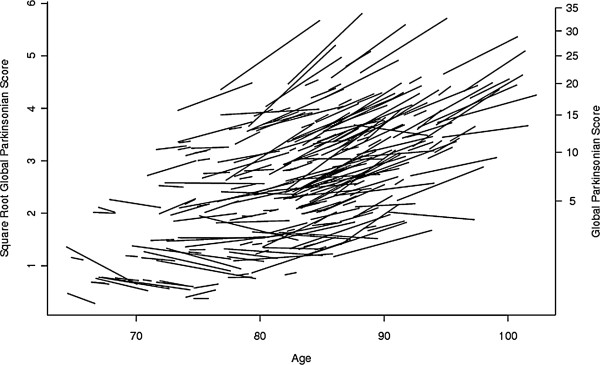
BACKGROUND: We tested the hypothesis that harm avoidance, a trait associated with behavioral inhibition, is associated with the rate of change in parkinsonism in older adults. METHODS: At baseline harm avoidance was assessed with a standard self-report instrument in 969 older people without dementia participating in the Rush Memory and Aging Project, a longitudinal community-based cohort study. Parkinsonism was assessed annually with a modified version of the motor section of the Unified Parkinson's Disease Rating Scale (mUPDRS). RESULTS: Average follow-up was 5 years. A linear mixed-effects model controlling for age, sex and education showed that for an average participant (female, 80 years old at baseline, with 14 years of education and a harm avoidance score of 10), the overall severity of parkinsonism increased by about 0.05 unit/ year (Estimate, 0.054, S.E., 0.007, p <0.001) and that the level of harm avoidance was associated with the progression of parkinsonism (Estimate, 0.004, S.E., 0.001, p <0.001). Thus, for an average participant, every 6 point (~1 SD) increase in harm avoidance score at baseline, the rate of progression of parkinsonism increased about 50% compared to an individual with an average harm avoidance score. This amount of change in parkinsonism over the course of the study was associated with about a 5% increased risk of death. The association between harm avoidance and progression of parkinsonism persisted when controlling for cognitive function, depressive symptoms, loneliness, neuroticism, late-life cognitive, social and physical activities and chronic health conditions. CONCLUSION: A higher level of the harm avoidance trait is associated with a more rapid progression of parkinsonism in older adults.
Overview
The claims and statistics of this paper haven’t been checked yet.
Free: it reads the open-access text and checks the first 5 claims that cite a source we can check. Create a free account to check every claim.
Integrity signals
Registry
Cites
Statistics
Figures
Verification
Claims the paper makes
The claims and statistics of this paper haven’t been checked yet.
Free: it reads the open-access text and checks the first 5 claims that cite a source we can check. Create a free account to check every claim.
Claims other papers make about this one
Each is checked against this paper’s own text: does it say what the citing paper says it does?
In the citing paper
“Research on individuals with age-related illness suggests that harm avoidance is similarly predictive of MDD in late life14,15.”
From Psychobiological factors of resilience and depression in late life (2019) · cites this paper as [15]
Self-check
Percentages, sums and reported differences re-computed from the paper’s own numbers.
The self-check needs the paper’s full text.
Citations
Cites
Adams, H. P., Bendixen, B. H., Kappelle, L. J., Biller, J., Love, B. B., Gordon, D. L., & Marsh, E. E. (1993) · Stroke · doi:10.1161/01.str.24.1.35 · Cited by 12,335
Models for Longitudinal Data: A Generalized Estimating Equation Approach
Zeger, S. L., Liang, K.-Y., & Albert, P. S. (1988) · Biometrics · doi:10.2307/2531734 · Cited by 4,505 · cited 1×
“Then we used a series of linear mixed-effects models to examine the association of baseline harm avoidance score with the rate of change in severity of parkinsonism during the study period [22].”
MethodA Systematic Method for Clinical Description and Classification of Personality Variants: A Proposal
Cloninger, C. R. (1987) · Archives of General Psychiatry · doi:10.1001/archpsyc.1987.01800180093014 · Cited by 3,678 · cited 3×
“People with a high level of the trait tend to be pessimistic, apprehensive, shy, and easily fatigued, behaviorally inhibited and to avoid new and potentially aversive situations [3].”
BackgroundMethodThe temperament and character inventory (TCI) : a guide to its development and use
Cloninger, C. R. (1994) · Medical Entomology and Zoology · Cited by 2,319
Two Shorter Forms of the CES-D Depression Symptoms Index
Kohout, F. J., Berkman, L. F., Evans, D. A., & Cornoni-Huntley, J. (1993) · Journal of Aging and Health · doi:10.1177/089826439300500202 · Cited by 2,284
Jack, C. R., Albert, M. S., Knopman, D. S., McKhann, G. M., Sperling, R. A., Carrillo, M. C., Thies, B., & Phelps, C. H. (2011) · Alzheimer's & Dementia · doi:10.1016/j.jalz.2011.03.004 · Cited by 2,042
Core assessment program for intracerebral transplantations (CAPIT)
Langston, J. W., Widner, H., Goetz, C. G., Brooks, D., Fahn, S., Freeman, T., & Watts, R. (1992) · Movement Disorders · doi:10.1002/mds.870070103 · Cited by 1,008 · cited 1×
“Participants were then evaluated in person by an experienced clinician who diagnosed dementia, stroke, or Parkinson’s disease, or other neurological and psychiatric disorders based on published criteria [11-13].”
BackgroundOverview and Findings from the Rush Memory and Aging Project
A. Bennett, D., A. Schneider, J., S. Buchman, A., L. Barnes, L., A. Boyle, P., & S. Wilson, R. (2012) · Current Alzheimer Research · doi:10.2174/156720512801322663 · Cited by 862 · cited 9×
“We thank all the participants in the Memory and Aging Project.”
MethodInfluentialSelf-citationPersonality Plasticity After Age 30
Terracciano, A., Costa, P. T., & McCrae, R. R. (2006) · Personality and Social Psychology Bulletin · doi:10.1177/0146167206288599 · Cited by 459 · cited 1×
“While some studies have suggested that personality traits such as harm avoidance are stable even in old age, others suggest that personality changes may occur with age but there are few studies which have focused on individuals older than 80 years [45-48].”
BackgroundBehavior of Boys in Kindergarten and the Onset of Substance Use During Adolescence
Masse, L. C. (1997) · Archives of General Psychiatry · doi:10.1001/archpsyc.1997.01830130068014 · Cited by 433
Proneness to psychological distress is associated with risk of Alzheimer’s disease
Wilson, R. S., Evans, D. A., Bienias, J. L., Mendes de Leon, C. F., Schneider, J. A., & Bennett, D. A. (2003) · Neurology · doi:10.1212/01.wnl.0000096167.56734.59 · Cited by 428 · cited 1×
“Prior studies have reported that higher levels of harm avoidance are associated with adverse health consequences in older adults including: incident disability, [6] and late-life cognitive impairments including incident mild cognitive impairment (MCI) and Alzheimer’s disease (AD) as well as cognitive decline [7,24,25].”
BackgroundSelf-citationEarly and late life cognitive activity and cognitive systems in old age
WILSON, R. S., BARNES, L. L., KRUEGER, K. R., HOGANSON, G., BIENIAS, J. L., & BENNETT, D. A. (2005) · Journal of the International Neuropsychological Society · doi:10.1017/s1355617705050459 · Cited by 355 · cited 1×
“, reading a newspaper) over the past year [19].”
BackgroundSelf-citationChronic distress and incidence of mild cognitive impairment
Wilson, R. S., Schneider, J. A., Boyle, P. A., Arnold, S. E., Tang, Y., & Bennett, D. A. (2007) · Neurology · doi:10.1212/01.wnl.0000264930.97061.82 · Cited by 269 · cited 2×
“Prior studies have reported that higher levels of harm avoidance are associated with adverse health consequences in older adults including: incident disability, [6] and late-life cognitive impairments including incident mild cognitive impairment (MCI) and Alzheimer’s disease (AD) as well as cognitive decline [7,24,25].”
BackgroundResultSelf-citationAssociation Between Late-Life Social Activity and Motor Decline in Older Adults
Buchman, A. S., Boyle, P. A., Wilson, R. S., Fleischman, D. A., Leurgans, S., & Bennett, D. A. (2009) · Archives of Internal Medicine · doi:10.1001/archinternmed.2009.135 · Cited by 268 · cited 2×
“Frequency of participation in social activity was based on 6 items about activities involving social interaction over the past year [20].”
BackgroundMethodSelf-citationChronic Psychological Distress and Risk of Alzheimer’s Disease in Old Age
Wilson, R. S., Arnold, S. E., Schneider, J. A., Kelly, J. F., Tang, Y., & Bennett, D. A. (2006) · Neuroepidemiology · doi:10.1159/000095761 · Cited by 266 · cited 1×
“Prior studies have reported that higher levels of harm avoidance are associated with adverse health consequences in older adults including: incident disability, [6] and late-life cognitive impairments including incident mild cognitive impairment (MCI) and Alzheimer’s disease (AD) as well as cognitive decline [7,24,25].”
BackgroundSelf-citationPostuma, R. B., Gagnon, J. F., Vendette, M., & Montplaisir, J. Y. (2009) · Brain · doi:10.1093/brain/awp244 · Cited by 260 · cited 1×
“diagnosis of PD [40-43].”
Exercise moderates age-related atrophy of the medial temporal lobe
Bugg, J. M., & Head, D. (2011) · Neurobiology of Aging · doi:10.1016/j.neurobiolaging.2009.03.008 · Cited by 239 · cited 1×
“Both harm avoidance and motor function in older people are preferentially associated with structural changes in specific brain regions including cortical and cerebellar structures which might account for their association in this study [29-33].”
BackgroundNigral pathology and parkinsonian signs in elders without Parkinson disease
Buchman, A. S., Shulman, J. M., Nag, S., Leurgans, S. E., Arnold, S. E., Morris, M. C., Schneider, J. A., & Bennett, D. A. (2012) · Annals of Neurology · doi:10.1002/ana.22588 · Cited by 213 · cited 5×
“Parkinsonism was assessed annually with a modified version of the motor section of the Unified Parkinson’s Disease Rating Scale (mUPDRS).”
BackgroundMethodInfluentialSelf-citationSmall, B. J., Hertzog, C., Hultsch, D. F., & Dixon, R. A. (2003) · The Journals of Gerontology Series B: Psychological Sciences and Social Sciences · doi:10.1093/geronb/58.3.p166 · Cited by 186 · cited 1×
“While some studies have suggested that personality traits such as harm avoidance are stable even in old age, others suggest that personality changes may occur with age but there are few studies which have focused on individuals older than 80 years [45-48].”
BackgroundDopamine D2 Receptors in the Insular Cortex and the Personality Trait of Novelty Seeking
Suhara, T., Yasuno, F., Sudo, Y., Yamamoto, M., Inoue, M., Okubo, Y., & Suzuki, K. (2001) · NeuroImage · doi:10.1006/nimg.2001.0761 · Cited by 184 · cited 1×
“diagnosis of PD [40-43].”
Factors associated with resilience in healthy adults
Simeon, D., Yehuda, R., Cunill, R., Knutelska, M., Putnam, F. W., & Smith, L. M. (2007) · Psychoneuroendocrinology · doi:10.1016/j.psyneuen.2007.08.005 · Cited by 177 · cited 1×
“Alternatively, lower harm avoidance is associated with resilience, optimism, composure, and energy which may facilitate adaptation to accumulating neurodegeneration and the accumulation of neuropathology in older adults [10,44].”
BackgroundExploring the relationship between personality and regional brain volume in healthy aging
Jackson, J., Balota, D. A., & Head, D. (2011) · Neurobiology of Aging · doi:10.1016/j.neurobiolaging.2009.12.009 · Cited by 174 · cited 1×
“Both harm avoidance and motor function in older people are preferentially associated with structural changes in specific brain regions including cortical and cerebellar structures which might account for their association in this study [29-33].”
BackgroundWaider, J., Araragi, N., Gutknecht, L., & Lesch, K. (2011) · Psychoneuroendocrinology · doi:10.1016/j.psyneuen.2010.12.012 · Cited by 162 · cited 1×
“, cortisol or dopamine) causing brain atrophy, damaging motor-related brain regions or decreasing the brain’s capacity (motor reserve) to tolerate ongoing neurodegeneration and the accumulation of other neuropathologies [34-37].”
BackgroundMild Parkinsonian signs: An overview of an emerging concept
Louis, E. D., & Bennett, D. A. (2007) · Movement Disorders · doi:10.1002/mds.21433 · Cited by 152 · cited 1×
“Parkinsonism is associated with a wide range of adverse health outcomes including morbidity, mortality, cognitive decline and dementia [1].”
BackgroundSelf-citationWhat is the evidence for a premorbid parkinsonian personality: A systematic review
Ishihara, L., & Brayne, C. (2006) · Movement Disorders · doi:10.1002/mds.20980 · Cited by 147 · cited 1×
“Over the years there have been many reports suggesting that PD may be associated with a distinctive personality which may manifest many years before clinical evidence of parkinsonism, but empirical studies have failed to support this suggestion [38,39].”
BackgroundBuchman, A. S., Boyle, P. A., Wilson, R. S., James, B. D., Leurgans, S. E., Arnold, S. E., & Bennett, D. A. (2010) · BMC Geriatrics · doi:10.1186/1471-2318-10-77 · Cited by 141 · cited 4×
“, “I miss having people around”) form of the deJong-Gierveld Loneliness Scale [16].”
BackgroundInfluentialSelf-citationPhysical activity and motor decline in older persons
Buchman, A. S., Boyle, P. A., Wilson, R. S., Bienias, J. L., & Bennett, D. A. (2007) · Muscle & Nerve · doi:10.1002/mus.20702 · Cited by 131 · cited 1×
“Minutes spent engaged in each activity were summed and expressed as hours of activity/week [21].”
MethodSelf-citationWestlye, L. T., Bjørnebekk, A., Grydeland, H., Fjell, A. M., & Walhovd, K. B. (2011) · Archives of General Psychiatry · doi:10.1001/archgenpsychiatry.2011.24 · Cited by 121 · cited 1×
“Both harm avoidance and motor function in older people are preferentially associated with structural changes in specific brain regions including cortical and cerebellar structures which might account for their association in this study [29-33].”
BackgroundFinding the Key to Happy Aging: A Day Reconstruction Study of Happiness
Oerlemans, W. G. M., Bakker, A. B., & Veenhoven, R. (2011) · The Journals of Gerontology Series B: Psychological Sciences and Social Sciences · doi:10.1093/geronb/gbr040 · Cited by 114 · cited 1×
“In contrast to other personality traits, [17,28] statistical adjustment for latelife physical, cognitive and social activities in the current study did not affect the association of harm avoidance with progressive parkinsonism.”
ResultParkinsonian signs in subjects with mild cognitive impairment
Boyle, P. A., Wilson, R. S., Aggarwal, N. T., Arvanitakis, Z., Kelly, J., Bienias, J. L., & Bennett, D. A. (2005) · Neurology · doi:10.1212/01.wnl.0000188878.81385.73 · Cited by 107 · cited 1×
“, myocardial infarction, congestive heart failure, claudication and stroke) [18].”
BackgroundSelf-citationNeuroanatomical correlates of personality in the elderly
Wright, C., Feczko, E., Dickerson, B., & Williams, D. M. (2007) · NeuroImage · doi:10.1016/j.neuroimage.2006.11.039 · Cited by 102 · cited 1×
“Both harm avoidance and motor function in older people are preferentially associated with structural changes in specific brain regions including cortical and cerebellar structures which might account for their association in this study [29-33].”
BackgroundStability and Change of Neuroticism in Aging
Steunenberg, B., Twisk, J. W. R., Beekman, A. T. F., Deeg, D. J. H., & Kerkhof, A. J. F. M. (2005) · The Journals of Gerontology Series B: Psychological Sciences and Social Sciences · doi:10.1093/geronb/60.1.p27 · Cited by 102 · cited 1×
“While some studies have suggested that personality traits such as harm avoidance are stable even in old age, others suggest that personality changes may occur with age but there are few studies which have focused on individuals older than 80 years [45-48].”
BackgroundPersonality traits in patients with Parkinson’s disease: assessment and clinical implications
Poletti, M., & Bonuccelli, U. (2011) · Journal of Neurology · doi:10.1007/s00415-011-6302-8 · Cited by 92 · cited 1×
“diagnosis of PD [40-43].”
A meta-analysis of temperament in axis I psychiatric disorders.
Miettunen, J., & Raevuori, A. (2012) · Comprehensive Psychiatry · doi:10.1016/j.comppsych.2011.03.008 · Cited by 84 · cited 1×
“While, harm avoidance is related to other personality traits and psychosocial factors, [26] the association of harm avoidance and parkinsonism was unchanged when we adjusted for several of these factors in the current study (Table 3) [27].”
BackgroundThe clinical neuropsychologist's dilemma
WILSON, B. A. (2005) · Journal of the International Neuropsychological Society · doi:10.1017/s1355617705050599 · Cited by 74
Buchman, A. S., Leurgans, S. E., Boyle, Schneider, Arnold, S. E., & Bennett, D. A. (2011) · BMC Medicine · doi:10.1186/1741-7015-9-42 · Cited by 70
Self-citationRelation among dopamine D2 receptor binding, obesity and personality in normal human subjects
Yasuno, F., Suhara, T., Sudo, Y., Yamamoto, M., Inoue, M., Okubo, Y., & Suzuki, K. (2001) · Neuroscience Letters · doi:10.1016/s0304-3940(01)01552-x · Cited by 61 · cited 1×
“diagnosis of PD [40-43].”
Personality and incident disability in older persons
Krueger, K. R., Wilson, R. S., Shah, R. C., Tang, Y., & Bennett, D. A. (2006) · Age and Ageing · doi:10.1093/ageing/afl028 · Cited by 61 · cited 3×
“These continuous trait measures were used in analyses as described in a prior study in this cohort [6].”
BackgroundMethodResultSelf-citationLinking novelty seeking and harm avoidance personality traits to cerebellar volumes
Laricchiuta, D., Petrosini, L., Piras, F., Macci, E., Cutuli, D., Chiapponi, C., Cerasa, A., Picerni, E., Caltagirone, C., Girardi, P., et al. (2012) · Human Brain Mapping · doi:10.1002/hbm.22174 · Cited by 57 · cited 1×
“Both harm avoidance and motor function in older people are preferentially associated with structural changes in specific brain regions including cortical and cerebellar structures which might account for their association in this study [29-33].”
BackgroundTuominen, L. J., Salo, J., Hirvonen, J., Någren, K., Laine, P., Melartin, T. K., Isometsä, E. T., Viikari, J. S. A., Raitakari, O. T., Keltikangas‐Järvinen, L., et al. (2012) · NeuroImage · doi:10.1016/j.neuroimage.2012.03.063 · Cited by 55 · cited 1×
“, cortisol or dopamine) causing brain atrophy, damaging motor-related brain regions or decreasing the brain’s capacity (motor reserve) to tolerate ongoing neurodegeneration and the accumulation of other neuropathologies [34-37].”
BackgroundHintsanen, M., Pulkki-Råbäck, L., Juonala, M., Viikari, J. S. A., Raitakari, O. T., & Keltikangas‐Järvinen, L. (2009) · Journal of Psychosomatic Research · doi:10.1016/j.jpsychores.2009.01.002 · Cited by 48 · cited 1×
“avoidance trait tend to engage in risky behaviors [4,5].”
BackgroundTerracciano, A., McCrae, R. R., & Costa, P. T. (2006) · The Journals of Gerontology Series B: Psychological Sciences and Social Sciences · doi:10.1093/geronb/61.2.p108 · Cited by 44
Shibuya, N., Suzuki, A., Sadahiro, R., Kamata, M., Matsumoto, Y., Goto, K., Hozumi, Y., & Otani, K. (2010) · Neuroscience Letters · doi:10.1016/j.neulet.2010.09.010 · Cited by 29
Harm Avoidance and Risk of Alzheimer's Disease
Wilson, R. S., Boyle, P. A., Buchman, A. S., Yu, L., Arnold, S. E., & Bennett, D. A. (2011) · Psychosomatic Medicine · doi:10.1097/psy.0b013e3182302ale · Cited by 25 · cited 1×
“While, harm avoidance is related to other personality traits and psychosocial factors, [26] the association of harm avoidance and parkinsonism was unchanged when we adjusted for several of these factors in the current study (Table 3) [27].”
BackgroundSelf-citationNeuroticism, Extraversion, and Motor Function in Community-Dwelling Older Persons
Buchman, A. S., Boyle, P. A., Wilson, R. S., Leurgans, S. E., Arnold, S. E., & Bennett, D. A. (2013) · American Journal of Geriatric Psychiatry · doi:10.1016/j.jagp.2012.10.015 · Cited by 21 · cited 6×
“The first term is the annual rate of change in parkinsonism and the 3 columns shows the relationship between the subscore and (not shown) which controlled for age, sex, education and their interaction with the r Psychosocial factors can affect late-life motor impairment [16,17].”
BackgroundResultInfluentialSelf-citationEffect of Personality Dimensions on the Diurnal Pattern of Motor Activity
Volkers, A., Tulen, J. H. M., Duivenvoorden, H. J., Gieteling, M. J., de Jong, M. W. , van den Broek, W. W., Passchier, J., & Pepplinkhuizen, L. (2002) · Journal of Personality · doi:10.1111/1467-6494.05004 · Cited by 14 · cited 1×
“While there is some evidence to suggest that the level of harm avoidance is related to the level of physical activity, it is not known if or to what extent this trait is associated with other agerelated conditions such as parkinsonism [8].”
BackgroundPallanti, S., Borgheresi, A., Pampaloni, I., Giovannelli, F., Bernardi, S., Cantisani, A., Zaccara, G., & Cincotta, M. (2010) · Journal of Neurology · doi:10.1007/s00415-010-5533-4 · Cited by 13 · cited 1×
“, cortisol or dopamine) causing brain atrophy, damaging motor-related brain regions or decreasing the brain’s capacity (motor reserve) to tolerate ongoing neurodegeneration and the accumulation of other neuropathologies [34-37].”
BackgroundCognitive and Affective Correlates of Temperament in Parkinson's Disease
Pluck, G. C., & Brown, R. G. (2011) · Depression Research and Treatment · doi:10.1155/2011/893873 · Cited by 11 · cited 1×
“Over the years there have been many reports suggesting that PD may be associated with a distinctive personality which may manifest many years before clinical evidence of parkinsonism, but empirical studies have failed to support this suggestion [38,39].”
Background
Research works printed but not linked: 1
- 23. SAS Institute Inc SAS/STAT® Software for Unix, Version (9.18) 2002–2003 Cary, NC: SAS Institute Inc
Cited by
Religious Orders Study and Rush Memory and Aging Project
Bennett, D. A., Buchman, A. S., Boyle, P. A., Barnes, L. L., Wilson, R. S., & Schneider, J. A. (2018) · Journal of Alzheimer's Disease · doi:10.3233/jad-179939 · Cited by 1,260
Self-citationPsychobiological factors of resilience and depression in late life
Laird, K. T., Krause, B., Funes, C., & Lavretsky, H. (2019) · Translational Psychiatry · doi:10.1038/s41398-019-0424-7 · Cited by 229
Katz, B. A., Matanky, K., Aviram, G., & Yovel, I. (2020) · Clinical Psychology Review · doi:10.1016/j.cpr.2020.101842 · Cited by 109
Personality, dopamine, and Parkinson's disease: Insights from subthalamic stimulation
Lhommée, E., Boyer, F., Wack, M., Pélissier, P., Klinger, H., Schmitt, E., Bichon, A., Fraix, V., Chabardès, S., Mertens, P., et al. (2017) · Movement Disorders · doi:10.1002/mds.27065 · Cited by 45
“Harm avoidance is associated with parkinsonism in the elderly population.(43) In our cohort, the increase in harm avoidance cannot be explained by a natural evolution of the disease within such a short follow-up (1 year).”
BackgroundTotal Daily Physical Activity and the Risk of Parkinsonism in Community-Dwelling Older Adults
Oveisgharan, S., Yu, L., Dawe, R. J., Bennett, D. A., & Buchman, A. S. (2019) · The Journals of Gerontology Series A · doi:10.1093/gerona/glz111 · Cited by 23
“This metric has been used extensively for longitudinal modeling of the progression of parkinsonism in older adults (2,10).”
MethodSelf-citation
Metadata
- Authors
- Buchman, A. S., Yu, L., Wilson, R. S., Shulman, J. M., Boyle, P. A., & Bennett, D. A.
- Affiliations
- Rush University Medical Center (US)
- Baylor College of Medicine (US)
- Corresponding author
- Buchman, Aron S
- Venue
- BMC Geriatrics
- Published
- 2014-04-23
- Volume
- 14
- Issue
- 1
- Pages
- 54-54
- ISSN
- 1471-2318 (ISSN-L)
- PMC
- PMC4022545
- OpenAlex
- W2031285234
- Cited by
- 9
- References
- 48
- Citations by year
- 2023: 1 · 2020: 1 · 2019: 3 · 2018: 3 · 2017: 1
- FWCI
- 0.22
- Type
- journal article
- Language
- en
- Open access
- gold
- doi.org
- Licence
- Locations
- BMC Geriatrics (publishedVersion, cc-by)
- Europe PMC (PubMed Central) (publishedVersion, cc-by)
- PubMed Central (publishedVersion, cc-by)
- PubMed (publishedVersion)
- Funders
- Illinois Department of Public Health (R01AG17917, R01AG34374)
- National Institute on Aging (R01AG017917, R01-AG34374, R01‐AG17917, K08AG034290, R01AG034374)
- National Institute of Neurological Disorders and Stroke (R01NS078009)
- Topics
- Health Sciences › Medicine › Clinical Neurology › Parkinson's Disease Mechanisms and Treatments
- Health Sciences › Medicine › Psychiatry and Mental health › Dementia and Cognitive Impairment Research
- Health Sciences › Medicine › Clinical Neurology › Deep Brain Stimulation and Movement Disorders
- Keywords
- harm avoidance, parkinsonism, disease progression, behavioral inhibition, personality traits, older adults, motor function decline, mortality risk, community-dwelling older adults
- MeSH terms
- Aged, Aged, 80 and over, Female, Follow-Up Studies, Humans, Longitudinal Studies, Male, Prospective Studies, Residence Characteristics, Cohort Studies, Disease Progression, Parkinsonian Disorders, Harm Reduction
About these checks
Registry, retraction, Cites and statistics results are computed, not judged, with one exception: a printed reference that no index lists is read once by a model before it counts as a citation error. Claims are extracted by a model and kept only when their quote appears verbatim in the text; each cited source is then checked, with a model’s help, for whether it says what the claim relies on. Those verdicts can be wrong — read the claim’s quote and the cited source before relying on one.
Statistics and arithmetic are recomputed, not judged.
Confidence bands are shown only for fields calibrated on our annotated test set. None is calibrated yet, so no band is shown.
What counts as a claim ›How we measure confidence ›How we check this ›
Are you an author, or do you see a problem with this page? Request a review
Data sources
Bibliographic data: Semantic Scholar, OpenAlex, Crossref.
Contains information from the Semantic Scholar Academic Graph Datasets, made available under the ODC Attribution License (ODC-BY 1.0).
Semantic Scholar’s data is described in: Kinney, R., et al. (2023). The Semantic Scholar Open Data Platform. arXiv:2301.10140.
