

A standard procedure for creating a frailty index
Open accessThe DOI matches its Crossref record; 42 of the 43 references it cites were found in a registry or an index, and 1 are not checked yet; 8 of the 50 sources its claims cite were checked for support.
Abstract
Background: Frailty can be measured in relation to the accumulation of deficits using a frailty index. A frailty index can be developed from most ageing databases. Our objective is to systematically describe a standard procedure for constructing a frailty index. Methods: This is a secondary analysis of the Yale Precipitating Events Project cohort study, based in New Haven CT. Non-disabled people aged 70 years or older (n = 754) were enrolled and re-contacted every 18 months. The database includes variables on function, cognition, co-morbidity, health attitudes and practices and physical performance measures. Data came from the baseline cohort and those available at the first 18-month follow-up assessment. Results: Procedures for selecting health variables as candidate deficits were applied to yield 40 deficits. Recoding procedures were applied for categorical, ordinal and interval variables such that they could be mapped to the interval 0–1, where 0 = absence of a deficit, and 1= full expression of the deficit. These individual deficit scores were combined in an index, where 0= no deficit present, and 1= all 40 deficits present. The values of the index were well fit by a gamma distribution. Between the baseline and follow-up cohorts, the age-related slope of deficit accumulation increased from 0.020 (95% confidence interval, 0.014–0.026) to 0.026 (0.020–0.032). The 99% limit to deficit accumulation was 0.6 in the baseline cohort and 0.7 in the follow-up cohort. Multivariate Cox analysis showed the frailty index, age and sex to be significant predictors of mortality. Conclusion: A systematic process for creating a frailty index, which relates deficit accumulation to the individual risk of death, showed reproducible properties in the Yale Precipitating Events Project cohort study. This method of quantifying frailty can aid our understanding of frailty-related health characteristics in older adults.
Verified 2026-10-11 · 1 reference not checked yet
Overview
CoChat Summary
## TL;DR
This paper presents a step-by-step procedure for constructing a frailty index from health deficits in older adults, using the Yale Precipitating Events Project cohort. In this cohort, a 40-deficit index showed a gamma-like distribution, an age-related deficit accumulation rate of 0.020/year at baseline and 0.026/year at follow-up, and significant prediction of mortality.
## Key findings
- The authors selected 40 deficits that met all frailty-index criteria at both baseline and 18-month follow-up.
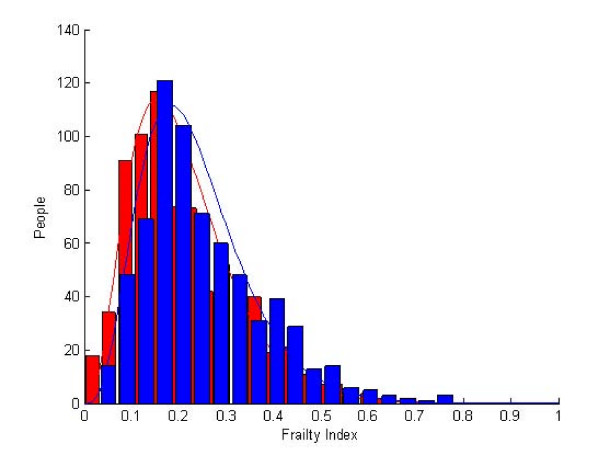
- The frailty index distribution was well fit by a gamma distribution with r² > 0.90.
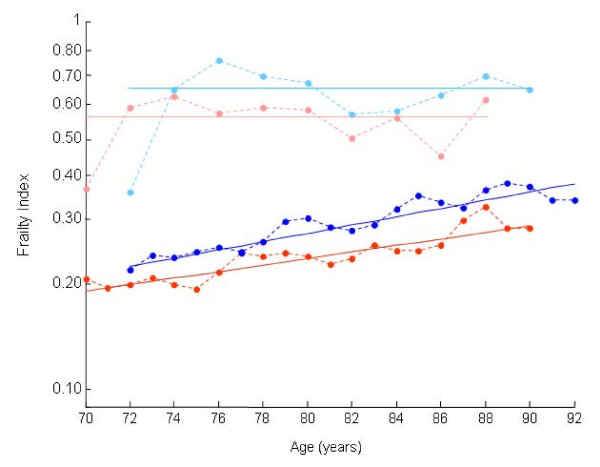
- The age-related slope of deficit accumulation was 0.020 per year at baseline (95% CI 0.014–0.026) and 0.026 per year at follow-up (95% CI 0.020–0.032).
- The 99% upper limit of the frailty index was about 0.6 at baseline and 0.7 at follow-up, and the frailty index, age, and sex were significant predictors of mortality in Cox models.
## Methods
- Secondary analysis of the Yale Precipitating Events Project (PEP) cohort in New Haven, CT; 754 community-dwelling, English-speaking, non-disabled adults aged 70+ were enrolled, with baseline and 18-month follow-up assessments.
- Candidate deficits were drawn from survey variables on function, cognition, comorbidity, attitudes/practices, physical performance, self-rated health, and mood; binary, ordinal, and continuous variables were recoded onto a 0–1 scale.
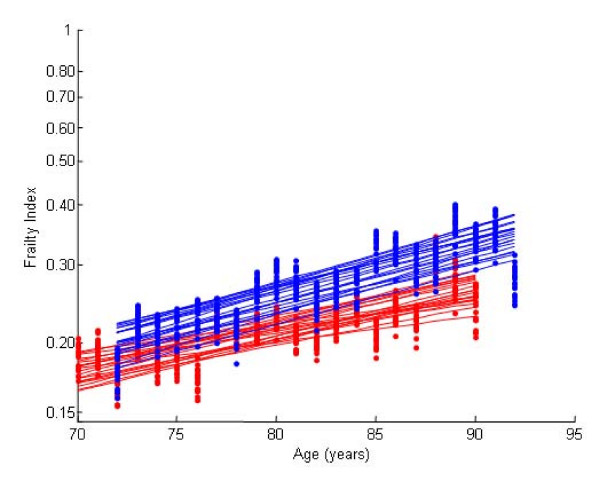
- Analysis included best-fit log(frailty index) vs age slopes, 1000 re-sampling (bootstrap-like) iterations using 80% of variables, comparison with a gamma distribution, 99th-percentile upper-limit plots, and bivariate and multivariable Cox regression for mortality.
## Limitations
- The paper states that not all items had established cut-points and that cut-points can be difficult to apply across a sample that covers many ages.
- The authors note the sample is small, so individual estimates can be unstable; they present re-sampling as a way to help with this.
- Evident from the text: the analysis is based on a single cohort and only baseline and 18-month follow-up data for constructing and comparing the indices, so generalizability beyond this dataset is not directly tested here.
Model-written summary. Check it against the paper before relying on it.
Integrity signals
Registry
Cites
Statistics
Figures
Verification
Claims the paper makes
6 Valid · 0 Not valid · 16 Not checked · 37 Own results and interpretations
The sources with a verdict support this claim; the rest weren’t checked yet, have no full text we could read, or their verdicts aren’t rated yet.
In the paper
“In each study, the frailer the person is (the higher the deficit count) the more vulnerable they are to adverse outcomes [5,8,11].”
§ A standard procedure for creating a frailty index > Background
What the sources say
- Not checked yetcites [5] Rockwood K, Mitnitski A: Frailty in relation to the accumulation of deficits. J Gerontol Biol Sci Med Sci. 2007, 62A: 722-727. source
- Supportedcites [8] Kulminski A, Yashin A, Arbeev K, Akushevich I, Ukraintseva S, Land K: Cumulative index of health disorders as an indicator of aging-associated processes in the elderly: Results from analyses of the National Long Term Care Survey. Mech Ageing Dev. 2007, 128: 250-258. 10.1016/j.mad.2006.12.004. source
The Results (3.3, p. n/a) state that 'individuals with smaller numbers of deficits live longer' and that 'having a large FI irrespective of age can be predictive of death', and Section 3.6 reports relative risks of death rising with each 1% increment in the FI (a deficit count/fraction). The Introduction also records that the FI is 'a robust concept predicting short- and long-term mortality outcomes and institutionalization' and permits stratification of health risks. Thus our copy supports the attributed point that greater deficit accumulation means greater frailty and greater vulnerability to adverse outcomes in this NLTCS elderly cohort; the 'in each study' framing belongs to the citing paper's pooling of several sources. (LLM, conf=0.85)
- Not checked yetcites [11] Woo J, Goggins W, Sham A, Ho SC: Social determinants of frailty. Gerontology. 2005, 51: 402-408. 10.1159/000088705. source
plainstates an association- Asserted: passes — The authors put it forward as true.
- Checkable: passes — It can be checked against evidence.
- Load-bearing: passes — The paper’s conclusions depend on it.
- Based: passes — The paper gives a reason why it holds.
Every source the paper cites for this claim was checked and supports it.
In the paper
“Frailty can be measured in relation to the accumulation of deficits using a frailty index.”
§ A standard procedure for creating a frailty index > Abstract > Background
What the sources say
- Supportedcites [4] Mitnitski AB, Mogilner AJ, Rockwood K: Accumulation of deficits as a proxy measure of aging. The Scientific World. 2001, 1: 323-336. source
The abstract (p. 1) states 'A frailty index was defined as the proportion of accumulated deficits (symptoms, signs, functional impairments, and laboratory abnormalities)', and METHODS defines the index as the proportion of deficits incurred by an individual, used as a measure of health status. The 'Frailty Index and Survival Probability' section explicitly links this accumulation-of-deficits index to the clinical syndrome of frailty ('We suggest that this correspond to the clinical syndrome of frailty'), and the CONCLUSIONS restate that the frailty index is the proportion of deficits present at the time of health appraisal. The paraphrase therefore matches what this paper does. (LLM, conf=0.92)
plainstates an association- Asserted: passes — The authors put it forward as true.
- Checkable: passes — It can be checked against evidence.
- Load-bearing: passes — The paper’s conclusions depend on it.
- Based: passes — The paper gives a reason why it holds.
- Supported
The cited sources support only part of this claim — read each source’s verdict below.
In the paper
“the results yielded by the frailty index have been consistent between surveys evaluated by our group [4-7] and by others [8-11] even though not every frailty index considers the same deficits, or even the same number of deficits.”
§ A standard procedure for creating a frailty index > Background
What the sources say
- Partly supportedcites [4] Mitnitski AB, Mogilner AJ, Rockwood K: Accumulation of deficits as a proxy measure of aging. The Scientific World. 2001, 1: 323-336. sourceExperimental — accuracy not yet measured
In “Accumulation of Deficits with Age” (page unavailable), the paper reports similar age-related results when the frailty index uses different selections and numbers of deficits. Its Methods describe data from the Canadian Study of Health and Aging; the paper does not establish consistency across surveys evaluated by the authors and by others. (LLM, conf=0.86)
- Not checked yetcites [5] Rockwood K, Mitnitski A: Frailty in relation to the accumulation of deficits. J Gerontol Biol Sci Med Sci. 2007, 62A: 722-727. source
- Not checked yetcites [6] Mitnitski A, Xiaowei S, Skoog I, Broe GA, Cox JL, Grunfeld E, Rockwood K: Relative fitness and frailty of elderly men and women in developed countries and their relationship with mortality. J Am Geriatr Soc. 2005, 53 (12): 2184-5189. 10.1111/j.1532-5415.2005.00506.x. source
- Not checked yetcites [7] Rockwood K, Andrew M, Mitnitski A: A Comparison of two approaches to measuring frailty in elderly people. J Gerontol A Biol Sci Med Sci. 2007, 62A (No 7): 738-743. source
- Partly supportedcites [8] Kulminski A, Yashin A, Arbeev K, Akushevich I, Ukraintseva S, Land K: Cumulative index of health disorders as an indicator of aging-associated processes in the elderly: Results from analyses of the National Long Term Care Survey. Mech Ageing Dev. 2007, 128: 250-258. 10.1016/j.mad.2006.12.004. sourceExperimental — accuracy not yet measured
The Introduction says the frailty-index approach works in various settings and depends on the aggregate of deficits rather than specific traits; Results §3.3 reports a similar age pattern in NLTCS and other data. But the paper does not establish consistency across surveys using different numbers of deficits, and the Introduction notes a difference between Canadian and Chinese findings about whether the index predicts death better than chronological age. (LLM, conf=0.84)
- Not checked yetcites [9] Kulminski A, Ukraintseva SV, Akushevich IV, Arbeev KG, Yashin AI: Cumulative index of health deficiencies as a characteristic of long life. J Am Geriatr Soc. 2007, 55 (6): 935-40. 10.1111/j.1532-5415.2007.01155.x. source
- Not checked yetcites [10] Goggins WB, Woo J, Sham A, Ho SC: Frailty index as a measure of personal biological age in a Chinese population. J Gerontol A Biol Sci Med Sci. 2005, 60A: 1046-1051. source
- Not checked yetcites [11] Woo J, Goggins W, Sham A, Ho SC: Social determinants of frailty. Gerontology. 2005, 51: 402-408. 10.1159/000088705. source
plain- Asserted: passes — The authors put it forward as true.
- Checkable: passes — It can be checked against evidence.
- Load-bearing: passes — The paper’s conclusions depend on it.
- Based: passes — The paper gives a reason why it holds.
- Partly supported
The cited sources support only part of this claim — read each source’s verdict below.
In the paper
“it does not matter if study A considered 40 deficits from set X of deficits and study B considered 60 deficits from set Y of deficits; the estimates from each (e.g. the rate of deficit accumulation, the relationship between deficit accumulation and mortality, or the limit to deficit accumulation) appear to be similar.”
§ A standard procedure for creating a frailty index > Background
What the sources say
- Partly supportedcites [4] Mitnitski AB, Mogilner AJ, Rockwood K: Accumulation of deficits as a proxy measure of aging. The Scientific World. 2001, 1: 323-336. sourceExperimental — accuracy not yet measured
In “Accumulation of Deficits with Age” (page not available), the paper reports similar age-related accumulation rates using randomly selected sets of 40 and 60 deficits. Its Conclusions report an association between the frailty index and survival, but do not show that the mortality relationship is similar across different deficit sets. The cited passages also do not establish a similar limit to deficit accumulation or compare independent studies. (LLM, conf=0.88)
- Not checked yetcites [5] Rockwood K, Mitnitski A: Frailty in relation to the accumulation of deficits. J Gerontol Biol Sci Med Sci. 2007, 62A: 722-727. source
- Not checked yetcites [6] Mitnitski A, Xiaowei S, Skoog I, Broe GA, Cox JL, Grunfeld E, Rockwood K: Relative fitness and frailty of elderly men and women in developed countries and their relationship with mortality. J Am Geriatr Soc. 2005, 53 (12): 2184-5189. 10.1111/j.1532-5415.2005.00506.x. source
- Not checked yetcites [7] Rockwood K, Andrew M, Mitnitski A: A Comparison of two approaches to measuring frailty in elderly people. J Gerontol A Biol Sci Med Sci. 2007, 62A (No 7): 738-743. source
- Partly supportedcites [8] Kulminski A, Yashin A, Arbeev K, Akushevich I, Ukraintseva S, Land K: Cumulative index of health disorders as an indicator of aging-associated processes in the elderly: Results from analyses of the National Long Term Care Survey. Mech Ageing Dev. 2007, 128: 250-258. 10.1016/j.mad.2006.12.004. sourceExperimental — accuracy not yet measured
The Introduction says frailty is characterized by the aggregate of deficits rather than the specific traits selected, and that this approach works in various settings. Methods §2.2 constructs an index from 32 questions, while Results §3.6 says its observed maximum is consistent with other studies. The paper does not establish that indices built from 40 versus 60 different deficits yield similar accumulation rates, mortality relationships, and limits. (LLM, conf=0.83)
- Not checked yetcites [9] Kulminski A, Ukraintseva SV, Akushevich IV, Arbeev KG, Yashin AI: Cumulative index of health deficiencies as a characteristic of long life. J Am Geriatr Soc. 2007, 55 (6): 935-40. 10.1111/j.1532-5415.2007.01155.x. source
- Not checked yetcites [10] Goggins WB, Woo J, Sham A, Ho SC: Frailty index as a measure of personal biological age in a Chinese population. J Gerontol A Biol Sci Med Sci. 2005, 60A: 1046-1051. source
- Not checked yetcites [11] Woo J, Goggins W, Sham A, Ho SC: Social determinants of frailty. Gerontology. 2005, 51: 402-408. 10.1159/000088705. source
hedged- Asserted: passes — The authors put it forward as true.
- Checkable: passes — It can be checked against evidence.
- Load-bearing: passes — The paper’s conclusions depend on it.
- Based: passes — The paper gives a reason why it holds.
- Partly supported
The cited sources support only part of this claim — read each source’s verdict below.
In the paper
“mortality exponentially increases with the accumulation of deficits [5,8,19].”
§ A standard procedure for creating a frailty index > Discussion
What the sources say
- Not checked yetcites [5] Rockwood K, Mitnitski A: Frailty in relation to the accumulation of deficits. J Gerontol Biol Sci Med Sci. 2007, 62A: 722-727. source
- Partly supportedcites [8] Kulminski A, Yashin A, Arbeev K, Akushevich I, Ukraintseva S, Land K: Cumulative index of health disorders as an indicator of aging-associated processes in the elderly: Results from analyses of the National Long Term Care Survey. Mech Ageing Dev. 2007, 128: 250-258. 10.1016/j.mad.2006.12.004. sourceExperimental — accuracy not yet measured
The Discussion and Conclusions (page unavailable) gives an approximate exponential relationship between mortality risk and the frailty index under a condition that approximately holds for males. But the Results, §3.5 (page unavailable), report that a logistic function fits the observed frailty-index-specific mortality rates better than an exponential function. The unqualified claim overstates the paper’s finding. (LLM, conf=0.84)
- Not checked yetcites [19] Rockwood K, Mitnitski A, Song X, Steen B, Skoog I: Long-term risks of death and institutionalization of elderly people in relation to deficit accumulation at age 70. J Am Geriatr Soc. 2006, 54 (6): 975-979. 10.1111/j.1532-5415.2006.00738.x. source
plainstates a cause- Asserted: passes — The authors put it forward as true.
- Checkable: passes — It can be checked against evidence.
- Load-bearing: passes — The paper’s conclusions depend on it.
- Based: passes — The paper gives a reason why it holds.
21 more claims
Create a free account to see all 59 claims and to verify the 42 references still open.
- Probably not a substantial claim. 16
- It may state two separate claims as one. 19
Claims other papers make about this one
Each is checked against this paper’s own text: does it say what the citing paper says it does?
In the citing paper
“The phenotype and cumulative deficit models demonstrate overlap in identification of frailty (82)”
From Frailty in elderly people (2013) · cites this paper as [82]
In the citing paper
“Frailty was assessed with the Frailty Index (FI), a commonly used tool which is based on the concept that frailty is the result of an accumulation of deficits during lifetime [3].”
From Frailty index predicts poor outcome in COVID-19 patients (2020) · cites this paper as [3]
In the citing paper
“Overall, we assessed 43 variables, which provided our index with a sufficient amount of robustness [3].”
From Frailty index predicts poor outcome in COVID-19 patients (2020) · cites this paper as [3]
In the citing paper
“Variables were selected because they are associated with health status, generally increase with age, are not universal in older age, and cover a range of systems (14).”
From Frailty as determined by a comprehensive geriatric assessment-derived deficit-accumulation index in older patients with cancer who receive chemotherapy (2016) · cites this paper as [14]
In the citing paper
“The Frailty Index was initially operationalized from a CGA by Jones et al and a standard procedure for creating a Frailty Index as described by Searle et al in 2008 (12,14), and shown to predict the risk of death, length of stay, and discharge to long term care in hospitalized older patients.(13)”
From Frailty as determined by a comprehensive geriatric assessment-derived deficit-accumulation index in older patients with cancer who receive chemotherapy (2016) · cites this paper as [14]
Citations
Cites
Folstein, M. F., Folstein, S. E., & McHugh, P. R. (1975) · Journal of Psychiatric Research · doi:10.1016/0022-3956(75)90026-6 · Cited by 88,282
An Introduction to the Bootstrap
Efron, B., & Tibshirani, R. J. (1994) · doi:10.1201/9780429246593 · Cited by 40,500
Frailty in Older Adults: Evidence for a Phenotype
Fried, L. P., Tangen, C. M., Walston, J., Newman, A. B., Hirsch, C., Gottdiener, J., Seeman, T., Tracy, R., Kop, W. J., Burke, G., et al. (2001) · The Journals of Gerontology Series A: Biological Sciences and Medical Sciences · doi:10.1093/gerona/56.3.m146 · Cited by 24,907
An Introduction to the Bootstrap
Efron, B., & Tibshirani, R. J. (1993) · doi:10.1007/978-1-4899-4541-9 · Cited by 21,230
Hirono, N., Mori, E., Ikejiri, Y., Imamura, T., Shimomura, T., Hashimoto, M., Yamashita, H., & Ikeda, M. (1997) · Brain and nerve · Cited by 21,039
Kok, J. S., Berg, I. J., & Scherder, E. J. A. (2013) · Dementia and Geriatric Cognitive Disorders Extra · doi:10.1159/000353441 · Cited by 20,589
Older Adults' Reasons for Using Technology while Aging in Place
Peek, S. T. M., Luijkx, K. G., Rijnaard, M. D., Nieboer, M. E., van der Voort, C. S., Aarts, S., van Hoof, J., Vrijhoef, H. J. M., & Wouters, E. J. M. (2016) · Gerontology · doi:10.1159/000430949 · Cited by 19,690
Sensitivity and False Alarm Rate of a Fall Sensor in Long-Term Fall Detection in the Elderly
Kangas, M., Korpelainen, R., Vikman, I., Nyberg, L., & Jämsä, T. (2015) · Gerontology · doi:10.1159/000362720 · Cited by 18,909
Health Measurement Scales: A Practical Guide to Their Development and Use
Streiner, D. L., Norman, G. R., & Cairney, J. (1989) · Cited by 9,595
Gompertz, B. (1825) · Philosophical Transactions of the Royal Society of London · doi:10.1098/rstl.1825.0026 · Cited by 3,816
Research works printed but not linked: 1
- Bergman H, Ferrucci L, Guralnik J, Hogan DB, Hummel S, Karunananthan S, Wolfson C: Frailty: an emerging research and clinical paradigm–issues and controversies. J Gerontol A Biol Sci Med Sci. 2007, 62 (7): 731-737. · DOI · Paper page
Cited by
Items 701–800 of 1,013
Pain and Frailty in Hospitalized Older Adults
Ardoino, I., Franchi, C., Nobili, A., Mannucci, P. M., Corli, O., REPOSI Investigators, Mannucci, P. M., Nobili, A., Pietrangelo, A., Perticone, F., et al. (2020) · Pain and Therapy · doi:10.1007/s40122-020-00202-3 · Cited by 49
Bai, G., Szwajda, A., Wang, Y., Li, X., Bower, H., Karlsson, I., Johansson, B. E. A., Aslan, A. K. D., Pedersen, N. L., Hägg, S., et al. (2021) · Age and Ageing · doi:10.1093/ageing/afab106 · Cited by 49
Methods of Assessing Frailty in the Critically Ill: A Systematic Review of the Current Literature
Bertschi, D., Waskowski, J., Schilling, M., Donatsch, C., Schefold, J. C., & Pfortmueller, C. A. (2022) · Gerontology · doi:10.1159/000523674 · Cited by 48
Network model of human aging: Frailty limits and information measures
Farrell, S. G., Mitnitski, A. B., Rockwood, K., & Rutenberg, A. D. (2016) · Physical Review E · doi:10.1103/physreve.94.052409 · Cited by 48
Self-citationCheng, Z., He, D., Li, J., Wu, Q. H., Liu, Z., & Zhu, Y. (2022) · Immunity & Ageing · doi:10.1186/s12979-022-00280-1 · Cited by 48
The metabolomics side of frailty: Toward personalized medicine for the aged
Picca, A., Coelho‐Júnior, H. J., Cesari, M., Marini, F., Miccheli, A., Gervasoni, J., Bossola, M., Landi, F., Bernabei, R., Marzetti, E., et al. (2019) · Experimental Gerontology · doi:10.1016/j.exger.2019.110692 · Cited by 48
Schoufour, J. D., Echteld, M. A., Bastiaanse, L. P., & Evenhuis, H. M. (2015) · Research in Developmental Disabilities · doi:10.1016/j.ridd.2014.12.001 · Cited by 48
Wang, C., Song, X., Mitnitski, A., Fang, X., Tang, Z., Yu, P., & Rockwood, K. J. (2014) · Journal of the American Geriatrics Society · doi:10.1111/jgs.12792 · Cited by 47
Self-citationFrailty In Patients Undergoing Vascular Surgery: A Narrative Review Of Current Evidence
Czobor, N. R., Lehot, J.-J., Holndonner-Kirst, E., Tully, P. J., Gál, J., & Székely, A. D. (2019) · Therapeutics and Clinical Risk Management · doi:10.2147/tcrm.s217717 · Cited by 47
Design of a frailty index among community living middle-aged and older people: The Rotterdam study
Schoufour, J. D., Erler, N. S., Jaspers, L., Jong, J. C. K., Voortman, T., Ziere, G. J., Lindemans, J. W., Klaver, C. C. W., Tiemeier, H. W., Stricker, B. H. C., et al. (2016) · Maturitas · doi:10.1016/j.maturitas.2016.12.002 · Cited by 47
Salaffi, F., Carlo, M. D., Carotti, M., Farah, S., & Giovagnoni, A. (2020) · Aging Clinical and Experimental Research · doi:10.1007/s40520-020-01667-0 · Cited by 47
Stolz, E., Mayerl, H., Hoogendijk, E. O., Armstrong, J. J., Roller‐Wirnsberger, R., & Freidl, W. (2021) · Annals of Epidemiology · doi:10.1016/j.annepidem.2021.03.008 · Cited by 47
Vatanabe, I. P., Pedroso, R. V., Teles, R. H. G., Ribeiro, J. C., Manzine, P. R., Pott, H., & Cominetti, M. R. (2021) · Aging & Mental Health · doi:10.1080/13607863.2021.1884844 · Cited by 47
Jung, H., Baek, J. Y., Jang, I., Guralnik, J. M., Rockwood, K. J., Lee, E., & Kim, D. H. (2021) · The Journals of Gerontology Series A · doi:10.1093/gerona/glab087 · Cited by 47
Self-citationCuccolo, N. G., Sparenberg, S., Ibrahim, A. M. S., Crystal, D. T., Blankensteijn, L. L., & Lin, S. J. (2019) · Journal of Plastic Surgery and Hand Surgery · doi:10.1080/2000656x.2019.1688166 · Cited by 47
The Relationship Between Frailty and Emotional Health in Older Patients with Advanced Cancer
Gilmore, N. J., Kehoe, L., Bauer, J., Xu, H., Hall, B., Wells, M., Lei, L., Culakova, E., Flannery, M. A., Grossman, V. A., et al. (2021) · The Oncologist · doi:10.1002/onco.13975 · Cited by 47
Puntos clave en la asistencia al anciano frágil en Urgencias
Martín‐Sánchez, F. J., Alonso, C. F., & Gregório, P. G. (2012) · Medicina Clínica · doi:10.1016/j.medcli.2012.04.009 · Cited by 47
Age-related disparities in older women with breast cancer
Bagegni, N. A., & Peterson, L. L. (2020) · Advances in cancer research · doi:10.1016/bs.acr.2020.01.003 · Cited by 48
Ma, L., Zhang, L., Tang, Z., Sun, F., Diao, L., Wang, J., Zhao, X., & Ge, G. (2016) · Archives of Gerontology and Geriatrics · doi:10.1016/j.archger.2015.11.002 · Cited by 47
Bernstein, I. A., Roxbury, C. R., Lin, S. Y., & Rowan, N. R. (2020) · International Forum of Allergy & Rhinology · doi:10.1002/alr.22718 · Cited by 47
Pierce, K. E., Passias, P. G., Alas, H., Brown, A., Bortz, C. A., Lafage, R., Lafage, V., Ames, C. P., Burton, D. C., Hart, R., et al. (2019) · Spine · doi:10.1097/brs.0000000000003288 · Cited by 47
Nishijima, T. F., Shimokawa, M., Esaki, T., Morita, M., Toh, Y., & Muss, H. B. (2021) · The Oncologist · doi:10.1002/onco.13894 · Cited by 46
Age acquired skewed X chromosome inactivation is associated with adverse health outcomes in humans
Roberts, A. L., Morea, A., Amar, A., Zito, A., Moustafa, J. S. E.-S., Tomlinson, M., Bowyer, R. C. E., Zhang, X., Christiansen, C., Costeira, R., et al. (2022) · eLife · doi:10.7554/elife.78263 · Cited by 46
Peng, L., Hsiao, F., Lee, W., Huang, S., & Chen, L. (2020) · Journal of Medical Internet Research · doi:10.2196/16213 · Cited by 46
Frailty is a determinant of suboptimal chemotherapy in women with advanced ovarian cancer
Narasimhulu, D. M., McGree, M. E., Weaver, A. L., Jatoi, A., LeBrasseur, N. K., Glaser, G. E., Langstraat, C., Block, M. S., & Kumar, A. (2020) · Gynecologic Oncology · doi:10.1016/j.ygyno.2020.05.046 · Cited by 46
The operationalization of fatigue in frailty scales: a systematic review
Knoop, V., Costenoble, A., Azzopardi, R. V., Vermeiren, S., Debain, A., Jansen, B., Scafoglieri, A., Bautmans, I., Bautmans, I., Verté, D., et al. (2019) · Ageing Research Reviews · doi:10.1016/j.arr.2019.100911 · Cited by 46
Zipser, C. M., Deuel, J., Ernst, J., Schubert, M., Weller, M., von Känel, R., & Böettger, S. (2019) · Journal of Neurology · doi:10.1007/s00415-019-09533-4 · Cited by 46
Liu, X., Dai, G., He, Q., Ma, H., & Hu, H. (2022) · Journal of Cardiovascular Development and Disease · doi:10.3390/jcdd9070228 · Cited by 46
Fan, J., Yu, C., Pang, Y., Guo, Y., Pei, P., Sun, Z., Yang, L., Chen, Y., Du, H., Sun, D., et al. (2021) · The Journals of Gerontology Series A · doi:10.1093/gerona/glab213 · Cited by 46
Yang, M. J., Zhuo, Y., Hu, X., & Xie, L. (2018) · Aging Clinical and Experimental Research · doi:10.1007/s40520-018-1041-7 · Cited by 46
Espeland, M. A., Justice, J. N., Bahnson, J. L., Evans, J. K., Munshi, M. N., Hayden, K. M., Simpson, F. R., Johnson, K., Johnston, C. A., & Kritchevsky, S. B. (2021) · The Journals of Gerontology Series A · doi:10.1093/gerona/glab342 · Cited by 46
Yao, T., DeJong, S. R., McGree, M. E., Weaver, A. L., Cliby, W. A., & Kumar, A. (2019) · Gynecologic Oncology · doi:10.1016/j.ygyno.2018.12.025 · Cited by 46
Pre-Stroke Frailty Is Independently Associated With Post-Stroke Cognition: A Cross-Sectional Study
Rowan, M. T., Keir, R., Cuthbertson, G., Shaw, R., Drozdowska, B. A., Elliott, E., Evans, J. J., Stott, D. J., & Quinn, T. J. (2019) · Journal of the International Neuropsychological Society · doi:10.1017/s1355617719000092 · Cited by 46
Longitudinal changes of frailty in 8 years: comparisons between physical frailty and frailty index
Hwang, A., Lee, W., Huang, N., Chen, L.-Y., Peng, L., Lin, M., Chou, Y., & Chen, L. (2021) · BMC Geriatrics · doi:10.1186/s12877-021-02665-1 · Cited by 46
Influential factors of saliva microbiota composition
Wells, P. M., Sprockett, D. D., Bowyer, R. C. E., Kurushima, Y., Relman, D. A., Williams, F. M. K., & Steves, C. J. (2022) · Scientific Reports · doi:10.1038/s41598-022-23266-x · Cited by 46
Pitter, J. G., Zemplényi, A., Babarczy, B., Németh, B., Kaló, Z., & Vokó, Z. (2023) · GeroScience · doi:10.1007/s11357-023-00975-3 · Cited by 46
Clinical relevance of frailty trajectory post myocardial infarction
Myers, V., Drory, Y., & Gerber, Y. (2012) · European Journal of Preventive Cardiology · doi:10.1177/2047487312462828 · Cited by 46
Mian, H. S., Wildes, T. M., & Fiala, M. A. (2018) · JCO Clinical Cancer Informatics · doi:10.1200/cci.18.00043 · Cited by 46
Minimally invasive distal pancreatectomy: greatest benefit for the frail
Konstantinidis, I. T., Lewis, A., Lee, B., Warner, S. G., Woo, Y., Singh, G. P., Fong, Y., & Melstrom, L. G. (2017) · Surgical Endoscopy · doi:10.1007/s00464-017-5593-y · Cited by 46
Aging in the USA: similarities and disparities across time and space
Abeliansky, A. L., Erel, D., & Strulik, H. (2020) · Scientific Reports · doi:10.1038/s41598-020-71269-3 · Cited by 46
Wister, A., Lear, S. A., Schuurman, N., Mackey, D. C., Mitchell, B. A., Cosco, T. D., & Fyffe, I. (2018) · BMC Geriatrics · doi:10.1186/s12877-018-0851-y · Cited by 46
Cooper, L., Loewenthal, J., Frain, L. N., Tulebaev, S. R., Cardin, K., Hshieh, T. T., DuMontier, C., Streiter, S., Joseph, C., Hilt, A., et al. (2021) · Journal of the American Geriatrics Society · doi:10.1111/jgs.17446 · Cited by 46
Self-citationSwiecicka, A., Eendebak, R. J. A. H., Lunt, M., O’Neill, T. W., Bartfai, G., Casanueva, F. F., Forti, G., Giwercman, A., Han, T. S., Slowikowska-Hilczer, J., et al. (2018) · The Journal of Clinical Endocrinology & Metabolism · doi:10.1210/jc.2017-01172 · Cited by 45
“The EMAS FI was created using a standardized procedure (19) and was calculated as the number of deficits present divided by the maximum number of deficits possible.”
MethodSedative Load and Frailty Among Community-Dwelling Population Aged ≥65 Years
Peklar, J., O’Halloran, A. M., Maidment, I., Henman, M. C., Kenny, R. A., & Kos, M. (2014) · Journal of the American Medical Directors Association · doi:10.1016/j.jamda.2014.10.010 · Cited by 45
Tay, L., Chua, M. P., Tay, E. L., Chan, H. N., Mah, S. M., Latib, A. B., Wong, C. Q., & Ng, Y. S. (2019) · Annals of the Academy of Medicine Singapore · doi:10.47102/annals-acadmedsg.v48n6p171 · Cited by 45
Frailty in Older Adults with Mild Dementia: Dementia with Lewy Bodies and Alzheimer’s Disease
Borda, M. G., Soennesyn, H., Steves, C. J., Vik‐Mo, A. O., Pérez‐Zepeda, M. U., & Aarsland, D. (2019) · Dementia and Geriatric Cognitive Disorders Extra · doi:10.1159/000496537 · Cited by 45
Cox, N. J., Bowyer, R. C. E., Lochlainn, M. N., Wells, P. M., Roberts, H. C., & Steves, C. J. (2021) · Journal of Cachexia Sarcopenia and Muscle · doi:10.1002/jcsm.12683 · Cited by 45
Predicting 3‐Year Survival in Older People with Intellectual Disabilities Using a Frailty Index
Schoufour, J. D., Mitnitski, A., Rockwood, K. J., Evenhuis, H. M., & Echteld, M. A. (2015) · Journal of the American Geriatrics Society · doi:10.1111/jgs.13239 · Cited by 45
Self-citationBidirectional Longitudinal Study of Frailty and Depressive Symptoms Among Older Chinese Adults
Cao, L., Zhou, Y., Liu, H., Shi, M., Wei, Y., & Xia, Y. (2022) · Frontiers in Aging Neuroscience · doi:10.3389/fnagi.2022.791971 · Cited by 45
Zeng, X., Meng, L., Li, Y., Jia, N., Shi, J. C., Zhang, C., Hu, X., Hu, J.-B., Li, J., Wu, D., et al. (2023) · Frontiers in Public Health · doi:10.3389/fpubh.2023.1110648 · Cited by 45
Giri, S., Al‐Obaidi, M., Weaver, A. N., Kenzik, K. M., McDonald, A. M., Clark, D., Smith, C. Y., Paluri, R. K., Nandagopal, L., Gbolahan, O. B., et al. (2021) · Journal of the National Comprehensive Cancer Network · doi:10.6004/jnccn.2020.7679 · Cited by 45
Frailty assessment, hip fracture and long‐term clinical outcomes in older adults
Pizzonia, M., Giannotti, C., Carmisciano, L., Signori, A., Rosa, G., Santolini, F., Caffa, I., Montecucco, F., Nencioni, A., & Monacelli, F. (2020) · European Journal of Clinical Investigation · doi:10.1111/eci.13445 · Cited by 45
Associations between a laboratory frailty index and adverse health outcomes across age and sex
Blodgett, J. M., Theou, O., Mitnitski, A., Howlett, S. E., & Rockwood, K. J. (2019) · Aging Medicine · doi:10.1002/agm2.12055 · Cited by 45
Self-citationTelomere length and frailty in older adults-a systematic review and meta-analysis
Araújo Carvalho, A. C., Tavares Mendes, M. L., da Silva Reis, M. C., Santos, V. S., Tanajura, D. M., & Martins-Filho, P. R. S. (2019) · Ageing Research Reviews · doi:10.1016/j.arr.2019.100914 · Cited by 44
Frailty and telomere length: Cross-sectional analysis in 3537 older adults from the ESTHER cohort
Saum, K.-U., Dieffenbach, A. K., Müezzinler, A., Müller, H., Holleczek, B., Stegmaier, C., Butterbach, K., Schick, M., Canzian, F., Stammer, H., et al. (2014) · Experimental Gerontology · doi:10.1016/j.exger.2014.08.009 · Cited by 44
The Frailty In Residential Sector over Time (FIRST) study: methods and baseline cohort description
Collaborators, O. B. O. T. F. S., Jadczak, A. D., Robson, L., Cooper, T., Bell, J. S., & Visvanathan, R. (2021) · BMC Geriatrics · doi:10.1186/s12877-020-01974-1 · Cited by 44
Characteristics of sarcopenia by European consensuses and a phenotype score
Jang, I., Lee, E., Lee, H., Park, H., Kim, S., Kim, K., Jung, H., & Kim, D. H. (2020) · Journal of Cachexia, Sarcopenia and Muscle · doi:10.1002/jcsm.12507 · Cited by 44
Friedrich, B., Lau, S., Elgert, L., Bauer, J. M., & Hein, A. (2021) · Healthcare · doi:10.3390/healthcare9020149 · Cited by 44
Meehan, A. J., Maher, A. B., Brent, L., Copanitsanou, P., Cross, J., Kimber, C. M., MacDonald, V., Marques, A., Peng, L., Queirós, C., et al. (2018) · International Journal of Orthopaedic and Trauma Nursing · doi:10.1016/j.ijotn.2018.11.001 · Cited by 44
McKenzie, K., Ouellette-Kuntz, H. M. J., & Martin, L. (2015) · BMC Geriatrics · doi:10.1186/s12877-015-0170-5 · Cited by 44
Lower Frailty Is Associated with Successful Cognitive Aging Among Older Adults with HIV
Wallace, L. M. K., Ferrara, M., Brothers, T. D., Garlassi, S., Kirkland, S., Theou, O., Zona, S., Mussini, C., Moore, D. J., Rockwood, K. J., et al. (2017) · AIDS Research and Human Retroviruses · doi:10.1089/aid.2016.0189 · Cited by 44
Self-citationCombined Impact of Physical Frailty and Social Isolation on Rate of Falls in Older Adults
Hayashi, T., Umegaki, H., Makino, T., Huang, C., Inoue, A., Shimada, H., & Kuzuya, M. (2020) · The journal of nutrition health & aging · doi:10.1007/s12603-020-1316-5 · Cited by 44
Kan, H. J., Kharrazi, H. H. K., Leff, B. A., Boyd, C. M., Davison, A., Chang, H., Kimura, J., Wu, S. S., Anzaldi, L. J., Richards, T., et al. (2018) · Medical Care · doi:10.1097/mlr.0000000000000865 · Cited by 44
Gajic‐Veljanoski, O., Παπαϊωάννου, Α., Kennedy, C. C., Ioannidis, G., Berger, C., Wong, A. K. O., Rockwood, K. J., Kirkland, S., Raina, P. S., Thabane, L., et al. (2018) · BMC Geriatrics · doi:10.1186/s12877-017-0692-0 · Cited by 44
Self-citationFrailty in Older Adults With Multiple Myeloma: A Study of US Veterans
Patel, B. G., Luo, S., Wildes, T. M., & Sanfilippo, K. M. (2020) · JCO Clinical Cancer Informatics · doi:10.1200/cci.19.00094 · Cited by 44
Frailty: a key indicator to minimize inappropriate medication in older people
Poudel, A., Hubbard, R. E., Nissen, L. M., & Mitchell, C. (2013) · QJM · doi:10.1093/qjmed/hct146 · Cited by 44
Starkman, R., Alibhai, S. M. H., Wells, R. A., Geddes, M. N., Zhu, N. Y., Keating, M., Leber, B. F., Chodirker, L., Sabloff, M., Christou, G., et al. (2019) · Leukemia · doi:10.1038/s41375-019-0666-7 · Cited by 44
Self-citationCheetham, N. J., Kibble, M., Wong, A., Silverwood, R. J., Knüppel, A., Williams, D. M., Hamilton, O. K., Lee, P. H., Staatz, C. B., Gessa, G. D., et al. (2023) · eLife · doi:10.7554/elife.80428 · Cited by 44
The Pictorial Fit-Frail Scale: Developing a Visual Scale to Assess Frailty
Theou, O., Andrew, M. K., Ahip, S. S., Squires, E., McGarrigle, L., Blodgett, J. M., Goldstein, J., Hominick, K., Godin, J., Hougan, G., et al. (2019) · Canadian Geriatrics Journal · doi:10.5770/cgj.22.357 · Cited by 44
Self-citationZaal, R. J., van der Kaaij, A., Evenhuis, H. M., & van den Bemt, P. M. L. A. (2013) · Research in Developmental Disabilities · doi:10.1016/j.ridd.2013.02.005 · Cited by 44
Frailty—A promising concept to evaluate disease vulnerability
Ribeiro, A. R., Howlett, S. E., & Fernandes, A. M. A. (2020) · Mechanisms of Ageing and Development · doi:10.1016/j.mad.2020.111217 · Cited by 43
A machine-vision-based frailty index for mice
Hession, L. E., Sabnis, G. S., Churchill, G. A., & Kumar, V. (2022) · Nature Aging · doi:10.1038/s43587-022-00266-0 · Cited by 43
Serum irisin level is independent of sarcopenia and related muscle parameters in older adults
Baek, J. Y., Jang, I., Jung, H., Park, S. J., Lee, J. Y., Choi, E., Lee, Y. S., Lee, E., & Kim, B. (2022) · Experimental Gerontology · doi:10.1016/j.exger.2022.111744 · Cited by 43
Dent, E., Grande, E. D., Price, K., & Taylor, A. W. (2017) · Maturitas · doi:10.1016/j.maturitas.2017.07.003 · Cited by 43
Predictors of transitions in frailty severity and mortality among people aging with HIV
Brothers, T. D., Kirkland, S., Theou, O., Zona, S., Malagoli, A., Wallace, L. M. K., Stentarelli, C., Mussini, C., Falutz, J., Guaraldi, G., et al. (2017) · PLoS ONE · doi:10.1371/journal.pone.0185352 · Cited by 43
Self-citationBartosch, P., McGuigan, F. E., & Åkesson, K. (2018) · Osteoporosis International · doi:10.1007/s00198-018-4593-7 · Cited by 43
Dietary patterns and changes in frailty status: the Rotterdam study
de Haas, S. C. M., de Jonge, E. A. L., Voortman, T., Graaff, J. S., Franco, O. H., Ikram, M. A., Rivadeneira, F., Jong, J. C. K., & Schoufour, J. D. (2017) · European Journal of Nutrition · doi:10.1007/s00394-017-1509-9 · Cited by 43
Frailty: A Common Pathway in Aging and Cancer
Balducci, L. (2013) · Interdisciplinary topics in gerontology and geriatrics · doi:10.1159/000343586 · Cited by 43
Cook, M. J., Lunt, M., Tim Board, & O’Neill, T. W. (2022) · Age and Ageing · doi:10.1093/ageing/afac118 · Cited by 43
Li, J., Zhao, D., Dong, B., Yu, D., Ren, Q., Chen, J., Qin, Q., Bi, P., & Sun, Y. (2018) · Geriatrics and gerontology international/Geriatrics & gerontology international · doi:10.1111/ggi.13280 · Cited by 43
Legge, A. C., Kirkland, S., Rockwood, K. J., Andreou, P., Bae, S., Gordon, C., Romero‐Díaz, J., Sánchez‐Guerrero, J., Wallace, D. J., Bernatsky, S., et al. (2020) · Arthritis & Rheumatology · doi:10.1002/art.41144 · Cited by 43
Self-citationArmstrong, J. J., Mitnitski, A., Andrew, M. K., Launer, L. J., White, L. R., & Rockwood, K. (2015) · Alzheimer's Research & Therapy · doi:10.1186/s13195-015-0120-7 · Cited by 42
“Using the procedure outlined to create a FI [21], 18 social variables were selected from the baseline wave to construct a measure of overall social vulnerability (Social Vulnerability Index; SVI).”
MethodSelf-citationBiomarkers in the path from cellular senescence to frailty
Zampino, M., Ferrucci, L., & Semba, R. D. (2019) · Experimental Gerontology · doi:10.1016/j.exger.2019.110750 · Cited by 42
Castrejón‐Pérez, R. C., Aguilar-Salinas, C. A., Gutiérrez‐Robledo, L. M., Cesari, M., & Pérez‐Zepeda, M. U. (2017) · Aging Clinical and Experimental Research · doi:10.1007/s40520-017-0852-2 · Cited by 42
A comparison of the relationship of 14 performance-based measures with frailty in older women
Theou, O., Jones, G. R., Jakobi, J. M., Mitnitski, A., & Vandervoort, A. A. (2011) · Applied Physiology, Nutrition, and Metabolism · doi:10.1139/h11-116 · Cited by 42
Self-citationBorenstein, J. E., Aronow, H. U., Bolton, L. B., Choi, J., Bresee, C. J., & Braunstein, G. D. (2013) · BMC Geriatrics · doi:10.1186/1471-2318-13-72 · Cited by 42
Systematic review of preoperative physical activity and its impact on postcardiac surgical outcomes
Kehler, D. S., Stammers, A. N., Tangri, N., Hiebert, B. M., Fransoo, R., Schultz, A. S. H., Macdonald, K., Giacomontonio, N., Hassan, A., Légaré, J., et al. (2017) · BMJ Open · doi:10.1136/bmjopen-2016-015712 · Cited by 42
Sardella, A., Lenzo, V., Bonanno, G. A., Basile, G., & Quattropani, M. C. A. (2021) · International Journal of Environmental Research and Public Health · doi:10.3390/ijerph18041698 · Cited by 42
Ferri‐Guerra, J., Aparicio‐Ugarriza, R., Salguero, D., Baskaran, D., Mohammed, Y. N., Florez, H. J., & Ruiz, J. G. (2020) · The Journal of Frailty & Aging · doi:10.14283/jfa.2019.31 · Cited by 42
Kelaiditi, E., Canevelli, M., Andrieu, S., del Campo, N., Soto, M. E., Vellas, B. J., Cesari, M., & the Impact of Cholinergic Treatment Use Study/DSA Group (2016) · Journal of the American Geriatrics Society · doi:10.1111/jgs.13956 · Cited by 42
Validation of an electronic frailty index with electronic health records: eFRAGICAP index
Orfila, F., Carrasco-Ribelles, L. A., Abellana, R. M., Roso‐Llorach, A., Lombardo, F. C., Reyes, C., & Violán, C. (2022) · BMC Geriatrics · doi:10.1186/s12877-022-03090-8 · Cited by 42
Frailty implications for exercise participation and outcomes in patients with heart failure
Mudge, A., Pelecanos, A. M., & Adsett, J. A. (2021) · Journal of the American Geriatrics Society · doi:10.1111/jgs.17145 · Cited by 42
Cesari, M., Costa, N., Hoogendijk, E. O., Vellas, B. J., Canevelli, M., & Pérez‐Zepeda, M. U. (2016) · Journal of the American Medical Directors Association · doi:10.1016/j.jamda.2016.02.007 · Cited by 42
Scarlata, S., Finamore, P., Laudisio, A., Cardaci, V., Ramaccia, M., D’Alessandro, F., Pedone, C., Incalzi, R. A., & Cesari, M. (2021) · Aging Clinical and Experimental Research · doi:10.1007/s40520-021-01878-z · Cited by 42
Joseph, W. J., Cuccolo, N. G., Baron, M. E., Chow, I., & Beers, E. H. (2019) · Hernia · doi:10.1007/s10029-019-02047-y · Cited by 42
Ritt, M., Schülein, S., Lubrich, H., Bollheimer, L. C., Sieber, C. C., & Gaßmann, K. (2016) · The journal of nutrition health & aging · doi:10.1007/s12603-016-0764-4 · Cited by 42
Tian, H., Li, Y.-M., Wang, C., Chen, G., & Lian, Y. (2025) · Cardiovascular Diabetology · doi:10.1186/s12933-025-02597-9 · Cited by 42
Ambagtsheer, R. C., Visvanathan, R., Cesari, M., Yu, S., Archibald, M. M., Schultz, T., Karnon, J. D., Kitson, A. A., & Beilby, J. (2017) · BMJ Open · doi:10.1136/bmjopen-2017-016663 · Cited by 41
Correlates of Frailty Among Homeless Adults
Salem, B. E., Nyamathi, A., Brecht, M., Phillips, L. R., Mentes, J. C., Sarkisian, C. A., & LEAKE, B. D. (2013) · Western Journal of Nursing Research · doi:10.1177/0193945913487608 · Cited by 41
Kawai, H., Obuchi, S. P., Watanabe, Y., Hirano, H., Fujiwara, Y., Ihara, K., Kim, H., Kobayashi, Y., Mochimaru, M., Tsushima, E., et al. (2020) · International Journal of Environmental Research and Public Health · doi:10.3390/ijerph17082707 · Cited by 41
Metadata
- Authors
- Searle, S. D., Mitnitski, A., Gahbauer, E. A., Gill, T. M., & Rockwood, K.
- Affiliations
- Dalhousie University (CA)
- Yale University (US)
- Corresponding author
- Rockwood, Kenneth
- Venue
- BMC Geriatrics
- Published
- 2008-09-30
- Volume
- 8
- Issue
- 1
- Pages
- 24-24
- ISSN
- 1471-2318 (ISSN-L)
- PMC
- PMC2573877
- OpenAlex
- W2105092978
- Cited by
- 3,568
- References
- 42
- Citations by year
- 2026: 373 · 2025: 411 · 2024: 408 · 2023: 379 · 2022: 367 · 2021: 324 · 2020: 288 · 2019: 227 · 2018: 169 · 2017: 167 · 2016: 127 · 2015: 91 · 2014: 80 · 2013: 60 · 2012: 40
- FWCI
- 7.68
- Type
- journal article
- Language
- en
- Open access
- gold
- doi.org
- Licence
- Locations
- BMC Geriatrics (publishedVersion, cc-by)
- PubMed Central (publishedVersion, cc-by)
- PubMed (publishedVersion)
- DOAJ (DOAJ: Directory of Open Access Journals) (submittedVersion, cc-by-sa)
- Research Explorer (The University of Manchester) (submittedVersion)
- Funders
- Robert Wood Johnson Foundation
- American Federation for Aging Research
- Patrick and Catherine Weldon Donaghue Medical Research Foundation
- Dalhousie Medical Research Foundation
- Dalhousie University
- Canadian Institutes of Health Research
- National Institute on Aging (R01AG022993, R37AG017560, K24AG021507)
- Topics
- Health Sciences › Medicine › Geriatrics and Gerontology › Frailty in Older Adults
- Health Sciences › Medicine › Epidemiology › Chronic Disease Management Strategies
- Health Sciences › Medicine › Public Health, Environmental and Occupational Health › Aging, Health, and Disability
- Keywords
- frailty index, frailty assessment, deficit accumulation, older adults, mortality risk, health deficits, gamma distribution
- MeSH terms
- Activities of Daily Living, Age Factors, Aged, Aged, 80 and over, Attitude to Health, Cognition Disorders, Disability Evaluation, Health Status Indicators, Humans, Male, Mortality, Physical Fitness, Probability, Sensitivity and Specificity, Sex Factors, Cohort Studies, Geriatric Assessment, Prevalence, Multivariate Analysis, Proportional Hazards Models, Frail Elderly, Vulnerable Populations
About these checks
Registry, retraction, Cites and statistics results are computed, not judged, with one exception: a printed reference that no index lists is read once by a model before it counts as a citation error. Claims are extracted by a model and kept only when their quote appears verbatim in the text; each cited source is then checked, with a model’s help, for whether it says what the claim relies on. Those verdicts can be wrong — read the claim’s quote and the cited source before relying on one.
The claim verdicts this report counts are experimental: their accuracy is not yet measured.
A language model drew the claims from the paper on 2026-10-11, under version 3 of the claim definition (model deepseek-v4.1-flash, prompt extract-v3).
A second model labelled each claim on 2026-10-11 (model jev-1.13-20260917, definition revision gold-guideline-v0.2).
Cited sources are checked with a language model’s help (qwen3.8-omni-flash and gpt-6-sol).
Statistics and arithmetic are recomputed, not judged.
Confidence bands are shown only for fields calibrated on our annotated test set. None is calibrated yet, so no band is shown.
What counts as a claim ›How we measure confidence ›How we check this ›
Are you an author, or do you see a problem with this page? Request a review
Data sources
Bibliographic data: Semantic Scholar, OpenAlex, Crossref.
Contains information from the Semantic Scholar Academic Graph Datasets, made available under the ODC Attribution License (ODC-BY 1.0).
Semantic Scholar’s data is described in: Kinney, R., et al. (2023). The Semantic Scholar Open Data Platform. arXiv:2301.10140.
