

Why do some women still prefer traditional birth attendants and home delivery?: a qualitative study on delivery care services in West Java Province, Indonesia
Open accessThe DOI matches its Crossref record; 51 of the 53 references it cites were found in a registry or an index.
Abstract
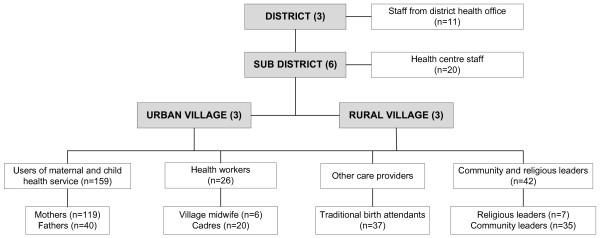
BACKGROUND: Trained birth attendants at delivery are important for preventing both maternal and newborn deaths. West Java is one of the provinces on Java Island, Indonesia, where many women still deliver at home and without the assistance of trained birth attendants. This study aims to explore the perspectives of community members and health workers about the use of delivery care services in six villages of West Java Province. METHODS: A qualitative study using focus group discussions (FGDs) and in-depth interviews was conducted in six villages of three districts in West Java Province from March to July 2009. Twenty FGDs and 165 in-depth interviews were conducted involving a total of 295 participants representing mothers, fathers, health care providers, traditional birth attendants and community leaders. The FGD and in-depth interview guidelines included reasons for using a trained or a traditional birth attendant and reasons for having a home or an institutional delivery. RESULTS: The use of traditional birth attendants and home delivery were preferable for some community members despite the availability of the village midwife in the village. Physical distance and financial limitations were two major constraints that prevented community members from accessing and using trained attendants and institutional deliveries. A number of respondents reported that trained delivery attendants or an institutional delivery were only aimed at women who experienced obstetric complications. The limited availability of health care providers was reported by residents in remote areas. In these settings the village midwife, who was sometimes the only health care provider, frequently travelled out of the village. The community perceived the role of both village midwives and traditional birth attendants as essential for providing maternal and health care services. CONCLUSIONS: A comprehensive strategy to increase the availability, accessibility, and affordability of delivery care services should be considered in these West Java areas. Health education strategies are required to increase community awareness about the importance of health services along with the existing financing mechanisms for the poor communities. Public health strategies involving traditional birth attendants will be beneficial particularly in remote areas where their services are highly utilized.
Overview
The claims and statistics of this paper haven’t been checked yet.
Free: it reads the open-access text and checks the first 5 claims that cite a source we can check. Create a free account to check every claim.
Integrity signals
Registry
Cites
Statistics
Figures
Verification
Claims the paper makes
The claims and statistics of this paper haven’t been checked yet.
Free: it reads the open-access text and checks the first 5 claims that cite a source we can check. Create a free account to check every claim.
Claims other papers make about this one
Each is checked against this paper’s own text: does it say what the citing paper says it does?
The source backs part of the claim, not all of it — or backs it for a different population, condition or comparison.
In the citing paper
“Facilitator/barrier: Health insurance schemes, national population policies, and national policies aimed to shift deliveries from the home to a facility”
From Facilitators and barriers to facility-based delivery in low- and middle-income countries: a qualitative evidence synthesis (2014) · cites this paper as [33]
Experimental — accuracy not yet measuredThe source backs part of the claim, not all of it — or backs it for a different population, condition or comparison.
In the citing paper
“Barrier: Inaccessibility of transportation and facilities during off-hours”
From Facilitators and barriers to facility-based delivery in low- and middle-income countries: a qualitative evidence synthesis (2014) · cites this paper as [33]
Experimental — accuracy not yet measuredThe source backs part of the claim, not all of it — or backs it for a different population, condition or comparison.
In the citing paper
“Barrier: TBAs perceived as providing high quality care”
From Facilitators and barriers to facility-based delivery in low- and middle-income countries: a qualitative evidence synthesis (2014) · cites this paper as [33]
Experimental — accuracy not yet measuredThe source backs part of the claim, not all of it — or backs it for a different population, condition or comparison.
In the citing paper
“Facilitator: TBAs perceived as providing low quality care”
From Facilitators and barriers to facility-based delivery in low- and middle-income countries: a qualitative evidence synthesis (2014) · cites this paper as [33]
Experimental — accuracy not yet measuredThe source backs part of the claim, not all of it — or backs it for a different population, condition or comparison.
In the citing paper
“Across many contexts, parturient women may not be in full control of the decision to seek facility-based delivery, instead relying on the decisions made by many actors, including elder women, husbands, family members, and neighbors.”
From Facilitators and barriers to facility-based delivery in low- and middle-income countries: a qualitative evidence synthesis (2014) · cites this paper as [33]
Experimental — accuracy not yet measured
50 more claims about this paper
Create a free account to see every claim other papers make about this one.
Self-check
Percentages, sums and reported differences re-computed from the paper’s own numbers.
The self-check needs the paper’s full text.
Citations
Cites
Qualitative research practice: a guide for social science students and researchers
(2003) · Choice Reviews Online · doi:10.5860/choice.41-1319 · Cited by 10,543
Qualitative methods for health research
(2009) · Choice Reviews Online · doi:10.5860/choice.47-0901 · Cited by 4,596
4 million neonatal deaths: When? Where? Why?
Lawn, J. E., Cousens, S., & Zupan, J. (2005) · The Lancet · doi:10.1016/s0140-6736(05)71048-5 · Cited by 3,670
Too far to walk: Maternal mortality in context
Thaddeus, S., & Maine, D. (1994) · Social Science & Medicine · doi:10.1016/0277-9536(94)90226-7 · Cited by 3,240
Maternal mortality: who, when, where, and why
Ronsmans, C., & Graham, W. J. (2006) · The Lancet · doi:10.1016/s0140-6736(06)69380-x · Cited by 1,801
Evidence-based, cost-effective interventions: How many newborn babies can we save?
Darmstadt, G. L., Bhutta, Z. A., Cousens, S., Adam, T., Walker, N., & de Bernis, L. (2005) · The Lancet · doi:10.1016/s0140-6736(05)71088-6 · Cited by 1,541 · cited 1×
“A recent review reported that around 20-30% of neonatal mortality could be reduced by implementing skilled birth care services [8].”
BackgroundEducation as a Factor in Mortality Decline An Examination of Nigerian Data
Caldwell, J. C. (1979) · Population Studies · doi:10.2307/2173888 · Cited by 1,093 · cited 1×
“A deprived financial situation is often linked to low education levels, which affects one’s ability to seek the most appropriate health care services [4,46].”
BackgroundThe World Health Report 2005 - make every mother and child count
Lerberghe, W. V., Manuel, A., Matthews, Z., & Wolfheim, C. (2005) · ePrints Soton (University of Southampton) · Cited by 1,015
Manandhar, D. S., Osrin, D., Shrestha, B. P., Mesko, N., Morrison, J., Tumbahangphe, K. M., Tamang, S., Thapa, S., Shrestha, D., Thapa, B., et al. (2004) · The Lancet · doi:10.1016/s0140-6736(04)17021-9 · Cited by 847
Bang, A. T., Bang, R. A., Baitule, S. B., Reddy, M. H., & Deshmukh, M. D. (1999) · The Lancet · doi:10.1016/s0140-6736(99)03046-9 · Cited by 842 · cited 1×
“Previous trials of delivery and postnatal care services involving traditional birth attendants in India and Pakistan demonstrated that engaging traditional birth attendants in the maternal and child health services had a favourable impact on neonatal and perinatal mortality [ 52 ,53].”
Background
Research works printed but not linked: 13
- Hull T Widayatun Raharto A Setiawan B Neither dukun nor doctor: Some problems of the village midwife programme in eastern Indonesia Australian Council for Overseas Aid Development Bulletin 1998 48
- Ministry of Health Republic of Indonesia - The Directorate General of Community Health Technical Guidelines for Health Insurance Scheme for the Population in Health Centres and its networks Year 2008 (Petunjuk teknis Jaminan Kesehatan Masyarakat (Jamkesmas) di Puskesmas dan Jaringannya Tahun 2008) 2008 Jakarta Ministry of Health Republic of Indonesia - The Directorate General of Community Health
- Badan Pusat Statistik-Statistics Indonesia (BPS), National Family Planning Coordinating Board, Ministry of Health, ORC Macro Indonesia Demographic and Health Survey 2007 2008 Calverton, Maryland: BPS and ORC Macro
- National Institute of Health Research and Development MoH, Republic of Indonesia Report on Results of National Basic Health Research 2007 2008 Jakarta: National Institute of Health Research and Development, Ministry of Health, Republic of Indonesia
- Ministry of Health Republic of Indonesia Indonesia Health Profile 2005 2007 Jakarta: Ministry of Health Republic of Indonesia
- Ministry of Health Republic of Indonesia Indonesia Health Profile 2007 2008 Jakarta: Ministry of Health Republic of Indonesia
- District Health Office of Garut Health Profile of Garut District (Profil Kesehatan Kabupaten Garut) 2008 2008 Garut District: District Health Office of Garut
- District Health Office of Ciamis Health Profile of Ciamis District (Profil Kesehatan Ciamis) 2008 2008 Ciamis District: District Health Office of Ciamis
- District Health Office of Sukabumi Health Profile of Sukabumi District (Profil Kesehatan Sukabumi) 2008 2008 Sukabumi District: District Health Office of Sukabumi
- Badan Pusat Statistik-Statistics Indonesia (BPS) Population of Indonesia: results of the 2005 Intercensal Population Survey [Penduduk Indonesia: hasil Survei Penduduk antar Sensus 2005] 2006 Jakarta: Badan Pusat Statistik-Statistics Indonesia (BPS)
- Ministry of Health Republic of Indonesia - Center for Data and Information Glosarium: Data & Informasi Kesehatan (Glossarium: Health Data and Information) 2006 Jakarta: Ministry of Health Republic of Indonesia - Center for Data and Information
- World Health Organization Traditional Birth Attendants: a joint WHO/UNFPA/UNICEF statement 1992 Geneva: World Health Organization
- Hunter CL Rozario S, Samuel G Embracing modernity: transformations in Sasak confinement practices The daughters of Hariti: childbirth and female healers in South and Southeast Asia 2002 London: Routledge
Cited by
Items 201–300 of 345
Drigo, L., Makhado, L., Lebese, R. T., & Chueng, M. J. (2021) · The Open Nursing Journal · doi:10.2174/1874434602115010130 · Cited by 11
Nigusie, A., Azale, T., Yitayal, M., & Gezie, L. D. (2022) · Reproductive Health · doi:10.1186/s12978-022-01497-5 · Cited by 9
Damtew, S. A., Fantaye, F. T., Yohannes, M., & Sene, K. M. (2024) · BMC Public Health · doi:10.1186/s12889-024-21129-w · Cited by 9
Factors associated with birth registrations in Indonesia
Pont, A. V., Hafid, F., Ramadhan, K., Almutairi, W. M., Irab, S. P., & Efendi, F. (2023) · Electronic Journal of General Medicine · doi:10.29333/ejgm/12900 · Cited by 25
Osuji, A., Pharr, J. R., Nwokoro, U., Ike, A., Ali, C., Ejiro, O., Osuyali, J., Obiefune, M. C., Fiscella, K. A., & Ezeanolue, E. E. (2015) · International Journal of Environmental Research and Public Health · doi:10.3390/ijerph120201969 · Cited by 7
“When HIV positive women are identified during pregnancy and AVR therapy is provided to mother and newborn, MTCT transmission rates are reduced to less than 1% [7,26].”
BackgroundDeterminants of Choice of Care Providers During Childbirth in Rural West Bengal, India
Bose, M. (2019) · Indian Journal of Human Development · doi:10.1177/0973703018822555 · Cited by 5
Massavon, W., Wilunda, C., Nannini, M., Agaro, C., Amandi, S., Orech, J. B., Vivo, E. D., Lochoro, P., & Putoto, G. (2019) · BMJ Open · doi:10.1136/bmjopen-2018-026851 · Cited by 5
Factors Shaping Uptake of Antenatal Care in Surabaya Municipality, Indonesia: A Qualitative Study
Jones, L. I., Damayanti, N. A., Wiseman, N., & Harris, N. (2021) · Kesmas National Public Health Journal · doi:10.21109/kesmas.v16i3.4849 · Cited by 6
Bangkara, B. M. A. S. A., Pattiasina, P. J., Fatmawati, E., Heryani, A., & Damayanto, A. (2022) · Linguistics and Culture Review · doi:10.21744/lingcure.v6ns5.2156 · Cited by 21
“This is the situation (Titaley et al., 2010).”
Baequni, Nakamura, Y., & Badriah, F. (2016) · doi:10.11197/jaih.31.87 · Cited by 5
Childbirth experiences of Sudanese women living with obstetric fistula – A qualitative study
Ahmed, S. A. E., Wangamati, C. K., & Thorsen, V. C. (2020) · Sexual & Reproductive Healthcare · doi:10.1016/j.srhc.2020.100532 · Cited by 6
Persistent mission home delivery in ibadan: attractive role of traditional birth attendants.
Ai, A. (2012) · PubMed Central · Cited by 11
Hariyono, H., Roesminingsih, M. V., Khamidi, A., & Hartono, H. (2023) · Revista de Gestão Social e Ambiental · doi:10.24857/rgsa.v17n3-003 · Cited by 8
Okonofua, F. E., Ntoimo, L. F. C., Ekezue, B. F., Ohenhen, V., Agholor, K. N., Imongan, W., Ogu, R., & Galadanci, H. S. (2023) · BMC Pregnancy and Childbirth · doi:10.1186/s12884-023-05893-y · Cited by 7
“The reasons proffered by women for use of unskilled birth attendants in Nigeria are multiple [5, 6] but they mostly center on their lack of satisfaction with the intrapartum and delivery care they receive in orthodox health facilities [7, 8].”
BackgroundMengenal Anemia: Patofisiologi, Klasifikasi, dan Diagnosis
Ferdina, A. R., Widyawaty, E. D., Rahmawati, I. T., Gunawan, L. S., Rohmah, M. K., Afriansyah, M. A., Kusumaningrum, Y. D., Ulfah, N. H., Putri, P. M. S., Kuntari, T., et al. (2023) · Penerbit BRIN eBooks · doi:10.55981/brin.906 · Cited by 42
Culture and Birthing: Experiences from a Rural Community in Western Kenya
Rono, A., Maithya, H., & Sorre, B. M. (2018) · Sociology and Anthropology · doi:10.13189/sa.2018.060105 · Cited by 4
“It was also reported that being part of the community, speaking the local language, living in the community, and sharing the same culture meant that TBAs commanded trust in the community [3].”
BackgroundMoving toward universal health coverage of Indonesia: where is the position?
Fuady, A. (2013) · Cited by 4
A Case Study of Primary Healthcare Services in Isu, Nigeria
Chimezie, R. O. (2013) · ProQuest Demo Repository · Cited by 4
Jaffer, M. Q., Jan, R., Kaufman, K. J., Lakhani, A., & Shahid, S. (2017) · British Journal of Midwifery · doi:10.12968/bjom.2017.25.6.372 · Cited by 4
An Exploration of the Stereotypes at the Intersection of Motherhood Status and Race
Guerrero, P., Arena, D. F., & Jones, K. P. (2024) · Emerald Group Publishing Limited eBooks · doi:10.1108/s2514-175920240000006002 · Cited by 3
Utomo, B., Romadlona, N. A., Naviandi, U., Nur, R. J. B., Makalew, R., Liyanto, E., Nanwani, S., Dibley, M. J., & Hull, T. H. (2025) · Scientific Reports · doi:10.1038/s41598-025-91942-9 · Cited by 17
“In many villages, TBAs are still active, and they are the first point of contact for mothers for consultation regarding pregnancy and childbirth 77,79 .”
Self-citationAlsahafi, N. A., Bukhari, A. A., Abokashabah, S. A., Zahidy, Z. A. A., Alshareef, E. A., & Bajouh, O. S. (2016) · Cited by 3
Community Engagement in Maternal and Newborn Health in Eastern Indonesia
Muhidin, S., Prasodjo, R. S., Silalahi, M., & Pardosi, J. F. (2018) · Springer eBooks · doi:10.1007/978-3-319-95633-6_7 · Cited by 4
Nanur, F. N., Nggarang, B. N., Bebok, C. F. M., & Fachry, M. E. (2020) · Enfermería Clínica · doi:10.1016/j.enfcli.2019.07.080 · Cited by 3
Regulating Midwives: Foreclosing Alternatives in the Policymaking Process in West Java, Indonesia
Magrath, P. A. (2022) · Global maternal and child health · doi:10.1007/978-3-030-84514-8_8 · Cited by 6
Nankabirwa, V., Mukunya, D., Ndeezi, G., Odongkara, B. M., Arach, A. A., Achora, V., Mugenyi, L., Sebit, M. B., Wandabwa, J., Waako, P. J., et al. (2024) · BMJ Open · doi:10.1136/bmjopen-2022-070798 · Cited by 3
“Future studies seeking to lower mortality outcomes need to care-fully consider adding ‘supply-side’ intervention packages that improve the health facilities’ ability to provide emergency obstetric and newborn care.”
BackgroundAines, P. Z., Graham, K. P., & Sweet, L. P. (2025) · Women and Birth · doi:10.1016/j.wombi.2024.101862 · Cited by 9
Gift Giving, Reciprocity, and Exchange
Hildebrand, V. M. (2017) · Springer eBooks · doi:10.1007/978-3-319-60786-3_7 · Cited by 7
Manik, H. M., Triyoga, R. S., Siregar, M. F. G., Rochadi, R. K., & Poddar, S. (2021) · Journal of Public Health Research · doi:10.4081/jphr.2021.2707 · Cited by 3
Please, understand why village midwife performance is not optimum!
Indrayani, I., Harianis, S., Ritasari, M., Astuti, H., Sari, N. I., Sari, D. E. A., Madinah, Dianty, N., & Rini, A. V. P. (2017) · Bangladesh Journal of Medical Science · doi:10.3329/bjms.v16i4.33603 · Cited by 3
Factors Affecting Utilization Of Antenatal And Postnatal Services In Punjab, Pakistan
Akhtar, N. (2014) · HEC National Digital Library · Cited by 3
Kagoya, E. K., Auma, P., Nsubuga, A. G., Joshua, M., Kawala, E., Asabawebwa, D., Mugahi, R., Mutunda, B. D., Gamubaka, R., Namaganda, A., et al. (2025) · Research Square · doi:10.21203/rs.3.rs-6378764/v1 · Cited by 3
Kananura, R. M. (2024) · Global Health Action · doi:10.1080/16549716.2024.2397163 · Cited by 5
Choice of place of Delivery amongst Women in a Rural Community in northeastern Nigeria
Mukaddas, H. (2018) · Journal of Medical Science And clinical Research · doi:10.18535/jmscr/v6i2.32 · Cited by 2
“Other studies [2, 18, 27-29] found that cost for health care especially for the poor is a factors that prevent women from seeking medical care from skilled”
ResultDoes a Ban on Informal Health Providers Save Lives? Evidence from Malawi
Godlonton, S., & Okeke, E. N. (2015) · RAND Corporation eBooks · doi:10.7249/wr1073-1 · Cited by 2
Putra, S. (2019) · Jurnal Inada Kajian Perempuan Indonesia di Daerah Tertinggal Terdepan dan Terluar · doi:10.33541/ji.v2i1.1036 · Cited by 2
"Why We Deliver Elsewhere": Women's Preferred Places of Delivery and Their Effects
Kodom, P. N. B., Kodom, M., & Senah, K. (2018) · Sociology and Anthropology · doi:10.13189/sa.2018.060305 · Cited by 3
“Experiences from other countries indicate that skilled attendants can be better promoted in a system that integrates traditional with the modern health system [26].”
BackgroundDesmennu, A. T., Yerokun, A. H., & Arulogun, O. (2018) · Journal of Population and Social Studies · doi:10.25133/jpssv26n2.012 · Cited by 2
“The perceived benefits of homebirth over hospital ones expressed by this study participants were corroborated by Christiana et al. (2010) who noted that Indonesian women could ill afford the cost of hiring a midwife or accessing health care facilities and therefore, preferred a home birth.”
BackgroundOladimeji, A. (2018) · International Journal of Advanced Research · doi:10.21474/ijar01/7274 · Cited by 2
Lestari, L., & Ramadhaniyati, R. (2019) · Belitung Nursing Journal · doi:10.33546/bnj.605 · Cited by 2
Nsemo, A. D. (2019) · Nursing and Palliative Care · doi:10.15761/npc.1000197 · Cited by 4
“Specifically, services of skilled birth attendants were perceived important only during complications [57,51].”
BackgroundSavings ownership and the use of maternal health services in Indonesia
Weon, S., Rothwell, D. W., Nandy, S., & Nandi, A. (2019) · Health Policy and Planning · doi:10.1093/heapol/czz094 · Cited by 2
Sando Pea: Between Tradition and Health Challenge among Kaluppini Indigenous People
Nurbaya, N., & Chandra, W. (2021) · Antropologi Indonesia · doi:10.7454/ai.v41i2.12988 · Cited by 2
Handayani, S., Suharmiati, S., Karlina, K., & Wardhani, Y. F. (2021) · Buletin Penelitian Sistem Kesehatan · doi:10.22435/hsr.v24i1.3406 · Cited by 2
August, F. (2016) · Uppsala University Publications (Uppsala University) · Cited by 4
Sisay, D., Muche, T., & Ewune, H. A. (2020) · doi:10.21203/rs.3.rs-62965/v1 · Cited by 2
“This nding is consistent with the study conducted in Pakistan and Rural Tanzania, This is due to that Women who deliver their rst child without any problem might think that they will not face the di culty of delivering their second baby and they may not also found a person who cares for their rst child to leave him at…”
ResultAbebe, L., Birhanu, Z., Bergen, N., Bulcha, G., Bedru, K. H., Kulkarni, M. A., Kurji, J., Abera, M., Mamo, A., Labonté, R., et al. (2022) · medRxiv · doi:10.1101/2022.06.14.22275177 · Cited by 3
The Impact of Health Insurance on Maternal Health Care in Indonesia: A Systematic ReviewPreprint
Hamzah, H. A., Afladhanti, P. M., Rafika, K., Romadhan, M. D., Deanasa, R. S., Farhan, M., & Chang, P. (2023) · Research Square · doi:10.21203/rs.3.rs-2855451/v1 · Cited by 4
Gurung, M. S., Wangdi, S., Lethro, P., Tshomo, T., Dema, T., & Pelzom, D. (2020) · Asia Pacific Journal of Public Health · doi:10.1177/1010539520969236 · Cited by 1
Role of Family Characteristics in the Utilization of Antenatal Care Services
Mustafa, T. (2023) · Annals of Human and Social Sciences · doi:10.35484/ahss.2023(4-ii)31 · Cited by 1
Birth Care Belief Practices: Traditional Mother–Child Care During Birth in Rural Punjab, Pakistan
Qamar, A. H., & Azher, S. (2024) · Journal of Ethnology and Folkloristics · doi:10.2478/jef-2024-0011 · Cited by 5
Women's beliefs, views and practices concerning medication use during pregnancy in rural Malawi
Kabuluzi, E., Campbell, M., Brabin, L., & McGowan, L. (2015) · African Journal of Midwifery and Women s Health · doi:10.12968/ajmw.2015.9.4.158 · Cited by 1
Determinants of postnatal care uptake in Bikita district, Zimbabwe
Pomerai, K. W., Shambira, G., & Mudyiradima, R. F. (2012) · African Journal of Midwifery and Women s Health · doi:10.12968/ajmw.2012.6.2.84 · Cited by 1
Return for postnatal check: current situation in a Nigerian tertiary health institution
Adanikin, A. I., & Adeyiolu, A. (2013) · ePrints Soton (University of Southampton) · Cited by 1
Nurrachmawati, A., Hakimi, M., & Utarini, A. (2018) · Public Health of Indonesia · doi:10.36685/phi.v4i2.198 · Cited by 1
“Increased women’s attention to pregnancy complications and skills of midwife in dealing with such complications will encourage delivery at health facilities (Titaley et al., 2010).”
BackgroundLaleva, K. S., & Georgieva, L. (2016) · Varna Medical Forum · doi:10.14748/vmf.v5i0.2891 · Cited by 1
Calpito, K. J. A., Cañizares, C. M., Celis, V. A. K. R., Duarte, N. E. P., Gaela, M. A. R. S., Medina, J. R. C., Guevarra, J. P., & Gregorio, E. R. (2015) · Acta Medica Philippina · doi:10.47895/amp.v49i3.934 · Cited by 2
Social Institutions and International Human Rights Law Implementation: Every Organ of Society
Fraser, J. (2020) · Cited by 3
Fraser, J. (2020) · Cambridge University Press eBooks · doi:10.1017/9781108777711.005 · Cited by 1
Shah, S. K. (2022) · International Journal of Community Medicine and Public Health · doi:10.18203/2394-6040.ijcmph20220684 · Cited by 1
Hossain, A. H. M. K., & Dana, G. P. T. (2023) · Social Science Review · doi:10.3329/ssr.v38i2.64463 · Cited by 1
Safety in obstetric anesthesia requires more research and support
van Zundert, A. A. J. (2023) · Frontiers in Anesthesiology · doi:10.3389/fanes.2023.1249720 · Cited by 4
Takon Edum, D., Mgbekem, M. A., Madubuko, G. E., & Ushie, C. A. (2023) · Calabar Journal of Health Sciences · doi:10.25259/cjhs_1_2020 · Cited by 1
Lawal, A. O., Wuraola, S., Oluwanifemi, M., Ambali, A., Oreoluwa, A., Ahmed, K., Nwakama, C., Maryam, A., Akande, T., Sumayya, A.-M., et al. (2023) · International Journal of TROPICAL DISEASE & Health · doi:10.9734/ijtdh/2023/v44i161463 · Cited by 1
“The services of TBAs are seen to be more easily accessible and user friendly by local communities [16,17], and TBAs are generally perceived to be more matured, patient and more accessible than midwives and other skill birth attendants [18,19].”
BackgroundOptimalisasi Antenatal Care pada Ibu Hamil di Usia Muda
Kuntari, T., Supadmi, S., & Purwoko, S. (2023) · Penerbit BRIN eBooks · doi:10.55981/brin.906.c808 · Cited by 1
Akowuah, J. A., Bour, K. B., Opuni, A. A., Sarpong, D., & Aboagye, R. O. (2024) · Cogent Public Health · doi:10.1080/27707571.2024.2340159 · Cited by 1
Exploring the effectiveness of dialogue in improving health facility deliveries
Moth, I., Kamiruka, J., & Olayo, R. N. (2015) · Scientific Research and Essays · doi:10.5897/sre2014.6002 · Cited by 1
“Prenatal care visits would also be used to educate mothers on how to avoid logistical barriers at the time of delivery (Hatt et al., 2007; Cotter et al., 2006; Magoma et al., 2010; van Eijk, 2006; Titaley et al., 2010).”
BackgroundAbdurahmen, J., Addissie, A., & Molla, M. (2014) · International Journal of Technology Enhancements and Emerging Engineering Research · Cited by 1
Pencarian Pelayanan Persalinan Ibu Hamil Risiko Tinggi di Puskesmas Waruroyom Kabupaten Cirebon
Amdad, A., Nurdiati, D. S., & Ratnawati, A. T. (2018) · Berita Kedokteran Masyarakat · doi:10.22146/bkm.26095 · Cited by 1
Manyiwa, J. S. (2018) · Texila international journal of public health · doi:10.21522/tijph.2013.06.03.art001 · Cited by 1
Manyiwa, J. S. (2018) · Texila international journal of public health · doi:10.21522/tijph.2013.06.03.art016 · Cited by 1
“The study population comprised of 301,505 women of childbearing age (15-49) in Mombasa County (Government of Kenya, Projected 2016).”
BackgroundResultADDRESSING GENDER INEQUALITY TO IMPROVE MATERNAL HEALTH IN INDONESIA: A NARRATIVE LITERATURE REVIEW
Putra, I. G. N. E. (2019) · Proceedings of the International Conference on Applied Science and Health · Cited by 1
Human Rights and Their Cultural Connection
Fraser, J. (2020) · Cambridge University Press eBooks · doi:10.1017/9781108777711.003 · Cited by 1
Dörr, N. M. (2021) · Social medicine · doi:10.71164/socialmedicine.v13i3.2020.1263 · Cited by 4
Khanal, G., Shrestha, N., Dhungana, G. P., & Priyani, S. (2021) · International Journal of Community Medicine and Public Health · doi:10.18203/2394-6040.ijcmph20213764
Diallo, B. A. (2011) · NORA - Norwegian Open Research Archives · Cited by 1
Kep, J. K. (2016) · RMIT Research Repository (RMIT University Library) · doi:10.25439/rmt.27590436 · Cited by 1
Traditional Practices Influencing the Use of Maternal Health Services in IndonesiaPreprint
Aryastami, N. K., & Mubasyiroh, R. (2020) · doi:10.21203/rs.2.20650/v1 · Cited by 1
Setyaningsih, E. (2017) · doi:10.26686/wgtn.17064245.v1 · Cited by 1
“These findings are aligned with other studies which show that non-financial incentives are factors that need to be addressed in order to attract more applicants to remote postings (Ensor et al., 2009; Frehywot et al.,2010; Titaley et al., 2010).”
ResultChildbirth decisions and outcomes in South Sulawesi Province, Indonesia
Ansariadi, A. (2017) · Figshare · doi:10.4225/03/58ae2d977f232
(2015) · International journal of Nursing Didactics · doi:10.15520/ijnd.2015.vol5.iss01.15.56-58
“[16].”
Preslar, J. P. (2010) · School for International Training Digital Collections (School for International Training)
Title: Shattered Lives: Understanding Obstetric Fistula in Uganda
Cheyney, M. J. (2012)
Factors Influencing Patronage of Supervised Delivery Among Parturients in Moriki of Zamfara, Nigeria
Muhammed, A., Donkor, E. S., & Naab, F. (2016) · International Journal of Childbirth · doi:10.1891/2156-5287.6.1.37 · Cited by 1
“The findings of this study in relation to significant influence of women’s income levels on patronage of supervised delivery concurs with the findings of previous studies (Singh et al., 2012; Titaley et al., 2010).”
ResultZuhaeni, R., Palutturi, S., Russeng, S. S., & Pasi, H. (2016) · International Journal of Medical Science and Public Health · doi:10.5455/ijmsph.2016.12072015441
Brooks, M. I. (2016) · OpenBU (Boston University)
Omondi, O., Amimo, F., Owino, O., & Amolo., A. (2017) · International Journal of Advanced Research · doi:10.21474/ijar01/3278
“emphasized to women that postnatal period is a crucial period where mother need specialized care to prevent unnecessary deaths [5, 40].”
BackgroundStrategies to improve utilisation of skilled birth attendance services in North West Ethiopia
Shiferaw, B. B. (2017) · Unisa Institutional Repository (University of South Africa) · Cited by 1
Julaecha, J., Anwar, A. D., Ruslami, R., Husin, F., Sunjaya, D. K., Achadiyani, A., & Abdulhak, I. (2017) · Jurnal Pendidikan dan Pelayanan Kebidanan Indonesia · doi:10.24198/ijemc.v3i2.18
Susilowati, E., Sekarwana, N., Susanto, H., Husin, F., Wirakusumah, F. F., & Nurihsan, J. (2017) · Jurnal Pendidikan dan Pelayanan Kebidanan Indonesia · doi:10.24198/ijemc.v3i2.51
Maheen, H. (2017) · Figshare · Cited by 1
Prihatini, F., Fahrudin, A., & Nursanti, I. (2019) · Asian Social Work Journal · doi:10.47405/aswj.v4i2.95
Titaley, C. R., Chaerani, S., Maelissa, M. M., Lima, F. V. I. D., Saija, A. F., Mainase, Y., Kailola, N. E., & Que, B. J. (2019) · MOLUCCA MEDICA · doi:10.30598/molmed.2019.v12.i1.25 · Cited by 1
Self-citationSocial Network to Prevent and Handle Pregnancy and Childbirth Emergency
Rizkianti, A. (2019) · World conference on womens studies · doi:10.17501/24246743.2019.4101
Ensuring Healthy Lives: Saving Lives at Birth in Indonesia
Muhidin, S., Prasodjo, R. S., Silalahi, M., & Pardosi, J. F. (2020) · Springer eBooks · doi:10.1007/978-981-15-0874-5_3
Hura, D. (2020) · Journal of Midwifery and Nursing
An-Na’im, A. A. (2020) · Cambridge University Press eBooks · doi:10.1017/9781108777711.001
Metadata
- Authors
- Titaley, C. R., Hunter, C. L., Dibley, M. J., & Heywood, P.
- Affiliations
- The University of Sydney (AU)
- Corresponding author
- Titaley, Christiana R
- Venue
- BMC Pregnancy and Childbirth
- Published
- 2010-08-11
- Volume
- 10
- Issue
- 1
- Pages
- 43-43
- ISSN
- 1471-2393 (ISSN-L)
- PMC
- PMC2928756
- OpenAlex
- W1965905056
- Cited by
- 346
- References
- 53
- Citations by year
- 2026: 7 · 2025: 12 · 2024: 12 · 2023: 23 · 2022: 20 · 2021: 23 · 2020: 32 · 2019: 27 · 2018: 29 · 2017: 32 · 2016: 31 · 2015: 29 · 2014: 30 · 2013: 17 · 2012: 12
- FWCI
- 11.30
- Type
- journal article
- Language
- en
- Open access
- gold
- doi.org
- Licence
- cc-by
- creativecommons.org/licenses/by/2.0 (tdm)
- Locations
- BMC Pregnancy and Childbirth (publishedVersion, cc-by)
- PubMed Central (publishedVersion, cc-by)
- PubMed (publishedVersion)
- DOAJ (DOAJ: Directory of Open Access Journals) (submittedVersion, cc-by-sa)
- Funders
- Ford Foundation
- Australian Agency for International Development
- University of Sydney
- Topics
- Health Sciences › Medicine › Pediatrics, Perinatology and Child Health › Global Maternal and Child Health
- Health Sciences › Medicine › Obstetrics and Gynecology › Maternal and Perinatal Health Interventions
- Health Sciences › Medicine › Pediatrics, Perinatology and Child Health › Maternal and Neonatal Healthcare
- Keywords
- traditional birth attendants, home delivery, institutional delivery, village midwives, access to maternal health services, barriers to health care access, health care financing, maternal and newborn health, community perceptions, West Java
- MeSH terms
- Community-Institutional Relations, Decision Making, Female, Financing, Personal, Health Services Accessibility, Home Childbirth, Humans, Indonesia, Male, Maternal Health Services, Midwifery, Patient Acceptance of Health Care, Pregnancy, Health Care Costs, Qualitative Research
About these checks
Registry, retraction, Cites and statistics results are computed, not judged, with one exception: a printed reference that no index lists is read once by a model before it counts as a citation error. Claims are extracted by a model and kept only when their quote appears verbatim in the text; each cited source is then checked, with a model’s help, for whether it says what the claim relies on. Those verdicts can be wrong — read the claim’s quote and the cited source before relying on one.
Statistics and arithmetic are recomputed, not judged.
Confidence bands are shown only for fields calibrated on our annotated test set. None is calibrated yet, so no band is shown.
What counts as a claim ›How we measure confidence ›How we check this ›
Are you an author, or do you see a problem with this page? Request a review
Data sources
Bibliographic data: Semantic Scholar, OpenAlex, Crossref.
Contains information from the Semantic Scholar Academic Graph Datasets, made available under the ODC Attribution License (ODC-BY 1.0).
Semantic Scholar’s data is described in: Kinney, R., et al. (2023). The Semantic Scholar Open Data Platform. arXiv:2301.10140.
