

Why do some women still prefer traditional birth attendants and home delivery?: a qualitative study on delivery care services in West Java Province, Indonesia
Open accessThe DOI matches its Crossref record; 51 of the 53 references it cites were found in a registry or an index.
Abstract
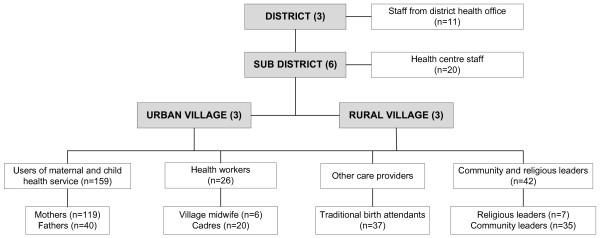
BACKGROUND: Trained birth attendants at delivery are important for preventing both maternal and newborn deaths. West Java is one of the provinces on Java Island, Indonesia, where many women still deliver at home and without the assistance of trained birth attendants. This study aims to explore the perspectives of community members and health workers about the use of delivery care services in six villages of West Java Province. METHODS: A qualitative study using focus group discussions (FGDs) and in-depth interviews was conducted in six villages of three districts in West Java Province from March to July 2009. Twenty FGDs and 165 in-depth interviews were conducted involving a total of 295 participants representing mothers, fathers, health care providers, traditional birth attendants and community leaders. The FGD and in-depth interview guidelines included reasons for using a trained or a traditional birth attendant and reasons for having a home or an institutional delivery. RESULTS: The use of traditional birth attendants and home delivery were preferable for some community members despite the availability of the village midwife in the village. Physical distance and financial limitations were two major constraints that prevented community members from accessing and using trained attendants and institutional deliveries. A number of respondents reported that trained delivery attendants or an institutional delivery were only aimed at women who experienced obstetric complications. The limited availability of health care providers was reported by residents in remote areas. In these settings the village midwife, who was sometimes the only health care provider, frequently travelled out of the village. The community perceived the role of both village midwives and traditional birth attendants as essential for providing maternal and health care services. CONCLUSIONS: A comprehensive strategy to increase the availability, accessibility, and affordability of delivery care services should be considered in these West Java areas. Health education strategies are required to increase community awareness about the importance of health services along with the existing financing mechanisms for the poor communities. Public health strategies involving traditional birth attendants will be beneficial particularly in remote areas where their services are highly utilized.
Overview
The claims and statistics of this paper haven’t been checked yet.
Free: it reads the open-access text and checks the first 5 claims that cite a source we can check. Create a free account to check every claim.
Integrity signals
Registry
Cites
Statistics
Figures
Verification
Claims the paper makes
The claims and statistics of this paper haven’t been checked yet.
Free: it reads the open-access text and checks the first 5 claims that cite a source we can check. Create a free account to check every claim.
Claims other papers make about this one
Each is checked against this paper’s own text: does it say what the citing paper says it does?
The source backs part of the claim, not all of it — or backs it for a different population, condition or comparison.
In the citing paper
“Facilitator/barrier: Health insurance schemes, national population policies, and national policies aimed to shift deliveries from the home to a facility”
From Facilitators and barriers to facility-based delivery in low- and middle-income countries: a qualitative evidence synthesis (2014) · cites this paper as [33]
Experimental — accuracy not yet measuredThe source backs part of the claim, not all of it — or backs it for a different population, condition or comparison.
In the citing paper
“Barrier: Inaccessibility of transportation and facilities during off-hours”
From Facilitators and barriers to facility-based delivery in low- and middle-income countries: a qualitative evidence synthesis (2014) · cites this paper as [33]
Experimental — accuracy not yet measuredThe source backs part of the claim, not all of it — or backs it for a different population, condition or comparison.
In the citing paper
“Barrier: TBAs perceived as providing high quality care”
From Facilitators and barriers to facility-based delivery in low- and middle-income countries: a qualitative evidence synthesis (2014) · cites this paper as [33]
Experimental — accuracy not yet measuredThe source backs part of the claim, not all of it — or backs it for a different population, condition or comparison.
In the citing paper
“Facilitator: TBAs perceived as providing low quality care”
From Facilitators and barriers to facility-based delivery in low- and middle-income countries: a qualitative evidence synthesis (2014) · cites this paper as [33]
Experimental — accuracy not yet measuredThe source backs part of the claim, not all of it — or backs it for a different population, condition or comparison.
In the citing paper
“Across many contexts, parturient women may not be in full control of the decision to seek facility-based delivery, instead relying on the decisions made by many actors, including elder women, husbands, family members, and neighbors.”
From Facilitators and barriers to facility-based delivery in low- and middle-income countries: a qualitative evidence synthesis (2014) · cites this paper as [33]
Experimental — accuracy not yet measured
50 more claims about this paper
Create a free account to see every claim other papers make about this one.
Self-check
Percentages, sums and reported differences re-computed from the paper’s own numbers.
The self-check needs the paper’s full text.
Citations
Cites
Qualitative research practice: a guide for social science students and researchers
(2003) · Choice Reviews Online · doi:10.5860/choice.41-1319 · Cited by 10,543
Qualitative methods for health research
(2009) · Choice Reviews Online · doi:10.5860/choice.47-0901 · Cited by 4,596
4 million neonatal deaths: When? Where? Why?
Lawn, J. E., Cousens, S., & Zupan, J. (2005) · The Lancet · doi:10.1016/s0140-6736(05)71048-5 · Cited by 3,670
Too far to walk: Maternal mortality in context
Thaddeus, S., & Maine, D. (1994) · Social Science & Medicine · doi:10.1016/0277-9536(94)90226-7 · Cited by 3,240
Maternal mortality: who, when, where, and why
Ronsmans, C., & Graham, W. J. (2006) · The Lancet · doi:10.1016/s0140-6736(06)69380-x · Cited by 1,801
Evidence-based, cost-effective interventions: How many newborn babies can we save?
Darmstadt, G. L., Bhutta, Z. A., Cousens, S., Adam, T., Walker, N., & de Bernis, L. (2005) · The Lancet · doi:10.1016/s0140-6736(05)71088-6 · Cited by 1,541 · cited 1×
“A recent review reported that around 20-30% of neonatal mortality could be reduced by implementing skilled birth care services [8].”
BackgroundEducation as a Factor in Mortality Decline An Examination of Nigerian Data
Caldwell, J. C. (1979) · Population Studies · doi:10.2307/2173888 · Cited by 1,093 · cited 1×
“A deprived financial situation is often linked to low education levels, which affects one’s ability to seek the most appropriate health care services [4,46].”
BackgroundThe World Health Report 2005 - make every mother and child count
Lerberghe, W. V., Manuel, A., Matthews, Z., & Wolfheim, C. (2005) · ePrints Soton (University of Southampton) · Cited by 1,015
Manandhar, D. S., Osrin, D., Shrestha, B. P., Mesko, N., Morrison, J., Tumbahangphe, K. M., Tamang, S., Thapa, S., Shrestha, D., Thapa, B., et al. (2004) · The Lancet · doi:10.1016/s0140-6736(04)17021-9 · Cited by 847
Bang, A. T., Bang, R. A., Baitule, S. B., Reddy, M. H., & Deshmukh, M. D. (1999) · The Lancet · doi:10.1016/s0140-6736(99)03046-9 · Cited by 842 · cited 1×
“Previous trials of delivery and postnatal care services involving traditional birth attendants in India and Pakistan demonstrated that engaging traditional birth attendants in the maternal and child health services had a favourable impact on neonatal and perinatal mortality [ 52 ,53].”
Background
Research works printed but not linked: 13
- Hull T Widayatun Raharto A Setiawan B Neither dukun nor doctor: Some problems of the village midwife programme in eastern Indonesia Australian Council for Overseas Aid Development Bulletin 1998 48
- Ministry of Health Republic of Indonesia - The Directorate General of Community Health Technical Guidelines for Health Insurance Scheme for the Population in Health Centres and its networks Year 2008 (Petunjuk teknis Jaminan Kesehatan Masyarakat (Jamkesmas) di Puskesmas dan Jaringannya Tahun 2008) 2008 Jakarta Ministry of Health Republic of Indonesia - The Directorate General of Community Health
- Badan Pusat Statistik-Statistics Indonesia (BPS), National Family Planning Coordinating Board, Ministry of Health, ORC Macro Indonesia Demographic and Health Survey 2007 2008 Calverton, Maryland: BPS and ORC Macro
- National Institute of Health Research and Development MoH, Republic of Indonesia Report on Results of National Basic Health Research 2007 2008 Jakarta: National Institute of Health Research and Development, Ministry of Health, Republic of Indonesia
- Ministry of Health Republic of Indonesia Indonesia Health Profile 2005 2007 Jakarta: Ministry of Health Republic of Indonesia
- Ministry of Health Republic of Indonesia Indonesia Health Profile 2007 2008 Jakarta: Ministry of Health Republic of Indonesia
- District Health Office of Garut Health Profile of Garut District (Profil Kesehatan Kabupaten Garut) 2008 2008 Garut District: District Health Office of Garut
- District Health Office of Ciamis Health Profile of Ciamis District (Profil Kesehatan Ciamis) 2008 2008 Ciamis District: District Health Office of Ciamis
- District Health Office of Sukabumi Health Profile of Sukabumi District (Profil Kesehatan Sukabumi) 2008 2008 Sukabumi District: District Health Office of Sukabumi
- Badan Pusat Statistik-Statistics Indonesia (BPS) Population of Indonesia: results of the 2005 Intercensal Population Survey [Penduduk Indonesia: hasil Survei Penduduk antar Sensus 2005] 2006 Jakarta: Badan Pusat Statistik-Statistics Indonesia (BPS)
- Ministry of Health Republic of Indonesia - Center for Data and Information Glosarium: Data & Informasi Kesehatan (Glossarium: Health Data and Information) 2006 Jakarta: Ministry of Health Republic of Indonesia - Center for Data and Information
- World Health Organization Traditional Birth Attendants: a joint WHO/UNFPA/UNICEF statement 1992 Geneva: World Health Organization
- Hunter CL Rozario S, Samuel G Embracing modernity: transformations in Sasak confinement practices The daughters of Hariti: childbirth and female healers in South and Southeast Asia 2002 London: Routledge
Cited by
Items 301–345 of 345
Role of Islamic Law and Institutions in Implementing Women’s Right to Family Planning in Indonesia
Fraser, J. (2020) · Cambridge University Press eBooks · doi:10.1017/9781108777711.006
Lynch, S. M. (2019) · UA Campus Repository (The University of Arizona)
Factors Shaping Uptake of Antenatal Care in Surabaya, Indonesia: a Qualitative StudyPreprint
Jones, L. I., Damayanti, N. A., Wiseman, N., & Harris, N. (2020) · Research Square · doi:10.21203/rs.3.rs-48436/v1
“These factors interact with broader cultural and social factors within which a mother lives to shape ANC uptake [17-20].”
BackgroundSendo, E. G. (2019) · Unisa Institutional Repository (University of South Africa)
Kencanawati, D. A. P. M., & Anggaraeningsih, N. L. M. D. P. (2021) · Journal of Educational and Social Research · doi:10.36941/jesr-2021-0071
Introduction: The Challenge of Human Rights Implementation
Fraser, J. (2020) · Cambridge University Press eBooks · doi:10.1017/9781108777711.002 · Cited by 2
Syaripah, R., & Marlina, E. D. (2021) · Journal of Midwifery Science and Women s Health · doi:10.36082/jmswh.v1i2.245
Fraser, J. (2020) · Cambridge University Press eBooks · doi:10.1017/9781108777711.004 · Cited by 1
Muhire, A., Mukarwego, B., Muhimba, I., Bizimana, G. E., Bagwaneza, T., & Rutayisire, E. (2021) · Austin Journal of Women’s Health · doi:10.26420/austinjwomenshealth.2021.1054
“Many births in low and middleincome countries are still occurring at home with no assistance of skilled attendants [2].”
BackgroundLaw, S., & Bhatia, R. (2014) · Scholar Commons (University of South Carolina)
Conclusions: Social Institutions and the Future of Domestic Human Rights Implementation
Fraser, J. (2020) · Cambridge University Press eBooks · doi:10.1017/9781108777711.007
Fraser, J. (2020) · Cambridge University Press eBooks · doi:10.1017/9781108777711.008
Safe motherhood: determinants of the utilization of maternal healthcare services in rural Zambia
Sialubanje, C. (2016) · Research Publications (Maastricht University) · doi:10.26481/dis.20160913cs
Setyaningsih, E. (2017) · Open Access Victoria University of Wellington | Te Herenga Waka (Figshare) · doi:10.26686/wgtn.17064245 · Cited by 1
Fraser, J. (2020) · Cambridge University Press eBooks · doi:10.1017/9781108777711.009
Analysis of the Selection of Birth Aid in Lebiti Village, Togean District, Tojo Una-Una Regency
Imbran, N. A., Djannah, S. N., & Solikhah, S. (2021) · Jurnal Aisyah Jurnal Ilmu Kesehatan · doi:10.30604/jika.v6is1.1032
Mselle, L. T., & Mpanda, S. M. (2022) · Global maternal and child health · doi:10.1007/978-3-031-06314-5_13
Takaeb, A. E. L., Ndun, H. J. N., & Hinga, I. A. T. (2022) · Media Publikasi Promosi Kesehatan Indonesia (MPPKI) · doi:10.56338/mppki.v5i5.2207
Simbolon, G. A. H., Siregar, M., & Pakpahan, S. (2022) · JURNAL KREATIVITAS PENGABDIAN KEPADA MASYARAKAT (PKM) · doi:10.33024/jkpm.v5i11.8029
“Under normal circumstances, maternal and neonatal mortality in Indonesia is still a big challenge, especially during a disaster situation (Titaley et al., 2010).”
BackgroundOktaviani, O., & Natalina, R. (2022) · GHMJ (Global Health Management Journal) · doi:10.35898/ghmj-51600
Factors contributing to home births among postpartum women in Manzini, Swaziland
Msibi, Z. S., Ntsoele, M. M. N., & Phaladi-Digamela, R. (2022) · African Journal of Midwifery and Women s Health · doi:10.12968/ajmw.2021.0037
Fitria, K., Wati, W., & Sumarni, D. W. (2022) · JURNAL PENELITIAN TERAPAN KESEHATAN · doi:10.33088/jptk.v9i1.237
Lusweti, C. N., & Ng'ambwa, T. O. (2023) · Journal of Anesthesia & Critical Care Open Access · doi:10.15406/jaccoa.2023.15.00548
Kusumawati, N., Erlinawati, E., Safitri, Y., Nurman, M., & Erlin, F. (2023) · PubMed Central · doi:10.30476/ijcbnm.2023.97491.2186 · Cited by 4
Nurfurqoni, F. A., Djamilus, F., & Astuti, M. (2023) · Journal of Health and Medical Sciences · doi:10.31014/aior.1994.06.02.267 · Cited by 2
Myint, W. W., Washburn, D. J., Lee, S., Colwell, B., Ahenda, P., & Maddock, J. E. (2023) · medRxiv · doi:10.1101/2023.10.05.23296593
REDUCING MATERNAL MORTALITY VIA MIDWIFERY IN DISTRICTS JHANG AND KHANEWAL OF PUNJAB, PAKISTAN
Rural Support Programme Network, I., Ijaz, M. S., Bibi, S., & Ministry of Poverty Alleviation and social safety (PASS), I. (2022) · Pakistan Journal of Social Research · doi:10.52567/pjsr.v4i03.1298
The struggle to deliver in squatters: a qualitative study on inter-state migrant women in Aligarh
Iqrar, S., & Musavi, A. (2024) · International Journal of Migration Health and Social Care · doi:10.1108/ijmhsc-12-2022-0119
Membangun Kesatuan Bangsa melalui Pendekatan Pemberdayaan Sosial dan Budaya Masyarakat Papua
Sarjito, A. (2024) · Journal of Governance and Policy Innovation · doi:10.51577/jgpi.v4i1.472 · Cited by 8
“Kurangnya keterwakilan masyarakat marginal dalam perumusan kebijakan dan proses pengambilan keputusan menyebabkan pengabaian kebutuhan dan aspirasi mereka (Titaley et al., 2010).”
BackgroundNanur, F. N., Widarini, N. P., & Karmaya, I. N. M. (2016) · Public Health and Preventive Medicine Archive · doi:10.53638/phpma.2016.v4.i1.p05
Indonesian midwives’ experiences in delivering childbirth services: A qualitative study
Oktiningrum, M., & Soraya, D. (2024) · Journal of Healthcare Administration · doi:10.33546/joha.3521
Camara, B. S., de Kok, B. C., Delvaux, T., Délamou, A., Grietens, K. P., & Gerrits, T. (2025) · Critical Public Health · doi:10.1080/09581596.2025.2484339
“…of maternity care services. they include the high financial (direct and indirect) costs of services (camara et al., 2021; Munguambe et al., 2016; titaley et al., 2010), poor infrastructure (hunter & Murray, 2017; Nyakang’o & Booth, 2018; Uneke et al., 2014), lack of resources (equipment,…”
Marwein, N. (2025) · INTERNATIONAL JOURNAL OF CREATIVE RESEARCH THOUGHTS · doi:10.56975/ijcrt.v13i4.284621
Kabwama, S. N., Bulafu, D., Ndejjo, R., Nampeera, R., Kihembo, C., Umeokonkwo, C. D., Antara, S. N., Gitta, S. N., Kyozira, C., Muruta, A. N., et al. (2025) · JMIR Public Health and Surveillance · doi:10.2196/77135 · Cited by 1
“Acknowledging cultural norms and values to advance public health goals has been successfully used to improve access to maternal health services in Indonesia [34], and scale up male circumcision in Lesotho and Swaziland [35].”
Iqbal, M. H., Deb, E., Chowdhury, M., Pia, M. B., & Mozahid, M. N. (2025) · Research Square · doi:10.21203/rs.3.rs-6234069/v1
Ngige, E., Kamara, M., Turay, M., Michaelis, A. P., Mekonnen, Z. A., Boima, F., & Jepkogei, G. (2025) · Research Square · doi:10.21203/rs.3.rs-6945535/v1
Biresaw, H. B., Fenta, S. M., Masresha, B. M., Fentaw, K. D., Moyehodie, Y. A., Belay, A. T., & Yalew, M. M. (2025) · SAGE Open · doi:10.1177/21582440251339968 · Cited by 1
Maximore, L., Mohammed, A. G., Issahaku, G. R., Sackey, S. O., & Kenu, E. (2022) · Figshare · doi:10.6084/m9.figshare.20521385
Islam, S., Adawiyah, W. R., Fauzi, D. R., Oalywllah, M., & Naik, A. R. (2026) · Global Social Welfare · doi:10.1007/s40609-026-00461-6
Traditional Ethno-Gynaecological Practises in Muriya Tribe of Bijapur District of Chhattisgarh
Neti, P. R., & Kumar, S. (2026) · International Journal of Reviews and Research in Social Sciences · doi:10.52711/2454-2687.2026.00007
Yusuf, B., Agustarika, B., Lukman, L., & Yuliati, Y. (2026) · Nursing Arts · doi:10.36741/na.v20i1.236
“…penelitian mengenai determinan maternal terhadap antropometri neonatal masih dilakukan di rumah sakit rujukan, sedangkan bukti dari fasilitas pelayanan kesehatan primer, khususnya pada persalinan normal dengan bantuan oksitosin, masih sangat terbatas (Organization, 2024; Titaley et al., 2010).”
Olagunju, O. I., Stephen, A. M., Wokoma, V. E., Eko, I. O., & Bolaji, A. K. (2026) · Annals of Global Health · doi:10.5334/aogh.5356
Cultural Considerations for Maternal and Child Health
Magrath, P. A., Miiro, F. N., & Woodson, L. L. (2026) · Springer eBooks · doi:10.1007/978-1-0716-5428-6_5
Fabian, A. (2026) · Advances in African economic, social and political development · doi:10.1007/978-3-032-29966-6_25
Birlie, A. A., Dube, G. N., Abebe, A. W., Tizie, S. B., Muluneh, A. A., Tadese, Z. B., & Bedada, T. D. (2026) · Scientific African · doi:10.1016/j.sciaf.2026.e03684
Metadata
- Authors
- Titaley, C. R., Hunter, C. L., Dibley, M. J., & Heywood, P.
- Affiliations
- The University of Sydney (AU)
- Corresponding author
- Titaley, Christiana R
- Venue
- BMC Pregnancy and Childbirth
- Published
- 2010-08-11
- Volume
- 10
- Issue
- 1
- Pages
- 43-43
- ISSN
- 1471-2393 (ISSN-L)
- PMC
- PMC2928756
- OpenAlex
- W1965905056
- Cited by
- 346
- References
- 53
- Citations by year
- 2026: 7 · 2025: 12 · 2024: 12 · 2023: 23 · 2022: 20 · 2021: 23 · 2020: 32 · 2019: 27 · 2018: 29 · 2017: 32 · 2016: 31 · 2015: 29 · 2014: 30 · 2013: 17 · 2012: 12
- FWCI
- 11.30
- Type
- journal article
- Language
- en
- Open access
- gold
- doi.org
- Licence
- cc-by
- creativecommons.org/licenses/by/2.0 (tdm)
- Locations
- BMC Pregnancy and Childbirth (publishedVersion, cc-by)
- PubMed Central (publishedVersion, cc-by)
- PubMed (publishedVersion)
- DOAJ (DOAJ: Directory of Open Access Journals) (submittedVersion, cc-by-sa)
- Funders
- Ford Foundation
- Australian Agency for International Development
- University of Sydney
- Topics
- Health Sciences › Medicine › Pediatrics, Perinatology and Child Health › Global Maternal and Child Health
- Health Sciences › Medicine › Obstetrics and Gynecology › Maternal and Perinatal Health Interventions
- Health Sciences › Medicine › Pediatrics, Perinatology and Child Health › Maternal and Neonatal Healthcare
- Keywords
- traditional birth attendants, home delivery, institutional delivery, village midwives, access to maternal health services, barriers to health care access, health care financing, maternal and newborn health, community perceptions, West Java
- MeSH terms
- Community-Institutional Relations, Decision Making, Female, Financing, Personal, Health Services Accessibility, Home Childbirth, Humans, Indonesia, Male, Maternal Health Services, Midwifery, Patient Acceptance of Health Care, Pregnancy, Health Care Costs, Qualitative Research
About these checks
Registry, retraction, Cites and statistics results are computed, not judged, with one exception: a printed reference that no index lists is read once by a model before it counts as a citation error. Claims are extracted by a model and kept only when their quote appears verbatim in the text; each cited source is then checked, with a model’s help, for whether it says what the claim relies on. Those verdicts can be wrong — read the claim’s quote and the cited source before relying on one.
Statistics and arithmetic are recomputed, not judged.
Confidence bands are shown only for fields calibrated on our annotated test set. None is calibrated yet, so no band is shown.
What counts as a claim ›How we measure confidence ›How we check this ›
Are you an author, or do you see a problem with this page? Request a review
Data sources
Bibliographic data: Semantic Scholar, OpenAlex, Crossref.
Contains information from the Semantic Scholar Academic Graph Datasets, made available under the ODC Attribution License (ODC-BY 1.0).
Semantic Scholar’s data is described in: Kinney, R., et al. (2023). The Semantic Scholar Open Data Platform. arXiv:2301.10140.
