

Key components of early intervention programs for preterm infants and their parents: a systematic review and meta-analysis
Open accessThe DOI matches its Crossref record; 78 of the 78 references it cites were found in a registry or an index.
Abstract
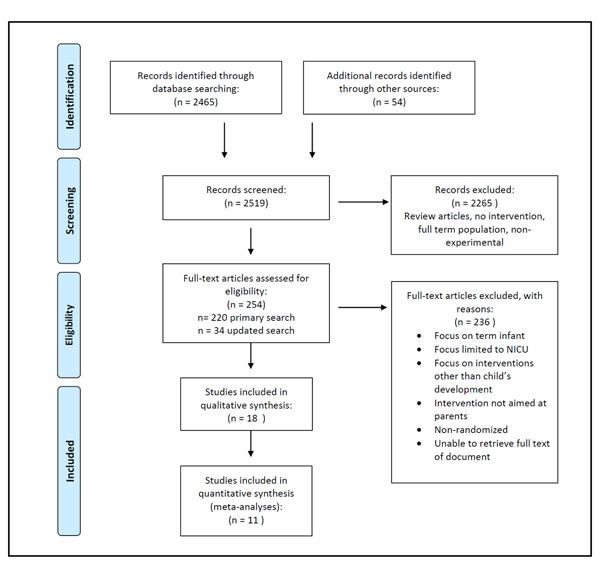
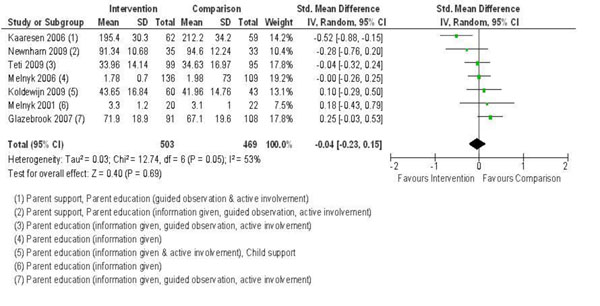
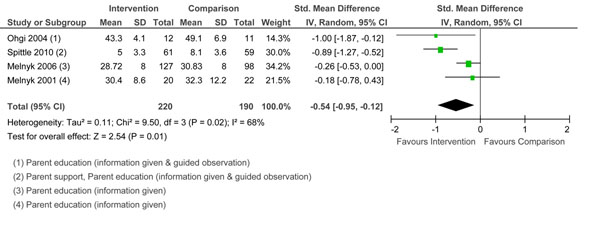
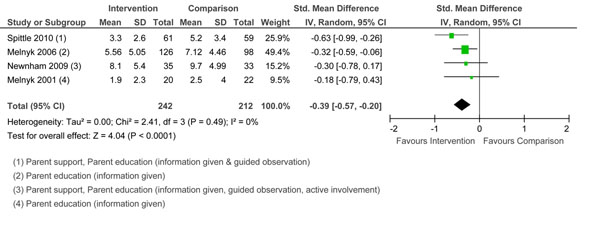
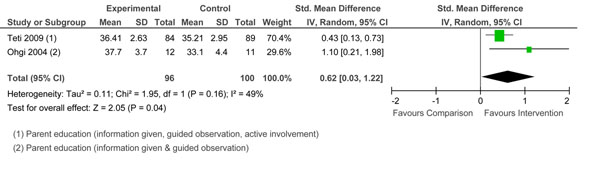
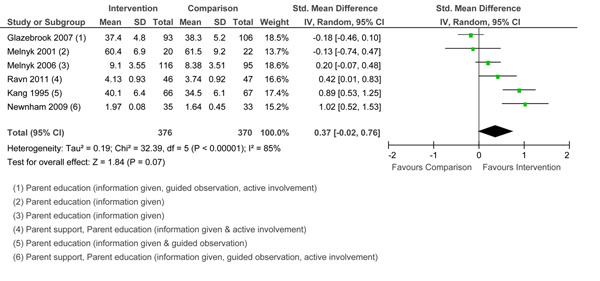
BACKGROUND: Preterm infants are at greater risk for neurodevelopmental disabilities than full term infants. Interventions supporting parents to improve the quality of the infant's environment should improve developmental outcomes for preterm infants. Many interventions that involve parents do not measure parental change, nor is it clear which intervention components are associated with improved parental outcomes. The aim of this review was to categorize the key components of early intervention programs and determine the direct effects of components on parents, as well as their preterm infants. METHODS: MEDLINE, EMBASE, CINAHL, ERIC, and Cochrane Database of Systematic Reviews were searched between 1990 and December 2011. Eligible randomized controlled trials (RCTs) included an early intervention for preterm infants, involved parents, and had a community component. Of 2465 titles and abstracts identified, 254 full text articles were screened, and 18 met inclusion criteria. Eleven of these studies reported maternal outcomes of stress, anxiety, depressive symptoms, self-efficacy, and sensitivity/responsiveness in interactions with the infant. Meta-analyses using a random effects model were conducted with these 11 studies. RESULTS: Interventions employed multiple components categorized as (a) psychosocial support, (b) parent education, and/or (c) therapeutic developmental interventions targeting the infant. All interventions used some form of parenting education. The reporting quality of most trials was adequate, and the risk of bias was low based on the Cochrane Collaboration tool. Meta-analyses demonstrated limited effects of interventions on maternal stress (Z = 0.40, p = 0.69) and sensitivity/responsiveness (Z = 1.84, p = 0.07). There were positive pooled effects of interventions on maternal anxiety (Z = 2.54, p = 0.01), depressive symptoms (Z = 4.04, p <.0001), and self-efficacy (Z = 2.05, p = 0.04). CONCLUSIONS: Positive and clinically meaningful effects of early interventions were seen in some psychosocial aspects of mothers of preterm infants. This review was limited by the heterogeneity of outcome measures and inadequate reporting of statistics. IMPLICATIONS OF KEY FINDINGS: Interventions for preterm infants and their mothers should consider including psychosocial support for mothers. If the intervention involves mothers, outcomes for both mothers and preterm infants should be measured to better understand the mechanisms for change.
Overview
The claims and statistics of this paper haven’t been checked yet.
Free: it reads the open-access text and checks the first 5 claims that cite a source we can check. Create a free account to check every claim.
Integrity signals
Registry
Cites
Statistics
Figures
Verification
Claims the paper makes
The claims and statistics of this paper haven’t been checked yet.
Free: it reads the open-access text and checks the first 5 claims that cite a source we can check. Create a free account to check every claim.
Claims other papers make about this one
Each is checked against this paper’s own text: does it say what the citing paper says it does?
The source backs part of the claim, not all of it — or backs it for a different population, condition or comparison.
In the citing paper
“These emotions increase during the transition to home from hospital,14–16 depending on the child’s condition and the parent’s readiness for discharge11 and their medical caregiving role.17 18”
From Coached, Coordinated, Enhanced Neonatal Transition (CCENT): Protocol for a multicentre pragmatic randomised controlled trial of transition-to-home support for parents of high-risk infants (2021) · cites this paper as [14]
Experimental — accuracy not yet measuredThe source backs part of the claim, not all of it — or backs it for a different population, condition or comparison.
In the citing paper
“In order to address the lack of evidence-based interventions supporting fathers of high-risk infants,9 14 we have included both fathers and mothers in our study.”
From Coached, Coordinated, Enhanced Neonatal Transition (CCENT): Protocol for a multicentre pragmatic randomised controlled trial of transition-to-home support for parents of high-risk infants (2021) · cites this paper as [14]
Experimental — accuracy not yet measuredThe source backs part of the claim, not all of it — or backs it for a different population, condition or comparison.
In the citing paper
“Enhanced psychosocial support for parents has the potential to improve parent-infant attachment and developmental outcomes for preterm infants (4).”
From Exploring Acceptance and Commitment Therapy for parents of preterm infants. (2021) · cites this paper as [4]
Experimental — accuracy not yet measuredThe cited source says what the claim attributes to it.
In the citing paper
“A systematic review of interventions for NICU parents including psychosocial support, education, and/or developmental interventions reported positive effect on depression and anxiety, but limited effect on stress.14”
The cited source says what the claim attributes to it.
In the citing paper
“A systematic review of early interventions to support parents of preterm infants found interventions composed of psychosocial support, education, and/or therapeutic developmental interventions had positive effects on depressive symptoms, anxiety, and self-efficacy, but limited effects on stress, and no overall significant effect on parental sensitivity/responsiveness (4).”
From Exploring Acceptance and Commitment Therapy for parents of preterm infants. (2021) · cites this paper as [4]
Self-check
Percentages, sums and reported differences re-computed from the paper’s own numbers.
The self-check needs the paper’s full text.
Citations
Cites
The Hospital Anxiety and Depression Scale
Zigmond, A. S., & Snaith, R. P. (1983) · Acta Psychiatrica Scandinavica · doi:10.1111/j.1600-0447.1983.tb09716.x · Cited by 47,139
Cochrane Handbook for Systematic Reviews of Interventions: Cochrane Book Series
(2008) · doi:10.1002/9780470712184 · Cited by 25,048
(1970) · Cited by 24,983
Pharmacological interventions for somatoform disorders in adults
Kleinstäuber, M., Witthöft, M., Steffanowski, A., van Marwijk, H., Hiller, W., & Lambert, M. J. (2014) · Cochrane Database of Systematic Reviews · doi:10.1002/14651858.cd010628.pub2 · Cited by 11,335
Developing and evaluating complex interventions: the new Medical Research Council guidance
Craig, P., Dieppe, P., Macintyre, S., Michie, S., Nazareth, I., & Petticrew, M. (2008) · BMJ · doi:10.1136/bmj.a1655 · Cited by 10,995
Funnel plots for detecting bias in meta-analysis
Sterne, J. A. C., & Egger, M. (2001) · Journal of Clinical Epidemiology · doi:10.1016/s0895-4356(01)00377-8 · Cited by 3,779
Cognitive and Behavioral Outcomes of School-Aged Children Who Were Born Preterm: A Meta-analysis
Bhutta, A. T., Cleves, M. A., Casey, P. H., Cradock, M. M., & Anand, K. J. S. (2002) · JAMA · doi:10.1001/jama.288.6.728 · Cited by 2,392
Less is more: meta-analyses of sensitivity and attachment interventions in early childhood
Bakermans-Kranenburg, M. J., van IJzendoorn, M. H., & Juffer, F. (2003) · Psychological Bulletin · doi:10.1037/0033-2909.129.2.195 · Cited by 1,883
The Worldwide Incidence of Preterm Birth: A Systematic Review of Maternal Mortality and Morbidity
Beck, S., Wojdyla, D., Say, L., Pilar Bertran, A., Meraldi, M., Harris Requejo, J., Rubens, C., Menon, R., & Van Look, P. (2010) · Bulletin of the World Health Organization · doi:10.2471/blt.08.062554 · Cited by 1,523
Postpartum depression effects on early interactions, parenting, and safety practices: a review
Field, T. (2010) · Infant Behavior and Development · doi:10.1016/j.infbeh.2009.10.005 · Cited by 1,493 · cited 1×
“Together, these psychosocial factors influence maternal sensitivity and responsiveness in interactions with the infant [25], which ultimately affect child developmental outcomes [26].”
Background
Research works printed but not linked: 5
- Bronfenbrenner U Bronfenbrenner U The biological theory of human development Making human beings human: Biological perspectives on human development 2005 Thousand Oaks, CA: Sage Publications 3 15
- IHDP - The Infant Health and Development Program Enhancing the outcomes of low-birth-weight, premature infants: A multisite, randomized trial Journal of the American Medical Association 1990 263 22 3035 3042 2188023
- The Cochrane Collaboration Review Manager (RevMan) 2011 5.1 Copenhagen: The Nordic Cochrane Centre
- IHDP (The Infant Health and Development Program) Enhancing the outcomes of low-birth-weight, premature infants: A multisite, randomized trial Journal of the American Medical Association 1990 263 22 3035 3042 2188023
- Egeland B Weinfield NS Bosquet M Cheng VK Osofsky JD, Fitzgerald HE Remembering, repeating, and working through: Lessons from attachment-based interventions Handbook of infant mental health Vol 4: Infant mental health in groups at high risk 2000 New York: Wiley 35 89
Cited by
Items 301–385 of 385
Perasso, G. F., Silton, N. R., & Angelis, J. D. (2020) · Advances in medical education, research, and ethics (AMERE) book series · doi:10.4018/978-1-7998-2940-9.ch009 · Cited by 3
Yamada, J., Ballantyne, M., Kron, A., & Sidani, S. (2020) · Canadian Journal of Nursing Research · doi:10.1177/0844562120931661 · Cited by 2
“This intervention is aligned with evidence supporting interventions for parents of preterm infants that consist of multiple components as more effective in addressing parents’ concerns and needs than single component interventions (Benzies et al., 2013).”
MethodSelf-citationFinlayson, F., Olsen, J. E., Remedios, L. J., & Spittle, A. J. (2020) · Acta Paediatrica · doi:10.1111/apa.15683 · Cited by 4
“This study is different to other reviews that have included only preterm infants, rather than broader neurodevelopmental impairments, or focused primarily on infant development [5], mother-infant attachment [6] or NICU-based [3] interventions.”
BackgroundResultHigh-risk babies and neurodevelopmental outcome
Shrestha, M. (2021) · Elsevier eBooks · doi:10.1016/b978-0-12-817988-8.00004-x · Cited by 2
Sierra, A. (2021) · British Journal of Midwifery · doi:10.12968/bjom.2021.29.7.392 · Cited by 2
Actitudes de madres adultas y adolescentes hacia la crianza de bebés prematuros
Carvajal, B. V., Porras, C. V., & Nieves, E. R. (2017) · Investigación en Enfermería Imagen y Desarrollo · doi:10.11144/javeriana.ie19-2.amaa · Cited by 3
Parent–Child Interaction Therapy for Children with Developmental Delay and Related Problems
Garcia, D., Magariño, L. S., & Bagner, D. M. (2018) · Springer eBooks · doi:10.1007/978-3-319-97698-3_7 · Cited by 3
Neuroconstructivism to understand the effect of very preterm birth on language and literacy
Guarini, A., Zuccarini, M., & Sansavini, A. (2019) · John Benjamins Publishing Company eBooks · doi:10.1075/z.223.02gua · Cited by 4
Early intervention: The challenge to find the best approach for infant and family
Hadders‐Algra, M. (2017) · Australian Occupational Therapy Journal · doi:10.1111/1440-1630.12427 · Cited by 2
Bear, R. J. (2019) · Open Access Victoria University of Wellington | Te Herenga Waka (Figshare) · doi:10.26686/wgtn.17135888 · Cited by 6
Risk Assessment and Neurodevelopmental Outcomes
DeMauro, S. B., & Hintz, S. R. (2023) · Elsevier eBooks · doi:10.1016/b978-0-323-82823-9.00024-6 · Cited by 1
Effectiveness of early intervention on developmental milestones among early-term babies
Gayathri, K. C., Subramanian, S. S., Mohan, S., Altaim, T. A., Thanigachalam, K., El-Gendy, S. R., Saicheethra, S., Senthil, P., & Gaowgzeh, R. A. M. (2023) · doi:10.56984/8zg20bxt7 · Cited by 1
Helmer, C. S. (2024) · Linköping University medical dissertations · doi:10.3384/9789180754934 · Cited by 2
Pusri, S., Payakkaraung, S., & Thampanichawat, W. (2025) · Infant Mental Health Journal · doi:10.1002/imhj.70013 · Cited by 1
“Benzies et al.’s (2013) systematic review found that maternal education and psychosocial support led to improved outcomes for mothers of preterm infants.”
An integrative review of family supports as components of early childhood home visiting models
Clark, C., Shaw, K. R., Snyder, P., Conroy, M. A., & Mawdsley, H. P. (2025) · Family Relations · doi:10.1111/fare.70001 · Cited by 1
Dsouza, S. N., Aranha, P. R., Mithun, H. K., Shenoy, M. S., & Nayak, P. (2025) · Journal of Datta Meghe Institute of Medical Sciences University · doi:10.4103/jdmimsu.jdmimsu_22_25 · Cited by 1
Sirma, G. Ç., Alpözgen, A. Z., & Balıkçı, A. (2025) · Frontiers in Pediatrics · doi:10.3389/fped.2025.1606490 · Cited by 5
Parent-Led Early Intervention in Very Preterm Infants and Executive Function at School Age
Tarouco, M. L., Procianoy, R. S., O’Shea, T. M., & Silveira, R. C. (2026) · Archives of Pediatrics and Adolescent Medicine · doi:10.1001/jamapediatrics.2025.5866 · Cited by 1
Robinson, G., Aquino, D., Su, J., Taylor, K., & Brown, K. (2026) · Maternal Health Neonatology and Perinatology · doi:10.1186/s40748-025-00245-4 · Cited by 1
“Clinical care needs to be embedded in a framework of culturally safe, wrap-around care and augmented by early intervention to build parenting strengths of mothers through effective psycho-social support [17, 18].”
Helmer, C. S., Thornberg, U. B., Abrahamsson, T., & Mörelius, E. (2026) · International Journal of Nursing Studies Advances · doi:10.1016/j.ijnsa.2026.100507 · Cited by 1
“These interventions often focus on enhancing parental responsiveness and providing structured guidance in caregiving (Benzies et al., 2013).”
Montreuil, T. C., Gratton, C., Mir-Shokraei, K., Biran, V., Beltempo, M., Brossard‐Racine, M., & Lecorguillé, M. (2026) · BMJ Open · doi:10.1136/bmjopen-2026-116985 · Cited by 2
McGuire-Brown, M., Banihani, R., Watson, J., Ng, E., Rocha, C., Borges, L., & Church, P. (2022) · Children · doi:10.3390/children9050591 · Cited by 1
Quiñones-Preciado, J. A., Peña-García, Á. A., Vallecilla-Zambrano, D. G., Yama-Oviedo, J. A., Hernández, N. L., & Ordóñez-Hernández, C. A. (2023) · Interface - Comunicação Saúde Educação · doi:10.1590/interface.220537 · Cited by 1
Coquery, M., Paviot, S., Phelix, L. A., & Daude, H. (2023) · Motricité Cérébrale · doi:10.1016/j.motcer.2023.08.001 · Cited by 1
Centar za odgoj, O. I. R. „. N., & Pasalic, A. (2023) · Multidisciplinarni Pristupi u Edukaciji i Rehabilitaciji · doi:10.59519/mper5204 · Cited by 1
Shearer, A. E. (2023) · The Volta Review · doi:10.17955/tvr.123.1.symp3 · Cited by 1
Evaluation of the Ei SMART training programme in the UK
Viviers, M., Jary, S., Basu, A. P., Moffat, J., Harniess, P., Erdmann, S., & Hutchon, B. (2024) · Journal of Neonatal Nursing · doi:10.1016/j.jnn.2024.07.018 · Cited by 1
Namprom, N., Picheansathian, W., Jintrawet, U., & Chotibang, J. (2017) · Walailak Journal of Science and Technology (WJST) · doi:10.48048/wjst.2019.3729 · Cited by 1
“Four systematic reviews on the early interventions involving parents for preterm infants indicated that 3 key components for improving mother and preterm outcomes should be included psychosocial support, educational support, and therapeutic developmental interventions targeting the infants [20-23].”
BackgroundMiller, K., Marvin, C., & Lambert, M. (2019) · Infants and young children · doi:10.1097/iyc.0000000000000130 · Cited by 2
Supporting Students with Cerebral Palsy
Gonzales, M. (2020) · Springer eBooks · doi:10.1007/978-981-33-4558-4_12 · Cited by 1
A Scoping Review of Mental Health Programs for Parents of Children with Complex Medical ConditionsPreprint
Kaminski, L., Joyce, K. M., Simpson, K. M., Wittmeier, K. D. M., Benzies, K., El-Gabalawy, R. M., Tomfohr‐Madsen, L. M., Woodgate, R. L., & Roos, L. E. (2021) · PsyArXiv (OSF Preprints) · doi:10.31234/osf.io/cjsz7 · Cited by 1
Self-citationMileski, M. M., Garcia, Y. M., & Campos, S. (2014) · Formação (Online) · doi:10.33081/formacao.v2i20.2356
Preterm Infants’ Follow-Up Program at a Public Hospital in Buenos Aires: Two-Decade Study
Aspres, N., Schapira, I. T., Benitez, A., Galindo, A., Brundi, M., Kasten, L., Feld, V., Granovsky, G., Allignani, G., Fiorentino, A., et al. (2014) · Journal of Intellectual Disability - Diagnosis and Treatment · doi:10.6000/2292-2598.2014.02.02.8
Current Resources for Evidence‐Based Practice, January/February 2014
Avery, M. D. (2014) · Journal of Obstetric, Gynecologic & Neonatal Nursing · doi:10.1111/1552-6909.12271
Seo, I. H., & Gye-Soon, K. (2013) · Korean Journal of Social Welfare Studies · doi:10.16999/kasws.2013.44.3.237
Roué, J., Ropars, J., Duigou, A.-L., Brochard, S., & Sizun, J. (2016) · Archives de Pédiatrie · doi:10.1016/j.arcped.2016.10.025
Parenting on the threshold of viability : The impact of preterm birth on parental care
Hoffenkamp, H. N. (2015) · Research portal (Tilburg University)
Hoffenkamp, H. N., Tooten, A., Hall, R. A. S., Braeken, J., Eliëns, M. P. J., Vingerhoets, A. J. J. M., & van Bakel, H. J. A. (2017) · Gezinstherapie Wereldwijd · doi:10.1007/s12440-016-0041-1
Méndez, S. C. (2018) · Enfermería actual en Costa Rica · doi:10.15517/revenf.v0i1.32293 · Cited by 4
Early Intervention Services for Young Children with Cerebral Palsy
Fiss, A. L., & Jeffries, L. M. (2018) · Springer eBooks · doi:10.1007/978-3-319-50592-3_153-1
Bonomi, S., & Filisetti, M. (2020) · Acta Scientific Paediatrics · doi:10.31080/aspe.2020.03.0291
Infant and Maternal Mental Health issues
Altimier, L., & Boyle, B. (2020) · Journal of Neonatal Nursing · doi:10.1016/j.jnn.2020.11.012
Landis, T. D., Hare, M. M., & Graziano, P. A. (2020) · medRxiv · doi:10.1101/2020.12.09.20246553
Faccini, J. G. (2020) · Revista Chilena de Terapia Ocupacional · doi:10.5354/0719-5346.2020.60545 · Cited by 1
“TO ‘tradicionales’ tenían más probabilidades de usar estrategias de modelado Universidad de Chile Facultad de Medicina Departamento de Terapia ocupacional y Ciencia de la Ocupación 108 ISSN ImpreSo: 0717–6767 ISSN electróNIco: 0719-5346 Temas Autores Studio Sensorial Enfocado en el padre//familia Grupal Coulthard et a…”
InfluentialParents of Preterm and Very Low Birthweight Infants and Their Childrearing Practices
Koldoff, E. A., Holtzclaw, B. J., & Kolobe, T. H. A. (2021) · Western Journal of Nursing Research · doi:10.1177/01939459211015670 · Cited by 1
“However, studies have found that with adequate information, support, and time to modify their expectations many families adjust well and experience positive family function (Benzies et al., 2013).”
BackgroundLuu, T. M., Xie, L. F., Peckre, P., Côté, S. M., Karsenti, T. P., Walker, C., & Gosselin, J. (2017) · doi:10.2196/preprints.8289
The impact of Kaizen approach on neurodevelopmental follow-up of high-risk infants
Kurt, M., Engür, D., Gençpınar, P., Akkaya, M. İ., Kaya, D. Ö., & Dündar, N. O. (2022) · International Journal of Healthcare Management · doi:10.1080/20479700.2022.2135068
“Inducing neuroplasticity during the critical period of brain development by early interventions will maximize the clinical outcomes [4].”
BackgroundRano otkrivanje i neurorehabilitacija djece sa neurorazvojnim odstupanjima
Brenčić, M., Karnjuš, R., Bodul, M., Kolić, I., & Đuranović, V. (2022) · Medicina Fluminensis · doi:10.21860/medflum2022_284682
Supporting Early Parenting Following Preterm Birth
Parascandalo, R. P., & Hugill, K. (2022) · Springer eBooks · doi:10.1007/978-3-031-17285-4_7 · Cited by 3
Quiñones-Preciado, J. A., Peña-García, Á. A., Vallecilla-Zambrano, D. G., Yama-Oviedo, J. A., Hernández, N. L., & Ordóñez-Hernández, C. A. (2023) · Interface - Comunicação Saúde Educação · doi:10.1590/interface.220670
“14 a educação é um componente crucial nos programas de acompanhamento de prematuros, pois melhora aspectos relacionados à segurança e autoeficácia ao fornecer aos pais ferramentas para cuidar de seu bebê, tendo impacto positivo no desenvolvimento infantil.”
BackgroundFitriahadi, E., Zaidah, L. L., & Kurniawan, A. (2023) · Advances in health sciences research/Advances in Health Sciences Research · doi:10.2991/978-94-6463-190-6_49
Lobo, R. S., Mendonca, T. L., & Chavan, S. S. (2023) · IP Journal of Paediatrics and Nursing Science · doi:10.18231/j.ijpns.2023.023
Cochlear Implants for Children with Unilateral Hearing Loss: Debunking the Myths
Park, L. R. (2023) · The Volta Review · doi:10.17955/tvr.123.1.symp4
Prematüre Bebeklere Yönelik Erken Müdahale Çalışmalarına İlişkin Tarama Çalışması
Kahraman, Ö. G., & Özdemir, E. S. (2024) · İzmir Katip Çelebi Üniversitesi Sağlık Bilimleri Fakültesi Dergisi · doi:10.61399/ikcusbfd.1238230
Investigating Autonomic Modulation During Shared Reading in Term and Preterm Infants: A Pilot Study
Lavezzo, L., Grandjean, D., Munoz, F. B., Borradori-Tolsa, C., Scilingo, E. P., Nardelli, M., & Filippa, M. (2024) · IEEE International Symposium on Medical Measurements and Applications (MeMeA) · doi:10.1109/memea60663.2024.10596898
“The critical period for ANS development extends until infancy [12], representing the most effective time window for early interventions aimed at mitigating these adverse effects [13].”
BackgroundEvidence-Based Physiotherapy and Rehabilitation Practices in Cerebral Palsy
Apaydın, Y., & Kırmızı, M. (2024) · doi:10.69860/nobel.9786053358794.5
Integrating Neonatal Vascular Access and Neuroprotective Care
van Rens, M. R., & Hugill, K. (2024) · Springer eBooks · doi:10.1007/978-3-031-81602-4_8
Early intervention and educational needs among school-aged children born preterm
Lacalle, L., Melero, S., & Sánchez‐Sandoval, Y. (2025) · Acta Psychologica · doi:10.1016/j.actpsy.2025.104941
Badura, A., Fiander, M., Gabriel, A., Pirinu, M., Beccani, L., Soll, R. F., Cracknell, J., Faas, D., Wellmann, S. M., & Bruschettini, M. (2025) · Cochrane Database of Systematic Reviews · doi:10.1002/14651858.cd016181 · Cited by 2
Badura, A., Hiekel, J., Saladino, A., Murature, D., Lenells, M., Fiander, M., Wellmann, S. M., & Bruschettini, M. (2025) · Cochrane Database of Systematic Reviews · doi:10.1002/14651858.cd016170
Henry, A. D., Stanton, C. A., Plosa, E. J., & Boles, J. C. (2025) · Journal of Neonatal-Perinatal Medicine · doi:10.1177/19345798251349416
Boissel, L., Benarous, X., Mariana, C., Scoury, D., Corde, P., Crovetto, C., Kongolo, G., Wallois, F., Bonaiuto, J. J., Rayson, H., et al. (2025) · Scientific Reports · doi:10.1038/s41598-025-20448-1 · Cited by 1
“These methods are essential, as numerous studies have emphasized the importance of early therapies in fostering the parent-child bond, starting from the NICU 4–6 .”
Additional file 1 of Maternal wellbeing of Malaysian mothers after the birth of a preterm infant
Jones, L., Mariapun, J., Tan, A. X. Q., Kassim, Z., & Su, T. T. (2024) · Figshare · doi:10.6084/m9.figshare.26604046
Principles of Early Intervention in Cerebral Palsy
Guzzetta, A., Chorna, O., Rocchitelli, L., & Bai, A. V. (2025) · Springer eBooks · doi:10.1007/978-3-032-09211-3_19
Hullumani, S., Qureshi, I., & Raghumahanti, R. (2026) · BMJ Open · doi:10.1136/bmjopen-2025-106452 · Cited by 1
Mental health in parents of very preterm infants at 12 months: Influential variables and profiles
Barbancho-Morant, M. M., Padilla-Muñoz, E. M., Sanduvete‐Chaves, S., Moscoso, S. C., & Lanzarote-Fernández, M. D. (2026) · Family Relations · doi:10.1111/fare.70136
Valencia‐Agudo, F., Villalta, L., Urbiola-Merina, E., Garriz-Luis, A., López-Moreno, L., Rivas-Rodríguez, M., Parellada, M., & Romero-González, M. (2026) · Journal of Autism and Developmental Disorders · doi:10.1007/s10803-026-07268-6
Sørvoll, M., Girolami, G. L., Ustad, T., Evensen, K. A. I., Campbell, S. K., & Øberg, G. K. (2026) · Frontiers in Psychology · doi:10.3389/fpsyg.2026.1750035
“Furthermore, there is still much to learn about which processes are essential for facilitating effective child and parental learning and development (Benzies et al., 2013; Anderson et al., 2020).”
Toma, A. I., Dima, V., Zaharie, G. C., Necula, A. I., Stoiciu, R. P., & Bivoleanu, A. R. (2026) · Medicina · doi:10.3390/medicina62061052
“Our stratified approach aims to maintain continuous contact with families and to involve them in the early intervention process, which is the recommended approach for such programmes [44].”
Bonfanti, C., Fontana, C., Meloni, S., Mosca, F., & Fumagalli, M. (2026) · Frontiers in Pediatrics · doi:10.3389/fped.2026.1823643
Mobbs, C. A., Spittle, A. J., & Johnston, L. M. (2026) · Physical & Occupational Therapy In Pediatrics · doi:10.1080/01942638.2026.2685764
“These findings emphasize supporting the caregiver-child relationship (Benzies et al., 2013; Spittle et al., 2015) and situating early intervention within everyday care-giving (Benzies et al., 2013; Hwang et al., 2013) in ways that align with each family’s participation priorities.”
Principles and Rationale of Early Intervention
Guzzetta, A. (2026) · Springer eBooks · doi:10.1007/978-3-032-26192-2_9
Buonomo, A., Minichino, M., Sgobbi, B., Blanchi, I., & Napolitano, M. (2026) · Voices A World Forum for Music Therapy · doi:10.15845/voices.v26i2.4475
Perceived Needs of Parents of Premature Infants Hospitalized in the Neonatal Intensive Care Unit
Simyari, M., Rasuli, M., & Shoghi, M. (2026) · Journal of Clinical Neonatology · doi:10.4103/jcn.jcn_33_26
Allen, C., Baumberger, G., Rao, A., Adeniyi, F., Menard, L. M., Cunningham, K., Thomas, M., Shah, R. P., & McHenry, M. S. (2026) · Journal of Developmental & Behavioral Pediatrics · doi:10.1097/dbp.0000000000001510
Farshi, M. R., Arabi, N., & Jabraeili, M. (2026) · BMC Pregnancy and Childbirth · doi:10.1186/s12884-026-09712-y
“Previous reviews have similarly reported that interventions incorporating guided parent–infant interaction, emotional support, and confidence-building strategies produce greater improvements in parental outcomes than educational interventions focused primarily on information provision [42, 43].”
Güzelyazıcı, A. T., & Kızıler, E. (2026) · Journal of Contemporary Medicine · doi:10.16899/jcm.1909187
Burstein, O., Zevin, Z. T., Lipschits, O., & Geva, R. (2026) · Mindfulness · doi:10.1007/s12671-026-02954-z
Content Validity of the Spanish Version of the Parental Stressor Scale: Neonatal Intensive Care Unit
Cuadrado‐Obregón, N., Miguel, R. N., Muñoz, J. J. F., & Cid‐Expósito, M. (2026) · Advances in Neonatal Care · doi:10.1097/anc.0000000000001407
Ferraz, L., Xavier, M. R., Gameiro, M., Vieira, R., Cardoso, A. F., Cardoso, D., Paradela, L., Dinis, D., Coutinho, E., Maia, A. C., et al. (2026) · International Journal of Nursing Studies Advances · doi:10.1016/j.ijnsa.2026.100684
“…parental education, and therapeutic input for infant development, with potential effects on parental outcomes such as stress, anxiety, competence and satisfaction, and on infant outcomes including health service utilisation and cognitive, motor, and social development (Benzies et al., 2013).”
Bridging the Gap in Early Intervention Services With Newborns and Young Infants
Sexton, S., & Davis, F. A. (2026) · Young Exceptional Children · doi:10.1177/10962506261477139
Uzkul, S., & Şengül, P. A. L. A. (2026) · BMC Pediatrics · doi:10.1186/s12887-026-07744-z
Campbell-Yeo, M. L., Bruce, C., Bacchini, F., Whitehead, L., Soraisham, A. S., Narvey, M. R., O’Brien, K., Simpson, C. D., Myles, T. M., Afifi, J. K., et al. (2026) · JMIR Research Protocols · doi:10.2196/104182
Kobus, S., Klasen, N. J., Weinkoetz, A., Schneider, F., Felderhoff‐Müser, U., & Bruns, N. (2026) · Maternal Health Neonatology and Perinatology · doi:10.1186/s40748-026-00300-8
“Accordingly, there is a clear need to identify interventions that effectively mitigate stress-related symptoms in mothers of preterm infants, while simultaneously fostering the development of a healthy mother–infant relationship [37].”
Metadata
- Authors
- Benzies, K. M., Magill-Evans, J. E., Hayden, K., & Ballantyne, M.
- Affiliations
- University of Calgary (CA)
- Corresponding author
- Benzies, Karen M
- Venue
- BMC Pregnancy and Childbirth
- Published
- 2013
- Volume
- 13
- Issue
- Suppl 1
- Pages
- S10
- ISSN
- 1471-2393 (ISSN-L)
- PMC
- PMC3561170
- OpenAlex
- W2123988943
- Semantic Scholar
- 4d85bf8ed2a990b5d25829f38a637c8a2d00b869
- Cited by
- 385
- References
- 77
- Citations by year
- 2026: 26 · 2025: 23 · 2024: 22 · 2023: 38 · 2022: 30 · 2021: 41 · 2020: 39 · 2019: 28 · 2018: 29 · 2017: 39 · 2016: 28 · 2015: 15 · 2014: 21 · 2013: 4
- Type
- conference abstract
- Language
- en
- Open access
- gold
- doi.org
- Licence
- cc-by
- Locations
- BMC Pregnancy and Childbirth (publishedVersion, cc-by)
- Europe PMC (PubMed Central) (publishedVersion, cc-by)
- PubMed Central (publishedVersion, cc-by)
- PubMed (publishedVersion)
- DOAJ (DOAJ: Directory of Open Access Journals) (submittedVersion)
- Funders
- Fondation pour la Recherche Médicale
- Alberta Innovates (200700595)
- Topics
- Health Sciences › Medicine › Pediatrics, Perinatology and Child Health › Infant Development and Preterm Care
- Social Sciences › Psychology › Clinical Psychology › Family and Disability Support Research
- Health Sciences › Medicine › Public Health, Environmental and Occupational Health › Maternal Mental Health During Pregnancy and Postpartum
- Keywords
- preterm infants, early intervention, parental involvement, maternal stress, maternal anxiety, depressive symptoms, maternal self-efficacy, parent education, psychosocial support, community-based intervention, neurodevelopmental outcomes, intervention components, maternal mental health, parent-infant interaction, intervention mechanisms, reporting quality, risk of bias, reporting bias, selection bias, attrition bias
- MeSH terms
- Female, Humans, Infant, Infant, Newborn, Infant, Premature, Male, Parents, Treatment Outcome, Early Intervention, Educational
About these checks
Registry, retraction, Cites and statistics results are computed, not judged, with one exception: a printed reference that no index lists is read once by a model before it counts as a citation error. Claims are extracted by a model and kept only when their quote appears verbatim in the text; each cited source is then checked, with a model’s help, for whether it says what the claim relies on. Those verdicts can be wrong — read the claim’s quote and the cited source before relying on one.
Statistics and arithmetic are recomputed, not judged.
Confidence bands are shown only for fields calibrated on our annotated test set. None is calibrated yet, so no band is shown.
What counts as a claim ›How we measure confidence ›How we check this ›
Are you an author, or do you see a problem with this page? Request a review
Data sources
Bibliographic data: Semantic Scholar, OpenAlex, Crossref.
Contains information from the Semantic Scholar Academic Graph Datasets, made available under the ODC Attribution License (ODC-BY 1.0).
Semantic Scholar’s data is described in: Kinney, R., et al. (2023). The Semantic Scholar Open Data Platform. arXiv:2301.10140.
