

Key components of early intervention programs for preterm infants and their parents: a systematic review and meta-analysis
Open accessThe DOI matches its Crossref record; 78 of the 78 references it cites were found in a registry or an index.
Abstract
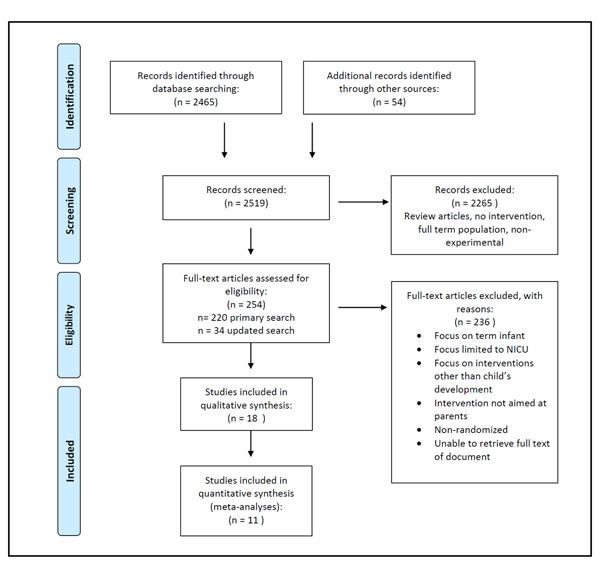
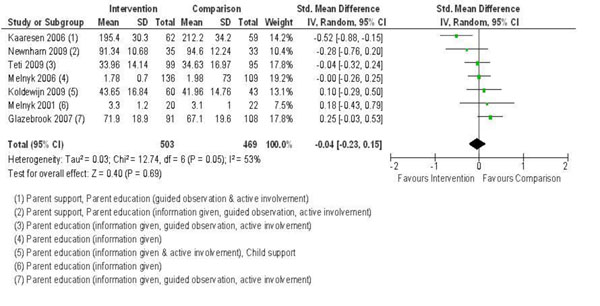
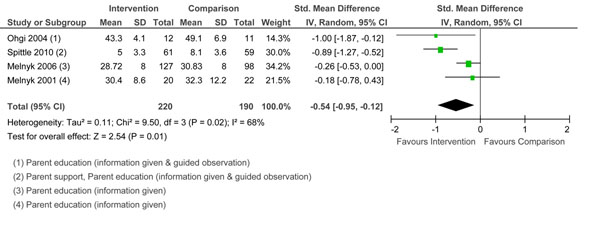
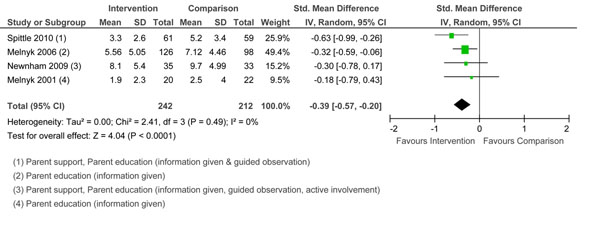
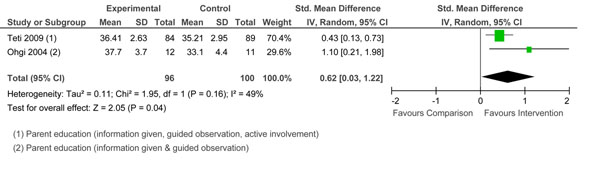
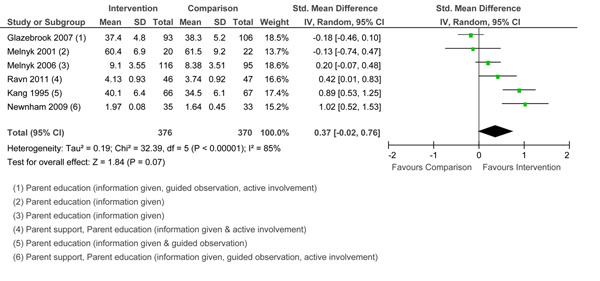
BACKGROUND: Preterm infants are at greater risk for neurodevelopmental disabilities than full term infants. Interventions supporting parents to improve the quality of the infant's environment should improve developmental outcomes for preterm infants. Many interventions that involve parents do not measure parental change, nor is it clear which intervention components are associated with improved parental outcomes. The aim of this review was to categorize the key components of early intervention programs and determine the direct effects of components on parents, as well as their preterm infants. METHODS: MEDLINE, EMBASE, CINAHL, ERIC, and Cochrane Database of Systematic Reviews were searched between 1990 and December 2011. Eligible randomized controlled trials (RCTs) included an early intervention for preterm infants, involved parents, and had a community component. Of 2465 titles and abstracts identified, 254 full text articles were screened, and 18 met inclusion criteria. Eleven of these studies reported maternal outcomes of stress, anxiety, depressive symptoms, self-efficacy, and sensitivity/responsiveness in interactions with the infant. Meta-analyses using a random effects model were conducted with these 11 studies. RESULTS: Interventions employed multiple components categorized as (a) psychosocial support, (b) parent education, and/or (c) therapeutic developmental interventions targeting the infant. All interventions used some form of parenting education. The reporting quality of most trials was adequate, and the risk of bias was low based on the Cochrane Collaboration tool. Meta-analyses demonstrated limited effects of interventions on maternal stress (Z = 0.40, p = 0.69) and sensitivity/responsiveness (Z = 1.84, p = 0.07). There were positive pooled effects of interventions on maternal anxiety (Z = 2.54, p = 0.01), depressive symptoms (Z = 4.04, p <.0001), and self-efficacy (Z = 2.05, p = 0.04). CONCLUSIONS: Positive and clinically meaningful effects of early interventions were seen in some psychosocial aspects of mothers of preterm infants. This review was limited by the heterogeneity of outcome measures and inadequate reporting of statistics. IMPLICATIONS OF KEY FINDINGS: Interventions for preterm infants and their mothers should consider including psychosocial support for mothers. If the intervention involves mothers, outcomes for both mothers and preterm infants should be measured to better understand the mechanisms for change.
Overview
The claims and statistics of this paper haven’t been checked yet.
Free: it reads the open-access text and checks the first 5 claims that cite a source we can check. Create a free account to check every claim.
Integrity signals
Registry
Cites
Statistics
Figures
Verification
Claims the paper makes
The claims and statistics of this paper haven’t been checked yet.
Free: it reads the open-access text and checks the first 5 claims that cite a source we can check. Create a free account to check every claim.
Claims other papers make about this one
Each is checked against this paper’s own text: does it say what the citing paper says it does?
The source backs part of the claim, not all of it — or backs it for a different population, condition or comparison.
In the citing paper
“These emotions increase during the transition to home from hospital,14–16 depending on the child’s condition and the parent’s readiness for discharge11 and their medical caregiving role.17 18”
From Coached, Coordinated, Enhanced Neonatal Transition (CCENT): Protocol for a multicentre pragmatic randomised controlled trial of transition-to-home support for parents of high-risk infants (2021) · cites this paper as [14]
Experimental — accuracy not yet measuredThe source backs part of the claim, not all of it — or backs it for a different population, condition or comparison.
In the citing paper
“In order to address the lack of evidence-based interventions supporting fathers of high-risk infants,9 14 we have included both fathers and mothers in our study.”
From Coached, Coordinated, Enhanced Neonatal Transition (CCENT): Protocol for a multicentre pragmatic randomised controlled trial of transition-to-home support for parents of high-risk infants (2021) · cites this paper as [14]
Experimental — accuracy not yet measuredThe source backs part of the claim, not all of it — or backs it for a different population, condition or comparison.
In the citing paper
“Enhanced psychosocial support for parents has the potential to improve parent-infant attachment and developmental outcomes for preterm infants (4).”
From Exploring Acceptance and Commitment Therapy for parents of preterm infants. (2021) · cites this paper as [4]
Experimental — accuracy not yet measuredThe cited source says what the claim attributes to it.
In the citing paper
“A systematic review of interventions for NICU parents including psychosocial support, education, and/or developmental interventions reported positive effect on depression and anxiety, but limited effect on stress.14”
The cited source says what the claim attributes to it.
In the citing paper
“A systematic review of early interventions to support parents of preterm infants found interventions composed of psychosocial support, education, and/or therapeutic developmental interventions had positive effects on depressive symptoms, anxiety, and self-efficacy, but limited effects on stress, and no overall significant effect on parental sensitivity/responsiveness (4).”
From Exploring Acceptance and Commitment Therapy for parents of preterm infants. (2021) · cites this paper as [4]
Self-check
Percentages, sums and reported differences re-computed from the paper’s own numbers.
The self-check needs the paper’s full text.
Citations
Cites
The Hospital Anxiety and Depression Scale
Zigmond, A. S., & Snaith, R. P. (1983) · Acta Psychiatrica Scandinavica · doi:10.1111/j.1600-0447.1983.tb09716.x · Cited by 47,139
Cochrane Handbook for Systematic Reviews of Interventions: Cochrane Book Series
(2008) · doi:10.1002/9780470712184 · Cited by 25,048
(1970) · Cited by 24,983
Pharmacological interventions for somatoform disorders in adults
Kleinstäuber, M., Witthöft, M., Steffanowski, A., van Marwijk, H., Hiller, W., & Lambert, M. J. (2014) · Cochrane Database of Systematic Reviews · doi:10.1002/14651858.cd010628.pub2 · Cited by 11,335
Developing and evaluating complex interventions: the new Medical Research Council guidance
Craig, P., Dieppe, P., Macintyre, S., Michie, S., Nazareth, I., & Petticrew, M. (2008) · BMJ · doi:10.1136/bmj.a1655 · Cited by 10,995
Funnel plots for detecting bias in meta-analysis
Sterne, J. A. C., & Egger, M. (2001) · Journal of Clinical Epidemiology · doi:10.1016/s0895-4356(01)00377-8 · Cited by 3,779
Cognitive and Behavioral Outcomes of School-Aged Children Who Were Born Preterm: A Meta-analysis
Bhutta, A. T., Cleves, M. A., Casey, P. H., Cradock, M. M., & Anand, K. J. S. (2002) · JAMA · doi:10.1001/jama.288.6.728 · Cited by 2,392
Less is more: meta-analyses of sensitivity and attachment interventions in early childhood
Bakermans-Kranenburg, M. J., van IJzendoorn, M. H., & Juffer, F. (2003) · Psychological Bulletin · doi:10.1037/0033-2909.129.2.195 · Cited by 1,883
The Worldwide Incidence of Preterm Birth: A Systematic Review of Maternal Mortality and Morbidity
Beck, S., Wojdyla, D., Say, L., Pilar Bertran, A., Meraldi, M., Harris Requejo, J., Rubens, C., Menon, R., & Van Look, P. (2010) · Bulletin of the World Health Organization · doi:10.2471/blt.08.062554 · Cited by 1,523
Postpartum depression effects on early interactions, parenting, and safety practices: a review
Field, T. (2010) · Infant Behavior and Development · doi:10.1016/j.infbeh.2009.10.005 · Cited by 1,493 · cited 1×
“Together, these psychosocial factors influence maternal sensitivity and responsiveness in interactions with the infant [25], which ultimately affect child developmental outcomes [26].”
Background
Research works printed but not linked: 5
- Bronfenbrenner U Bronfenbrenner U The biological theory of human development Making human beings human: Biological perspectives on human development 2005 Thousand Oaks, CA: Sage Publications 3 15
- IHDP - The Infant Health and Development Program Enhancing the outcomes of low-birth-weight, premature infants: A multisite, randomized trial Journal of the American Medical Association 1990 263 22 3035 3042 2188023
- The Cochrane Collaboration Review Manager (RevMan) 2011 5.1 Copenhagen: The Nordic Cochrane Centre
- IHDP (The Infant Health and Development Program) Enhancing the outcomes of low-birth-weight, premature infants: A multisite, randomized trial Journal of the American Medical Association 1990 263 22 3035 3042 2188023
- Egeland B Weinfield NS Bosquet M Cheng VK Osofsky JD, Fitzgerald HE Remembering, repeating, and working through: Lessons from attachment-based interventions Handbook of infant mental health Vol 4: Infant mental health in groups at high risk 2000 New York: Wiley 35 89
Cited by
Items 101–200 of 385
The effect of maternal presence on premature infant response to recorded music
Dearn, T., & Shoemark, H. (2014) · Journal of Obstetric, Gynecologic & Neonatal Nursing · doi:10.1111/1552-6909.12303 · Cited by 31
Kim, S.-Y., & Kim, A. R. (2022) · International Journal of Environmental Research and Public Health · doi:10.3390/ijerph19031126 · Cited by 38
“[32], who suggested three types of intervention ap roaches within a bio-ecological framework, we coded intervention components into five categories: (a) parent–infant interactions; (b) parent education—only information given (E1); (c) parent education—guided observatio s, incl di parent observati ns or demonstrati ns…”
BackgroundAn educational intervention for NICU staff decreased maternal postpartum depression
Ahlqvist‐Björkroth, S., Axelin, A., Korja, R., & Lehtonen, L. (2019) · Pediatric Research · doi:10.1038/s41390-019-0306-y · Cited by 52
Upadhyay, A. K., & Srivastava, S. (2016) · BMC Pregnancy and Childbirth · doi:10.1186/s12884-016-0909-9 · Cited by 47
Calder, S. D., Ward, R., Jones, M., Johnston, J., & Claessen, M. (2017) · Disability and Rehabilitation · doi:10.1080/09638288.2017.1353144 · Cited by 35
“The temporal restraints reflect the paradigm shift in the implementation of early intervention in the early 1990s and follow previous reviews in the literature [56].”
BackgroundResultInfluentialInformation and Support Needs of Parents With Premature Infants: An Integrative Review
Davis-Strauss, S. L., Johnson, E., & Lubbe, W. (2020) · Journal of Early Intervention · doi:10.1177/1053815120957734 · Cited by 34
“Relevant studies confirm that premature infants experience greater risks of neurodevelopmental disabilities, cognitive and language delays, behavioral and emotional problems, and learning disabilities (Benzies et al., 2013; Boykova & Kenner, 2012).”
BackgroundA Modular Sensorized Mat for Monitoring Infant Posture
Donati, M., Cecchi, F., Bonaccorso, F., Branciforte, M., Dario, P., & Vitiello, N. (2013) · Sensors · doi:10.3390/s140100510 · Cited by 29
“The concept of early intervention for the treatment of children and infants with developmental disabilities was introduced in clinical management some decades ago and its importance has increased considerably in the last three decades, thanks to new suggested methods of intervention and greater systematic use in clini…”
MethodSpatial Thinking in Term and Preterm-Born Preschoolers: Relations to Parent–Child Speech and Gesture
Clingan-Siverly, S., Nelson, P. M., Göksun, T., & Demir‐Lira, Ö. E. (2021) · Frontiers in Psychology · doi:10.3389/fpsyg.2021.651678 · Cited by 33
“Many interventions for PTs focus on prenatal and early postnatal life (e.g., breastfeeding), and formal follow-ups focus primarily on early PTs (Benzies et al., 2013).”
BackgroundHow to support fathers of preterm infants in early parenthood – An integrative review
Holm, K. G., Aagaard, H., Maastrup, R., Weis, J., Feenstra, M. M., Haslund‐Thomsen, H., Hägi‐Pedersen, M., Nilsson, I. M. S., Kristensen, I. H., Dreier, S., et al. (2022) · Journal of Pediatric Nursing · doi:10.1016/j.pedn.2022.10.001 · Cited by 38
“Supportive interventions have been identified with both maternal and parental outcomes (Benzies et al., 2013; Puthussery et al., 2018).”
BackgroundGrønborg, I. M., Tetens, I., Andersen, E. W., Kristensen, M., Larsen, R. E. K., Tran, T. L. L., & Andersen, R. (2019) · Nutrition Journal · doi:10.1186/s12937-019-0504-9 · Cited by 31
Rapid review to update evidence for Healthy Child Programme 0-5
Axford, N., Barlow, J., Coad, J. E., McMillan, A. S., Bjornstad, G. J., Berry, V., Wrigley, Z., Goodwin, A., Ohlson, C., Sonthalia, S., et al. (2015) · Figshare · Cited by 35
VALIDATION OF THE SCALE OF PERCEIVED SELF-EFFICACY OF MATERNAL PARENTING IN BRAZILIAN SAMPLE
Tristão, R. M., Neiva, E. R., Barnes, C. R., & Adamson-Macedo, E. N. (2015) · Journal of Human Growth and Development · doi:10.7322/jhgd.96759 · Cited by 48
Seppänen, A., Sauvegrain, P., Draper, E. S., Toome, L., Rafei, R. E., Petrou, S., Barros, H., Zimmermann, L. J. I., Cuttini, M., Zeitlin, J. A., et al. (2020) · Pediatric Research · doi:10.1038/s41390-020-01120-y · Cited by 36
Polizzi, C., Perricone, G., Morales, M. R., & Burgio, S. (2021) · International Journal of Environmental Research and Public Health · doi:10.3390/ijerph18168670 · Cited by 31
“with the consequent hospitalisation [30,62–67], and above all because they can be the main source of support for mothers [68,69].”
BackgroundCheng, Y.-C., Chen, L.-L., Chang, Y.-S., Li, T., Chen, C.-J., & Huang, L. (2018) · Midwifery · doi:10.1016/j.midw.2018.03.010 · Cited by 27
When a common language is missing: Nurse–mother communication in the NICU. A qualitative study
Kynø, N. M., Fugelseth, D., & Hanssen, I. (2020) · Journal of Clinical Nursing · doi:10.1111/jocn.15212 · Cited by 47
Variation in follow-up for children born very preterm in Europe
Seppänen, A., Barros, H., Draper, E. S., Petrou, S., Andronis, L., Kim, S. W., Maier, R. F., Pedersen, P., Gadzinowski, J., Pierrat, V., et al. (2023) · European Journal of Public Health · doi:10.1093/eurpub/ckad192 · Cited by 26
Mothers’ experiences of the NICU and a NICU support group programme
Turner, M., Chur‐Hansen, A., & Winefield, H. R. (2015) · Journal of Reproductive and Infant Psychology · doi:10.1080/02646838.2014.998184 · Cited by 41
Namprom, N., Picheansathian, W., Jintrawet, U., & Chotibang, J. (2018) · Journal of Neonatal Nursing · doi:10.1016/j.jnn.2018.03.003 · Cited by 26
Ferreira, R. D. C., Alves, C. R. L., Guimarães, M. A. P., de Menezes, K. K. P., & Magalhães, L. D. C. (2020) · LA Referencia (Red Federada de Repositorios Institucionales de Publicaciones Científicas) · Cited by 26
Rogers, H. J., Hogan, L., Coates, D., Homer, C., & Henry, A. (2021) · BMC Women s Health · doi:10.1186/s12905-021-01368-4 · Cited by 36
Massae, A. F., Larsson, M., Leshabari, S., Mbekenga, C., Pembe, A. B., & Svanberg, A. S. (2021) · BMC Pregnancy and Childbirth · doi:10.1186/s12884-021-04169-7 · Cited by 35
Home-Based Care for Children with Serious Illness: Ecological Framework and Research Implications
Boyden, J. Y., Hill, D. L., LaRagione, G., Wolfe, J., & Feudtner, C. (2022) · Children · doi:10.3390/children9081115 · Cited by 29
“Infants and toddlers with serious illness may benefit from early intervention (EI) programs to reduce the impact of disability, prevent further complications, and promote optimal health, function, and quality of life [93,94].”
BackgroundSanz-Gadea, B. M., Montes, M. T., Antón, M., Serrada, M. T., Cabrera, M., & Pellicer, A. (2021) · Frontiers in Pediatrics · doi:10.3389/fped.2021.682097 · Cited by 29
Øberg, G. K., Sørvoll, M., Labori, C., Girolami, G. L., & Håkstad, R. B. (2023) · Frontiers in Psychology · doi:10.3389/fpsyg.2023.1172578 · Cited by 26
Carniel, C. Z., Furtado, M. C. D. C., Vicente, J. B., de Abreu, R. Z., Tarozzo, R. M., Cardia, S. E. T. R., Massei, M. C. I., & Cerveira, R. C. G. F. (2017) · Revista CEFAC · doi:10.1590/1982-0216201719115616 · Cited by 24
Lebel, V., Héon, M., Juneau, A. L., Collette, K., & Feeley, N. (2020) · Journal of Neonatal Nursing · doi:10.1016/j.jnn.2020.06.004 · Cited by 29
Namazzi, G., Tumwine, J. K., Hildenwall, H., Ndeezi, G., Mubiri, P., Hanson, C., Kakooza‐Mwesige, A., & Waiswa, P. (2020) · Global Health Action · doi:10.1080/16549716.2020.1820714 · Cited by 31
“Survival and developmental outcomes of preterm babies are also determined by environmental factors related to birth, quality of care services and nurturing limitations as a result of maternal psychosocial effects of preterm birth [8,9].”
BackgroundSimulation-based childbirth education for Chinese primiparas: A pilot randomized controlled trial
Dai, L., Shen, Q., Redding, S. R., & Ouyang, Y. (2021) · Patient Education and Counseling · doi:10.1016/j.pec.2021.02.036 · Cited by 31
Ochandorena‐Acha, M., Terradas‐Monllor, M., Sala, L. L., Cazorla-Sánchez, M., Marti, M. F., Pérez, I. M., Agut-Quijano, T., Iriondo, M., & Casas-Baroy, J. C. (2022) · Children · doi:10.3390/children9060895 · Cited by 83
“As a consequence of an unexpected delivery or the admission to the Neonatal Intensive Care Unit (NICU) [10], preterm infants’ parents usually experience high levels of anxiety, stress, or depression, and that, in turn, might influence children’s development [11,12].”
BackgroundTHROUGH THE EYES OF A NEW DAD: EXPERIENCES OF FIRST-TIME FATHERS OF LATE-PRETERM INFANTS
Benzies, K., & Magill‐Evans, J. (2014) · Infant Mental Health Journal · doi:10.1002/imhj.21489 · Cited by 35
Self-citationCareToy: Stimulation and Assessment of Preterm Infant’s Activity Using a Novel Sensorized System
Rihar, A., Sgandurra, G., Beani, E., Cecchi, F., Pašič, J., Cioni, G., Dario, P., Mihelj, M., & Munih, M. (2016) · Annals of Biomedical Engineering · doi:10.1007/s10439-016-1669-4 · Cited by 24
Effects on Parental Stress of Early Home-Based CareToy Intervention in Low-Risk Preterm Infants
Sgandurra, G., Beani, E., Inguaggiato, E., Lorentzen, J., Nielsen, J. B., & Cioni, G. (2019) · Neural Plasticity · doi:10.1155/2019/7517351 · Cited by 32
“In relation to the importance of a parental role in infant care, the literature suggests that their involvement in early intervention (EI) programs seems to have positive psychosocial effects both on child and on parents [25].”
BackgroundMogos, M. F., Salinas‐Miranda, A., Salemi, J. L., Medina, I. M., & Salihu, H. M. (2016) · Journal of Immigrant and Minority Health · doi:10.1007/s10903-016-0410-6 · Cited by 25
Lee, S., Chau, J. P. C., Choi, K. C., & Lo, S. H. S. (2019) · BMC Pediatrics · doi:10.1186/s12887-019-1794-y · Cited by 21
Dickinson, C., Whittingham, K., Sheffield, J., Wotherspoon, J., & Boyd, R. N. (2020) · Infant Mental Health Journal · doi:10.1002/imhj.21871 · Cited by 22
Dirks, T., Hielkema, T., Hamer, E. G., Reinders‐Messelink, H. A., & Hadders‐Algra, M. (2016) · Research in Developmental Disabilities · doi:10.1016/j.ridd.2016.02.006 · Cited by 25
Parent-Guided Developmental Intervention for Infants With Very Low Birth Weight
Silveira, R. C., Valentini, N. C., O’Shea, T. M., Mendes, E. W., Fróes, G. F., Cauduro, L. S., Panceri, C., Fuentefria, R. D. N., & Procianoy, R. S. (2024) · JAMA Network Open · doi:10.1001/jamanetworkopen.2024.21896 · Cited by 27
Dambi, J. M., Mandizvidza, C., Chiwaridzo, M., Nhunzvi, C., & Tadyanemhandu, C. (2017) · Malawi Medical Journal · doi:10.4314/mmj.v28i4.4 · Cited by 29
“Median (range) 36 (12-144) 20 (3-132) 30 (3-144) U = 141.”
Nieves, H., Clements‐Hickman, A. L., & Davies, C. C. (2021) · The Journal of Perinatal & Neonatal Nursing · doi:10.1097/jpn.0000000000000540 · Cited by 23
“Previous studies had identified that there was reduced maternal depression symptoms when using the COPE program, but this was not a finding in the current study.(25,26) In addition, there was no significant difference between parents who received the COPE program and those who did not in terms of length of stay.”
ResultHorwitz, S. M., Leibovitz, A., Lilo, E. A., Jo, B., DeBattista, A. M., John, N. S., & Shaw, R. J. (2014) · Infant Mental Health Journal · doi:10.1002/imhj.21484 · Cited by 27
“, 2009); they are most effective in improving anxiety, stress and depression when coupled with psychosocial support (Benzies et al., 2013); and that interventions to improve maternal sensitivity are particularly effective in mother-child dyads with high clinical needs such as prematurity (Bakermans-Kranenburg et al.”
BackgroundInfluentialTraumatisme parental et conséquences lors d’une naissance prématurée
Borghini, A., & Nix, C. M. (2015) · Contraste · doi:10.3917/cont.041.0065 · Cited by 30
Heller, A., & Hannig, A. (2017) · Anthropology and Medicine · doi:10.1080/13648470.2016.1249252 · Cited by 26
Rania, N. (2019) · Health Psychology Open · doi:10.1177/2055102919844492 · Cited by 26
Lavallée, A., Clifford‐Faugère, G. D., Ballard, A., & Aita, M. (2021) · Journal of Early Intervention · doi:10.1177/1053815121991928 · Cited by 28
“Benzies et al. (2013) reported a mean effect estimate (ES) of 0.37 regarding the parental sensitivity outcome regardless of the measure time points in the included studies.”
BackgroundResultInfluentialLavallée, A., Aita, M., Bourbonnais, A., & Clifford‐Faugère, G. D. (2017) · Systematic Reviews · doi:10.1186/s13643-017-0459-x · Cited by 21
“Benzies and colleagues [10] also published a systematic review and meta-analysis looking at effects of early interventions for preterm infants involving parents, where sensitivity has been reported as a parental outcome.”
BackgroundMobbs, C. A., Spittle, A. J., & Johnston, L. M. (2022) · Early Human Development · doi:10.1016/j.earlhumdev.2022.105551 · Cited by 24
Ferreira, R. D. C., Alves, C. R. L., Guimarães, M. A. P., de Menezes, K. K. P., & Magalhães, L. D. C. (2020) · Jornal de Pediatria (Versão em Português) · doi:10.1016/j.jpedp.2019.05.023 · Cited by 19
Smythe, T., Almasri, N. A., Angarita, M. M., Berman, B. D., de Camargo, O. K., Hadders‐Algra, M., Lynch, P. J., Samms‐Vaughan, M. E., & Olusanya, B. O. (2022) · Frontiers in Pediatrics · doi:10.3389/fped.2022.927678 · Cited by 29
Schmitt, J. M., Arnold, K., Druschke, D., Swart, E., Grählert, X., Maywald, U., Fuchs, A., Werblow, A., Schemken, M., Reichert, J., et al. (2016) · BMC Pediatrics · doi:10.1186/s12887-016-0640-8 · Cited by 30
Role of Research Syntheses for Identifying Evidence-Based Early Childhood Intervention Practices
Dunst, C. J. (2016) · Springer eBooks · doi:10.1007/978-3-319-28492-7_28 · Cited by 22
Understanding mistreatment during institutional delivery in Northeast Nigeria: a mixed-method study
Umar, N., Wickremasinghe, D., Hill, Z. E., Usman, U. A., & Marchant, T. (2019) · Reproductive Health · doi:10.1186/s12978-019-0837-z · Cited by 28
Afectividad en madres de niños prematuros hospitalizados. Un mundo desconocido
Katherine Rossel, C., Carreño, T., & Maldonado, M. (2002) · Revista chilena de pediatría · doi:10.4067/s0370-41062002000100004 · Cited by 36
Luu, T. M., Xie, L. F., Peckre, P., Cote, S., Karsenti, T., Walker, C.-D., & Gosselin, J. (2017) · JMIR Research Protocols · doi:10.2196/resprot.8289 · Cited by 18
“Benefits on maternal anxiety, depressive symptoms, and self-efficacy have also been documented [11].”
Training Parents to Implement Early Interventions for Children with Autism Spectrum Disorders
Ruppert, T., Machalicek, W., Hansen, S. G., Raulston, T. J., & Frantz, R. J. (2016) · Evidence-based practices in behavioral health · doi:10.1007/978-3-319-30925-5_8 · Cited by 29
Youn, Y., Shin, S. H., Kim, E., Jin, H. J., Jung, Y., Heo, J. S., Jeon, J.-H., Park, J.-H., & Sung, I.-K. (2021) · Brain Sciences · doi:10.3390/brainsci11050575 · Cited by 23
Mariani, I., Vuillard, C. L. J., Bua, J., Girardelli, M., & Lazzerini, M. (2024) · BMJ Paediatrics Open · doi:10.1136/bmjpo-2024-002537 · Cited by 32
Dewi, D. T. K., Nguyen, C. T. T., Chen, S., Lee, G. T., Tsai, S., Huda, M. H., & Kuo, S. (2025) · International Journal of Nursing Studies · doi:10.1016/j.ijnurstu.2025.105128 · Cited by 25
Vyas, S. S., Ford, M. K., Tam, E., Westmacott, R., Sananes, R., Beck, R., & Williams, T. S. (2021) · The Clinical Neuropsychologist · doi:10.1080/13854046.2020.1871516 · Cited by 19
“…that impact brain development, early intervention studies focus heavily on services delivered in the first year following hospital discharge (Benzies et al., 2013; Evans et al., 2014; Kraljevic & Warnock, 2013; Landsem et al., 2014; Puthussery et al., 2018; van Wassenaer-Leemhuis et al.,…”
BackgroundReliability Study of the Items of the Alberta Infant Motor Scale (AIMS) Using Kappa Analysis
Ko, J., & Lim, H. K. (2022) · International Journal of Environmental Research and Public Health · doi:10.3390/ijerph19031767 · Cited by 19
“Regularly administered tests are valuable for detecting developmental disorders and predicting and preparing for further developments in preterm infants [10,11].”
BackgroundFuertes, M., Antunes, S., Martelo, I., & Dionísio, F. (2022) · Early Human Development · doi:10.1016/j.earlhumdev.2022.105633 · Cited by 17
“Past research found that these interventions can effectively support parents’ behavior and parents-infant relationships (Benzies et al., 2013) once provided in a continuous and individualized process during children’s first years of life.”
BackgroundBayo, P., Belaid, L., Tahir, E. O., Ochola, E., Dimiti, A., Greco, D., & Zarowsky, C. (2020) · BMC Pregnancy and Childbirth · doi:10.1186/s12884-020-02910-2 · Cited by 21
Schneider, J., Borghini, A., Harari, M. M., Faure, N., Tenthorey, C., Berre, A. L., Tolsa, J., & Horsch, A. (2019) · BMJ Open · doi:10.1136/bmjopen-2018-026484 · Cited by 22
Filippa, M., Casa, E. D., D’Amico, R., Picciolini, O., Lunardi, C., Sansavini, A., & Ferrari, F. (2021) · International Journal of Environmental Research and Public Health · doi:10.3390/ijerph18083915 · Cited by 22
“Research suggests that early interventions aimed at reducing the sequelae of prematurity can have positive effects, especially in the short-term periods [63,64].”
BackgroundSanefuji, M., Sonoda, Y., Ito, Y., Ogawa, M., Tocan, V., Inoue, H., Ochiai, M., Shimono, M., Suga, R., Senju, A., et al. (2021) · BMC Pediatrics · doi:10.1186/s12887-021-02815-9 · Cited by 22
“Furthermore, as outcomes, a majority of these studies investigated the neurocognitive function during preschool through adulthood [6–10, 13–16] with only a few examining those in infancy [8, 11, 12], during which intervention has the potential to improve the outcomes of both the parents and their children [17, 18].”
BackgroundÖzyurt, G., Özyurt, A., Öztürk, T., Yaman, A., & Berk, A. T. (2017) · Ophthalmic Epidemiology · doi:10.1080/09286586.2017.1372487 · Cited by 19
“ence of parent with infant, and satisfaction of being a parent.(30) Necessity of premature infants for more stimuli from their mothers leads the mothers to be more active,”
BackgroundParents’ perceptions of administering a motor intervention with their preterm infant in the NICU
Øberg, G. K., Ustad, T., Jørgensen, L., Kaaresen, P. I., Labori, C., & Girolami, G. L. (2018) · European Journal of Physiotherapy · doi:10.1080/21679169.2018.1503718 · Cited by 17
“relationship, and explore mechanisms that may support or enhance a positive child-rearing attitude [4,15].”
BackgroundLi, S., Liu, S., Zhang, X., Chen, Y., & Ren, X. (2022) · Journal of International Medical Research · doi:10.1177/03000605221110699 · Cited by 19
“Up to 30% of preterm infants are rehospitalized within 6 months after hospital discharge for common problems such as infection, feeding difficulties, weight loss, and gastrointestinal and respiratory conditions because their parents lack required care knowledge, skills, and self-efficacy at home.(4) Studies have shown…”
BackgroundOchandorena‐Acha, M., Noell-Boix, R., Yıldırım, M., Cazorla-Sánchez, M., Sanz, M. I., Troyano-Martos, M. J., & Casas-Baroy, J. C. (2020) · Physiotherapy Theory and Practice · doi:10.1080/09593985.2020.1818339 · Cited by 23
Gooding, L. F., & Trainor, B. L. (2017) · The Arts in Psychotherapy · doi:10.1016/j.aip.2017.12.005 · Cited by 15
Campbell-Yeo, M. L., Dol, J., McCulloch, H., Hughes, B., Hundert, A. S., Bacchini, F., Whitehead, L., Afifi, J. K., Alcock, L., Bishop, T., et al. (2022) · Journal of Family Nursing · doi:10.1177/10748407221114326 · Cited by 15
“Compared with parents of healthy newborns, parents of infants in the NICU report higher levels of immediate stress, anxiety, depression, posttraumatic stress, and greater adverse parenting outcomes, all of which have been heightened during the COVID-19 pandemic (Bembich et al., 2021; Benzies et al., 2013; Cena et al.,…”
BackgroundFathers' Experiences in Alberta Family Integrated Care: A Qualitative Study
Shafey, A., Benzies, K., Amin, R., Stelfox, H. T., & Shah, V. S. (2022) · The Journal of Perinatal & Neonatal Nursing · doi:10.1097/jpn.0000000000000684 · Cited by 21
“and not fathers or showed a benefit in mothers but not in fathers.(10) Studies that incorporated skin-to-skin care, information about their infant, and peer support”
BackgroundSelf-citationAltunalan, T., Sarı, Z., Doğan, T. D., Hacıfazlıoğlu, N. E., Akman, İ., Altıntaş, T., Uzer, S., & Akçakaya, N. H. (2023) · Brain and Behavior · doi:10.1002/brb3.3266 · Cited by 15
“The first limitation is the need for high-quality evidence; the second is the effectiveness of traditional methods; and the third is the need for holistic interventions, including parental involvement (Benzies et al., 2013; Spittle et al., 2015).”
BackgroundDevelopment of a Support System for Parents of Premature Infants
Mousavi, S. S., Chaman, R., Mohagheghi, P., Mousavi, S. A., Khosravi, A., & Keramat, A. (2017) · Iranian Journal of Pediatrics · doi:10.5812/ijp.9578 · Cited by 15
“Pregnancy duration allows for emotional adjustment with the changes of pregnancy and preparation for parenting (2).”
BackgroundGrylka‐Baeschlin, S., van Teijlingen, E., & Groß, M. M. (2014) · BMC Pregnancy and Childbirth · doi:10.1186/1471-2393-14-277 · Cited by 21
Seyedfarajollah, S., Nayeri, F., Kalhori, S. R. N., Ghazisaeedi, M., & Keikha, L. (2018) · Acta Informatica Medica · doi:10.5455/aim.2018.26.46-50 · Cited by 17
Follow-Up de Nascidos Prematuros: Uma Revisão Sistemática da Literatura
Frantz, M. F., Schaefer, M. P., & Donelli, T. M. S. (2021) · Psicologia Teoria e Pesquisa · doi:10.1590/0102.3772e37316 · Cited by 40
Klutse, K. D., Hillan, E. M., Wright, A. L., & Johnston, L. J. (2022) · Journal of Neonatal Nursing · doi:10.1016/j.jnn.2021.12.004 · Cited by 18
Preterm Infant Outcomes at 24 Months After Clinician-Supported Web-Based Intervention
Treyvaud, K., Eeles, A. L., Spittle, A. J., Lee, K. J., Cheong, J. L. Y., Shah, P., Doyle, L. W., & Anderson, P. J. (2022) · PEDIATRICS · doi:10.1542/peds.2021-055398 · Cited by 18
McHale, P., Fahy, K., Pennington, A., Schlüter, D. K., Barr, B., & Taylor-Robinson, D. C. (2025) · BMJ Open · doi:10.1136/bmjopen-2024-084147 · Cited by 17
Parent-Preterm Infant Interaction
Provasi, J. (2019) · Springer eBooks · doi:10.1007/978-3-030-04769-6_7 · Cited by 17
Effective stress intervention programs for parents of premature children: A systematic review
Martínez‐Shaw, M. L., & Sánchez‐Sandoval, Y. (2022) · Stress and Health · doi:10.1002/smi.3194 · Cited by 18
Schappin, R., Wijnroks, L., Venema, M. U., Wijnberg-Williams, B. J., Veenstra, R., Koopman-Esseboom, C., Tollenaer, S. M. M.-D., van der Tweel, I., & Jongmans, M. J. (2014) · BMC Pediatrics · doi:10.1186/s12887-014-0305-4 · Cited by 16
“Existing interventions for preterm-born and asphyxiated term-born children aimed at improving developmental outcomes exclusively take place during the neonatal period and the first year of life [9,10].”
Psychometric Properties of the Italian Perceived Maternal Parenting Self-Efficacy (PMP S-E)
Pedrini, L., Ferrari, C., & Ghilardi, A. (2018) · Journal of Clinical Psychology in Medical Settings · doi:10.1007/s10880-018-9578-3 · Cited by 20
Orkin, J., Major, N., Esser, K., Parmar, A., Couture, E., Daboval, T., Kieran, E., Ly, L., O"Brien, K., Patel, H., et al. (2021) · BMJ Open · doi:10.1136/bmjopen-2020-046706 · Cited by 11
Self-citationHirschel, J., Carlhan-Ledermann, A., Ferraz, C., Brand, L., Filippa, M., Gentaz, É., Lejeune, F., & Baud, O. (2023) · Children · doi:10.3390/children10091469 · Cited by 13
“Despite an abundant literature on the role of socio-emotional environment and parental interactions in the neurodevelopmental outcomes of infants born preterm [27], only a few studies addressed the developmental trajectories of OT in the neonatal period and its balance with cortisol in dyadic interactive contexts [11,…”
BackgroundToma, A. I., Dima, V., Alexe, A., Bojan, C., Nemeş, A. F., Gonț, B. F., Arghirescu, A., Necula, A. I., Fieraru, A., Stoiciu, R. P., et al. (2024) · Life · doi:10.3390/life14040480 · Cited by 14
“Another systematic review and meta-analysis suggested that the interventions should consider including psychosocial support for the mothers and measure the outcomes for both mothers and children [37].”
BackgroundAlves, C. R. L., Gaspardo, C. M., Altafim, E. R. P., & Linhares, M. B. M. (2021) · Children and Youth Services Review · doi:10.1016/j.childyouth.2021.106333 · Cited by 13
Parental Reflective Functioning as a Moderator of the Link Between Prematurity and Parental Stress
Dollberg, D. G., Harlev, Y., Malishkevitch, S., & Leitner, Y. (2022) · Frontiers in Psychiatry · doi:10.3389/fpsyt.2022.804694 · Cited by 15
“Finally, it has been noted that many of the existing interventions target mothers only (82, 86) and are less committed to involving resistant fathers in the therapy.”
BackgroundACADEMIC OUTCOMES OF VERY LOW BIRTH WEIGHT INFANTS: THE INFLUENCE OF MOTHER-CHILD RELATIONSHIPS
Boyce, L., Cook, G. A., Simonsmeier, V., & Hendershot, S. M. (2014) · Infant Mental Health Journal · doi:10.1002/imhj.21495 · Cited by 12
Piccoli, G. B., Postorino, V., Cabiddu, G., Ghiotto, S., Guzzo, G., Roggero, S., Manca, E., Puddu, R., Meloni, F., Attini, R., et al. (2015) · Nephrology Dialysis Transplantation · doi:10.1093/ndt/gfv127 · Cited by 15
Early Vocal Contact: Direct Talking and Singing to Preterm Infants in the NICU
Filippa, M. (2017) · Springer eBooks · doi:10.1007/978-3-319-65077-7_8 · Cited by 17
Masri, S., Charafeddine, L., Tamim, H., Naamani, M., Taleb, J., & Dirani, L. A. (2019) · Journal of Clinical Psychology in Medical Settings · doi:10.1007/s10880-019-09643-1 · Cited by 14
Aleitamento materno e aspectos fonoaudiológicos: conhecimento e aceitação de mães de uma maternidade
Medeiros, A. M. C., Batista, B. G., & Barreto, Í. D. D. C. (2015) · Audiology - Communication Research · doi:10.1590/2317-6431-acr-2015-1565 · Cited by 11
“Organizing educational groups promotes knowledge exchange with parents and family on maternal care, children maturation and the importance of interaction between family and baby((8)), mainly their mothers((9)), in maternities.”
BackgroundJapakasetr, S., Sirikulchayanonta, C., Suthutvoravut, U., Chindavijak, B., Kagawa, M., & Nokdee, S. (2016) · Nutrients · doi:10.3390/nu8120820 · Cited by 11
“The contents of the education program were based on previous studies that recommended the importance of these variables [31,32].”
MethodPretermConnect: Leveraging mobile technology to mitigate social disadvantage in the NICU and beyond
Jani, S. G., Nguyen, A. D., Abraham, Z., Scala, M. L., Blumenfeld, Y. J., Morton, J., Nguyen, M. M., Ma, J., Hsing, J. C., Moiwa-Grant, M., et al. (2021) · Seminars in Perinatology · doi:10.1016/j.semperi.2021.151413 · Cited by 11
Håkstad, R. B., Obstfelder, A. U., & Øberg, G. K. (2015) · Qualitative Health Research · doi:10.1177/1049732315608137 · Cited by 17
“Hence, parental support as part of the assistance offered to these families is recommended (Benzies et al., 2013; Brett et al., 2011; Spittle, Orton, Anderson, Boyd, & Doyle, 2012; Treyvaud, 2013).”
BackgroundMedina, N. T., Mesa, P. B., & Enríquez, C. D. L. C. (2017) · Investigación en Enfermería Imagen y Desarrollo · doi:10.11144/javeriana.ie19-2.eaap · Cited by 10
Gibbs, D., Harniess, P., & Crossley, S. (2019) · Infants & Young Children · doi:10.1097/iyc.0000000000000149 · Cited by 15
“, 2003; Legendre, Burtner, Martinez, & Crowe, 2011; Wallin & Eriksson, 2009) and with regard to the components of EI programs that promote infant and family development postdischarge (Benzies et al., 2013; Spittle et al., 2015).”
BackgroundFeasibility study of a preventive parenting program with mothers of children born preterm
da Silva, F. B., Altafim, E. R. P., & Linhares, M. B. M. (2019) · Children and Youth Services Review · doi:10.1016/j.childyouth.2019.104526 · Cited by 10
Metadata
- Authors
- Benzies, K. M., Magill-Evans, J. E., Hayden, K., & Ballantyne, M.
- Affiliations
- University of Calgary (CA)
- Corresponding author
- Benzies, Karen M
- Venue
- BMC Pregnancy and Childbirth
- Published
- 2013
- Volume
- 13
- Issue
- Suppl 1
- Pages
- S10
- ISSN
- 1471-2393 (ISSN-L)
- PMC
- PMC3561170
- OpenAlex
- W2123988943
- Semantic Scholar
- 4d85bf8ed2a990b5d25829f38a637c8a2d00b869
- Cited by
- 385
- References
- 77
- Citations by year
- 2026: 26 · 2025: 23 · 2024: 22 · 2023: 38 · 2022: 30 · 2021: 41 · 2020: 39 · 2019: 28 · 2018: 29 · 2017: 39 · 2016: 28 · 2015: 15 · 2014: 21 · 2013: 4
- Type
- conference abstract
- Language
- en
- Open access
- gold
- doi.org
- Licence
- cc-by
- Locations
- BMC Pregnancy and Childbirth (publishedVersion, cc-by)
- Europe PMC (PubMed Central) (publishedVersion, cc-by)
- PubMed Central (publishedVersion, cc-by)
- PubMed (publishedVersion)
- DOAJ (DOAJ: Directory of Open Access Journals) (submittedVersion)
- Funders
- Fondation pour la Recherche Médicale
- Alberta Innovates (200700595)
- Topics
- Health Sciences › Medicine › Pediatrics, Perinatology and Child Health › Infant Development and Preterm Care
- Social Sciences › Psychology › Clinical Psychology › Family and Disability Support Research
- Health Sciences › Medicine › Public Health, Environmental and Occupational Health › Maternal Mental Health During Pregnancy and Postpartum
- Keywords
- preterm infants, early intervention, parental involvement, maternal stress, maternal anxiety, depressive symptoms, maternal self-efficacy, parent education, psychosocial support, community-based intervention, neurodevelopmental outcomes, intervention components, maternal mental health, parent-infant interaction, intervention mechanisms, reporting quality, risk of bias, reporting bias, selection bias, attrition bias
- MeSH terms
- Female, Humans, Infant, Infant, Newborn, Infant, Premature, Male, Parents, Treatment Outcome, Early Intervention, Educational
About these checks
Registry, retraction, Cites and statistics results are computed, not judged, with one exception: a printed reference that no index lists is read once by a model before it counts as a citation error. Claims are extracted by a model and kept only when their quote appears verbatim in the text; each cited source is then checked, with a model’s help, for whether it says what the claim relies on. Those verdicts can be wrong — read the claim’s quote and the cited source before relying on one.
Statistics and arithmetic are recomputed, not judged.
Confidence bands are shown only for fields calibrated on our annotated test set. None is calibrated yet, so no band is shown.
What counts as a claim ›How we measure confidence ›How we check this ›
Are you an author, or do you see a problem with this page? Request a review
Data sources
Bibliographic data: Semantic Scholar, OpenAlex, Crossref.
Contains information from the Semantic Scholar Academic Graph Datasets, made available under the ODC Attribution License (ODC-BY 1.0).
Semantic Scholar’s data is described in: Kinney, R., et al. (2023). The Semantic Scholar Open Data Platform. arXiv:2301.10140.
