

Do Couple-Based Interventions Make a Difference for Couples Affected by Cancer?: A Systematic Review
Open accessThe DOI matches its Crossref record; 81 of the 82 references it cites were found in a registry or an index.
Abstract
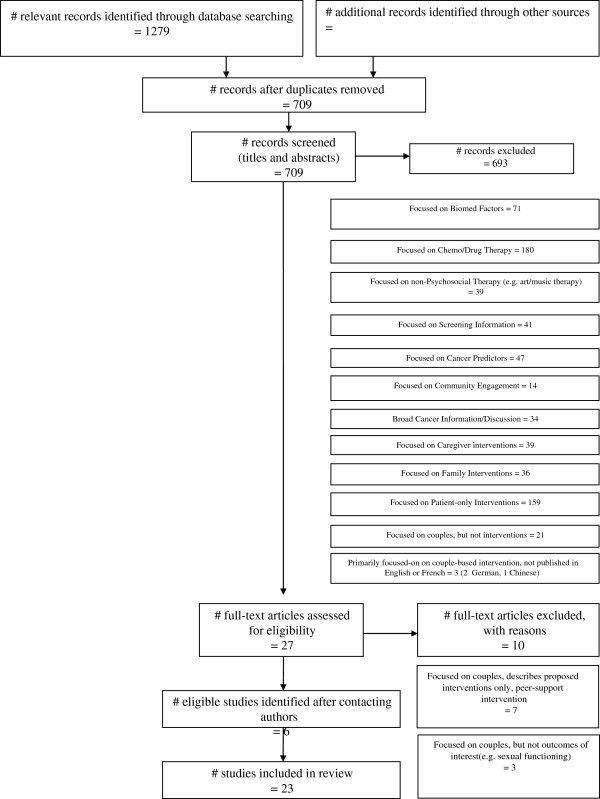
BACKGROUND: With the growing recognition that patients and partners react to a cancer diagnosis as an interdependent system and increasing evidence that psychosocial interventions can be beneficial to both patients and partners, there has been a recent increase in the attention given to interventions that target couples. The aim of this systematic review was to identify existing couple-based interventions for patients with cancer and their partners and explore the efficacy of these interventions (including whether there is added value to target the couple versus individuals), the content and delivery of couple-based interventions, and to identify the key elements of couple-based interventions that promote improvement in adjustment to cancer diagnosis. METHOD: A systematic review of the cancer literature was performed to identify experimental and quasi-experimental couple-based interventions published between 1990 and 2011. To be considered for this review, studies had to test the efficacy of a psychosocial intervention for couples affected by cancer. Studies were excluded if they were published in a language other than English or French, focused on pharmacological, exercise, or dietary components combined with psychosocial components, or did not assess the impact of the intervention on psychological distress (e.g., depression, anxiety) or quality of life. Data were extracted using a standardised data collection form, and were analysed independently by three reviewers. RESULTS: Of the 709 articles screened, 23 were included in this review. Couple-based interventions were most efficacious in improving couple communication, psychological distress, and relationship functioning. Interventions had a limited impact on physical distress and social adjustment. Most interventions focused on improving communication and increasing understanding of the cancer diagnosis within couples. Interventions were most often delivered by masters-level nurses or clinical psychologists. Although most were delivered in person, few were telephone-based. No difference in efficacy was noted based on mode of delivery. Factors associated with uptake and completion included symptom severity, available time and willingness to travel. CONCLUSION: Given effect sizes of couple-based interventions are similar to those reported in recent meta-analyses of patient-only and caregiver-only interventions (~d=.35-.45), it appears couple-based interventions for patients with cancer and their partners may be at least as efficacious as patient-only and caregiver-only interventions. Despite evidence that couple-based interventions enhance psycho-social adjustment for both patients and partners, these interventions have not yet been widely adopted. Although more work is needed to facilitate translation to routine practice, evidence reviewed is promising in reducing distress and improving coping and adjustment to a cancer diagnosis or to cancer symptoms.
Overview
The claims and statistics of this paper haven’t been checked yet.
Free: it reads the open-access text and checks the first 5 claims that cite a source we can check. Create a free account to check every claim.
Integrity signals
Registry
Cites
Statistics
Figures
Verification
Claims the paper makes
The claims and statistics of this paper haven’t been checked yet.
Free: it reads the open-access text and checks the first 5 claims that cite a source we can check. Create a free account to check every claim.
Claims other papers make about this one
Each is checked against this paper’s own text: does it say what the citing paper says it does?
The source backs part of the claim, not all of it — or backs it for a different population, condition or comparison.
In the citing paper
“A previous systematic review 74 by our team showed that dyadic caregiver interventions are more efficacious than caregiver-only intervention.”
From Non-pharmacological Interventions for Caregivers with Depression and Caregivers of Care Recipients with Co-morbid Depression: Systematic Review and Meta-analysis (2021) · cites this paper as [74]
Experimental — accuracy not yet measured
Self-check
Percentages, sums and reported differences re-computed from the paper’s own numbers.
The self-check needs the paper’s full text.
Citations
Cites
Preferred Reporting Items for Systematic Reviews and Meta-Analyses: the PRISMA statement
Moher, D., Liberati, A., Tetzlaff, J., Altman, D. G., & for the PRISMA Group (2009) · BMJ · doi:10.1136/bmj.b2535 · Cited by 83,823
Preferred Reporting Items for Systematic Reviews and Meta-Analyses: The PRISMA Statement
Moher, D., Liberati, A., Tetzlaff, J., Altman, D. G., & The PRISMA Group (2009) · PLoS Medicine · doi:10.1371/journal.pmed.1000097 · Cited by 64,042 · cited 1×
“To maximise methodological quality, this review was conducted in accordance with the guidelines suggested by the Preferred Reporting Items for Systematic Reviews and Metaanalyses (PRISMA) [41].”
MethodPreferred reporting items for systematic reviews and meta-analyses: the PRISMA Statement.
(2009) · PubMed Central · Cited by 44,859
Eysenck, H. J. (1985) · Behaviour Research and Therapy · doi:10.1016/0005-7967(85)90087-7 · Cited by 31,975
“Stress: appraisal and coping,”
Folkman, S. (2013) · Encyclopedia of Behavioral Medicine · doi:10.1007/978-1-4419-1005-9_215 · Cited by 27,833
Borenstein, M., Hedges, L. V., Higgins, J. P. T., & Rothstein, H. R. (2009) · doi:10.1002/9780470743386 · Cited by 14,225
Borenstein, M., Hedges, L. V., Higgins, J. P. T., & Rothstein, H. R. (2021) · doi:10.1002/9781119558378 · Cited by 9,799
Cohen, J. (1992) · Psychological Bulletin · doi:10.1037//0033-2909.112.1.155 · Cited by 8,771
Evaluating non-randomised intervention studies
Deeks, J., Dinnes, J., D'Amico, R., Sowden, A., Sakarovitch, C., Song, F., Petticrew, M., & Altman, D. (2003) · Health Technology Assessment · doi:10.3310/hta7270 · Cited by 2,907 · cited 1×
“[44,45].”
Danaei, G., Ding, E. L., Mozaffarian, D., Taylor, B., Rehm, J., Murray, C. J. L., & Ezzati, M. (2009) · PLoS Medicine · doi:10.1371/journal.pmed.1000058 · Cited by 2,860
Research works printed but not linked: 4
- Australian Institute of Health and Welfare (AIHW) Australasian Association of Cancer Registries (AACR) Cancer in Australia: an overview, 2008. Cancer series no. 46 2008 AIHW, Canberra
- Regan T Lambert S Girgis A When two halves are better than one: A systematic review of the efficacy of couple-based interventions vs. patient-only interventions Asia-Pac JClin Oncol 2010 6 S.3 200
- Centre NBC Initiative NCC Clinical practice guidelines for the psychosocial care of adults with cancer 2003 In. Edited by Centre NBC, Camperdown, NSW
- Lambert S Girgis A Chambers SK Sundquist K Coping-Together: Development and pilot pesting of a self-directed coping skills intervention for patients-primary support person dyads Psycho-Oncology 2010 19 Suppl. 2 S259
Cited by
Items 101–186 of 186
The unaddressed mental health burden among cancer patients in China: a call to action
Chu, Q., Cheong, I. H., Le, P. D., Yang, L. H., Wang, H., & Hall, B. J. (2021) · The Lancet Psychiatry · doi:10.1016/s2215-0366(21)00180-2 · Cited by 16
Zhou, Y., Che, C. C., Chong, M. C., Zhao, H., & Yin, L. (2023) · Supportive Care in Cancer · doi:10.1007/s00520-023-07826-z · Cited by 20
“[23] assessed the effects of psychosocial interventions (psychological, behavioral, or educational) for people with cancer.”
BackgroundHallward, L., Chemtob, K., Lambert, S., & Duncan, L. R. (2020) · Journal of Clinical Medicine · doi:10.3390/jcm9103244 · Cited by 16
“Dyadic interventions have been shown to improve coping abilities, self-efficacy, communication and relationship functioning, distress, and quality of life for the cancer survivors and caregivers [17,18].”
BackgroundSelf-citationRelationship Between Physical and Psychological Status of Cancer Patients and Caregivers
Douglas, S. L., Daly, B. J., & Lipson, A. R. (2016) · Western Journal of Nursing Research · doi:10.1177/0193945916632531 · Cited by 16
“While examination of dyadic psychosocial interventions for cancer patients and their spousal caregivers has been tested (Badr, Carmack, & Diefenbach, 2015; Li & Loke, 2014; Manne, 1994; Regan et al., 2012), little work has examined interventions that have been tested for spousal as well as nonspousal caregivers.”
BackgroundTelomeres and stress: Promising avenues for research in psycho-oncology
Law, E., Girgis, A., Sylvie, L., Levesque, J. V., & Pickett, H. A. (2016) · Asia-Pacific Journal of Oncology Nursing · doi:10.4103/2347-5625.182931 · Cited by 15
“Interventions that address both the patient and the caregiver as a dyad may have a significant impact on psychological functioning and subsequent health.([106])”
BackgroundSelf-citationCharacteristics of Breast Cancer Survivors That Predict Partners' Participation in Research
Christie, K. M., Meyerowitz, B. E., Stanton, A. L., Rowland, J. H., & Ganz, P. A. (2013) · Annals of Behavioral Medicine · doi:10.1007/s12160-013-9477-7 · Cited by 18
“In a recent review of psychosocial interventions for couples in which either the husband or wife was affected by cancer [20], the majority of samples were similar to our participants in terms of rate of participation, racial identity, and socioeconomic status.”
BackgroundReese, J. B., Lepore, S. J., Handorf, E. A., & Haythornthwaite, J. A. (2017) · Journal of Psychosocial Oncology · doi:10.1080/07347332.2017.1331492 · Cited by 14
“…the intimate relationship often serves a critical role in influencing patient and partner psychological distress and adjustment in response to CRC and other cancers (Kayser, Watson, & Andrade, 2007; Northouse, Schafer, Tipton, & Metivier, 1999) and is amenable to intervention (Regan et al., 2012).”
Cincidda, C., Oliveri, S., Sanchini, V., & Pravettoni, G. (2022) · Frontiers in Psychology · doi:10.3389/fpsyg.2022.962634 · Cited by 17
“) and patients’ Quality of Life improvement (Regan et al., 2012; Griffin et al., 2014; Hu et al., 2019).”
BackgroundGorman, J. R., Lyons, K. S., Harvey, S. M., Acquati, C., Salsman, J. M., Kashy, D. A., Drizin, J. H., Smith, E., Flexner, L. M., Hayes‐Lattin, B., et al. (2022) · Trials · doi:10.1186/s13063-022-06665-3 · Cited by 13
“Finally, supportive care to help couples with RSH concerns is not widely available, particularly in rural areas, and barriers accessing such care remain high [29, 30].”
BackgroundAcquati, C., Wittmann, D. A., Roth, M. E., Rosen, A., Carr, L. C., Gresham, Z., & Ionescu, E. (2023) · JMIR Research Protocols · doi:10.2196/41831 · Cited by 13
Li, J., Li, C., Zou, J., Cheng, F., Peng, L., Deng, L., Wu, P.-P., Gao, S.-Y., Xiong, Z.-Y., Zuo, Y., et al. (2025) · BMC Nursing · doi:10.1186/s12912-024-02635-z · Cited by 15
Robertson, J. M., Molloy, G. J., Bollina, P. R., Kelly, D. M., McNeill, S. A., & Forbat, L. (2014) · Trials · doi:10.1186/1745-6215-15-183 · Cited by 13
“Evidence therefore exists to support the efficacy of couple-based interventions for reducing psychological distress, enhancing couple communication and improving relationship functioning among couples affected by cancer [32].”
BackgroundLau, B. H. P., Chow, A. Y. M., Wong, D. F. K., Chan, J. S. M., Chan, C., Ho, R., So, T., Lam, T.-C., Lee, V. H.-F., Lee, A. W. M., et al. (2018) · Journal of Evidence-Informed Social Work · doi:10.1080/23761407.2018.1435325 · Cited by 13
“Studies have also documented significant improvement in dyadic communication and relationship, enhancement in general wellbeing, and reduction in depression, anxiety, and caregiving burden among interventions that engaged both the patients and their FCGs (Badr et al., 2015; Hopkinson et al., 2012; Li, Xu, Zhou, & Loke…”
BackgroundInfluentialChen, W., Li, H., Qin, N., Zhou, J., Ou-Yang, J., & Wang, K. (2022) · Supportive Care in Cancer · doi:10.1007/s00520-022-07532-2 · Cited by 13
Five Functions of Art Therapy Supporting Couples Affected by Alzheimer’s Disease
Couture, N., Villeneuve, P., & Éthier, S. (2020) · Art Therapy · doi:10.1080/07421656.2020.1726707 · Cited by 11
“The literature confirms that when both partners are involved in a psychosocial intervention, they can produce positive impacts, particularly regarding communication between spouses, psychological distress of the partners, and interactions in the relationship (Regan et al., 2012).”
BackgroundRiachi, R. (2017) · Journal of Social Work Practice · doi:10.1080/02650533.2017.1381948 · Cited by 43
“Research examining interventions to support couples during chronic illness highlights the effectiveness of supporting both persons in a caring partnership (Baik & Adams 2011; Haight, Gibson, & Michel 2006; Hellstrom, Nolan, & Lundh 2005; Regan et al. 2012).”
BackgroundDyadic Function of Couples with Cancer: A Review
Rajaei, A., Jensen, J. F., Brimhall, A. S., Torres, E., & Schwartz, A. (2020) · Journal of Couple & Relationship Therapy · doi:10.1080/15332691.2020.1841055 · Cited by 11
“Adaptive processes for dealing with cancer Couples cope with cancer in various ways including using adaptive processes in their relationships (Badr & Krebs, 2012; Martire, Shulz, Helgeson, Small, & Saghafi, 2010; Regan et al., 2012).”
BackgroundMethodWikman, A., Örnéus, S., Melzi, G., Enebrink, P., Strandh, M. R., & Ljungman, L. (2025) · European Journal of Oncology Nursing · doi:10.1016/j.ejon.2025.102814 · Cited by 11
Zimmermann, T. (2015) · Elsevier eBooks · doi:10.1016/b978-0-08-097086-8.14065-6 · Cited by 10
Moura, R., Camilo, C., & Luís, S. (2021) · Frontiers in Psychology · doi:10.3389/fpsyg.2021.661496 · Cited by 11
Yamamoto, S., Tazumi, K., & Arao, H. (2015) · International Journal of Qualitative Studies on Health and Well-Being · doi:10.3402/qhw.v10.29283 · Cited by 8
Ma, H., Yang, Y., Li, Y., Cariola, L. A., & Gillanders, D. T. (2025) · Psycho-Oncology · doi:10.1002/pon.70080 · Cited by 9
“This approach may enhance the effectiveness of interventions by encouraging communication and shared learning within couples, thus facilitating their dyadic adjustment [20].”
Qiu, X., Wang, C., Zhang, Y., Mao, J., Yang, X., Zhao, J., Lin, Y., & Li, Q. (2025) · European Journal of Oncology Nursing · doi:10.1016/j.ejon.2025.102821 · Cited by 8
Son, T., Lambert, S., Jakubowski, A. A., DiCicco‐Bloom, B., & Loiselle, C. G. (2018) · BMC Health Services Research · doi:10.1186/s12913-018-3483-1 · Cited by 7
“However, CBIs have rarely been integrated into routine care due to several barriers including patients being too busy to participate, limited intervention access, the lack of tailored interventions and costs related to reliance on trained professionals [14, 15, 19].”
BackgroundSelf-citationThe impact of caring on caregivers of patients with life-threatening organ failure
Kurita, G. P., Eidemak, I., Larsen, S., Jeppesen, P. B., Antonsen, L. B., Mølsted, S., Liem, Y. S., Pressler, T., & Sjøgren, P. (2023) · Palliative & Supportive Care · doi:10.1017/s1478951523000469 · Cited by 6
Regan, T. W., Acquati, C., & Zimmerman, T. K. (2018) · Springer eBooks · doi:10.1007/978-3-319-77432-9_14 · Cited by 6
Self-citationBlais, M.-C., Maunsell, E., Grenier, S., Lauzier, S., Dorval, M., Pelletier, S., Guay, S., Robidoux, A., & Provencher, L. (2014) · Journal of Cancer Survivorship · doi:10.1007/s11764-014-0359-1 · Cited by 7
“It could eventually be complemented by other strategies using a stepped approach, including more intensive clinical interventions for couples with greater needs [48, 22, 36, 49, 50].”
MethodSun, Z., Yang, X., Wang, Y., Li, R., Zhang, Y., Li, Q., & Zhao, J. (2024) · European Journal of Oncology Nursing · doi:10.1016/j.ejon.2024.102608 · Cited by 6
Müller, F., van Dongen, S. I., van Woezik, R., Tibosch, M., Tuinman, M. A., Schellekens, M. P. J., Laurenceau, J., van der Lee, M. L., & Hagedoorn, M. (2023) · JMIR Research Protocols · doi:10.2196/48329 · Cited by 6
Sauer, C., Ullerich, C., Livingstone, E., Tagay, S., Bugaj, T. J., Skoda, E.-M., Teufel, M., Schadendorf, D., & Friederich, H. (2024) · Journal of Psychosocial Oncology · doi:10.1080/07347332.2024.2371344 · Cited by 5
“38,39 However, to the best of our knowledge no study has investigated the effects of couple interventions explicitly in skin cancer.”
Wiesenfeld, S., Lambert, S., & Laizner, A. M. (2025) · Supportive Care in Cancer · doi:10.1007/s00520-025-09175-5 · Cited by 5
“Self-management interventions that target patients and caregivers as a dyad have the added advantage of supporting both individuals, fostering collaborative coping and mutual support, and ultimately making them more effective than individual-focused interventions [4].”
Self-citationDavey, M. P., Bilkins, B., Diamond, G. S., Willis, A. I., Mitchell, E. P., Davey, A., & Young, F. M. (2015) · Journal of Cancer Education · doi:10.1007/s13187-015-0861-9 · Cited by 6
“Similarly, Regan and colleagues [18] reviewed 23 couple-based psychosocial intervention studies and reported that they help to improve couple communication, psychological distress, and relationship functioning.”
BackgroundCoyne, E., Dieperink, K. B., Voltelen, B., Barreto, M. D. S., & García‐Vivar, C. (2024) · Supportive Care in Cancer · doi:10.1007/s00520-024-08909-1 · Cited by 8
“A systematic review that investigated couple-based interventions found improved communication, psychological distress, and relationship functioning during treatment phase of cancer (Regan et al., 2012; Regan et al., 2015).”
BackgroundWang, Y., Zhang, J., Wang, S., Wu, Y., Hang, L., Hua, Y., & Shi, W. (2024) · Asia-Pacific Journal of Oncology Nursing · doi:10.1016/j.apjon.2024.100621 · Cited by 4
van Dongen, S. I., Müller, F., van Woezik, R., Hagedoorn, M., & van der Lee, M. L. (2025) · European Journal of Cancer Care · doi:10.1155/ecc/8313220 · Cited by 4
Couple Relationships and Cancer
Badr, H. (2022) · Springer eBooks · doi:10.1007/978-3-030-85702-8_3 · Cited by 6
Lin, W., Chen, S., Chen, J., Wang, C., & Feng, L. (2025) · Frontiers in Oncology · doi:10.3389/fonc.2025.1490108 · Cited by 4
Couples-based interventions for perinatal depression and anxiety: A global systematic review
Gopalakrishnan, L., Pichon, P. V., Austria, G., Ebot, A. N., Conroy, A. A., & Nadkarni, A. (2026) · SSM - Mental Health · doi:10.1016/j.ssmmh.2026.100605 · Cited by 4
Langer, S. L., Joseph, R. P., Mistretta, E. G., Tao, C., Porter, L. S., Campos, A. S., & Khera, N. (2024) · Transplantation and Cellular Therapy · doi:10.1016/j.jtct.2024.01.066 · Cited by 4
Thana, K., Miller, M. E., Chintanawat, R., & Reangsing, C. (2024) · Journal of Cancer Survivorship · doi:10.1007/s11764-024-01675-3 · Cited by 3
Gawlytta, R., Wintermann, G., Jaenichen, D., Knaevelsrud, C., Niemeyer, H., Böttche, M., & Rosendahl, J. (2017) · Trauma und Gewalt · doi:10.21706/tg-11-4-308 · Cited by 3
Chen, M., Gong, J., Cao, Q., & Li, Q. (2022) · Asia-Pacific Journal of Oncology Nursing · doi:10.1016/j.apjon.2022.03.002 · Cited by 5
Gong, J., Chen, M., Cao, Q., Lin, Y., Loke, A. Y., & Li, Q. (2022) · Asia-Pacific Journal of Oncology Nursing · doi:10.1016/j.apjon.2022.100179 · Cited by 4
“52 The present SE program is guided by SE theory with the primary goal of enhancing couples ’ SE.”
Pillay, B., Ritchie, D., Panek‐Hudson, Y., Jefford, M., Garcia, T., Shields, C., Gniel, J., Phipps‐Nelson, J., Drosdowsky, A., Ellen, S., et al. (2024) · Integrative Cancer Therapies · doi:10.1177/15347354241230956 · Cited by 3
“32 This is particularly important when couples are experiencing stressors associated with undergoing HSCT which has longer-term emotional and physical impacts on the dyad.”
BackgroundPaarbeziehung bei Tumorerkrankungen
Zimmermann, T. (2014) · PSYCH up2date · doi:10.1055/s-0034-1387357 · Cited by 3
Veillard, D., Baumstarck, K., Hamonic, S., Ousmen, A., Hamidou, Z., Edan, G., & Auquier, P. (2023) · Revue Neurologique · doi:10.1016/j.neurol.2023.02.072 · Cited by 2
Multilevel interventions to address sexual health challenges in men with prostate cancer
Phahlamohlaka, N. M., & Mdletshe, S. (2022) · South African Journal of Oncology · doi:10.4102/sajo.v6i0.243 · Cited by 2
Harb, S. I., & Fergus, K. D. (2023) · Journal of Marital and Family Therapy · doi:10.1111/jmft.12668 · Cited by 2
Salayez, S. M. T., & Aragón, R. S. (2021) · Psicología y Salud · doi:10.25009/pys.v31i3.2731 · Cited by 3
Strøm, A., & Dreyer, A. (2018) · Journal of Multidisciplinary Healthcare · doi:10.2147/jmdh.s183946 · Cited by 2
An Integrative Counseling Approach for African American Couples With Prostate Cancer
Wood, A. W., Martin, J. L., & Bruns, K. M. (2021) · Adultspan Journal · doi:10.1002/adsp.12113 · Cited by 2
Wiley, J. F., & Stanton, A. L. (2015) · Elsevier eBooks · doi:10.1016/b978-0-12-397045-9.00150-6 · Cited by 2
Badr, H. (2017) · Acta Oncologica · doi:10.1080/0284186x.2017.1413249 · Cited by 3
“[5] Porter LS, Keefe FJ, Baucom DH, et al.”
BackgroundClabburn, O. (2022) · Journal of Couple & Relationship Therapy · doi:10.1080/15332691.2022.2051659 · Cited by 1
“…which have been reported to be detrimentally affected by cancer are communication (Badr & Krebs, 2013; Baik & Adams, 2011), intimacy (Berry et al., 2017), finance (Regan et al., 2012), household roles, daily responsibilities and overall family life (Badr & Taylor, 2008; Traa et al., 2015).”
BackgroundCoping with primary brain tumors together: a scoping review of dyadic psychosocial interventions
Acquati, C., Cáceres, N. A., Clark, K. L., Fernandez, A., Portnow, J., Feldman, L. A., Yoon, S., Badie, B., Loscalzo, M. J., & Dale, W. (2026) · Supportive Care in Cancer · doi:10.1007/s00520-026-10676-0 · Cited by 1
Liu, Y., Fang, S., Lin, S., & Lin, M. (2019) · Cochrane Database of Systematic Reviews · doi:10.1002/14651858.cd013324 · Cited by 2
Winter, N., Jongebloed, H., Green, A., Ugalde, A., & Livingston, P. M. (2023) · BMJ Supportive & Palliative Care · doi:10.1136/spcare-2022-004034 · Cited by 2
Cardwell, K. L., Awadia, Z., McKenna, O. J., Venasse, M., Hume, T. A., Ludgate, J., Freedman, M. S., Finlayson, M. L., Latimer‐Cheung, A. E., Pilutti, L. A., et al. (2023) · Multiple Sclerosis and Related Disorders · doi:10.1016/j.msard.2023.105399 · Cited by 2
Wonders, K. Y. (2013) · Journal of Palliative Care & Medicine · doi:10.4172/2165-7386.s1-003 · Cited by 2
“Vachon MLS (2001) The meaning of illness to a long-term survivor.”
BackgroundPicard, L., Villeneuve, P., & Blais, M.-C. (2021) · Canadian social work review · doi:10.7202/1075111ar · Cited by 2
Acquati, C. (2016) · ThinkIR: The University of Louisville's Institutional Repository (University of Louisville) · doi:10.18297/etd/2392 · Cited by 5
Girme, Y. U. (2015) · ResearchSpace (University of Auckland) · Cited by 1
Wiley, J. F., & Stanton, A. L. (2023) · Elsevier eBooks · doi:10.1016/b978-0-323-91497-0.00232-0 · Cited by 1
Wozniak, J. C. (2015) · Libraries and Cultural Resources (University of Calgary) · doi:10.5072/prism/24952
Vivência da sexualidade e apoio psicossocial do doente oncológico
Clínica, P., Moreira, T. L., Jacinto, J., & Vasconcelos-Raposo, J. (2013) · Portuguese National Funding Agency for Science, Research and Technology (RCAAP Project by FCT)
Sexuality After Colorectal Cancer Treatment: A Narrative Synthesis
Bourque, M. (2014) · DalSpace (Dalhousie University)
Psychologie de la santé : applications et interventions
Vallet, F., & Christophe, V. (2014) · Dunod eBooks · doi:10.3917/dunod.fisch.2014.01.0195
Winger, J. G. (2016) · Purdue e-Pubs (Purdue University System) · doi:10.7912/c2/1155
Sormanti, M. E., & Mason, G. (2015) · Oxford University Press eBooks · doi:10.1093/obo/9780195389678-0230 · Cited by 1
Davis, M. P. (2019) · Journal of Pain and Symptom Management · doi:10.1016/j.jpainsymman.2019.03.001
Daire, A. P., Tucker, K., Wheeler, N. J., Liu, X., Williams, B., Regal, R. A., Peoples, T., & Moumouris, T. (2020) · Counseling Outcome Research and Evaluation · doi:10.1080/21501378.2020.1737518
L’approche psychologique des couples confrontés au cancer bénéficie à ses deux membres
Bacque, M. (2021) · Psycho-Oncologie · doi:10.3166/pson-2021-0157
Belastung und Betreuung der Angehörigen krebskranker Menschen
Zimmermann, T., & Heußner, P. (2022) · Springer Reference Medizin · doi:10.1007/978-3-662-46764-0_352-1
Stulz, A., Favez, N., & Flahault, C. (2022) · Psycho-Oncologie · doi:10.3166/pson-2022-0206
Acquati, C., Chen, Q., Arthur, E. K., Reese, J. B., & Gorman, J. R. (2024) · Journal of Psychosocial Oncology · doi:10.1080/07347332.2024.2398095
Baron, K. G., Baucom, B., Chapman, A., Duff, K. M., Gorovoy, S. B., Sundar, K. M., Harvey, A. G., & Troxel, W. (2025) · Sleep Health · doi:10.1016/j.sleh.2025.08.006 · Cited by 1
Hawkey, A., Ussher, J. M., Perz, J., & Parton, C. (2021) · Figshare · doi:10.6084/m9.figshare.13612233
Hawkey, A., Ussher, J. M., Perz, J., & Parton, C. (2021) · Figshare · doi:10.6084/m9.figshare.13612230
Hawkey, A., Ussher, J. M., Perz, J., & Parton, C. (2021) · Figshare · doi:10.6084/m9.figshare.13612224
Gorman, J. R., Lyons, K. S., Harvey, S. M., Acquati, C., Salsman, J. M., Kashy, D. A., Drizin, J. H., Smith, E., Flexner, L. M., Hayes‐Lattin, B., et al. (2022) · Figshare · doi:10.6084/m9.figshare.20887259
Hawkey, A., Ussher, J. M., Perz, J., & Parton, C. (2021) · Figshare · doi:10.6084/m9.figshare.13612227
Ning, Y., Liu, L., Kuang, J., Wei, Y., Shen, N., Yang, L., Wu, W. C., Yu, Y., Cai, W., & Li, S. (2026) · Frontiers in Psychology · doi:10.3389/fpsyg.2026.1789074
“…further establish that anxiety symptoms typically emerge earlier and at higher intensity than depressive symptoms in the first year post-diagnosis (Regan et al., 2012 cognitive appraisal models in which anxiety represents the initial response to threat, while depression develops under sustained…”
秦, 晴. (2026) · Advances in Clinical Medicine · doi:10.12677/acm.2026.1662251
Couple-Based Interventions on Intimacy Among Cancer Survivors and Their Partners: A Scoping Review
Wulandari, S. M., Fang, S., & Huang, C.-C. (2026) · Journal of Sex & Marital Therapy · doi:10.1080/0092623x.2026.2682333
“…support prior research indicating that emotional connection and open communication enhance coping, alleviate distress, and strengthen relationship resilience during survivorship (Abdelkhalek et al., 2024; Leo et al., 2024; Navabinejad et al., 2024; Regan et al., 2012; Tavaloli et al., 2022).”
Sowan, W., Saleh, R. A., Jammal-Abboud, R., & Bushari, L. I. (2026) · Family Process · doi:10.1111/famp.70171
“This systemic coordination buffers both partners against the psychological toll of chronic illness, reducing demoralization through enhanced emotional support and mutual understanding (Bodenmann et al. 2016; Kissane et al. 2004; Regan et al. 2012).”
Metadata
- Authors
- Regan, T. W., Lambert, S. D., Girgis, A., Kelly, B., Kayser, K., & Turner, J.
- Affiliations
- University of Newcastle Australia (AU)
- UNSW Sydney (AU)
- University of Louisville (US)
- The University of Queensland (AU)
- Corresponding author
- Regan, Tim W
- Venue
- BMC Cancer
- Published
- 2012-07-06
- Volume
- 12
- Issue
- 1
- Pages
- 279-279
- ISSN
- 1471-2407 (ISSN-L)
- PMC
- PMC3464780
- OpenAlex
- W2079094414
- Semantic Scholar
- 5ec519ee55f679f46a684284deaf067b464e2ed3
- Cited by
- 185
- References
- 82
- Citations by year
- 2026: 6 · 2025: 9 · 2024: 9 · 2023: 13 · 2022: 18 · 2021: 18 · 2020: 14 · 2019: 12 · 2018: 12 · 2017: 15 · 2016: 12 · 2015: 22 · 2014: 13 · 2013: 9 · 2012: 3
- FWCI
- 1.55
- Type
- journal article
- Language
- en
- Open access
- gold
- doi.org
- Licence
- Locations
- BMC Cancer (publishedVersion, cc-by)
- Europe PMC (PubMed Central) (publishedVersion, cc-by)
- PubMed Central (publishedVersion, cc-by)
- PubMed (publishedVersion)
- DOAJ (DOAJ: Directory of Open Access Journals) (submittedVersion)
- NOVA (University of Newcastle Australia) (submittedVersion)
- Funders
- Australian Government
- Topics
- Health Sciences › Medicine › Oncology › Cancer survivorship and care
- Social Sciences › Psychology › Social Psychology › Attachment and Relationship Dynamics
- Health Sciences › Nursing › Research and Theory › Nursing care and research
- Keywords
- couple-based interventions, cancer, partners of cancer patients, psychosocial interventions, couple communication, psychological distress, relationship functioning, caregiver burden, intervention delivery
- MeSH terms
- Adaptation, Psychological, Family Characteristics, Humans, Interpersonal Relations, Neoplasms, Problem Solving, Prognosis, Quality of Life, Social Adjustment, Stress, Psychological, Cognitive Behavioral Therapy, Sexuality, Self Efficacy
About these checks
Registry, retraction, Cites and statistics results are computed, not judged, with one exception: a printed reference that no index lists is read once by a model before it counts as a citation error. Claims are extracted by a model and kept only when their quote appears verbatim in the text; each cited source is then checked, with a model’s help, for whether it says what the claim relies on. Those verdicts can be wrong — read the claim’s quote and the cited source before relying on one.
Statistics and arithmetic are recomputed, not judged.
Confidence bands are shown only for fields calibrated on our annotated test set. None is calibrated yet, so no band is shown.
What counts as a claim ›How we measure confidence ›How we check this ›
Are you an author, or do you see a problem with this page? Request a review
Data sources
Bibliographic data: Semantic Scholar, OpenAlex, Crossref.
Contains information from the Semantic Scholar Academic Graph Datasets, made available under the ODC Attribution License (ODC-BY 1.0).
Semantic Scholar’s data is described in: Kinney, R., et al. (2023). The Semantic Scholar Open Data Platform. arXiv:2301.10140.
