

Do Couple-Based Interventions Make a Difference for Couples Affected by Cancer?: A Systematic Review
Open accessThe DOI matches its Crossref record; 81 of the 82 references it cites were found in a registry or an index.
Abstract
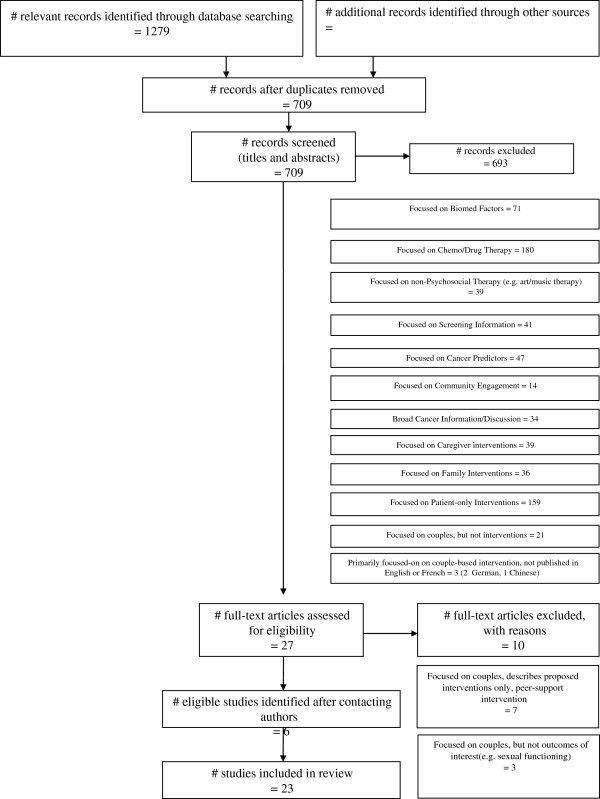
BACKGROUND: With the growing recognition that patients and partners react to a cancer diagnosis as an interdependent system and increasing evidence that psychosocial interventions can be beneficial to both patients and partners, there has been a recent increase in the attention given to interventions that target couples. The aim of this systematic review was to identify existing couple-based interventions for patients with cancer and their partners and explore the efficacy of these interventions (including whether there is added value to target the couple versus individuals), the content and delivery of couple-based interventions, and to identify the key elements of couple-based interventions that promote improvement in adjustment to cancer diagnosis. METHOD: A systematic review of the cancer literature was performed to identify experimental and quasi-experimental couple-based interventions published between 1990 and 2011. To be considered for this review, studies had to test the efficacy of a psychosocial intervention for couples affected by cancer. Studies were excluded if they were published in a language other than English or French, focused on pharmacological, exercise, or dietary components combined with psychosocial components, or did not assess the impact of the intervention on psychological distress (e.g., depression, anxiety) or quality of life. Data were extracted using a standardised data collection form, and were analysed independently by three reviewers. RESULTS: Of the 709 articles screened, 23 were included in this review. Couple-based interventions were most efficacious in improving couple communication, psychological distress, and relationship functioning. Interventions had a limited impact on physical distress and social adjustment. Most interventions focused on improving communication and increasing understanding of the cancer diagnosis within couples. Interventions were most often delivered by masters-level nurses or clinical psychologists. Although most were delivered in person, few were telephone-based. No difference in efficacy was noted based on mode of delivery. Factors associated with uptake and completion included symptom severity, available time and willingness to travel. CONCLUSION: Given effect sizes of couple-based interventions are similar to those reported in recent meta-analyses of patient-only and caregiver-only interventions (~d=.35-.45), it appears couple-based interventions for patients with cancer and their partners may be at least as efficacious as patient-only and caregiver-only interventions. Despite evidence that couple-based interventions enhance psycho-social adjustment for both patients and partners, these interventions have not yet been widely adopted. Although more work is needed to facilitate translation to routine practice, evidence reviewed is promising in reducing distress and improving coping and adjustment to a cancer diagnosis or to cancer symptoms.
Overview
The claims and statistics of this paper haven’t been checked yet.
Free: it reads the open-access text and checks the first 5 claims that cite a source we can check. Create a free account to check every claim.
Integrity signals
Registry
Cites
Statistics
Figures
Verification
Claims the paper makes
The claims and statistics of this paper haven’t been checked yet.
Free: it reads the open-access text and checks the first 5 claims that cite a source we can check. Create a free account to check every claim.
Claims other papers make about this one
Each is checked against this paper’s own text: does it say what the citing paper says it does?
The source backs part of the claim, not all of it — or backs it for a different population, condition or comparison.
In the citing paper
“A previous systematic review 74 by our team showed that dyadic caregiver interventions are more efficacious than caregiver-only intervention.”
From Non-pharmacological Interventions for Caregivers with Depression and Caregivers of Care Recipients with Co-morbid Depression: Systematic Review and Meta-analysis (2021) · cites this paper as [74]
Experimental — accuracy not yet measured
Self-check
Percentages, sums and reported differences re-computed from the paper’s own numbers.
The self-check needs the paper’s full text.
Citations
Cites
Preferred Reporting Items for Systematic Reviews and Meta-Analyses: the PRISMA statement
Moher, D., Liberati, A., Tetzlaff, J., Altman, D. G., & for the PRISMA Group (2009) · BMJ · doi:10.1136/bmj.b2535 · Cited by 83,823
Preferred Reporting Items for Systematic Reviews and Meta-Analyses: The PRISMA Statement
Moher, D., Liberati, A., Tetzlaff, J., Altman, D. G., & The PRISMA Group (2009) · PLoS Medicine · doi:10.1371/journal.pmed.1000097 · Cited by 64,042 · cited 1×
“To maximise methodological quality, this review was conducted in accordance with the guidelines suggested by the Preferred Reporting Items for Systematic Reviews and Metaanalyses (PRISMA) [41].”
MethodPreferred reporting items for systematic reviews and meta-analyses: the PRISMA Statement.
(2009) · PubMed Central · Cited by 44,859
Eysenck, H. J. (1985) · Behaviour Research and Therapy · doi:10.1016/0005-7967(85)90087-7 · Cited by 31,975
“Stress: appraisal and coping,”
Folkman, S. (2013) · Encyclopedia of Behavioral Medicine · doi:10.1007/978-1-4419-1005-9_215 · Cited by 27,833
Borenstein, M., Hedges, L. V., Higgins, J. P. T., & Rothstein, H. R. (2009) · doi:10.1002/9780470743386 · Cited by 14,225
Borenstein, M., Hedges, L. V., Higgins, J. P. T., & Rothstein, H. R. (2021) · doi:10.1002/9781119558378 · Cited by 9,799
Cohen, J. (1992) · Psychological Bulletin · doi:10.1037//0033-2909.112.1.155 · Cited by 8,771
Evaluating non-randomised intervention studies
Deeks, J., Dinnes, J., D'Amico, R., Sowden, A., Sakarovitch, C., Song, F., Petticrew, M., & Altman, D. (2003) · Health Technology Assessment · doi:10.3310/hta7270 · Cited by 2,907 · cited 1×
“[44,45].”
Danaei, G., Ding, E. L., Mozaffarian, D., Taylor, B., Rehm, J., Murray, C. J. L., & Ezzati, M. (2009) · PLoS Medicine · doi:10.1371/journal.pmed.1000058 · Cited by 2,860
Research works printed but not linked: 4
- Australian Institute of Health and Welfare (AIHW) Australasian Association of Cancer Registries (AACR) Cancer in Australia: an overview, 2008. Cancer series no. 46 2008 AIHW, Canberra
- Regan T Lambert S Girgis A When two halves are better than one: A systematic review of the efficacy of couple-based interventions vs. patient-only interventions Asia-Pac JClin Oncol 2010 6 S.3 200
- Centre NBC Initiative NCC Clinical practice guidelines for the psychosocial care of adults with cancer 2003 In. Edited by Centre NBC, Camperdown, NSW
- Lambert S Girgis A Chambers SK Sundquist K Coping-Together: Development and pilot pesting of a self-directed coping skills intervention for patients-primary support person dyads Psycho-Oncology 2010 19 Suppl. 2 S259
Cited by
Distress Management, Version 3.2019, NCCN Clinical Practice Guidelines in Oncology
Riba, M. B., Donovan, K. A., Andersen, B., Braun, I., Breitbart, W. S., Brewer, B. W., Buchmann, L. O., Clark, M. M., Collins, M., Corbett, C., et al. (2019) · Journal of the National Comprehensive Cancer Network · doi:10.6004/jnccn.2019.0048 · Cited by 871
Sklenarova, H., Krümpelmann, A., Haun, M. W., Friederich, H., Huber, J., Thomas, M., Winkler, E. C., Herzog, W., & Hartmann, M. (2015) · Cancer · doi:10.1002/cncr.29223 · Cited by 438
“In fact, dyadic interventions are reported to be at least as efficacious as patient-only and caregiver-only interventions.(26) Caregiver distress was found to be associated with a higher need for support in the domains of health care service and information, emotional and psychological needs, and work and social secur…”
BackgroundDyadic coping and relationship functioning in couples coping with cancer: A systematic review
Traa, M. J., De Vries, J., Bodenmann, G., & Den Oudsten, B. L. (2015) · British Journal of Health Psychology · doi:10.1111/bjhp.12094 · Cited by 367
“Several reviews already reported on the potential of couple-based interventions to improve the dyadic coping of couples coping with cancer and on the beneficial effects of this coping on the psychosocial adjustment and relationship functioning of patients and partners (e.g., Badr & Krebs, 2012; Martire, Shulz, Helgeso…”
BackgroundInfluentialA systematic review and meta‐analysis of psychosocial interventions for couples coping with cancer
Badr, H., & Krebs, P. (2013) · Psycho-Oncology · doi:10.1002/pon.3200 · Cited by 330
“Although there have been several notable reviews in this area [1,8–13], none have evaluated the efficacy of couplebased interventions on multiple aspects of QOL for both members of the couple.”
BackgroundA review of family caregiving intervention trials in oncology
Ferrell, B., & Wittenberg, E. (2017) · CA: A Cancer Journal for Clinicians · doi:10.3322/caac.21396 · Cited by 256
Girgis, A., Lambert, S. D., McElduff, P., Bonevski, B., Lecathelinais, C., Boyes, A., & Stacey, F. (2013) · Psycho-Oncology · doi:10.1002/pon.3166 · Cited by 176
Self-citationFeeling well and talking about sex: psycho-social predictors of sexual functioning after cancer
The Australian Cancer and Sexuality Study Team, Perz, J., Ussher, J. M., & Gilbert, E. (2014) · BMC Cancer · doi:10.1186/1471-2407-14-228 · Cited by 164
Li, Q., & Loke, A. Y. (2014) · Psycho-Oncology · doi:10.1002/pon.3535 · Cited by 152
Psychosocial interventions for informal caregivers of people living with cancer
Treanor, C. J., Santin, O., Prue, G., Coleman, H., Cardwell, C. R., O'Halloran, P., & Donnelly, M. (2019) · Cochrane Database of Systematic Reviews · doi:10.1002/14651858.cd009912.pub2 · Cited by 145
Schellekens, M. P. J., van den Hurk, D. G. M., Prins, J. B., Donders, A. R. T., Molema, J., Dekhuijzen, R., van der Drift, M. A., & Speckens, A. E. M. (2017) · Psycho-Oncology · doi:10.1002/pon.4430 · Cited by 138
“319 Low 11 (36) 13 (41) 3 (14) 5 (22) Intermediate 11 (36) 10 (31) 9 (43) 13 (57) High 9 (29) 9 (28) 9 (43) 5 (22) Currently employed 12 (38) 12 (39) .”
“All or nothing”: Attachment avoidance and the curvilinear effects of partner support.
Girme, Y. U., Overall, N. C., Simpson, J. A., & Fletcher, G. J. O. (2015) · Journal of Personality and Social Psychology · doi:10.1037/a0038866 · Cited by 148
Deshields, T. L., Gregorio, S. W., Flowers, S. R., Irwin, K. E., Nipp, R. D., Padgett, L. S., & Zebrack, B. (2021) · CA A Cancer Journal for Clinicians · doi:10.3322/caac.21672 · Cited by 159
Rumpold, T., Schur, S., Amering, M., Kirchheiner, K., Masel, E. K., Watzke, H., & Schrank, B. (2015) · Supportive Care in Cancer · doi:10.1007/s00520-015-2987-z · Cited by 123
Dyadic Interventions for Cancer Survivors and Caregivers: State of the Science and New Directions
Badr, H., Bakhshaie, J., & Chhabria, K. (2019) · Seminars in Oncology Nursing · doi:10.1016/j.soncn.2019.06.004 · Cited by 102
Couples coping with cancer: exploration of theoretical frameworks from dyadic studies
Regan, T. W., Lambert, S. D., Kelly, B., Falconier, M., Kissane, D., & Levesque, J. V. (2015) · Psycho-Oncology · doi:10.1002/pon.3854 · Cited by 105
Self-citationLambert, S. D., Duncan, L. R., Kapellas, S., Bruson, A.-M., Myrand, M., Santa Mina, D., Culos-Reed, N., & Lambrou, A. (2016) · Annals of Behavioral Medicine · doi:10.1007/s12160-016-9819-3 · Cited by 98
Self-citationFamily Involvement in Adult Chronic Disease Care: Reviewing the Systematic Reviews
Gilliss, C. L., Pan, W., & Davis, L. L. (2019) · Journal of Family Nursing · doi:10.1177/1074840718822365 · Cited by 107
Marital adjustment in the context of female breast cancer: A systematic review
Brandão, T., Pedro, J., Nunes, N., Martins, M. V., Costa, M. E., & Matos, P. M. (2017) · Psycho-Oncology · doi:10.1002/pon.4432 · Cited by 93
“This can be done by adopting couple‐based interventions or, at least, offer support to partners of women with BC, since there is still scarce evidence that intervening with couples might be better than with patients.(69) Also, by identifying associations between some specific demographic, disease‐ related, and psychos…”
BackgroundJadalla, A., Ginex, P., Coleman, M., Vrabel, M., & Bevans, M. (2020) · Clinical Journal of Oncology Nursing · doi:10.1188/20.cjon.31-50 · Cited by 77
Acquati, C., & Kayser, K. (2019) · Frontiers in Psychology · doi:10.3389/fpsyg.2019.00404 · Cited by 87
“Over the last two decades, several couple-based interventions have been developed and tested in RCTs (Baik and Adams, 2011; Regan et al., 2012; Badr and Krebs, 2013).”
BackgroundSelf-citationIntimate Relationships Affected by Breast Cancer: Interventions for Couples
Zimmermann, T. (2015) · Breast Care · doi:10.1159/000381966 · Cited by 91
Use and need for psychosocial support in cancer patients
Ernst, J. C., Beierlein, V., Romer, G., Möller, B., Koch, U., & Bergelt, C. (2013) · Cancer · doi:10.1002/cncr.28021 · Cited by 71
“Psychosocial interventions have been proven to be effective in reducing the distress of both patients and their relatives and increasing their quality of life.(8) However, although the availability of psychooncological support for the patient and his/her relatives is a goal of integrated cancer care and has been ackno…”
BackgroundThompson, T., Ketcher, D., Gray, T. F., & Kent, E. E. (2021) · Social Science & Medicine · doi:10.1016/j.socscimed.2021.114357 · Cited by 77
Association between dyadic interventions and outcomes in cancer patients: a meta-analysis
Hu, Y., Liu, T., & Li, F. (2019) · Supportive Care in Cancer · doi:10.1007/s00520-018-4556-8 · Cited by 72
Psychological intervention with couples coping with breast cancer: a systematic review
Brandão, T., Schulz, M. S., & Matos, P. M. (2014) · Psychology & Health · doi:10.1080/08870446.2013.859257 · Cited by 65
“…for a broad mix of cancers (e.g. breast, prostrate and lung) or to include interventions for other types of chronic diseases (e.g. cardiovascular disease or hypertension, osteoarthritis, HIV and diabetes) (Badr & Krebs, 2012; Martire, Schulz, Helgeson, Small, & Saghafi, 2010; Regan et al., 2012).”
BackgroundErnst, J., Hinz, A., Niederwieser, D. W., Döhner, H., Hönig, K., Vogelhuber, M., Mehnert-Theuerkauf, A., & Weißflog, G. (2016) · Leukemia & lymphoma/Leukemia and lymphoma · doi:10.1080/10428194.2016.1194983 · Cited by 71
Keogh, J., Patel, A., MacLeod, R., & Masters, J. (2013) · European Journal of Cancer Care · doi:10.1111/ecc.12141 · Cited by 75
Lambert, S. D., & Girgis, A. (2017) · Asia-Pacific Journal of Oncology Nursing · doi:10.4103/2347-5625.204485 · Cited by 56
“Approximately, one‐third (range=9%–49%) of caregivers who begin a caregiver intervention do not complete it.([11]) Commonly, attrition is due to high patient symptom severity or high caregiver burden and strain.”
BackgroundSelf-citationBryant, J., Mansfield, E. L., Boyes, A., Waller, A. E., Sanson‐Fisher, R., & Regan, T. (2016) · International Journal of COPD · doi:10.2147/copd.s107571 · Cited by 57
“15 Similar to other chronic disease contexts, 16,17 informal caregivers of patients with COPD represent potential agents of change that can facilitate and enhance adherence to COPD management behaviors.”
Self-citationThe 2014–2018 Oncology Nursing Society Research Agenda
Knobf, M., Cooley, M., Duffy, S., Doorenbos, A., Eaton, L., Given, B., Mayer, D., McCorkle, R., Miaskowski, C., Mitchell, S., et al. (2015) · Oncology Nursing Forum · doi:10.1188/15.onf.450-465 · Cited by 53
Supportive interventions for family caregivers of patients with advanced cancer: A systematic review
Becqué, Y. N., van der Wel, M., Arslan, M., van Driel, A. G., Rietjens, J. A. C., van der Heide, A., & Witkamp, E. (2023) · Psycho-Oncology · doi:10.1002/pon.6126 · Cited by 63
von Heymann-Horan, A., Bidstrup, P., Guldin, M.-B., Sjøgren, P., Andersen, E. A. W., von der Maase, H., Kjellberg, J., Timm, H., & Johansen, C. (2018) · British Journal of Cancer · doi:10.1038/s41416-018-0193-8 · Cited by 54
Updated meta-review of evidence on support for carers
Thomas, S., Dalton, J., Harden, M., Eastwood, A. J., & Parker, G. M. (2017) · Health Services and Delivery Research · doi:10.3310/hsdr05120 · Cited by 75
Kroenke, C. H. (2018) · Translational Behavioral Medicine · doi:10.1093/tbm/ibx061 · Cited by 55
Uptake and attrition in couple-based interventions for cancer: Perspectives from the literature
Regan, T., Lambert, S. D., & Kelly, B. (2013) · Psycho-Oncology · doi:10.1002/pon.3342 · Cited by 49
“[9] further highlighted the paucity of detail regarding uptake and attrition rates reported in existing couple-based interventions and suggested that to improve the applicability of couple-based interventions,”
BackgroundSelf-citationSalakari, M., Pylkkänen, L., Sillanmäki, L., Nurminen, R., Rautava, P., Koskenvuo, M., & Suominen, S. (2017) · The Breast · doi:10.1016/j.breast.2017.06.017 · Cited by 49
Lambert, S. D., McElduff, P., Girgis, A., Levesque, J. V., Regan, T. W., Turner, J., Candler, H., Mihalopoulos, C., Shih, S. T. F., Kayser, K., et al. (2016) · Supportive Care in Cancer · doi:10.1007/s00520-015-2833-3 · Cited by 48
“The Caregiver Quality of Life Index–Cancer (CQOLC) scale: development and validation of an instrument to measure quality of life of the family caregiver of patients with cancer.”
InfluentialSelf-citationThe Australian Cancer and Sexuality Study Team, Perz, J., & Ussher, J. M. (2015) · BMC Cancer · doi:10.1186/s12885-015-1638-6 · Cited by 51
“Combined with previous reports that that psychosocial interventions are more effective when partners engage with the process through taking part in homework activities [36, 107], this suggests that clinicians should include an emphasis on couple communication and exploration of sexual changes, regardless of whether th…”
BackgroundThe Experiences of Chinese Couples Living With Cancer: A Focus Group Study
Li, Q., Chiang, V. C. L., Xu, X., Xu, Y., & Loke, A. Y. (2015) · Cancer Nursing · doi:10.1097/ncc.0000000000000196 · Cited by 44
“Group 2 P6, P7 SC6 Group 3 P8Y10 SC7 SC8Y10 Group 4 P11 SC11Y17 Mean age 61 (Range, 43Y72) 66 (Range, 43Y76) Mean length of the marriage 40 (Range, 18Y50) 41 (Range, 19Y52) Gender (n) Male: 6; female: 5 Male: 8; female: 9 Levels of education (n) Undergraduate education (1), middle school (10) Middle school (11), prima…”
BackgroundLi, M., Zhang, L., Li, N., Luo, X., Chen, J., Zhang, Y., Xiong, C., Zhao, M. L., Guo, Z., & Yan, J. (2023) · Journal of Advanced Nursing · doi:10.1111/jan.15639 · Cited by 42
The Impact of Cancer and Chronic Conditions on Caregivers and Family Members
Lambert, S., Levesque, J. V., & Girgis, A. (2016) · Springer eBooks · doi:10.1007/978-981-10-1844-2_6 · Cited by 59
Self-citationNicolaisen, A., Hagedoorn, M., Hansen, D. G., Flyger, H. L., Christensen, R., Rottmann, N., Lunn, P. B., Terp, H., Soee, K., & Johansen, C. (2018) · Psycho-Oncology · doi:10.1002/pon.4613 · Cited by 39
“Three systematic reviews with 37 couple interventions for cancer patients and partners found significant, small to moderate effect sizes regarding psychological, physical and relationship outcomes for both patients and partners [13-15].”
BackgroundUpdated meta-review of evidence on support for carers
Dalton, J., Thomas, S., Harden, M., Eastwood, A. J., & Parker, G. M. (2018) · Journal of Health Services Research & Policy · doi:10.1177/1355819618766559 · Cited by 49
Development of a novel positive psychology-based intervention for couples post-stroke.
Terrill, A. L., Reblin, M., MacKenzie, J. J., Cardell, B., Einerson, J., Berg, C. A., Majersik, J. J., & Richards, L. G. (2018) · Rehabilitation Psychology · doi:10.1037/rep0000181 · Cited by 47
“In the cancer literature, a growing body of research supports that couples-based interventions utilizing some of these strategies foster improved psychosocial adjustment to cancer in both patient and partner caregiver (e.g., Badr & Krebs, 2013; Regan et al., 2012).”
Fergus, K., Ahmad, S., Gardner, S., Ianakieva, I., McLeod, D., Stephen, J., Carter, W., Periera, A., Warner, E., & Panchaud, J. (2022) · Psycho-Oncology · doi:10.1002/pon.5836 · Cited by 38
Carolan, C. M., Smith, A., & Forbat, L. (2015) · Palliative Medicine · doi:10.1177/0269216315575680 · Cited by 50
Robertson, J., McNamee, P., Molloy, G., Hubbard, G., McNeill, A., Bollina, P., Kelly, D., & Forbat, L. (2016) · The Journal of Sexual Medicine · doi:10.1016/j.jsxm.2016.05.013 · Cited by 37
“A systemic approach is supported by evidence demonstrating that lack of couple communication, relationship problems, and psychological distress are the psychosocial sequelae most amenable to intervention in couples affected by cancer.(21) Other investigators have evaluated the efficacy of psychosocial interventions ad…”
Beyond “being open about it”: A systematic review on cancer related communication within couples
Hasson‐Ohayon, I., Goldzweig, G., Braun, M., & Hagedoorn, M. (2022) · Clinical Psychology Review · doi:10.1016/j.cpr.2022.102176 · Cited by 43
“In addition to these meta-analyses, two narrative systematic reviews showed that improving communication as a mechanism for change in couples' relationships is evident in most of the interventions although rarely measured (Li & Loke, 2014; Regan et al., 2012).”
MethodUnique characteristics of informal hospice cancer caregiving
Washington, K. T., Pike, K. C., Demiris, G., & Oliver, D. P. (2015) · Supportive Care in Cancer · doi:10.1007/s00520-014-2570-z · Cited by 34
“Couple-based interventions for individuals affected by cancer have been shown to be particularly effective in improving communication and relationship functioning and in reducing psychological distress [28], outcomes that no doubt contribute to overall quality of life for both hospice cancer patients and their caregiv…”
Bitz, C., Kent, E. E., Clark, K. L., & Loscalzo, M. J. (2020) · Psycho-Oncology · doi:10.1002/pon.5364 · Cited by 36
“Evidence is building that couples-based interventions can be as effective as interventions that target the patient or caregiver only.(32) Although data are robust for engaging couples early in the process, there remains a gap to clinical implementation.”
BackgroundDonovan, E. E., & Farris, K. L. (2018) · Communication Theory · doi:10.1093/ct/qty026 · Cited by 39
Talking but not always understanding: couple communication about infertility concerns after cancer
Hawkey, A., Ussher, J. M., Perz, J., & Parton, C. (2021) · BMC Public Health · doi:10.1186/s12889-021-10188-y · Cited by 38
Lambert, S., Duncan, L. R., Culos-Reed, S. N., Hallward, L., Higano, C. S., Loban, K., Katz, A., de Raad, M., Ellis, J., Korman, M. B., et al. (2022) · Current Oncology · doi:10.3390/curroncol29020067 · Cited by 35
“In fact, dyadic interventions are found to be more efficacious than patient-only or caregiver-only interventions, because of the shared learning that occurs and the interdependency of patients’ and caregivers’ coping and health outcomes [20].”
BackgroundSelf-citationLambert, S. D., Girgis, A., Turner, J., McElduff, P., Kayser, K., & Vallentine, P. (2012) · Health and Quality of Life Outcomes · doi:10.1186/1477-7525-10-119 · Cited by 30
Self-citationChen, M., Gong, J., Lin, C., Luo, H., & Li, Q. (2022) · European Journal of Oncology Nursing · doi:10.1016/j.ejon.2022.102226 · Cited by 33
Yan, Q., Zhu, C., Li, L., Li, Y., Chen, Y., & Hu, X. (2024) · International Journal of Nursing Studies · doi:10.1016/j.ijnurstu.2024.104895 · Cited by 34
Drabe, N., Klaghofer, R., Weidt, S., Zwahlen, D., Büchi, S., & Jenewein, J. (2014) · Psycho-Oncology · doi:10.1002/pon.3662 · Cited by 30
“Moreover, when RQ is impaired and patients and/or partners seem to be depressed, couples therapy should be considered a viable option for treating that depression, because it is well described in the literature that couples therapy is as effective as single-patient psychotherapy [52].”
BackgroundMcCormick, S. A., Vatter, S., Carter, L., Smith, S. J., Orgeta, V., Poliakoff, E., Silverdale, M., Raw, J., Ahearn, D., Taylor, C., et al. (2019) · Journal of Neurology · doi:10.1007/s00415-019-09329-6 · Cited by 31
Pang, X., Jin, Y., & Wang, H. (2022) · Asia-Pacific Journal of Oncology Nursing · doi:10.1016/j.apjon.2022.100104 · Cited by 33
Hawkey, A., Ussher, J. M., Perz, J., Parton, C., Patterson, P., Bateson, D. J., Hobbs, K., & Kirsten, L. T. (2020) · European Journal of Cancer Care · doi:10.1111/ecc.13348 · Cited by 35
Lambert, S., Brahim, L. O., McCusker, J., Coumoundouros, C., Audet, L.-A., Yaffe, M., Kayser, J., Magalhaes, M., Belzile, E., & Turner, N. (2021) · Journal of General Internal Medicine · doi:10.1007/s11606-021-06891-6 · Cited by 28
Self-citationLambert, S., Girgis, A., Turner, J., Regan, T. W., Candler, H., Britton, B., Chambers, S. K., Lawsin, C. R., & Kayser, K. (2013) · Supportive Care in Cancer · doi:10.1007/s00520-013-1914-4 · Cited by 29
Self-citationFergus, K., Ahmad, S., McLeod, D. L., Stephen, J., Gardner, S., Pereira, A., Warner, E., & Carter, W. (2015) · Trials · doi:10.1186/s13063-014-0534-8 · Cited by 27
“for couples coping with breast cancer [53-57], they may not be a feasible option for younger couples who are already living very busy lives with additional demands, such as caring for young children and balancing domestic duties and active careers alongside attending medical appointments.”
BackgroundIn Sickness and in Health: Couples Coping with Stroke across the Life Span: Table 1:
McCarthy, M. J., & Bauer, E. (2015) · Health & Social Work · doi:10.1093/hsw/hlv043 · Cited by 44
Hackshaw‐McGeagh, L., Sutton, E. J., Persad, R. A., Aning, J. J., Bahl, A. K., Koupparis, A. J., Millett, C., Martin, R. M., & Lane, J. A. (2017) · BMC Urology · doi:10.1186/s12894-017-0284-5 · Cited by 31
“This is in contrast to studies supporting the efficacy of couple based interventions [11].”
ResultWang, F., Luo, D., Fu, L., Zhang, H., Wu, S., Zhang, M., Zhou, H., Sun, T., & Chen, X. (2016) · Cancer Nursing · doi:10.1097/ncc.0000000000000356 · Cited by 29
“Reducing psychological distress, increasing coping ability, and improving the HRQoL of cancer patients and their spouses or caregivers are priorities for researchers and clinicians.(2) Numerous studies have assessed interventions designed to improve the HRQoL and reduce the emotional distress of cancer patients.”
InfluentialCollaço, N., Wagland, R., Alexis, O., Gavin, A., Glaser, A., & Watson, E. K. (2020) · Journal of Cancer Survivorship · doi:10.1007/s11764-020-00936-1 · Cited by 26
Kochaki Nejad, Z., Mohajjel Aghdam, A., Hassankhani, H., & Sanaat, Z. (2016) · Iranian Red Crescent Medical Journal · doi:10.5812/ircmj.21627 · Cited by 27
“In a systematic review, Regan and colleagues emphasized that most of the couple-based interventions included in their review demonstrated significant improvements regarding psychological distress for intervention couples compared to control couples (24).”
BackgroundChan, J. S. M., Yu, N. X., Chow, A. Y. M., Chan, C., Chung, K., Ho, R., Ng, S., Yuen, L.-P., & Chan, C. (2016) · Psycho-Oncology · doi:10.1002/pon.4240 · Cited by 29
Lambert, S., Girgis, A., McElduff, P., Turner, J., Levesque, J. V., Kayser, K., Mihalopoulos, C., Shih, S. T. F., & Barker, D. (2013) · BMJ Open · doi:10.1136/bmjopen-2013-003337 · Cited by 29
Self-citationRegan, T. W., Levesque, J. V., Lambert, S., & Kelly, B. J. (2015) · PLoS ONE · doi:10.1371/journal.pone.0133837 · Cited by 34
“The current evidence regarding couple-based interventions suggests they have a low to moderate impact on reducing psychological distress [2, 51].”
BackgroundInfluentialSelf-citationNeuzillet, C., Vergnault, M., Bonnetain, F., & Hammel, P. R. (2015) · Trials · doi:10.1186/s13063-015-0983-8 · Cited by 29
“This practice is expected to sustain the patient motivation and to be beneficial for the partner in terms of psychological outcome, while avoiding the potentially deleterious psychological effects of the patient group [40].”
BackgroundThe Effectiveness of Psychoeducational Interventions Focused on Sexuality in Cancer
Kim, J., Yang, Y.-H., & Hwang, E.-S. (2015) · Cancer Nursing · doi:10.1097/ncc.0000000000000212 · Cited by 27
Lambert, S., Duncan, L. R., Ellis, J., Schaffler, J. L., Loban, K., Robinson, J. W., Culos-Reed, N. S., Matthew, A., Clayberg, K., Mina, D. S., et al. (2020) · Journal of Clinical Medicine · doi:10.3390/jcm9103284 · Cited by 24
“Given the critical role that caregivers play in maintaining patients’ health and wellbeing, it is imperative that more studies test effective and sustainable methods to preserve or improve their QOL.”
BackgroundSelf-citationThe shared uncertainty experience of older adults with advanced cancer and their caregivers
Zhang, Y., Mohile, S. G., Culakova, E., Norton, S. A., Loh, K. P., Kadambi, S. G., Kehoe, L., Grossman, V. A., Vogel, V. G., Burnette, B. L., et al. (2022) · Psycho-Oncology · doi:10.1002/pon.5895 · Cited by 24
“(2012)'s review suggested that the dyad‐based psychosocial interventions for patients with cancer and their partners may be at least as efficacious as patient‐only and caregiver‐only interventions.(41) A dyadic intervention may affect the interdependence of uncertainty experience.”
BackgroundLambert, S., Kelly, B. J., Boyes, A., Cameron, A., Adams, C., Proietto, A. M., & Girgis, A. (2014) · Journal of the National Comprehensive Cancer Network · doi:10.6004/jnccn.2014.0084 · Cited by 26
Self-citationOnline couple interventions in cancer
Vanstone, R. N., & Fergus, K. D. (2019) · Current Opinion in Supportive and Palliative Care · doi:10.1097/spc.0000000000000476 · Cited by 24
“For example, the development of telephone-based interventions for couples [18,27,20,28] has shown promise in terms of increasing reach while showing no significant difference in outcomes relative to in-person interventions [4].”
BackgroundInfluentialHendriksen, E., Rivera, A. M., Williams, E., Lee, E., Sporn, N. J., Cases, M. G., & Palesh, O. G. (2019) · Psychology and Health · doi:10.1080/08870446.2019.1579909 · Cited by 26
“A small but growing body of research views the cancer patient-caregiver dyad as the smallest indivisible unit of study, even in interventions (Baik & Adams, 2011; Hopkinson, Brown, Okamoto, & Addington-Hall, 2012; Li & Loke, 2014; Regan et al., 2012).”
BackgroundPromoting Patient and Caregiver Engagement to Care in Cancer
Saita, E., Acquati, C., & Molgora, S. (2016) · Frontiers in Psychology · doi:10.3389/fpsyg.2016.01660 · Cited by 26
“This view of engagement as inclusive of the patient’s tapestry of relationships has essential implications for cancer, since it is now wellestablished in the literature that cancer is a relational illness (Revenson et al., 2005; Kayser et al., 2007; Manne and Badr, 2008).”
BackgroundChien, C., Chung, H., Liu, K., Pang, S., Wu, C., Chang, Y., Huang, X., Chang, Y., Lin, T., Lin, W., et al. (2020) · Journal of Advanced Nursing · doi:10.1111/jan.14471 · Cited by 23
Duke, S., Campling, N. C., May, C. R., Lund, S., Lunt, N. T., Bartlett, G., Harris, L., Flannery, E., Connolly, M., Booth, P., et al. (2020) · BMC Palliative Care · doi:10.1186/s12904-020-00647-5 · Cited by 24
Effects of Dyadic Interventions on Quality of Life among Cancer Patients: An Integrative Review
Sharma, A., Saneha, C., & Phligbua, W. (2021) · Asia-Pacific Journal of Oncology Nursing · doi:10.4103/apjon.apjon_63_20 · Cited by 26
“Couple-based/dyadic interventions for cancer patient and their partner have been found to enhance patient’s psychological and social adjustment such as communication and relationship functioning.([27]) Dyadic intervention in cancer has potential for achieving success as it simultaneously addresses survivor, caregiver,…”
BackgroundJonsdottir, J. I., Jónsdóttir, H., & Klinke, M. E. (2017) · Journal of Advanced Nursing · doi:10.1111/jan.13470 · Cited by 25
“Prostate cancer most often occurs in older males (Regan et al., 2012).”
BackgroundThompson, T., Heiden‐Rootes, K. M., Joseph, M., Gilmore, L. A., Johnson, L. P., Proulx, C. M., Albright, E. L., Brown, M. T., & McElroy, J. A. (2020) · Social Science & Medicine · doi:10.1016/j.socscimed.2020.113214 · Cited by 28
Gorman, J. R., Lyons, K. S., Reese, J. B., Acquati, C., Smith, E., Drizin, J. H., Salsman, J. M., Flexner, L. M., Hayes‐Lattin, B., & Harvey, S. M. (2022) · Frontiers in Psychology · doi:10.3389/fpsyg.2022.813548 · Cited by 21
“…after cancer for young survivors and their partners, and when left unaddressed, often lead to poorer mental health and quality of life (Carter et al., 2010; Levin et al., 2010; Vaz et al., 2011; Canada and Schover, 2012; Robertson et al., 2016; Ljungman et al., 2018; Patterson et al., 2020).”
BackgroundSun, Q., Wang, K., Chen, Y., Peng, X., Jiang, X., & Peng, J. (2023) · Journal of Clinical Nursing · doi:10.1111/jocn.16890 · Cited by 20
Lamarche, J., Cusson, A., Nissim, R., Avery, J., Wong, J., Maheu, C., Lambert, S. D., Laizner, A. M., Jones, J., Esplen, M. J., et al. (2023) · Frontiers in Digital Health · doi:10.3389/fdgth.2023.1129536 · Cited by 18
Self-citationThompson, T., Davis, M., Pérez, M., Jonson‐Reid, M., & Jeffe, D. B. (2021) · Journal of the Society for Social Work and Research · doi:10.1086/713478 · Cited by 21
Chen, M., Gong, J., Li, J., Luo, X., & Li, Q. (2021) · Healthcare · doi:10.3390/healthcare9050512 · Cited by 18
Lambert, S. D., Hulbert‐Williams, N., Belzile, E., Ciampi, A., & Girgis, A. (2018) · Psycho-Oncology · doi:10.1002/pon.4696 · Cited by 17
“This observation provides a rationale for dyadic or couple‐ based interventions, whereby addressing patients' and caregivers' unmet needs can have synergistic effects and enhance outcomes for both.(29) Although a set of core and frequent needs was identified on the basis of prevalence, these were not necessarily the m…”
BackgroundSelf-citationNicolaisen, A., Hansen, D. G., Hagedoorn, M., Flyger, H., Rottmann, N., Nielsen, P., Søe, K. L., Pedersen, A., & Johansen, C. (2014) · BMC Psychology · doi:10.1186/2050-7283-2-19 · Cited by 18
“…studies of breast cancer patients and their partners have been substantially influenced by methodological limitations such as small sample sizes, large attrition rates, inadequate description of attrition rates, and lack of specific randomisation procedures (Regan et al. 2012; Badr & Krebs 2013).”
BackgroundA Systematic Review: The Effect of Cancer on the Divorce Rate
Fugmann, D., Boeker, M., Holsteg, S., Steiner, N., Prins, J. B., & Karger, A. (2022) · Frontiers in Psychology · doi:10.3389/fpsyg.2022.828656 · Cited by 17
“The long-term effects of cancer on relationships are less clear (Manne and Badr, 2008; Regan et al., 2012).”
BackgroundSun, Q., Xu, P., Li, L., Wang, Z., Chen, Y., Wen, C., Wu, Z., & Peng, J. (2025) · Journal of Clinical Nursing · doi:10.1111/jocn.17677 · Cited by 18
Ammari, A. B. H., Hendriksen, C., & Rydahl‐Hansen, S. (2018) · Journal of Psychosocial Oncology · doi:10.1080/07347332.2018.1460003 · Cited by 17
“…research investigating the effect of longitudinal psychosocial interventions aimed at how patients and caregivers cope with advanced cancer is in its early stages, and previous research have mainly focused on interventions aimed at patients’ or relatives’ coping individually (Regan et al., 2012).”
BackgroundLuo, X., Li, J., Cao, Q., Sun, L., Chen, Y., Zhao, J., & Li, Q. (2020) · Nursing Open · doi:10.1002/nop2.700 · Cited by 18
“Cancer diagnosis and treatment affect both patients and spousal caregivers, leading to a growing recognition of couples-based interventions (Badr & Krebs, 2013; Regan et al., 2012).”
BackgroundMethodCarlson, L. E., Rouleau, C. R., Speca, M., Robinson, J. W., & Bultz, B. D. (2017) · Supportive Care in Cancer · doi:10.1007/s00520-016-3551-1 · Cited by 20
Boehmer, U., Stokes, J. E., Bazzi, A. R., & Clark, M. A. (2019) · Supportive Care in Cancer · doi:10.1007/s00520-019-05148-7 · Cited by 21
“These interventions have been mostly psychosocial and produced small effects [25] similar to the effects of individual interventions for survivors or caregivers alone [21].”
BackgroundBeesley, V. L., Turner, J., Chan, R. J., Yates, P. M., Gordon, L. G., Burge, M., Eastgate, M. A., Staneva, A., Northfield, S., Beebe, H., et al. (2020) · European Journal of Oncology Nursing · doi:10.1016/j.ejon.2020.101729 · Cited by 17
“The key feature that determined the success of these interventions was delivery by experienced nurses or clinical psychologists, either in person or by telephone (Regan et al., 2012), and a duration of at least 2 months (Faller et al.”
BackgroundSelf-citationLambert, S., Beatty, L., McElduff, P., Levesque, J. V., Lawsin, C. R., Jacobsen, P. B., Turner, J., & Girgis, A. (2017) · Patient Education and Counseling · doi:10.1016/j.pec.2017.06.039 · Cited by 15
Self-citationWhy do breast cancer survivors decline a couple-based intimacy enhancement intervention trial?
Reese, J. B., Sorice, K. A., Oppenheimer, N. M., Smith, K. C., Bober, S. L., Bantug, E. T., Schwartz, S., & Porter, L. S. (2018) · Translational Behavioral Medicine · doi:10.1093/tbm/iby129 · Cited by 15
“First, given that few couple-based interventions for cancer survivors have used a telephone format [6], there is little information available on whether this format poses a recruitment challenge.”
Background
Metadata
- Authors
- Regan, T. W., Lambert, S. D., Girgis, A., Kelly, B., Kayser, K., & Turner, J.
- Affiliations
- University of Newcastle Australia (AU)
- UNSW Sydney (AU)
- University of Louisville (US)
- The University of Queensland (AU)
- Corresponding author
- Regan, Tim W
- Venue
- BMC Cancer
- Published
- 2012-07-06
- Volume
- 12
- Issue
- 1
- Pages
- 279-279
- ISSN
- 1471-2407 (ISSN-L)
- PMC
- PMC3464780
- OpenAlex
- W2079094414
- Semantic Scholar
- 5ec519ee55f679f46a684284deaf067b464e2ed3
- Cited by
- 185
- References
- 82
- Citations by year
- 2026: 6 · 2025: 9 · 2024: 9 · 2023: 13 · 2022: 18 · 2021: 18 · 2020: 14 · 2019: 12 · 2018: 12 · 2017: 15 · 2016: 12 · 2015: 22 · 2014: 13 · 2013: 9 · 2012: 3
- FWCI
- 1.55
- Type
- journal article
- Language
- en
- Open access
- gold
- doi.org
- Licence
- Locations
- BMC Cancer (publishedVersion, cc-by)
- Europe PMC (PubMed Central) (publishedVersion, cc-by)
- PubMed Central (publishedVersion, cc-by)
- PubMed (publishedVersion)
- DOAJ (DOAJ: Directory of Open Access Journals) (submittedVersion)
- NOVA (University of Newcastle Australia) (submittedVersion)
- Funders
- Australian Government
- Topics
- Health Sciences › Medicine › Oncology › Cancer survivorship and care
- Social Sciences › Psychology › Social Psychology › Attachment and Relationship Dynamics
- Health Sciences › Nursing › Research and Theory › Nursing care and research
- Keywords
- couple-based interventions, cancer, partners of cancer patients, psychosocial interventions, couple communication, psychological distress, relationship functioning, caregiver burden, intervention delivery
- MeSH terms
- Adaptation, Psychological, Family Characteristics, Humans, Interpersonal Relations, Neoplasms, Problem Solving, Prognosis, Quality of Life, Social Adjustment, Stress, Psychological, Cognitive Behavioral Therapy, Sexuality, Self Efficacy
About these checks
Registry, retraction, Cites and statistics results are computed, not judged, with one exception: a printed reference that no index lists is read once by a model before it counts as a citation error. Claims are extracted by a model and kept only when their quote appears verbatim in the text; each cited source is then checked, with a model’s help, for whether it says what the claim relies on. Those verdicts can be wrong — read the claim’s quote and the cited source before relying on one.
Statistics and arithmetic are recomputed, not judged.
Confidence bands are shown only for fields calibrated on our annotated test set. None is calibrated yet, so no band is shown.
What counts as a claim ›How we measure confidence ›How we check this ›
Are you an author, or do you see a problem with this page? Request a review
Data sources
Bibliographic data: Semantic Scholar, OpenAlex, Crossref.
Contains information from the Semantic Scholar Academic Graph Datasets, made available under the ODC Attribution License (ODC-BY 1.0).
Semantic Scholar’s data is described in: Kinney, R., et al. (2023). The Semantic Scholar Open Data Platform. arXiv:2301.10140.
