

The DOI matches its Crossref record; 34 of the 34 references it cites were found in a registry or an index.
Effects of a physical education intervention on cognitive function in young children: randomized controlled pilot study
Open accessAbstract
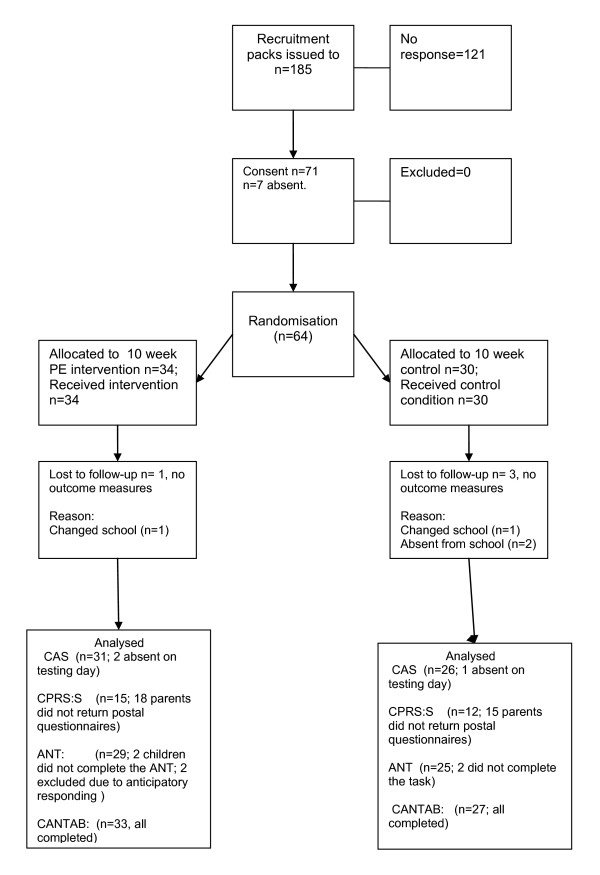
Background: Randomized controlled trials (RCT) are required to test relationships between physical activity and cognition in children, but these must be informed by exploratory studies. This study aimed to inform future RCT by: conducting practical utility and reliability studies to identify appropriate cognitive outcome measures; piloting an RCT of a 10 week physical education (PE) intervention which involved 2 hours per week of aerobically intense PE compared to 2 hours of standard PE (control). Methods: 64 healthy children (mean age 6.2 yrs SD 0.3; 33 boys) recruited from 6 primary schools. Outcome measures were the Cambridge Neuropsychological Test Battery (CANTAB), the Attention Network Test (ANT), the Cognitive Assessment System (CAS) and the short form of the Connor's Parent Rating Scale (CPRS:S). Physical activity was measured habitually and during PE sessions using the Actigraph accelerometer. Results: Test- retest intraclass correlations from CANTAB Spatial Span (r 0.51) and Spatial Working Memory Errors (0.59) and ANT Reaction Time (0.37) and ANT Accuracy (0.60) were significant, but low. Physical activity was significantly higher during intervention vs. control PE sessions (p < 0.0001). There were no significant differences between intervention and control group changes in CAS scores. Differences between intervention and control groups favoring the intervention were observed for CANTAB Spatial Span, CANTAB Spatial Working Memory Errors, and ANT Accuracy. Conclusions: The present study has identified practical and age-appropriate cognitive and behavioral outcome measures for future RCT, and identified that schools are willing to increase PE time. Trial registration number: ISRCTN70853932 (http://www.controlled-trials.com)
Overview
The claims and statistics of this paper haven’t been checked yet.
Run the check — free, no account needed. It reads the open-access text and checks the sources it cites.
Integrity signals
Registry
Cites
Statistics
Figures
Verification
Claims the paper makes
The claims and statistics of this paper haven’t been checked yet.
Run the check — free, no account needed. It reads the open-access text and checks the sources it cites.
Claims other papers make about this one
Each is checked against this paper’s own text: does it say what the citing paper says it does?
The source backs part of the claim, not all of it — or backs it for a different population, condition or comparison.
In the citing paper
“Several studies have identified a positive relationship between cardiorespiratory fitness, weight and AP (46–49) or with overall physical fitness (82).”
From Children's Physical Activity, Academic Performance, and Cognitive Functioning: A Systematic Review and Meta-Analysis (2020) · cites this paper as [46]
Experimental — accuracy not yet measured
Self-check
Percentages, sums and reported differences re-computed from the paper’s own numbers.
The self-check needs the paper’s full text.
Citations
Cites
Developing and evaluating complex interventions: the new Medical Research Council guidance
Craig, P., Dieppe, P., Macintyre, S., Michie, S., Nazareth, I., & Petticrew, M. (2008) · BMJ · doi:10.1136/bmj.a1655 · Cited by 10,995
Measures of Reliability in Sports Medicine and Science
Hopkins, W. G. (2000) · Sports Medicine · doi:10.2165/00007256-200030010-00001 · Cited by 4,635 · cited 1×
“Intraclass correlations (ICC), and standard error of measurement (SEM) - measures of within subject variation from biological difference or equipment ‘noise’ or error [28] were calculated.”
MethodFitness Effects on the Cognitive Function of Older Adults: A Meta-Analytic Study
Colcombe, S., & Kramer, A. F. (2003) · Psychological Science · doi:10.1111/1467-9280.t01-1-01430 · Cited by 3,782
Be smart, exercise your heart: Exercise effects on brain and cognition
Hillman, C. H., Erickson, K. I., & Kramer, A. F. (2008) · Nature Reviews Neuroscience · doi:10.1038/nrn2298 · Cited by 3,563
Developing and Evaluating Complex Interventions: New Guidance
Craig, P., Dieppe, P. A., MacIntyre, S., Michie, S., Nazareth, I., & Petticrew, M. P. (2006) · UCL Discovery (University College London) · Cited by 1,878
Cardiovascular fitness, cortical plasticity, and aging
Colcombe, S. J., Kramer, A. F., Erickson, K. I., Scalf, P., McAuley, E., Cohen, N. J., Webb, A., Jerome, G. J., Marquez, D. X., & Elavsky, S. (2004) · Proceedings of the National Academy of Sciences · doi:10.1073/pnas.0400266101 · Cited by 1,648 · cited 2×
“Research, largely in older adults, supports the notion that aerobic exercise can enhance human brain structure, prevent age-related brain tissue loss, and improve cognitive performance [7-9].”
BackgroundAgeing, fitness and neurocognitive function
Kramer, A. F., Hahn, S., Cohen, N. J., Banich, M. T., McAuley, E., Harrison, C. R., Chason, J., Vakil, E., Bardell, L., Boileau, R. A., et al. (1999) · Nature · doi:10.1038/22682 · Cited by 1,394 · cited 2×
“Research, largely in older adults, supports the notion that aerobic exercise can enhance human brain structure, prevent age-related brain tissue loss, and improve cognitive performance [7-9].”
BackgroundDevelopment of attentional networks in childhood
Rueda, M. R., Fan, J., McCandliss, B. D., Halparin, J. D., Gruber, D. B., Lercari, L. P., & Posner, M. I. (2004) · Neuropsychologia · doi:10.1016/j.neuropsychologia.2003.12.012 · Cited by 1,339 · cited 3×
“For a detailed description of the ANT see http://www.sacklerinstitute. org/users/jin.fan and Rueda et al [20], but in brief, the ANT was administered in four blocks of tests, each lasting approximately 5 minutes: a practice block of tests was used first to train the children in what was expected, and to identify any p…”
MethodInfluentialThe relationship between physical activity and cognition in children: a meta-analysis
Sibley, B. A., & Etnier, J. L. (2003) · Pediatric Exercise Science · doi:10.1123/pes.15.3.243 · Cited by 1,308 · cited 3×
“Experimental evidence in children is very limited [3,5]: < 1% of published exercise and cognition * Correspondence: John.”
BackgroundResearch Methods and Statistics in Psychology
Coolican, H., & Coolican, H. (2014) · Psychology Press eBooks · doi:10.4324/9780203769836 · Cited by 1,174
The Hawthorne effect: A reconsideration of the methodological artifact.
Adair, J. G. (1984) · Journal of Applied Psychology · doi:10.1037/0021-9010.69.2.334 · Cited by 1,095 · cited 1×
“To control for any improvement in psychological variables by simply intervening [22] and to try to ensure that any differences between groups might be attributable to the difference in aerobically intense PE between the two groups, control and intervention groups were matched for intervention time.”
Validation and Calibration of Physical Activity Monitors in Children
Puyau, M. R., Adolph, A. L., Vohra, F. A., & Butte, N. F. (2002) · Obesity Research · doi:10.1038/oby.2002.24 · Cited by 1,013 · cited 3×
“behavior (accelerometer counts per minute < 1100; [23], light intensity physical activity (accelerometer count per minute 1100-3200) and moderate-vigorous intensity physical activity (MVPA, > 3200 counts per minute) [25].”
BackgroundMethodConners' rating scales-revised : technical manual
Conners, C. K. (1997) · Medical Entomology and Zoology · Cited by 1,004
Dishman, R. K., Berthoud, H., Booth, F. W., Cotman, C. W., Edgerton, V. R., Fleshner, M. R., Gandevia, S. C., Gomez‐Pinilla, F., Greenwood, B. N., Hillman, C. H., et al. (2006) · Obesity · doi:10.1038/oby.2006.46 · Cited by 958
Davis, C. L., Tomporowski, P. D., McDowell, J. E., Austin, B. P., Miller, P. H., Yanasak, N. E., Allison, J. D., & Naglieri, J. A. (2011) · Health Psychology · doi:10.1037/a0021766 · Cited by 911 · cited 3×
“Research, largely in older adults, supports the notion that aerobic exercise can enhance human brain structure, prevent age-related brain tissue loss, and improve cognitive performance [7-9].”
BackgroundSelf-citationExercise and Children’s Intelligence, Cognition, and Academic Achievement
Tomporowski, P. D., Davis, C. L., Miller, P. H., & Naglieri, J. A. (2008) · Educational Psychology Review · doi:10.1007/s10648-007-9057-0 · Cited by 874 · cited 2×
“Several biologically plausible mechanisms link physical activity and cognition [4,6,33] but identifying these in future larger-scale and longer-term RCT may require a greater contrast in the ‘dose’ of physical activity between experimental and control groups.”
BackgroundSelf-citationA meta-regression to examine the relationship between aerobic fitness and cognitive performance
Etnier, J. L., Nowell, P. M., Landers, D. M., & Sibley, B. A. (2006) · Brain Research Reviews · doi:10.1016/j.brainresrev.2006.01.002 · Cited by 749 · cited 3×
“Experimental evidence in children is very limited [3,5]: < 1% of published exercise and cognition * Correspondence: John.”
BackgroundEffects of a classroom-based program on physical activity and on-task behavior
MAHAR, M. T., MURPHY, S. K., ROWE, D. A., GOLDEN, J., SHIELDS, A. T., & RAEDEKE, T. D. (2006) · Medicine & Science in Sports & Exercise · doi:10.1249/01.mss.0000235359.16685.a3 · Cited by 674
Effect of physical education and activity levels on academic achievement in children
COE, D. P., PIVARNIK, J. M., WOMACK, C. J., REEVES, M. J., & MALINA, R. M. (2006) · Medicine & Science in Sports & Exercise · doi:10.1249/01.mss.0000227537.13175.1b · Cited by 611 · cited 1×
“The literature is consistent in reporting that increased time spent on physical education in schools has no detrimental effect on more ‘academic’ subjects and may even enhance academic attainment [10-13].”
BackgroundDonnelly, J. E., Greene, J. L., Gibson, C. A., Smith, B. K., Washburn, R. A., Sullivan, D. K., DuBose, K., Mayo, M. S., Schmelzle, K. H., Ryan, J. J., et al. (2009) · Preventive Medicine · doi:10.1016/j.ypmed.2009.07.022 · Cited by 595 · cited 2×
“Previous studies have noted repeatedly that levels of physical activity during PE are often very low, and have also noted the difficulty in producing sustained increases in intensity of physical activity during PE in children [11,16-18,32].”
BackgroundObjective measurement of physical activity and sedentary behaviour: review with new data
Reilly, J. J., Penpraze, V, Hislop, J., Davies, G., Grant, S., & Paton, J. Y. (2008) · Archives of Disease in Childhood · doi:10.1136/adc.2007.133272 · Cited by 564 · cited 10×
“Future RCT should reduce the amount of time children spend not moving during PE, and increase the amount of MVPA.”
BackgroundMethodInfluentialSelf-citationAerobic Fitness and Neurocognitive Function in Healthy Preadolescent Children
Hillman, C. H., Castelli, D. M., & BUCK, S. M. (2005) · Medicine & Science in Sports & Exercise · doi:10.1249/01.mss.0000176680.79702.ce · Cited by 531 · cited 2×
“Higher levels of physical fitness in children may be associated with improved neurocognitive processing [12], and increased physical activity may enhance school ‘on-task’ behavior [13].”
BackgroundPhysical activity to prevent obesity in young children: cluster randomised controlled trial
Reilly, J. J., Kelly, L. A., Montgomery, C., Williamson, A., Fisher, A., McColl, J. H., Conte, R. L., Paton, J. Y., & Grant, S. (2006) · BMJ · doi:10.1136/bmj.38979.623773.55 · Cited by 379
Self-citationThe Measurement of Executive Function in Early Childhood
Blair, C., Zelazo, P. D., & Greenberg, M. T. (2005) · Developmental Neuropsychology · doi:10.1207/s15326942dn2802_1 · Cited by 354 · cited 1×
“The measurement of executive function is especially problematic in younger children [15].”
BackgroundEffects of Aerobic Exercise on Overweight Children's Cognitive Functioning
Davis, C. L., Tomporowski, P. D., Boyle, C. A., Waller, J. L., Miller, P. H., Naglieri, J. A., & Gregoski, M. J. (2007) · Research Quarterly for Exercise and Sport · doi:10.1080/02701367.2007.10599450 · Cited by 335
Self-citationClinimetric review of motion sensors in children and adolescents
de Vries, S. I., Bakker, I. M. C., Hopman-Rock, M., Hirasing, R. A., & van Mechelen, W. (2006) · Journal of Clinical Epidemiology · doi:10.1016/j.jclinepi.2005.11.020 · Cited by 257 · cited 1×
“Validity of the Actigraph in children has been demonstrated repeatedly against criterion methods of energy expenditure and direct observation [24,26].”
MethodAn Objective Method for Measurement of Sedentary Behavior in 3‐ to 4‐Year Olds
Reilly, J. J., Coyle, J., Kelly, L. A., Burke, G., Grant, S., & Paton, J. Y. (2003) · Obesity Research · doi:10.1038/oby.2003.158 · Cited by 237 · cited 3×
“behavior (accelerometer counts per minute < 1100; [23], light intensity physical activity (accelerometer count per minute 1100-3200) and moderate-vigorous intensity physical activity (MVPA, > 3200 counts per minute) [25].”
BackgroundMethodSelf-citationMonitoring of Physical Activity in Young Children: How Much Is Enough?
Penpraze, V., Reilly, J. J., MacLean, C. M., Montgomery, C., Kelly, L. A., Paton, J. Y., Aitchison, T. C., & Grant, S. (2006) · Pediatric Exercise Science · doi:10.1123/pes.18.4.483 · Cited by 226
Self-citationA school-based intervention can reduce body fat and blood pressure in young adolescents
MCMURRAY, R., Harrell, J. C., Bangdiwala, S. I., BRADLEY, C., DENG, S., & LEVINE, A. (2002) · Journal of Adolescent Health · doi:10.1016/s1054-139x(02)00348-8 · Cited by 221 · cited 2×
“Previous studies have noted repeatedly that levels of physical activity during PE are often very low, and have also noted the difficulty in producing sustained increases in intensity of physical activity during PE in children [11,16-18,32].”
BackgroundMallam, K. M., Metcalf, B. S., Kirkby, J., Voss, L. D., & Wilkin, T. J. (2003) · BMJ · doi:10.1136/bmj.327.7415.592 · Cited by 125
Research Methods and Statistics in Psychology
Langelaan, S., & JONGE, J. D. (2004) · Gedrag & Organisatie · doi:10.5117/2004.017.004.005 · Cited by 105
Antecedent exercise in the treatment of disruptive behavior: A meta-analytic review.
Allison, D. B., Faith, M. S., & Franklin, R. D. (1995) · Clinical Psychology Science and Practice · doi:10.1111/j.1468-2850.1995.tb00045.x · Cited by 75 · cited 1×
“We also measured parent ratings of child behavior using the short form of the Conner’s Parent Rating Scale [30], on the grounds that increases in physical activity could have favorable effects [31].”
MethodEnergy Expenditure of the Physical Activity across the Curriculum Intervention
Honas, J. J., Washburn, R. A., SMITH, B. K., Greene, J. L., & Donnelly, J. E. (2008) · Medicine & Science in Sports & Exercise · doi:10.1249/mss.0b013e31816d6591 · Cited by 35 · cited 2×
“Previous studies have noted repeatedly that levels of physical activity during PE are often very low, and have also noted the difficulty in producing sustained increases in intensity of physical activity during PE in children [11,16-18,32].”
Background(2013) · Depression and Anxiety · doi:10.1002/da.22062 · Cited by 3
Research works printed but not linked: 2
- Naglieri JA, Das JP: Cognitive Assessment System: Interpretive handbook. 1997, Itasca, IL
- McLoone P: Carstairs scores for Scottish postcode sectors from the 2001 census. MRC Social and Public Health Sciences Unit, Glasgow. 2004
Cited by
Sorted by citations
Donnelly, J. E., Hillman, C. H., Castelli, D., Etnier, J. L., Lee, S., Tomporowski, P., Lambourne, K., & Szabo-Reed, A. N. (2016) · Medicine & Science in Sports & Exercise · doi:10.1249/mss.0000000000000901 · Cited by 1,864
“Cognitive measures included the random number generation (RNG) task (47), a perceptual speed task (135), the CAS (71), the Cambridge Neuropsychological Test Battery (CANTAB)(71), and the Attention Network Test (ANT) (71).”
InfluentialSelf-citationde Greeff, J. W., Bosker, R. J., Oosterlaan, J., Visscher, C., & Hartman, E. (2018) · Journal of Science and Medicine in Sport · doi:10.1016/j.jsams.2017.09.595 · Cited by 841
Verburgh, L., Königs, M., Scherder, E. J. A., & Oosterlaan, J. (2014) · British Journal of Sports Medicine · doi:10.1136/bjsports-2012-091441 · Cited by 617
Singh, A. S., Saliasi, E., van den Berg, V., Uijtdewilligen, L., de Groot, R. H. M., Jolles, J., Andersen, L. B., Bailey, R., Chang, Y.-K., Diamond, A., et al. (2019) · British Journal of Sports Medicine · doi:10.1136/bjsports-2017-098136 · Cited by 588
Self-citationÁlvarez-Bueno, C., Pesce, C., Cavero-Redondo, I., Sánchez-López, M., Martínez-Hortelano, J. A., & Martínez-Vizcaíno, V. (2017) · Journal of the American Academy of Child & Adolescent Psychiatry · doi:10.1016/j.jaac.2017.06.012 · Cited by 478
Metadata
- Authors
- Fisher, A., Boyle, J. M., Paton, J. Y., Tomporowski, P., Watson, C., McColl, J. H., & Reilly, J. J.
- Affiliations
- University College London (GB)
- University of Strathclyde (GB)
- University of Glasgow (GB)
- University of Georgia (US)
- Glasgow City Council (GB)
- Corresponding author
- Reilly, John J
- Venue
- BMC Pediatrics
- Published
- 2011-10-28
- Volume
- 11
- Issue
- 1
- Pages
- 97-97
- ISSN
- 1471-2431 (ISSN-L)
- PMC
- PMC3217848
- OpenAlex
- W2039422753
- Cited by
- 127
- References
- 34
- Citations by year
- 2026: 2 · 2025: 8 · 2024: 14 · 2023: 9 · 2022: 11 · 2021: 9 · 2020: 9 · 2019: 10 · 2018: 6 · 2017: 9 · 2016: 8 · 2015: 6 · 2014: 13 · 2013: 9 · 2012: 4
- FWCI
- 5.67
- Type
- journal article
- Language
- en
- Open access
- gold
- doi.org
- Licence
- Locations
- BMC Pediatrics (publishedVersion, cc-by)
- Europe PMC (PubMed Central) (publishedVersion, cc-by)
- PubMed Central (publishedVersion, cc-by)
- PubMed (publishedVersion)
- Strathprints: The University of Strathclyde institutional repository (University of Strathclyde) (acceptedVersion)
- ENLIGHTEN (Jurnal Bimbingan dan Konseling Islam) (acceptedVersion)
- DOAJ (DOAJ: Directory of Open Access Journals) (submittedVersion)
- UCL Discovery (University College London) (submittedVersion)
- Topics
- Health Sciences › Medicine › Public Health, Environmental and Occupational Health › Physical Activity and Health
- Social Sciences › Psychology › Developmental and Educational Psychology › Children's Physical and Motor Development
- Social Sciences › Education › Physical Education and Pedagogy
- Keywords
- physical education intervention, cognitive function, young children, physical activity and cognition, test-retest reliability, outcome measure selection, spatial working memory, attention, elementary school students, accelerometer-measured activity
- MeSH terms
- Child, Cognition, Physical Exertion, Female, Humans, Male, Neuropsychological Tests, Physical Education and Training, Pilot Projects
About these checks
Registry, retraction, Cites and statistics results are computed, not judged, with one exception: a printed reference that no index lists is read once by a model before it counts as a citation error. Claims are extracted by a model and kept only when their quote appears verbatim in the text; each cited source is then checked, with a model’s help, for whether it says what the claim relies on. Those verdicts can be wrong — read the claim’s quote and the cited source before relying on one.
Statistics and arithmetic are recomputed, not judged.
Confidence bands are shown only for fields calibrated on our annotated test set. None is calibrated yet, so no band is shown.
What counts as a claim ›How we measure confidence ›How we check this ›
Are you an author, or do you see a problem with this page? Request a review
