

A pilot randomised controlled trial of cognitive behavioural therapy for antenatal depression
Open accessThe DOI matches its Crossref record; 59 of the 60 references it cites were found in a registry or an index.
Abstract
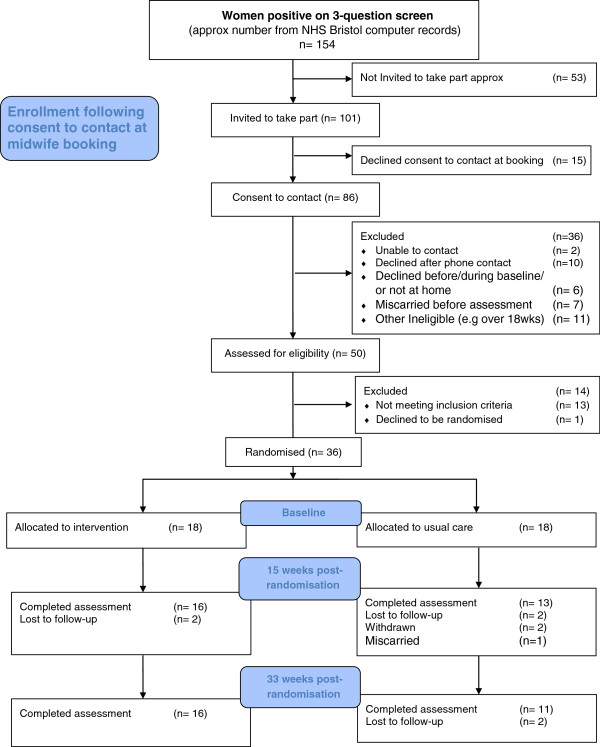
BACKGROUND: Few trials have evaluated the effectiveness of psychological treatment in improving depression by the end of pregnancy. This is the first pilot randomised controlled trial (RCT) of individual cognitive behavioural therapy (CBT) looking at treating depression by the end of pregnancy. Our aim was to assess the feasibility of delivering a CBT intervention modified for antenatal depression during pregnancy. METHODS: Women in North Bristol, UK between 8-18 weeks pregnant were recruited through routine contact with midwives and randomised to receive up to 12 sessions of individual CBT in addition to usual care or to continue with usual care only. Women were eligible for randomisation if they screened positive on a 3-question depression screen used routinely by midwives and met ICD-10 criteria for depression assessed using the clinical interview schedule - revised version (CIS-R). Two CBT therapists delivered the intervention. Follow-up was at 15 and 33 weeks post-randomisation when assessments of mental health were made using measures which included the CIS-R. RESULTS: Of the 50 women assessed for the trial, 36 met ICD-10 depression criteria and were randomised: 18 to the intervention and 18 to usual care. Thirteen of the 18 (72%) women who were allocated to receive the intervention completed 9 or more sessions of CBT before the end of pregnancy. Follow-up rates at 15 and 33 weeks post-randomisation were higher in the group who received the intervention (89% vs. 72% at 15 weeks and 89% vs. 61% at 33 weeks post-randomisation). At 15 weeks post-randomisation (the end of pregnancy), there were more women in the intervention group (11/16; 68.7%) who recovered (i.e. no longer met ICD-10 criteria for depression), than those receiving only usual care (5/13; 38.5%). CONCLUSIONS: This pilot trial shows the feasibility of conducting a large RCT to assess the effectiveness of CBT for treating antenatal depression before the end of pregnancy. The intervention could be delivered during the antenatal period and there was some evidence to suggest that it could be effective. TRIAL REGISTRATION: ISRCTN44902048.
Overview
The claims and statistics of this paper haven’t been checked yet.
Free: it reads the open-access text and checks the first 5 claims that cite a source we can check. Create a free account to check every claim.
Integrity signals
Registry
Cites
Statistics
Figures
Verification
Claims the paper makes
The claims and statistics of this paper haven’t been checked yet.
Free: it reads the open-access text and checks the first 5 claims that cite a source we can check. Create a free account to check every claim.
Claims other papers make about this one
Each is checked against this paper’s own text: does it say what the citing paper says it does?
The cited source doesn’t support the claim as written.
In the citing paper
“The rates of medication use in this sample are considerably higher than a pilot RCT of individualised CBT for antenatal depression, where 20% of women in the intervention arm were taking an anti-depressant (Burns et al., 2013), and a pilot RCT of individualized CBT for postnatal OCD where 41% of women were treated with psychotropic medication (Challacombe et al., 2017).”
From Acceptance and Commitment Therapy for perinatal mood and anxiety disorders: A feasibility and proof of concept study. (2020) · cites this paper as Burns et al., 2013
Checked by a reasoning model — may be wrong.
Experimental — accuracy not yet measuredThe source backs part of the claim, not all of it — or backs it for a different population, condition or comparison.
In the citing paper
“individual face-to-face CBT has been found to be effective in this group (Burns et al., 2013;O'Mahen et al., 2013a;Sockol, 2015;Milgrom et al., 2015).”
From Internet delivered cognitive behavior therapy for antenatal depression: A randomised controlled trial (2017) · cites this paper as Burns et al., 2013
Experimental — accuracy not yet measured
Self-check
Percentages, sums and reported differences re-computed from the paper’s own numbers.
The self-check needs the paper’s full text.
Citations
Cites
The PHQ-9: Validity of a brief depression severity measure
Kroenke, K., Spitzer, R. L., & Williams, J. B. W. (2001) · Journal of General Internal Medicine · doi:10.1046/j.1525-1497.2001.016009606.x · Cited by 44,910
WARE, J. E., KOSINSKI, M., & KELLER, S. D. (1996) · Medical Care · doi:10.1097/00005650-199603000-00003 · Cited by 17,392
EuroQol: a new facility for the measurement of health-related quality of life
(1990) · Health Policy · doi:10.1016/0168-8510(90)90421-9 · Cited by 15,736
Detection of Postnatal Depression: Development of the 10-item Edinburgh Postnatal Depression Scale
Cox, J. L., Holden, J. M., & Sagovsky, R. (1987) · British Journal of Psychiatry · doi:10.1192/bjp.150.6.782 · Cited by 14,183
Perinatal Depression: A Systematic Review of Prevalence and Incidence
Gavin, N. I., Gaynes, B. N., Lohr, K. N., Meltzer-Brody, S., Gartlehner, G., & Swinson, T. (2005) · Obstetrics & Gynecology · doi:10.1097/01.aog.0000183597.31630.db · Cited by 3,282
Grote, N. K., Bridge, J. A., Gavin, A. R., Melville, J. L., Iyengar, S., & Katon, W. J. (2010) · Archives of General Psychiatry · doi:10.1001/archgenpsychiatry.2010.111 · Cited by 1,882
Lewis, G., Pelosi, A. J., Araya, R., & Dunn, G. (1992) · Psychological Medicine · doi:10.1017/s0033291700030415 · Cited by 1,487 · cited 17×
“Continuous CIS-R outcome at 33 weeks – proposed secondary Similar results were seen at 33 weeks post-randomisation.”
BackgroundMethodInfluentialPersuasion and Healing: A Comparative Study of Psychotherapy
Frank, J. D. (1961) · Cited by 1,391
Risk factors for depressive symptoms during pregnancy: a systematic review
Lancaster, C. A., Gold, K. J., Flynn, H. A., Yoo, H., Marcus, S. M., & Davis, M. M. (2010) · American Journal of Obstetrics and Gynecology · doi:10.1016/j.ajog.2009.09.007 · Cited by 1,208
The course of anxiety and depression through pregnancy and the postpartum in a community sample
Heron, J., O'Connor, T. G., Evans, J., Golding, J., & Glover, V. (2004) · Journal of Affective Disorders · doi:10.1016/j.jad.2003.08.004 · Cited by 1,151 · cited 2×
“Women who experience perinatal depression are more likely to have a poor couple relationship, to self-harm [2-4], and it can affect the developing child independently of the occurrence of postnatal depression [5-8].”
BackgroundSelf-citation
Research works printed but not linked: 1
- 18. NICE: Antenatal and postnatal mental health: Clinical management and service guidance. G45, National Institue for Health and Clinical Excellence. London: DoH; 2007.
Cited by
Non-psychotic mental disorders in the perinatal period
Howard, L. M., Molyneaux, E., Dennis, C.-L., Rochat, T., Stein, A., & Milgrom, J. (2014) · The Lancet · doi:10.1016/s0140-6736(14)61276-9 · Cited by 1,328
Cuijpers, P., Cristea, I. A., Karyotaki, E., Reijnders, M., & Huibers, M. J. H. (2016) · World Psychiatry · doi:10.1002/wps.20346 · Cited by 572
Lifetime costs of perinatal anxiety and depression
Bauer, A., Knapp, M., & Parsonage, M. (2016) · Journal of Affective Disorders · doi:10.1016/j.jad.2015.12.005 · Cited by 382
“…utility attributable to perinatal depression and depression Health disutility perinatal depression 0.26 Morrell et al., 2009; Ara and Brazier, 2011; Burns et al., 2013; health utility for perinatal depression referred to 8-18wks pregnant and 6wks postpartum (ICD-10 or EPDS> 11) Health disutility…”
BackgroundInfluentialPrenatal Depression and Adverse Birth Outcomes: An Updated Systematic Review
Accortt, E. E., Cheadle, A. C. D., & Dunkel Schetter, C. (2015) · Maternal and Child Health Journal · doi:10.1007/s10995-014-1637-2 · Cited by 318
“Non-pharmacological treatments for depression, such as cognitive behavioral therapy [112, 113] and complementary treatments [111] can produce symptom relief with minimal sideeffects, although pharmacological treatments should not be ruled out where evidence suggests they are safe and if prescribed and monitored carefu…”
Nillni, Y. I., Mehralizade, A., Mayer, L., & Milanovic, S. (2018) · Clinical Psychology Review · doi:10.1016/j.cpr.2018.06.004 · Cited by 207
“In all four of these trials, women in the active CBT treatment condition reported significantly less depressive symptoms at post-treatment as compared to women in the control conditions (Burns et al., 2013; Cho, Kwon, & Lee, 2008; Dimidjian et al., 2017; Muresan-Madar & Baban, 2015).”
ResultForsell, E., Bendix, M., Holländare, F., Szymanska von Schultz, B., Nasiell, J., Blomdahl-Wetterholm, M., Eriksson, C., Kvarned, S., Lindau van der Linden, J., Söderberg, E., et al. (2017) · Journal of Affective Disorders · doi:10.1016/j.jad.2017.06.013 · Cited by 175
“Perinatal women seem to prefer individual therapy for depression over group therapy or medication (O'Mahen and Flynn, 2008; Goodman, 2009), and individual face-to-face CBT has been found to be effective in this group (Burns et al., 2013; O'Mahen et al., 2013a; Sockol, 2015; Milgrom et al., 2015).”
BackgroundEffect of psychotherapy for depression on quality of life: meta-analysis
Kolovos, S., Kleiboer, A., & Cuijpers, P. (2016) · British Journal of Psychiatry · doi:10.1192/bjp.bp.115.175059 · Cited by 153
Waters, C. S., Hay, D. F., Simmonds, J. R., & van Goozen, S. H. M. (2014) · European Child & Adolescent Psychiatry · doi:10.1007/s00787-014-0582-3 · Cited by 143
“More recently, Burns and colleagues [111] conducted a pilot randomised controlled trial comparing Cognitive Behavioural Therapy (CBT) against routine care for the treatment of antenatal depression.”
MethodResultAccortt, E. E., & Wong, M. S. (2017) · Obstetrical & Gynecological Survey · doi:10.1097/ogx.0000000000000477 · Cited by 122
Milgrom, J., Holt, C., Holt, C. J., Ross, J., Ericksen, J., & Gemmill, A. W. (2015) · Archives of Women's Mental Health · doi:10.1007/s00737-015-0512-5 · Cited by 104
Vigod, S. N., Wilson, C. A., & Howard, L. M. (2016) · BMJ · doi:10.1136/bmj.i1547 · Cited by 148
Psychological treatment of perinatal depression: a meta-analysis
Cuijpers, P., Franco, P., Ciharova, M., Miguel, C., Segre, L., Quero, S., & Karyotaki, E. (2023) · Psychological Medicine · doi:10.1017/s0033291721004529 · Cited by 103
Verkuijl, N. E., Richter, L., Norris, S. A., Stein, A., Avan, B., & Ramchandani, P. G. (2014) · The Lancet Psychiatry · doi:10.1016/s2215-0366(14)70361-x · Cited by 78
Self-citationGoodman, D., Milliken, C. U., Theiler, R. N., Nordstrom, B. R., & Akerman, S. C. (2015) · Journal of Dual Diagnosis · doi:10.1080/15504263.2015.1104484 · Cited by 74
“However, this approach has not been widely tested in pregnant women and was found not to be superior to other evidence-based outpatient treatment approaches in one study of pregnant women with cocaine dependence (Burns et al., 2013).”
Pettman, D., O’Mahen, H., Blomberg, O., Svanberg, A. S., von Essén, L., & Woodford, J. (2023) · BMC Psychiatry · doi:10.1186/s12888-023-04547-9 · Cited by 127
“[89] Yes (CIS-R) Moderate Ethnicity 36 Clinical TAU EPDS, PI, 4 MFU UK No White 30, 83.”
BackgroundSelf-citationShortis, E., Warrington, D., & Whittaker, P. (2020) · Journal of Affective Disorders · doi:10.1016/j.jad.2020.03.067 · Cited by 62
Karyotaki, E., Smit, Y., de Beurs, D. P., Henningsen, K. H., Robays, J., Huibers, M. J. H., Weitz, E., & Cuijpers, P. (2016) · Depression and Anxiety · doi:10.1002/da.22491 · Cited by 56
Waters, C. S., Annear, B., Flockhart, G., Jones, I., Simmonds, J. R., Smith, S., Traylor, C., & Williams, J. F. (2020) · British Journal of Clinical Psychology · doi:10.1111/bjc.12261 · Cited by 51
The effect of teaching religious principles on the infants’ growth and development
Gilani, T. M., Ghodrati, F., Yazdanpanahi, Z., Amooee, S., & Akbarzadeh, M. (2019) · Journal of Education and Health Promotion · doi:10.4103/jehp.jehp_81_19 · Cited by 46
“Other studies that used training showed reduced anxiety.[38,39] Despite increased awareness and reduction of maternal anxiety, there was no significant difference between the birth weight and other health indicators in our study.”
BackgroundNetsi, E., Evans, J., Wulff, K., O’Mahen, H., & Ramchandani, P. G. (2015) · Journal of Affective Disorders · doi:10.1016/j.jad.2015.08.055 · Cited by 43
“The design, analysis of primary outcome, and description of the sample have been reported in detail elsewhere (Burns et al., 2013).”
BackgroundMethodSelf-citationComputer-assisted cognitive behavioral therapy for pregnant women with major depressive disorder
Kim, D. R., Hantsoo, L., Thase, M. E., Sammel, M., & Epperson, C. N. (2014) · Journal of Women's Health · doi:10.1089/jwh.2014.4867 · Cited by 42
“Modified CBT for women with AD has been attempted in two pilot studies.(26,27) Burns et al.”
BackgroundMethodPsychotherapeutic Treatments for Depression During Pregnancy
Genovez, M., Vanderkruik, R. C., Lemon, E. L., & Dimidjian, S. (2018) · Clinical Obstetrics & Gynecology · doi:10.1097/grf.0000000000000388 · Cited by 43
Williams, C. J., Turner, K. M., Burns, A., J. Evans, M., & Bennert, K. (2016) · Midwifery · doi:10.1016/j.midw.2016.01.015 · Cited by 48
“It must take into consideration that preventing the harmful consequences of depression in pregnancy to the fetus will still require treatment before the birth of the baby and hence will benefit from early detection (Burns et al., 2013).”
BackgroundSelf-citationSubstance Abuse Treatment Services for Pregnant Women
Haug, N. A., Duffy, M., & McCaul, M. E. (2014) · Obstetrics and Gynecology Clinics of North America · doi:10.1016/j.ogc.2014.03.001 · Cited by 44
Pearson, R. M., O’Mahen, H., Burns, A., Bennert, K., Shepherd, C., Baxter, H., Chauhan, D., & Evans, J. (2012) · Journal of Affective Disorders · doi:10.1016/j.jad.2012.07.033 · Cited by 45
Self-citationTrevillion, K., Ryan, E., Pickles, A. R., Heslin, M., Byford, S., Nath, S., Bick, D., Milgrom, J., Mycroft, R. H., Domoney, J., et al. (2019) · Journal of Affective Disorders · doi:10.1016/j.jad.2019.10.013 · Cited by 44
“At the beginning of the trial, findings of local audits and a recent study (Burns et al., 2013) indicated that very few pregnant women were referred for psychological therapy in routine practice.”
ResultPilot Study of the Mastery Lifestyle Intervention
Ruiz, R. J., Newman, M., Records, K., Wommack, J. C., Stowe, R. P., & Pasillas, R. M. (2019) · Nursing Research · doi:10.1097/nnr.0000000000000384 · Cited by 30
“Pilot testing of the MLI indicated that it was well accepted when provided in groups, consistent with the literature (Burns et al., 2013).”
ResultLi, Z., Liu, Y., Wang, J., Liu, J., Zhang, C., & Liu, Y. (2020) · Journal of Clinical Nursing · doi:10.1111/jocn.15378 · Cited by 44
Social Support and Perinatal Depression: The Perspectives of Mexican-American Adolescent Mothers
Recto, P., & Champion, J. D. (2020) · Issues in Mental Health Nursing · doi:10.1080/01612840.2020.1731027 · Cited by 34
Ahmadi, A., Fathi-Ashtiani, A., Bonab, B. G., Azizi, M., & Saheb-Alzamani, S. (2015) · International Journal of Preventive Medicine · doi:10.4103/2008-7802.169078 · Cited by 32
“[52‐55] One characteristic that motioned study had in common and could explain the reduction in the depression scores is early identification of at‐risk mother for PDD and introducing CBT intervention in earlier phase of the disorder that could lead to more improvement of psychological health.”
van Ravesteyn, L. M., Kamperman, A. M., Schneider, T. A. J., Raats, M. E., Steegers, E. A. P., Tiemeier, H. W., Hoogendijk, W. J. G., & den Berg, M. P. L. (2017) · Journal of Affective Disorders · doi:10.1016/j.jad.2017.09.019 · Cited by 27
“For example, Cognitive Behavioral Therapy (Austin et al., 2008; Burns et al., 2013; O'Mahen et al., 2013; Rahman et al., 2008), Interpersonal Psychotherapy (Grote et al., 2009; Spinelli et al., 2013) and mindfulness-based cognitive therapy (Dimidjian et al., 2015) showed small to moderate effect…”
MethodResultInfluentialEfficacy of nondrug interventions in perinatal depression: A meta-analysis
Jiang, X., Li, H., Wang, D., Shan, L., Wang, F., & Kang, Y. (2022) · Psychiatry Research · doi:10.1016/j.psychres.2022.114916 · Cited by 25
Waqas, A., Zafar, S. W., Akhtar, P. S., Naveed, S., & Rahman, A. (2023) · Cambridge Prisms Global Mental Health · doi:10.1017/gmh.2023.8 · Cited by 31
“…visits (Prendergast and Austin, 2001; Chabrol et al., 2002; Cooper et al., 2003; Rahman et al., 2008; Morrell et al., 2009; Ammerman et al., 2013; Burns et al., 2013; Tandon et al., 2018; Sikander et al., 2019a; Van Horne et al., 2021), three in multiple settings (McKee et al., 2006; Silverstein…”
BackgroundMethodInfluentialKlatter, C. K., van Ravesteyn, L. M., & Stekelenburg, J. (2022) · Archives of Women s Mental Health · doi:10.1007/s00737-022-01251-7 · Cited by 21
Dafei, M., Mojahed, S., Dastjerdi, G., Dehghani, A., & Ardakani, T. S. (2021) · Journal of Education and Health Promotion · doi:10.4103/jehp.jehp_926_20 · Cited by 21
“[23] According to great psychologists such as David Burns, anxiety occurs precisely when a person constantly sees himself in danger.[24] A midwife and a psychologist were present at the meetings.”
BackgroundChen, X., Hu, W., Hu, Y., Xia, X., & Li, X. (2020) · Journal of Psychosomatic Obstetrics & Gynecology · doi:10.1080/0167482x.2020.1770221 · Cited by 23
Trevillion, K., Domoney, J., Pickles, A. R., Bick, D., Byford, S., Heslin, M., Milgrom, J., Mycroft, R. H., Pariante, C. M., Ryan, E., et al. (2016) · Trials · doi:10.1186/s13063-016-1632-6 · Cited by 19
Impact of Parental Psychiatric Illness on Infant Development
Milgrom, J., Ericksen, J., & Sved‐Williams, A. (2015) · Springer eBooks · doi:10.1007/978-3-319-21557-0_4 · Cited by 18
Public Health Perspectives on Depressive Disorders
Cohen, N. L. (2017) · Johns Hopkins University Press eBooks · doi:10.1353/book.52762 · Cited by 99
Mantler, T., Jackson, K. T., Walsh, E. J., Jackson, B., Baer, J., Davidson, C. A., Shillington, K. J., & Parkinson, S. (2021) · Journal of Advanced Nursing · doi:10.1111/jan.15117 · Cited by 18
Karyotaki, E., Smit, Y., Cuijpers, P. J., Debauche, M., Keyser, T. D., Habraken, H., Pitchot, W., Reas, F., Salomez, D., Gillain, B., et al. (2014) · doi:10.57598/r230c · Cited by 13
Bauer, A., Grégoire, A., Tinelli, M., & Knapp, M. R. J. (2024) · International Journal of Nursing Studies · doi:10.1016/j.ijnurstu.2024.104733 · Cited by 11
Dooley, R. L., & McAloon, J. (2025) · Journal of Affective Disorders · doi:10.1016/j.jad.2025.02.008 · Cited by 15
Principles of Supportive Psychotherapy for Perinatal Distress
Kleiman, K., & Wenzel, A. E. (2017) · Journal of Obstetric, Gynecologic & Neonatal Nursing · doi:10.1016/j.jogn.2017.03.003 · Cited by 8
Schwank, S. E., Chung, H.-F., Hsu, M., Fu, S.-C., Du, L., Zhu, L., Huang, H.-Y., Andersson, E. P., & Acharya, G. (2020) · BMJ Open · doi:10.1136/bmjopen-2020-041133 · Cited by 11
Han, Q., Min, G., Ren, F., Duan, D., & Xu, X. (2020) · Experimental and Therapeutic Medicine · doi:10.3892/etm.2020.9011 · Cited by 18
“Eight studies jointly evaluated the effects of midwife-supported psychotherapy on both depression and anxiety (32,51,52,54,58,60,61,66).”
Sharp, D. (2018) · Cambridge University Press eBooks · doi:10.1017/9781911623038.014 · Cited by 5
Self-citationEvidence‐Based Treatments and Pathways to Care
O’Hara, M. W., Dennis, C., McCabe, J. E., & Galbally, M. (2015) · Wiley eBooks · doi:10.1002/9781118509722.ch11 · Cited by 7
Ingram, J. C., Johnson, D., Johnson, S., O’Mahen, H., Kessler, D. S., Taylor, H., Law, R., Round, J. A., Ford, J., Hopley, R., et al. (2019) · BMJ Open · doi:10.1136/bmjopen-2019-032649 · Cited by 7
“We will compare recruitment through two routes which have been used successfully in two previous trials of antenatal depression and antenatal anxiety.(29) 30 Method 1: Women will be identified at community midwife booking clinics (around 8–10 weeks’ gestation) through the routine screening undertaken for depression us…”
MethodSelf-citationHua, G., Yue, K., Zhu, Y., Yang, F., & Zhou, M. (2025) · BMC Psychiatry · doi:10.1186/s12888-025-07462-3 · Cited by 10
Sassaroli, S., Brambilla, R., Cislaghi, E., Colombo, R., Cislaghi, E., Centorame, F., Veronese, G., Favaretto, E., Fiore, F., Veronese, G., et al. (2015) · Research in Psychotherapy Psychopathology Process and Outcome · doi:10.4081/ripppo.2014.146 · Cited by 5
“…this theory by having shown both the efficacy of CBT protocols in treating mood, anxiety, and eating disorders and the psychopathological role played by cognitive beliefs and processes in emotional disorders (Burns et al., 2013; Haaga, Dyck, & Ernst, 1991; Sethi, 2013; Spielmans et al.,, 2013).”
BackgroundSimon, N. A., Evans, J., Bispham, D., Williams, F., Jones, J., Roberts, N. P., & Waters, C. S. (2025) · Depression and Anxiety · doi:10.1155/da/3698331 · Cited by 6
“Another study included components on thoughts and beliefs around mother-hood, cognitive restructuring around motherhood restrictions, interpersonal/social support, and communication skills around con fl ict support [56].”
Self-citationCouch, E., Mai, H. J., Kanaan, G., Caputo, E. L., Lewis, O., Zahradnik, M. L., Howard, M. M., Bohlen, L. C., Konnyu, K. J., & Balk, E. M. (2025) · Annals of Internal Medicine · doi:10.7326/annals-24-03520 · Cited by 6
Cuijpers, P., Stikkelbroek, Y. A. J., Holt, C., Hirschler, Y., Miguel, C., Harrer, M., Karyotaki, E., van Straten, A., & Milgrom, J. (2026) · Journal of the American Academy of Child & Adolescent Psychiatry · doi:10.1016/j.jaac.2026.02.005 · Cited by 5
An Investigation of Sequencing Effects in Combining Cognitive Questioning and Mindful Acceptance
Borlimi, R., Benetka, G., Brighetti, G., Caselli, G., Caletti, E., Redaelli, C. A., Ruggiero, G. M., Sarracino, D., & Sassaroli, S. (2018) · Journal of Rational-Emotive & Cognitive-Behavior Therapy · doi:10.1007/s10942-018-0312-8 · Cited by 3
Shin, H.-H., Shin, Y., & Kim, G. (2016) · Journal of the Korea Academia-Industrial cooperation Society · doi:10.5762/kais.2016.17.11.271 · Cited by 3
Wu, S. S., Shi, Y., Xu, J., Ma, Y., & Wang, X. (2025) · Archives of Public Health · doi:10.1186/s13690-025-01643-y · Cited by 2
“However, in many cases, spouses are not formally invited to participate in psychological care provided by the hospitals [50, 51].”
Psychiatric Care During Pregnancy and Postpartum: Part I: Diagnosis and Management of Mood Disorders
McKean, M. (2013) · Psychopharm Review · doi:10.1097/01.psyphr.0000428766.86387.f4 · Cited by 2
Women’s health update: A literature review impacting primary care
Dolan, B. M., Merriam, S. B., Prifti, C. A., & Walsh, J. M. E. (2022) · Cleveland Clinic Journal of Medicine · doi:10.3949/ccjm.89a.21123 · Cited by 4
Fetal Movement Counting and Maternal Depression: A Randomized, Controlled Trial
Delaram, M., Jafarzadeh, L., & Shams, S. (2017) · Zahedan Journal of Research in Medical Sciences · doi:10.5812/zjrms.5680 · Cited by 3
“Despite many studies on postpartum depression, few studies have examined the depression in pregnancy and have focused on ways to treat it [18].”
BackgroundBauer, A., Knapp, M. R. J., Iemmi, V., & Adelaja, B. (2020) · Érès eBooks · doi:10.3917/eres.dugna.2020.01.0283 · Cited by 1
Perinatal mental health: the impact on mother-infant bonding and attachment
Flowers, A. (2017) · Own your potential (DEAKIN)
Tagliabue, S., Zambelli, M., Farina, F., & Cimino, C. (2020) · PSICOLOGIA DI COMUNITA · doi:10.3280/psc2020-001007
Depresión antenatal y factores relacionados en mujeres primigestas y multigestas
Ovando-Martínez, E., González-Castro, P. J., Gutiérrez-Zepeda, A. E., Mendoza-Parra, M., & Villanueva-Reyes, D. (2022) · Perinatología y Reproducción Humana · doi:10.24875/per.19000011 · Cited by 1
Bernstein, L. B., Carson, M., Cruz, M., Harrison, R. K., Johnson, A., Kho, A., Lewis, B., & Tilstra, S. A. (2020) · Springer eBooks · doi:10.1007/978-3-030-50695-7_39
Simoni, M. K., & Yonkers, K. A. (2018) · Wiley eBooks · doi:10.1002/9781119072980.ch36
Waqas, A., Zafar, S. W., Akhtar, P. S., et al. (2023) · Cambridge Prisms Global Mental Health · doi:10.1017/gmh.2023.8.pr10
Waqas, A., Zafar, S. W., Akhtar, P. S., et al. (2023) · Cambridge Prisms Global Mental Health · doi:10.1017/gmh.2023.8.pr8
Waqas, A., Zafar, S. W., Akhtar, P. S., et al. (2023) · Cambridge Prisms Global Mental Health · doi:10.1017/gmh.2023.8.pr6
Waqas, A., Zafar, S. W., Akhtar, P. S., et al. (2023) · Cambridge Prisms Global Mental Health · doi:10.1017/gmh.2023.8.pr9
Waqas, A. (2023) · Cambridge Prisms Global Mental Health · doi:10.1017/gmh.2023.8.pr7
Waqas, A., Zafar, S. W., Akhtar, P. S., et al. (2022) · Cambridge Prisms Global Mental Health · doi:10.1017/gmh.2023.8.pr4
Waqas, A., Zafar, S. W., Akhtar, P. S., et al. (2022) · Cambridge Prisms Global Mental Health · doi:10.1017/gmh.2023.8.pr3
Waqas, A., Zafar, S. W., Akhtar, P. S., et al. (2022) · Cambridge Prisms Global Mental Health · doi:10.1017/gmh.2023.8.pr5
Waqas, A., Zafar, S. W., Akhtar, P. S., et al. (2022) · Cambridge Prisms Global Mental Health · doi:10.1017/gmh.2023.8.pr2
Waqas, A. (2022) · Cambridge Prisms Global Mental Health · doi:10.1017/gmh.2023.8.pr1
Intervenções comportamentais para Depressão Pós-Parto: revisão sistemática da literatura
Gomes, L. C. (2023) · Digital Library of Theses and Dissertations (Universidade de São Paulo) · doi:10.11606/d.47.2023.tde-11042024-170404
Santé mentale des femmes enceintes et développement de l'enfant
Lochard, G. (2014) · theses.fr (ABES) · doi:10.70675/5b021bd2zbaf8z42cezace9z534dbd74f967 · Cited by 1
Shqair, S. S. A. A. R., Hayek, M. F., Zabin, L. M., Marie, M., Qaddumi, J. A. S., Qadous, S. G., & Sarhan, A. L. (2026) · Depression and Anxiety · doi:10.1155/da/4692841
Metadata
- Authors
- Burns, A., O’Mahen, H., Baxter, H., Bennert, K., Wiles, N., Ramchandani, P., Turner, K., Sharp, D., Thorn, J., Noble, S., & Evans, J.
- Affiliations
- University of Bristol (GB)
- University of Exeter (GB)
- Imperial College London (GB)
- Corresponding author
- Burns, Alison
- ORCID
- Venue
- BMC Psychiatry
- Published
- 2013-01-22
- Volume
- 13
- Issue
- 1
- Pages
- 33-33
- ISSN
- 1471-244X (ISSN-L)
- PMC
- PMC3666914
- OpenAlex
- W2117066386
- Cited by
- 80
- References
- 60
- Citations by year
- 2026: 2 · 2025: 5 · 2024: 1 · 2023: 8 · 2022: 8 · 2021: 4 · 2020: 10 · 2019: 4 · 2018: 5 · 2017: 8 · 2016: 7 · 2015: 8 · 2014: 8 · 2013: 1
- FWCI
- 8.16
- Type
- journal article
- Language
- en
- Open access
- gold
- doi.org
- Licence
- Locations
- BMC Psychiatry (publishedVersion, cc-by)
- Europe PMC (PubMed Central) (publishedVersion, cc-by)
- PubMed Central (publishedVersion, cc-by)
- PubMed (publishedVersion)
- Explore Bristol Research (publishedVersion)
- Figshare (submittedVersion)
- Open Research Exeter (University of Exeter) (submittedVersion, cc-by)
- Apollo (University of Cambridge) (submittedVersion, cc-by)
- Apollo (cc-by)
- Funders
- National Institute for Health and Care Research (PB-PG-1207-15063)
- Research for Patient Benefit Programme
- Topics
- Health Sciences › Medicine › Public Health, Environmental and Occupational Health › Maternal Mental Health During Pregnancy and Postpartum
- Social Sciences › Psychology › Applied Psychology › Digital Mental Health Interventions
- Social Sciences › Psychology › Experimental and Cognitive Psychology › Anxiety, Depression, Psychometrics, Treatment, Cognitive Processes
- Keywords
- antenatal depression, cognitive behavioral therapy, pregnancy, psychological intervention, feasibility, depression screening, postpartum mental health
- MeSH terms
- Adult, Depression, Depressive Disorder, Female, Humans, Pilot Projects, Pregnancy, Pregnancy Complications, Cognitive Behavioral Therapy, Treatment Outcome, Young Adult
About these checks
Registry, retraction, Cites and statistics results are computed, not judged, with one exception: a printed reference that no index lists is read once by a model before it counts as a citation error. Claims are extracted by a model and kept only when their quote appears verbatim in the text; each cited source is then checked, with a model’s help, for whether it says what the claim relies on. Those verdicts can be wrong — read the claim’s quote and the cited source before relying on one.
Statistics and arithmetic are recomputed, not judged.
Confidence bands are shown only for fields calibrated on our annotated test set. None is calibrated yet, so no band is shown.
What counts as a claim ›How we measure confidence ›How we check this ›
Are you an author, or do you see a problem with this page? Request a review
Data sources
Bibliographic data: Semantic Scholar, OpenAlex, Crossref.
Contains information from the Semantic Scholar Academic Graph Datasets, made available under the ODC Attribution License (ODC-BY 1.0).
Semantic Scholar’s data is described in: Kinney, R., et al. (2023). The Semantic Scholar Open Data Platform. arXiv:2301.10140.
