

Posttraumatic stress disorder is associated with an enhanced spontaneous production of pro-inflammatory cytokines by peripheral blood mononuclear cells
Open accessThe DOI matches its Crossref record; 44 of the 44 references it cites were found in a registry or an index.
Abstract
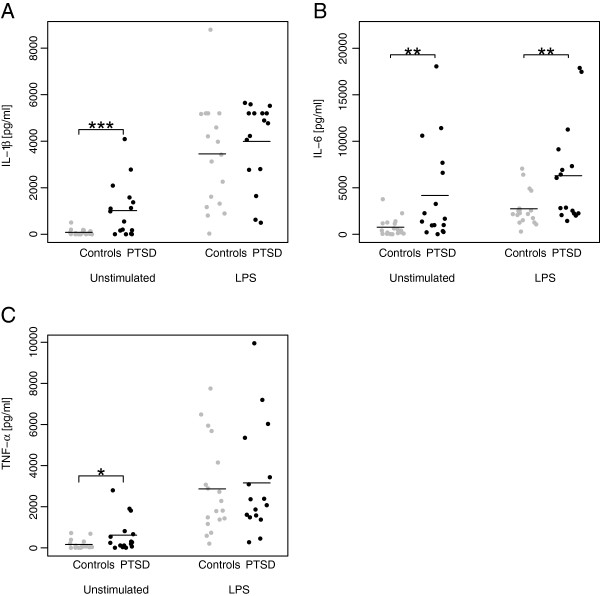
BACKGROUND: Posttraumatic stress disorder (PTSD) is associated with an enhanced risk for cardiovascular and other inflammatory diseases. Chronic low-level inflammation has been suggested as a potential mechanism linking these conditions. METHODS: We investigated plasma cytokine levels as well as spontaneous and lipopolysaccharide (LPS)-stimulated cytokine production by peripheral blood mononuclear cells (PBMCs) in a group of 35 severely traumatized PTSD patients compared to 25 healthy controls. RESULTS: Spontaneous production of interleukin (IL)-1β, IL-6 and tumor necrosis factor (TNF)-α by isolated PBMCs was significantly higher in the PTSD compared to the control group and even correlated with PTSD symptom severity within the PTSD group. In contrast, circulating plasma levels of pro- and anti-inflammatory cytokines such as IL-6, IL-8, IL-10, TNF-α, or monocyte chemotactic protein (MCP)-1 were not significantly altered in PTSD patients compared to healthy controls. CONCLUSIONS: Our findings indicate that PBMCs of PTSD patients are already pre-activated in vivo, providing further evidence for low-grade inflammation in PTSD. This might possibly represent one psychobiological pathway from PTSD to poor physical health.
Overview
The claims and statistics of this paper haven’t been checked yet.
Free: it reads the open-access text and checks the first 5 claims that cite a source we can check. Create a free account to check every claim.
Integrity signals
Registry
Cites
Statistics
Figures
Verification
Claims the paper makes
The claims and statistics of this paper haven’t been checked yet.
Free: it reads the open-access text and checks the first 5 claims that cite a source we can check. Create a free account to check every claim.
Claims other papers make about this one
Each is checked against this paper’s own text: does it say what the citing paper says it does?
The cited source says what the claim attributes to it.
In the citing paper
“There has also been one report that increased spontaneous production of IL-1 and TNF-α in PBMCs is present in individuals with PTSD compared with healthy controls (Gola et al, 2013).”
From Inflammation in Fear- and Anxiety-Based Disorders: PTSD, GAD, and Beyond (2017) · cites this paper as Gola et al, 2013
In the citing paper
“Peripheral blood cells isolated from stressed individuals show increased production of spontaneous IL-6 and in response to immune challenge [12, 13].”
From Interleukin-6 Induced by Social Stress Promotes a Unique Transcriptional Signature in the Monocytes That Facilitate Anxiety (2019) · cites this paper as [13]
Self-check
Percentages, sums and reported differences re-computed from the paper’s own numbers.
The self-check needs the paper’s full text.
Citations
Cites
R: A Language and Environment for Statistical Computing
R Core Team (2025) · doi:10.32614/r.manuals · Cited by 352,181
Hamilton, M. (1960) · Journal of Neurology, Neurosurgery & Psychiatry · doi:10.1136/jnnp.23.1.56 · Cited by 32,817 · cited 1×
“In addition, depressive symptoms were assessed with the Hamilton Depression Rating Scale HAM-D, [29].”
MethodA Simple Sequentially Rejective Multiple Test Procedure
(1979) · Scandinavian Journal of Statistics · doi:10.2307/4615733 · Cited by 21,526 · cited 1×
“In addition, we report p values corrected for multiple comparisons with Holm’s stepwise procedure [35], applied first for the five cytokines measured in plasma and then for the three cytokines produced by PBMCs measured in presence or absence of LPS.”
Method(1998) · The Journal of Clinical Psychiatry · Cited by 19,139
(1998) · PubMed · Cited by 10,216
Diagnostic and Statistical Manual of Mental Disorders (DSM-IV)
Hu, R. J. (2003) · Encyclopedia of the Neurological Sciences · doi:10.1016/b0-12-226870-9/01070-4 · Cited by 9,117
Inflammation in atherosclerosis
Libby, P. (2002) · Nature · doi:10.1038/nature01323 · Cited by 8,315
The mini international neuropsychiatric interview
Lecrubier, Y., Sheehan, D., Hergueta, T., & Weiller, E. (1998) · European Psychiatry · doi:10.1016/s0924-9338(99)80239-9 · Cited by 5,872
The development of a Clinician-Administered PTSD Scale
Blake, D. D., Weathers, F. W., Nagy, L. M., Kaloupek, D. G., Gusman, F. D., Charney, D. S., & Keane, T. M. (1995) · Journal of Traumatic Stress · doi:10.1002/jts.2490080106 · Cited by 5,024 · cited 7×
“Subsequently, PTSD symptom frequency and severity were assessed with the CAPS [25].”
BackgroundMethodInfluentialInflammation in Atherosclerosis
Libby, P. (2012) · Arteriosclerosis, Thrombosis, and Vascular Biology · doi:10.1161/atvbaha.108.179705 · Cited by 3,736 · cited 2×
“In addition, clinical studies affirm a correlation of circulating markers of inflammation with propensity to develop ischemic events and with prognosis after acute coronary syndromes [13,14].”
BackgroundResult
Research works printed but not linked: 1
- Schauer M Neuner F Elbert T Narrative Exposure Therapy 2011 2nd Göttingen, Germany: Hogrefe & Huber
Cited by
Items 201–239 of 239
Garfield, L., Watson‐Singleton, N. N., Mathews, H. L., & Janusek, L. W. (2024) · Brain Behavior and Immunity Integrative · doi:10.1016/j.bbii.2024.100060 · Cited by 2
“…(Selye, 1984) anxiety, (Dantzer et al., 1999) poor sleep, (Michopoulos et al., 2017) posttraumatic stress, (Irwin and Opp, 2017) and fatigue (Gola et al., 2013) are linked to inflammatory processes through the hypothalamic pituitary adrenal (HPA) axis and the kynurenine tryptophan pathway.”
BackgroundBlakey, S. M., Dillon, K. H., McFARLANE, A. C., & Beckham, J. C. (2024) · Springer eBooks · doi:10.1007/978-3-030-51366-5_59 · Cited by 1
Augustin, D. (2017) · NSUWorks (Nova Southeastern University) · Cited by 1
Morath, J. (2013) · KOPS (University of Konstanz) · Cited by 1
Pinheiro, R. M. C. (2014) · Americanae (AECID Library)
Befunde sprechen für zeitnahe Psychotherapie: Molekulare Psychologie der PTBS
Schwarz, E., & Kolassa, I. (2013) · NeuroTransmitter · doi:10.1007/s15016-013-0461-z
Self-citationMileva, G. R. (2016) · uO Research (University of Ottawa) · doi:10.20381/ruor-586
“in pro-inflammatory cytokines may not be limited to depression as patients with schizophrenia (Miller, Buckley, Seabolt, Mellor, & Kirkpatrick, 2011), mania (Maes, Bosmans, Calabrese, Smith, & Meltzer, 1995) and post-traumatic stress disorder (Gola et al., 2013) all show increases”
BackgroundYusta, G., Díaz-Peláez, E., & Muriel, C. (2007) · PubMed
Genetic, Biomarker and Psychological Factors for Risk and Resilience of PTSD
Bruenig, D. (2017) · Queensland University of Technology · doi:10.5204/thesis.eprints.112180
Bustamante, A. C. (2017) · Illinois Digital Environment for Access to Learning and Scholarship (University of Illinois at Urbana-Champaign)
Tingelstad, H. C. (2018) · uO Research (University of Ottawa) · doi:10.20381/ruor-21569
Récepteurs 5-HT2C, BDNF et mémoire traumatique
Règue, M. (2018) · theses.fr (ABES) · doi:10.70675/32aaf292z880ez41d2z8836z9fa9fa8a9bf8
Holmes, K. S. (2018) · CU Scholar (University of Colorado Boulder)
Disturbo da stress post traumatico nei pazienti adulti: revisione integrativa sui fattori biologici
Pavan, A., & Palese, A. (2018) · Scenario - Il Nursing nella sopravvivenza · doi:10.4081/scenario.2016.36 · Cited by 1
Jones, M. (2017) · Carolina Digital Repository (University of North Carolina at Chapel Hill) · doi:10.17615/7rx3-qr60
Chemokines as Potential Biomarkers for PTSD in Military Population
Zhang, L., Hu, X., Li, X., & Ursano, R. J. (2021) · IntechOpen eBooks · doi:10.5772/intechopen.96133 · Cited by 1
Einführung in die methodischen und klinischen Aspekte der transkulturellen Psychotraumatologie
Weierstall‐Pust, R., & Pust, G. E. A. (2020) · Springer eBooks · doi:10.1007/978-3-662-45995-9_47-1
(2018) · Elsevier eBooks · doi:10.1016/b978-0-12-811351-6.00026-7
Jarkas, D. (2022) · Carleton University's Institutional Repository (MacOdrum Library, Carleton University) · doi:10.22215/etd/2022-15321
Of Soldiers and Their Ghosts: Are We Ready for a Review of PTSD Evidence?
Sfera, A., Anton, J. J., Imran, H., Kozlakidis, Z., Klein, C. A., & Osorio, C. P. (2023) · BioMed · doi:10.3390/biomed3040039
(2024) · Elsevier eBooks · doi:10.1016/b978-0-443-23565-8.09996-8
Anisman, H., Hayley, S. P., & Kusnecov, A. W. (2024) · Elsevier eBooks · doi:10.1016/b978-0-443-23565-8.00010-7
Hu, X., & Zhang, L. (2025) · Immune discovery. · doi:10.70322/immune.2025.10013 · Cited by 1
Gryksa, K. (2023) · University of Regensburg Publication Server (University of Regensburg) · doi:10.5283/epub.52678 · Cited by 1
Li, S., Liao, Y., Dong, Y., Li, X., Li, J., Cheng, Y., Cheng, J., & Yuan, Z. (2021) · Figshare · doi:10.6084/m9.figshare.13525292
Anwar, F., Sparrow, N. A., Rashid, M. H., Guidry, G., Gezalian, M. M., Ley, E. J., Koronyo‐Hamaoui, M., Danovitch, I., Ely, E. W., Karumanchi, S. A., et al. (2022) · Figshare · doi:10.6084/m9.figshare.21099112
Ghosh, S., Mohammed, Z., & Singh, I. (2021) · Figshare · doi:10.6084/m9.figshare.17162831
Characterization of DNA methylation and gene expression profiles in post-traumatic stress disorder
Kim, G. S. (2019) · Illinois Digital Environment for Access to Learning and Scholarship (University of Illinois at Urbana-Champaign)
Mild Traumatic Brain Injury and Neuroinflammation
Malik, S. (2023) · MacSphere (McMaster University) · doi:10.71548/12871
Graham, K. (2019) · Adelaide Research & Scholarship (AR&S) (University of Adelaide) · Cited by 4
Gut microbiota: a perspective for post-traumatic stress disorder
Soleimani, R. A. (2025) · Gastrointestinal Nursing · doi:10.12968/gasn.2025.0071
Risk and Protective Factors in the Natural History of Autoimmunity
(2026) · Frontiers research topics · doi:10.3389/978-2-8325-7323-5
Visualizing Posttraumatic stress disorder with in vivo brain imaging: a multimodal approach
Watling, S. E. (2023) · TSpace (University of Toronto)
Wiche, H., Anhuef, O., Martinache, S., Simon, J. J., Frey, N., Backs, J., Friederich, H.-C., Schultz, J.-H., & Bruns, B. (2026) · BMC Cardiovascular Disorders · doi:10.1186/s12872-026-05713-z
Schiele, J., Tsai, P.-L., Schimmele, T., Beck, S., Meyer, M., Mannes, M., Desmond, L. W., Noschka, R., Huber-Lang, M. S., Haffner‐Luntzer, M., et al. (2026) · Molecular Psychiatry · doi:10.1038/s41380-026-03638-9
Keppler, H., Mavioğlu, R. N., Behnke, A., Gola, H., Hitzler, M., Fieres, J., Christmann, M., Bürkle, A., Moreno‐Villanueva, M., Kolassa, I., et al. (2026) · Psychoneuroendocrinology · doi:10.1016/j.psyneuen.2026.107902
Self-citationMetabolic alterations in adolescent psychiatric outpatients
Kurkinen, K. (2025) · UEF eRepo (University of Eastern Finland)
Chronic Stress and the Risk of Autoimmune Diseases: Narrative Literature Review
Cupiał, N. K., Symon, Z., Dybka, E. J., Mróz, T., Pińczak, Z. K., Gryczko, J., Sokołowski, J., Augustyniak, W. W., Czepczarz, A., & Gryczko, J. (2026) · African Journal of Biomedical Research · doi:10.69980/ajbr.v29i1s.9885
Metadata
- Authors
- Gola, H., Engler, H., Sommershof, A., Adenauer, H., Kolassa, S., Schedlowski, M., Groettrup, M., Elbert, T., & Kolassa, I.-T.
- Affiliations
- University of Konstanz (DE)
- Essen University Hospital (DE)
- Systems, Applications & Products in Data Processing (Switzerland) (CH)
- Corresponding author
- Kolassa, Iris-Tatjana
- ORCID
- Venue
- BMC Psychiatry
- Published
- 2013-01-29
- Volume
- 13
- Issue
- 1
- Pages
- 40-40
- ISSN
- 1471-244X (ISSN-L)
- PMC
- PMC3574862
- OpenAlex
- W2001986928
- Cited by
- 225
- References
- 44
- Citations by year
- 2026: 5 · 2025: 13 · 2024: 15 · 2023: 12 · 2022: 20 · 2021: 16 · 2020: 14 · 2019: 14 · 2018: 30 · 2017: 24 · 2016: 21 · 2015: 14 · 2014: 15 · 2013: 11
- FWCI
- 22.62
- Type
- journal article
- Language
- en
- Open access
- gold
- doi.org
- Licence
- cc-by
- creativecommons.org/licenses/by/2.0 (tdm)
- creativecommons.org/licenses/by/2.0 (vor)
- Locations
- BMC Psychiatry (publishedVersion, cc-by)
- Europe PMC (PubMed Central) (publishedVersion, cc-by)
- PubMed Central (publishedVersion, cc-by)
- PubMed (publishedVersion)
- DOAJ (DOAJ: Directory of Open Access Journals) (submittedVersion, cc-by-sa)
- Lancaster EPrints (Lancaster University) (submittedVersion)
- KOPS (University of Konstanz) (submittedVersion)
- Funders
- Deutsche Forschungsgemeinschaft (FOR751)
- Universität Ulm
- Universität Konstanz
- European Refugee Fund
- Topics
- Social Sciences › Psychology › Clinical Psychology › Posttraumatic Stress Disorder Research
- Life Sciences › Neuroscience › Behavioral Neuroscience › Stress Responses and Cortisol
- Life Sciences › Neuroscience › Biological Psychiatry › Tryptophan and brain disorders
- Keywords
- post-traumatic stress disorder, inflammatory cytokines, peripheral blood mononuclear cells, spontaneous cytokine production, lipopolysaccharide stimulation, IL-1β, interleukin-6, TNF-α, low-grade inflammation, plasma cytokines, PTSD symptom severity, cardiovascular risk
- MeSH terms
- Adolescent, Adult, Female, Humans, Leukocytes, Mononuclear, Male, Middle Aged, Stress Disorders, Post-Traumatic, Tumor Necrosis Factor-alpha, Interleukin-6, Case-Control Studies, Cytokines, Interleukin-8, Interleukin-10, Chemokine CCL2, Interleukin-1beta, Young Adult
About these checks
Registry, retraction, Cites and statistics results are computed, not judged, with one exception: a printed reference that no index lists is read once by a model before it counts as a citation error. Claims are extracted by a model and kept only when their quote appears verbatim in the text; each cited source is then checked, with a model’s help, for whether it says what the claim relies on. Those verdicts can be wrong — read the claim’s quote and the cited source before relying on one.
Statistics and arithmetic are recomputed, not judged.
Confidence bands are shown only for fields calibrated on our annotated test set. None is calibrated yet, so no band is shown.
What counts as a claim ›How we measure confidence ›How we check this ›
Are you an author, or do you see a problem with this page? Request a review
Data sources
Bibliographic data: Semantic Scholar, OpenAlex, Crossref.
Contains information from the Semantic Scholar Academic Graph Datasets, made available under the ODC Attribution License (ODC-BY 1.0).
Semantic Scholar’s data is described in: Kinney, R., et al. (2023). The Semantic Scholar Open Data Platform. arXiv:2301.10140.
