

A systematic review and meta-analysis of randomised controlled trials of peer support for people with severe mental illness
Open accessThe DOI matches its Crossref record; 61 of the 62 references it cites were found in a registry or an index.
Abstract
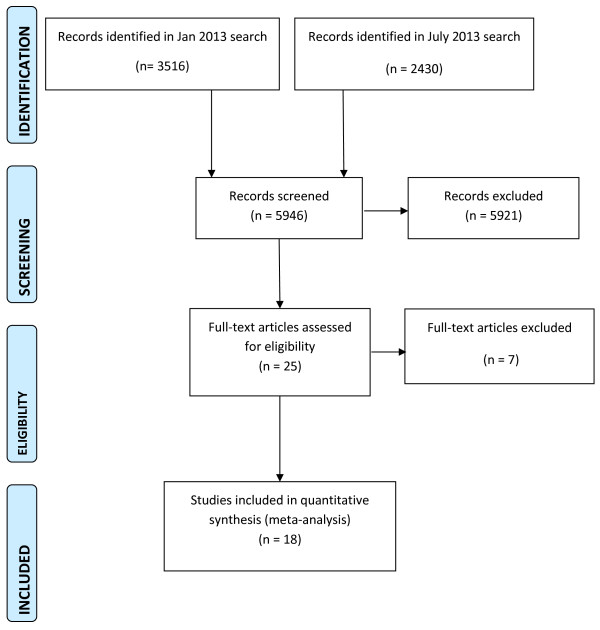
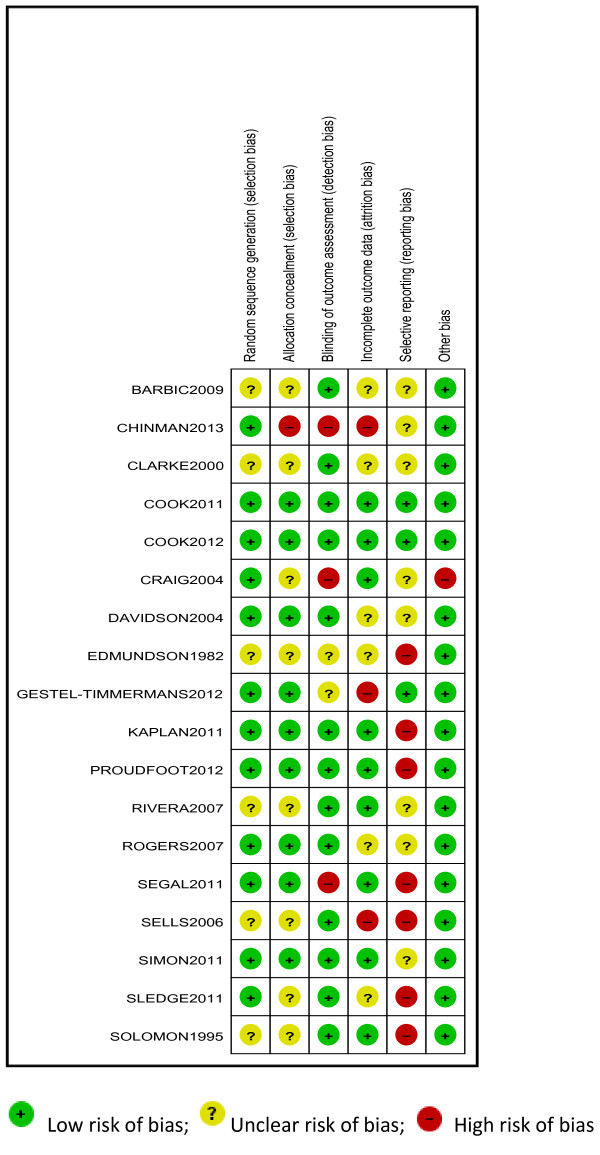
BACKGROUND: Little is known about whether peer support improves outcomes for people with severe mental illness. METHOD: A systematic review and meta-analysis was conducted. Cochrane CENTRAL Register, Medline, Embase, PsycINFO, and CINAHL were searched to July 2013 without restriction by publication status. Randomised trials of non-residential peer support interventions were included. Trial interventions were categorised and analysed separately as: mutual peer support, peer support services, or peer delivered mental health services. Meta-analyses were performed where possible, and studies were assessed for bias and the quality of evidence described. RESULTS: Eighteen trials including 5597 participants were included. These comprised four trials of mutual support programmes, eleven trials of peer support services, and three trials of peer-delivered services. There was substantial variation between trials in participants' characteristics and programme content. Outcomes were incompletely reported; there was high risk of bias. From small numbers of studies in the analyses it was possible to conduct, there was little or no evidence that peer support was associated with positive effects on hospitalisation, overall symptoms or satisfaction with services. There was some evidence that peer support was associated with positive effects on measures of hope, recovery and empowerment at and beyond the end of the intervention, although this was not consistent within or across different types of peer support. CONCLUSIONS: Despite the promotion and uptake of peer support internationally, there is little evidence from current trials about the effects of peer support for people with severe mental illness. Although there are few positive findings, this review has important implications for policy and practice: current evidence does not support recommendations or mandatory requirements from policy makers for mental health services to provide peer support programmes. Further peer support programmes should be implemented within the context of high quality research projects wherever possible. Deficiencies in the conduct and reporting of existing trials exemplify difficulties in the evaluation of complex interventions.
Overview
The claims and statistics of this paper haven’t been checked yet.
Free: it reads the open-access text and checks the first 5 claims that cite a source we can check. Create a free account to check every claim.
Integrity signals
Registry
Cites
Statistics
Figures
Verification
Claims the paper makes
The claims and statistics of this paper haven’t been checked yet.
Free: it reads the open-access text and checks the first 5 claims that cite a source we can check. Create a free account to check every claim.
Claims other papers make about this one
Each is checked against this paper’s own text: does it say what the citing paper says it does?
The source backs part of the claim, not all of it — or backs it for a different population, condition or comparison.
In the citing paper
“Reviews of peer interventions for persons with serious mental illnesses, usually incorporating a small but significant number of individuals with BD, have demonstrated modest evidence from RCTs and other controlled studies suggesting that there are important improvements in self‐efficacy and reduction in self‐stigma.106, 107, 108, 109”
From Canadian Network for Mood and Anxiety Treatments ( CANMAT ) and International Society for Bipolar Disorders ( ISBD ) 2018 guidelines for the management of patients with bipolar disorder (2018) · cites this paper as [106]
Experimental — accuracy not yet measuredThe source backs part of the claim, not all of it — or backs it for a different population, condition or comparison.
In the citing paper
“Studies have reported the benefits of peer-led intervention programs in various settings, including prisons.52, 56–58”
From Psychosocial Interventions for Prisoners with Mental and Substance Use Disorders: A Systematic Review (2022) · cites this paper as [58]
Experimental — accuracy not yet measured
Self-check
Percentages, sums and reported differences re-computed from the paper’s own numbers.
The self-check needs the paper’s full text.
Citations
Cites
The Cochrane Collaboration's tool for assessing risk of bias in randomised trials
Higgins, J. P. T., Altman, D. G., Gotzsche, P. C., Juni, P., Moher, D., Oxman, A. D., Savovic, J., Schulz, K. F., Weeks, L., Sterne, J. A. C., et al. (2011) · BMJ · doi:10.1136/bmj.d5928 · Cited by 33,817
Kytle, J., & Bandura, A. (1978) · Contemporary Sociology · doi:10.2307/2065952 · Cited by 25,422
Dermyshi, E., Wang, Y., Yan, C., Hong, W., Qiu, G., Gong, X., & Zhang, T. (2017) · Neonatology · doi:10.1159/000454668 · Cited by 24,451
A theory of social comparison processes
Festinger, L. (1954) · Human Relations · doi:10.1177/001872675400700202 · Cited by 20,926 · cited 1×
“This is consistent with psychological theories of change: peers’ social proximity to the people they are supporting may enhance their value as pro-social models [4] and promote motivation to achieve recovery by providing an upward social comparison [5].”
BackgroundCONSORT 2010 Statement: updated guidelines for reporting parallel group randomised trials
the CONSORT Group, Schulz, K. F., Altman, D. G., & Moher, D. (2010) · BMC Medicine · doi:10.1186/1741-7015-8-18 · Cited by 13,371
Grading quality of evidence and strength of recommendations
(2004) · BMJ · doi:10.1136/bmj.328.7454.1490 · Cited by 8,477 · cited 2×
“Meta-analysis was conducted using RevMan and a summary of results was prepared using the GRADE system [26], which is a structured assessment of confidence in the evidence for individual outcomes attending: threats to internal validity, inconsistency, indirectness, imprecision, and reporting bias.”
BackgroundMethodLeamy, M., Bird, V., Boutillier, C. L., Williams, J., & Slade, M. (2011) · British Journal of Psychiatry · doi:10.1192/bjp.bp.110.083733 · Cited by 3,038 · cited 1×
“selfrated recovery, hope and empowerment [53].”
Evaluating non-randomised intervention studies
Deeks, J., Dinnes, J., D'Amico, R., Sowden, A., Sakarovitch, C., Song, F., Petticrew, M., & Altman, D. (2003) · Health Technology Assessment · doi:10.3310/hta7270 · Cited by 2,907 · cited 1×
“In line with best practice guidelines for systematic reviews [54], we have not sought to supplement existing randomised trial evidence by including non-randomised trials in our review [55].”
Process evaluation in randomised controlled trials of complex interventions
Oakley, A., Strange, V., Bonell, C., Allen, E., & Stephenson, J. (2006) · BMJ · doi:10.1136/bmj.332.7538.413 · Cited by 1,247
A review of the literature on peer support in mental health services
Repper, J., & Carter, T. (2011) · Journal of Mental Health · doi:10.3109/09638237.2011.583947 · Cited by 1,103 · cited 3×
“However, they often accentuate positive findings from poor quality evidence, highlighting “limited but promising evidence,” [20] the “potential to drive through recovery-focused changes in services,” [21] and the possibility for peer-provided mental health services “without detrimental effect” [24] or “with no evidenc…”
BackgroundPeer Support/Peer Provided Services Underlying Processes, Benefits, and Critical Ingredients.
Solomon, P. (2004) · Psychiatric Rehabilitation Journal · doi:10.2975/27.2004.392.401 · Cited by 1,060 · cited 1×
“There have been at least nine reviews of peer support; however, these include narrative reviews, [1,17-19] reviews limited to sub-types of peer support [20-22], and a review limited to peer support for people with depression only [23].”
BackgroundCONSORT 2010 statement: updated guidelines for reporting parallel group randomised trials.
Schulz, K. F., Altman, D. G., & Moher, D. (2010) · Journal of Clinical Epidemiology · doi:10.1016/j.jclinepi.2010.02.005 · Cited by 1,022
Recovery as A Journey of the Heart
Deegan, P. (1996) · Psychiatric Rehabilitation Journal · doi:10.1037/h0101301 · Cited by 796 · cited 1×
“Access to peer support for people with severe mental health problems has been widely advocated internationally by service user researchers [6-8] and by professional organisations [9-11].”
BackgroundPeer Support Among Adults With Serious Mental Illness: A Report From the Field
Davidson, L., Chinman, M., Sells, D., & Rowe, M. (2005) · Schizophrenia Bulletin · doi:10.1093/schbul/sbj043 · Cited by 702
Better reporting of randomised controlled trials: the CONSORT statement
Altman, D. G. (1996) · BMJ · doi:10.1136/bmj.313.7057.570 · Cited by 609 · cited 1×
“With a few exceptions [45,46], included studies were poorly reported and failed to adhere to the CONSORT guidelines for reporting trials [57].”
ResultPeer support among individuals with severe mental illness: A review of the evidence.
Davidson, L., Chinman, M., Kloos, B., Weingarten, R., Stayner, D., & Tebes, J. K. (1999) · Clinical Psychology: Science and Practice · doi:10.1093/clipsy.6.2.165 · Cited by 579 · cited 2×
“There have been at least nine reviews of peer support; however, these include narrative reviews, [1,17-19] reviews limited to sub-types of peer support [20-22], and a review limited to peer support for people with depression only [23].”
BackgroundEfficacy of peer support interventions for depression: a meta-analysis
Pfeiffer, P. N., Heisler, M., Piette, J. D., Rogers, M. A. M., & Valenstein, M. (2011) · General Hospital Psychiatry · doi:10.1016/j.genhosppsych.2010.10.002 · Cited by 484 · cited 1×
“There have been at least nine reviews of peer support; however, these include narrative reviews, [1,17-19] reviews limited to sub-types of peer support [20-22], and a review limited to peer support for people with depression only [23].”
BackgroundDruss, B. G., Zhao, L., von Esenwein, S. A., Bona, J. R., Fricks, L., Jenkins-Tucker, S., Sterling, E., DiClemente, R., & Lorig, K. (2010) · Schizophrenia Research · doi:10.1016/j.schres.2010.01.026 · Cited by 363 · cited 1×
“physical health; drug and alcohol use; employment); [32-34] or the intervention involved additional clinical care and peer support, so the independent effect of peer support could not be estimated [35].”
BackgroundInvolving users in the delivery and evaluation of mental health services: systematic review
Simpson, E. L., & House, A. O. (2002) · BMJ · doi:10.1136/bmj.325.7375.1265 · Cited by 349 · cited 3×
“However, they often accentuate positive findings from poor quality evidence, highlighting “limited but promising evidence,” [20] the “potential to drive through recovery-focused changes in services,” [21] and the possibility for peer-provided mental health services “without detrimental effect” [24] or “with no evidenc…”
BackgroundConsumer-providers of care for adult clients of statutory mental health services
Pitt, V., Lowe, D., Hill, S., Prictor, M., Hetrick, S. E., Ryan, R., & Berends, L. (2013) · Cochrane Database of Systematic Reviews · doi:10.1002/14651858.cd004807.pub2 · Cited by 280 · cited 3×
“However, they often accentuate positive findings from poor quality evidence, highlighting “limited but promising evidence,” [20] the “potential to drive through recovery-focused changes in services,” [21] and the possibility for peer-provided mental health services “without detrimental effect” [24] or “with no evidenc…”
BackgroundCook, J. A., Copeland, M. E., Jonikas, J. A., Hamilton, M. M., Razzano, L. A., Grey, D. D., Floyd, C. B., Hudson, W. B., Macfarlane, R. T., Carter, T. M., et al. (2012) · Schizophrenia Bulletin · doi:10.1093/schbul/sbr012 · Cited by 273 · cited 10×
“With a few exceptions [45,46], included studies were poorly reported and failed to adhere to the CONSORT guidelines for reporting trials [57].”
BackgroundResultInfluentialSledge, W. H., Lawless, M. S., Sells, D., Wieland, M. E., O’Connell, M. J., & Davidson, L. (2011) · Psychiatric Services · doi:10.1176/appi.ps.62.5.541 · Cited by 241 · cited 4×
“Among the studies of peer-delivered services included in our review, some were comparatively brief, structured self-management focused programmes [27,37,39,45,46,50] and others were longer-term and less structured [38,41,44,48].”
BackgroundInfluentialClarke, G. N., Herinckx, H. A., Kinney, R. F., Paulson, R. I., Cutler, D. L., Lewis, K., & Oxman, E. (2000) · Mental Health Services Research · doi:10.1023/a:1010141826867 · Cited by 223 · cited 2×
“Clarke 2000 [40] Oregon USA 178 60% SS31% SM 37 39% 18% N/R”
BackgroundIdentifying consumer-provider benefits in evaluations of consumer-delivered services.
Salzer, M. S., & Shear, S. L. (2002) · Psychiatric Rehabilitation Journal · doi:10.1037/h0095014 · Cited by 219 · cited 1×
“For example, it may promote self-efficacy and hope through sharing experiential knowledge and through modelling recovery and coping strategies [3].”
BackgroundDavidson, L., Shahar, G., Stayner, D. A., Chinman, M. J., Rakfeldt, J., & Tebes, J. K. (2004) · Journal of Community Psychology · doi:10.1002/jcop.20013 · Cited by 198 · cited 5×
“Davidson 2004 [41] Connecticut USA 260 50% SS 34% mood 42 57% 18% 20%”
BackgroundInfluentialMutual Help Groups for Mental Health Problems: A Review of Effectiveness Studies
Pistrang, N., Barker, C., & Humphreys, K. (2008) · American Journal of Community Psychology · doi:10.1007/s10464-008-9181-0 · Cited by 189 · cited 3×
“However, they often accentuate positive findings from poor quality evidence, highlighting “limited but promising evidence,” [20] the “potential to drive through recovery-focused changes in services,” [21] and the possibility for peer-provided mental health services “without detrimental effect” [24] or “with no evidenc…”
BackgroundSells, D., Davidson, L., Jewell, C., Falzer, P. R., & Rowe, M. (2006) · Psychiatric Services · doi:10.1176/appi.ps.57.8.1179 · Cited by 189 · cited 2×
“Of the remaining 15 studies with mixed populations of secondary mental health service users, seven involved a majority of participants diagnosed with schizophrenia [28,39-44], six involved a majority with mood disorders [45-50], and two failed to report data concerning participant diagnosis although all were mental he…”
BackgroundThe effectiveness of peer support groups in psychosis: a randomized controlled trial
Castelein, S., Bruggeman, R., Van Busschbach, J. T., Van Der Gaag, M., Stant, A. D., Knegtering, H., & Wiersma, D. (2008) · Acta Psychiatrica Scandinavica · doi:10.1111/j.1600-0447.2008.01216.x · Cited by 185 · cited 1×
“Seven trials were excluded because the intervention was mainly clinician-led, despite being described as peer support; [29-31] the intervention targeted only clinical or social needs not specific to severe mental illness (e.”
BackgroundRowe, M., Bellamy, C., Baranoski, M., Wieland, M., O'Connell, M. J., Benedict, P., Davidson, L., Buchanan, J., & Sells, D. (2007) · Psychiatric Services · doi:10.1176/ps.2007.58.7.955 · Cited by 174
Internet peer support for individuals with psychiatric disabilities: a randomized controlled trial
Kaplan, K., Salzer, M. S., Solomon, P., Brusilovskiy, E., & Cousounis, P. (2011) · Social Science & Medicine · doi:10.1016/j.socscimed.2010.09.037 · Cited by 167
Personal Recovery and Mental Illness: A Guide for Mental Health Professionals
Slade, M. (2009) · doi:10.1017/cbo9780511581649 · Cited by 147
Proudfoot, J., Parker, G., Manicavasagar, V., Hadzi-Pavlovic, D., Whitton, A., Nicholas, J., Smith, M., & Burckhardt, R. (2012) · Journal of Affective Disorders · doi:10.1016/j.jad.2012.04.007 · Cited by 146 · cited 5×
“Two studies included only participants with bipolar disorder [27,37] and one study included only participants with schizophrenia spectrum disorders [38].”
BackgroundInfluentialRogers, E. S., Teague, G. B., Lichenstein, C., Campbell, J., Lyass, A., Chen, R., & Banks, S. (2007) · The Journal of Rehabilitation Research and Development · doi:10.1682/jrrd.2006.10.0125 · Cited by 143 · cited 2×
“Of the remaining 15 studies with mixed populations of secondary mental health service users, seven involved a majority of participants diagnosed with schizophrenia [28,39-44], six involved a majority with mood disorders [45-50], and two failed to report data concerning participant diagnosis although all were mental he…”
BackgroundChinman, M., Oberman, R. S., Hanusa, B. H., Cohen, A. N., Salyers, M. P., Twamley, E. W., & Young, A. S. (2013) · The Journal of Behavioral Health Services & Research · doi:10.1007/s11414-013-9343-1 · Cited by 135 · cited 6×
“A sensitivity analysis was conducted which excluded the Chinman (2013) cluster randomised trial [36], because of concerns that the low take-up of the trial intervention among service users in the intervention group services might have affected results.”
BackgroundMethodInfluentialOn Our Own, Together: Peer Programs for People with Mental Illness
Clay, S. (2005) · Project Muse (Johns Hopkins University) · Cited by 127
Effects of a Peer-Run Course on Recovery From Serious Mental Illness: A Randomized Controlled Trial
van Gestel-Timmermans, H., Brouwers, E. P. M., van Assen, M. A. L. M., & van Nieuwenhuizen, C. (2012) · Psychiatric Services · doi:10.1176/appi.ps.201000450 · Cited by 118 · cited 3×
“Among the studies of peer-delivered services included in our review, some were comparatively brief, structured self-management focused programmes [27,37,39,45,46,50] and others were longer-term and less structured [38,41,44,48].”
BackgroundTherapeutic relationships: from psychiatric hospital to community
FORCHUK, C., MARTIN, M. ‐., CHAN, Y. L., & JENSEN, E. (2005) · Journal of Psychiatric and Mental Health Nursing · doi:10.1111/j.1365-2850.2005.00873.x · Cited by 117 · cited 1×
“physical health; drug and alcohol use; employment); [32-34] or the intervention involved additional clinical care and peer support, so the independent effect of peer support could not be estimated [35].”
BackgroundThe efficacy of a consumer case management team: 2-year outcomes of a randomized trial
Solomon, P., & Draine, J. (2006) · The Journal of Mental Health Administration · doi:10.1007/bf02518754 · Cited by 116
Cook, J. A., Steigman, P., Pickett, S., Diehl, S., Fox, A., Shipley, P., MacFarlane, R., Grey, D. D., & Burke-Miller, J. K. (2012) · Schizophrenia Research · doi:10.1016/j.schres.2011.10.016 · Cited by 114 · cited 4×
“Among the studies of peer-delivered services included in our review, some were comparatively brief, structured self-management focused programmes [27,37,39,45,46,50] and others were longer-term and less structured [38,41,44,48].”
BackgroundResultInfluentialGrant, S. P., Mayo-Wilson, E., Melendez-Torres, G. J., & Montgomery, P. (2013) · PLoS ONE · doi:10.1371/journal.pone.0065442 · Cited by 111
Self-citationBarbic, S., Krupa, T., & Armstrong, I. (2009) · Psychiatric Services · doi:10.1176/appi.ps.60.4.491 · Cited by 103 · cited 4×
“Among the studies of peer-delivered services included in our review, some were comparatively brief, structured self-management focused programmes [27,37,39,45,46,50] and others were longer-term and less structured [38,41,44,48].”
BackgroundInfluentialPeer support relationships: an unexplored interpersonal process in mental health
COATSWORTH‐PUSPOKY, R., FORCHUK, C., & WARD‐GRIFFIN, C. (2006) · Journal of Psychiatric and Mental Health Nursing · doi:10.1111/j.1365-2850.2006.00970.x · Cited by 100 · cited 1×
“Peer support has been positively appraised in qualitative literature as beneficial for service user recipients [65,66] and as a mechanism for challenging attitudes of clinical staff and contributing to culture change within mental health services [67].”
BackgroundAdding Consumer-Providers to Intensive Case Management: Does It Improve Outcome?
Rivera, J. J., Sullivan, A. M. T., & Valenti, S. S. (2007) · Psychiatric Services · doi:10.1176/appi.ps.58.6.802 · Cited by 100 · cited 5×
“Rivera 2007 [48] New York USA 255 48% SS 26% BPD 22% MDD 38 49% 71% N/R”
BackgroundInfluentialSalyers, M. P., McGuire, A. B., Rollins, A. L., Bond, G. R., Mueser, K. T., & Macy, V. R. (2010) · Community Mental Health Journal · doi:10.1007/s10597-009-9284-6 · Cited by 95 · cited 1×
“Seven trials were excluded because the intervention was mainly clinician-led, despite being described as peer support; [29-31] the intervention targeted only clinical or social needs not specific to severe mental illness (e.”
BackgroundThe state of knowledge of the effectiveness of consumer provided services.
Solomon, P., & Draine, J. (2001) · Psychiatric Rehabilitation Journal · doi:10.1037/h0095054 · Cited by 89 · cited 1×
“There have been at least nine reviews of peer support; however, these include narrative reviews, [1,17-19] reviews limited to sub-types of peer support [20-22], and a review limited to peer support for people with depression only [23].”
BackgroundA helping hand: taking peer support into the 21st century
Faulkner, A., & Basset, T. (2012) · Mental Health and Social Inclusion · doi:10.1108/20428301211205892 · Cited by 87 · cited 1×
“Access to peer support for people with severe mental health problems has been widely advocated internationally by service user researchers [6-8] and by professional organisations [9-11].”
BackgroundO'Donnell, M., Parker, G., Proberts, M., Matthews, R., Fisher, D., Johnson, B., & Hadzi-Pavlovic, D. (1999) · Australian and New Zealand Journal of Psychiatry · doi:10.1046/j.1440-1614.1999.00629.x · Cited by 80
Mayo-Wilson, E. (2007) · American Journal of Public Health · doi:10.2105/ajph.2006.094169 · Cited by 66 · cited 1×
“Reporting guidelines may be insufficient for studies of complex interventions [58], but most included studies omitted basic details about their methods and outcomes [59].”
BackgroundSelf-citationImplementing recovery: an analysis of the key technologies in Scotland
Smith-Merry, J., Freeman, R., & Sturdy, S. (2011) · International Journal of Mental Health Systems · doi:10.1186/1752-4458-5-11 · Cited by 66 · cited 1×
“Peer support has been positively appraised in qualitative literature as beneficial for service user recipients [65,66] and as a mechanism for challenging attitudes of clinical staff and contributing to culture change within mental health services [67].”
BackgroundOutcomes From Consumer-Operated and Community Mental Health Services: A Randomized Controlled Trial
Segal, S. P., Silverman, C. J., & Temkin, T. L. (2011) · Psychiatric Services · doi:10.1176/ps.62.8.pss6208_0915 · Cited by 65
One-year outcomes of a randomized trial of consumer case management
Solomon, P., & Draine, J. (1995) · Evaluation and Program Planning · doi:10.1016/0149-7189(95)00003-t · Cited by 62 · cited 7×
“Solomon 1995 [28] Pennsylvania USA 96 82% SS 12% mood 41 47% 37% N/R”
BackgroundInfluentialAn Online Recovery Plan Program: Can Peer Coaching Increase Participation?
Simon, G. E., Ludman, E. J., Goodale, L. C., Dykstra, D. M., Stone, E., Cutsogeorge, D., Operskalski, B., Savarino, J., & Pabiniak, C. (2011) · Psychiatric Services · doi:10.1176/ps.62.6.pss6206_0666 · Cited by 62 · cited 5×
“Two studies included only participants with bipolar disorder [27,37] and one study included only participants with schizophrenia spectrum disorders [38].”
BackgroundInfluentialThe Recovery Promotion Fidelity Scale: Assessing The Organizational Promotion of Recovery
Armstrong, N. P., & Steffen, J. J. (2008) · Community Mental Health Journal · doi:10.1007/s10597-008-9176-1 · Cited by 53 · cited 1×
“Provision of peer support is identified as a fidelity requirement for recovery-orientated services [12], and it is commonly promoted in recovery literature [13,14].”
BackgroundCraig, T., Doherty, I., Jamieson-Craig, R., Boocock, A., & Attafua, G. (2004) · Journal of Mental Health · doi:10.1080/09638230410001654567 · Cited by 52
Developing peer support worker roles: reflecting on experiences in Scotland
Bradstreet, S., & Pratt, R. J. (2010) · Mental Health and Social Inclusion · doi:10.5042/mhsi.2010.0443 · Cited by 47 · cited 2×
“Access to peer support for people with severe mental health problems has been widely advocated internationally by service user researchers [6-8] and by professional organisations [9-11].”
BackgroundThe Self Help Employment Center: Some outcomes from the first year.
Kaufmann, C. L. (1995) · Psychosocial Rehabilitation Journal · doi:10.1037/h0095473 · Cited by 44 · cited 1×
“physical health; drug and alcohol use; employment); [32-34] or the intervention involved additional clinical care and peer support, so the independent effect of peer support could not be estimated [35].”
BackgroundA year of peer support in Nottingham: lessons learned
Repper, J., & Watson, E. (2012) · The Journal of Mental Health Training Education and Practice · doi:10.1108/17556221211236466 · Cited by 39
Capturing Dynamic Processes of Change in GROW Mutual Help Groups for Mental Health
Finn, L., Bishop, B. J., & Sparrow, N. (2009) · American Journal of Community Psychology · doi:10.1007/s10464-009-9265-5 · Cited by 31
A year of peer support in Nottingham: the peer support workers and their work with individuals
Repper, J., & Watson, E. (2012) · The Journal of Mental Health Training Education and Practice · doi:10.1108/17556221211236475 · Cited by 29
On Our Own, Together: Peer Programs for People With Mental Illness
Chamberlin, J. (2006) · The Journal of Nervous and Mental Disease · doi:10.1097/01.nmd.0000249010.10285.dd · Cited by 26
Trial Registration: Understanding and Preventing Reporting Bias in Social Work Research
Harrison, B. A., & Mayo-Wilson, E. (2014) · Research on Social Work Practice · doi:10.1177/1049731513512374 · Cited by 18
Self-citationIntegrating Skill Building and Peer Support in Mental Health Treatment
Edmunson, E. D., Bedell, J. R., Archer, R. P., & Gordon, R. E. (1982) · Springer eBooks · doi:10.1007/978-1-4613-3356-2_8 · Cited by 15
Research works printed but not linked: 10
- Mead S Defining Peer Support 2003 Web resource: http://www.intentionalpeersupport.org/documents/DefiningPeerSupport.pdf
- Halvorson A Whitter M Approaches to Recovery-Oriented Systems of Care at the State and Local Levels: Three Case Studies 2009 Rockville, MD: Center for Substance Abuse Treatment, Substance Abuse and Mental Health Services Administration
- The Royal College of Psychiatrists Social Inclusion Scoping Group Mental Health and Social Inclusion: Making Psychiatry and Mental Health Services Fit for the 21st Century 2009 London: Royal College of Psychiatrists
- Scottish Recovery Network The role and potential development of peer support services 2005 Glasgow: Scottish Recovery Network
- Minnesota Department of Human Services “Certified peer support services” 2013 Web Resource: http://www.mhcsn.org/certified-peer-specialist/
- Repper J Peer support workers: theory and practice 2013 London: Centre for Mental Health
- NCCMH Schizophrenia: Core Interventions in the Treatment and Management of Schizophrenia in Adults in Primary and Secondary Care. Updated ed Leicester and London: The British Psychological Society and the Royal College of Psychiatrists In press 20704054
- Reeves BD Higgins J Wells J Wells G Higgins J, Green S Chapter 13: including non-randomised studies Cochrane Handbook for Systematic reviews of Interventions v.5.1.0 2011 Cochrane Collaboration Web resource: http://www.cochrane-handbook.org
- New Freedom Commission on Mental Health Achieving the promise: transforming mental health care in America. Final report 2003 MD: Department of Health and Human Services DHHS pub no SMA-03-3832
- Perkins R Repper J Rinaldi M Brown H Recovery Colleges: Implementing Recovery through Organisational Change (ImROC) briefing paper 2012 London: Centre for Mental Health
Cited by
Yatham, L. N., Kennedy, S. H., Parikh, S. V., Schaffer, A., Bond, D. J., Frey, B. N., Sharma, V., Goldstein, B. I., Rej, S., Beaulieu, S., et al. (2018) · Bipolar Disorders · doi:10.1111/bdi.12609 · Cited by 1,852
“Reviews of peer interventions for persons with serious mental illness es, usually incorporating a small but significant number of individuals with bipolar disorder, have demonstrated modest evidence from RCTs and other controlled studies suggesting that there are important improvements in self-efficacy and reduction i…”
Castro, E. M., Van Regenmortel, T., Vanhaecht, K., Sermeus, W., & Van Hecke, A. (2016) · Patient Education and Counseling · doi:10.1016/j.pec.2016.07.026 · Cited by 952
Peer Support in Mental Health: Literature Review
Shalaby, R. A. H., & Agyapong, V. I. O. (2020) · JMIR Mental Health · doi:10.2196/15572 · Cited by 522
Investing in the Health and Well-Being of Young Adults
Stroud, C., Walker, L. R., Davis, M., & Irwin, C. E. (2015) · Journal of Adolescent Health · doi:10.1016/j.jadohealth.2014.11.012 · Cited by 435
Stubbs, B., Firth, J., Berry, A., Schuch, F. B., Rosenbaum, S., Gaughran, F., Veronesse, N., Williams, J., Craig, T., Yung, A. R., et al. (2016) · Schizophrenia Research · doi:10.1016/j.schres.2016.05.017 · Cited by 379
Metadata
- Authors
- Lloyd-Evans, B., Mayo-Wilson, E., Harrison, B., Istead, H., Brown, E., Pilling, S., Johnson, S., & Kendall, T.
- Affiliations
- University College London (GB)
- University of the West of England (GB)
- Sheffield Health and Social Care NHS Foundation Trust (GB)
- Venue
- BMC Psychiatry
- Published
- 2014-02-14
- Volume
- 14
- Issue
- 1
- Pages
- 39-39
- ISSN
- 1471-244X (ISSN-L)
- PMC
- PMC3933205
- OpenAlex
- W1989263398
- Cited by
- 558
- References
- 62
- Citations by year
- 2026: 20 · 2025: 41 · 2024: 47 · 2023: 64 · 2022: 64 · 2021: 67 · 2020: 60 · 2019: 53 · 2018: 40 · 2017: 39 · 2016: 36 · 2015: 14 · 2014: 13
- FWCI
- 5.75
- Type
- journal article
- Language
- en
- Open access
- gold
- doi.org
- Licence
- Locations
- BMC Psychiatry (publishedVersion, cc-by)
- Europe PMC (PubMed Central) (publishedVersion, cc-by)
- PubMed Central (publishedVersion, cc-by)
- PubMed (publishedVersion)
- Minerva Access (University of Melbourne) (submittedVersion, cc-by)
- UCL Discovery (University College London) (submittedVersion)
- Figshare (submittedVersion, cc-by)
- Funders
- National Institute for Health and Care Research (RP-PG-0109-10078)
- Programme Grants for Applied Research (RP-PG-0109-10078)
- Topics
- Health Sciences › Health Professions › General Health Professions › Mental Health and Patient Involvement
- Social Sciences › Psychology › Clinical Psychology › Psychiatric care and mental health services
- Health Sciences › Medicine › Psychiatry and Mental health › Mental Health Treatment and Access
- Keywords
- peer support, severe mental illness, peer support services, hospitalization, symptom severity, service satisfaction, hope, recovery, empowerment, complex interventions, trial quality
- MeSH terms
- Adult, Mental Disorders, Counseling, Female, Humans, Male, Mental Health Services, Peer Group, Social Support, Randomized Controlled Trials as Topic
About these checks
Registry, retraction, Cites and statistics results are computed, not judged, with one exception: a printed reference that no index lists is read once by a model before it counts as a citation error. Claims are extracted by a model and kept only when their quote appears verbatim in the text; each cited source is then checked, with a model’s help, for whether it says what the claim relies on. Those verdicts can be wrong — read the claim’s quote and the cited source before relying on one.
Statistics and arithmetic are recomputed, not judged.
Confidence bands are shown only for fields calibrated on our annotated test set. None is calibrated yet, so no band is shown.
What counts as a claim ›How we measure confidence ›How we check this ›
Are you an author, or do you see a problem with this page? Request a review
Data sources
Bibliographic data: Semantic Scholar, OpenAlex, Crossref.
Contains information from the Semantic Scholar Academic Graph Datasets, made available under the ODC Attribution License (ODC-BY 1.0).
Semantic Scholar’s data is described in: Kinney, R., et al. (2023). The Semantic Scholar Open Data Platform. arXiv:2301.10140.
