

Cognitive behavioural therapy for the treatment of depression in people with multiple sclerosis: a systematic review and meta-analysis
Open accessThe DOI matches its Crossref record; 78 of the 79 references it cites were found in a registry or an index.
Abstract
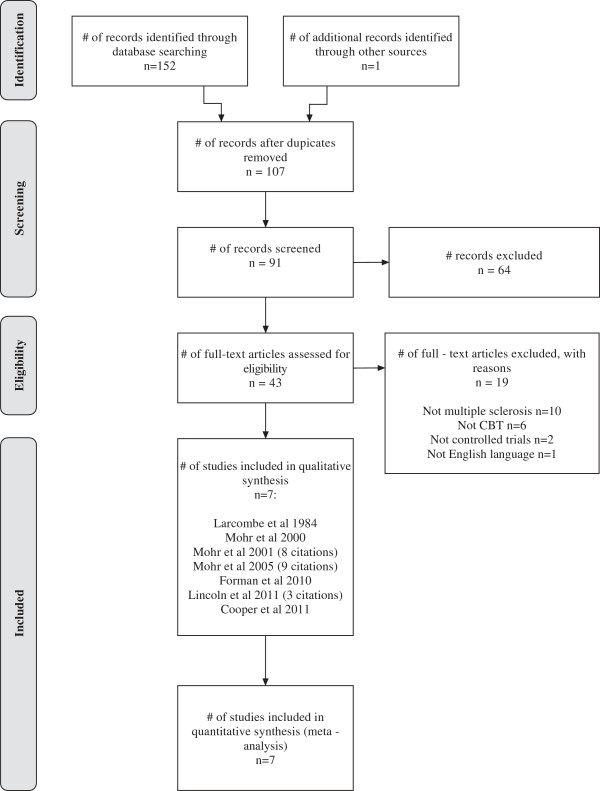
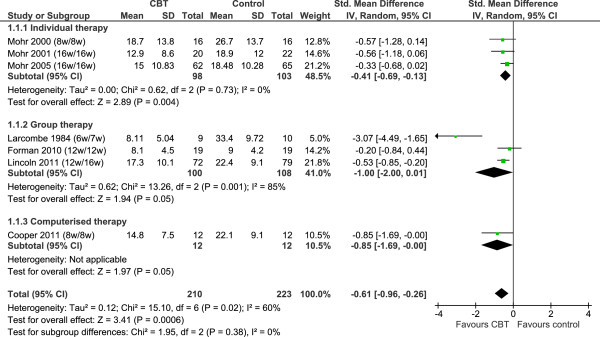
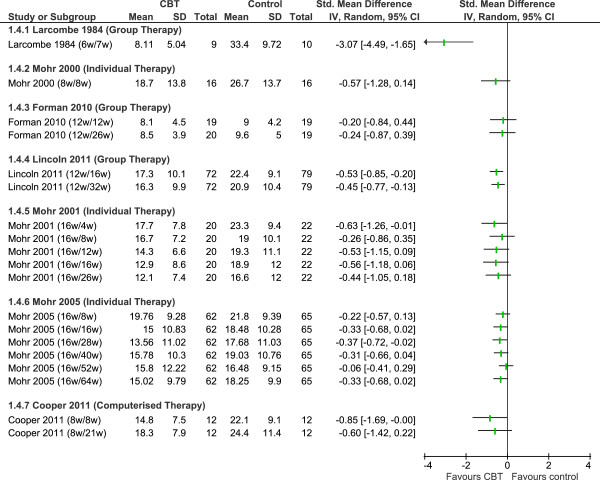
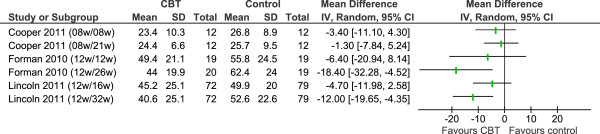
BACKGROUND: Depression is a common symptom in people with multiple sclerosis. We systematically reviewed published controlled trials on the effectiveness of cognitive behavioural therapy (CBT) for the treatment of depression in people with multiple sclerosis. METHODS: Publications were identified using MEDLINE, PsycINFO and the Cochrane Central Register of Controlled Trials to June/July 2013. We combined thesaurus and free-text terms which were synonyms of the concepts multiple sclerosis, depression and cognitive behavioural therapy. We included published controlled trials which compared individual, group CBT, conducted face-to-face or remotely, to no CBT. Two reviewers extracted data to calculate standardized mean differences (SMD) for self-reported symptoms of depression and weighted mean differences (WMD) for the Multiple Sclerosis Impact Scale (MSIS-29), with 95% Confidence Intervals (CIs). We investigated statistical heterogeneity using I². RESULTS: Seven eligible studies (n = 433) were identified, which evaluated the effect on depression of CBT delivered individually (3 studies), in a group (3 studies) and by computer (1 study). The summary effect (SMD -0.61, 95% CI -0.96 to -0.26, p=0.0006) was reduced (SMD -0.46, 95% CI -0.75 to -0.17, p=0.002) when an outlying study was removed in a sensitivity analysis to examine statistical heterogeneity. Three studies (n=213) observed a direction of effect using the MSIS-29 which was not statistically significant (WMD -4.36, 95% CI -9.33 to 0.62, p=0.09). There was no between-subgroup heterogeneity (I²=0). CONCLUSIONS: CBT can be an effective treatment for depression in MS. Further research should explore optimal durations and modalities of treatment for patients with different characteristics.
Overview
The claims and statistics of this paper haven’t been checked yet.
Free: it reads the open-access text and checks the first 5 claims that cite a source we can check. Create a free account to check every claim.
Integrity signals
Registry
Cites
Statistics
Figures

Verification
Claims the paper makes
The claims and statistics of this paper haven’t been checked yet.
Free: it reads the open-access text and checks the first 5 claims that cite a source we can check. Create a free account to check every claim.
Claims other papers make about this one
Each is checked against this paper’s own text: does it say what the citing paper says it does?
The cited source says what the claim attributes to it.
In the citing paper
“The magnitude of these effects are consistent with several smaller disorder-specific meta-analyses in PD (Ghielen et al., 2019), MS (Hind et al., 2014), and epilepsy (Li et al., 2023), as well as in adults with long-term physical health conditions (Scott et al., 2023).”
From Cognitive behavioral interventions for depression and anxiety in adults with neurological disorders: a systematic review and meta-analysis (2024) · cites this paper as Hind et al., 2014
The cited source says what the claim attributes to it.
In the citing paper
“A meta-analysis on seven clinical trials showed considerable effect of CBT on mitigating the depression symptomsof PwMSposttest(46).”
The cited source says what the claim attributes to it.
In the citing paper
“A review of seven CBT studies (individual (3 studies), group (3 studies) and by computer (1 study)) found a medium treatment effect of 0.5 SD [12].”
Self-check
Percentages, sums and reported differences re-computed from the paper’s own numbers.
The self-check needs the paper’s full text.
Citations
Cites
Statistical Power Analysis for the Behavioral Sciences
Muller, K. (1989) · Technometrics · doi:10.1080/00401706.1989.10488618 · Cited by 99,167
Statistical power analysis for the behavioral sciences
(1990) · Computers, Environment and Urban Systems · doi:10.1016/0198-9715(90)90050-4 · Cited by 65,269
Measuring inconsistency in meta-analyses
Higgins, J. P. T., Thompson, S. G., Deeks, J. J., & Altman, D. G. (2003) · BMJ · doi:10.1136/bmj.327.7414.557 · Cited by 63,139 · cited 1×
“Conventionally, I(2) values of 25%, 50%, and 75% denote low, moderate, and high levels of inconsistency [41].”
BackgroundMeta-analysis in clinical trials
DerSimonian, R., & Laird, N. (1986) · Controlled Clinical Trials · doi:10.1016/0197-2456(86)90046-2 · Cited by 39,552 · cited 1×
“Trials were combined using the DerSimonian and Laird random effects model [40].”
MethodLiberati, A., Altman, D. G., Tetzlaff, J., Mulrow, C., Gøtzsche, P. C., Ioannidis, J. P. A., Clarke, M., Devereaux, P. J., Kleijnen, J., & Moher, D. (2009) · PLoS Medicine · doi:10.1371/journal.pmed.1000100 · Cited by 28,164 · cited 1×
“Reporting conforms to the PRISMA statement [31].”
Liberati, A., Altman, D. G., Tetzlaff, J., Mulrow, C., Gotzsche, P. C., Ioannidis, J. P. A., Clarke, M., Devereaux, P. J., Kleijnen, J., & Moher, D. (2009) · BMJ · doi:10.1136/bmj.b2700 · Cited by 17,648
Rating neurologic impairment in multiple sclerosis: An expanded disability status scale (EDSS)
Kurtzke, J. F. (1983) · Neurology · doi:10.1212/wnl.33.11.1444 · Cited by 15,011 · cited 1×
“We abstracted baseline prognostic characteristics, including age, sex, duration and course of disease, MS-specific disability measured by the Expanded Disability Status Scale or the Guy’s Neurological Disability Scale [33,34] and selfreported depression, however measured.”
MethodCochrane Handbook for Systematic Reviews of Interventions Version 5.0.1. The Cochrane Collaboration
Higgins, J. P. T., Green, S. R., & Higgins, J. P. T. (2008) · Cited by 7,259
(1975) · Medical Entomology and Zoology · Cited by 7,245
Schulz (1995) · doi:10.1001/jama.1995.03520290060030 · Cited by 5,634 · cited 1×
“AT and JC assessed the included studies, unblinded, for generic dimensions of methodological quality associated with estimates of treatment effects in controlled trials: (1) concealment of the allocation schedule; (2) generation of the allocation sequences (randomization); and, (3) inclusion in the analysis of all ran…”
Cited by
Items 101–181 of 181
Ytterberg, C., Chruzander, C., Backenroth, G., Kierkegaard, M., Ahlström, G., & Gottberg, K. (2017) · International Journal of Qualitative Studies on Health and Well-Being · doi:10.1080/17482631.2017.1325673 · Cited by 7
“Nevertheless, studies are needed on how CBT can be tailored for people with MS (Hind et al., 2014), since there are several disease-related aspects, such as fatigue and cognitive impairment, that need to be considered (Johansson et al., 2007; McAlpine & Compston, 2006).”
BackgroundAssociation between age, distress, and orientations to happiness in individuals with disabilities.
Terrill, A. L., Müller, R., Jensen, M. P., Molton, I. R., Ipsen, C., & Ravesloot, C. (2015) · Rehabilitation Psychology · doi:10.1037/rep0000016 · Cited by 10
Rubel, A., DelMastro, H. M., Ruiz, J. A., Lo, A., & Gromisch, E. S. (2023) · International Journal of MS Care · doi:10.7224/1537-2073.2023-023 · Cited by 5
Iosipchuk, O., Wylie, G. R., Motl, R. W., & Sandroff, B. M. (2025) · International Journal of MS Care · doi:10.7224/1537-2073.2024-003 · Cited by 5
Abedi, H., Matinnia, N., & Yazdi‐Ravandi, S. (2023) · Neurological Sciences · doi:10.1007/s10072-023-06953-z · Cited by 4
“It was also investigated in studies on CBT in treating depression in patients with MS, and this method was recognized as a possible effective treatment in patients with MS [31].”
MethodMuller, V. R., Chan, F. H., Iwanaga, K., Wu, J.-R., Chen, X., Lee, B., Tao, J., Rumrill, P. D., & Bezyak, J. (2020) · Rehabilitation Counseling Bulletin · doi:10.1177/0034355220925157 · Cited by 4
“Psychological and mental health counseling can be used to help clients reduce their depression and anxiety (Bennett & Nelson, 2006; Hind et al., 2014).”
Backgroundpakniya, N., Bahmani, B., Dadkhah, A., Azimian, M., Naghiyaee, M., & MasudiSani, R. (2015) · Iranian Rehabilitation Journal · Cited by 4
A short-term exercise program in patients with multiple sclerosis: is body mass index important?
Yığman, Z. A., Karaahmet, Ö. Z., Ertürk, F. A., & Yığman, F. (2021) · International Journal of Rehabilitation Research · doi:10.1097/mrr.0000000000000462 · Cited by 5
Alkhawajah, M. M., Albarakati, R. G., Al-Jedai, A. H., Malik, Y. M. A., Almudaiheem, H., Al-Omari, B. A., Althubaiti, I. A., Al-Yafeai, R. H., Bunyan, R. F., Cupler, E., et al. (2023) · Clinical and Translational Neuroscience · doi:10.3390/ctn7020010 · Cited by 3
“Therefore, cognitive behavioral therapy may be adopted as an effective treatment instead [44].”
BackgroundChmiel, J., & Stępień–Słodkowska, M. (2024) · Journal of Clinical Medicine · doi:10.3390/jcm13247793 · Cited by 3
“Common treatments include antidepressant medications [13], cognitive behavioral therapy (CBT) [14,15], and physical exercise [16,17].”
Neurorehabilitation for Multiple Sclerosis Patients with Emotional Dysfunctions
Hung, Y., & Yarmak, P. (2016) · Frontiers in Neurology · doi:10.3389/fneur.2015.00272 · Cited by 3
Trastornos mentales y responsabilidad criminal en incendiarios
Cid, R. D., & Folino, J. Ó. (2016) · Revista Española de Medicina Legal · doi:10.1016/j.reml.2016.10.002 · Cited by 3
Psychological Treatment Considerations in Medical Comorbidity
Farris, S. G., Kibbey, M. M., Fedorenko, E. J., Babu, A. A., Gomez, G. J., & Smith, J. E. (2021) · Elsevier eBooks · doi:10.1016/b978-0-12-818697-8.00195-3 · Cited by 3
Fragkiadaki, E., Cotterill, N., Rice, C. M., Smith, J. A., & Nizza, I. E. (2023) · PLoS ONE · doi:10.1371/journal.pone.0288295 · Cited by 5
Study protocol: exercise training for treating major depressive disorder in multiple sclerosis
Motl, R. W., Bombardier, C. H., Duffecy, J. L., Hibner, B. A., Wathen, A., Carrithers, M. D., & Cutter, G. (2024) · BMC Neurology · doi:10.1186/s12883-024-03634-y · Cited by 5
“We propose the addition of CBT as it has been considered a “possibly efficacious” treatment for depression in MS [7, 8] and can be delivered remotely [9].”
Wolfenden, L., Albers, B., & Shlonsky, A. (2018) · Campbell Systematic Reviews · doi:10.1002/cl2.201 · Cited by 6
Mental disorders and criminal responsibility in arsonists
Cid, R. D., & Folino, J. Ó. (2017) · Revista Española de Medicina Legal · doi:10.1016/j.remle.2017.04.005 · Cited by 3
Bahmani, B., Mehraban, S., Azkhosh, M., Khanjani, M. S., & Azimian, M. (2022) · Iranian Journal of Psychiatry and Behavioral Sciences · doi:10.5812/ijpbs-127590 · Cited by 2
Goldsmith, K., Hudson, J. L., Chalder, T., Dennison, L., & Moss-Morris, R. (2020) · Behaviour Research and Therapy · doi:10.1016/j.brat.2020.103594 · Cited by 2
Feinstein, A., Bar‐Or, A., Benedict, R. H. B., Filippi, M., Freedman, D., Kever, A., Meza, C., & Rocca, M. A. (2025) · Brain · doi:10.1093/brain/awaf319 · Cited by 8
Online CBT in patients with multiple sclerosis and depression
Otte, C. (2015) · The Lancet Psychiatry · doi:10.1016/s2215-0366(15)00010-3 · Cited by 2
Psychotherapy in treatment and rehabilitation of patients with multiple sclerosis
Nikolaev, E., Poluektov, M. G., Васильева, Н. В., & Голенков, А. В. (2017) · S S Korsakov Journal of Neurology and Psychiatry · doi:10.17116/jnevro2017117121132-140 · Cited by 2
EVALUATION OF EATING ATTITUDES IN PATIENTS ATTENDING MULTIPLE SCLEROSIS PATIENT CAMP
Uzdil, Z., Kaya, S., Sökülmez, P., & Terzi, M. (2021) · Samsun Sağlık Bilimleri Dergisi · doi:10.47115/jshs.765412 · Cited by 2
“These include depression, anxiety, fatigue, insomnia, and pain (Fiest et al., 2016; Hind et al., 2014).”
BackgroundEarly intervention for depressive symptoms in multiple sclerosis
Kiropoulos, L. A. (2023) · The Lancet Digital Health · doi:10.1016/s2589-7500(23)00162-0 · Cited by 2
FEATS Score Differences and Comorbid Depression Within in Persons Diagnosed With Multiple Sclerosis
Shella, T. (2020) · Art Therapy · doi:10.1080/07421656.2020.1738314 · Cited by 2
Chronic pain associated with temporomandibular disorders
Senaratne, D. N. S., & Colvin, L. (2023) · BMJ · doi:10.1136/bmj.p2877 · Cited by 3
Kikuchi, H., Niino, M., Hirotani, M., Miyazaki, Y., & Kikuchi, S. (2019) · Clinical and Experimental Neuroimmunology · doi:10.1111/cen3.12529 · Cited by 2
“CBT might also play a role in the management of MS fatigue and depression.(7,19,24) The present study provides some preliminary evidence suggesting that CBT might be helpful for the treatment of depression and fatigue in Japanese patients with MS.”
MethodResultKiropoulos, L., Kilpatrick, T., Kalincik, T., Churilov, L., McDonald, E., Wijeratne, T., Threader, J., Rozenblat, V., O’Brien-Simpson, N., Van Der Walt, A., et al. (2020) · Trials · doi:10.1186/s13063-020-04261-x · Cited by 2
ÖZTÜRK, P., & Öztürk, M. E. (2026) · Frontiers in Neurology · doi:10.3389/fneur.2026.1770236 · Cited by 1
“Elevated FoR levels may reflect maladaptive interpretations of bodily sensations and uncertainty regarding disease progression (28).”
Verhaltensmedizin in der Neurologie: State of the Art
Leplow, B. (2014) · Verhaltenstherapie · doi:10.1159/000362909 · Cited by 1
Sauder, T., Keune, P. M., Schenk, T., & Hansen, S. (2024) · Zeitschrift für Neuropsychologie · doi:10.1024/1016-264x/a000398 · Cited by 1
Raji, I., Harch, I. E., Ragala, M. E. A., Berraho, M., Nejjar, F., & Belahsen, F. (2024) · Health Promotion Perspectives · doi:10.34172/hpp.42619 · Cited by 2
“60,61 CBT therefore complements TPE in an effective way.”
BackgroundGromisch, E. S., Neto, L. O., Lo, A., DeLuca, G. C., Turner, A. P., Agresta, T. P., Castiglione, A. S., & DelMastro, H. M. (2024) · Disability and Rehabilitation · doi:10.1080/09638288.2024.2438254 · Cited by 2
“…whether depression or fatigue may be contributing to patients’ perceptions, may facilitate referrals for treatments such as cognitive behavioral [74,75] and occupational therapy [76]. in addition, clinicians should consider whether a patient’s vascular comorbidities are being optimally managed…”
kiasari, S. T. H., Givi, H. G., & Khaleqkhah, A. (2015) · Majallah-i dānishgāh-i ̒ulūm-i pizishkī-i Māzandarān/Journal of Mazandaran University of Medical Sciences · Cited by 5
Thérapeutiques et prise en charge de la sclérose en plaques
Brochet, B., Lebrun‐Frénay, C., Seze, J. D., Zéphir, H., Allart, E., Audoin, B., Ayrignac, X., Bensa, C., Blanchard-Dauphin, A., Brassat, D., et al. (2017) · Elsevier eBooks · doi:10.1016/b978-2-294-75020-5.00016-8 · Cited by 3
Zakharchenko, D. A., & Petrikov, S. S. (2018) · Counseling Psychology and Psychotherapy · doi:10.17759/cpp.2018260107 · Cited by 3
Karimi, M., Bagajan, K. Q., Naghsh, Z., Ghazaghi, T., & Malekzadeh, L. (2021) · Scientific Journal of Kurdistan University of Medical Sciences · doi:10.52547/sjku.26.4.117 · Cited by 1
Self-management support for people with Multiple Sclerosis
Abbad, A., & Nimer, B. K. (2020) · Keele Research Repository (Keele University) · Cited by 2
Murray, K., Melchiorre, G., Dobbin, A., & Welch, K. A. (2021) · medRxiv · doi:10.1101/2021.07.15.21260604 · Cited by 2
Smyth, P. S., Watson, K. E., Hamarneh, Y. N. A., & Tsuyuki, R. T. (2022) · Research Square · doi:10.21203/rs.3.rs-1386216/v1 · Cited by 1
Ranjbar, A., & Izadi, S. (2020) · Research Square · doi:10.21203/rs.3.rs-35475/v1 · Cited by 1
“Various drugs can be useful in relieving MS symptoms, such as amantadine, methylphenidate, and moda nil for Fatigue (10), selective serotonin reuptake inhibitors are preferred choice for depression (11), and Tricyclic antidepressants and antiepileptics for the management of pain (12).”
BackgroundDeterminants of Depression in Multiple Sclerosis
Berzins, S. A. (2014) · Libraries and Cultural Resources (University of Calgary) · doi:10.5072/prism/25602
Online CBT in patients with multiple sclerosis and depression
Gerard, S. K. (2015)
Verhaltensmedizin neurologischer Erkrankungen
Leplow, B., & Paetow, K. (2015) · Springer-Lehrbuch · doi:10.1007/978-3-662-48035-9_15
Neurorehabilitation for Multiple Sclerosis Patients with Emotional Dysfunctions
Hung, Y., & Yarmak, P. (2015) · DSpace@MIT (Massachusetts Institute of Technology)
The Role of Metacognition in Emotional Distress in People with Multiple Sclerosis
Heffer-Rahn, P. (2017) · University of Liverpool · doi:10.17638/03009731
Fatigue and associated factors in multiple sclerosis patients in Latvia
Setlere, S., Abelsen, A., Pastare, D., & Millers, A. (2018) · Neurologijos seminarai · doi:10.29014/ns.2018.05 · Cited by 1
Psychische Veränderungen, Krankheitsbewältigung und Patientenführung
Schifferdecker, M. (2015) · Elsevier eBooks · doi:10.1016/b978-3-437-22083-8.00021-3
Sickness & behavior in ME/CFS (Chronic Fatigue Syndrome)
Jonsjö, M. A. (2019)
Psychische Veränderungen, Krankheitsbewältigung, Patientenführung und -coaching
Hoppenworth, U., Schifferdecker, M., & Sokol, C. (2021) · Elsevier eBooks · doi:10.1016/b978-3-437-22085-2.00022-7
(2021) · Elsevier eBooks · doi:10.1016/b978-3-437-22085-2.00028-8
Bevens, W., Weiland, T. J., Gray, K. M., Neate, S. L., Nag, N., Simpson, S., Reece, J. C., Yu, M., & Jelinek, G. A. (2021) · SSRN Electronic Journal · doi:10.2139/ssrn.3987076
Kiropoulos, L. A. (2021) · touchREVIEWS in Neurology · doi:10.17925/usn.2021.17.2.68
Schenk, A., Popa, C. O., & Cojocaru, C. M. (2022) · Acta Marisiensis. Seria Medica · doi:10.2478/amma-2021-0042
Preston, J., & Edmans, J. (2016) · doi:10.1002/9781119223719.ch4
Burbridge, J. A., & Leveroni, C. L. (2016) · Springer eBooks · doi:10.1007/978-3-319-29294-6_9
Arnett, P. A., & Cadden, M. H. (2022) · Elsevier eBooks · doi:10.1016/b978-0-323-91497-0.00234-4
Salgado, A. H., Silva, Â., Santos, E., Flores, C., & Lau, R. (2023) · Sinapse · doi:10.46531/sinapse/ao/230009/2023
Neuropsychiatric Manifestations in Multiple Sclerosis and Other Demyelinating Diseases
Kwon, Y. N. (2024) · Springer eBooks · doi:10.1007/978-981-97-1821-4_18
Campese, S., Lyons, J. N., Learmonth, Y. C., Metse, A. P., Kermode, A. G., Marck, C. H., & Karahalios, A. (2024) · Multiple Sclerosis and Related Disorders · doi:10.1016/j.msard.2024.105763
Viviendo con esclerosis múltiple: entendiendo los aspectos de la calidad de vida
Aguilar, A., & Monter, S. C. V. (2025) · Xihmai · doi:10.37646/xihmai.v19i38.640
Bruno, A., Dolcetti, E., Annovazzi, P. O. L., Clerico, M., Cocco, E. E., Conte, A., Marfia, G. A., Salvetti, M., Tomassini, V., Clerici, V. T., et al. (2025) · Frontiers in Psychiatry · doi:10.3389/fpsyt.2025.1557335 · Cited by 1
Latest Trends in Digital Therapeutics for Neurology
Kim, H., Kim, K. M., Kim, B., Kim, S. W., Baik, K., Seok, J. M., Sunwoo, J., Song, I., Woo, H. G., Lee, E., et al. (2025) · Journal of the Korean Neurological Association · doi:10.17340/jkna.2025.0027 · Cited by 1
Thevar, P., Wong, D. K., Hutton, E. J., Alpitsis, R., & McIlroy, A. (2025) · Neuropsychological Rehabilitation · doi:10.1080/09602011.2025.2547771
“While past studies have demonstrated the efficacy of CBT in treating depression in pwMS (Gottberg et al., 2016; Hind et al., 2014; Larcombe & Wilson, 1984), there have been no evaluations of its use for migraine pain.”
Meyer, B., Betz, L. T., Jacob, G. A., Krause, N., Riemann-Lorenz, K., Gold, S. M., Pöttgen, J., & Heesen, C. (2024) · Figshare · doi:10.6084/m9.figshare.27042353
Motl, R. W., Bombardier, C. H., Duffecy, J. L., Hibner, B. A., Wathen, A., Carrithers, M., & Cutter, G. (2024) · Figshare · doi:10.6084/m9.figshare.25632897
Smyth, P. S., Watson, K. E., Hamarneh, Y. N. A., & Tsuyuki, R. T. (2022) · Figshare · doi:10.6084/m9.figshare.20372726
Smyth, P. S., Watson, K. E., & Tsuyuki, R. T. (2021) · Figshare · doi:10.6084/m9.figshare.16960222
Smyth, P. S., Watson, K. E., & Tsuyuki, R. T. (2021) · Figshare · doi:10.6084/m9.figshare.16960219
Smyth, P. S., Watson, K. E., & Tsuyuki, R. T. (2021) · Figshare · doi:10.6084/m9.figshare.16960216
Smyth, P. S., Watson, K. E., & Tsuyuki, R. T. (2021) · Figshare · doi:10.6084/m9.figshare.16960213
Meyer, B., Betz, L. T., Jacob, G. A., Krause, N., Riemann-Lorenz, K., Gold, S. M., Pöttgen, J., & Heesen, C. (2024) · Figshare · doi:10.6084/m9.figshare.27042350
CBT mobile apps as a therapeutic intervention for treatment of depression
Szwed, M., & Talewski, M. (2026) · Psychiatria i Psychologia Kliniczna · doi:10.15557/pipk.2025.0029
Pagliari, C., Cabinio, M., & Blasi, V. (2026) · Springer eBooks · doi:10.1007/978-3-032-08980-9_21
Houllé, W. A. (2017) · theses.fr (ABES) · doi:10.70675/2e441ac3z1a1fz4353z8369zac732d48065c · Cited by 1
“Une méta-analyse systématique de Hind et al. (2014), portant sur 7 études, vient conforter les bénéfices de l’utilisation des thérapies TCC dans la sclérose en plaques, plus précisément dans le cadre du traitement de la dépression.”
Xu, W., Shen, B., Xu, H., Zhou, Y., & Wang, Y. (2026) · Medicine · doi:10.1097/md.0000000000048327
“[15,16] A careful screening of relevant references and gray literature was conducted simultaneously to ensure the comprehensiveness of the search.”
Abelovska, A., Malinová, R., Suchá, L., Novotna, K., Friedová, L., Havrdová, E., & Motýl, J. (2026) · Neurological Sciences · doi:10.1007/s10072-026-09130-0
“The drop-out rate of 9.1% was at the lower limit of what is typically reported in comparable psychotherapeutic interventions for somatic disorders [37, 21] or psychotherapy and physiotherapy in general [38, 39].”
InfluentialZhang, C., Scandiffio, J., Sureshkumar, A., Wasilewski, M. B., Donkers, S. J., Munce, S., & Simpson, R. (2026) · Disability and Rehabilitation · doi:10.1080/09638288.2026.2719953
White, M. A., Culton, D. A., Seiffert-Sinha, K., Sinha, A. A., & Tomayko, M. M. (2026) · Archives of Dermatological Research · doi:10.1007/s00403-026-04969-x
Metadata
- Authors
- Hind, D., Cotter, J., Thake, A., Bradburn, M., Cooper, C., Isaac, C., & House, A.
- Affiliations
- University of Sheffield (GB)
- University of Manchester (GB)
- University of Hertfordshire (GB)
- Sheffield Teaching Hospitals NHS Foundation Trust (GB)
- University of Leeds (GB)
- Corresponding author
- Hind, Daniel
- Venue
- BMC Psychiatry
- Published
- 2014-01-09
- Volume
- 14
- Issue
- 1
- Pages
- 5-5
- ISSN
- 1471-244X (ISSN-L)
- PMC
- PMC3890565
- OpenAlex
- W2111272873
- Cited by
- 180
- References
- 79
- Citations by year
- 2026: 7 · 2025: 9 · 2024: 18 · 2023: 13 · 2022: 14 · 2021: 20 · 2020: 14 · 2019: 11 · 2018: 12 · 2017: 18 · 2016: 18 · 2015: 19 · 2014: 7
- FWCI
- 2.93
- Type
- journal article
- Language
- en
- Open access
- gold
- doi.org
- Licence
- Locations
- BMC Psychiatry (publishedVersion, cc-by)
- Europe PMC (PubMed Central) (publishedVersion, cc-by)
- PubMed Central (publishedVersion, cc-by)
- PubMed (publishedVersion)
- White Rose Research Online (University of Leeds, The University of Sheffield, University of York) (acceptedVersion)
- Research Explorer (The University of Manchester) (submittedVersion, cc-by)
- Funders
- Multiple Sclerosis Society (845/06)
- Topics
- Health Sciences › Medicine › Clinical Neurology › Multiple Sclerosis Research Studies
- Social Sciences › Psychology › Experimental and Cognitive Psychology › Anxiety, Depression, Psychometrics, Treatment, Cognitive Processes
- Social Sciences › Psychology › Clinical Psychology › Psychological Treatments and Assessments
- Keywords
- cognitive behavioral therapy, depression, multiple sclerosis, treatment effectiveness, group therapy, individual psychotherapy, MSIS-29, quality of life
- MeSH terms
- Depression, Humans, Multiple Sclerosis, Cognitive Behavioral Therapy, Treatment Outcome
About these checks
Registry, retraction, Cites and statistics results are computed, not judged, with one exception: a printed reference that no index lists is read once by a model before it counts as a citation error. Claims are extracted by a model and kept only when their quote appears verbatim in the text; each cited source is then checked, with a model’s help, for whether it says what the claim relies on. Those verdicts can be wrong — read the claim’s quote and the cited source before relying on one.
Statistics and arithmetic are recomputed, not judged.
Confidence bands are shown only for fields calibrated on our annotated test set. None is calibrated yet, so no band is shown.
What counts as a claim ›How we measure confidence ›How we check this ›
Are you an author, or do you see a problem with this page? Request a review
Data sources
Bibliographic data: Semantic Scholar, OpenAlex, Crossref.
Contains information from the Semantic Scholar Academic Graph Datasets, made available under the ODC Attribution License (ODC-BY 1.0).
Semantic Scholar’s data is described in: Kinney, R., et al. (2023). The Semantic Scholar Open Data Platform. arXiv:2301.10140.
