

Cognitive behavioural therapy for the treatment of depression in people with multiple sclerosis: a systematic review and meta-analysis
Open accessThe DOI matches its Crossref record; 78 of the 79 references it cites were found in a registry or an index.
Abstract
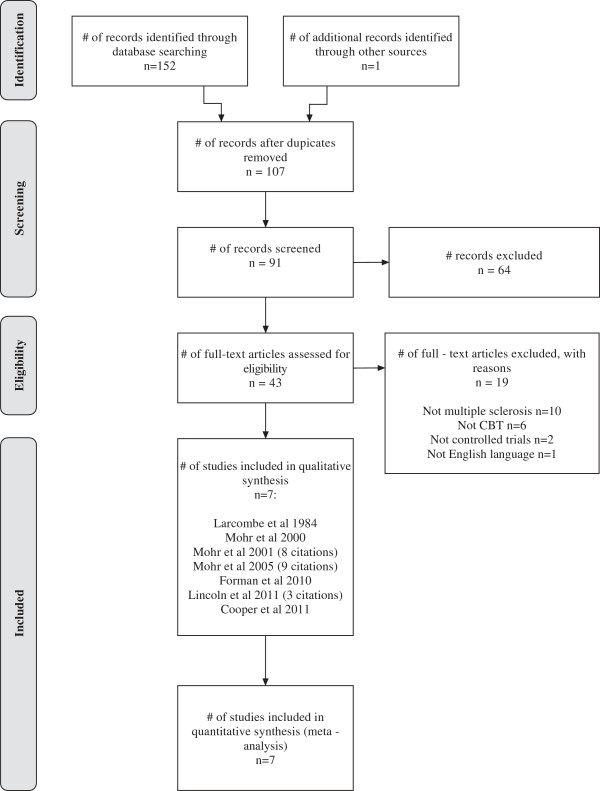
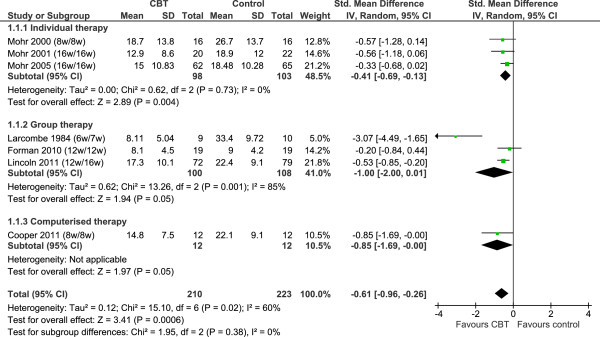
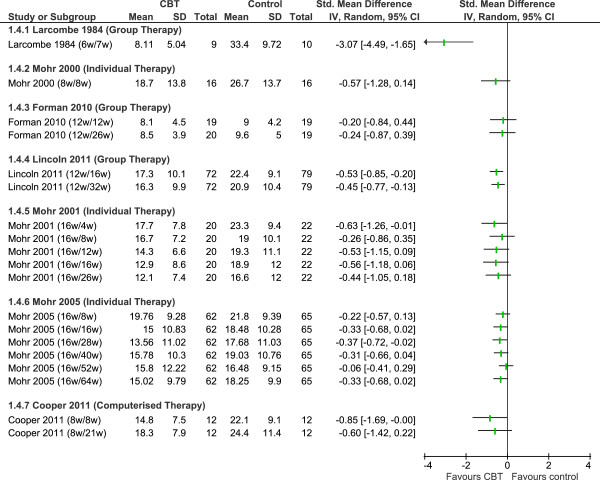
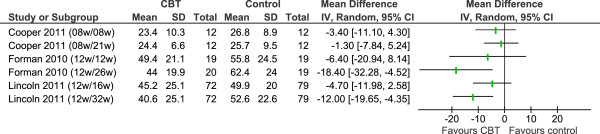
BACKGROUND: Depression is a common symptom in people with multiple sclerosis. We systematically reviewed published controlled trials on the effectiveness of cognitive behavioural therapy (CBT) for the treatment of depression in people with multiple sclerosis. METHODS: Publications were identified using MEDLINE, PsycINFO and the Cochrane Central Register of Controlled Trials to June/July 2013. We combined thesaurus and free-text terms which were synonyms of the concepts multiple sclerosis, depression and cognitive behavioural therapy. We included published controlled trials which compared individual, group CBT, conducted face-to-face or remotely, to no CBT. Two reviewers extracted data to calculate standardized mean differences (SMD) for self-reported symptoms of depression and weighted mean differences (WMD) for the Multiple Sclerosis Impact Scale (MSIS-29), with 95% Confidence Intervals (CIs). We investigated statistical heterogeneity using I². RESULTS: Seven eligible studies (n = 433) were identified, which evaluated the effect on depression of CBT delivered individually (3 studies), in a group (3 studies) and by computer (1 study). The summary effect (SMD -0.61, 95% CI -0.96 to -0.26, p=0.0006) was reduced (SMD -0.46, 95% CI -0.75 to -0.17, p=0.002) when an outlying study was removed in a sensitivity analysis to examine statistical heterogeneity. Three studies (n=213) observed a direction of effect using the MSIS-29 which was not statistically significant (WMD -4.36, 95% CI -9.33 to 0.62, p=0.09). There was no between-subgroup heterogeneity (I²=0). CONCLUSIONS: CBT can be an effective treatment for depression in MS. Further research should explore optimal durations and modalities of treatment for patients with different characteristics.
Overview
The claims and statistics of this paper haven’t been checked yet.
Free: it reads the open-access text and checks the first 5 claims that cite a source we can check. Create a free account to check every claim.
Integrity signals
Registry
Cites
Statistics
Figures

Verification
Claims the paper makes
The claims and statistics of this paper haven’t been checked yet.
Free: it reads the open-access text and checks the first 5 claims that cite a source we can check. Create a free account to check every claim.
Claims other papers make about this one
Each is checked against this paper’s own text: does it say what the citing paper says it does?
The cited source says what the claim attributes to it.
In the citing paper
“The magnitude of these effects are consistent with several smaller disorder-specific meta-analyses in PD (Ghielen et al., 2019), MS (Hind et al., 2014), and epilepsy (Li et al., 2023), as well as in adults with long-term physical health conditions (Scott et al., 2023).”
From Cognitive behavioral interventions for depression and anxiety in adults with neurological disorders: a systematic review and meta-analysis (2024) · cites this paper as Hind et al., 2014
The cited source says what the claim attributes to it.
In the citing paper
“A meta-analysis on seven clinical trials showed considerable effect of CBT on mitigating the depression symptomsof PwMSposttest(46).”
The cited source says what the claim attributes to it.
In the citing paper
“A review of seven CBT studies (individual (3 studies), group (3 studies) and by computer (1 study)) found a medium treatment effect of 0.5 SD [12].”
Self-check
Percentages, sums and reported differences re-computed from the paper’s own numbers.
The self-check needs the paper’s full text.
Citations
Cites
Statistical Power Analysis for the Behavioral Sciences
Muller, K. (1989) · Technometrics · doi:10.1080/00401706.1989.10488618 · Cited by 99,167
Statistical power analysis for the behavioral sciences
(1990) · Computers, Environment and Urban Systems · doi:10.1016/0198-9715(90)90050-4 · Cited by 65,269
Measuring inconsistency in meta-analyses
Higgins, J. P. T., Thompson, S. G., Deeks, J. J., & Altman, D. G. (2003) · BMJ · doi:10.1136/bmj.327.7414.557 · Cited by 63,139 · cited 1×
“Conventionally, I(2) values of 25%, 50%, and 75% denote low, moderate, and high levels of inconsistency [41].”
BackgroundMeta-analysis in clinical trials
DerSimonian, R., & Laird, N. (1986) · Controlled Clinical Trials · doi:10.1016/0197-2456(86)90046-2 · Cited by 39,552 · cited 1×
“Trials were combined using the DerSimonian and Laird random effects model [40].”
MethodLiberati, A., Altman, D. G., Tetzlaff, J., Mulrow, C., Gøtzsche, P. C., Ioannidis, J. P. A., Clarke, M., Devereaux, P. J., Kleijnen, J., & Moher, D. (2009) · PLoS Medicine · doi:10.1371/journal.pmed.1000100 · Cited by 28,164 · cited 1×
“Reporting conforms to the PRISMA statement [31].”
Liberati, A., Altman, D. G., Tetzlaff, J., Mulrow, C., Gotzsche, P. C., Ioannidis, J. P. A., Clarke, M., Devereaux, P. J., Kleijnen, J., & Moher, D. (2009) · BMJ · doi:10.1136/bmj.b2700 · Cited by 17,648
Rating neurologic impairment in multiple sclerosis: An expanded disability status scale (EDSS)
Kurtzke, J. F. (1983) · Neurology · doi:10.1212/wnl.33.11.1444 · Cited by 15,011 · cited 1×
“We abstracted baseline prognostic characteristics, including age, sex, duration and course of disease, MS-specific disability measured by the Expanded Disability Status Scale or the Guy’s Neurological Disability Scale [33,34] and selfreported depression, however measured.”
MethodCochrane Handbook for Systematic Reviews of Interventions Version 5.0.1. The Cochrane Collaboration
Higgins, J. P. T., Green, S. R., & Higgins, J. P. T. (2008) · Cited by 7,259
(1975) · Medical Entomology and Zoology · Cited by 7,245
Schulz (1995) · doi:10.1001/jama.1995.03520290060030 · Cited by 5,634 · cited 1×
“AT and JC assessed the included studies, unblinded, for generic dimensions of methodological quality associated with estimates of treatment effects in controlled trials: (1) concealment of the allocation schedule; (2) generation of the allocation sequences (randomization); and, (3) inclusion in the analysis of all ran…”
Cited by
Prevalence of depression and anxiety in Multiple Sclerosis: A systematic review and meta-analysis
Boeschoten, R. E., Braamse, A. M. J., Beekman, A. T. F., Cuijpers, P., van Oppen, P., Dekker, J., & Uitdehaag, B. M. J. (2017) · Journal of the Neurological Sciences · doi:10.1016/j.jns.2016.11.067 · Cited by 713
Comorbid depression in medical diseases
Gold, S. M., Köhler-Forsberg, O., Moss-Morris, R., Mehnert, A., Miranda, J. J., Bullinger, M., Steptoe, A., Whooley, M. A., & Otte, C. (2020) · Nature Reviews Disease Primers · doi:10.1038/s41572-020-0200-2 · Cited by 534
The link between multiple sclerosis and depression
Feinstein, A., Magalhaes, S., Richard, J.-F., Audet, B., & Moore, C. (2014) · Nature Reviews Neurology · doi:10.1038/nrneurol.2014.139 · Cited by 523
Graham, C. D., Gouick, J., Krahé, C., & Gillanders, D. (2016) · Clinical Psychology Review · doi:10.1016/j.cpr.2016.04.009 · Cited by 476
“been widely applied to improve distress and self-management in long-term conditions (Beatty & Lambert, 2013; Greer et al., 1992; Hind et al., 2014; Ismail, Winkley, & Rabe-Hesketh, 2004; Petrie, Perry, Broadbent, & Weinman, 2012).”
Depression in multiple sclerosis
Patten, S. B., Marrie, R. A., & Carta, M. G. (2017) · International Review of Psychiatry · doi:10.1080/09540261.2017.1322555 · Cited by 262
“Comparable results were reported in a 2014 systematic review of cognitive behavioural therapy (Hind et al., 2014).”
ResultRehabilitation in Multiple Sclerosis: A Systematic Review of Systematic Reviews
Khan, F., & Amatya, B. (2017) · Archives of Physical Medicine and Rehabilitation · doi:10.1016/j.apmr.2016.04.016 · Cited by 194
Neuropsychiatric Symptoms of Multiple Sclerosis: State of the Art
Silveira, C., Guedes, R., Maia, D., Curral, R., & Coelho, R. (2019) · Psychiatry Investigation · doi:10.30773/pi.2019.0106 · Cited by 173
Munkholm, K., Vinberg, M., & Kessing, L. V. (2016) · Molecular Psychiatry · doi:10.1038/mp.2015.54 · Cited by 157
Depression in Multiple Sclerosis: Epidemiology, Aetiology, Diagnosis and Treatment
Solaro, C. M., Gamberini, G., & Masuccio, F. G. (2018) · CNS Drugs · doi:10.1007/s40263-018-0489-5 · Cited by 199
Fischer, A., Schröder, J., Vettorazzi, E., Wolf, O. T., Pöttgen, J., Lau, S., Heesen, C., Moritz, S., & Gold, S. M. (2015) · The Lancet Psychiatry · doi:10.1016/s2215-0366(14)00049-2 · Cited by 143
Distress improves after mindfulness training for progressive MS: a pilot randomised trial
Bogosian, A., Chadwick, P., Windgassen, S., Norton, S., McCrone, P., Mosweu, I., Silber, E., & Moss-Morris, R. (2015) · Multiple Sclerosis Journal · doi:10.1177/1352458515576261 · Cited by 135
Kidd, T., Carey, N., Mold, F., Westwood, S., Miklaucich, M., Konstantara, E., Sterr, A., & Cooke, D. D. (2017) · PLoS ONE · doi:10.1371/journal.pone.0185931 · Cited by 158
“Moreover, CBT and behavioural components appeared successful in improving QOL outcomes [48] which also seemed to the case in this current review.”
BackgroundJannati, N., Mazhari, S., Ahmadian, L., & Mirzaee, M. (2020) · International Journal of Medical Informatics · doi:10.1016/j.ijmedinf.2020.104145 · Cited by 118
Ng, T., Teo, S. M., Yeo, H. L., Shwe, M., Gan, Y. X., Cheung, Y. T., Foo, K. M., Cham, M. T., Lee, J. A., Tan, Y. P., et al. (2016) · Neuro-Oncology · doi:10.1093/neuonc/nov162 · Cited by 100
Thom, R. P., Silbersweig, D., & BOLAND, R. J. (2019) · Psychosomatic Medicine · doi:10.1097/psy.0000000000000678 · Cited by 129
Li, C., Xu, D., Hu, M., Tan, Y., Zhang, P., Li, G., & Chen, L. (2017) · Journal of Psychosomatic Research · doi:10.1016/j.jpsychores.2017.02.006 · Cited by 90
Bogosian, A., Hughes, A., Norton, S., Silber, E., & Moss‐Morris, R. (2016) · British Journal of Health Psychology · doi:10.1111/bjhp.12201 · Cited by 75
Ghielen, I., Rutten, S., Boeschoten, R. E., Houniet-de Gier, M., van Wegen, E. E. H., van den Heuvel, O. A., & Cuijpers, P. (2019) · Journal of Psychosomatic Research · doi:10.1016/j.jpsychores.2019.05.001 · Cited by 74
Fleming, K. M., Coote, S. B., & Herring, M. P. (2021) · Multiple Sclerosis Journal · doi:10.1177/13524585211009216 · Cited by 77
Depression in multiple sclerosis: Is one approach for its management enough?
Jones, C. D., Motl, R. W., & Sandroff, B. M. (2021) · Multiple Sclerosis and Related Disorders · doi:10.1016/j.msard.2021.102904 · Cited by 66
Epidemiology, diagnosis and management of sexual dysfunction in multiple sclerosis
Drulovic, J. S., Kisić-Tepavčević, D., & Pekmezovic, T. D. (2020) · Acta Neurologica Belgica · doi:10.1007/s13760-020-01323-4 · Cited by 69
Psychosocial interventions for adults with newly diagnosed chronic disease: A systematic review
Akyirem, S., Forbes, A., Wad, J. L., & Due-Christensen, M. (2022) · Journal of Health Psychology · doi:10.1177/1359105321995916 · Cited by 60
“CBT has been successfully applied to patients with long-standing T1D (McGrady and Hood, 2013), T2D (Safren et al., 2014), MS (Hind et al., 2014), HIV (Tobin et al., 2017), RA (Sharpe, 2016) and Inflammatory bowel disease (IBD) (Mikocka-Walus et al., 2015).”
BackgroundSangelaji, B., Smith, C. M., Paul, L., Sampath, K. K., Treharne, G. J., & Hale, L. A. (2015) · Clinical Rehabilitation · doi:10.1177/0269215515595274 · Cited by 67
Disability, depression and suicide ideation in people with multiple sclerosis
Lewis, V. M., Williams, K., KoKo, C., Woolmore, J., Jones, C. A., & Powell, T. (2016) · Journal of Affective Disorders · doi:10.1016/j.jad.2016.08.038 · Cited by 63
Sexual dysfunction in patients with multiple sclerosis
Lew‐Starowicz, M., & Gianotten, W. L. (2015) · Handbook of clinical neurology · doi:10.1016/b978-0-444-63247-0.00020-1 · Cited by 64
Multiple sclerosis and sexual dysfunction: A need for further education and interdisciplinary care
Delaney, K. E., & Donovan, J. M. (2017) · Neurorehabilitation · doi:10.3233/nre-172200 · Cited by 70
“Cognitive behavioral therapy has been shown to be effective (Hind et al., 2014).”
Sesel, A.-L., Sharpe, L., & Naismith, S. L. (2018) · Psychotherapy and Psychosomatics · doi:10.1159/000486806 · Cited by 54
A Framework to Support Cognitive Behavior Therapy for Emotional Disorder After Stroke
Kneebone, I. I. (2016) · Cognitive and Behavioral Practice · doi:10.1016/j.cbpra.2015.02.001 · Cited by 51
“…supported by studies on patients with a range of acquired brain injuries (Stalder-Lüthy et al., 2013;Waldron, Casserly, &O’Sullivan, 2012) and those with other neurological conditions such as multiple sclerosis (Hind et al., 2014) and Parkinson’s disease (Armento et al., 2012;Dobkin et al., 2011).”
BackgroundFernie, B. A., Kollmann, J., & Brown, R. G. (2015) · Journal of Psychosomatic Research · doi:10.1016/j.jpsychores.2015.02.012 · Cited by 51
“Systematic reviews exist that evaluate the efficacy of either CBT or antidepressants in specific neurological conditions [19–21] and antidepressants in neurological conditions as a category [18].”
BackgroundKiropoulos, L. A., Kilpatrick, T., Holmes, A., & Threader, J. (2016) · BMC Psychiatry · doi:10.1186/s12888-016-1152-7 · Cited by 50
Wills, O. C., & Probst, Y. (2022) · Health and Quality of Life Outcomes · doi:10.1186/s12955-022-02046-1 · Cited by 58
“One meta-analysis reported that incorporating cognitive behavioural theory in interventions for plwMS is effective in improving QOL domains [11, 101].”
MethodEmerging Approaches for Validating and Managing Multiple Sclerosis Relapse
Mills, E. A., Mirza, A., & Mao‐Draayer, Y. (2017) · Frontiers in Neurology · doi:10.3389/fneur.2017.00116 · Cited by 45
“Alleviating depressive symptoms through a combination of antidepressants (56) and cognitive behavioral therapy (57) can help with symptom relief in some patients.”
BackgroundGold, S. M., Friede, T., Meyer, B., Moss-Morris, R. E., Hudson, J. L., Asseyer, S., Bellmann–Strobl, J., Leisdon, A., Ißels, L., Ritter, K., et al. (2023) · The Lancet Digital Health · doi:10.1016/s2589-7500(23)00109-7 · Cited by 51
“The basic structure of the email support was based on our previous work 29 and is described in detail in the manual (appendix pp 15–24).”
Third wave cognitive behavioural therapies for people with multiple sclerosis: a scoping review
Zarotti, N., Eccles, F., Broyd, A., Longinotti, C., Mobley, A., & Simpson, J. (2023) · Disability and Rehabilitation · doi:10.1080/09638288.2022.2069292 · Cited by 40
Signaling pathways regulating Homer1a expression: implications for antidepressant therapy
Serchov, T., Heumann, R., van Calker, D., & Biber, K. P. H. (2015) · Biological Chemistry · doi:10.1515/hsz-2015-0267 · Cited by 47
Hasselmann, H., Bellmann–Strobl, J., Ricken, R., Oberwahrenbrock, T., Rose, M., Otte, C., Adli, M., Paul, F., Brandt, A. U., Finke, C., et al. (2016) · Multiple Sclerosis Journal · doi:10.1177/1352458515622826 · Cited by 41
Determinants and incidence of depression in multiple sclerosis: A prospective cohort study
Berzins, S., Bulloch, A. G. M., Burton, J., Dobson, K. S., Fick, G. H., & Patten, S. B. (2017) · Journal of Psychosomatic Research · doi:10.1016/j.jpsychores.2017.06.012 · Cited by 50
Explaining fatigue in multiple sclerosis: cross-validation of a biopsychosocial model
Wijenberg, M., Stapert, S. Z., Köhler, S., & Bol, Y. (2016) · Journal of Behavioral Medicine · doi:10.1007/s10865-016-9749-3 · Cited by 40
“Knoop et al. (2011) concluded that changes in thoughts about fatigue play a crucial role in CBT for fatigue in MS. Hoogerwerf et al. (submitted) showed that also the third generation CBT, Mindfulness Based Cognitive Therapy (MBCT) is an effective intervention for severely fatigued MS patients.”
InfluentialBahrani, S., Zargar, F., Yousefipour, G., & Akbari, H. (2017) · Iranian Red Crescent Medical Journal · doi:10.5812/ircmj.44566 · Cited by 36
“One of the most effective psychotherapies is cognitive behavior therapy (CBT), which was proven to have moderate effects on psychological symptoms such as depression in patients with MS (25, 26).”
BackgroundDepressive symptoms in Friedreich ataxia
Nieto, A., Hernández-Torres, A., Pérez-Flores, J., & Montón, F. (2017) · International Journal of Clinical and Health Psychology · doi:10.1016/j.ijchp.2017.11.004 · Cited by 37
Moderators of Exercise Effects on Depressive Symptoms in Multiple Sclerosis: A Meta-regression
Herring, M. P., Fleming, K. M., Hayes, S., Motl, R. W., & Coote, S. B. (2017) · American Journal of Preventive Medicine · doi:10.1016/j.amepre.2017.04.011 · Cited by 42
Neurorehabilitation in Multiple Sclerosis—A Review of Present Approaches and Future Considerations
Sîrbu, C. A., Thompson, D. C., Pleşa, C., Vasile, M., Jianu, D. C., Mitrică, M., Anghel, D. N., & Ștefani, C. (2022) · Journal of Clinical Medicine · doi:10.3390/jcm11237003 · Cited by 47
“Cognitive behavioral therapy (CBT) is an example of psychotherapy that enables cortical prefrontal structures to mitigate negative emotional responses by adjusting the patients’ perception and stress levels in situations outside their control [190].”
BackgroundSenders, A., Sando, K., Wahbeh, H., Hiller, A., & Shinto, L. H. (2016) · Journal of Health Psychology · doi:10.1177/1359105314562084 · Cited by 40
“While specific MS studies have not assessed stress as a primary outcome, several trials have demonstrated effectiveness in improving stress-related outcomes (see Hind et al., 2014 for review).”
BackgroundMS care: integrating advanced therapies and holistic management
Giovannoni, G., Ford, H. L., Schmierer, K., Middleton, R., Stennett, A., Pomeroy, I. M., Fisniku, L. K., Scalfari, A., Bannon, C., Stross, R., et al. (2024) · Frontiers in Neurology · doi:10.3389/fneur.2023.1286122 · Cited by 31
White, S., Russell, C. L., Johnson, R. A., Cheng, A. L., & McClain, N. (2017) · Applied Nursing Research · doi:10.1016/j.apnr.2017.08.002 · Cited by 32
Bevens, W., Weiland, T. J., Gray, K. M., Neate, S. L., Nag, N., Simpson, S., Reece, J. C., Yu, M., & Jelinek, G. A. (2022) · Frontiers in Public Health · doi:10.3389/fpubh.2022.852214 · Cited by 31
Treatment of Mood Disorders in Multiple Sclerosis
Pérez, L., Sánchez-González, R., & Lázaro, E. (2014) · Current Treatment Options in Neurology · doi:10.1007/s11940-014-0323-4 · Cited by 29
Hudson, J. L., & Moss-Morris, R. (2019) · European Psychologist · doi:10.1027/1016-9040/a000352 · Cited by 27
“…suggest disengagement from psychotherapy is related to 153 health care professionals labelling negative emotions with a term that does not accurately 154 reflect the challenge of struggling to adjust to having a LTC (Hind et al., 2014; Knowles, 155 Chew-Graham, Adeyemi, Coupe, & Coventry, 2015).”
BackgroundManaging multiple sclerosis in individuals aged 55 and above: a comprehensive review
Fernández, Ó., Sørensen, P. S., Comı, G., Vermersch, P., Hartung, H., Leocani, L., Berger, T., Wijmeersch, B. V., & Oreja‐Guevara, C. (2024) · Frontiers in Immunology · doi:10.3389/fimmu.2024.1379538 · Cited by 45
Jonassaint, C. R., Kang, C., Prussien, K. V., Yarboi, J., Sanger, M., Wilson, J. D., Castro, L. M. D., Shah, N., & Sarkar, U. (2018) · Translational Behavioral Medicine · doi:10.1093/tbm/iby107 · Cited by 28
Schirda, B., Duraney, E., Lee, H. K., Manglani, H. R., Andridge, R. R., Plate, A., Nicholas, J. A., & Prakash, R. S. (2020) · Rehabilitation Psychology · doi:10.1037/rep0000324 · Cited by 26
Programmable “Semismart” Sensor: Relevance to Monitoring Antipsychotics
Kim, E., Chocron, S. E., Ben‐Yoav, H., Winkler, T. E., Liu, Y., Glassman, M., Wolfram, C., Kelly, D. L., Ghodssi, R., & Payne, G. F. (2015) · Advanced Functional Materials · doi:10.1002/adfm.201403783 · Cited by 26
Robinson, P. L., Russell, A., & Dysch, L. (2019) · Brain Impairment · doi:10.1017/brimp.2019.2 · Cited by 24
“Systematic reviews exist that demonstrate the efficacy of CBT for depression in specific neurological conditions such as MS (Hind et al., 2014), epilepsy (Fiest et al., 2013); TBI (Fann, Hart, & Schomer, 2009; Gertler, Tate, & Cameron, 2015); CBT for anxiety in TBI (Soo & Tate, 2007) and CBT for…”
BackgroundSadeghi-Bahmani, D., Esmaeili, L., Mokhtari, F., Sadeghi Bahmani, L., Afsharzadeh, M., Shaygannejad, V., Mirmosayyeb, O., Goldstein-Piekarski, A. N., & Gross, J. J. (2022) · Multiple Sclerosis and Related Disorders · doi:10.1016/j.msard.2022.104029 · Cited by 22
Anderson, J., Turner, A., & Clyne, W. (2016) · Disability and Rehabilitation · doi:10.1080/09638288.2016.1181211 · Cited by 25
“[6] It is estimated that up to 55% of people living with MS experience major depression in their lifetime.[7] Depression in MS has been”
InfluentialRintala, A., Matcham, F., Radaelli, M., Locafaro, G., Simblett, S. K., Pietro, C. B. D. S., Bulgari, V., Burke, P., Devonshire, J., Weyer, J., et al. (2019) · Journal of Psychosomatic Research · doi:10.1016/j.jpsychores.2019.109761 · Cited by 25
Heffer-Rahn, P., & Fisher, P. L. (2018) · Journal of Psychosomatic Research · doi:10.1016/j.jpsychores.2017.11.014 · Cited by 22
Experience of Identity Change in People Who Reported a Diagnosis of Multiple Sclerosis
Barker, A. B., Smale, K., Hunt, N. C., Lincoln, N. B., & das Nair, R. (2019) · International Journal of MS Care · doi:10.7224/1537-2073.2018-069 · Cited by 32
Gandy, M., Woldhuis, T., Wu, W., Youssef, M., Bisby, M. A., Dear, B. F., Heriseanu, A. I., & Scott, A. J. (2024) · Psychological Medicine · doi:10.1017/s0033291724001995 · Cited by 20
“The moderate effect sizes of those studies which used a severity criterion were more comparable to effect sizes observed in the general population (Cuijpers et al., 2023).”
InfluentialDonisi, V., Gajofatto, A., Mazzi, M. A., Gobbin, F., Busch, I. M., Ghellere, A., Klonova, A., Rudi, D., Vitali, F., Schena, F. F., et al. (2021) · Frontiers in Psychology · doi:10.3389/fpsyg.2021.598726 · Cited by 24
Lucien, A., Francis, H., Wu, W., Woldhuis, T., & Gandy, M. (2024) · Multiple Sclerosis and Related Disorders · doi:10.1016/j.msard.2024.105858 · Cited by 28
Stigma and health outcomes in multiple sclerosis: a systematic review
Powell, B., Mills, R. J., Tennant, A., Young, C. A., & Langdon, D. W. (2024) · BMC Neurology · doi:10.1186/s12883-024-03853-3 · Cited by 24
“Interventions incorporating cognitive and behavioural approaches to help manage stigma should be evaluated [37, 43, 56, 57].”
BackgroundInfluentialA psychoeducation program for stress management and psychosocial problems in multiple sclerosis
Öz, H. S., & Öz, F. (2020) · Nigerian Journal of Clinical Practice · doi:10.4103/njcp.njcp_462_19 · Cited by 21
Individual Face-to-Face Cognitive Behavioural Therapy in Multiple Sclerosis: A Qualitative Study
Gottberg, K., Chruzander, C., Backenroth, G., Johansson, S., Ahlström, G., & Ytterberg, C. (2016) · Journal of Clinical Psychology · doi:10.1002/jclp.22288 · Cited by 25
Faraclas, E. (2023) · Degenerative Neurological and Neuromuscular Disease · doi:10.2147/dnnd.s395733 · Cited by 24
“Studies indicate many pwMS have yet to be offered therapies such as CBT as part of their care.(26,83,84) Considerations when using CBT are that it might not have longlasting effects and, therefore, may need to be employed throughout the disease course multiple times.”
BackgroundMeyer, B., Betz, L. T., Jacob, G. A., Krause, N., Riemann-Lorenz, K., Gold, S. M., Pöttgen, J., & Heesen, C. (2024) · BMC Neurology · doi:10.1186/s12883-024-03843-5 · Cited by 21
“While these treatments are mainly recommended for relapsing MS forms, some non-pharmacological interventions have shown promise in various MS forms, alleviating fatigue and depressive symptoms as well as improving quality of life (QoL) [5–7].”
BackgroundComputerized Cognitive Behavioral Therapy for Treatment of Depression in Multiple Sclerosis
Ratajska, A. M., Zurawski, J. D., Healy, B. C., & Glanz, B. I. (2018) · International Journal of MS Care · doi:10.7224/1537-2073.2017-094 · Cited by 18
Current Psychological Approaches in Neurodegenerative Diseases
Kormas, P., & Moutzouri, A. (2022) · Springer eBooks · doi:10.1007/978-3-319-75479-6_10-1 · Cited by 17
Oates, L., Moghaddam, N. G., Evangelou, N., & das Nair, R. (2019) · Clinical Rehabilitation · doi:10.1177/0269215519896404 · Cited by 9
Work difficulties in people with multiple sclerosis: The role of anxiety, depression and coping
van Egmond, E. E. A., van der Hiele, K., van Gorp, D., Jongen, P. J., van der Klink, J., Reneman, M., Beenakker, E. A. C., van Eijk, J., Frequin, S. T. F. M., de Gans, K., et al. (2022) · Multiple Sclerosis Journal - Experimental Translational and Clinical · doi:10.1177/20552173221116282 · Cited by 20
“The current study aimed to examine the relationships between anxiety, depression, coping and work difficulties in people with MS.”
BackgroundInfluentialBehavioral Neurology of Multiple Sclerosis and Autoimmune Encephalopathies
Moghadasi, A. N., Pourmand, S., Sharifian, M., Minagar, A., & Sahraian, M. A. (2015) · Neurologic Clinics · doi:10.1016/j.ncl.2015.08.002 · Cited by 15
das Nair, R., Kontou, E., Smale, K., Barker, A. B., & Lincoln, N. B. (2016) · Clinical Rehabilitation · doi:10.1177/0269215515616446 · Cited by 23
Association Between Disability and Quality of Life in Multiple Sclerosis Patients in Ahvaz, Iran
Salehi, R., Shakhi, K., & Khiavi, A. (2016) · Materia Socio Medica · doi:10.5455/msm.2016.28.215-219 · Cited by 15
“Given the large and significant association between the cognitive subscale and the quality of life of patients, it seems using specialized treatments such as psychotherapy and cognitive therapy can reduce the degree of cognitive disability (41, 42).”
BackgroundHarrison, A. M., McCracken, L. M., Jones, K., Norton, S., & Moss-Morris, R. (2017) · Disability and Rehabilitation · doi:10.1080/09638288.2016.1209580 · Cited by 14
“[26] Traditionally, CBT for pwMS has been delivered using high-intensity, face-to-face delivery methods,[27,28] which can potentially be expensive and limit access to more disabled individuals.”
BackgroundThe evaluation of an online mindfulness program for people with multiple sclerosis: study protocol
Sesel, A.-L., Sharpe, L., Beadnall, H. N., Barnett, M. H., Szabó, M., & Naismith, S. L. (2019) · BMC Neurology · doi:10.1186/s12883-019-1356-9 · Cited by 15
Depression in multiple sclerosis
Štětkářová, I., Javůrková, A., & Raudenská, J. (2018) · Neurologie pro praxi · doi:10.36290/neu.2019.031 · Cited by 18
“Existuje i v delší devítipoložkové verzi (PHQ-9), která u populace RS vykazuje dobré psychometrické vlastnosti: při skóru >10 identifikuje s 88% senzitivitou a specificitou depresivní epizodu (Hind et al., 2014).”
InfluentialSmyth, P. S., Watson, K. E., & Tsuyuki, R. T. (2021) · Trials · doi:10.1186/s13063-021-05726-3 · Cited by 14
Smyth, P. S., Watson, K. E., Hamarneh, Y. N. A., & Tsuyuki, R. T. (2022) · BMC Neurology · doi:10.1186/s12883-022-02809-9 · Cited by 19
Sesel, A.-L., Sharpe, L., Beadnall, H. N., Barnett, M. H., Szabo, M., & Naismith, S. L. (2021) · Journal of Medical Internet Research · doi:10.2196/19309 · Cited by 12
Iyer, P., Wiles, K., Ismail, A., Nanda, S., Murray, K., Hughes, S., Ford, H. L., Pearson, O. R., White, S., Bonham, N., et al. (2023) · Multiple Sclerosis Journal · doi:10.1177/13524585221148094 · Cited by 11
Managing Disability in Progressive Multiple Sclerosis
Dubey, D., Sguigna, P. V., & Stüve, O. (2016) · Current Treatment Options in Neurology · doi:10.1007/s11940-016-0412-7 · Cited by 11
Reliability and validity of the multiple sclerosis resiliency scale (MSRS)
Hughes, A. J., Patel, K. K., Fitzgerald, K. C., Brown, A. J., Gromisch, E. S., & Mowry, E. M. (2020) · Journal of the Neurological Sciences · doi:10.1016/j.jns.2020.116983 · Cited by 12
Toussaint, A. C., Buck, L., Hartl, J., Löwe, B., & Schramm, C. (2022) · BMJ Open · doi:10.1136/bmjopen-2022-061419 · Cited by 11
“Integrated biopsy-chosocial research in patients with multiple sclerosis (MS) and poststroke found a fatigue-enhancing cycle of avoidance behaviour towards physical activity and depression, 22 23 whereas cognitive behavioural therapy reduced fatigue in patients with MS, 22 and graded exercise therapy moderately improv…”
BackgroundTietjen, K. M., Wilson, M., Amiri, S., & Dietz, J. (2017) · Journal of Neuroscience Nursing · doi:10.1097/jnn.0000000000000328 · Cited by 9
Claessens, G., Gerritzen, I., van Osch, F., van den Bergh, J. P., Verberne, D. P. J., Gach, D., van Balen, E., & Heugten, C. M. V. (2024) · Frontiers in Psychology · doi:10.3389/fpsyg.2024.1396963 · Cited by 9
Psychological interventions in multiple sclerosis: Improving cognition and quality of life
Harand, C., & Defer, G. L. (2018) · Annals of Physical and Rehabilitation Medicine · doi:10.1016/j.rehab.2018.10.002 · Cited by 11
Güner, M. C., Yazar, M. S., & Meterelliyoz, K. Ş. (2020) · The European Journal of Psychiatry · doi:10.1016/j.ejpsy.2020.06.004 · Cited by 9
Kiropoulos, L. A., Kilpatrick, T. J., Kalincek, T., Cherulov, L., McDonald, E. A., Wijeratne, T., Threader, J., Rozenblat, V., O’brien-simpson, N. M., van der Walt, A., et al. (2020) · Trials · doi:10.1186/s13063-019-4018-8 · Cited by 8
Chang, H., Sun, L., Wang, X., Wang, H., & Shi, Y. (2025) · Journal of Affective Disorders · doi:10.1016/j.jad.2025.04.109 · Cited by 7
Preventing suicidal behavior in patients with multiple sclerosis: a scoping review
Mellentin, A. I., Stenager, E. N., & Stenager, E. (2018) · Expert Review of Neurotherapeutics · doi:10.1080/14737175.2018.1549990 · Cited by 9
“Classical clinical psychological approaches such as cognitive behavioral therapy (CBT) targeting maladaptive coping strategies and adjustment, and also derives of CBT such as mindfulness-based therapy (MBT) targeting to diminish psychological distress and prevent relapse in depressive and other psychiatric symptoms ha…”
BackgroundFragkiadaki, E., Anagnostopoulos, F., & Triliva, S. (2023) · Counselling and Psychotherapy Research · doi:10.1002/capr.12615 · Cited by 9
Chruzander, C., Gottberg, K., Ytterberg, C., Backenroth, G., Fredrikson, S., Holmqvist, L. W., & Johansson, S. (2016) · Disability and Rehabilitation · doi:10.3109/09638288.2015.1130179 · Cited by 9
“Since this pilot study was conducted, two valuable articles of CBT as treatment method to alleviate depressive symptoms in PwMS have been published.[40,41] These studies propose that CBT might be an effective method for alleviating depressive symptoms in some subgroups in PwMS but that further knowledge is needed [40,…”
MethodElite Academy Soccer Players’ Perceptions Towards Cognitive Behavioral Therapy
Wilkins, L., Sweeney, J., Zaborski, Z., Nelson, C., Tweddle, S., Beukes, E. W., & Allen, P. M. (2018) · Journal of Clinical Sport Psychology · doi:10.1123/jcsp.2018-0026 · Cited by 8
Current Psychological Approaches in Neurodegenerative Diseases
Kormas, P., & Moutzouri, A. (2023) · Springer eBooks · doi:10.1007/978-3-319-75922-7_10 · Cited by 8
Reece, J. C., Yu, M., Bevens, W., Simpson, S., Jelinek, G. A., Jelinek, P. L., Davenport, R. A., Nag, N., Gray, K. M., & Neate, S. L. (2023) · BMC Neurology · doi:10.1186/s12883-023-03298-0 · Cited by 6
Cognitive Impairment and Depression in Mastocytosis: A Synthesis of the Literature
Nicoloro‐SantaBarbara, J. M., Majd, M., Burdick, K. E., Dixon, V., & Giannetti, M. P. (2024) · Current Allergy and Asthma Reports · doi:10.1007/s11882-024-01127-z · Cited by 6
“CBT has been shown to be effective in end-stage renal disease [122], Parkinson’s disease [123], MS [124], and psoriasis [124, 125].”
SECCION IX. Síndrome Post COVID-19: complicaciones tardías y rehabilitación
Saavedra, C. (2021) · Infectio · doi:10.22354/in.v25i4.979 · Cited by 15
Complementary and alternative medicine usage amongst multiple sclerosis patients in Iran
Ranjbar, A., Daneshfard, B., & Izadi, S. (2021) · Neurology Asia · doi:10.54029/2021zfv · Cited by 6
Krause, N., Derad, C., von Glasenapp, B., Riemann-Lorenz, K., Meyer, B., Asendorf, T., Temmes, H., van de Loo, M., Gold, S. M., Schubert, C., et al. (2025) · Multiple Sclerosis Journal · doi:10.1177/13524585251356410 · Cited by 6
“36 Efforts to enable behaviour change have also been undertaken in physical activity and exercise, indicating short-term benefits of up to 6 months based on social cognitive theory approaches.”
Scandiffio, J., Langer, L. K., Senthilnathan, V., Feng, G., Sureshkumar, A., Bromberg, M., Babineau, J., Donkers, S. J., Knox, K. B., Bruno, T. R., et al. (2025) · Journal of Neurology · doi:10.1007/s00415-025-13315-6 · Cited by 9
“These findings are consistent with previous literature on psychological interventions among PwMS, which has found improvements for certain psychological therapies (e.g., CBT, MBI) in mental health [42–44], physical health [45, 46], and QoL [47].”
Metadata
- Authors
- Hind, D., Cotter, J., Thake, A., Bradburn, M., Cooper, C., Isaac, C., & House, A.
- Affiliations
- University of Sheffield (GB)
- University of Manchester (GB)
- University of Hertfordshire (GB)
- Sheffield Teaching Hospitals NHS Foundation Trust (GB)
- University of Leeds (GB)
- Corresponding author
- Hind, Daniel
- Venue
- BMC Psychiatry
- Published
- 2014-01-09
- Volume
- 14
- Issue
- 1
- Pages
- 5-5
- ISSN
- 1471-244X (ISSN-L)
- PMC
- PMC3890565
- OpenAlex
- W2111272873
- Cited by
- 180
- References
- 79
- Citations by year
- 2026: 7 · 2025: 9 · 2024: 18 · 2023: 13 · 2022: 14 · 2021: 20 · 2020: 14 · 2019: 11 · 2018: 12 · 2017: 18 · 2016: 18 · 2015: 19 · 2014: 7
- FWCI
- 2.93
- Type
- journal article
- Language
- en
- Open access
- gold
- doi.org
- Licence
- Locations
- BMC Psychiatry (publishedVersion, cc-by)
- Europe PMC (PubMed Central) (publishedVersion, cc-by)
- PubMed Central (publishedVersion, cc-by)
- PubMed (publishedVersion)
- White Rose Research Online (University of Leeds, The University of Sheffield, University of York) (acceptedVersion)
- Research Explorer (The University of Manchester) (submittedVersion, cc-by)
- Funders
- Multiple Sclerosis Society (845/06)
- Topics
- Health Sciences › Medicine › Clinical Neurology › Multiple Sclerosis Research Studies
- Social Sciences › Psychology › Experimental and Cognitive Psychology › Anxiety, Depression, Psychometrics, Treatment, Cognitive Processes
- Social Sciences › Psychology › Clinical Psychology › Psychological Treatments and Assessments
- Keywords
- cognitive behavioral therapy, depression, multiple sclerosis, treatment effectiveness, group therapy, individual psychotherapy, MSIS-29, quality of life
- MeSH terms
- Depression, Humans, Multiple Sclerosis, Cognitive Behavioral Therapy, Treatment Outcome
About these checks
Registry, retraction, Cites and statistics results are computed, not judged, with one exception: a printed reference that no index lists is read once by a model before it counts as a citation error. Claims are extracted by a model and kept only when their quote appears verbatim in the text; each cited source is then checked, with a model’s help, for whether it says what the claim relies on. Those verdicts can be wrong — read the claim’s quote and the cited source before relying on one.
Statistics and arithmetic are recomputed, not judged.
Confidence bands are shown only for fields calibrated on our annotated test set. None is calibrated yet, so no band is shown.
What counts as a claim ›How we measure confidence ›How we check this ›
Are you an author, or do you see a problem with this page? Request a review
Data sources
Bibliographic data: Semantic Scholar, OpenAlex, Crossref.
Contains information from the Semantic Scholar Academic Graph Datasets, made available under the ODC Attribution License (ODC-BY 1.0).
Semantic Scholar’s data is described in: Kinney, R., et al. (2023). The Semantic Scholar Open Data Platform. arXiv:2301.10140.
