

Psychotherapy mediated by remote communication technologies: a meta-analytic review
Open accessThe DOI matches its Crossref record; 69 of the 70 references it cites were found in a registry or an index.
Abstract
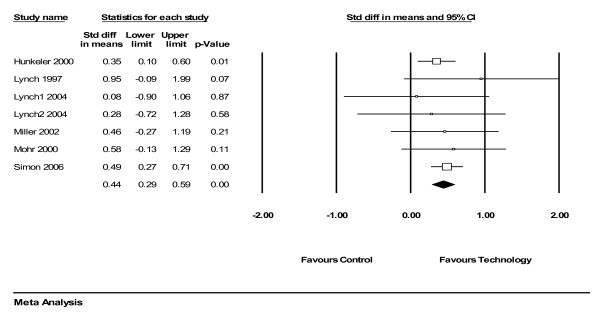
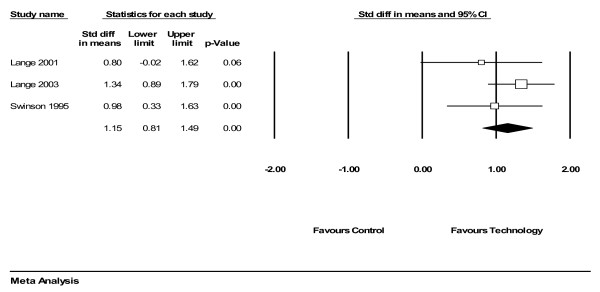
BACKGROUND: Access to psychotherapy is limited by psychopathology (e.g. agoraphobia), physical disability, occupational or social constraints and/or residency in under-served areas. For these populations, interventions delivered via remote communication technologies (e.g. telephone, internet) may be more appropriate. However, there are concerns that such delivery may influence the therapeutic relationship and thus reduce therapy effectiveness. This review aimed to determine the clinical effectiveness of remotely communicated, therapist-delivered psychotherapy. METHODS: Systematic review (including electronic database searching and correspondence with authors) of randomised trials of individual remote psychotherapy. Electronic databases searched included MEDLINE (1966-2006), PsycInfo (1967-2006), EMBASE (1980-2006) and CINAHL databases (1982-2006). The Cochrane Central Register of Controlled Trials (CENTRAL) and the Cochrane Collaboration Depression, Anxiety and Neurosis Controlled Trials Register (CCDAN-CTR). All searches were conducted to include studies with a publication date to July 2006. RESULTS: Thirteen studies were identified, ten assessing psychotherapy by telephone, two by internet and one by videoconference. Pooled effect sizes for remote therapy versus control conditions were 0.44 for depression (95%CI 0.29 to 0.59, 7 comparisons, n = 726) and 1.15 for anxiety-related disorders (95%CI 0.81 to 1.49, 3 comparisons, n = 168). There were few comparisons of remote versus face-to-face psychotherapy. CONCLUSION: Remote therapy has the potential to overcome some of the barriers to conventional psychological therapy services. Telephone-based interventions are a particularly popular research focus and as a means of therapeutic communication may confer specific advantages in terms of their widespread availability and ease of operation. However, the available evidence is limited in quantity and quality. More rigorous trials are required to confirm these preliminary estimates of effectiveness. Future research priorities should include overcoming the methodological shortcomings of published work by conducting large-scale trials that incorporate both clinical outcome and more process-orientated measures.
Overview
The claims and statistics of this paper haven’t been checked yet.
Free: it reads the open-access text and checks the first 5 claims that cite a source we can check. Create a free account to check every claim.
Integrity signals
Registry
Cites
Statistics
Figures
Verification
Claims the paper makes
The claims and statistics of this paper haven’t been checked yet.
Free: it reads the open-access text and checks the first 5 claims that cite a source we can check. Create a free account to check every claim.
Claims other papers make about this one
Each is checked against this paper’s own text: does it say what the citing paper says it does?
The source backs part of the claim, not all of it — or backs it for a different population, condition or comparison.
In the citing paper
“A growing body of research also supports the efficacy of internet-based interventions for these treatment targets (4–8).”
From Interest in behavioral and psychological treatments delivered face-to-face, by telephone, and by internet (2010) · cites this paper as [7]
Experimental — accuracy not yet measuredThe source backs part of the claim, not all of it — or backs it for a different population, condition or comparison.
In the citing paper
“Furthermore, first meta-analyses have shown comparable effectiveness of these interventions and regular face-to-face psychotherapy (Andersson et al., 2014, Barak et al., 2008, Bee et al., 2008) especially for depression and anxiety (Andersson and Cuijpers, 2009, Andrews et al., 2010, Richards and Richardson, 2012).”
From Using a transdiagnostic, psychodynamic online self-help intervention to maintain inpatient psychosomatic treatment effects: Study protocol of a feasibility study (2016) · cites this paper as Bee et al., 2008
Experimental — accuracy not yet measured
Self-check
Percentages, sums and reported differences re-computed from the paper’s own numbers.
The self-check needs the paper’s full text.
Citations
Cites
Measuring inconsistency in meta-analyses
Higgins, J. P. T., Thompson, S. G., Deeks, J. J., & Altman, D. G. (2003) · BMJ · doi:10.1136/bmj.327.7414.557 · Cited by 63,139 · cited 1×
“Between-study heterogeneity was assessed using the I 2 statistic [ 44 ], which describes the percentage of total variation across studies that is due to heterogeneity rather than chance.”
MethodBias in meta-analysis detected by a simple, graphical test
Egger, M., Smith, G. D., Schneider, M., & Minder, C. (1997) · BMJ · doi:10.1136/bmj.315.7109.629 · Cited by 56,722
Cochrane Handbook for Systematic Reviews of Interventions: Cochrane Book Series
(2008) · doi:10.1002/9780470712184 · Cited by 25,048
(2000) · Cited by 9,198
Diagnostic and Statistical Manual of Mental Disorders (DSM-IV)
Hu, R. J. (2003) · Encyclopedia of the Neurological Sciences · doi:10.1016/b0-12-226870-9/01070-4 · Cited by 9,117
(1996) · Cited by 6,884
Cochrane Handbook for Systematic Reviews of Interventions
Higgins, J. P. T., Green, S., & Ben Van Den, A. (2020) · International Coaching Psychology Review · doi:10.53841/bpsicpr.2020.15.2.123 · Cited by 5,670
Internet paradox: A social technology that reduces social involvement and psychological well-being?
Kraut, R., Patterson, M., Lundmark, V., Kiesler, S., Mukophadhyay, T., & Scherlis, W. (1998) · American Psychologist · doi:10.1037/0003-066x.53.9.1017 · Cited by 4,793 · cited 1×
“Whether or not an effective alliance can be delivered in the absence of interpersonal contact thus remains a topic of some debate [20-22].”
BackgroundThe Journal of Family Practice
(1997) · The American Journal of Family Therapy · doi:10.1080/01926189708251066 · Cited by 3,067
Eysenbach, G. (2005) · Journal of Medical Internet Research · doi:10.2196/jmir.7.1.e11 · Cited by 2,524 · cited 1×
“Trials of written self help materials for anxiety and depressive disorders report comparable figures of between 0 and 61% [62], although attrition from open access online therapy is generally assumed to be higher and may be as much as 99% [63], Once again however, differences in study context, recruitment and sample c…”
BackgroundInternet-based cognitive behaviour therapy for symptoms of depression and anxiety: A meta-analysis
SPEK, V., CUIJPERS, P., NYKLÍČEK, I., RIPER, H., KEYZER, J., & POP, V. (2007) · Psychological Medicine · doi:10.1017/s0033291706008944 · Cited by 1,586
Psychotherapy relationships that work : therapist contributions and responsiveness to patients
Norcross, J. C. (2002) · Cited by 1,197
Psychotherapy Relationships That Work: Therapist Contributions and Responsiveness to Patients
Weiner, I. B. (2003) · Psychotherapy Research · doi:10.1093/ptr/kpg044 · Cited by 1,154
Wampold, B. E., Mondin, G. W., Moody, M., Stich, F., Benson, K., & Ahn, H.-N. (1997) · Psychological Bulletin · doi:10.1037/0033-2909.122.3.203 · Cited by 1,091
The quality of care for depressive and anxiety disorders in the United States
Young, A. S., Klap, R., Sherbourne, C. D., & Wells, K. B. (2001) · Archives of General Psychiatry · doi:10.1001/archpsyc.58.1.55 · Cited by 1,061 · cited 2×
“Research has also highlighted the potential value of these approaches in the treatment of dysthymia, phobia and generalized anxiety disorder [6].”
BackgroundSirey, J. A., Bruce, M. L., Alexopoulos, G. S., Perlick, D. A., Friedman, S. J., & Meyers, B. S. (2001) · Psychiatric Services · doi:10.1176/appi.ps.52.12.1615 · Cited by 796
Simon, G. E. (2000) · BMJ · doi:10.1136/bmj.320.7234.550 · Cited by 521 · cited 1×
“Recent studies of collaborative care provision, in which telephone support is often provided as an adjunct to other interventions, have documented positive outcomes [23-27].”
BackgroundLange, A., Rietdijk, D., Hudcovicova, M., van de Ven, J.-P., Schrieken, B., & Emmelkamp, P. M. G. (2003) · Journal of Consulting and Clinical Psychology · doi:10.1037/0022-006x.71.5.901 · Cited by 495
Hunkeler, E. M. (2000) · Archives of Family Medicine · doi:10.1001/archfami.9.8.700 · Cited by 464 · cited 6×
“Only two studies involved more than 100 participants per trial arm [51,55], the vast majority (n = 9) recruiting less than 50.”
BackgroundResultInfluentialGELLATLY, J., BOWER, P., HENNESSY, S., RICHARDS, D., GILBODY, S., & LOVELL, K. (2007) · Psychological Medicine · doi:10.1017/s0033291707000062 · Cited by 419 · cited 1×
“The analysis treated 'usual care' and waiting list' controls as equivalent to 'no treatment', although it should be noted that previous studies have suggested that effects in usual care may be significantly lower [ 69 ].”
Self-citationSimon, G. E., Ludman, E. J., Tutty, S., Operskalski, B., & Korff, M. V. (2004) · JAMA · doi:10.1001/jama.292.8.935 · Cited by 395 · cited 8×
“Only two studies involved more than 100 participants per trial arm [51,55], the vast majority (n = 9) recruiting less than 50.”
BackgroundResultInfluentialChurchill, R., Hunot, V., Corney, R., Knapp, M., McGuire, H., Tylee, A., & Wessely, S. (2002) · Health Technology Assessment · doi:10.3310/hta5350 · Cited by 368 · cited 4×
“Psychological interventions were defined as treatments with an explicit psychological orientation [36].”
BackgroundInfluentialA meta‐analysis of bibliotherapy studies
Marrs, R. W. (1995) · American Journal of Community Psychology · doi:10.1007/bf02507018 · Cited by 366 · cited 4×
“Reviews and meta-analyses of computer-delivered CBT packages [28,29] and self-help treatments [30-33] also provide promising results.”
BackgroundInfluentialKaltenthaler, E., Brazier, J., De Nigris, E., Tumur, I., Ferriter, M., Beverley, C., Parry, G., Rooney, G., & Sutcliffe, P. (2006) · Health Technology Assessment · doi:10.3310/hta10330 · Cited by 357
A meta-analysis of self-help treatment approaches
Gould, R. A., & Clum, G. A. (1993) · Clinical Psychology Review · doi:10.1016/0272-7358(93)90039-o · Cited by 335 · cited 3×
“guided self help) for anxiety and depressive disorders report mean effect sizes of between 0.40 and 1.19 [30, 31 ,33,34,36,61], However,”
BackgroundInfluentialHollon, S. D., Muñoz, R. F., Barlow, D. H., Beardslee, W. R., Bell, C. C., Bernal, G., Clarke, G. N., Franciosi, L. P., Kazdin, A. E., Kohn, L., et al. (2002) · Biological Psychiatry · doi:10.1016/s0006-3223(02)01384-7 · Cited by 328
Who (or What) Can Do Psychotherapy: The Status and Challenge of Nonprofessional Therapies
Christensen, A., & Jacobson, N. S. (1994) · Psychological Science · doi:10.1111/j.1467-9280.1994.tb00606.x · Cited by 318 · cited 1×
“Reviews and meta-analyses of computer-delivered CBT packages [28,29] and self-help treatments [30-33] also provide promising results.”
BackgroundTelephone-administered psychotherapy for depression
Mohr, D. C., Hart, S. L., Julian, L., Catledge, C., Honos-Webb, L., Vella, L., & Tasch, E. T. (2005) · Archives of General Psychiatry · doi:10.1001/archpsyc.62.9.1007 · Cited by 298
Treating Childhood Depression over Videoconferencing
Nelson, E.-L., Barnard, M., & Cain, S. (2003) · Telemedicine Journal and e-Health · doi:10.1089/153056203763317648 · Cited by 269 · cited 5×
“Less than half of the included studies (n = 5) defined a main outcome a priori [50,51,54-56] and only five reported conducting a power analysis [49,54-57].”
BackgroundResultInfluentialSystematic reviews of trials and other studies.
Sutton, Abrams, Jones, Sheldon, & Song (1998) · Health Technology Assessment · doi:10.3310/hta2190 · Cited by 246 · cited 1×
“Initial meta-analyses used a fixed effect model [43] to provide an overall pooled measure of effect.”
MethodInterapy. Treatment of posttraumatic stress through the Internet: a controlled trial
Lange, A., van de Ven, J.-P., Schrieken, B., & Emmelkamp, P. M. G. (2001) · Journal of Behavior Therapy and Experimental Psychiatry · doi:10.1016/s0005-7916(01)00023-4 · Cited by 244 · cited 4×
“Two other studies also provided data to suggest that levels of patient satisfaction with remote psychotherapy are high, although in these instances no comparable data from control conditions were available [ 48 ,53].”
BackgroundResultInfluentialMohr, D. C., Likosky, W., Bertagnolli, A., Goodkin, D. E., Van Der Wende, J., Dwyer, P., & Dick, L. P. (2000) · Journal of Consulting and Clinical Psychology · doi:10.1037/0022-006x.68.2.356 · Cited by 240
Bower, P., Richards, D. A., & Lovell, K. (2001) · Europe PMC (PubMed Central) · Cited by 226
Self-citationPractice guideline for major depressive disorder in adults. American Psychiatric Association
(1993) · American Journal of Psychiatry · doi:10.1176/ajp.150.4.1 · Cited by 226
Michaels, J., Campbell, W., Brazier, J., MacIntyre, J., Palfreyman, S., Ratcliffe, J., & Rigby, K. (2006) · Health Technology Assessment · doi:10.3310/hta10130 · Cited by 225
Why is self-help neglected in the treatment of emotional disorders? A meta-analysis
DEN BOER, P. C. A. M., WIERSMA, D., & VAN DEN BOSCH, R. J. (2004) · Psychological Medicine · doi:10.1017/s003329170300179x · Cited by 220
Telehealth and the evolving health care system: Strategic opportunities for professional psychology.
Nickelson, D. W. (1998) · Professional Psychology: Research and Practice · doi:10.1037//0735-7028.29.6.527 · Cited by 209
Barriers to initiating depression treatment in primary care practice
Nutting, P. A., Rost, K., Dickinson, M., Werner, J. J., Dickinson, P., Smith, J. L., & Gallovic, B. (2002) · Journal of General Internal Medicine · doi:10.1046/j.1525-1497.2002.10128.x · Cited by 190 · cited 1×
“Other recognized barriers include time and economic constraints, caring responsibilities, psychological or physical impairment and concerns regarding the potential stigma of attending outpatient appointments [9-11].”
BackgroundDevelopment of a quality assessment instrument for trials of treatments for depression and neurosis
Moncrieff, J., Churchill, R., Drummond, D. C., & McGuire, H. (2001) · International Journal of Methods in Psychiatric Research · doi:10.1002/mpr.108 · Cited by 185 · cited 1×
“The CCDAN quality rating scale [39] scores each study according to 23 elements of design and conduct including randomisation methods, sample size, follow-up period, power and appropriateness of analysis.”
MethodDistressed women’s clinic patients:
Alvidrez, J., & Azocar, F. (1999) · General Hospital Psychiatry · doi:10.1016/s0163-8343(99)00038-9 · Cited by 178 · cited 1×
“Insufficient numbers of mental health professionals impede access to effective interventions, with people living in remote or underserved areas often having to travel long distances to obtain face-to-face services [8].”
BackgroundECT, Research, and Professional Ambivalence
Salzman, C. (1998) · American Journal of Psychiatry · doi:10.1176/ajp.155.1.1 · Cited by 175
Cuevas, C. D. L., Arredondo, M. T., Cabrera, M. F., Sulzenbacher, H., & Meise, U. (2006) · Telemedicine and e-Health · doi:10.1089/tmj.2006.12.341 · Cited by 173
Randomised Controlled Trials: A User's Guide
Vader, J.-P. (1998) · BMJ · doi:10.1136/bmj.317.7167.1258 · Cited by 173
Lovell, K., Cox, D., Haddock, G., Jones, C., Raines, D., Garvey, R., Roberts, C., & Hadley, S. (2006) · BMJ · doi:10.1136/bmj.38940.355602.80 · Cited by 162 · cited 8×
“Less than half of the included studies (n = 5) defined a main outcome a priori [50,51,54-56] and only five reported conducting a power analysis [49,54-57].”
BackgroundResultInfluentialSelf-citationClinical applications of telehealth in mental health care.
Stamm, B. H. (1998) · Professional Psychology Research and Practice · doi:10.1037/0735-7028.29.6.536 · Cited by 159 · cited 1×
“Whether or not an effective alliance can be delivered in the absence of interpersonal contact thus remains a topic of some debate [20-22].”
BackgroundThe use of telemedicine in psychiatry
NORMAN, S. (2006) · Journal of Psychiatric and Mental Health Nursing · doi:10.1111/j.1365-2850.2006.01033.x · Cited by 157 · cited 1×
“A recent systematic review has shown real time telepsychiatry to represent a highly feasible method of conducting mental health treatments and assessments, often with clinical outcomes and rates of attendance equivalent to those obtained face to face [67].”
BackgroundPatients' perspectives on the management of emotional distress in primary care settings
Brody, D. S., Khaliq, A. A., & Thompson, T. L. (1997) · Journal of General Internal Medicine · doi:10.1046/j.1525-1497.1997.00070.x · Cited by 156 · cited 2×
“Randomized trials of face-to-face therapy for depression report post-treatment drop-outs of between 0 and 60% [7].”
BackgroundEfficacy of self-administered treatment programs: Meta-analytic review.
Scogin, F., Bynum, J., Stephens, G., & Calhoon, S. (1990) · Professional Psychology: Research and Practice · doi:10.1037//0735-7028.21.1.42 · Cited by 150 · cited 3×
“anxiety disorders) responding better to self-help packages supported by increased therapist contact [ 30 ,33].”
BackgroundInfluentialRandomised Controlled Trials: A User's Guide
Jadad, A. R. (1998) · Cited by 144
The Internet versus the telephone: What is telehealth anyway?
VandenBos, G. R., & Williams, S. (2000) · Professional Psychology Research and Practice · doi:10.1037/0735-7028.31.5.490 · Cited by 121
Lynch, D. J., Tamburrino, M., & Nagel, R. W. (1997) · PubMed · Cited by 111
Oslin, D. W., Sayers, S., Ross, J., Kane, V., Ten Have, T., Conigliaro, J., & Cornelius, J. (2003) · Psychosomatic Medicine · doi:10.1097/01.psy.0000097335.35776.fb · Cited by 101
Ludman, E. J., Simon, G. E., Tutty, S., & Von Korff, M. (2007) · Journal of Consulting and Clinical Psychology · doi:10.1037/0022-006x.75.2.257 · Cited by 99 · cited 2×
“Another, examining telephone psychotherapy for depression and conducted as a follow-up to one of trials in the present meta-analysis reports maintenance of clinical benefits when compared to usual care [ 65 ].”
BackgroundResultEfficacy of telephone-administered behavioral therapy for panic disorder with agoraphobia
Swinson, R. P., Fergus, K. D., Cox, B. J., & Wickwire, K. (1995) · Behaviour Research and Therapy · doi:10.1016/0005-7967(94)00061-n · Cited by 95
COMPUTERIZED COGNITIVE BEHAVIOUR THERAPY: A SYSTEMATIC REVIEW
Kaltenthaler, E., Parry, G., & Beverley, C. (2004) · Behavioural and Cognitive Psychotherapy · doi:10.1017/s135246580400102x · Cited by 92 · cited 1×
“Reviews and meta-analyses of computer-delivered CBT packages [28,29] and self-help treatments [30-33] also provide promising results.”
BackgroundDeveloping a U.K. protocol for collaborative care: a qualitative study
Richards, D. A., Lankshear, A. J., Fletcher, J., Rogers, A. E., Barkham, M., Bower, P., Gask, L., Gilbody, S. M., & Lovell, K. (2006) · General Hospital Psychiatry · doi:10.1016/j.genhosppsych.2006.03.005 · Cited by 84 · cited 1×
“Recent studies of collaborative care provision, in which telephone support is often provided as an adjunct to other interventions, have documented positive outcomes [23-27].”
BackgroundSelf-citationTelephone-guided treatment for housebound agoraphobics with panic disorder: Exposure vs. relaxation
McNamee, G., O'Sullivan, G. H., Lelliott, P. T., & Marks, I. M. (1989) · Behavior Therapy · doi:10.1016/s0005-7894(89)80128-5 · Cited by 79
Systematic reviews of trials and other studies.
Sutton, A. J., Abrams, K. R., Jones, D. R. H., Sheldon, T., & Song, F. (1998) · PubMed · Cited by 79
N., J. C. (1993) · American Journal of Psychiatry · doi:10.1176/ajp.150.1.1 · Cited by 74
The pilot study of a telephone disease management program for depression
Datto, C. J., Thompson, R., Horowitz, D., Disbot, M., & Oslin, D. W. (2003) · General Hospital Psychiatry · doi:10.1016/s0163-8343(03)00019-7 · Cited by 73
Interpersonal psychotherapy delivered over the telephone to recurrent depressives. A pilot study
Miller, L., & Weissman, M. (2002) · Depression and Anxiety · doi:10.1002/da.10047 · Cited by 72 · cited 4×
“Two other studies also provided data to suggest that levels of patient satisfaction with remote psychotherapy are high, although in these instances no comparable data from control conditions were available [48,53].”
BackgroundResultInfluentialTelepsychiatry and E-Mental Health
Wootton, R., Yellowlees, P., & McLaren, P. (2003) · DigitalGeorgetown (Georgetown University Library) · Cited by 71
Feasibility of telemedicine intervention for childhood depression
Nelson, E.-L., Barnard, M., & Cain, S. (2006) · Counselling and Psychotherapy Research · doi:10.1080/14733140600862303 · Cited by 67 · cited 2×
“A scoping search of literature published since the original searches were undertaken has returned only a small number of additional studies [64-66].”
BackgroundE-Health, Telehealth, and Telemedicine
Maheu, M. M., Whitten, P. S., & Allen, A. (2002) · Journal for Healthcare Quality · doi:10.1111/j.1945-1474.2002.tb00449.x · Cited by 63
Design and implementation of the Telemedicine-Enhanced Antidepressant Management Study
Fortney, J. C., Pyne, J. M., Edlund, M. J., Robinson, D. E., Mittal, D., & Henderson, K. L. (2005) · General Hospital Psychiatry · doi:10.1016/j.genhosppsych.2005.07.001 · Cited by 48
Telephone-Based Treatment for Family Practice Patients with Mild Depression
Lynch, D., Tamburrino, M., Nagel, R., & Smith, M. K. (2004) · Psychological Reports · doi:10.2466/pr0.94.3.785-792 · Cited by 48 · cited 4×
“Less than half of the included studies (n = 5) defined a main outcome a priori [50,51,54-56] and only five reported conducting a power analysis [49,54-57].”
BackgroundInfluentialThe internet and clinical psychology
Smith, M., & Senior, C. (2001) · Clinical Psychology Review · doi:10.1016/s0272-7358(99)00043-4 · Cited by 29 · cited 1×
“More recently, the emergence of computer-aided technology alongside growth in the popularity of the Internet have increased multifold the opportunities for real time, long-distance consultations [17].”
BackgroundE-Health, Telehealth and Telemedicine
Cook, D. J. (2002) · Telemedicine Journal and e-Health · doi:10.1089/15305620260008101 · Cited by 16 · cited 1×
“Remote communication technologies such as the telephone, internet or videophone have the potential to mitigate many of these inequalities [12,13].”
Background
Research works printed but not linked: 8
- Department of Veteran Affairs (DVA) Clinical guideline for major depressive disorder 1993 Washington, DC: Veterans Health Administration
- Depression Guideline Panel Depression in primary care: treatment of major depression 1993 Rockville, Md.: US Dept. of Health and Human Services, Public Health Service, Agency for Health Care Policy and Research
- FCC Supplemental telephone penetration report 1993 US Federal Communications Commission
- Veterans Health Administration (VHA) Telemental health toolkit 2003 Veterans Health Administration
- Hsuing R E-therapy 2002 London: WW Norton & Company Ltd
- World Health Organisation The ICD-10 classification of mental and behavioural disorders: clinical descriptions and diagnostic guidelines 1992 Geneva: World Health Organisation
- Cohen J Statistical power analysis for the behavioural sciences 1988 New Jersey: Lawrence Erlbaum
- Deeks JJ Higgins JPT Altman DG Higgins JPT, Green S Analysing and presenting results Cochrane Handbook for Systematic Reviews of Interventions 425 2005 Chichester UK: John Wiley & Sons Ltd
Cited by
Bakitas, M., Lyons, K. D., Hegel, M. T., Balan, S., Brokaw, F. C., Seville, J., Hull, J. G., Li, Z., Tosteson, T. D., Byock, I. R., et al. (2009) · JAMA · doi:10.1001/jama.2009.1198 · Cited by 1,726
Effectiveness of telemedicine: A systematic review of reviews
Ekeland, A. G., Bowes, A., & Flottorp, S. (2010) · International Journal of Medical Informatics · doi:10.1016/j.ijmedinf.2010.08.006 · Cited by 1,162
Videoconferencing psychotherapy: a systematic review
Backhaus, A., Agha, Z., Maglione, M. L., Repp, A., Ross, B., Zuest, D., Rice-Thorp, N. M., Lohr, J., & Thorp, S. R. (2012) · Psychological Services · doi:10.1037/a0027924 · Cited by 586
Kennedy, S. H., Lam, R. W., Parikh, S. V., Patten, S. B., & Ravindran, A. V. (2009) · Journal of Affective Disorders · doi:10.1016/j.jad.2009.06.043 · Cited by 525
“Several other studies have shown the acceptability and efficacy of telephone therapy (Bee et al., 2008).”
BackgroundTherapist-supported Internet cognitive behavioural therapy for anxiety disorders in adults
Olthuis, J. V., Watt, M. C., Bailey, K., Hayden, J. A., & Stewart, S. H. (2016) · Cochrane Database of Systematic Reviews · doi:10.1002/14651858.cd011565.pub2 · Cited by 390
Metadata
- Authors
- Bee, P. E., Bower, P., Lovell, K., Gilbody, S., Richards, D., Gask, L., & Roach, P.
- Affiliations
- University of Manchester (GB)
- University of York (GB)
- Corresponding author
- Bee, Penny E
- Venue
- BMC Psychiatry
- Published
- 2008-07-22
- Volume
- 8
- Issue
- 1
- Pages
- 60-60
- ISSN
- 1471-244X (ISSN-L)
- PMC
- PMC2496903
- OpenAlex
- W2096868971
- Cited by
- 189
- References
- 70
- Citations by year
- 2026: 2 · 2025: 4 · 2024: 10 · 2023: 12 · 2022: 8 · 2021: 13 · 2020: 13 · 2019: 14 · 2018: 12 · 2017: 6 · 2016: 16 · 2015: 11 · 2014: 8 · 2013: 16 · 2012: 12
- FWCI
- 1.61
- Type
- journal article
- Language
- en
- Open access
- gold
- doi.org
- Licence
- cc-by
- creativecommons.org/licenses/by/2.0 (tdm)
- Locations
- BMC Psychiatry (publishedVersion, cc-by)
- PubMed Central (publishedVersion, cc-by)
- PubMed (publishedVersion)
- Open Research Exeter (University of Exeter) (publishedVersion)
- DOAJ (DOAJ: Directory of Open Access Journals) (submittedVersion)
- Figshare (submittedVersion)
- Research Explorer (The University of Manchester) (submittedVersion)
- Topics
- Health Sciences › Medicine › Public Health, Environmental and Occupational Health › Telemedicine and Telehealth Implementation
- Social Sciences › Psychology › Applied Psychology › Digital Mental Health Interventions
- Social Sciences › Psychology › Clinical Psychology › Psychotherapy Techniques and Applications
- Keywords
- remote psychotherapy, online therapy, videoconferencing, depression, anxiety disorders, access to mental health care, barriers to psychotherapy, therapeutic relationship, clinical effectiveness
- MeSH terms
- Humans, Phobic Disorders, Cognitive Behavioral Therapy, Internet
About these checks
Registry, retraction, Cites and statistics results are computed, not judged, with one exception: a printed reference that no index lists is read once by a model before it counts as a citation error. Claims are extracted by a model and kept only when their quote appears verbatim in the text; each cited source is then checked, with a model’s help, for whether it says what the claim relies on. Those verdicts can be wrong — read the claim’s quote and the cited source before relying on one.
Statistics and arithmetic are recomputed, not judged.
Confidence bands are shown only for fields calibrated on our annotated test set. None is calibrated yet, so no band is shown.
What counts as a claim ›How we measure confidence ›How we check this ›
Are you an author, or do you see a problem with this page? Request a review
Data sources
Bibliographic data: Semantic Scholar, OpenAlex, Crossref.
Contains information from the Semantic Scholar Academic Graph Datasets, made available under the ODC Attribution License (ODC-BY 1.0).
Semantic Scholar’s data is described in: Kinney, R., et al. (2023). The Semantic Scholar Open Data Platform. arXiv:2301.10140.
