

Breastfeeding promotion interventions and breastfeeding practices: a systematic review
Open accessThe DOI matches its Crossref record; 123 of the 123 references it cites were found in a registry or an index.
Abstract
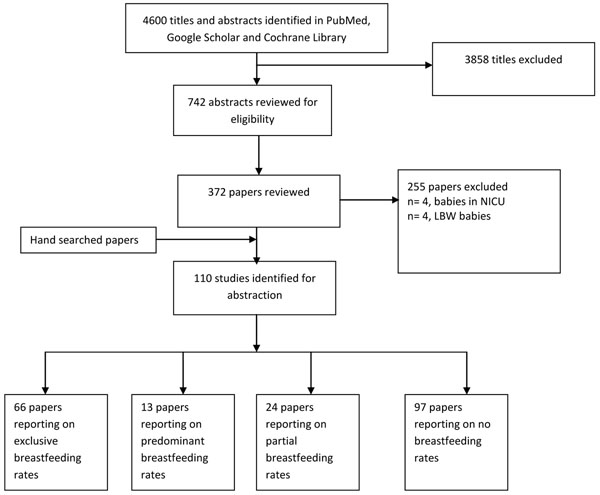
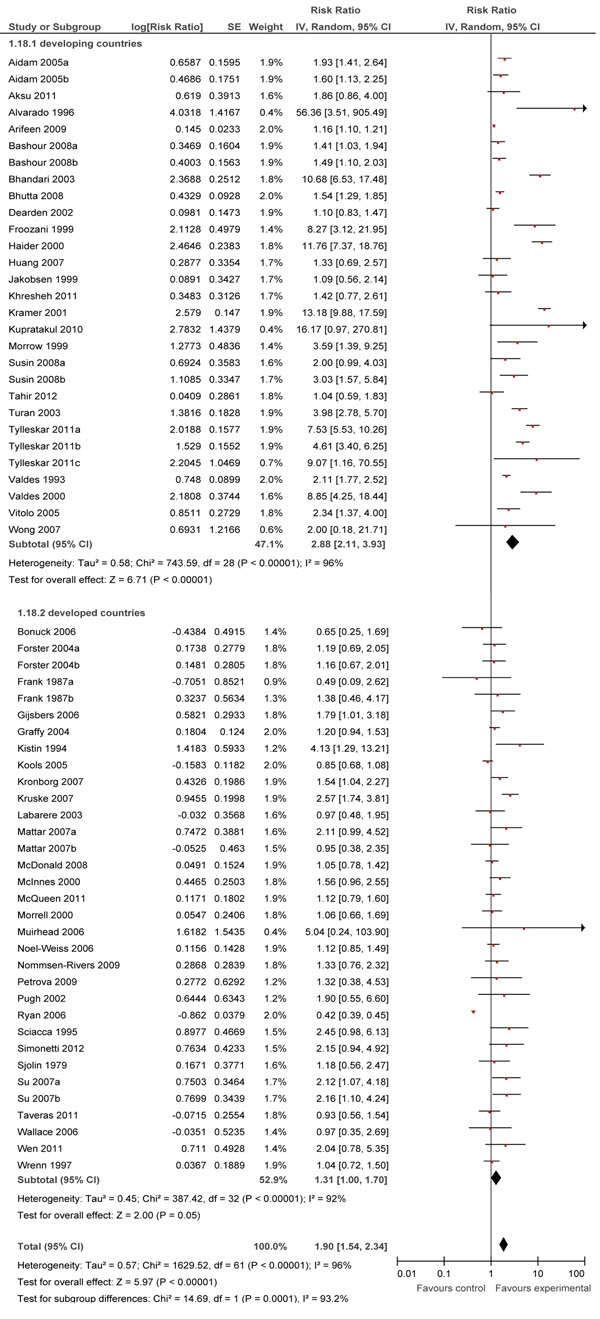
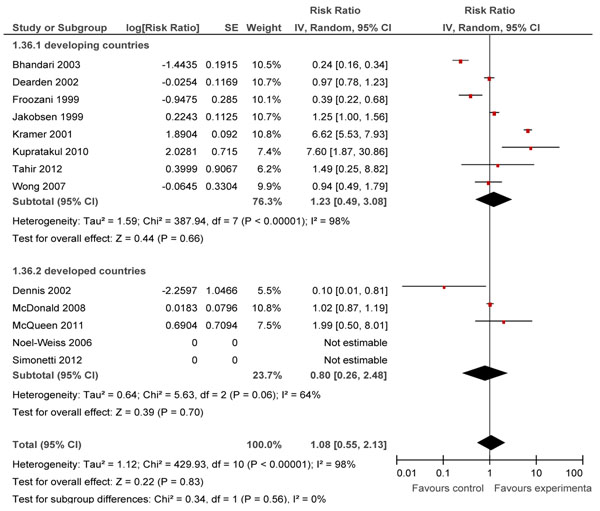
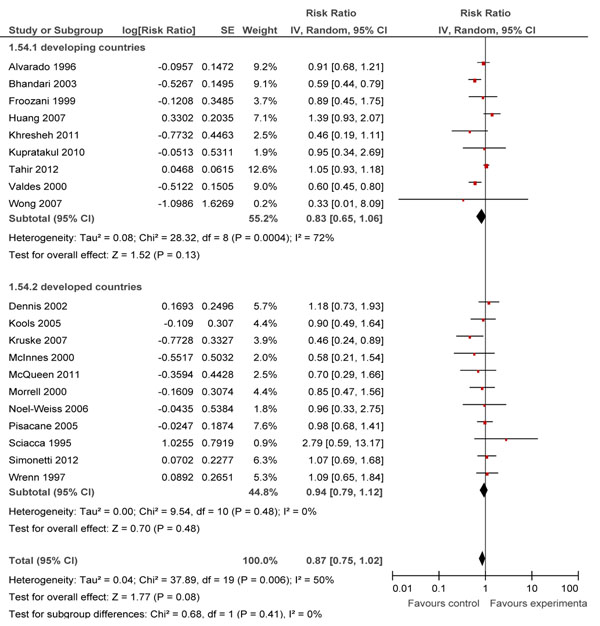
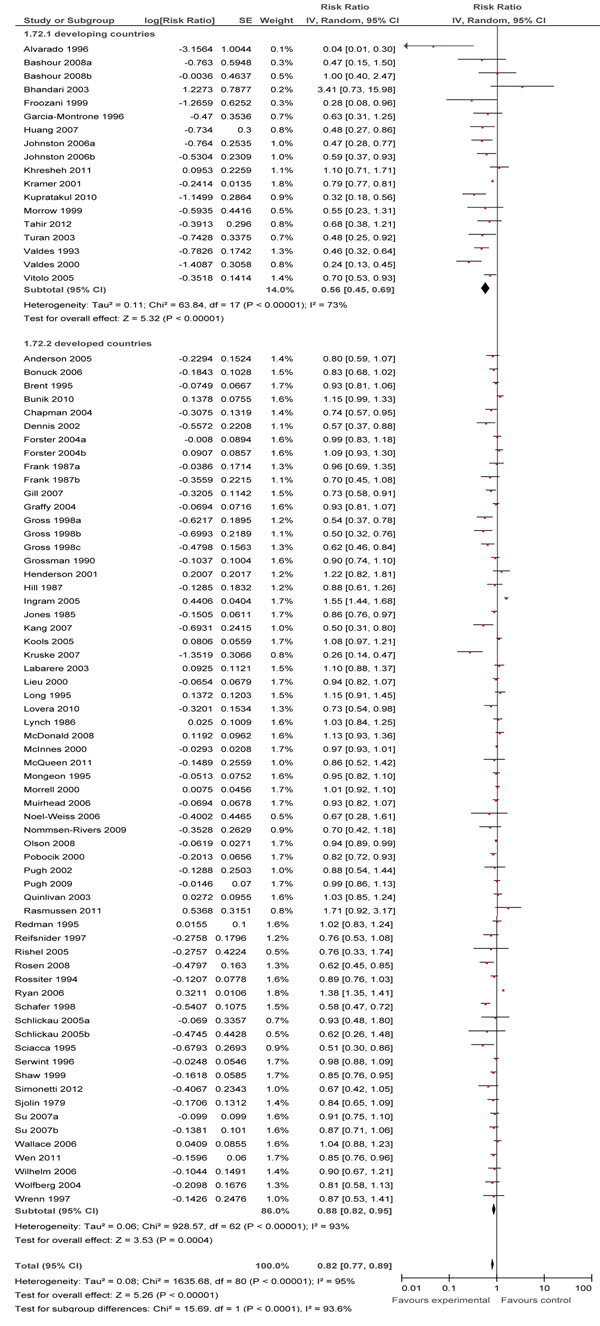
INTRODUCTION: Exclusive Breastfeeding (EBF) rates remain low in both low-income and high-income countries despite World Health Organization recommendations for EBF till 6 months. Breastfeeding has been shown to have a protective effect against gastrointestinal infections, among other benefits. Large-scale interventions focusing on educating mothers about breastfeeding have the potential to increase breastfeeding prevalence, especially EBF, up to recommended standards and also to decrease infant morbidity. METHODS: A systematic literature search was conducted for RCTs and quasi-experimental studies comparing breastfeeding education or support to routine care. The effect of interventions was observed for exclusive, predominant, partial and no breastfeeding rates. The time intervals of interest were day 1, <1 month, and 1 to 5 months. Outcome-specific evidence was graded according to the Child Health Epidemiology Reference Group (CHERG) rules using the adapted Grading of Recommendations, Assessment, Development and Evaluation (GRADE) criteria and recommendations were made from studies in developing countries for inclusion into the Lives Saved Tool (LiST) model. RESULTS: After reviewing 4600 abstracts, 372 studies were selected for full text screening and 110 of these studies were finally included. Statistically significant increases in EBF rates as a result of breastfeeding promotion interventions were observed: 43% at day 1, 30% at <1 month, and 90% at 1-5 months. Rates of 'no breastfeeding' reduced by 32% at 1 day, 30% at <1 month, and 18% at 1-5 months. The effect of interventions on the rates of predominant and partial breastfeeding were non-significant. CONCLUSION: Breastfeeding education and/or support increased EBF rates and decreased no breastfeeding rates at birth, <1 month and 1-5 months. Combined individual and group counseling appeared to be superior to individual or group counseling alone. Interventions in developing countries had a greater impact than those in developed countries.
Overview
The claims and statistics of this paper haven’t been checked yet.
Free: it reads the open-access text and checks the first 5 claims that cite a source we can check. Create a free account to check every claim.
Integrity signals
Registry
Cites
Statistics
Figures
Verification
Claims the paper makes
The claims and statistics of this paper haven’t been checked yet.
Free: it reads the open-access text and checks the first 5 claims that cite a source we can check. Create a free account to check every claim.
Claims other papers make about this one
Each is checked against this paper’s own text: does it say what the citing paper says it does?
The source backs part of the claim, not all of it — or backs it for a different population, condition or comparison.
In the citing paper
“According to systematic reviews and meta-analyses, breastfeeding support interventions that focus on prenatal/antenatal education and continuous long-term care reinforce the intention of women to breastfeed antenatally; such interventions are supportive of the duration and exclusivity of breastfeeding, and are characterized as effective [9,10,11,12,13,14,15,16,17].”
From Association between Breastfeeding Duration and Long-Term Midwifery-Led Support and Psychosocial Support: Outcomes from a Greek Non-Randomized Controlled Perinatal Health Intervention (2021) · cites this paper as [16]
Experimental — accuracy not yet measured
Self-check
Percentages, sums and reported differences re-computed from the paper’s own numbers.
The self-check needs the paper’s full text.
Citations
Cites
Grading quality of evidence and strength of recommendations
(2004) · BMJ · doi:10.1136/bmj.328.7454.1490 · Cited by 8,477 · cited 1×
“according to the CHERG adaptation of the GRADE technique [27].”
MethodKramer, M. S., Chalmers, B., Hodnett, E. D., Sevkovskaya, Z., Dzikovich, I., Shapiro, S., Collet, J.-P., Vanilovich, I., Mezen, I., Ducruet, T., et al. (2001) · JAMA · doi:10.1001/jama.285.4.413 · Cited by 1,534
Breastfeeding and the risk for diarrhea morbidity and mortality
Lamberti, L. M., Fischer Walker, C. L., Noiman, A., Victora, C., & Black, R. E. (2011) · BMC Public Health · doi:10.1186/1471-2458-11-s3-s15 · Cited by 657
Variables Associated With Breastfeeding Duration
Thulier, D., & Mercer, J. (2009) · Journal of Obstetric, Gynecologic & Neonatal Nursing · doi:10.1111/j.1552-6909.2009.01021.x · Cited by 606
Kumar, V., Mohanty, S., Kumar, A., Misra, R. P., Santosham, M., Awasthi, S., Baqui, A. H., Singh, P., Singh, V., Ahuja, R. C., et al. (2008) · The Lancet · doi:10.1016/s0140-6736(08)61483-x · Cited by 498
Morrow, A. L., Guerrero, M. L., Shults, J., Calva, J. J., Lutter, C., Bravo, J., Ruiz-Palacios, G., Morrow, R. C., & Butterfoss, F. D. (1999) · The Lancet · doi:10.1016/s0140-6736(98)08037-4 · Cited by 414
Haider, R., Ashworth, A., Kabir, I., & Huttly, S. R. (2000) · The Lancet · doi:10.1016/s0140-6736(00)03159-7 · Cited by 396
Dennis, C., HODNETT, E. D., Gallop, R., & CHALMERS, B. E. (2002) · PubMed Central · Cited by 383
Bhandari, N., Bahl, R., Mazumdar, S., Martines, J., Black, R. E., & Bhan, M. K. (2003) · The Lancet · doi:10.1016/s0140-6736(03)13134-0 · Cited by 376
Global trends in exclusive breastfeeding
Cai, X., Wardlaw, T., & Brown, D. W. (2012) · International Breastfeeding Journal · doi:10.1186/1746-4358-7-12 · Cited by 362
Research works printed but not linked: 7
- UNICEF A Report Card on Nutrition: Number 4 2006
- WHO UNICEF Integrated management of childhood illness: chartbook and training course 1995 Geneva: World Health Organization PMC2557738 10593034
- RevMan The Cochrane Colloboration. Review Manager (RevMan) 5 for Windows 2003 Oxford, England
- WHO Indicators for assessing breastfeeding practices 1991 91 WHO Geneva, Switzerland: WHO Document WHO/CDD/SER 14
- WHO Indicators for Assessing Infant and Young Child Feeding Practices: Conclusions of a Consensus Meeting Held 6-8 November 2007 in Washington DC, USA 2008 World Health Organization (WHO)
- Langer A Intrapartum Social Support and Exclusive Breastfeeding in Mexico. Wellstart International, Expanded Promotion of Breastfeeding Program Exclusive Breastfeeding Promotion: A Summary of Findings from EPB's Applied Research Program (1992-1996) 1996
- Wrenn SE Effects of a model-based intervention on breastfeeding attrition [dissertation] 1997 San Antonio: University of Texas
Cited by
Items 401–458 of 458
Periasami, V., Muthu, V., Sakkarai, E. V., Ayyavoo, A. M., & Jayachandan, G. (2017) · International Journal of Contemporary Pediatrics · doi:10.18203/2349-3291.ijcp20171713
“At present, globally only 38% of the infants are exclusively breastfed.(2) and alarmingly nearly 800,000 infant deaths occur due to sub optimal breast feeding.”
BackgroundBreast-Feeding Friendly, but Not Formula Averse
Lewis, J. (2017) · Pediatric Annals · doi:10.3928/19382359-20171019-01 · Cited by 1
A randomized controlled trial of an antenatal intervention to increase exclusive breastfeeding
Cheung, K.-L. W. (2014) · The HKU Scholars Hub (University of Hong Kong) · doi:10.5353/th_b5351044
“In addition, reviews examining interventions given during both the antenatal and postpartum periods suggest that combining individual and group counseling are more effective than individual or group counseling alone [206].”
BackgroundVargas, P. T. (2018) · IntechOpen eBooks · doi:10.5772/intechopen.80383
“Individual counseling and peer counseling are effective, but group counseling also improves rates of exclusive breastfeeding, and a combination of these approaches appears to be particularly effective [19].”
BackgroundThe Story of “KINDNESS” From Rural Alaska: A Model for Comprehensive Infant Feeding Support
Preece, H., & Hawn, C. (2019) · Clinical Lactation · doi:10.1891/2158-0782.10.4.164
Beliefs of Pregnant Women in Qom City about Exclusive Breastfeeding until 6 Months of Age, Iran
Rahimi, T., Dehdari, T., Shojaei, S., Hashemi, B. S., Akbari, Z., & Daryafti, H. (2016) · DOAJ (DOAJ: Directory of Open Access Journals) · Cited by 1
Breastfeeding as A Method of Health Promotion
Phillips, K. F. (2019) · Lupine Online Journal of Nursing & Health care · doi:10.32474/lojnhc.2019.02.000134
“Establishing and maintaining practices that offer education and support are critical in improving breastfeeding rates [28].”
BackgroundEffect of breastfeeding promotions interventions on baby weight at three months of age
Krithika, S., Adarsh, E., & Rajanish, K. V. (2020) · International Journal of Contemporary Pediatrics · doi:10.18203/2349-3291.ijcp20202517
“Large-scale interventions focusing on educating mothers about breastfeeding have the potential to increase breastfeeding prevalence, especially EBF, up to recommended standards and also to decrease infant morbidity.(10)”
BackgroundBertram, N., Püschner, F., Binder, S., Schliffke, M., Göhl, M., & Petersen, C. (2020) · Springer eBooks · doi:10.1007/978-3-658-29015-3_16
Gandomi, Z., Sharifzadeh, G., & Norozi, E. (2021) · Modern Care Journal · doi:10.5812/modernc.113757 · Cited by 1
“from 26% in 2000 - 2005 to 42% in 2006 - 2011 in 48 countries of the world; however, this value provides lower estimates compared to the standard recommended by the WHO to cover 90% of countries (9).”
Successful Breast-Feeding Following a Level II NICU Stay In Qatar – A Prospective StudyPreprint
Viswanathan, B., Al-Bedaywi, R. R. R., Tomerak, A., & Abedin, S. (2021) · Research Square · doi:10.21203/rs.3.rs-557719/v1
Ismainar, H., Hayana, H., & Marlina, H. (2021) · Jurnal Pengabdian Kesehatan Komunitas · doi:10.25311/jpkk.vol1.iss2.968
Kelas Laktasi untuk Sukseskan ASI Eksklusif melalui NYUPIT (Penyuluhan dan Pijat Oksitosin)
Prafitri, L. D., Zuhana, N., & Ersila, W. (2021) · Abdi Geomedisains · doi:10.23917/abdigeomedisains.v2i1.292
Selected Topics on Infant Feeding
Al-Zwaini, I. J., & AL-Musawi, H. H. (2022) · IntechOpen eBooks · doi:10.5772/intechopen.98106
Parra, F. I. A. (2020) · Repositorio Institucional (Pontificia Universidad Javeriana) · doi:10.11144/javeriana.10554.49101
11 Muttermilch im wirtschaftlichen Kontext
Pokhrel, S. (2018) · The Global Health Network eBooks · doi:10.21428/3d48c34a.124ab001
2 Muttermilch, weltweite Gesundheit und nachhaltige Entwicklung
Greenslade, L. (2018) · The Global Health Network eBooks · doi:10.21428/3d48c34a.fc618a55
Jain, S., Kushwaha, A. S., & Marwaha, V. (2022) · IntechOpen eBooks · doi:10.5772/intechopen.104297
Successful breastfeeding following a level II NICU stay in Qatar – a longitudinal study
Viswanathan, B., Al-Bedaywi, R. R. R., Tomerak, A., Abedin, S., & Chandra, P. (2022) · International Breastfeeding Journal · doi:10.1186/s13006-022-00513-5 · Cited by 4
“found that breastfeeding education and / or support increased exclusive breastfeeding rates and decreased the rate of no breastfeeding at birth, < 1 month and 1–5 months [32].”
BackgroundVanzele, P. A. R. (2023) · Digital Library of Theses and Dissertations (Universidade de São Paulo) · doi:10.11606/d.9.2023.tde-15032023-143429 · Cited by 1
Flores-Quispe, M. D. P., Duro, S. M. S., Facchini, L. A., Barros, N. B. R., & Tomasi, E. (2024) · Ciência & Saúde Coletiva · doi:10.1590/1413-81232024291.09192022 · Cited by 4
Shafi, K., Nawab, F., Jabeen, R., & Jmalvi, W. (2019) · JMMC · doi:10.62118/jmmc.v7i2.14
“These results are comparable with other studies conducted locally and internationally 16&17 .”
ResultThe Effects of Antenatal Education on Level of Exclusive Breastfeeding in the First Two Months
Gökçeoğlu, S., Koruk, İ., & BEYAZ, E. (2024) · Clinical and Experimental Health Sciences · doi:10.33808/clinexphealthsci.1065762 · Cited by 2
The benefits of exclusive breastfeeding: a comprehensive literature review
Muhammad, N. (2024) · i-manager’s Journal on Nursing · doi:10.26634/jnur.13.4.20156 · Cited by 3
Emilda, E., Asmanidar, A., Veri, N., & Laila, A. (2024) · INTERNATIONAL JOURNAL OF HEALTH & MEDICAL RESEARCH · doi:10.58806/ijhmr.2024.v3i06n18 · Cited by 1
da Rocha, N. B., & Moimaz, S. A. S. (2025) · Arquivos Catarinenses de Medicina · doi:10.63845/q6bat777
Breastfeeding, lung development and asthma
Verd, S. (2025) · Expert Review of Respiratory Medicine · doi:10.1080/17476348.2025.2546611
“Numerous investigations have identified effective interventions to prevent early cessation of breastfeeding [20], enabling the development of the most effective strategies to achieve a 150% increase in breastfeeding rates through counseling or support [21].”
Maiti, U., Maroof, K. A., Bhasin, S. K., & Shah, D. (2025) · Journal of Education and Health Promotion · doi:10.4103/jehp.jehp_1853_24
The cost-effectiveness of education and support group interventions aimed at promoting breastfeeding
Mavranezouli, I., Rajesh, S., Deshpande, S., Swanson, V., Wright, C. M., Ross, S., Sibson, V. L., McLean, K., Kambo, A., Fisher, S., et al. (2025) · European Journal of Public Health · doi:10.1093/eurpub/ckaf172
Kyulu, T. M., Ngure, K., & Mutai, J. K. (2025) · International Journal of Community Medicine and Public Health · doi:10.18203/2394-6040.ijcmph20253230
Camacho, E. M., & Reyes, K. A. (2025) · BMC Pregnancy and Childbirth · doi:10.1186/s12884-025-08405-2 · Cited by 1
“Many interventions to promote breastfeeding are targeted at the individual level, with evidence suggesting that education [6], support [6, 35], improving mothers’ breastfeeding self-efficacy [36], or a combination of strategies [8] are associated with positive breastfeeding outcomes.”
Kelcey, B., Cunningham, K., & Frongillo, E. A. (2026) · Journal of Nutrition · doi:10.1016/j.tjnut.2026.101657
Buckland, C., Hector, D., Kolt, G. S., Fahey, P., & Arora, A. (2020) · Figshare · doi:10.6084/m9.figshare.13310800
Buckland, C., Hector, D., Kolt, G. S., Fahey, P., & Arora, A. (2020) · Figshare · doi:10.6084/m9.figshare.13310803
Buckland, C., Hector, D., Kolt, G. S., Fahey, P., & Arora, A. (2020) · Figshare · doi:10.6084/m9.figshare.13310806
Mavranezouli, I., Varley‐Campbell, J., Stockton, S., Francis, J., Macdonald, C., Sharma, S., Fleming, P., Punter, E., Barry, C., Kallioinen, M., et al. (2022) · Figshare · doi:10.6084/m9.figshare.18864901
Viswanathan, B., Al-Bedaywi, R. R. R., Tomerak, A., Abedin, S., & Chandra, P. (2022) · Figshare · doi:10.6084/m9.figshare.21522149
Mavranezouli, I., Varley‐Campbell, J., Stockton, S., Francis, J., Macdonald, C., Sharma, S., Fleming, P., Punter, E., Barry, C., Kallioinen, M., et al. (2022) · Figshare · doi:10.6084/m9.figshare.18864907
Buckland, C., Hector, D., Kolt, G. S., Fahey, P., & Arora, A. (2020) · Figshare · doi:10.6084/m9.figshare.13310797
Rodríguez-Gallego, I., Leon-Larios, F., Ruiz-Ferrón, C., & Lomas-Campos, M.-D.-L.-M. (2020) · Figshare · doi:10.6084/m9.figshare.12672516
Titaley, C. R., Dibley, M. J., Ariawan, I., Mu’asyaroh, A., Alam, A., Damayanti, R., Do, T. T., Ferguson, E., Htet, K., Li, M., et al. (2021) · Figshare · doi:10.6084/m9.figshare.13612730
Huang, X., Yang, B., Liu, Q., Zhang, R., Tang, S., & Story, M. (2020) · Figshare · doi:10.6084/m9.figshare.13323898
Titaley, C. R., Dibley, M. J., Ariawan, I., Mu’asyaroh, A., Alam, A., Damayanti, R., Do, T. T., Ferguson, E., Htet, K., Li, M., et al. (2021) · Figshare · doi:10.6084/m9.figshare.13612727
Buckland, C., Hector, D., Kolt, G. S., Fahey, P., & Arora, A. (2020) · Figshare · doi:10.6084/m9.figshare.13310809
Winters, S., Martinez, S., & Johannsen, J. (2024) · Figshare · doi:10.6084/m9.figshare.26702818
Mavranezouli, I., Varley‐Campbell, J., Stockton, S., Francis, J., Macdonald, C., Sharma, S., Fleming, P., Punter, E., Barry, C., Kallioinen, M., et al. (2022) · Figshare · doi:10.6084/m9.figshare.18864904
Buckland, C., Hector, D., Kolt, G. S., Fahey, P., & Arora, A. (2020) · Figshare · doi:10.6084/m9.figshare.13310812
Viswanathan, B., Al-Bedaywi, R. R. R., Tomerak, A., Abedin, S., & Chandra, P. (2022) · Figshare · doi:10.6084/m9.figshare.21522152
Evaluation of early oral stimulation by sweeping method to enhance breastfeeding in term neonates
Sabu, M. A., Sravya, C., & Soans, S. (2026) · Karnataka Pediatric Journal · doi:10.25259/kpj_47_2025
Morrin, S. T., Buck, R. H., & Hill, D. R. (2026) · Frontiers in Pediatrics · doi:10.3389/fped.2026.1765159
Bodunde, I. O., Adebayo, M. O., Abiola, O. F., & Olatunji, T.-J. (2026) · Journal of Human Lactation · doi:10.1177/08903344261434528
Gubran, A. N. M., Ali, N. T., Abdurabu, A. N., Mohammed, A. N. A., Al-Khuraibi, A. Y., Ghaleb, A. M., Al-Ghazaly, A. O., Mubarak, H. K. A., Mohsen, H. A., Shamlan, K. A., et al. (2026) · Research Square · doi:10.21203/rs.3.rs-10328221/v1
Purohit, H., Bhatt, G. S., Patel, N., Prajapati, S., & Mehariya, V. M. (2026) · Breastfeeding Medicine · doi:10.1177/15568253261473721 · Cited by 1
“22 There was a very high level of heterogeneity ( I 2 > 90”
Kaur, D., Kumar, R., & Kochar, I. S. (2026) · Journal of Human Lactation · doi:10.1177/08903344261461891
Eagen‐Torkko, M. K. (2015) · Deep Blue (University of Michigan) · doi:10.13140/rg.2.2.32574.08007 · Cited by 2
Metadata
- Authors
- Haroon, S., Das, J. K., Salam, R. A., Imdad, A., & Bhutta, Z. A.
- Affiliations
- Aga Khan University (PK)
- Corresponding author
- Bhutta, Zulfiqar A
- Venue
- BMC Public Health
- Published
- 2013-09
- Volume
- 13
- Issue
- S3
- Pages
- S20-S20
- ISSN
- 1471-2458 (ISSN-L)
- PMC
- PMC3847366
- OpenAlex
- W2095348857
- Semantic Scholar
- 77fc4446053efe8f97f6782255f6ff7fe255bba7
- Cited by
- 460
- References
- 123
- Citations by year
- 2026: 8 · 2025: 16 · 2024: 25 · 2023: 27 · 2022: 30 · 2021: 59 · 2020: 44 · 2019: 45 · 2018: 62 · 2017: 45 · 2016: 44 · 2015: 36 · 2014: 14 · 2013: 5
- FWCI
- 3.91
- Type
- journal article
- Language
- en
- Open access
- gold
- doi.org
- Licence
- cc-by
- Locations
- BMC Public Health (publishedVersion, cc-by)
- Europe PMC (PubMed Central) (publishedVersion, cc-by)
- PubMed Central (publishedVersion, cc-by)
- PubMed (publishedVersion)
- Funders
- Bill and Melinda Gates Foundation
- Topics
- Health Sciences › Medicine › Epidemiology › Breastfeeding Practices and Influences
- Health Sciences › Nursing › Nutrition and Dietetics › Infant Nutrition and Health
- Health Sciences › Medicine › Pediatrics, Perinatology and Child Health › Global Maternal and Child Health
- Keywords
- breastfeeding promotion, exclusive breastfeeding, breastfeeding education, breastfeeding support, infant feeding practices, breastfeeding counseling, Lives Saved Tool, infant morbidity, developing countries, low-income countries
- MeSH terms
- Breast Feeding, Developing Countries, Female, Health Promotion, Humans, Infant, Infant Nutritional Physiological Phenomena, Maternal Behavior, Mothers, World Health Organization, Randomized Controlled Trials as Topic, Developed Countries
About these checks
Registry, retraction, Cites and statistics results are computed, not judged, with one exception: a printed reference that no index lists is read once by a model before it counts as a citation error. Claims are extracted by a model and kept only when their quote appears verbatim in the text; each cited source is then checked, with a model’s help, for whether it says what the claim relies on. Those verdicts can be wrong — read the claim’s quote and the cited source before relying on one.
Statistics and arithmetic are recomputed, not judged.
Confidence bands are shown only for fields calibrated on our annotated test set. None is calibrated yet, so no band is shown.
What counts as a claim ›How we measure confidence ›How we check this ›
Are you an author, or do you see a problem with this page? Request a review
Data sources
Bibliographic data: Semantic Scholar, OpenAlex, Crossref.
Contains information from the Semantic Scholar Academic Graph Datasets, made available under the ODC Attribution License (ODC-BY 1.0).
Semantic Scholar’s data is described in: Kinney, R., et al. (2023). The Semantic Scholar Open Data Platform. arXiv:2301.10140.
