

Participants' perspective on maintaining behaviour change: a qualitative study within the European Diabetes Prevention Study
Open accessThe DOI matches its Crossref record; 29 of the 29 references it cites were found in a registry or an index.
Abstract
BACKGROUND: The European Diabetes Prevention Study (EDIPS) is an RCT of diet and exercise interventions in people with impaired glucose tolerance. We undertook a qualitative study, nested within the EDIPS in Newcastle-upon-Tyne, UK, aiming to understand the experience of participants who maintained behaviour change, in order to inform future interventions. METHODS: Participants were purposively sampled, according to success criteria for diet and physical activity change maintenance, and invited to attend individual semi-structured interviews. Fifteen participants completed an interview and reflected on their experience over three to five years. We used the Framework method to analyse the transcribed data. RESULTS: Main themes were identified as factors that help (props) and those that hinder (burdens) behaviour change maintenance at different organisational levels: individual (both physical and psychological), social and environmental. Pre-existing physical conditions (such as arthritis) and social demands (such as caring for an ageing relative) hindered, whereas the benefits of becoming fitter and of having social and professional support helped, participants in maintaining behaviour change. Participants' long term experiences highlighted the salience of the continuous change in their physical, social and environmental conditions over time. CONCLUSION: The construct of props and burdens facilitates a holistic view of participants' behaviour. Efforts to encourage behaviour change maintenance should take account of context and the way this changes over time, and should include strategies to address these issues. The experience of participants who maintain behaviour change highlights the challenges for the wider implementation of diabetes prevention strategies. TRIAL REGISTRATION: (ISRCTN 15670600).
Overview
The claims and statistics of this paper haven’t been checked yet.
Free: it reads the open-access text and checks the first 5 claims that cite a source we can check. Create a free account to check every claim.
Integrity signals
Registry
Cites
Statistics
Figures
Verification
Claims the paper makes
The claims and statistics of this paper haven’t been checked yet.
Free: it reads the open-access text and checks the first 5 claims that cite a source we can check. Create a free account to check every claim.
Claims other papers make about this one
Each is checked against this paper’s own text: does it say what the citing paper says it does?
The source backs part of the claim, not all of it — or backs it for a different population, condition or comparison.
In the citing paper
“Social support has also been associated with greater levels of PA ( 93 , 190 , 215 ), supporting the role of social networks in the spread of obesity ( 41 ).”
From Exercise and Type 2 Diabetes (2010) · cites this paper as [215]
Experimental — accuracy not yet measured
Self-check
Percentages, sums and reported differences re-computed from the paper’s own numbers.
The self-check needs the paper’s full text.
Citations
Cites
Reduction in the incidence of type 2 diabetes with lifestyle intervention or metformin
(2002) · New England Journal of Medicine · doi:10.1056/nejmoa012512 · Cited by 19,011 · cited 1×
“Impaired glucose tolerance (IGT) is considered to be a stage in the development of type 2 diabetes and studies have shown that progression to diabetes can be prevented or delayed by changes in the lifestyles of those at risk [9-12].”
BackgroundTuomilehto, J., Lindström, J., Eriksson, J. G., Valle, T. T., Hämäläinen, H., Ilanne-Parikka, P., Keinänen-Kiukaanniemi, S., Laakso, M., Louheranta, A., Rastas, M., et al. (2001) · New England Journal of Medicine · doi:10.1056/nejm200105033441801 · Cited by 10,873 · cited 1×
“Impaired glucose tolerance (IGT) is considered to be a stage in the development of type 2 diabetes and studies have shown that progression to diabetes can be prevented or delayed by changes in the lifestyles of those at risk [ 9-12 ].”
BackgroundQualitative research practice: a guide for social science students and researchers
(2003) · Choice Reviews Online · doi:10.5860/choice.41-1319 · Cited by 10,543
Health Promotion by Social Cognitive Means
Bandura, A. (2004) · Health Education & Behavior · doi:10.1177/1090198104263660 · Cited by 7,238 · cited 1×
“Social cognitive theory acknowledges the importance of the environment and the social circumstances of an individual, and the effects these have on individual values in a triadic reciprocality described by Bandura as reciprocal determinism [28].”
BackgroundDoing Qualitative Research: A Practical Handbook
Silverman, D. J. (1999) · Cited by 7,134
Pan, X.-R., Li, G.-W., Hu, Y.-H., Wang, J.-X., Yang, W.-Y., An, Z.-X., Hu, Z.-X., Juan-Lin, Xiao, J.-Z., Cao, H.-B., et al. (1997) · Diabetes Care · doi:10.2337/diacare.20.4.537 · Cited by 4,320 · cited 1×
“Impaired glucose tolerance (IGT) is considered to be a stage in the development of type 2 diabetes and studies have shown that progression to diabetes can be prevented or delayed by changes in the lifestyles of those at risk [ 9-12 ].”
BackgroundFramework for design and evaluation of complex interventions to improve health
Campbell, M. (2000) · BMJ · doi:10.1136/bmj.321.7262.694 · Cited by 3,474 · cited 1×
“A staged approach to the development and evaluation of complex interventions has been promoted [1-3].”
BackgroundEvidence for prescribing exercise as therapy in chronic disease
Pedersen, B. K., & Saltin, B. (2006) · Scandinavian Journal of Medicine & Science in Sports · doi:10.1111/j.1600-0838.2006.00520.x · Cited by 1,384
S UCCESSFUL W EIGHT L OSS M AINTENANCE
Wing, R. R., & Hill, J. O. (2001) · Annual Review of Nutrition · doi:10.1146/annurev.nutr.21.1.323 · Cited by 1,382 · cited 1×
“Earlier qualitative studies relating to the management of diet and exercise in people with diabetes have used a realist approach where the interview data is used to access people's beliefs[19].”
BackgroundNoar, S. M., & Zimmerman, R. S. (2005) · Health Education Research · doi:10.1093/her/cyg113 · Cited by 793
Evaluating health promotion—progress, problems and solutions
Nutbeam, D. (1998) · Health Promotion International · doi:10.1093/heapro/13.1.27 · Cited by 671
[The Da Qing IGT and Diabetes study].
Ayame, H. (2005) · PubMed · Cited by 658
Eriksson, J., Lindström, J., Valle, T., Aunola, S., Hämäläinen, H., Ilanne-Parikka, P., Keinänen-Kiukaanniemi, S., Laakso, M., Lauhkonen, M., Lehto, P., et al. (1999) · Diabetologia · doi:10.1007/s001250051229 · Cited by 368 · cited 1×
“The European Diabetes Prevention Study (EDIPS) extends the DPS to different European populations and uses the same study design which has been described in detail [13].”
MethodMarteau, T. M., & Weinman, J. (2006) · Social Science & Medicine · doi:10.1016/j.socscimed.2005.08.005 · Cited by 285 · cited 2×
“However the diagnosis of IGT was viewed by participants as both a risk and a reassurance (i.e. not diabetes yet), and therefore this diagnosis may contribute to different aspects of perceived controllability as described in Leventhal's self-regulation theory (sometimes called the Common Sense Model) [31].”
BackgroundMoffatt, S., White, M., Mackintosh, J., & Howel, D. (2006) · BMC Health Services Research · doi:10.1186/1472-6963-6-28 · Cited by 239
Self-citationA National Service Framework for diabetes
Davies, M. J. (2001) · The British Journal of Diabetes · doi:10.1177/14746514010010021101 · Cited by 119
The challenge to provide evidence in health promotion
Nutbeam, D. (1999) · Health Promotion International · doi:10.1093/heapro/14.2.99 · Cited by 115
Patterns of diet related self-care in diabetes
Maclean, H. M. (1991) · Social Science & Medicine · doi:10.1016/0277-9536(91)90148-6 · Cited by 105 · cited 1×
“In some studies researchers have sought an explanation for compliance or non compliance with the advised regime in order to identify modifiable factors affecting these outcomes [ 20 ].”
BackgroundDoes Weight Loss Maintenance Become Easier Over Time?
Klem, M. L., Wing, R. R., Lang, W., McGuire, M. T., & Hill, J. O. (2000) · Obesity Research · doi:10.1038/oby.2000.54 · Cited by 103 · cited 1×
“These behavioural strategies were expected from the literature [18,29].”
MethodN UTRITION AND P REVENTION OF T YPE 2 D IABETES
Costacou, T., & Mayer-Davis, E. J. (2003) · Annual Review of Nutrition · doi:10.1146/annurev.nutr.23.011702.073027 · Cited by 99 · cited 1×
“The prevalence of type 2 diabetes is increasing and there are causal links with obesity,[5] diet[6] and lack of exercise [7].”
BackgroundTaking the Biscuit? A Discursive Approach to Managing Diet in Type 2 Diabetes
Peel, E., Parry, O., Douglas, M., & Lawton, J. (2005) · Journal of Health Psychology · doi:10.1177/1359105305057313 · Cited by 76 · cited 1×
“More recently, in qualitative studies of health issues, there has been much interest in considering the dialogue within interviews from a discursive psychological perspective [21].”
BackgroundEmpirical Phenomenology - An Approach for Qualitative Research
Aspers, P. (2004) · Alexandria (UniSG) (University of St.Gallen) · Cited by 50
Schüz, B. (2007) · Universitätsbibliothek der FU Berlin Hochschulschriftenstelle u. Dokumentenserver · doi:10.17169/refubium-14578 · Cited by 48
Wiedemann, A. U. (2009) · Universitätsbibliothek der FU Berlin Hochschulschriftenstelle u. Dokumentenserver · doi:10.17169/refubium-5491 · Cited by 38
Diet and lifestyle in type 2 diabetes: the patient's perspective
Frandsen, K. B., & Kristensen, J. (2002) · Practical Diabetes · doi:10.1002/pdi.327 · Cited by 34 · cited 1×
“The dimensions of achieving and maintaining lifestyle change are complex, including social, psychological [15] and educational [16] aspects.”
BackgroundJepson, R. G., Harris, F., MacGillivray, S. A., Kearney, N., & Rowa‐Dewar, N. (2006) · Stirling Online Research Repository (University of Stirling) · Cited by 31
Treating obesity: A qualitative evaluation of a lifestyle intervention for weight reduction
Adolfsson, B., Carlson, A., Undén, A., & Rössner, S. (2002) · Health Education Journal · doi:10.1177/001789690206100306 · Cited by 20
The four levels of health promotion: An integrated approach
Kelly, M. P., Charlton, B. G., & Hanlon, P. (1993) · Public Health · doi:10.1016/s0033-3506(05)80123-4 · Cited by 11 · cited 2×
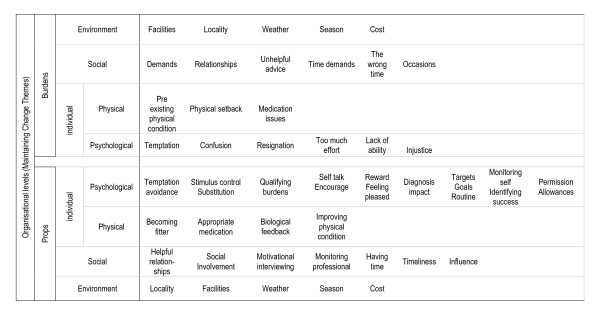
“Figure 1 summarises the props and burdens we identified and shows these in organisational levels in line with health promotion theory [26].”
MethodResultThe Effect of Exercise and Diet on Glucose Intolerance and Substrate Utilization?
Astrup, A. V. (2004) · KARGER eBooks · doi:10.1159/000080647 · Cited by 1 · cited 1×
“The prevalence of type 2 diabetes is increasing and there are causal links with obesity,[5] diet[6] and lack of exercise [7].”
Background
Research works printed but not linked: 4
- Penn Linda White Martin Interventions to prevent or delay the onset of type 2 diabetes in people with impaired glucose tolerance BMJ Health Intelligence, Public Health 2008
- David Taylor Michael Bury Natasha Campling Sarah Carter Sara Garfied Jenny Newbould Rennie T Health D A Review of the use of the Health Belief Model (HBM), the Theory of Reasoned Action (TRA), the Theory of Planned Behaviour (TPB) and the Trans-Theoretical Model (TTM) to study and predict health related behaviour change. DOH (UK) NICE guidance 2006 Department of Health
- QSR International Pty Ltd NVivo qualitative data analysis software; Version 7 2006 PR9 OPA, QSR International Pty Ltd
- Dalgren G Whitehead M Policies and strategies to promote social equity in health 1991 Stockholm, Institute of Futures Studies
Cited by
Colberg, S. R., Sigal, R. J., Fernhall, B., Regensteiner, J. G., Blissmer, B. J., Rubin, R. R., Chasan-Taber, L., Albright, A. L., & Braun, B. (2010) · Diabetes Care · doi:10.2337/dc10-9990 · Cited by 1,955
“Social support has also been associated with greater levels of PA (93, 190,215), supporting the role of social networks in the spread of obesity (41).”
(2010) · Medicine & Science in Sports & Exercise · doi:10.1249/mss.0b013e3181eeb61c · Cited by 567
“Social support has also been associated with greater levels of PA (93,190,215), supporting the role of social networks in the spread of obesity (41).”
The Handbook of Behavior Change
(2020) · Cambridge University Press eBooks · doi:10.1017/9781108677318 · Cited by 407
Hemmingsen, B., Gimenez-Perez, G., Mauricio, D., Roqué i Figuls, M., Metzendorf, M.-I., & Richter, B. (2017) · Cochrane Database of Systematic Reviews · doi:10.1002/14651858.cd003054.pub4 · Cited by 316
Changing Behavior Using the Theory of Planned Behavior
Ajzen, I., & Schmidt, P. (2020) · The Handbook of Behavior Change · doi:10.1017/9781108677318.002 · Cited by 266
Metadata
- Authors
- Penn, L., Moffatt, S. M., & White, M.
- Affiliations
- Newcastle University (GB)
- Corresponding author
- Penn, Linda
- Venue
- BMC Public Health
- Published
- 2008-07-10
- Volume
- 8
- Issue
- 1
- Pages
- 235-235
- ISSN
- 1471-2458 (ISSN-L)
- PMC
- PMC2491611
- OpenAlex
- W2026170963
- Cited by
- 117
- References
- 29
- Citations by year
- 2026: 1 · 2025: 3 · 2024: 1 · 2023: 3 · 2022: 3 · 2021: 5 · 2020: 52 · 2019: 3 · 2018: 3 · 2017: 8 · 2016: 2 · 2015: 1 · 2014: 8 · 2013: 9 · 2012: 3
- FWCI
- 5.16
- Type
- journal article
- Language
- en
- Open access
- gold
- doi.org
- Licence
- cc-by
- creativecommons.org/licenses/by/2.0 (tdm)
- Locations
- BMC Public Health (publishedVersion, cc-by)
- PubMed Central (publishedVersion, cc-by)
- PubMed (publishedVersion)
- DOAJ (DOAJ: Directory of Open Access Journals) (submittedVersion)
- Apollo (University of Cambridge) (submittedVersion, cc-by)
- Apollo (cc-by)
- Funders
- Wellcome Trust
- Economic and Social Research Council (ES/G007470/1)
- Topics
- Social Sciences › Psychology › Applied Psychology › Behavioral Health and Interventions
- Health Sciences › Medicine › Endocrinology, Diabetes and Metabolism › Diabetes Management and Education
- Health Sciences › Medicine › Public Health, Environmental and Occupational Health › Physical Activity and Health
- Keywords
- behavior maintenance, diabetes prevention, impaired glucose tolerance, diet and exercise intervention, participant experiences, social support, physical activity, social needs, environmental context
- MeSH terms
- Aged, Behavior Therapy, Diabetes Mellitus, Europe, Female, Humans, Interviews as Topic, Male, Middle Aged, Social Environment, Health Behavior, Exercise, Glucose Intolerance, Qualitative Research
About these checks
Registry, retraction, Cites and statistics results are computed, not judged, with one exception: a printed reference that no index lists is read once by a model before it counts as a citation error. Claims are extracted by a model and kept only when their quote appears verbatim in the text; each cited source is then checked, with a model’s help, for whether it says what the claim relies on. Those verdicts can be wrong — read the claim’s quote and the cited source before relying on one.
Statistics and arithmetic are recomputed, not judged.
Confidence bands are shown only for fields calibrated on our annotated test set. None is calibrated yet, so no band is shown.
What counts as a claim ›How we measure confidence ›How we check this ›
Are you an author, or do you see a problem with this page? Request a review
Data sources
Bibliographic data: Semantic Scholar, OpenAlex, Crossref.
Contains information from the Semantic Scholar Academic Graph Datasets, made available under the ODC Attribution License (ODC-BY 1.0).
Semantic Scholar’s data is described in: Kinney, R., et al. (2023). The Semantic Scholar Open Data Platform. arXiv:2301.10140.
