

Participants' perspective on maintaining behaviour change: a qualitative study within the European Diabetes Prevention Study
Open accessThe DOI matches its Crossref record; 29 of the 29 references it cites were found in a registry or an index.
Abstract
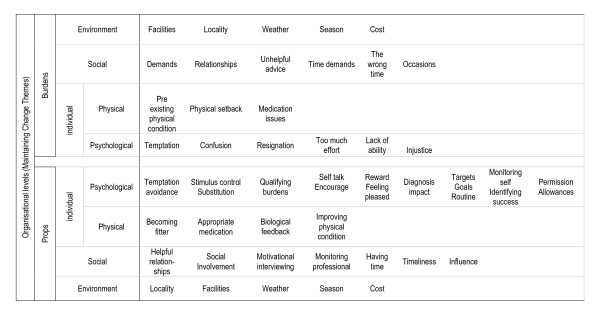
BACKGROUND: The European Diabetes Prevention Study (EDIPS) is an RCT of diet and exercise interventions in people with impaired glucose tolerance. We undertook a qualitative study, nested within the EDIPS in Newcastle-upon-Tyne, UK, aiming to understand the experience of participants who maintained behaviour change, in order to inform future interventions. METHODS: Participants were purposively sampled, according to success criteria for diet and physical activity change maintenance, and invited to attend individual semi-structured interviews. Fifteen participants completed an interview and reflected on their experience over three to five years. We used the Framework method to analyse the transcribed data. RESULTS: Main themes were identified as factors that help (props) and those that hinder (burdens) behaviour change maintenance at different organisational levels: individual (both physical and psychological), social and environmental. Pre-existing physical conditions (such as arthritis) and social demands (such as caring for an ageing relative) hindered, whereas the benefits of becoming fitter and of having social and professional support helped, participants in maintaining behaviour change. Participants' long term experiences highlighted the salience of the continuous change in their physical, social and environmental conditions over time. CONCLUSION: The construct of props and burdens facilitates a holistic view of participants' behaviour. Efforts to encourage behaviour change maintenance should take account of context and the way this changes over time, and should include strategies to address these issues. The experience of participants who maintain behaviour change highlights the challenges for the wider implementation of diabetes prevention strategies. TRIAL REGISTRATION: (ISRCTN 15670600).
Overview
The claims and statistics of this paper haven’t been checked yet.
Free: it reads the open-access text and checks the first 5 claims that cite a source we can check. Create a free account to check every claim.
Integrity signals
Registry
Cites
Statistics
Figures
Verification
Claims the paper makes
The claims and statistics of this paper haven’t been checked yet.
Free: it reads the open-access text and checks the first 5 claims that cite a source we can check. Create a free account to check every claim.
Claims other papers make about this one
Each is checked against this paper’s own text: does it say what the citing paper says it does?
The source backs part of the claim, not all of it — or backs it for a different population, condition or comparison.
In the citing paper
“Social support has also been associated with greater levels of PA ( 93 , 190 , 215 ), supporting the role of social networks in the spread of obesity ( 41 ).”
From Exercise and Type 2 Diabetes (2010) · cites this paper as [215]
Experimental — accuracy not yet measured
Self-check
Percentages, sums and reported differences re-computed from the paper’s own numbers.
The self-check needs the paper’s full text.
Citations
Cites
Reduction in the incidence of type 2 diabetes with lifestyle intervention or metformin
(2002) · New England Journal of Medicine · doi:10.1056/nejmoa012512 · Cited by 19,011 · cited 1×
“Impaired glucose tolerance (IGT) is considered to be a stage in the development of type 2 diabetes and studies have shown that progression to diabetes can be prevented or delayed by changes in the lifestyles of those at risk [9-12].”
BackgroundTuomilehto, J., Lindström, J., Eriksson, J. G., Valle, T. T., Hämäläinen, H., Ilanne-Parikka, P., Keinänen-Kiukaanniemi, S., Laakso, M., Louheranta, A., Rastas, M., et al. (2001) · New England Journal of Medicine · doi:10.1056/nejm200105033441801 · Cited by 10,873 · cited 1×
“Impaired glucose tolerance (IGT) is considered to be a stage in the development of type 2 diabetes and studies have shown that progression to diabetes can be prevented or delayed by changes in the lifestyles of those at risk [ 9-12 ].”
BackgroundQualitative research practice: a guide for social science students and researchers
(2003) · Choice Reviews Online · doi:10.5860/choice.41-1319 · Cited by 10,543
Health Promotion by Social Cognitive Means
Bandura, A. (2004) · Health Education & Behavior · doi:10.1177/1090198104263660 · Cited by 7,238 · cited 1×
“Social cognitive theory acknowledges the importance of the environment and the social circumstances of an individual, and the effects these have on individual values in a triadic reciprocality described by Bandura as reciprocal determinism [28].”
BackgroundDoing Qualitative Research: A Practical Handbook
Silverman, D. J. (1999) · Cited by 7,134
Pan, X.-R., Li, G.-W., Hu, Y.-H., Wang, J.-X., Yang, W.-Y., An, Z.-X., Hu, Z.-X., Juan-Lin, Xiao, J.-Z., Cao, H.-B., et al. (1997) · Diabetes Care · doi:10.2337/diacare.20.4.537 · Cited by 4,320 · cited 1×
“Impaired glucose tolerance (IGT) is considered to be a stage in the development of type 2 diabetes and studies have shown that progression to diabetes can be prevented or delayed by changes in the lifestyles of those at risk [ 9-12 ].”
BackgroundFramework for design and evaluation of complex interventions to improve health
Campbell, M. (2000) · BMJ · doi:10.1136/bmj.321.7262.694 · Cited by 3,474 · cited 1×
“A staged approach to the development and evaluation of complex interventions has been promoted [1-3].”
BackgroundEvidence for prescribing exercise as therapy in chronic disease
Pedersen, B. K., & Saltin, B. (2006) · Scandinavian Journal of Medicine & Science in Sports · doi:10.1111/j.1600-0838.2006.00520.x · Cited by 1,384
S UCCESSFUL W EIGHT L OSS M AINTENANCE
Wing, R. R., & Hill, J. O. (2001) · Annual Review of Nutrition · doi:10.1146/annurev.nutr.21.1.323 · Cited by 1,382 · cited 1×
“Earlier qualitative studies relating to the management of diet and exercise in people with diabetes have used a realist approach where the interview data is used to access people's beliefs[19].”
BackgroundNoar, S. M., & Zimmerman, R. S. (2005) · Health Education Research · doi:10.1093/her/cyg113 · Cited by 793
Research works printed but not linked: 4
- Penn Linda White Martin Interventions to prevent or delay the onset of type 2 diabetes in people with impaired glucose tolerance BMJ Health Intelligence, Public Health 2008
- David Taylor Michael Bury Natasha Campling Sarah Carter Sara Garfied Jenny Newbould Rennie T Health D A Review of the use of the Health Belief Model (HBM), the Theory of Reasoned Action (TRA), the Theory of Planned Behaviour (TPB) and the Trans-Theoretical Model (TTM) to study and predict health related behaviour change. DOH (UK) NICE guidance 2006 Department of Health
- QSR International Pty Ltd NVivo qualitative data analysis software; Version 7 2006 PR9 OPA, QSR International Pty Ltd
- Dalgren G Whitehead M Policies and strategies to promote social equity in health 1991 Stockholm, Institute of Futures Studies
Cited by
Colberg, S. R., Sigal, R. J., Fernhall, B., Regensteiner, J. G., Blissmer, B. J., Rubin, R. R., Chasan-Taber, L., Albright, A. L., & Braun, B. (2010) · Diabetes Care · doi:10.2337/dc10-9990 · Cited by 1,955
“Social support has also been associated with greater levels of PA (93, 190,215), supporting the role of social networks in the spread of obesity (41).”
(2010) · Medicine & Science in Sports & Exercise · doi:10.1249/mss.0b013e3181eeb61c · Cited by 567
“Social support has also been associated with greater levels of PA (93,190,215), supporting the role of social networks in the spread of obesity (41).”
The Handbook of Behavior Change
(2020) · Cambridge University Press eBooks · doi:10.1017/9781108677318 · Cited by 407
Hemmingsen, B., Gimenez-Perez, G., Mauricio, D., Roqué i Figuls, M., Metzendorf, M.-I., & Richter, B. (2017) · Cochrane Database of Systematic Reviews · doi:10.1002/14651858.cd003054.pub4 · Cited by 316
Changing Behavior Using the Theory of Planned Behavior
Ajzen, I., & Schmidt, P. (2020) · The Handbook of Behavior Change · doi:10.1017/9781108677318.002 · Cited by 266
Demark-Wahnefried, W., Morey, M. C., Sloane, R., Snyder, D. C., Miller, P. E., Hartman, T. J., & Cohen, H. J. (2012) · Journal of Clinical Oncology · doi:10.1200/jco.2011.40.0895 · Cited by 225
O’Cathain, A., Thomas, K. J., Drabble, S. J., Rudolph, A., Goode, J., & Hewison, J. (2014) · Health Technology Assessment · doi:10.3310/hta18380 · Cited by 159
Penn, L., White, M., Oldroyd, J., Walker, M., Alberti, K. G. M., & Mathers, J. C. (2009) · BMC Public Health · doi:10.1186/1471-2458-9-342 · Cited by 153
“one year or three years) and with reference to the findings of our qualitative study linked to this trial[20].”
BackgroundResultSelf-citationChanging Behavior Using the Model of Action Phases
Keller, L., Gollwitzer, P. M., & Sheeran, P. (2020) · The Handbook of Behavior Change · doi:10.1017/9781108677318.006 · Cited by 147
Factors influencing the ability to self-manage diabetes for adults living with type 1 or 2 diabetes
Wilkinson, A., Whitehead, L., & Ritchie, L. (2014) · International Journal of Nursing Studies · doi:10.1016/j.ijnurstu.2013.01.006 · Cited by 140
Penn, L., White, M., Lindström, J., den Boer, A. T., Blaak, E., Eriksson, J. G., Feskens, E., Ilanne-Parikka, P., Keinänen-Kiukaanniemi, S. M., Walker, M., et al. (2013) · PLoS ONE · doi:10.1371/journal.pone.0057143 · Cited by 140
Self-citationLie, M. L. S., Hayes, L., Lewis‐Barned, N. J., May, C., White, M., & Bell, R. (2013) · Diabetic Medicine · doi:10.1111/dme.12206 · Cited by 117
Self-citationChanging Behavior Using the Health Action Process Approach
Schwarzer, R., & Hamilton, K. (2020) · The Handbook of Behavior Change · doi:10.1017/9781108677318.007 · Cited by 102
Skoglund, G., Nilsson, B. B., Olsen, C. F., Bergland, A., & Hilde, G. (2022) · BMC Public Health · doi:10.1186/s12889-022-12885-8 · Cited by 137
“Being able to identify oneself as a person with an active lifestyle and the desire to be a good role model for one’s children were facilitators for lifestyle change [38, 40, 47, 49].”
BackgroundInfluentialPhysical Activity Adoption to Adherence, Lapse, and Dropout: A Self-Determination Theory Perspective
Kinnafick, F.-E., Thøgersen-Ntoumani, C., & Duda, J. L. (2014) · Qualitative Health Research · doi:10.1177/1049732314528811 · Cited by 101
Lifestyle Changes After a Diagnosis of Type 2 Diabetes
Chong, S., Ding, D., Byun, R., Comino, E. J., Bauman, A. E., & Jalaludin, B. B. (2017) · Diabetes Spectrum · doi:10.2337/ds15-0044 · Cited by 121
“Continuing support to develop self-motivational strategies is also important so that healthy lifestyle changes can become lifelong behaviors (18).”
BackgroundInfluentialTierney, S., Mamas, M., Skelton, D., Woods, S., Rutter, M. K., Gibson, M., Neyses, L., & Deaton, C. (2011) · Health Psychology · doi:10.1037/a0022848 · Cited by 94
Röhr, S., Pabst, A., Baber, R., Engel, C., Glaesmer, H., Hinz, A., Schroeter, M. L., Witte, A. V., Zeynalova, S., Villringer, A., et al. (2022) · Scientific Reports · doi:10.1038/s41598-022-16771-6 · Cited by 92
Hsueh, W., McLellan, K., Wyne, K., & Villagomez, E. (2014) · Therapeutics and Clinical Risk Management · doi:10.2147/tcrm.s39564 · Cited by 91
Vaidya, A., & Krettek, A. (2014) · International Journal of Behavioral Nutrition and Physical Activity · doi:10.1186/1479-5868-11-39 · Cited by 103
“, arthritis) or social demands [62].”
What influences physical activity in people with heart failure? A qualitative study
Tierney, S., Elwers, H., Sange, C., Mamas, M., Rutter, M. K., Gibson, M., Neyses, L., & Deaton, C. (2011) · International Journal of Nursing Studies · doi:10.1016/j.ijnurstu.2011.03.003 · Cited by 85
Vanstone, M. G., Giacomini, M. K., Smith, A. L., Brundisini, F. K., DeJean, D., & Winsor, S. (2013) · Europe PMC (PubMed Central) · Cited by 111
Changing Behavior Using Social Cognitive Theory
Łuszczyńska, A., & Schwarzer, R. (2020) · Cambridge University Press eBooks · doi:10.1017/9781108677318.003 · Cited by 105
Gardner, B., Rebar, A. L., & Lally, P. J. (2020) · Cambridge University Press eBooks · doi:10.1017/9781108677318.041 · Cited by 82
Peel, E., Douglas, M. J., Parry, O., & Lawton, J. (2010) · British Journal of General Practice · doi:10.3399/bjgp10x515061 · Cited by 81
“Nonetheless, the longitudinal follow-up of participants in these studies was either limited to 9 months,(7) or retrospective.(8) While qualitative studies ‘nested within’ RCTs(14) are clearly valuable, the experiences (and potentially motivation) of participants recruited to RCTs may differ from those undergoing routi…”
Barriers and facilitators to physical activity among urban residents with diabetes in Nepal
Kadariya, S., & Aro, A. R. (2018) · PLoS ONE · doi:10.1371/journal.pone.0199329 · Cited by 64
Penn, L., Dombrowski, S. U., Sniehotta, F. F., & White, M. (2013) · BMJ Open · doi:10.1136/bmjopen-2013-002949 · Cited by 55
“Interviews were completed by 15 participants and lasted between 45 min and 1 h.10 We developed the topic guide based on relevant qualitative research within the European Diabetes Prevention Study.19 20 As in our previous work, we allowed flexibility within the topic guide for participants to follow their own train of…”
MethodSelf-citationWarner, L. M., & French, D. (2020) · Cambridge University Press eBooks · doi:10.1017/9781108677318.032 · Cited by 79
Lifestyle Counseling for Type 2 Diabetes Risk Reduction in Dutch Primary Care
Vermunt, P. W. A., Milder, I. E. J., Wielaard, F., de Vries, J. H. M., van Oers, H. A. M., & Westert, G. P. (2011) · Diabetes Care · doi:10.2337/dc10-2293 · Cited by 52
“In line with this hypothesis, lack of family support was found to be a barrier for both achieving (6) and maintaining (23) behavioral change in interventions for type 2 diabetes prevention.”
BackgroundChanging Behavior Using Ecological Models
Salmon, J., Hesketh, K. D., Arundell, L., Downing, K. L., & Biddle, S. (2020) · Cambridge University Press eBooks · doi:10.1017/9781108677318.017 · Cited by 90
Changing Behavior Using Self-Determination Theory
Hagger, M. S., Hankonen, N. E., Chatzisarantis, N. L. D., & Ryan, R. M. (2020) · Cambridge University Press eBooks · doi:10.1017/9781108677318.008 · Cited by 87
Vanstone, M., Rewegan, A., Brundisini, F., Giacomini, M., Kandasamy, S., & DeJean, D. (2017) · Chronic Illness · doi:10.1177/1742395316675024 · Cited by 48
Pilkington, K., Loef, M., & Polley, M. (2017) · Journal of Medical Internet Research · doi:10.2196/jmir.6431 · Cited by 43
“Also qualitative study and follow-up Intensive behavioral interventions to promote dietary modification and increased physical activity (group sessions plus signposting to community physical activities) EDIPS (European Diabetes Prevention Study)-Newcastle [51-53]”
Kinnafick, F., Thøgersen‐Ntoumani, C., Duda, J. L., & Taylor, I. M. (2013) · Psychology of sport and exercise · doi:10.1016/j.psychsport.2013.10.009 · Cited by 65
Change in Physical Activity after a Diabetes Diagnosis: Opportunity for Intervention
Schneider, K. L., Andrews, C., Hovey, K. M., Seguin‐Fowler, R. A., Manini, T. M., LaMonte, M. J., Margolis, K. L., Waring, M. E., Ning, Y., Sims, S. T., et al. (2013) · Medicine & Science in Sports & Exercise · doi:10.1249/mss.0b013e3182a33010 · Cited by 48
“A qualitative study of individuals with impaired glucose tolerance who participated in a diabetes prevention lifestyle intervention trial and maintained improvements in lifestyle behaviors, mentioned that their impaired glucose tolerance diagnosis was a strong motivating factor for behavior change.(41) The best strate…”
Planning and Implementation Intention Interventions
Rhodes, R. E., Grant, S. J., & de Bruijn, G. (2020) · Cambridge University Press eBooks · doi:10.1017/9781108677318.039 · Cited by 49
Attitudes and Persuasive Communication Interventions
Hamilton, K., & Johnson, B. T. (2020) · Cambridge University Press eBooks · doi:10.1017/9781108677318.031 · Cited by 61
Vermunt, P. W. A., Milder, I. E. J., Wielaard, F., Baan, C. A., Schelfhout, J. D. M., Westert, G. P., & van Oers, H. (2012) · BMC Family Practice · doi:10.1186/1471-2296-13-79 · Cited by 54
Changing Behavior: A Theory- and Evidence-Based Approach
Hagger, M. S., Cameron, L. D., Hamilton, K., Hankonen, N. E., & Lintunen, T. (2020) · Cambridge University Press eBooks · doi:10.1017/9781108677318.001 · Cited by 63
Changing Behavior Using Integrated Theories
Hagger, M. S., & Hamilton, K. (2020) · Cambridge University Press eBooks · doi:10.1017/9781108677318.015 · Cited by 51
Changing Behavior Using Habit Theory
Orbell, S., & Verplanken, B. (2020) · Cambridge University Press eBooks · doi:10.1017/9781108677318.013 · Cited by 66
Korkiakangas, E. E., Taanila, A. M., & Keinanen-Kiukaanniemi, S. M. (2010) · Health & Social Care in the Community · doi:10.1111/j.1365-2524.2010.00942.x · Cited by 61
Tarrant, M., Haslam, C., Carter, M., Calitri, R., & Haslam, S. A. (2020) · Cambridge University Press eBooks · doi:10.1017/9781108677318.044 · Cited by 43
Rodrigues, A., Haste, A., Penn, L., Bell, R., Summerbell, C., White, M., Adamson, A., & Sniehotta, F. F. (2020) · BMC Health Services Research · doi:10.1186/s12913-020-05160-2 · Cited by 35
Self-citationPrevalence of obesity and overweight among type 2 diabetic patients in Bisha, Saudi Arabia
AlShahrani, M. S. (2021) · Journal of Family Medicine and Primary Care · doi:10.4103/jfmpc.jfmpc_1349_20 · Cited by 39
“reported the diagnosis as a motivational factor for participants to exercise and follow a healthy diet.[29] Findings by Chong et al.”
BackgroundChanging Behavior Using the Health Belief Model and Protection Motivation Theory
Orbell, S., Zahid, H., & Henderson, C. J. (2020) · Cambridge University Press eBooks · doi:10.1017/9781108677318.004 · Cited by 40
Changing Behavior Using the Transtheoretical Model
DiClemente, C. C., & Graydon, M. M. (2020) · Cambridge University Press eBooks · doi:10.1017/9781108677318.010 · Cited by 38
Gillison, F., Greaves, C., Stathi, A., Ramsay, R., Bennett, P., Taylor, G., Francis, M., & Chandler, R. (2012) · British Journal of Health Psychology · doi:10.1111/j.2044-8287.2011.02040.x · Cited by 32
Penn, L., Ryan, V., & White, M. (2013) · BMJ Open · doi:10.1136/bmjopen-2013-003585 · Cited by 36
“Intervention design built on research evidence for T2D prevention including the Finnish DPS12 and EDIPSNewcastle.26 27 The intervention was developed in accordance with the UK National Social Marketing Centre benchmark criteria,29 designed for adults living in socioeconomically disadvantaged areas, and intended to be…”
MethodInfluentialSelf-citationVermunt, P. W. A., Milder, I. E. J., Wielaard, F., Baan, C. A., Schelfhout, J. D. M., Westert, G. P., & van Oers, H. (2013) · BMC Family Practice · doi:10.1186/1471-2296-14-78 · Cited by 37
“Conclusions A better insight into the process of behavior change can contribute to better adapted and potentially more effective interventions for diabetes prevention [9-11].”
BackgroundSommerlad, A., Manela, M., Cooper, C., Rapaport, P., & Livingston, G. (2014) · BMJ Open · doi:10.1136/bmjopen-2014-005273 · Cited by 29
“These have included breastfeeding support interventions,(12) CBT self-management of IBS(13) and maintaining healthy behaviour change.(14) This approach has not, to the best of our knowledge, been used previously to evaluate complex interventions for dementia carers.”
BackgroundChanging Behavior Using the Reflective-Impulsive Model
Deutsch, R., & Strack, F. (2020) · Cambridge University Press eBooks · doi:10.1017/9781108677318.012 · Cited by 37
Changing Behavior by Changing Environments
Marteau, T. M., Fletcher, P. C., Hollands, G. J., & Munafo, M. R. (2020) · Cambridge University Press eBooks · doi:10.1017/9781108677318.014 · Cited by 35
Increasing intention to cook from basic ingredients: A randomised controlled study
Lavelle, F., Hollywood, L. E., Caraher, M., McGowan, L. J., Spence, M., Surgenor, D., McCloat, A., Mooney, E., Raats, M. M., & Dean, M. (2017) · Appetite · doi:10.1016/j.appet.2017.05.024 · Cited by 30
Sutcliffe, K., Meléndez‐Torres, G. J., Burchett, H., Richardson, M. A., Rees, R. W., & Thomas, J. (2018) · Health Expectations · doi:10.1111/hex.12657 · Cited by 38
Madigan, C. D., Grimmett, C., Sweet, S. N., Daley, A., Kettle, V. E., Phillips, B., & Graham, H. (2024) · International Journal of Behavioral Medicine · doi:10.1007/s12529-024-10335-w · Cited by 32
Developing Behavior Change Interventions
Hankonen, N. E., & Hardeman, W. (2020) · Cambridge University Press eBooks · doi:10.1017/9781108677318.021 · Cited by 38
Makin, H., Chisholm, A., Fallon, V., & Goodwin, L. (2021) · Clinical Obesity · doi:10.1111/cob.12457 · Cited by 35
Design, Implementation, and Evaluation of Behavior Change Interventions: A Ten-Task Guide
Abraham, C., & Denford, S. (2020) · Cambridge University Press eBooks · doi:10.1017/9781108677318.019 · Cited by 36
Rothman, A. J., Klein, W. M. P., & Sheeran, P. (2020) · Cambridge University Press eBooks · doi:10.1017/9781108677318.020 · Cited by 30
Katangwe‐Chigamba, T., Family, H. E., Sokhi, J., Kirkdale, C. L., & Twigg, M. J. (2019) · Research in Social and Administrative Pharmacy · doi:10.1016/j.sapharm.2019.11.001 · Cited by 30
Dyadic Behavior Change Interventions
Scholz, U., Berli, C., Lüscher, J., & Knoll, N. (2020) · Cambridge University Press eBooks · doi:10.1017/9781108677318.043 · Cited by 29
Changing Behavior Using the Common-Sense Model of Self-Regulation
Cameron, L. D., Fleszar‐Pavlović, S. E., & Khachikian, T. (2020) · Cambridge University Press eBooks · doi:10.1017/9781108677318.005 · Cited by 32
The community pharmacy setting for diabetes prevention: Views and perceptions of stakeholders
Katangwe‐Chigamba, T., Family, H. E., Sokhi, J., Al‐Jabr, H., Kirkdale, C. L., & Twigg, M. J. (2019) · PLoS ONE · doi:10.1371/journal.pone.0219686 · Cited by 27
Imagery, Visualization, and Mental Simulation Interventions
Hagger, M. S., & Conroy, D. (2020) · Cambridge University Press eBooks · doi:10.1017/9781108677318.033 · Cited by 25
Bazarganipour, F., Social Determinants of Health Research Center, Y. U. O. M. S., Taghavi, S. A., Fertility and Infertility Research Center, H. U. O. M. S., Allan, H., Centre for Critical Research in Nursing and Midwifery, S. O. H. A. E., Hosseini, N., & Social Determinants of Health Research Center, Y. U. O. M. S. (2017) · International Journal of Reproductive BioMedicine · doi:10.29252/ijrm.15.9.553 · Cited by 21
Varney, J. E., Liew, D., Weiland, T. J., Inder, W. J., & Jelinek, G. A. (2016) · BMC Health Services Research · doi:10.1186/s12913-016-1645-6 · Cited by 21
“Although other telephone coaching trials have observed improved glycaemic control with 12 months of intervention [9, 15–20], and the maintenance literature indicates that the provision of ongoing follow-up and support facilitates the longerterm maintenance of intervention gains [3–12], the true effect of continuously…”
BackgroundKolb, J. M., Kitos, N. R., Ramachandran, A., Lin, J. J., & Mann, D. M. (2014) · Journal of Bioinformatics and Diabetes · doi:10.14302/issn.2374-9431.jbd-13-312 · Cited by 24
Engagement of Stakeholders in the Design, Evaluation, and Implementation of Complex Interventions
Hudson, J. L., Moon, Z., Hughes, L. D., & Moss-Morris, R. E. (2020) · Cambridge University Press eBooks · doi:10.1017/9781108677318.024 · Cited by 29
Colberg, S. R., Sigal, R. J., Fernhall, B., Regensteiner, J. G., Blissmer, B. J., Rubin, R. R., Chasan‐Taber, L., Albright, A. L., & Braun, B. (2010) · Cited by 21
Gneezy, U., Kajackaite, A., & Meier, S. (2020) · Cambridge University Press eBooks · doi:10.1017/9781108677318.036 · Cited by 28
Chong, S., Mazumdar, S., Ding, D., Morgan, G. G., Comino, E. J., Bauman, A. E., & Jalaludin, B. B. (2019) · BMJ Open · doi:10.1136/bmjopen-2019-028947 · Cited by 21
Changing Behavior Using Social Identity Processes
Reynolds, K. J., Branscombe, N. R., Subašić, E., & Willis, L. (2020) · Cambridge University Press eBooks · doi:10.1017/9781108677318.016 · Cited by 24
Ruiter, R. A. C., Crutzen, R., de Leeuw, E., & Kok, G. (2020) · Cambridge University Press eBooks · doi:10.1017/9781108677318.018 · Cited by 22
Aoko, O., Maharaj, T., Boland, F., Cheriyan, D. G., & Ryan, J. D. (2023) · Alimentary Pharmacology & Therapeutics · doi:10.1111/apt.17805 · Cited by 17
“17,18,20 To date, neither lifestyle modification (LM) nor NAFLD-specific medications have been shown to be reliable or effective in the treatment of NAFLD.”
Clark, P. G., Greene, G. W., Blissmer, B. J., Lees, F. D., Riebe, D. A., & Stamm, K. E. (2017) · Journal of Aging and Health · doi:10.1177/0898264317746264 · Cited by 20
Hansen, A. H., Wangberg, S. C., & Årsand, E. (2021) · BMC Health Services Research · doi:10.1186/s12913-021-06660-5 · Cited by 11
“Receiving a diagnosis of diabetes or other chronic disease including an encouragement of lifestyle changes might be a motivator, however, motivation might fade with time [25, 26].”
BackgroundWalker, C. F., Hernan, A. L., Reddy, P., & Dunbar, J. (2012) · BMC Health Services Research · doi:10.1186/1472-6963-12-460 · Cited by 16
“[24] we undertook a qualitative evaluation going beyond the program itself to examine context [25].”
MethodResultWebb, T. L., & de Bruin, M. (2020) · Cambridge University Press eBooks · doi:10.1017/9781108677318.037 · Cited by 17
Gopalan, A., Blatchins, M. A., Xu, K. K., Altschuler, A., Marshall, C. J., Hessler, D. M., Fernandez, A., & Grant, R. W. (2022) · The Journal of the American Board of Family Medicine · doi:10.3122/jabfm.2022.02.210223 · Cited by 12
Critical and Qualitative Approaches to Behavior Change
Chamberlain, K., & Lyons, A. C. (2020) · Cambridge University Press eBooks · doi:10.1017/9781108677318.030 · Cited by 16
Personnel and Participant Experiences of a Residential Weight-Loss Program. A Qualitative Study
Dahl, U., Rise, M. B., Kulseng, B. E., & Steinsbekk, A. (2014) · PLoS ONE · doi:10.1371/journal.pone.0100226 · Cited by 19
“In addition, moderate changes and the experience of success can motivate persons with obesity to maintain lifestyle changes [46].”
BackgroundWang, Z., Shi, Q., Zeng, Y., & Li, Y. (2023) · Journal of Clinical Nursing · doi:10.1111/jocn.16713 · Cited by 17
Maximizing User Engagement with Behavior Change Interventions
Yardley, L., Morrison, L. G., Müller, I., & Bradbury, K. J. (2020) · Cambridge University Press eBooks · doi:10.1017/9781108677318.025 · Cited by 13
The Science of Behavior Change: The Road Ahead
Hagger, M. S., Cameron, L. D., Hamilton, K., Hankonen, N. E., & Lintunen, T. (2020) · Cambridge University Press eBooks · doi:10.1017/9781108677318.046 · Cited by 16
Postgraduate education needs of Nurses’ who are caregivers for patients with diabetes
Uğur, E., Demir, H. G., & Akbal, E. (2015) · Pakistan Journal of Medical Sciences · doi:10.12669/pjms.313.6732 · Cited by 16
Autonomy-Supportive Interventions
Reeve, J., & Cheon, S. H. (2020) · Cambridge University Press eBooks · doi:10.1017/9781108677318.035 · Cited by 15
de Ridder, D. T. D., Gillebaart, M., & Friese, M. (2020) · Cambridge University Press eBooks · doi:10.1017/9781108677318.040 · Cited by 11
Implementation Science and Translation in Behavior Change
Łuszczyńska, A., Łobczowska, K., & Horodyska, K. (2020) · Cambridge University Press eBooks · doi:10.1017/9781108677318.023 · Cited by 13
Epton, T., & Armitage, C. J. (2020) · Cambridge University Press eBooks · doi:10.1017/9781108677318.038 · Cited by 8
Patients' Perspectives About Dietary Maintenance in Type 2 Diabetes
Gutschall, M. D., Onega, L. L., & Wright, W. K. (2011) · Topics in Clinical Nutrition · doi:10.1097/tin.0b013e3182260d69 · Cited by 8
Evaluation of Behavior Change Interventions
Matthews, L., & Simpson, S. A. (2020) · Cambridge University Press eBooks · doi:10.1017/9781108677318.022 · Cited by 10
Zou, Z., Zeng, J., Ren, T., Shi, Y., Yang, R., & Fan, J. (2021) · Journal of Clinical and Translational Hepatology · doi:10.14218/jcth.2020.00183 · Cited by 7
Motivational Interviewing Interventions
Berman, A. H., Beckman, M., & Lindqvist, H. (2020) · Cambridge University Press eBooks · doi:10.1017/9781108677318.045 · Cited by 14
Economic and Behavioral Economic Approaches to Behavior Change
Brown, P. M., Cameron, L. D., Wilkinson, M., & Taylor, D. (2020) · Cambridge University Press eBooks · doi:10.1017/9781108677318.042 · Cited by 10
Changing Behavior Using Integrative Self-Control Theory
Hofmann, W., Dohle, S., & Diel, K. (2020) · Cambridge University Press eBooks · doi:10.1017/9781108677318.011 · Cited by 8
Conner, M. T., Williams, D. M., & Rhodes, R. E. (2020) · Cambridge University Press eBooks · doi:10.1017/9781108677318.034 · Cited by 8
Addressing Underserved Populations and Disparities in Behavior Change
Schüz, B., & Hooper, M. W. (2020) · Cambridge University Press eBooks · doi:10.1017/9781108677318.027 · Cited by 8
Chen, J., Lin, Z., Lei, Y., Wang, Q., Tang, L., & Cheng, H. (2025) · International Journal of Nursing Studies · doi:10.1016/j.ijnurstu.2025.105156 · Cited by 5
Changing Behavior in the Digital Age
Kavanagh, D. J. (2020) · Cambridge University Press eBooks · doi:10.1017/9781108677318.029 · Cited by 20
Metadata
- Authors
- Penn, L., Moffatt, S. M., & White, M.
- Affiliations
- Newcastle University (GB)
- Corresponding author
- Penn, Linda
- Venue
- BMC Public Health
- Published
- 2008-07-10
- Volume
- 8
- Issue
- 1
- Pages
- 235-235
- ISSN
- 1471-2458 (ISSN-L)
- PMC
- PMC2491611
- OpenAlex
- W2026170963
- Cited by
- 117
- References
- 29
- Citations by year
- 2026: 1 · 2025: 3 · 2024: 1 · 2023: 3 · 2022: 3 · 2021: 5 · 2020: 52 · 2019: 3 · 2018: 3 · 2017: 8 · 2016: 2 · 2015: 1 · 2014: 8 · 2013: 9 · 2012: 3
- FWCI
- 5.16
- Type
- journal article
- Language
- en
- Open access
- gold
- doi.org
- Licence
- cc-by
- creativecommons.org/licenses/by/2.0 (tdm)
- Locations
- BMC Public Health (publishedVersion, cc-by)
- PubMed Central (publishedVersion, cc-by)
- PubMed (publishedVersion)
- DOAJ (DOAJ: Directory of Open Access Journals) (submittedVersion)
- Apollo (University of Cambridge) (submittedVersion, cc-by)
- Apollo (cc-by)
- Funders
- Wellcome Trust
- Economic and Social Research Council (ES/G007470/1)
- Topics
- Social Sciences › Psychology › Applied Psychology › Behavioral Health and Interventions
- Health Sciences › Medicine › Endocrinology, Diabetes and Metabolism › Diabetes Management and Education
- Health Sciences › Medicine › Public Health, Environmental and Occupational Health › Physical Activity and Health
- Keywords
- behavior maintenance, diabetes prevention, impaired glucose tolerance, diet and exercise intervention, participant experiences, social support, physical activity, social needs, environmental context
- MeSH terms
- Aged, Behavior Therapy, Diabetes Mellitus, Europe, Female, Humans, Interviews as Topic, Male, Middle Aged, Social Environment, Health Behavior, Exercise, Glucose Intolerance, Qualitative Research
About these checks
Registry, retraction, Cites and statistics results are computed, not judged, with one exception: a printed reference that no index lists is read once by a model before it counts as a citation error. Claims are extracted by a model and kept only when their quote appears verbatim in the text; each cited source is then checked, with a model’s help, for whether it says what the claim relies on. Those verdicts can be wrong — read the claim’s quote and the cited source before relying on one.
Statistics and arithmetic are recomputed, not judged.
Confidence bands are shown only for fields calibrated on our annotated test set. None is calibrated yet, so no band is shown.
What counts as a claim ›How we measure confidence ›How we check this ›
Are you an author, or do you see a problem with this page? Request a review
Data sources
Bibliographic data: Semantic Scholar, OpenAlex, Crossref.
Contains information from the Semantic Scholar Academic Graph Datasets, made available under the ODC Attribution License (ODC-BY 1.0).
Semantic Scholar’s data is described in: Kinney, R., et al. (2023). The Semantic Scholar Open Data Platform. arXiv:2301.10140.
