

Prevalence of obstructive sleep apnea in Asian adults: a systematic review of the literature
Open accessThe DOI matches its Crossref record; 38 of the 38 references it cites were found in a registry or an index.
Abstract
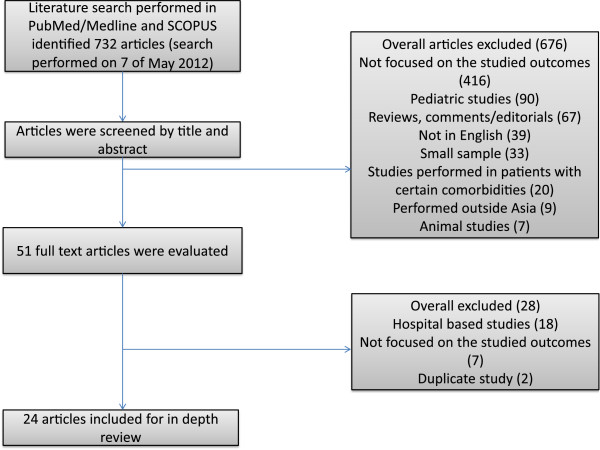
BACKGROUND: Obstructive sleep apnea (OSA) is a common disease, affecting approximately 2% of women and 4% of men residing in Western communities. No systematically reviewed data are available about the prevalence of this disease in Asia, the most heavily populated continent. METHODS: PubMed/Medline, Scopus and Google Scholar were searched for articles published from 1993 to May 2012 that reported the prevalence of OSA diagnosed via sleep monitoring and the prevalence of patients at risk for OSA as assessed by symptomatology and/or sleep questionnaires. We have also searched abstract database of major pulmonary and sleep scientific societies for relevant abstracts presented from 2010 to 2012. The following inclusion criteria were used: articles published in English, age ≥ 18 years, ≥ 100 participants in studies using sleep monitoring for the diagnosis of OSA, ≥ 300 participants in studies using questionnaires to detect patients at high risk for OSA. EXCLUSION CRITERIA: duplicate publications, studies reporting the prevalence of central sleep apnea only, hospital based studies as well as studies assessing OSA prevalence among patients with resistant arterial hypertension, chronic kidney disease, heart failure and in patients with concomitant neurological disease. RESULTS: Twenty four articles were found to meet the inclusion criteria, covering 47,957 subjects (26,042 men and 21,915 women) and four relevant abstracts were noted. OSA prevalence ranged from 3.7% to 97.3%. Male gender, older age, a higher BMI and waist to hip ratio, greater neck circumference, arterial hypertension, smoking, snoring and daytime sleepiness were associated with OSA. Sample size, difference between the populations studied and the fact that some works included patients with a high pre-test probability of OSA explain the difference in prevalence rates. CONCLUSION: This systematic review highlights the lack of data regarding the prevalence of OSA in Asians. Only a few studies provide an approximate estimate of the OSA burden in some Asian communities.
Overview
The claims and statistics of this paper haven’t been checked yet.
Free: it reads the open-access text and checks the first 5 claims that cite a source we can check. Create a free account to check every claim.
Integrity signals
Registry
Cites
Statistics
Figures
Verification
Claims the paper makes
The claims and statistics of this paper haven’t been checked yet.
Free: it reads the open-access text and checks the first 5 claims that cite a source we can check. Create a free account to check every claim.
Claims other papers make about this one
Each is checked against this paper’s own text: does it say what the citing paper says it does?
The cited source says what the claim attributes to it.
In the citing paper
“Neck circumference (NC) or collar size is associated with OSA in adults.184,528–534”
From International Consensus Statement on Obstructive Sleep Apnea (2023) · cites this paper as [531]
Self-check
Percentages, sums and reported differences re-computed from the paper’s own numbers.
The self-check needs the paper’s full text.
Citations
Cites
Preferred Reporting Items for Systematic Reviews and Meta-Analyses: the PRISMA statement
Moher, D., Liberati, A., Tetzlaff, J., Altman, D. G., & for the PRISMA Group (2009) · BMJ · doi:10.1136/bmj.b2535 · Cited by 83,823
Preferred Reporting Items for Systematic Reviews and Meta-Analyses: The PRISMA Statement
Moher, D., Liberati, A., Tetzlaff, J., Altman, D. G., & The PRISMA Group (2009) · PLoS Medicine · doi:10.1371/journal.pmed.1000097 · Cited by 64,042 · cited 1×
“The systematic review was performed according to the key tenets of the PRISMA guidance for systematic reviews [5].”
MethodPreferred reporting items for systematic reviews and meta-analyses: the PRISMA Statement.
(2009) · PubMed Central · Cited by 44,859
Preferred Reporting Items for Systematic Reviews and Meta-Analyses: The PRISMA Statement
Moher, D., Liberati, A., Tetzlaff, J., & Altman, D. G. (2009) · Journal of Clinical Epidemiology · doi:10.1016/j.jclinepi.2009.06.005 · Cited by 19,575
A New Method for Measuring Daytime Sleepiness: The Epworth Sleepiness Scale
Johns, M. W. (1991) · Sleep · doi:10.1093/sleep/14.6.540 · Cited by 17,364 · cited 20×
“Another flaw is that questionnaires such as the ESS cannot rule out other sleep disorders; in fact this scale was primarily invented to detect EDS [3], and not OSA or patients at high risk for OSA.”
BackgroundMethodInfluentialMcNicholas, W. T., Strohl, K. P., White, D. P., Levy, P. A., Schmidt, W., Wheatley, J. R., Redline, S. S., Carley, D. W., Buysse, D. J., Young, T. B., et al. (1999) · PubMed · Cited by 3,665
Systematic reviews: CRD's guidance for undertaking reviews in health care
Tacconelli, E. (2010) · The Lancet Infectious Diseases · doi:10.1016/s1473-3099(10)70065-7 · Cited by 3,245
Using the Berlin Questionnaire To Identify Patients at Risk for the Sleep Apnea Syndrome
Netzer, N. C., Stoohs, R. A., Netzer, C. M., Clark, K., & Strohl, K. P. (1999) · Annals of Internal Medicine · doi:10.7326/0003-4819-131-7-199910050-00002 · Cited by 2,973 · cited 2×
“Netzer NC, Stoohs RA, Netzer CM, Clark K, Strohl KP: Using the Berlin Questionnaire to identify patients at risk for the sleep apnea syndrome.”
MethodPrevalence of Sleep-disordered Breathing in Middle-aged Korean Men and Women
Kim, J., In, K., Kim, J., You, S., Kang, K., Shim, J., Lee, S., Lee, J., Lee, S., Park, C., et al. (2004) · American Journal of Respiratory and Critical Care Medicine · doi:10.1164/rccm.200404-519oc · Cited by 516 · cited 5×
“[31]; 2004 Korea Cross-Sectional study using home sleep study or PSG n- 457 Males- 67.”
BackgroundMethodInfluentialA Community Study of Sleep-Disordered Breathing in Middle-aged Chinese Men in Hong Kong
Ip, M. S. M., Lam, B., Lauder, I. J., Tsang, K. W. T., Chung, K.-F., Mok, Y.-W., & Lam, W.-K. (2001) · Chest · doi:10.1378/chest.119.1.62 · Cited by 449
Obstructive Sleep Apnea and Heart Failure
Kasai, T., & Bradley, T. D. (2011) · Journal of the American College of Cardiology · doi:10.1016/j.jacc.2010.08.627 · Cited by 345 · cited 1×
“much higher in these groups than in the general population [6-8].”
BackgroundPrevalence and Risk Factors of Obstructive Sleep Apnea Syndrome in a Population of Delhi, India
Sharma, S. K., Kumpawat, S., Banga, A., & Goel, A. (2006) · Chest · doi:10.1378/chest.130.1.149 · Cited by 336
A Community Study of Sleep-Disordered Breathing in Middle-Aged Chinese Women in Hong Kong
Ip, M. S. M., Lam, B., Tang, L. C. H., Lauder, I. J., Ip, T. Y., & Lam, W. K. (2004) · Chest · doi:10.1378/chest.125.1.127 · Cited by 277 · cited 5×
“There were five Chinese studies (n-6,447): three from HongKong (n-3,145) [20-22], two studies from mainland China (3,302) [23,24]; four Japanese studies (n-3,475) [25-28], two Indian studies (n-4,665) [29,30], and one”
BackgroundMethodInfluentialReddy, E. V., Kadhiravan, T., Mishra, H. K., Sreenivas, V., Handa, K. K., Sinha, S., & Sharma, S. K. (2009) · Sleep Medicine · doi:10.1016/j.sleep.2008.08.011 · Cited by 210 · cited 6×
“There were five Chinese studies (n-6,447): three from HongKong (n-3,145) [20-22], two studies from mainland China (3,302) [23,24]; four Japanese studies (n-3,475) [25-28], two Indian studies (n-4,665) [29,30], and one”
BackgroundMethodInfluentialResistant hypertension, obstructive sleep apnoea and aldosterone
Dudenbostel, T., & Calhoun, D. A. (2012) · Journal of Human Hypertension · doi:10.1038/jhh.2011.47 · Cited by 168 · cited 1×
“much higher in these groups than in the general population [6-8].”
BackgroundEASTWOOD, P. R., MALHOTRA, A., PALMER, L. J., KEZIRIAN, E. J., HORNER, R. L., IP, M. S., THURNHEER, R., ANTIC, N. A., & HILLMAN, D. R. (2010) · Respirology · doi:10.1111/j.1440-1843.2009.01699.x · Cited by 106 · cited 1×
“OSA, please refer to a well- written review article on this topic [4].”
BackgroundDaytime sleepiness and its determining factors in Chinese obstructive sleep apnea patients
Chen, R., Xiong, K., Lian, Y., Huang, J.-Y., Zhao, M., Li, J., & Liu, C. (2010) · Sleep And Breathing · doi:10.1007/s11325-010-0337-4 · Cited by 88 · cited 3×
“There were five Chinese studies (n-6,447): three from HongKong (n-3,145) [20-22], two studies from mainland China (3,302) [23,24]; four Japanese studies (n-3,475) [25-28], two Indian studies (n-4,665) [29,30], and one”
BackgroundMethodTanigawa, T., Tachibana, N., Yamagishi, K., Muraki, I., Kudo, M., Ohira, T., Kitamura, A., Sato, S., Shimamoto, T., & Iso, H. (2004) · Hypertension Research · doi:10.1291/hypres.27.479 · Cited by 76 · cited 3×
“There were five Chinese studies (n-6,447): three from HongKong (n-3,145) [20-22], two studies from mainland China (3,302) [23,24]; four Japanese studies (n-3,475) [25-28], two Indian studies (n-4,665) [29,30], and one”
BackgroundMethodKhoo, S. M., Tan, W. C., Ng, T. P., & Ho, C. H. (2004) · Respiratory Medicine · doi:10.1016/j.rmed.2003.11.017 · Cited by 74 · cited 2×
“32,508 participants (17,580 women and 14,928 men): two studies from Turkey (n-6,117) [10,11], two studies from Taiwan/China (n-5,263) [12,13], two studies from Iran (n-4,056) [14,15], one study each from Japan (n-8,483) [16], Thailand (n-4,680) [17], Singapore (n-2,298) [18] and Malaysia (n-1,611) [18].”
MethodResultPrevalence of symptoms and risk of obstructive sleep apnea syndrome in the general population
Khazaie, H., Najafi, F., Rezaie, L., Tahmasian, M., Sepehry, A. A., & Herth, F. J. F. (2013) · Sleep Medicine · doi:10.1016/j.sleep.2013.11.390 · Cited by 67 · cited 3×
“The smallest sample was 527 in the Iranian study [15] and the largest sample”
BackgroundMethodResultPrevalence of sleep apnea-related symptoms in a Persian population
Amra, B., Farajzadegan, Z., Golshan, M., Fietze, I., & Penzel, T. (2010) · Sleep And Breathing · doi:10.1007/s11325-010-0353-4 · Cited by 67 · cited 3×
“This difference could be explained by the fact that the study with a lower prevalence [14] included a higher number of women and a much younger population, as well as a larger sample.”
MethodResultPrevalence of snoring and witnessed apnea in Taiwanese adults.
Chuang, L., Hsu, S., Lin, S., Ko, W.-S., Chen, N., & Tsai, Y.-H. (2008) · PubMed · Cited by 62
Obstructive sleep apnea and kidney disease: is there any direct link?
Mirrakhimov, A. E. (2011) · Sleep And Breathing · doi:10.1007/s11325-011-0624-8 · Cited by 57 · cited 1×
“much higher in these groups than in the general population [6-8].”
BackgroundSelf-citationRisk factors for snoring among Japanese men and women: a community-based cross-sectional study
for the CIRCS Investigators, Nagayoshi, M., Yamagishi, K., Tanigawa, T., Sakurai, S., Kitamura, A., Kiyama, M., Imano, H., Ohira, T., Sato, S., et al. (2009) · Sleep And Breathing · doi:10.1007/s11325-009-0319-6 · Cited by 53 · cited 2×
“[16]; 2011 Japan Cross-Sectional study using modified questionnaire n-8,483 females-63% mean age-59.”
MethodResultSnoring and breathing pauses during sleep in the Malaysian population
KAMIL, M. A., Teng, C. L., & HASSAN, S. A. (2007) · Respirology · doi:10.1111/j.1440-1843.2007.01030.x · Cited by 48 · cited 1×
“[19]; 2007 Malaysia Cross-Sectional study using modified questionnaire and Epworth Sleepiness Scale for EDS n-1,611 (47.”
MethodFrom snoring to sleep apnea in a Singapore population.
Puvanendran, K., & Goh, K. L. (1999) · PubMed · Cited by 48
Cui, R., Tanigawa, T., Sakurai, S., Yamagishi, K., & Iso, H. (2006) · Hypertension Research · doi:10.1291/hypres.29.605 · Cited by 42 · cited 3×
“There were five Chinese studies (n-6,447): three from HongKong (n-3,145) [20-22], two studies from mainland China (3,302) [23,24]; four Japanese studies (n-3,475) [25-28], two Indian studies (n-4,665) [29,30], and one”
BackgroundMethodExcessive Daytime Sleepiness Among Japanese Public Transportation Drivers Engaged in Shiftwork
Asaoka, S., Namba, K., Tsuiki, S., Komada, Y., & Inoue, Y. (2010) · Journal of Occupational and Environmental Medicine · doi:10.1097/jom.0b013e3181ea5a67 · Cited by 40 · cited 3×
“There were five Chinese studies (n-6,447): three from HongKong (n-3,145) [20-22], two studies from mainland China (3,302) [23,24]; four Japanese studies (n-3,475) [25-28], two Indian studies (n-4,665) [29,30], and one”
BackgroundHUI, D. S. C., KO, F. W. S., CHAN, J. K. W., TO, K. W., FOK, J. P. C., NGAI, J. C., CHAN, M. C. H., TUNG, A., CHAN, D. P., HO, C. W., et al. (2006) · Respirology · doi:10.1111/j.1440-1843.2006.00932.x · Cited by 40
Suwanprathes, P., Won, C. H. J., Komoltri, C., Nana, A., Kotchabhakdi, N., & Guilleminault, C. (2010) · Sleep Medicine · doi:10.1016/j.sleep.2010.04.007 · Cited by 30
He, Q.-Y., Feng, J., Zhang, X., Liang, Z.-A., Huang, S., Kang, J., Wang, G., Zhang, L.-Q., Ma, L.-J., Wang, B., et al. (2010) · PubMed · Cited by 28
Obstructive Sleep Apnea Among Express Bus Drivers in Malaysia: Important Indicators for Screening
Yusoff, M. F. M., Baki, M. M., Mohamed, N., Mohamed, A. S., Yunus, M. R. M., Ami, M., Othman, I., & Ishak, A. I. (2010) · Traffic Injury Prevention · doi:10.1080/15389588.2010.505255 · Cited by 28
The prevalence of sleep related disorders in Sivas, Turkey.
Özdemır, L., Akkurt, İ., Sümer, H., Çetinkaya, S., Gönlügür, U., Özşahin, S. L., Nur, N., & Doğan, Ö. T. (2005) · PubMed · Cited by 25
Prevalence of snoring in Taichung area: an epidemiological study.
Liu, S., & Liu, C.-Y. (2004) · PubMed · Cited by 15
Okabayashi, K., Kasahara, E., Uchiyama, H., Yokota, K., Togashi, Y., Kono, C., Yamada, Y., Amano, H., Yamaguchi, T., Kawamoto, T., et al. (2007) · Journal of Occupational Health · doi:10.1539/joh.49.117 · Cited by 12 · cited 4×
“There were five Chinese studies (n-6,447): three from HongKong (n-3,145) [20-22], two studies from mainland China (3,302) [23,24]; four Japanese studies (n-3,475) [25-28], two Indian studies (n-4,665) [29,30], and one”
BackgroundMethodInfluentialPrevalence of major obstructive sleep apnea syndrome symptoms in coal miners and healthy adults.
Kart, L., Dutkun, Y., Altın, R., Örnek, T., & Kıran, S. (2010) · PubMed · Cited by 7
(2010) · Respirology · doi:10.1111/j.1440-1843.2010.01865.x · Cited by 1
Cited by
Prevalence of obstructive sleep apnea in the general population: A systematic review
Senaratna, C. V., Perret, J. L., Lodge, C. J., Lowe, A. J., Campbell, B. E., Matheson, M. C., Hamilton, G. S., & Dharmage, S. C. (2017) · Sleep Medicine Reviews · doi:10.1016/j.smrv.2016.07.002 · Cited by 2,581
International Consensus Statement on Obstructive Sleep Apnea
Chang, J. L., Goldberg, A. N., Alt, J. A., Mohammed, A., Ashbrook, L., Auckley, D., Ayappa, I., Bakhtiar, H., Barrera, J. E., Bartley, B. L., et al. (2023) · International Forum of Allergy & Rhinology · doi:10.1002/alr.23079 · Cited by 350
Disparities and genetic risk factors in obstructive sleep apnea
Dudley, K. A., & Patel, S. R. (2016) · Sleep Medicine · doi:10.1016/j.sleep.2015.01.015 · Cited by 211
“9% to 24% [71].”
BackgroundSleep Apnea and Cancer: Analysis of a Nationwide Population Sample
Gozal, D., Ham, S. A., & Mokhlesi, B. (2016) · Sleep · doi:10.5665/sleep.6004 · Cited by 199
Nonalcoholic fatty liver disease and vascular disease: State-of-the-art
Fargion, S. (2014) · World Journal of Gastroenterology · doi:10.3748/wjg.v20.i37.13306 · Cited by 196
Metadata
- Authors
- Mirrakhimov, A. E., Sooronbaev, T., & Mirrakhimov, E. M.
- Affiliations
- Kyrgyz State Medical Academy (KG)
- National Center of Cardiology and Internal Medicine (KG)
- Corresponding author
- Mirrakhimov, Aibek E
- Venue
- BMC Pulmonary Medicine
- Published
- 2013-02-23
- Volume
- 13
- Issue
- 1
- Pages
- 10-10
- ISSN
- 1471-2466 (ISSN-L)
- PMC
- PMC3585751
- OpenAlex
- W2040843169
- Semantic Scholar
- ebc0566a6c9976955301eb5bf5ce1f98dcd3b179
- Cited by
- 206
- References
- 38
- Citations by year
- 2026: 3 · 2025: 12 · 2024: 15 · 2023: 20 · 2022: 15 · 2021: 21 · 2020: 17 · 2019: 18 · 2018: 11 · 2017: 18 · 2016: 9 · 2015: 22 · 2014: 13 · 2013: 10
- FWCI
- 1.98
- Type
- journal article
- Language
- en
- Open access
- gold
- doi.org
- Licence
- cc-by
- creativecommons.org/licenses/by/2.0 (tdm)
- Locations
- BMC Pulmonary Medicine (publishedVersion, cc-by)
- Europe PMC (PubMed Central) (publishedVersion, cc-by)
- PubMed Central (publishedVersion, cc-by)
- PubMed (publishedVersion)
- DOAJ (DOAJ: Directory of Open Access Journals) (submittedVersion)
- Topics
- Health Sciences › Medicine › Physiology (medical) › Obstructive Sleep Apnea Research
- Social Sciences › Psychology › Experimental and Cognitive Psychology › Sleep and related disorders
- Life Sciences › Neuroscience › Endocrine and Autonomic Systems › Neuroscience of respiration and sleep
- Keywords
- obstructive sleep apnea, prevalence, Asian adults, risk factors, sleep monitoring, OSA screening questionnaires, snoring, daytime sleepiness, obesity, hypertension, smoking, sex differences
- MeSH terms
- Adult, Asia, Female, Humans, Male, Risk Factors, Prevalence, Sleep Apnea, Obstructive, Asian People
About these checks
Registry, retraction, Cites and statistics results are computed, not judged, with one exception: a printed reference that no index lists is read once by a model before it counts as a citation error. Claims are extracted by a model and kept only when their quote appears verbatim in the text; each cited source is then checked, with a model’s help, for whether it says what the claim relies on. Those verdicts can be wrong — read the claim’s quote and the cited source before relying on one.
Statistics and arithmetic are recomputed, not judged.
Confidence bands are shown only for fields calibrated on our annotated test set. None is calibrated yet, so no band is shown.
What counts as a claim ›How we measure confidence ›How we check this ›
Are you an author, or do you see a problem with this page? Request a review
Data sources
Bibliographic data: Semantic Scholar, OpenAlex, Crossref.
Contains information from the Semantic Scholar Academic Graph Datasets, made available under the ODC Attribution License (ODC-BY 1.0).
Semantic Scholar’s data is described in: Kinney, R., et al. (2023). The Semantic Scholar Open Data Platform. arXiv:2301.10140.
