

The DOI matches its Crossref record; 37 of the 37 references it cites were found in a registry or an index.
Cross-cultural adaptation and validation of the Norwegian pain catastrophizing scale in patients with low back pain
Open accessAbstract
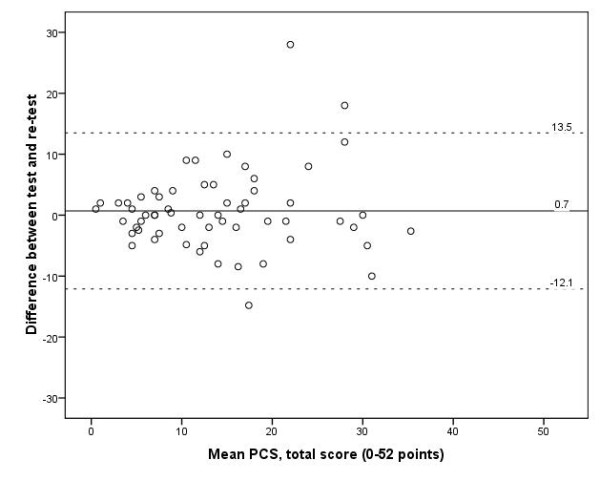
BACKGROUND: Pain catastrophizing has been found to be an important predictor of disability and days lost from work in patients with low back pain. The most commonly used outcome measure to identify pain catastrophizing is the Pain Catastrophizing Scale (PCS). To enable the use of the PCS in clinical settings and research in Norwegian speaking patients, the PCS had to be translated. The purpose of this study was therefore to translate and cross-culturally adapt the PCS into Norwegian and to test internal consistency, construct validity and reproducibility of the PCS. METHODS: The PCS was translated before it was tested for psychometric properties. Patients with subacute or chronic non-specific low back pain aged 18 years or more were recruited from primary and secondary care. Validity of the PCS was assessed by evaluating data quality (missing, floor and ceiling effects), principal components analysis, internal consistency (Cronbach's alpha), and construct validity (Spearman's rho). Reproducibility analyses included standard error of measurement, minimum detectable change, limits of agreement, and intraclass correlation coefficients. RESULTS: A total of 38 men and 52 women (n = 90), with a mean (SD) age of 47.6 (11.7) years, were included for baseline testing. A subgroup of 61 patients was included for test-retest assessments. The Norwegian PCS was easy-to-comprehend. The principal components analysis supported a three-factor structure, internal consistency was satisfactory for the PCS total score (α 0.90) and the subscales rumination (α 0.83) and helplessness (α 0.86), but not for the subscale magnification (α 0.53). In total, 86% of the correlation analyses were in accordance with predefined hypothesis. The reliability analyses showed intraclass correlation coefficients of 0.74 - 0.87 for the PCS total score and subscales. The PCS total score (range 0-52 points) showed a standard error of measurement of 4.6 points and a 95% minimum detectable change estimate of 12.8 points. CONCLUSIONS: The Norwegian PCS total score showed acceptable psychometric properties in terms of comprehensibility, consistency, construct validity, and reproducibility when applied to patients with subacute or chronic LBP from different clinical settings. Our study support the use of the PCS total score for clinical or research purposes identifying or evaluating pain catastrophizing.
Overview
The claims and statistics of this paper haven’t been checked yet.
Run the check — free, no account needed. It reads the open-access text and checks the sources it cites.
Integrity signals
Registry
Cites
Statistics
Figures
Verification
Claims the paper makes
The claims and statistics of this paper haven’t been checked yet.
Run the check — free, no account needed. It reads the open-access text and checks the sources it cites.
Claims other papers make about this one
Each is checked against this paper’s own text: does it say what the citing paper says it does?
The source backs part of the claim, not all of it — or backs it for a different population, condition or comparison.
In the citing paper
“The questionnaire has acceptable internal consistency and reliability and has been validated in a Norwegian population sample with chronic pain [47].”
From Short-Term Findings From Testing EPIO, a Digital Self-Management Program for People Living With Chronic Pain: Randomized Controlled Trial (2023) · cites this paper as [47]
Experimental — accuracy not yet measuredThe source backs part of the claim, not all of it — or backs it for a different population, condition or comparison.
In the citing paper
“The PCS has acceptable internal consistency and reliability, and has been validated in a Norwegian population sample with chronic pain [59].”
From Digital Self-Management in Support of Patients Living With Chronic Pain: Feasibility Pilot Study (2020) · cites this paper as [59]
Experimental — accuracy not yet measured
Self-check
Percentages, sums and reported differences re-computed from the paper’s own numbers.
The self-check needs the paper’s full text.
Citations
Cites
STATISTICAL METHODS FOR ASSESSING AGREEMENT BETWEEN TWO METHODS OF CLINICAL MEASUREMENT
Martin Bland, J., & Altman, D. (1986) · The Lancet · doi:10.1016/s0140-6736(86)90837-8 · Cited by 47,965
EuroQol: a new facility for the measurement of health-related quality of life
(1990) · Health Policy · doi:10.1016/0168-8510(90)90421-9 · Cited by 15,736
Guidelines for the process of cross-cultural adaptation of self-report measures
Beaton, D. E., Bombardier, C., Guillemin, F., & Ferraz, M. B. (2000) · Spine · doi:10.1097/00007632-200012150-00014 · Cited by 14,542
Quality criteria were proposed for measurement properties of health status questionnaires
Terwee, C. B., Bot, S. D. M., de Boer, M. R., van der Windt, D. A. W. M., Knol, D. L., Dekker, J., Bouter, L. M., & de Vet, H. C. W. (2007) · Journal of Clinical Epidemiology · doi:10.1016/j.jclinepi.2006.03.012 · Cited by 10,764
The Pain Catastrophizing Scale: Development and validation.
Sullivan, M. J. L., Bishop, S. R., & Pivik, J. (1995) · Psychological Assessment · doi:10.1037//1040-3590.7.4.524 · Cited by 8,227
Guillemin, F., Bombardier, C., & Beaton, D. (1993) · Journal of Clinical Epidemiology · doi:10.1016/0895-4356(93)90142-n · Cited by 6,060
Pallant, J. (2020) · Routledge eBooks · doi:10.4324/9781003117407 · Cited by 6,034
The Hopkins Symptom Checklist (HSCL): A self-report symptom inventory
Derogatis, L. R., Lipman, R. S., Rickels, K., Uhlenhuth, E. H., & Covi, L. (1974) · Behavioral Science · doi:10.1002/bs.3830190102 · Cited by 4,604
Waddell, G., Newton, M., Henderson, I., Somerville, D., & Main, C. J. (1993) · Pain · doi:10.1016/0304-3959(93)90127-b · Cited by 3,167
(2007) · Cited by 3,005
Fear of movement/(re)injury in chronic low back pain and its relation to behavioral performance
Vlaeyen, J. W. S., Kole-Snijders, A. M. J., Boeren, R. G. B., & van Eek, H. (1995) · Pain · doi:10.1016/0304-3959(94)00279-n · Cited by 2,446
When to use agreement versus reliability measures
de Vet, H. C. W., Terwee, C. B., Knol, D. L., & Bouter, L. M. (2006) · Journal of Clinical Epidemiology · doi:10.1016/j.jclinepi.2005.10.015 · Cited by 1,801
Waddell, G. (2004) · Cited by 1,258
Outcome Measures for Low Back Pain Research: A Proposal for Standardized Use
Deyo, R. A., Battie, M., Beurskens, A. J. H. M., Bombardier, C., Croft, P., Koes, B., Malmivaara, A., Roland, M., Von Korff, M., & Waddell, G. (1998) · Spine · doi:10.1097/00007632-199809150-00018 · Cited by 1,229
The Pain Catastrophizing Scale: further psychometric evaluation with adult samples
Osman, A., Barrios, F. X., Gutierrez, P. M., Kopper, B. A., Merrifield, T., & Grittmann, L. (2000) · Journal of Behavioral Medicine · doi:10.1023/a:1005548801037 · Cited by 944
Factor structure, reliability, and validity of the Pain Catastrophizing Scale
Osman, A., Barrios, F. X., Kopper, B. A., Hauptmann, W., Jones, J., & O'Neill, E. (1997) · Journal of Behavioral Medicine · doi:10.1023/a:1025570508954 · Cited by 881
Criteria for assessing the tools of disability outcomes research
Andresen, E. M. (2000) · Archives of Physical Medicine and Rehabilitation · doi:10.1053/apmr.2000.20619 · Cited by 872
Keefe, F. J., Lefebvre, J. C., Egert, J. R., Affleck, G., Sullivan, M. J., & Caldwell, D. S. (2000) · Pain · doi:10.1016/s0304-3959(00)00296-7 · Cited by 735
Van Damme, S., Crombez, G., Bijttebier, P., Goubert, L., & Van Houdenhove, B. (2002) · Pain · doi:10.1016/s0304-3959(01)00463-8 · Cited by 579
(1980) · PubMed · Cited by 473
A Study of the Natural History of Low-Back Pain
Roland, M. O., & Morris, R. W. (1983) · Spine · doi:10.1097/00007632-198303000-00005 · Cited by 462
Meyer, K., Sprott, H., & Mannion, A. F. (2008) · Journal of Psychosomatic Research · doi:10.1016/j.jpsychores.2007.12.004 · Cited by 319
Outcome assessment in low back pain: how low can you go?
Mannion, A. F., Elfering, A., Staerkle, R. F., Junge, A., Grob, D., Semmer, N. K., Jacobshagen, N., Dvořák, J., & Boos, N. (2005) · European Spine Journal · doi:10.1007/s00586-005-0911-9 · Cited by 245
A Psychometric Investigation of Fear-Avoidance Model Measures in Patients With Chronic Low Back Pain
George, S. Z., Valencia, C., & Beneciuk, J. M. (2010) · Journal of Orthopaedic and Sports Physical Therapy · doi:10.2519/jospt.2010.3298 · Cited by 209
A prospective sequential analysis of the fear-avoidance model of pain
Wideman, T. H., Adams, H., & Sullivan, M. J. L. (2009) · Pain · doi:10.1016/j.pain.2009.04.022 · Cited by 171
Brox, J. I., Storheim, K., Grotle, M., Tveito, T. H., Indahl, A., & Eriksen, H. R. (2007) · The Spine Journal · doi:10.1016/j.spinee.2007.07.389 · Cited by 154
Self-citationBiopsychosocial Multivariate Predictive Model of Occupational Low Back Disability
Schultz, I. Z., Crook, J. M., Berkowitz, J., Meloche, G. R., MILNER, R. A., Zuberbier, O. A., & Meloche, W. (2002) · Spine · doi:10.1097/00007632-200212010-00012 · Cited by 135
Lamé, I. E., Peters, M. L., Kessels, A. G., Van Kleef, M., & Patijn, J. (2008) · Journal of Health Psychology · doi:10.1177/1359105308093866 · Cited by 115
Psychological predictors of pain expression and activity intolerance in chronic pain patients
Thibault, P., Loisel, P., Durand, M., Catchlove, R. F. H., & Sullivan, M. J. L. (2008) · Pain · doi:10.1016/j.pain.2008.02.029 · Cited by 101
Fear-Avoidance Beliefs, Catastrophizing, and Distress
Westman, A., Boersma, K., Leppert, J., & Linton, S. J. (2011) · Clinical Journal of Pain · doi:10.1097/ajp.0b013e318219ab6c · Cited by 100
Pain Intensity Measurement in Chronic Low Back Pain
Strong, J., Ashton, R., & Chant, D. C. (1991) · Clinical Journal of Pain · doi:10.1097/00002508-199109000-00007 · Cited by 97
Pain Behavior and the Development of Pain-related Disability: The Importance of Guarding
Prkachin, K. M., Schultz, I. Z., & Hughes, E. (2007) · Clinical Journal of Pain · doi:10.1097/ajp.0b013e3180308d28 · Cited by 93
Clinical Investigation of Pain-related Fear and Pain Catastrophizing for Patients With Low Back Pain
George, S. Z., Calley, D. Q., Valencia, C., & Beneciuk, J. M. (2010) · Clinical Journal of Pain · doi:10.1097/ajp.0b013e3181f21414 · Cited by 60
Main, C. J., & Watson, P. (1996) · Journal of Musculoskeletal Pain · doi:10.1300/j094v04n04_16 · Cited by 48
Öhlund, C., Lindström, I., Areskoug, B., Eek, C., Peterson, L., & NACHEMSON, A. L. (1994) · Pain · doi:10.1016/0304-3959(94)90200-3 · Cited by 40
Martel, M. O., Thibault, P., & Sullivan, M. J. L. (2010) · Pain · doi:10.1016/j.pain.2010.07.004 · Cited by 36
Responsiveness and Construct Validity of the Depression, Anxiety, and Positive Outlook Scale (DAPOS)
Pincus, T., Rusu, A. C., & Santos, R. (2008) · Clinical Journal of Pain · doi:10.1097/ajp.0b013e318164341c · Cited by 29
Research works printed but not linked: 1
- Hesbacher PT, Rickels K, Morris RJ, Newman H, Rosenfeld H: Psychiatric illness in family practice. J Clin Psychiatry. 1980, 41: 6-10.
Cited by
Sorted by citations
Schütze, R., Rees, C., Smith, A., Slater, H., Campbell, J. M., & O'Sullivan, P. (2018) · The Journal of Pain · doi:10.1016/j.jpain.2017.09.010 · Cited by 231
Müller, R., Gertz, K. J., Molton, I. R., Terrill, A. L., Bombardier, C. H., Ehde, D. M., & Jensen, M. P. (2016) · The Clinical Journal of Pain · doi:10.1097/ajp.0000000000000225 · Cited by 179
Chronic Abdominal Pain and Symptoms 5 Years After Gastric Bypass for Morbid Obesity
Høgestøl, I. K. D., Chahal-Kummen, M., Eribe, I., Brunborg, C., Stubhaug, A., Hewitt, S., Kristinsson, J. A., & Mala, T. (2016) · Obesity Surgery · doi:10.1007/s11695-016-2499-z · Cited by 110
Cho, S., Kim, H., & Lee, J.-H. (2012) · Quality of Life Research · doi:10.1007/s11136-012-0308-2 · Cited by 92
Høvik, L. H., Winther, S. B., Foss, O. A., & Gjeilo, K. H. (2016) · BMC Musculoskeletal Disorders · doi:10.1186/s12891-016-1073-0 · Cited by 86
Metadata
- Authors
- Fernandes, L., Storheim, K., Lochting, I., & Grotle, M.
- Affiliations
- Oslo University Hospital (NO)
- Corresponding author
- Fernandes, Linda
- Venue
- BMC Musculoskeletal Disorders
- Published
- 2012-06-22
- Volume
- 13
- Issue
- 1
- Pages
- 111-111
- ISSN
- 1471-2474 (ISSN-L)
- PMC
- PMC3407790
- OpenAlex
- W2063178009
- Cited by
- 130
- References
- 37
- Citations by year
- 2026: 10 · 2025: 10 · 2024: 11 · 2023: 12 · 2022: 8 · 2021: 21 · 2020: 15 · 2019: 7 · 2018: 5 · 2017: 9 · 2016: 6 · 2015: 6 · 2014: 5 · 2013: 3 · 2012: 1
- FWCI
- 3.52
- Type
- journal article
- Language
- en
- Open access
- gold
- doi.org
- Licence
- Locations
- BMC Musculoskeletal Disorders (publishedVersion, cc-by)
- Europe PMC (PubMed Central) (publishedVersion, cc-by)
- PubMed Central (publishedVersion, cc-by)
- PubMed (publishedVersion)
- DOAJ (DOAJ: Directory of Open Access Journals) (submittedVersion)
- NORA - Norwegian Open Research Archives (submittedVersion, cc-by)
- Topics
- Health Sciences › Health Professions › Physical Therapy, Sports Therapy and Rehabilitation › Musculoskeletal pain and rehabilitation
- Social Sciences › Decision Sciences › Management Science and Operations Research › Psychometric Methodologies and Testing
- Health Sciences › Medicine › Pediatrics, Perinatology and Child Health › Pediatric Pain Management Techniques
- Keywords
- pain catastrophizing, Pain Catastrophizing Scale, cross-cultural adaptation, Norwegian translation, low back pain, psychometric properties, construct validity, internal consistency, reproducibility, test-retest reliability, minimal detectable change, rumination, helplessness, magnification
- MeSH terms
- Cross-Cultural Comparison, Disability Evaluation, Female, Humans, Male, Middle Aged, Norway, Pain Measurement, Primary Health Care, Psychometrics, Reproducibility of Results, Low Back Pain, Catastrophization
About these checks
Registry, retraction, Cites and statistics results are computed, not judged, with one exception: a printed reference that no index lists is read once by a model before it counts as a citation error. Claims are extracted by a model and kept only when their quote appears verbatim in the text; each cited source is then checked, with a model’s help, for whether it says what the claim relies on. Those verdicts can be wrong — read the claim’s quote and the cited source before relying on one.
Statistics and arithmetic are recomputed, not judged.
Confidence bands are shown only for fields calibrated on our annotated test set. None is calibrated yet, so no band is shown.
What counts as a claim ›How we measure confidence ›How we check this ›
Are you an author, or do you see a problem with this page? Request a review
