

Impact of electronic medical record on physician practice in office settings: a systematic review
Open accessThe DOI matches its Crossref record; 66 of the 67 references it cites were found in a registry or an index.
Abstract
BACKGROUND: Increased investments are being made for electronic medical records (EMRs) in Canada. There is a need to learn from earlier EMR studies on their impact on physician practice in office settings. To address this need, we conducted a systematic review to examine the impact of EMRs in the physician office, factors that influenced their success, and the lessons learned. RESULTS: For this review we included publications cited in Medline and CINAHL between 2000 and 2009 on physician office EMRs. Studies were included if they evaluated the impact of EMR on physician practice in office settings. The Clinical Adoption Framework provided a conceptual scheme to make sense of the findings and allow for future comparison/alignment to other Canadian eHealth initiatives.In the final selection, we included 27 controlled and 16 descriptive studies. We examined six areas: prescribing support, disease management, clinical documentation, work practice, preventive care, and patient-physician interaction. Overall, 22/43 studies (51.2%) and 50/109 individual measures (45.9%) showed positive impacts, 18.6% studies and 18.3% measures had negative impacts, while the remaining had no effect. Forty-eight distinct factors were identified that influenced EMR success. Several lessons learned were repeated across studies: (a) having robust EMR features that support clinical use; (b) redesigning EMR-supported work practices for optimal fit; (c) demonstrating value for money; (d) having realistic expectations on implementation; and (e) engaging patients in the process. CONCLUSIONS: Currently there is limited positive EMR impact in the physician office. To improve EMR success one needs to draw on the lessons from previous studies such as those in this review.
Overview
The claims and statistics of this paper haven’t been checked yet.
Free: it reads the open-access text and checks the first 5 claims that cite a source we can check. Create a free account to check every claim.
Integrity signals
Registry
Cites
Statistics
Figures
Verification
Claims the paper makes
The claims and statistics of this paper haven’t been checked yet.
Free: it reads the open-access text and checks the first 5 claims that cite a source we can check. Create a free account to check every claim.
Claims other papers make about this one
Each is checked against this paper’s own text: does it say what the citing paper says it does?
The source backs part of the claim, not all of it — or backs it for a different population, condition or comparison.
In the citing paper
“Similarly, the regulatory framework, particularly where it was restrictive or absent was found to impede implementation [41, 51, 58].”
From Achieving change in primary care—causes of the evidence to practice gap: systematic reviews of reviews (2015) · cites this paper as [58]
Experimental — accuracy not yet measuredThe source backs part of the claim, not all of it — or backs it for a different population, condition or comparison.
In the citing paper
“The presence of a positive culture which was receptive to change and valued innovation was viewed as important for implementation [32, 41, 58].”
From Achieving change in primary care—causes of the evidence to practice gap: systematic reviews of reviews (2015) · cites this paper as [58]
Experimental — accuracy not yet measuredThe source backs part of the claim, not all of it — or backs it for a different population, condition or comparison.
In the citing paper
“implementation of a new intervention might lead to cost savings or more efficient workflow [51, 58].”
From Achieving change in primary care—causes of the evidence to practice gap: systematic reviews of reviews (2015) · cites this paper as [58]
Experimental — accuracy not yet measuredIn the citing paper
“Four reviews included data on the effects of the e-health systems implemented [24, 36, 49, 52]; these reported mixed effects.”
From Factors that influence the implementation of e-health: a systematic review of systematic reviews (an update) (2016) · cites this paper as [36]
Self-check
Percentages, sums and reported differences re-computed from the paper’s own numbers.
The self-check needs the paper’s full text.
Citations
Cites
The DeLone and McLean Model of Information Systems Success: A Ten-Year Update
(2003) · Journal of Management Information Systems · doi:10.1080/07421222.2003.11045748 · Cited by 11,791 · cited 2×
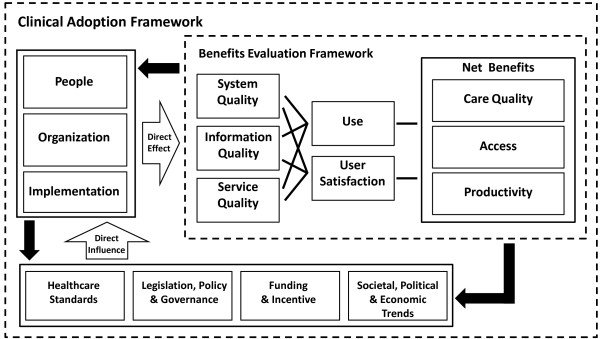
“It extends the Infoway Benefits Evaluation (BE) Framework published in 2006 [18] (adapted from the DeLone and McLean information system success model [19,20]).”
BackgroundMethodInformation Systems Success: The Quest for the Dependent Variable
DeLone, W. H., & McLean, E. R. (1992) · Information Systems Research · doi:10.1287/isre.3.1.60 · Cited by 10,697 · cited 2×
“It extends the Infoway Benefits Evaluation (BE) Framework published in 2006 [18] (adapted from the DeLone and McLean information system success model [19,20]).”
Garg, A. X., Adhikari, N. K. J., McDonald, H., Rosas-Arellano, M. P., Devereaux, P. J., Beyene, J., Sam, J., & Haynes, R. B. (2005) · JAMA · doi:10.1001/jama.293.10.1223 · Cited by 2,936 · cited 5×
“This was similar to reviews that assessed the effects of HIS in other health settings [21,22].”
BackgroundMethodResultInfluentialInformation Technology Implementation Research: A Technological Diffusion Approach
Cooper, R. B., & Zmud, R. W. (1990) · Management Science · doi:10.1287/mnsc.36.2.123 · Cited by 2,765 · cited 1×
“In this regard, the CA Framework should be expanded by incorporating post-adoption usage behaviours by physicians and their effects over time to reflect the different maturity stages of the EMRs involved [66,67].”
Method(2010) · Handbook of Disease Burdens and Quality of Life Measures · doi:10.1007/978-0-387-78665-0_6514 · Cited by 1,385
Mays, N., Pope, C., & Popay, J. (2005) · Journal of Health Services Research & Policy · doi:10.1258/1355819054308576 · Cited by 1,375
Electronic Health Record Use and the Quality of Ambulatory Care in the United States
Linder, J. A., Ma, J., Bates, D. W., Middleton, B., & Stafford, R. S. (2007) · Archives of Internal Medicine · doi:10.1001/archinte.167.13.1400 · Cited by 438 · cited 3×
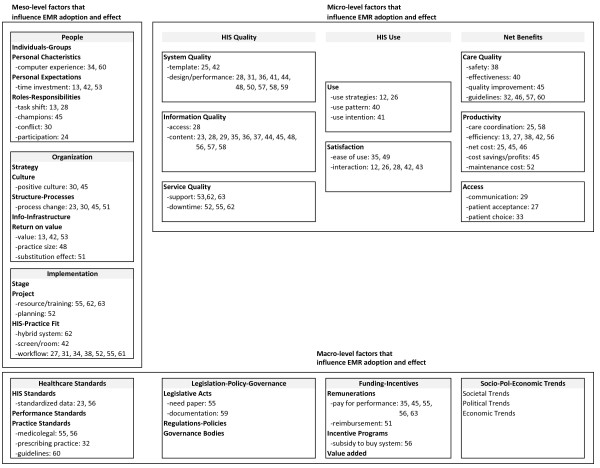
“At the micro-level, system quality factors included the availability of templates [25,42], interface design [31,36,41,44,48,50,55,57,59] and technical performance (e.”
BackgroundDeterminants of Success of Inpatient Clinical Information Systems: A Literature Review
van der Meijden, M. J. (2003) · Journal of the American Medical Informatics Association · doi:10.1197/jamia.m1094 · Cited by 363 · cited 1×
“When compared with the success factors reported in van der Meijden’s review [65] of inpatient clinical information systems, we were able to map many of their factors to those listed under the micro-level dimensions of the CA Framework in our EMR review.”
ResultSchoen, C., Osborn, R., Doty, M. M., Squires, D., Peugh, J., & Applebaum, S. (2009) · Health Affairs · doi:10.1377/hlthaff.28.6.w1171 · Cited by 358 · cited 2×
“[Exhibit-1 in ref [3]]), study design (experimental/observational/descriptive) and time period (2000-04 vs.”
BackgroundTamblyn, R. M., Huang, A. R., Perreault, R. B., Jacques, A., Roy, D., Hanley, J. A., McLeod, P. J., & Laprise, R. (2003) · Europe PMC (PubMed Central) · Cited by 345
Research works printed but not linked: 2
- Canadian Medical Association Information Technology and Health care in Canada: 2010 Status Report http://www.cma.ca/IThandbook
- Lai JK Lau F Shaw N A study of information technology use and implementation of electronic medical record systems in BC medical practices BC Medical Journal 2009 51 3 114 121
Cited by
Ross, J., Stevenson, F., Lau, R., & Murray, E. (2016) · Implementation Science · doi:10.1186/s13012-016-0510-7 · Cited by 1,011
“…their implementation were reported as important implementation factors by the majority of studies across all e-health domains [15 – 19, 22 – 25, 27, 28, 30 – 33, 36, 38, 39, 41, 43, 47, 49, 51 – 54, 57], with some studies citing cost-related factors as the main barrier to implementation [49, 54].”
BackgroundInfluentialLau, R., Stevenson, F., Ong, B. N., Dziedzic, K., Treweek, S., Eldridge, S., Everitt, H., Kennedy, A., Qureshi, N., Rogers, A., et al. (2015) · Implementation Science · doi:10.1186/s13012-016-0396-4 · Cited by 533
“Infrastructure [14, 15, 42, 53, 58, 67, 72, 74, 75, 82, 86, 101, 104] B: Inadequate employment contracts, practice facilities and functioning of the primary care team [85] F: Mechanism of support and infrastructure to support health care professionals [85] √ √ √ √ √”
BackgroundMethodInfluentialA review of PHR, EMR and EHR integration: A more personalized healthcare and public health policy
Heart, T., Ben-Assuli, O., & Shabtai, I. (2017) · Health Policy and Technology · doi:10.1016/j.hlpt.2016.08.002 · Cited by 251
“Though there are many advantages to this system, adoption rates are fairly low in community clinics [17] that face a number of obstacles [18].”
BackgroundAlkureishi, M. A., Lee, W. W., Lyons, M., Press, V. G., Imam, S., Nkansah-Amankra, A., Werner, D., & Arora, V. M. (2016) · Journal of General Internal Medicine · doi:10.1007/s11606-015-3582-1 · Cited by 230
Gillum, R. F. (2013) · The American Journal of Medicine · doi:10.1016/j.amjmed.2013.03.024 · Cited by 177
A Time-Motion Study of Primary Care Physicians’ Work in the Electronic Health Record Era
Young, R. A., Burge, S. K., Kumar, K. A., Wilson, J. M., & Ortiz, D. F. (2018) · Family Medicine · doi:10.22454/fammed.2018.184803 · Cited by 159
Visual analytics in healthcare – opportunities and research challenges
Caban, J. J., & Gotz, D. (2015) · Journal of the American Medical Informatics Association · doi:10.1093/jamia/ocv006 · Cited by 155
“However, despite the substantial evidence showing the benefits of EHR adoption, e-prescriptions, and other components of health information exchanges, healthcare providers often report only modest improvements in their ability to make better decisions by using more comprehensive clinical information.(2,3)”
BackgroundAyaad, O. A., Alloubani, A., Alhijaa, E. H. A., Farhan, M., Abuseif, S., Hroub, A. A., & Akhu‐Zaheya, L. (2019) · International Journal of Medical Informatics · doi:10.1016/j.ijmedinf.2019.04.014 · Cited by 170
O’Donnell, A., Kaner, E., Shaw, C., & Haighton, C. (2018) · BMC Medical Informatics and Decision Making · doi:10.1186/s12911-018-0703-x · Cited by 108
Meeting the challenge of COPD care delivery in the USA: a multiprovider perspective
Han, M. K., Martinez, C. H., Au, D. H., Bourbeau, J., Boyd, C. M., Branson, R. D., Criner, G. J., Kalhan, R., Kallstrom, T. J., King, A., et al. (2016) · The Lancet Respiratory Medicine · doi:10.1016/s2213-2600(16)00094-1 · Cited by 122
Progress in electronic medical record adoption in Canada.
Chang, F., & Gupta, N. (2015) · PubMed Central · Cited by 91
Dornan, L., Pinyopornpanish, K., Jiraporncharoen, W., Hashmi, A., Dejkriengkraikul, N., & Angkurawaranon, C. (2019) · BioMed Research International · doi:10.1155/2019/7341841 · Cited by 81
“In order to examine the content for utilisation in public health, one needs to consider it along with two other interactive components: the context and process [19].”
BackgroundMethodEntzeridou, E., Markopoulou, E., & Mollaki, V. (2017) · International Journal of Medical Informatics · doi:10.1016/j.ijmedinf.2017.12.004 · Cited by 90
McGinn, C. A., Gagnon, M.-P., Shaw, N., Sicotte, C., Mathieu, L., Leduc, Y., Grenier, S., Duplantie, J., Abdeljelil, A. B., & Légaré, F. (2012) · BMC Medical Informatics and Decision Making · doi:10.1186/1472-6947-12-105 · Cited by 76
“Recent systematic reviews show that EMR/EHR systems have not yet demonstrated clinical and economic benefits [1] [5] [6].”
BackgroundEffects of exam room EHR use on doctor-patient communication: a systematic literature review
Kazmi, Z. (2014) · Journal of Innovation in Health Informatics · doi:10.14236/jhi.v21i1.37 · Cited by 75
Price, M., & Lau, F. (2014) · BMC Medical Informatics and Decision Making · doi:10.1186/1472-6947-14-43 · Cited by 89
“However, the promise of these transformative tools has not been consistently seen [3-5] and meaningful adoption in many jurisdictions remains low [6,7].”
BackgroundMethodSelf-citationMedical Records: A Historical Narrative
Lorkowski, J., & Pokorski, M. (2022) · Biomedicines · doi:10.3390/biomedicines10102594 · Cited by 80
“Despite obvious advantages, 20% of respondents representing various types of medical professionals still express doubts about benefits stemming from eHealth records [4,88,105].”
BackgroundAbraham, J., Novak, L. L., Reynolds, T. L., Gettinger, A., & Zheng, K. (2016) · Yearbook of Medical Informatics · doi:10.15265/iy-2016-036 · Cited by 74
Rahal, R. M., Mercer, J. G., Kuziemsky, C. E., & Yaya, S. (2021) · BMC Medical Informatics and Decision Making · doi:10.1186/s12911-021-01434-9 · Cited by 78
“However, there is evidence of modest improvement in the use of advanced EMR features, such as electronic reminders prompting follow-up for preventive care and clinical decision support tools in preventative care and disease management [6, 7].”
BackgroundAdopting electronic medical records: are they just electronic paper records?
Price, M., Singer, A. G., & Kim, J. (2013) · Canadian Family Physician · Cited by 92
Self-citationRaymond, L., Paré, G., de Guinea, A. O., Poba‐Nzaou, P., Trudel, M.-C., Marsan, J., & Micheneau, T. (2015) · BMC Medical Informatics and Decision Making · doi:10.1186/s12911-015-0152-8 · Cited by 69
“For instance, Lau et al. [6] concluded that, based on prior empirical studies, there is a 51% chance that an EMR system will improve office practices, a 30% likelihood that it will have no effect, and a 19% chance that it will lead to negative outcomes.”
Schopf, T. R., Nedrebø, B., Hufthammer, K. O., Daphu, I., & Lærum, H. (2019) · BMC Health Services Research · doi:10.1186/s12913-019-4763-0 · Cited by 69
A study of general practitioners’ perspectives on electronic medical records systems in NHSScotland
Bouamrane, M.-M., & Mair, F. S. (2013) · BMC Medical Informatics and Decision Making · doi:10.1186/1472-6947-13-58 · Cited by 54
“identified the following factors which influenced adoption: (i) technical design, performance and support affected usage and user satisfaction, (ii) implementation processes and workflows impacted on the practice productivity and coordination and (iii) performance-related financial incentives were important drivers fo…”
BackgroundGagalova, K., Elizalde, M. A. L., Portales-Casamar, É., & Görges, M. (2020) · JMIR Formative Research · doi:10.2196/17687 · Cited by 70
“EHR systems have been increasingly adopted in the United States over the past 10 years [1], and their use is spreading worldwide in both hospital and outpatient care settings [2,3].”
BackgroundHyppönen, H., Saranto, K., Vuokko, R., Mäkelä-Bengs, P., Doupi, P., Lindqvist, M., & Mākelä, M. (2013) · International Journal of Medical Informatics · doi:10.1016/j.ijmedinf.2013.11.006 · Cited by 60
“(1) The range of possible ICT applications in the health care sector has increased exponentially, with a number of countries progressing from local towards regional or national level patient/health information exchange (2)(3)(4)(5)(6)(7).”
BackgroundMethodResultInfluentialThe clinical artificial intelligence department: a prerequisite for success
Cosgriff, C. V., Stone, D. J., Weissman, G., Pirracchio, R., & Celi, L. A. (2020) · BMJ Health & Care Informatics · doi:10.1136/bmjhci-2020-100183 · Cited by 43
Liang, D., Darko, A. P., & Ju, Z. (2019) · Journal of Experimental & Theoretical Artificial Intelligence · doi:10.1080/0952813x.2019.1694589 · Cited by 51
Pavlik, V., Brown, A. E., Nash, S., & Gossey, J. T. (2014) · The Journal of the American Board of Family Medicine · doi:10.3122/jabfm.2014.02.130137 · Cited by 51
“A recent systematic review of the effects of EHRs in office settings does not mention the potential role of the AVS in supporting desired care outcomes.(6) The extant literature on the AVS is limited to a study of patient attitudes about the use of the AVS in clinical settings.”
BackgroundParé, G., Raymond, L., de Guinea, A. O., Poba‐Nzaou, P., Trudel, M.-C., Marsan, J., & Micheneau, T. (2015) · International Journal of Medical Informatics · doi:10.1016/j.ijmedinf.2015.07.005 · Cited by 52
Best Practice in Online Survey Research with Sensitive Topics
Kays, K. M., Keith, T. L., & Broughal, M. (2013) · IGI Global eBooks · doi:10.4018/978-1-4666-3918-8.ch009 · Cited by 47
Zhang, J., Chen, Y., Ashfaq, S., Bell, K., Calvitti, A., Farber, N. J., Gabuzda, M. T., Gray, B., Liu, L., Rick, S., et al. (2015) · Journal of the American Medical Informatics Association · doi:10.1093/jamia/ocv142 · Cited by 47
“looked into the potential of the EHR as a patient education and engagement tool.(4,38) For instance, a collaborative reading of the EHR screen can lead to improved care quality, informed patient decision-making, and patient engagement.”
Price, M., Davies, I., Rusk, R., Lesperance, M., & Weber, J. (2017) · JMIR Medical Informatics · doi:10.2196/medinform.6226 · Cited by 41
“Although there is promise in these tools, the benefits of using these tools are not consistently realized [25,26].”
BackgroundSelf-citationMeasuring Electronic Health Record Use in Primary Care: A Scoping Review
Huang, M., Gibson, C. J., & Terry, A. L. (2018) · Applied Clinical Informatics · doi:10.1055/s-0037-1615807 · Cited by 50
“While there is mixed evidence of the impact of EHR use on clinical practice, 73 early research points to the importance of more mature, or advanced EHR use, 18 including integration with work fl ow, 20 in achieving positive effects.”
BackgroundThe good, the bad and the early adopters: providers' attitudes about a common, commercial EHR
Makam, A. N., Lanham, H. J., Batchelor, K., Moran, B., Howell‐Stampley, T., Kirk, L., Cherukuri, M., Samal, L., Santini, N., Leykum, L. K., et al. (2014) · Journal of Evaluation in Clinical Practice · doi:10.1111/jep.12076 · Cited by 40
Reis, S. P., Sagi, D., Eisenberg, O., Kuchnir, Y., Azuri, J., Shalev, V., & Ziv, A. (2013) · Patient Education and Counseling · doi:10.1016/j.pec.2013.08.007 · Cited by 41
“The use of EMRs has a positive impact on medical care through better adherence to guidelines, clinical monitoring and medical error prevention [5].”
BackgroundVuk, J., Anders, M., Mercado, C. C., Kennedy, R. L., Casella, J., & Steelman, S. C. (2015) · International Journal of Medical Informatics · doi:10.1016/j.ijmedinf.2015.02.003 · Cited by 38
Rheumatology Workforce Planning in Western Countries: A Systematic Literature Review
Dejaco, C., Lackner, A., Buttgereit, F., Matteson, E. L., Narath, M., & Sprenger, M. (2016) · Arthritis Care & Research · doi:10.1002/acr.22894 · Cited by 37
“Other concerns are the unclear effects of electronic medical records (EMR) on productivity of rheumatologists, given that EMRs are increasingly implemented in western countries (30).”
BackgroundImplementation of Electronic Medical Records in Mental Health Settings: Scoping Review
Zurynski, Y. A., Ellis, L. A., Tong, H. L., Laranjo, L., Clay‐Williams, R., Testa, L., Meulenbroeks, I., Turton, C., & Sara, G. E. (2021) · JMIR Mental Health · doi:10.2196/30564 · Cited by 53
LAB-IN-A-BOX: semi-automatic tracking of activity in the medical office
Weibel, N., Rick, S., Emmenegger, C., Ashfaq, S., Calvitti, A., & Agha, Z. (2014) · Personal and Ubiquitous Computing · doi:10.1007/s00779-014-0821-0 · Cited by 38
“A recent review [34] of 9 years of EHR studies found the majority of EHRs have had very limited to negative impact on clinical workflow, and documenting improvements is difficult.”
BackgroundPatient perceptions of electronic medical records use and ratings of care quality
Rutten, L. J. F., Vieux, S. N., Sauver, J. L. S., Arora, N. K., Moser, R. P., Beckjord, E. B., & Hesse, B. W. (2014) · Patient Related Outcome Measures · doi:10.2147/prom.s58967 · Cited by 42
Evaluation of the Impacts of Innovation in the Health Care Sector: A comparative analysis
Cucciniello, M., & Nasi, G. (2013) · Public Management Review · doi:10.1080/14719037.2013.798026 · Cited by 47
“…in assisting human-executed process, but also encompasses process integration, care effectiveness, motivation of internal stakeholders (physicians, nurses, and staff), and contributes to the overall performance of an organization (Lau et al. 2012; López et al. 2010; Thompson et al. 2009).”
BackgroundA Hybrid MCDM Model for Improving the Electronic Health Record to Better Serve Client Needs
Liou, J. J. H., Lu, M., Hu, S.-K., Cheng, C.-H., & Chuang, Y. (2017) · Sustainability · doi:10.3390/su9101819 · Cited by 37
“One major factor is the financial cost of the system [12,13].”
BackgroundE-Prescribing: History, Issues, Potential
Salmon, J. W., & Jiang, R. (2012) · Online Journal of Public Health Informatics · doi:10.5210/ojphi.v4i3.4304 · Cited by 41
Avery, A., Toro, M. D., & Caron, A. (2013) · BMJ Quality & Safety · doi:10.1136/bmjqs-2012-001775 · Cited by 30
Hamade, N., Terry, A. L., & Malvankar‐Mehta, M. S. (2019) · BMJ Health & Care Informatics · doi:10.1136/bmjhci-2019-000023 · Cited by 37
The impact of electronic medical records' functions on the quality of health services
Sharikh, E. A., Shannak, R. O., Suifan, T. S., & Ayaad, O. A. (2020) · British Journal of Healthcare Management · doi:10.12968/bjhc.2019.0056 · Cited by 48
Visual Analytics for Electronic Health Records: A Review
Rostamzadeh, N., Abdullah, S. S., & Sedig, K. (2021) · Informatics · doi:10.3390/informatics8010012 · Cited by 33
“However, despite the evidence showing the benefits of EHR-based systems, they rarely improve healthcare experts’ ability to make better clinical decisions by having access to more comprehensive information [9,10].”
BackgroundBailie, R. S., Bailie, J., Chakraborty, A., & Swift, K. (2014) · Australian Journal of Primary Health · doi:10.1071/py14071 · Cited by 32
“Many claims aremade regarding a wide range of potential benefits, but there is little evidence to substantiate these claims (Black et al. 2011; Crosson et al. 2012; Lau et al. 2012).”
BackgroundCeiling effect in EMR system assimilation: a multiple case study in primary care family practices
Trudel, M.-C., Marsan, J., Paré, G., Raymond, L., de Guinea, A. O., Maillet, É., & Micheneau, T. (2017) · BMC Medical Informatics and Decision Making · doi:10.1186/s12911-017-0445-1 · Cited by 36
Lee, M., Kim, K., Shin, Y., Lee, Y. K., & Kim, T. J. (2025) · Cancers · doi:10.3390/cancers17091552 · Cited by 50
“Despite this growth, concerns about usability, physician burden, and clinical impact persisted [43,44].”
Computer-Based Decision Tools for Shared Therapeutic Decision-making in Oncology: Systematic Review
Yung, A., Kay, J., Beale, P. J., Gibson, K., & Shaw, T. J. (2021) · JMIR Cancer · doi:10.2196/31616 · Cited by 26
“The CAF, as shown in Figure 1, is an extension of the Benefits Evaluation Framework (Canada Health Infoway), which was adapted from the DeLone and McLean information system success measurement model, as cited in the study by Lau et al [22].”
BackgroundMethodResultInfluentialNordic eHealth Indicators: Organisation of Research, First Results and Plan for the Future
Hannele, H., Faxvaag, A., Gilstad, H., Audur, H. G., Jerlvall, L., Kangas, M., Koch, S., Nøhr, C. G., Pehrsson, T., Reponen, J., et al. (2013) · Studies in health technology and informatics · doi:10.3233/978-1-61499-289-9-273 · Cited by 26
Singer, A. G., & Duarte, R. (2015) · BMC Family Practice · doi:10.1186/s12875-015-0378-7 · Cited by 34
“[7], EMR use has a 51% chance of improving office practice, a 19% chance of having negative consequences, and a 30% chance of not having any effect.”
BackgroundIT ‐based clinical knowledge management in primary health care: A conceptual framework
Raymond, L., Paré, G., & Maillet, É. (2017) · Knowledge and Process Management · doi:10.1002/kpm.1545 · Cited by 28
Pflugfelder, N. S. (2020) · Journal of Intellectual Capital · doi:10.1108/jic-02-2020-0068 · Cited by 26
Beyond empathy training for practitioners: Cultivating empathic healthcare systems and leadership
Howick, J., de Zulueta, P., & Gray, M. (2024) · Journal of Evaluation in Clinical Practice · doi:10.1111/jep.13970 · Cited by 38
Martin, P. M., & Sbaffi, L. (2019) · Health Informatics Journal · doi:10.1177/1460458219895184 · Cited by 23
Qureshi, N. A., Al-Dossari, D. S., Al-Zaagi, I. A., Al-Bedah, A. M., Abudalli, A. N., & Koenig, H. G. (2015) · Journal of Advances in Medicine and Medical Research · doi:10.9734/bjmmr/2015/13490 · Cited by 29
“A recent systematic review focused on the impacts of several EMRs areas on physicians’ offices [80].”
BackgroundInfluentialCustomization of Electronic Medical Record Templates to Improve End-User Satisfaction
Gardner, C. L., & Pearce, P. F. F. (2013) · CIN Computers Informatics Nursing · doi:10.1097/nxn.0b013e3182771814 · Cited by 27
“of electronic medical record features, such as templates, that support clinic workflow and usage can impact the success of an electronic medical record system.(17) Providers within a practice are in a unique position to adapt interfaces and create templates based on personal preferences and practice demographics to me…”
BackgroundEnhancing patient-doctor-computer communication in primary care: towards measurement construction
Assis-Hassid, S., Reychav, I., Heart, T., Pliskin, J. S., & Reis, S. P. (2015) · Israel Journal of Health Policy Research · doi:10.1186/2045-4015-4-4 · Cited by 26
“The introduction of EMRs into all levels of care, clearly entails substantial potential advantages to healthcare [20,22-24].”
BackgroundThe era of “e”: The use of new technologies in advance care planning
Green, M. J., & Levi, B. H. (2012) · Nursing Outlook · doi:10.1016/j.outlook.2012.08.005 · Cited by 31
“Ample evidence shows that high tech solutions are sometimes more burdensome than liberating (Gajic, Herasevich, & Hubmayr, 2010; Lau et al., 2012) and that careful design is needed to prevent technology from becoming an overwhelming and anxiety-provoking resource (Kadry, Sanderson, & Macario, 2010;…”
Terry, A. L., Stewart, M., Fortin, M., Wong, S. T., Kennedy, M. S., Burge, F., Birtwhistle, R., Grava-Gubins, I., Webster, G., & Thind, A. (2014) · Healthcare policy · doi:10.12927/hcpol.2014.23927 · Cited by 23
“There is some evidence to support the association between EMR use and improved PHC practice (Lau et al. 2012); yet, we know that the realization of these potential benefits is dependent on optimal use of “multifunctional” EMRs (Friedberg et al.”
BackgroundThe future of practice science: challenges and opportunities for neurosurgery
Selden, N. R. W., Ghogawala, Z., Harbaugh, R. E., Litvack, Z., McGirt, M. J., & Asher, A. L. (2013) · Neurosurgical FOCUS · doi:10.3171/2012.11.focus12309 · Cited by 20
Ranking the Micro Level Critical Factors of Electronic Medical Records Adoption Using Topsis Method
Ahmadi, H., Rad, M. S., Nilashi, M., Ibrahim, O., & Almaee, A. (2013) · Health Informatics - An International Journal · doi:10.5121/hiij.2013.2402 · Cited by 22
Bassi, J., Lau, F., & Lesperance, M. (2012) · Interactive Journal of Medical Research · doi:10.2196/ijmr.2113 · Cited by 21
“separate review was published on the set of analytic and descriptive papers [17], and the remaining survey-based studies were included in this review.”
InfluentialSelf-citationHarsha, P., Paul, J., Chong, M., Buckley, N., Tidy, A., Clarke, A., Buckley, D. N., Sirko, Z., Vanniyasingam, T., Walsh, J., et al. (2019) · JMIR Medical Informatics · doi:10.2196/14603 · Cited by 20
“Various evaluation studies, including systematic reviews, have used this framework to understand technology adoption in different clinical settings [19,37,38].”
BackgroundThe emergence of health technology organizations among institutional healthcare and economic actors
Beaulieu, M., & Lehoux, P. (2018) · International Entrepreneurship and Management Journal · doi:10.1007/s11365-018-0551-2 · Cited by 21
van Mens, H. J. T., Duijm, R. D., Nienhuis, R., de Keizer, N. F., & Cornet, R. (2019) · International Journal of Medical Informatics · doi:10.1016/j.ijmedinf.2019.05.014 · Cited by 19
Rekam Medis Elektronik sebagai Pendukung Manajemen Pelayanan Pasien di RS Universitas Gadjah Mada
Andriani, R., Wulandari, D. S., & Margianti, R. S. (2022) · Jurnal Ilmiah Perekam dan Informasi Kesehatan Imelda (JIPIKI) · doi:10.52943/jipiki.v7i1.599 · Cited by 70
Moerenhout, T., Fischer, G. S., & Devisch, I. (2019) · Medicine Health Care and Philosophy · doi:10.1007/s11019-019-09923-5 · Cited by 19
Govindaraju, R., Hadining, A. F., & Chandra, D. R. (2013) · Lecture notes in computer science · doi:10.1007/978-3-642-36818-9_5 · Cited by 21
“Further, most of the medical personnel in previous studies are not physicians [3], [8], [9], [13], [24].”
BackgroundMethodBoonstra, A., Vos, J. F. J., & Rosenberg, L. (2022) · Procedia Computer Science · doi:10.1016/j.procs.2021.12.014 · Cited by 24
Motivational Interviewing and Motivational Interactions for Health Behavior Change and Maintenance
McNeil, D. W., Addicks, S. H., & Randall, C. L. (2017) · Oxford University Press eBooks · doi:10.1093/oxfordhb/9780199935291.013.21 · Cited by 18
“, 2001), need to adopt new technologies in record-keeping (Lau et al., 2012), and high rates of burnout among primary care physicians (Shanafelt, Bradley, Wipf, & Back, 2002; Spickard, Gabbe, & Christensen, 2002), MI might be regarded as a panacea for some of these ills.”
BackgroundRandhawa, G. K., Shachak, A., Courtney, K. L., & Kushniruk, A. W. (2019) · BMJ Health & Care Informatics · doi:10.1136/bmjhci-2019-100086 · Cited by 17
Alemu, T., Gezie, L. D., Willems, H., Metzger, J., Abere, B., Seyoum, B., Abraham, L., Wendrad, N., Meressa, S., Desta, B., et al. (2024) · Digital Health · doi:10.1177/20552076241301946 · Cited by 39
The effect of electronic medical record system sophistication on preventive healthcare for women
Tundia, N. L., Kelton, C. M. L., Cavanaugh, T. M., Guo, J. J., Hanseman, D. J., & Heaton, P. C. (2012) · Journal of the American Medical Informatics Association · doi:10.1136/amiajnl-2012-001099 · Cited by 16
Chapman, A. L. N., Darton, T. C., & Foster, R. (2013) · Clinical Epidemiology · doi:10.2147/clep.s37072 · Cited by 15
“However, there are also potential challenges, including underestimation of time commitment by physicians, the need for expensive ongoing technical support, and concerns about the maintenance of patient confidentiality.(24) With increasing availability and reliability of Internet access globally, there is recognition t…”
Mahabee‐Gittens, E. M., Dixon, C. A., Vaughn, L. M., Duma, E. M., & Gordon, J. S. (2013) · Journal of Emergency Nursing · doi:10.1016/j.jen.2013.06.001 · Cited by 15
Blockchain Technology Acceptance in Electronic Medical Record System
Wanitcharakkhakul, L., & Rotchanakitumnuai, S. (2017) · AIS Electronic Library (AISeL) · Cited by 17
Bruns, E. J., Hook, A. N., Parker, E. M. L., Esposito, I., Sather, A. K., Parigoris, R. M., Lyon, A. R., & Hyde, K. L. (2018) · Journal of Medical Internet Research · doi:10.2196/10197 · Cited by 15
“These findings align with findings from other studies [15,72] that work tasks can be influenced positively by EHR adoption.”
Framework to Enhance Nurses’ Use of EMR
Parthasarathy, R., Steinbach, T. A., Knight, J., & Knight, L. (2018) · Hospital Topics · doi:10.1080/00185868.2018.1488545 · Cited by 17
“Therefore, successful EMR implementation will be an important consideration for the healthcare industry now and in the future (Holroyd-Leduc et al. 2011; Loo et al. 2011; Klompas et al. 2012; Lau et al. 2012; Terry et al. 2012; Taylor et al. 2014; Florman 2015).”
BackgroundCurrent status and future directions of EMR use in psychology clinics
Cellucci, L. W., Cellucci, T. J., Stanton, M. R., Kerrigan, D., & Madrake, M. (2015) · Health Policy and Technology · doi:10.1016/j.hlpt.2015.02.005 · Cited by 12
“[7] similarly provide a comprehensive model of factors that may influence EMR adoption and impact; 50% of studies reviewed showed positive impacts – particularly in productivity, work practices, and prevention.”
BackgroundLanier, C., Cerutti, B., Dominicé Dao, M., Hudelson, P., & Junod Perron, N. (2018) · International Journal of General Medicine · doi:10.2147/ijgm.s178672 · Cited by 12
“according to their expectations and experiences toward computers use.(10) It is known that self-perceptions often do not correlate with observable behaviors.”
Teaching Electronic Health Record Communication Skills
Palumbo, M. V., Sandoval, M. B., Hart, V., & Drill, C. (2016) · CIN Computers Informatics Nursing · doi:10.1097/cin.0000000000000238 · Cited by 17
Factors affecting the implementation of the SmartCare EHR system in Zambia
Kaumba, P. C. (2023) · Social Sciences & Humanities Open · doi:10.1016/j.ssaho.2023.100399 · Cited by 13
Raymond, L., Paré, G., & Marchand, M. (2017) · Health Informatics Journal · doi:10.1177/1460458217704244 · Cited by 11
“25(1) 71 –82 © The Author(s) 2017 Article reuse guidelines: sagepub.”
Chu, L. C. H., Ahmed, T. M., Blanco, A., Javed, A. A., Weisberg, E. M., Kawamoto, S., Hruban, R. H., Kinzler, K. W., Vogelstein, B., & Fishman, E. K. (2023) · Journal of Computer Assisted Tomography · doi:10.1097/rct.0000000000001503 · Cited by 13
Ahmadi, H., Rad, M. S., Almaee, A., Nilashi, M., Ibrahim, O., Mohamed, H., & Zakaria, R. B. (2015) · Cited by 11
Rating the digital help: electronic medical records, software providers, and physicians
Butler, R., & Johnson, W. G. (2016) · International Journal of Health Economics and Management · doi:10.1007/s10754-016-9190-8 · Cited by 10
“The predictions have not, however, been fully realized (Kellermann and Jones 2013; Jones et al. 2012; Freudenheim 2012; Lau et al. 2012).”
BackgroundA Study of the Management of Electronic Medical Records in Fijian HospitalsPreprint
Ravindra, S. S., Chandra, R., & Dhenesh, V. S. (2015) · arXiv (Cornell University) · doi:10.48550/arxiv.1507.03659 · Cited by 13
Campione, J. R., Mardon, R. E., & McDonald, K. M. (2018) · Journal of Patient Safety · doi:10.1097/pts.0000000000000531 · Cited by 13
Hyppönen, H., Faxvaag, A., Gilstad, H., Harðardóttir, G. A., Jerlvall, L., Kangas, M., Koch, S., Nøhr, C. G., Pehrsson, T., Reponen, J., et al. (2013) · doi:10.6027/tn2013-522 · Cited by 13
A Way to Understand Inpatients Based on the Electronic Medical Records in the Big Data Environment
Mao, H., & Sun, Y. (2017) · International Journal of Telemedicine and Applications · doi:10.1155/2017/9185686 · Cited by 13
“[21] find that the use of EMR in healthcare covers topics in healthcare communication, decision-making support, patient outcomes, and hospital performance.”
BackgroundElectronic Health Systems: Challenges Faced by Hospital-Based Providers
Agno, C. F., & Guo, K. L. (2013) · The Health Care Manager · doi:10.1097/hcm.0b013e31829d76a4 · Cited by 10
“Another means of decreasing costs is based on financial incentives associated with pay-by-performance, where EHR adoption has actually increased the return on investment for health care providers in the long-term.(10,13)”
BackgroundJaakkimainen, R. L., Schultz, S. E., & Tu, K. (2013) · CMAJ Open · doi:10.9778/cmajo.20120039 · Cited by 9
Rahal, R. M., Mercer, J. G., Kuziemsky, C. E., & Yaya, S. (2019) · JMIR Medical Informatics · doi:10.2196/13318 · Cited by 9
“One participant with over 10 years of EMR experience, who was also the IT leader, described how they exploited the system: I am too far into using EMRs.”
BackgroundResultInfluentialTerpou, B. A., Lapointe‐Shaw, L., Wang, R., Martin, D., Tadrous, M., Bhatia, R. S., Shuldiner, J., Berthelot, S., Thakkar, N. A., McBrien, K., et al. (2024) · PLoS ONE · doi:10.1371/journal.pone.0303107 · Cited by 11
Developmental Surveillance and Screening in the Electronic Health Record
Smith, T. R. (2016) · Pediatric Clinics of North America · doi:10.1016/j.pcl.2016.06.014 · Cited by 9
Towards optimal electronic medical record use: perspectives of advanced users
Terry, A. L., Ryan, B. L., McKay, S., Oates, M., Strong, J., McRobert, K., & Thind, A. (2018) · Family Practice · doi:10.1093/fampra/cmy002 · Cited by 10
“Realizing the potential benefits of primary health care context EMRs is dependent not only on EMR acquisition, but also on its comprehensive use by practitioners and integration into their practice (2,3).”
BackgroundPersonalizing the BioPsychoSocial Approach: “Add-Ons” and “Add-Ins” in Generalist Practice
Ventres, W., & Frankel, R. M. (2021) · Frontiers in Psychiatry · doi:10.3389/fpsyt.2021.716486 · Cited by 9
Metadata
- Authors
- Lau, F., Price, M., Boyd, J., Partridge, C., Bell, H., & Raworth, R.
- Affiliations
- University of Victoria (CA)
- University of British Columbia (CA)
- Corresponding author
- Lau, Francis
- Venue
- BMC Medical Informatics and Decision Making
- Published
- 2012-02-24
- Volume
- 12
- Issue
- 1
- Pages
- 10-10
- ISSN
- 1472-6947 (ISSN-L)
- PMC
- PMC3315440
- OpenAlex
- W2086254292
- Cited by
- 199
- References
- 67
- Citations by year
- 2026: 1 · 2025: 3 · 2024: 9 · 2023: 10 · 2022: 11 · 2021: 11 · 2020: 12 · 2019: 14 · 2018: 15 · 2017: 18 · 2016: 18 · 2015: 25 · 2014: 19 · 2013: 26 · 2012: 6
- FWCI
- 4.02
- Type
- journal article
- Language
- en
- Open access
- gold
- doi.org
- Licence
- cc-by
- creativecommons.org/licenses/by/2.0 (tdm)
- Locations
- BMC Medical Informatics and Decision Making (publishedVersion, cc-by)
- Europe PMC (PubMed Central) (publishedVersion, cc-by)
- PubMed Central (publishedVersion, cc-by)
- PubMed (publishedVersion)
- UVic’s Research and Learning Repository (University of Victoria) (submittedVersion, cc-by)
- DOAJ (DOAJ: Directory of Open Access Journals) (submittedVersion, cc-by-sa)
- UVic’s Research and Learning Repository (University of Victoria) (submittedVersion)
- Funders
- University of British Columbia
- Canadian Institutes of Health Research
- Topics
- Health Sciences › Health Professions › Health Information Management › Electronic Health Records Systems
- Health Sciences › Health Professions › Health Information Management › Medical Coding and Health Information
- Health Sciences › Nursing › Research and Theory › Nursing Diagnosis and Documentation
- Keywords
- electronic health records, physician practice, eHealth implementation, disease management, clinical documentation, preventive medicine, patient-physician interaction, lessons learned, value for money
- MeSH terms
- Diffusion of Innovation, Family Practice, Humans, Physician-Patient Relations, Preventive Health Services, Prospective Studies, Electronic Health Records
About these checks
Registry, retraction, Cites and statistics results are computed, not judged, with one exception: a printed reference that no index lists is read once by a model before it counts as a citation error. Claims are extracted by a model and kept only when their quote appears verbatim in the text; each cited source is then checked, with a model’s help, for whether it says what the claim relies on. Those verdicts can be wrong — read the claim’s quote and the cited source before relying on one.
Statistics and arithmetic are recomputed, not judged.
Confidence bands are shown only for fields calibrated on our annotated test set. None is calibrated yet, so no band is shown.
What counts as a claim ›How we measure confidence ›How we check this ›
Are you an author, or do you see a problem with this page? Request a review
Data sources
Bibliographic data: Semantic Scholar, OpenAlex, Crossref.
Contains information from the Semantic Scholar Academic Graph Datasets, made available under the ODC Attribution License (ODC-BY 1.0).
Semantic Scholar’s data is described in: Kinney, R., et al. (2023). The Semantic Scholar Open Data Platform. arXiv:2301.10140.
