

Impact of electronic medical record on physician practice in office settings: a systematic review
Open accessThe DOI matches its Crossref record; 66 of the 67 references it cites were found in a registry or an index.
Abstract
BACKGROUND: Increased investments are being made for electronic medical records (EMRs) in Canada. There is a need to learn from earlier EMR studies on their impact on physician practice in office settings. To address this need, we conducted a systematic review to examine the impact of EMRs in the physician office, factors that influenced their success, and the lessons learned. RESULTS: For this review we included publications cited in Medline and CINAHL between 2000 and 2009 on physician office EMRs. Studies were included if they evaluated the impact of EMR on physician practice in office settings. The Clinical Adoption Framework provided a conceptual scheme to make sense of the findings and allow for future comparison/alignment to other Canadian eHealth initiatives.In the final selection, we included 27 controlled and 16 descriptive studies. We examined six areas: prescribing support, disease management, clinical documentation, work practice, preventive care, and patient-physician interaction. Overall, 22/43 studies (51.2%) and 50/109 individual measures (45.9%) showed positive impacts, 18.6% studies and 18.3% measures had negative impacts, while the remaining had no effect. Forty-eight distinct factors were identified that influenced EMR success. Several lessons learned were repeated across studies: (a) having robust EMR features that support clinical use; (b) redesigning EMR-supported work practices for optimal fit; (c) demonstrating value for money; (d) having realistic expectations on implementation; and (e) engaging patients in the process. CONCLUSIONS: Currently there is limited positive EMR impact in the physician office. To improve EMR success one needs to draw on the lessons from previous studies such as those in this review.
Overview
The claims and statistics of this paper haven’t been checked yet.
Free: it reads the open-access text and checks the first 5 claims that cite a source we can check. Create a free account to check every claim.
Integrity signals
Registry
Cites
Statistics
Figures
Verification
Claims the paper makes
The claims and statistics of this paper haven’t been checked yet.
Free: it reads the open-access text and checks the first 5 claims that cite a source we can check. Create a free account to check every claim.
Claims other papers make about this one
Each is checked against this paper’s own text: does it say what the citing paper says it does?
The source backs part of the claim, not all of it — or backs it for a different population, condition or comparison.
In the citing paper
“Similarly, the regulatory framework, particularly where it was restrictive or absent was found to impede implementation [41, 51, 58].”
From Achieving change in primary care—causes of the evidence to practice gap: systematic reviews of reviews (2015) · cites this paper as [58]
Experimental — accuracy not yet measuredThe source backs part of the claim, not all of it — or backs it for a different population, condition or comparison.
In the citing paper
“The presence of a positive culture which was receptive to change and valued innovation was viewed as important for implementation [32, 41, 58].”
From Achieving change in primary care—causes of the evidence to practice gap: systematic reviews of reviews (2015) · cites this paper as [58]
Experimental — accuracy not yet measuredThe source backs part of the claim, not all of it — or backs it for a different population, condition or comparison.
In the citing paper
“implementation of a new intervention might lead to cost savings or more efficient workflow [51, 58].”
From Achieving change in primary care—causes of the evidence to practice gap: systematic reviews of reviews (2015) · cites this paper as [58]
Experimental — accuracy not yet measuredIn the citing paper
“Four reviews included data on the effects of the e-health systems implemented [24, 36, 49, 52]; these reported mixed effects.”
From Factors that influence the implementation of e-health: a systematic review of systematic reviews (an update) (2016) · cites this paper as [36]
Self-check
Percentages, sums and reported differences re-computed from the paper’s own numbers.
The self-check needs the paper’s full text.
Citations
Cites
The DeLone and McLean Model of Information Systems Success: A Ten-Year Update
(2003) · Journal of Management Information Systems · doi:10.1080/07421222.2003.11045748 · Cited by 11,791 · cited 2×
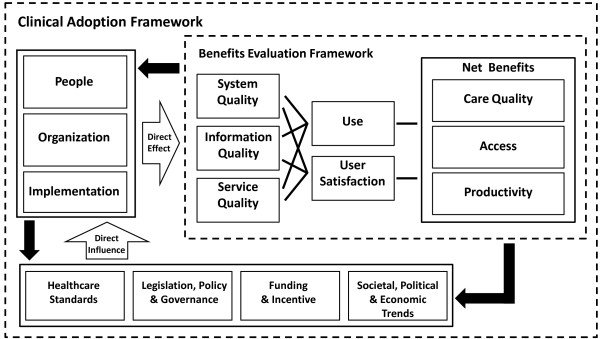
“It extends the Infoway Benefits Evaluation (BE) Framework published in 2006 [18] (adapted from the DeLone and McLean information system success model [19,20]).”
BackgroundMethodInformation Systems Success: The Quest for the Dependent Variable
DeLone, W. H., & McLean, E. R. (1992) · Information Systems Research · doi:10.1287/isre.3.1.60 · Cited by 10,697 · cited 2×
“It extends the Infoway Benefits Evaluation (BE) Framework published in 2006 [18] (adapted from the DeLone and McLean information system success model [19,20]).”
Garg, A. X., Adhikari, N. K. J., McDonald, H., Rosas-Arellano, M. P., Devereaux, P. J., Beyene, J., Sam, J., & Haynes, R. B. (2005) · JAMA · doi:10.1001/jama.293.10.1223 · Cited by 2,936 · cited 5×
“This was similar to reviews that assessed the effects of HIS in other health settings [21,22].”
BackgroundMethodResultInfluentialInformation Technology Implementation Research: A Technological Diffusion Approach
Cooper, R. B., & Zmud, R. W. (1990) · Management Science · doi:10.1287/mnsc.36.2.123 · Cited by 2,765 · cited 1×
“In this regard, the CA Framework should be expanded by incorporating post-adoption usage behaviours by physicians and their effects over time to reflect the different maturity stages of the EMRs involved [66,67].”
Method(2010) · Handbook of Disease Burdens and Quality of Life Measures · doi:10.1007/978-0-387-78665-0_6514 · Cited by 1,385
Mays, N., Pope, C., & Popay, J. (2005) · Journal of Health Services Research & Policy · doi:10.1258/1355819054308576 · Cited by 1,375
Electronic Health Record Use and the Quality of Ambulatory Care in the United States
Linder, J. A., Ma, J., Bates, D. W., Middleton, B., & Stafford, R. S. (2007) · Archives of Internal Medicine · doi:10.1001/archinte.167.13.1400 · Cited by 438 · cited 3×
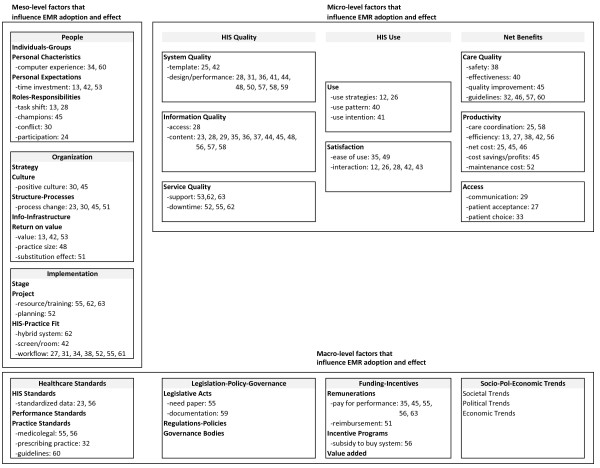
“At the micro-level, system quality factors included the availability of templates [25,42], interface design [31,36,41,44,48,50,55,57,59] and technical performance (e.”
BackgroundDeterminants of Success of Inpatient Clinical Information Systems: A Literature Review
van der Meijden, M. J. (2003) · Journal of the American Medical Informatics Association · doi:10.1197/jamia.m1094 · Cited by 363 · cited 1×
“When compared with the success factors reported in van der Meijden’s review [65] of inpatient clinical information systems, we were able to map many of their factors to those listed under the micro-level dimensions of the CA Framework in our EMR review.”
ResultSchoen, C., Osborn, R., Doty, M. M., Squires, D., Peugh, J., & Applebaum, S. (2009) · Health Affairs · doi:10.1377/hlthaff.28.6.w1171 · Cited by 358 · cited 2×
“[Exhibit-1 in ref [3]]), study design (experimental/observational/descriptive) and time period (2000-04 vs.”
BackgroundTamblyn, R. M., Huang, A. R., Perreault, R. B., Jacques, A., Roy, D., Hanley, J. A., McLeod, P. J., & Laprise, R. (2003) · Europe PMC (PubMed Central) · Cited by 346
Systematic review of scope and quality of electronic patient record data in primary care
Thiru, K., Hassey, A., & Sullivan, F. (2003) · BMJ · doi:10.1136/bmj.326.7398.1070 · Cited by 342 · cited 4×
“When compared with the earlier reviews for primary care and general practice settings, our findings showed less improvement in the areas of disease management [6], patient record quality [7,8] and decision support tools [9], but similar improvement in preventive care [11].”
BackgroundResultInfluentialMargalit, R. S., Roter, D., Dunevant, M. A., Larson, S., & Reis, S. (2006) · Patient Education and Counseling · doi:10.1016/j.pec.2005.03.004 · Cited by 310 · cited 2×
“psychological) [12,26,42,43], consult room layout [42] and patients’ ability to schedule appointments [27,33].”
BackgroundMontgomery, A. A. (2000) · BMJ · doi:10.1136/bmj.320.7236.686 · Cited by 279 · cited 3×
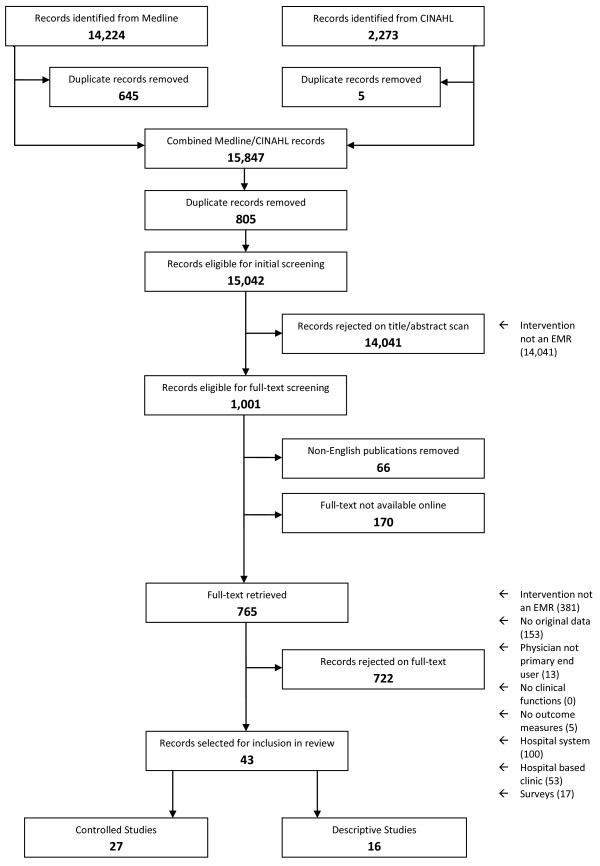
“Of the 765 full-text articles screened, 43 studies were selected for this review (27 controlled, 16 descriptive) [12,13,23-63].”
BackgroundEslami, S., Keizer, N. F. D., & Abu-Hanna, A. (2008) · International Journal of Medical Informatics · doi:10.1016/j.ijmedinf.2007.10.001 · Cited by 272 · cited 1×
“[64] on inpatient computerized provider order entry (CPOE) systems identified in the Lau review [15].”
BackgroundMitchell, E. (2001) · BMJ · doi:10.1136/bmj.322.7281.279 · Cited by 271 · cited 4×
“When compared with the earlier reviews for primary care and general practice settings, our findings showed less improvement in the areas of disease management [6], patient record quality [7,8] and decision support tools [9], but similar improvement in preventive care [11].”
BackgroundResultInfluentialCorrelates of Electronic Health Record Adoption in Office Practices: A Statewide Survey
Simon, S. R., Kaushal, R., Cleary, P. D., Jenter, C. A., Volk, L. A., Poon, E. G., Orav, E. J., Lo, H. G., Williams, D. H., & Bates, D. W. (2007) · Journal of the American Medical Informatics Association · doi:10.1197/jamia.m2187 · Cited by 271 · cited 2×
“Different approaches have also been applied to examine the impact of EMRs, including field observation studies [12], workflow analysis [13] and surveys [14].”
BackgroundMethodThe Value Of Electronic Health Records In Solo Or Small Group Practices
Miller, R. H., West, C., Brown, T. M., Sim, I., & Ganchoff, C. (2005) · Health Affairs · doi:10.1377/hlthaff.24.5.1127 · Cited by 249 · cited 8×
“Information quality factors included the organization, accuracy, completeness and accessibility of the patient record [23,28,29,35-37,44,45,47-56].”
BackgroundInfluentialQuality of morbidity coding in general practice computerized medical records: a systematic review
Jordan, K. (2004) · Family Practice · doi:10.1093/fampra/cmh409 · Cited by 199 · cited 4×
“When compared with the earlier reviews for primary care and general practice settings, our findings showed less improvement in the areas of disease management [6], patient record quality [7,8] and decision support tools [9], but similar improvement in preventive care [11].”
BackgroundResultInfluentialThe clinical value of computerized information services. A review of 98 randomized clinical trials
Balas, E. A. (1996) · Archives of Family Medicine · doi:10.1001/archfami.5.5.271 · Cited by 190 · cited 3×
“This was similar to reviews that assessed the effects of HIS in other health settings [21,22].”
BackgroundMethodResultA review on systematic reviews of health information system studies
Lau, F., Kuziemsky, C., Price, M., & Gardner, J. (2010) · Journal of the American Medical Informatics Association · doi:10.1136/jamia.2010.004838 · Cited by 186 · cited 6×
“1%) [15], while our review showed greater improvement in work practice (64.”
BackgroundMethodInfluentialSelf-citationThe electronic patient record in primary care–regression or progression? A cross sectional study.
Hippisley-Cox, J., Pringle, M., Cater, R., Wynn, A., Hammersley, V., Coupland, C., Hapgood, R., Horsfield, P., Teasdale, S., & Johnson, C. (2003) · BMJ · doi:10.1136/bmj.326.7404.1439 · Cited by 176 · cited 2×
“Of the 765 full-text articles screened, 43 studies were selected for this review (27 controlled, 16 descriptive) [12,13,23-63].”
BackgroundBryan, C., & Boren, S. (2008) · Journal of Innovation in Health Informatics · doi:10.14236/jhi.v16i2.679 · Cited by 170 · cited 4×
“When compared with the earlier reviews for primary care and general practice settings, our findings showed less improvement in the areas of disease management [6], patient record quality [7,8] and decision support tools [9], but similar improvement in preventive care [11].”
BackgroundResultInfluentialBooth, N., Robinson, P., & Kohannejad, J. (2004) · Journal of Innovation in Health Informatics · doi:10.14236/jhi.v12i2.111 · Cited by 133 · cited 3×
“psychological) [12,26,42,43], consult room layout [42] and patients’ ability to schedule appointments [27,33].”
Backgroundvan Wyk, J. T., van Wijk, M. A. M., Sturkenboom, M. C. J. M., Mosseveld, M., Moorman, P. W., & van der Lei, J. (2008) · Circulation · doi:10.1161/circulationaha.107.697201 · Cited by 124 · cited 2×
“Of the 765 full-text articles screened, 43 studies were selected for this review (27 controlled, 16 descriptive) [12,13,23-63].”
BackgroundImplementing electronic health records: Key factors in primary care.
Terry, A. L., Thorpe, C. F., Giles, G., Brown, J. B., Harris, S. B., Reid, G. J., Thind, A., & Stewart, M. (2008) · PubMed · Cited by 120
Hollingworth, W., Devine, E. B., Hansen, R. N., Lawless, N. M., Comstock, B. A., Wilson-Norton, J. L., Tharp, K. L., & Sullivan, S. D. (2007) · Journal of the American Medical Informatics Association · doi:10.1197/jamia.m2377 · Cited by 114 · cited 3×
“Of the 765 full-text articles screened, 43 studies were selected for this review (27 controlled, 16 descriptive) [12,13,23-63].”
Backgrounde-Prescribing, Efficiency, Quality: Lessons from the Computerization of UK Family Practice
Schade, C. P., Sullivan, F. M., de Lusignan, S., & Madeley, J. (2006) · Journal of the American Medical Informatics Association · doi:10.1197/jamia.m2041 · Cited by 113 · cited 7×
“Information quality factors included the organization, accuracy, completeness and accessibility of the patient record [23,28,29,35-37,44,45,47-56].”
BackgroundInfluentialTamblyn, R., Huang, A., Taylor, L., Kawasumi, Y., Bartlett, G., Grad, R., Jacques, A., Dawes, M., Abrahamowicz, M., Perreault, R., et al. (2008) · Journal of the American Medical Informatics Association · doi:10.1197/jamia.m2606 · Cited by 110 · cited 3×
“At the micro-level, system quality factors included the availability of templates [25,42], interface design [31,36,41,44,48,50,55,57,59] and technical performance (e.”
BackgroundWells, S., Furness, S., Rafter, N., Horn, E., Whittaker, R., Stewart, A., Moodabe, K., Roseman, P., Selak, V., Bramley, D., et al. (2008) · European Journal of Cardiovascular Prevention & Rehabilitation · doi:10.1097/hjr.0b013e3282f13af4 · Cited by 109 · cited 6×
“The service support provided during implementation was critical [48,53,62,63], since they affected the disruptions that physicians and office staff had to overcome while learning to use the EMR and redesign their work routines.”
BackgroundInfluentialQuality Improvement with an Electronic Health Record: Achievable, but Not Automatic
Baron, R. J. (2007) · Annals of Internal Medicine · doi:10.7326/0003-4819-147-8-200710160-00007 · Cited by 108 · cited 5×
“Information quality factors included the organization, accuracy, completeness and accessibility of the patient record [23,28,29,35-37,44,45,47-56].”
BackgroundInfluentialCrosson, J. C., Ohman-Strickland, P. A., Hahn, K. A., DiCicco-Bloom, B., Shaw, E., Orzano, A. J., & Crabtree, B. F. (2007) · The Annals of Family Medicine · doi:10.1370/afm.696 · Cited by 107 · cited 2×
“At the micro-level, system quality factors included the availability of templates [25,42], interface design [31,36,41,44,48,50,55,57,59] and technical performance (e.”
BackgroundAssessment of Decision Support for Blood Test Ordering in Primary Care: A Randomized Trial
van Wijk, M. A. M., van der Lei, J., Mosseveld, M., Bohnen, A. M., & van Bemmel, J. H. (2001) · Annals of Internal Medicine · doi:10.7326/0003-4819-134-4-200102200-00010 · Cited by 98 · cited 5×
“At the meso-level, people factors included personal characteristics and expectations such as prior EMR experience of the users [34,60], and their personal time investment in exchange for the benefits expected from the system [13,28,42].”
BackgroundInfluentialChristensen, T., & Grimsmo, A. (2008) · BMC Medical Informatics and Decision Making · doi:10.1186/1472-6947-8-12 · Cited by 98
Ludwick, D. A., & Doucette, J. (2009) · International Journal of Telemedicine and Applications · doi:10.1155/2009/853524 · Cited by 93 · cited 6×
“At the meso-level, people factors included personal characteristics and expectations such as prior EMR experience of the users [34,60], and their personal time investment in exchange for the benefits expected from the system [13,28,42].”
BackgroundInfluentialCrosson, J. C. (2005) · The Annals of Family Medicine · doi:10.1370/afm.326 · Cited by 92 · cited 4×
“hybrid EMR/paper systems) [50], and EMR-supported office and workflow design [30,45,51,53,56,59,63] such as the placement of computer screens in consult rooms [42].”
BackgroundInfluentialFilippi, A., Sabatini, A., Badioli, L., Samani, F., Mazzaglia, G., Catapano, A., & Cricelli, C. (2003) · Diabetes Care · doi:10.2337/diacare.26.5.1497 · Cited by 91 · cited 2×
“Of the 765 full-text articles screened, 43 studies were selected for this review (27 controlled, 16 descriptive) [12,13,23-63].”
BackgroundExploring Physician Adoption of EMRs: A Multi-Case Analysis
Randeree, E. (2007) · Journal of Medical Systems · doi:10.1007/s10916-007-9089-5 · Cited by 85 · cited 5×
“Information quality factors included the organization, accuracy, completeness and accessibility of the patient record [23,28,29,35-37,44,45,47-56].”
BackgroundInfluentialImpact of an electronic medical record system on community-based primary care practices.
Wager, K. A., Lee, F. W., White, A. W., Ward, D. M., & Ornstein, S. M. (2000) · PubMed · Cited by 84
Lau, F., Price, M., & Keshavjee, K. (2011) · Healthcare Quarterly · doi:10.12927/hcq.2011.22157 · Cited by 83 · cited 4×
“quality improvement versus record keeping) [41], actual strategies for optimal/appropriate use [12-26], ease of use [35,49], and usage patterns that emerged over time [40].”
BackgroundMethodInfluentialSelf-citationRollman, B. L., Hanusa, B. H., Gilbert, T., Lowe, H. J., Kapoor, W. N., & Schulberg, H. C. (2001) · Archives of Internal Medicine · doi:10.1001/archinte.161.2.189 · Cited by 77 · cited 2×
“Of the 765 full-text articles screened, 43 studies were selected for this review (27 controlled, 16 descriptive) [12,13,23-63].”
BackgroundThe effect of computer reminders on GPs’ prescribing behaviour: A cluster-randomised trial
Martens, J. D., van der Weijden, T., Severens, J. L., de Clercq, P. A., Bruijn‐Geraets, D. P. D., Kester, A. D. M., & Winkens, R. A. G. (2007) · International Journal of Medical Informatics · doi:10.1016/j.ijmedinf.2007.04.005 · Cited by 70 · cited 3×
“At the micro-level, system quality factors included the availability of templates [25,42], interface design [31,36,41,44,48,50,55,57,59] and technical performance (e.”
BackgroundA proposed benefits evaluation framework for health information systems in Canada.
Lau, F., Hagens, S., & Muttitt, S. C. (2007) · PubMed · Cited by 68
Self-citationOpportunistic electronic reminders. Improving performance of preventive care in general practice.
Frank, O., Litt, J., & Beilby, J. (2004) · PubMed · Cited by 62
Adaji, A., Schattner, P., & Jones, K. (2008) · Journal of Innovation in Health Informatics · doi:10.14236/jhi.v16i3.698 · Cited by 58 · cited 4×
“When compared with the earlier reviews for primary care and general practice settings, our findings showed less improvement in the areas of disease management [6], patient record quality [7,8] and decision support tools [9], but similar improvement in preventive care [11].”
BackgroundResultInfluentialHamilton, W. T., Round, A., Sharp, D., & Peters, T. J. (2003) · Europe PMC (PubMed Central) · Cited by 54
Understanding Post-Adoptive Usage Behaviors: A Two-Dimensional View
Hsieh, J. J. P.-A., & Zmud, R. W. (2006) · Digital Archive @ GSU · Cited by 52
Poley, M. J., Edelenbos, K., Mosseveld, M., van Wijk, M. A. M., de Bakker, D. H., van der Lei, J., & Mölken, M. R. (2007) · Clinical Chemistry · doi:10.1373/clinchem.2006.073908 · Cited by 50 · cited 5×
“Information quality factors included the organization, accuracy, completeness and accessibility of the patient record [23,28,29,35-37,44,45,47-56].”
BackgroundInfluentialChan, W.-S., Stevenson, M., & McGlade, K. J. (2007) · International Journal of Medical Informatics · doi:10.1016/j.ijmedinf.2007.10.005 · Cited by 45 · cited 4×
“psychological) [12,26,42,43], consult room layout [42] and patients’ ability to schedule appointments [27,33].”
BackgroundMethodInfluentialMeasuring the success of electronic medical record implementation using electronic and survey data.
Keshavjee, K., Troyan, S., Holbrook, A. M., & VanderMolen, D. (2001) · Europe PMC (PubMed Central) · Cited by 44
Samoutis, G., Soteriades, E., Kounalakis, D., Zachariadou, T., Philalithis, A., & Lionis, C. (2008) · Journal of Innovation in Health Informatics · doi:10.14236/jhi.v15i4.660 · Cited by 41 · cited 8×
“Information quality factors included the organization, accuracy, completeness and accessibility of the patient record [23,28,29,35-37,44,45,47-56].”
BackgroundInfluentialEffects of electronic communication in general practice
van der Kam, W. J., Moorman, P. W., & Koppejan-Mulder, M. J. (2000) · International Journal of Medical Informatics · doi:10.1016/s1386-5056(00)00096-4 · Cited by 40 · cited 3×
“These reviews covered topics in diabetes management [6], patient record quality [7,8], decision support tools [9], electronic communication [10], and provider performance and patient outcomes [11].”
BackgroundKenealy, T. W., Arroll, B., & Petrie, K. J. (2005) · Journal of General Internal Medicine · doi:10.1111/j.1525-1497.2005.0197.x · Cited by 39 · cited 1×
“Of the 765 full-text articles screened, 43 studies were selected for this review (27 controlled, 16 descriptive) [12,13,23-63].”
BackgroundThe quality of electronic patient records in Finnish primary healthcare needs to be improved
Vainiomäki, S., Kuusela, M., Vainiomäki, P., & Rautava, P. T. (2008) · Scandinavian Journal of Primary Health Care · doi:10.1080/02813430701868806 · Cited by 33 · cited 4×
“At the micro-level, system quality factors included the availability of templates [25,42], interface design [31,36,41,44,48,50,55,57,59] and technical performance (e.”
BackgroundInfluentialDo decision support systems influence variation in prescription?
de Jong, J. D., Groenewegen, P., Spreeuwenberg, P. M. M., Westert, G. P., & de Bakker, D. H. (2009) · BMC Health Services Research · doi:10.1186/1472-6963-9-20 · Cited by 31 · cited 4×
“Of the 765 full-text articles screened, 43 studies were selected for this review (27 controlled, 16 descriptive) [12,13,23-63].”
BackgroundInfluentialEffect of computerised prescribing on use of antibiotics
Newby, D., Fryer, J., & Henry, D. A. (2003) · The Medical Journal of Australia · doi:10.5694/j.1326-5377.2003.tb05164.x · Cited by 31
Kinn, J. W., O'Toole, M. F., Rowley, S. M., Marek, J. C., Bufalino, V. J., & Brown, A. S. (2001) · The American Journal of Cardiology · doi:10.1016/s0002-9149(01)01612-5 · Cited by 30 · cited 3×
“Of the 765 full-text articles screened, 43 studies were selected for this review (27 controlled, 16 descriptive) [12,13,23-63].”
BackgroundAn Effective Electronic Surgical Referral System
Dennison, J., Eisen, S., Towers, M., & Clark, C. L. I. (2006) · Annals of The Royal College of Surgeons of England · doi:10.1308/003588406x130642 · Cited by 25 · cited 2×
“psychological) [12,26,42,43], consult room layout [42] and patients’ ability to schedule appointments [27,33].”
BackgroundMitchell, E., McConnachie, A., & Sullivan, F. (2003) · Journal of Innovation in Health Informatics · doi:10.14236/jhi.v11i2.557 · Cited by 24 · cited 5×
“Information quality factors included the organization, accuracy, completeness and accessibility of the patient record [23,28,29,35-37,44,45,47-56].”
BackgroundInfluentialChristensen, T., & Grimsmo, A. (2008) · Journal of Innovation in Health Informatics · doi:10.14236/jhi.v16i1.671 · Cited by 23 · cited 2×
“Of the 765 full-text articles screened, 43 studies were selected for this review (27 controlled, 16 descriptive) [12,13,23-63].”
BackgroundElectronic Medical Records in Solo/Small Groups: A Qualitative Study of Physician User Types
Miller, R. H., Ida, S., & Jeff, N. (2004) · Studies in health technology and informatics · doi:10.3233/978-1-60750-949-3-658 · Cited by 22 · cited 2×
“Of the 765 full-text articles screened, 43 studies were selected for this review (27 controlled, 16 descriptive) [12,13,23-63].”
BackgroundBassa, A., del Val, M., Cobos, A., Torremad, E., n, S. B., Crespo, C., Brosa, M., o, S. M., & Espinosa, C. (2005) · Disease Management & Health Outcomes · doi:10.2165/00115677-200513010-00007 · Cited by 21 · cited 4×
“Of the 765 full-text articles screened, 43 studies were selected for this review (27 controlled, 16 descriptive) [12,13,23-63].”
BackgroundInfluentialThe impact of electronic patient records on workflow in general practice
Cauldwell, M., Beattie, C. E., Cox, B. M., Denby, W. J., Ede-Golightly, J. A., & Linton, F. L. (2007) · Health Informatics Journal · doi:10.1177/1460458207076470 · Cited by 18 · cited 3×
“psychological) [12,26,42,43], consult room layout [42] and patients’ ability to schedule appointments [27,33].”
BackgroundUsing computer based templates for chronic disease management.
Bolger-Harris, H., Schattner, P. L., & Saunders, M. (2008) · PubMed · Cited by 13
Using electronic patient records to inform strategic decision making in primary care
Mitchell, E., Sullivan, F., Watt, G. C. M., Grimshaw, J., & Donnan, P. T. (2004) · Studies in health technology and informatics · doi:10.3233/978-1-60750-949-3-1157 · Cited by 13 · cited 2×
“Of the 765 full-text articles screened, 43 studies were selected for this review (27 controlled, 16 descriptive) [12,13,23-63].”
BackgroundInformation technology creeps into rural general practice
Robinson, A. (2003) · Australian Health Review · doi:10.1071/ah030131 · Cited by 5 · cited 5×
“Information quality factors included the organization, accuracy, completeness and accessibility of the patient record [23,28,29,35-37,44,45,47-56].”
BackgroundInfluentialHamilton, W. T., Round, A., Sharp, D., & Peters, T. J. (2004) · Cited by 5
Research works printed but not linked: 2
- Canadian Medical Association Information Technology and Health care in Canada: 2010 Status Report http://www.cma.ca/IThandbook
- Lai JK Lau F Shaw N A study of information technology use and implementation of electronic medical record systems in BC medical practices BC Medical Journal 2009 51 3 114 121
Cited by
Ross, J., Stevenson, F., Lau, R., & Murray, E. (2016) · Implementation Science · doi:10.1186/s13012-016-0510-7 · Cited by 1,011
“…their implementation were reported as important implementation factors by the majority of studies across all e-health domains [15 – 19, 22 – 25, 27, 28, 30 – 33, 36, 38, 39, 41, 43, 47, 49, 51 – 54, 57], with some studies citing cost-related factors as the main barrier to implementation [49, 54].”
BackgroundInfluentialLau, R., Stevenson, F., Ong, B. N., Dziedzic, K., Treweek, S., Eldridge, S., Everitt, H., Kennedy, A., Qureshi, N., Rogers, A., et al. (2015) · Implementation Science · doi:10.1186/s13012-016-0396-4 · Cited by 533
“Infrastructure [14, 15, 42, 53, 58, 67, 72, 74, 75, 82, 86, 101, 104] B: Inadequate employment contracts, practice facilities and functioning of the primary care team [85] F: Mechanism of support and infrastructure to support health care professionals [85] √ √ √ √ √”
BackgroundMethodInfluentialA review of PHR, EMR and EHR integration: A more personalized healthcare and public health policy
Heart, T., Ben-Assuli, O., & Shabtai, I. (2017) · Health Policy and Technology · doi:10.1016/j.hlpt.2016.08.002 · Cited by 251
“Though there are many advantages to this system, adoption rates are fairly low in community clinics [17] that face a number of obstacles [18].”
BackgroundAlkureishi, M. A., Lee, W. W., Lyons, M., Press, V. G., Imam, S., Nkansah-Amankra, A., Werner, D., & Arora, V. M. (2016) · Journal of General Internal Medicine · doi:10.1007/s11606-015-3582-1 · Cited by 230
Gillum, R. F. (2013) · The American Journal of Medicine · doi:10.1016/j.amjmed.2013.03.024 · Cited by 177
Metadata
- Authors
- Lau, F., Price, M., Boyd, J., Partridge, C., Bell, H., & Raworth, R.
- Affiliations
- University of Victoria (CA)
- University of British Columbia (CA)
- Corresponding author
- Lau, Francis
- Venue
- BMC Medical Informatics and Decision Making
- Published
- 2012-02-24
- Volume
- 12
- Issue
- 1
- Pages
- 10-10
- ISSN
- 1472-6947 (ISSN-L)
- PMC
- PMC3315440
- OpenAlex
- W2086254292
- Cited by
- 199
- References
- 67
- Citations by year
- 2026: 1 · 2025: 3 · 2024: 9 · 2023: 10 · 2022: 11 · 2021: 11 · 2020: 12 · 2019: 14 · 2018: 15 · 2017: 18 · 2016: 18 · 2015: 25 · 2014: 19 · 2013: 26 · 2012: 6
- FWCI
- 4.02
- Type
- journal article
- Language
- en
- Open access
- gold
- doi.org
- Licence
- cc-by
- creativecommons.org/licenses/by/2.0 (tdm)
- Locations
- BMC Medical Informatics and Decision Making (publishedVersion, cc-by)
- Europe PMC (PubMed Central) (publishedVersion, cc-by)
- PubMed Central (publishedVersion, cc-by)
- PubMed (publishedVersion)
- UVic’s Research and Learning Repository (University of Victoria) (submittedVersion, cc-by)
- DOAJ (DOAJ: Directory of Open Access Journals) (submittedVersion, cc-by-sa)
- UVic’s Research and Learning Repository (University of Victoria) (submittedVersion)
- Funders
- University of British Columbia
- Canadian Institutes of Health Research
- Topics
- Health Sciences › Health Professions › Health Information Management › Electronic Health Records Systems
- Health Sciences › Health Professions › Health Information Management › Medical Coding and Health Information
- Health Sciences › Nursing › Research and Theory › Nursing Diagnosis and Documentation
- Keywords
- electronic health records, physician practice, eHealth implementation, disease management, clinical documentation, preventive medicine, patient-physician interaction, lessons learned, value for money
- MeSH terms
- Diffusion of Innovation, Family Practice, Humans, Physician-Patient Relations, Preventive Health Services, Prospective Studies, Electronic Health Records
About these checks
Registry, retraction, Cites and statistics results are computed, not judged, with one exception: a printed reference that no index lists is read once by a model before it counts as a citation error. Claims are extracted by a model and kept only when their quote appears verbatim in the text; each cited source is then checked, with a model’s help, for whether it says what the claim relies on. Those verdicts can be wrong — read the claim’s quote and the cited source before relying on one.
Statistics and arithmetic are recomputed, not judged.
Confidence bands are shown only for fields calibrated on our annotated test set. None is calibrated yet, so no band is shown.
What counts as a claim ›How we measure confidence ›How we check this ›
Are you an author, or do you see a problem with this page? Request a review
Data sources
Bibliographic data: Semantic Scholar, OpenAlex, Crossref.
Contains information from the Semantic Scholar Academic Graph Datasets, made available under the ODC Attribution License (ODC-BY 1.0).
Semantic Scholar’s data is described in: Kinney, R., et al. (2023). The Semantic Scholar Open Data Platform. arXiv:2301.10140.
