

Improving follow-up of abnormal cancer screens using electronic health records: trust but verify test result communication
The DOI matches its Crossref record; 11 of the 11 references it cites were found in a registry or an index.
Abstract
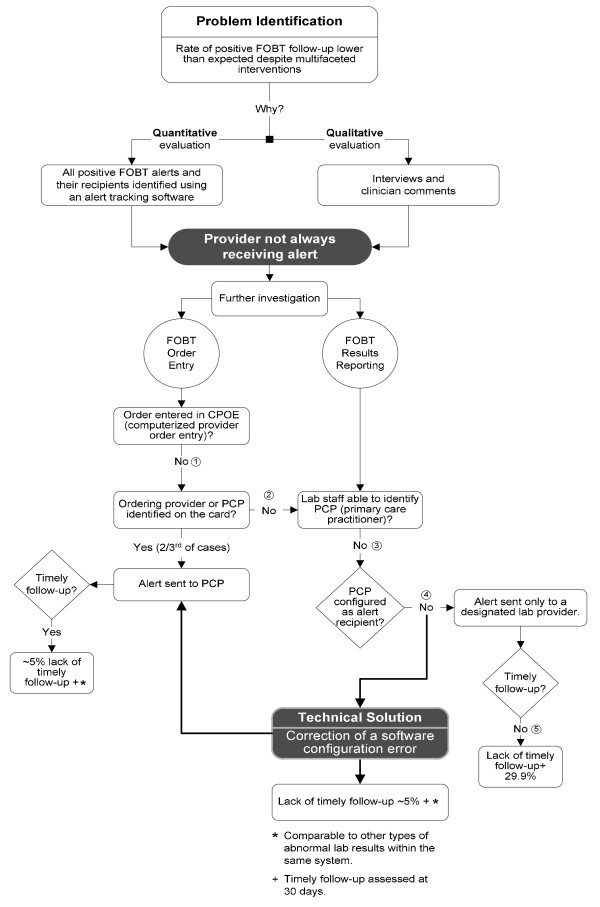
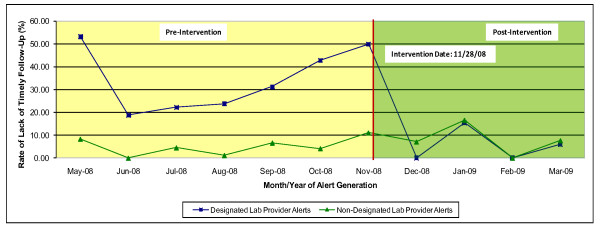
BACKGROUND: Early detection of colorectal cancer through timely follow-up of positive Fecal Occult Blood Tests (FOBTs) remains a challenge. In our previous work, we found 40% of positive FOBT results eligible for colonoscopy had no documented response by a treating clinician at two weeks despite procedures for electronic result notification. We determined if technical and/or workflow-related aspects of automated communication in the electronic health record could lead to the lack of response. METHODS: Using both qualitative and quantitative methods, we evaluated positive FOBT communication in the electronic health record of a large, urban facility between May 2008 and March 2009. We identified the source of test result communication breakdown, and developed an intervention to fix the problem. Explicit medical record reviews measured timely follow-up (defined as response within 30 days of positive FOBT) pre- and post-intervention. RESULTS: Data from 11 interviews and tracking information from 490 FOBT alerts revealed that the software intended to alert primary care practitioners (PCPs) of positive FOBT results was not configured correctly and over a third of positive FOBTs were not transmitted to PCPs. Upon correction of the technical problem, lack of timely follow-up decreased immediately from 29.9% to 5.4% (p<0.01) and was sustained at month 4 following the intervention. CONCLUSION: Electronic communication of positive FOBT results should be monitored to avoid limiting colorectal cancer screening benefits. Robust quality assurance and oversight systems are needed to achieve this. Our methods may be useful for others seeking to improve follow-up of FOBTs in their systems.
Overview
The claims and statistics of this paper haven’t been checked yet.
Free: it reads the open-access text and checks the first 5 claims that cite a source we can check. Create a free account to check every claim.
Integrity signals
Registry
Cites
Statistics
Figures
Verification
Claims the paper makes
The claims and statistics of this paper haven’t been checked yet.
Free: it reads the open-access text and checks the first 5 claims that cite a source we can check. Create a free account to check every claim.
Claims other papers make about this one
Each is checked against this paper’s own text: does it say what the citing paper says it does?
The cited source says what the claim attributes to it.
In the citing paper
“We recently evaluated why, despite implementation of an automated notification system to enhance communication of fecal occult blood test (FOBT) results, providers did not take follow-up actions in almost 40% of cases [63].”
From A new sociotechnical model for studying health information technology in complex adaptive healthcare systems (2010) · cites this paper as [63]
Self-check
Percentages, sums and reported differences re-computed from the paper’s own numbers.
The self-check needs the paper’s full text.
Citations
Cites
Koppel, R., Wetterneck, T., Telles, J. L., & Karsh, B.-T. (2008) · Journal of the American Medical Informatics Association · doi:10.1197/jamia.m2616 · Cited by 685
Missed and delayed diagnoses in the ambulatory setting: a study of closed malpractice claims
Gandhi, T. K., Kachalia, A., Thomas, E. J., Puopolo, A. L., Yoon, C., Brennan, T. A., & Studdert, D. M. (2006) · Annals of Internal Medicine · doi:10.7326/0003-4819-145-7-200610030-00006 · Cited by 662
Phillips, R. L. (2004) · Quality and Safety in Health Care · doi:10.1136/qshc.2003.008029 · Cited by 233
Singh, H., Naik, A. D., Rao, R., & Petersen, L. A. (2008) · Journal of General Internal Medicine · doi:10.1007/s11606-007-0393-z · Cited by 162
Self-citationSingh, H., Thomas, E. J., Sittig, D. F., Wilson, L., Espadas, D., Khan, M. M., & Petersen, L. A. (2010) · The American Journal of Medicine · doi:10.1016/j.amjmed.2009.07.027 · Cited by 160
Self-citationCommunication outcomes of critical imaging results in a computerized notification system
Singh, H., Arora, H. S., Vij, M. S., Rao, R., Khan, M. M., & Petersen, L. A. (2007) · Journal of the American Medical Informatics Association · doi:10.1197/jamia.m2280 · Cited by 140
Self-citationYabroff, K. R., Washington, K. S., Leader, A., Neilson, E., & Mandelblatt, J. (2003) · Medical Care Research and Review · doi:10.1177/1077558703254698 · Cited by 137
Errors in cancer diagnosis: current understanding and future directions
Singh, H., Sethi, S., Raber, M., & Petersen, L. A. (2007) · Journal of Clinical Oncology · doi:10.1200/jco.2007.13.2142 · Cited by 121
Self-citationDesign and implementation of a comprehensive outpatient Results Manager
Poon, E. G., Wang, S. J., Gandhi, T. K., Bates, D. W., & Kuperman, G. J. (2003) · Journal of Biomedical Informatics · doi:10.1016/s1532-0464(03)00061-3 · Cited by 111
Eight Rights of Safe Electronic Health Record Use
Sittig, D. F. (2009) · JAMA · doi:10.1001/jama.2009.1311 · Cited by 85
Self-citation
Research works printed but not linked: 17
- Baig N Myers RE Turner BJ Physician-reported reasons for limited follow-up of patients with a positive fecal occult blood test screening result The American Journal of Gastroenterology 2003 98 2078 2081 10.1111/j.1572-0241.2003.07575.x 14499791 · DOI
- Levin B Hess K Johnson C Screening for colorectal cancer. A comparison of 3 fecal occult blood tests Arch Intern Med 1997 157 970 976 10.1001/archinte.157.9.970 9140267 · DOI
- Morris JB Stellato TA Guy BB Gordon NH Berger NA A critical analysis of the largest reported mass fecal occult blood screening program in the United States Am J Surg 1991 161 101 105 10.1016/0002-9610(91)90368-N 1987842 · DOI
- Burack RC Simon MS Stano M George J Coombs J Follow-up among women with an abnormal mammogram in an HMO: is it complete, timely, and efficient? Am J Manag Care 2000 6 1102 1113 11184666
- Bastani R Yabroff KR Myers RE Glenn B Interventions to improve follow-up of abnormal findings in cancer screening Cancer 2004 101 1188 1200 10.1002/cncr.20506 15316914 PMC1811062 · DOI · Paper page
- Mandel JS Church TR Bond JH The effect of fecal occult-blood screening on the incidence of colorectal cancer N Engl J Med 2000 343 1603 1607 10.1056/NEJM200011303432203 11096167 · DOI · Paper page
- Mandel JS Bond JH Church TR Reducing mortality from colorectal cancer by screening for fecal occult blood. Minnesota Colon Cancer Control Study N Engl J Med 1993 328 1365 1371 10.1056/NEJM199305133281901 8474513 · DOI · Paper page
- Kronborg O Jorgensen OD Fenger C Rasmussen M Randomized study of biennial screening with a faecal occult blood test: results after nine screening rounds Scand J Gastroenterol 2004 39 846 851 10.1080/00365520410003182 15513382 · DOI · Paper page
- Etzioni D Yano E Rubenstein L Measuring the Quality of Colorectal Cancer Screening: The Importance of Follow-Up Diseases of the Colon & Rectum 2006 49 1002 1010 10.1007/s10350-006-0533-2 16673056 · DOI
- Fisher DA Jeffreys A Coffman CJ Fasanella K Barriers to full colon evaluation for a positive fecal occult blood test Cancer Epidemiol Biomarkers Prev 2006 15 1232 1235 10.1158/1055-9965.EPI-05-0916 16775188 · DOI
- Myers RE Hyslop T Gerrity M Physician Intention to Recommend Complete Diagnostic Evaluation in Colorectal Cancer Screening Cancer Epidemiol Biomarkers Prev 1999 8 587 593 10428195
- Myers RE Turner B Weinberg D Impact of a physician-oriented intervention on follow-up in colorectal cancer screening Prev Med 2004 38 375 381 10.1016/j.ypmed.2003.11.010 15020170 · DOI
- Jimbo M Myers RE Meyer B Reasons Patients With a Positive Fecal Occult Blood Test Result Do Not Undergo Complete Diagnostic Evaluation Ann Fam Med 2009 7 11 16 10.1370/afm.906 19139444 PMC2625842 · DOI
- Singh H Kadiyala H Bhagwath G Using a multifaceted approach to improve the follow-up of positive fecal occult blood test results Am J Gastroenterol 2009 104 942 952 10.1038/ajg.2009.55 19293786 PMC2921791 · DOI · Paper page
- Bagian JP Gosbee J Lee CZ Williams L McKnight SD Mannos DM The Veterans Affairs root cause analysis system in action Jt Comm J Qual Improv 2002 28 531 545 12369156
- Ash JS Smith AC Stavri PZ Friedman CP, Wyatt JC Performing subjectivist studies in the qualitative traditions responsive to users Evaluation Methods in Biomedical Informatics 2006 2 Springer New York 267 300 full_text · DOI
- Bates DW Leape LL Doing better with critical test results Jt Comm J Qual Patient Saf 2005 31 66 67 15791765 · DOI
Cited by
Sittig, D. F., & Singh, H. (2010) · Quality and Safety in Health Care · doi:10.1136/qshc.2010.042085 · Cited by 897
Self-citationAn analysis of electronic health record-related patient safety concerns
Meeks, D. W., Smith, M. W., Taylor, L., Sittig, D. F., Scott, J. M., & Singh, H. (2014) · Journal of the American Medical Informatics Association · doi:10.1136/amiajnl-2013-002578 · Cited by 207
Self-citationElectronic health records and national patient-safety goals
Sittig, D. F., & Singh, H. (2012) · New England Journal of Medicine · doi:10.1056/nejmsb1205420 · Cited by 204
Self-citationAdvancing the science of measurement of diagnostic errors in healthcare: the Safer Dx framework
Singh, H., & Sittig, D. F. (2015) · BMJ Quality & Safety · doi:10.1136/bmjqs-2014-003675 · Cited by 195
Self-citationSingh, H., & Sittig, D. F. (2016) · BMJ Quality & Safety · doi:10.1136/bmjqs-2015-004486 · Cited by 167
Self-citationDefining Health Information Technology–Related Errors: New Developments Since To Err Is Human
Sittig, D. F. (2011) · Archives of Internal Medicine · doi:10.1001/archinternmed.2011.327 · Cited by 166
Self-citationMeeks, D. W., Takian, A., Sittig, D. F., Singh, H., & Barber, N. (2014) · Journal of the American Medical Informatics Association · doi:10.1136/amiajnl-2013-001762 · Cited by 91
Self-citationSmith, M., Murphy, D., Laxmisan, A., Sittig, D., Reis, B., Esquivel, A., & Singh, H. (2013) · Applied Clinical Informatics · doi:10.4338/aci-2013-04-ra-0019 · Cited by 31
Self-citationThe economics of diagnostic safety
Slawomirski, L., Kelly, D., de Bienassis, K., Kallas, K.-A., & Klazinga, N. (2025) · OECD Health Working Papers · doi:10.1787/fc61057a-en · Cited by 20
Metadata
- Authors
- Singh, H., Wilson, L., Petersen, L. A., Sawhney, M. K., Reis, B., Espadas, D., & Sittig, D. F.
- Venue
- BMC Medical Informatics and Decision Making
- Published
- 2009-12
- Volume
- 9
- Issue
- 1
- ISSN
- 1472-6947
- PMC
- PMC2797509
- Cited by
- 47
- References
- 11
- Language
- en
- Licence
- creativecommons.org/licenses/by/2.0 (tdm)
About these checks
Registry, retraction, Cites and statistics results are computed, not judged, with one exception: a printed reference that no index lists is read once by a model before it counts as a citation error. Claims are extracted by a model and kept only when their quote appears verbatim in the text; each cited source is then checked, with a model’s help, for whether it says what the claim relies on. Those verdicts can be wrong — read the claim’s quote and the cited source before relying on one.
Statistics and arithmetic are recomputed, not judged.
Confidence bands are shown only for fields calibrated on our annotated test set. None is calibrated yet, so no band is shown.
What counts as a claim ›How we measure confidence ›How we check this ›
Are you an author, or do you see a problem with this page? Request a review
Data sources
Bibliographic data: Semantic Scholar, OpenAlex, Crossref.
Contains information from the Semantic Scholar Academic Graph Datasets, made available under the ODC Attribution License (ODC-BY 1.0).
Semantic Scholar’s data is described in: Kinney, R., et al. (2023). The Semantic Scholar Open Data Platform. arXiv:2301.10140.
