

Nursing churn and turnover in Australian hospitals: nurses perceptions and suggestions for supportive strategies
Open accessThe DOI matches its Crossref record; 58 of the 59 references it cites were found in a registry or an index.
Abstract
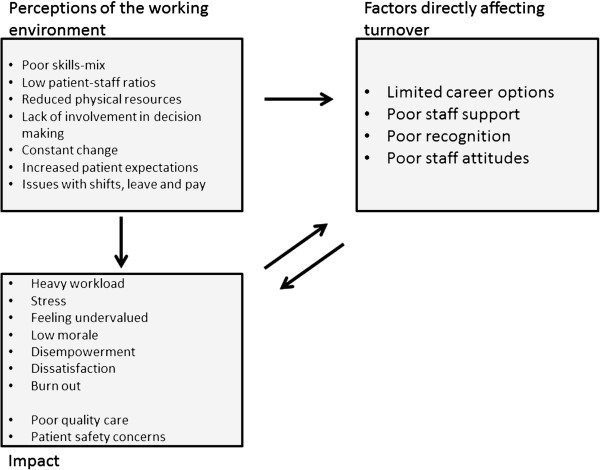
BACKGROUND: This study aimed to reveal nurses' experiences and perceptions of turnover in Australian hospitals and identify strategies to improve retention, performance and job satisfaction. Nursing turnover is a serious issue that can compromise patient safety, increase health care costs and impact on staff morale. A qualitative design was used to analyze responses from 362 nurses collected from a national survey of nurses from medical and surgical nursing units across 3 Australian States/Territories. METHOD: A qualitative design was used to analyze responses from 362 nurses collected from a national survey of nurses from medical and surgical nursing units across 3 Australian States/Territories. RESULTS: Key factors affecting nursing turnover were limited career opportunities; poor support; a lack of recognition; and negative staff attitudes. The nursing working environment is characterised by inappropriate skill-mix and inadequate patient-staff ratios; a lack of overseas qualified nurses with appropriate skills; low involvement in decision-making processes; and increased patient demands. These issues impacted upon heavy workloads and stress levels with nurses feeling undervalued and disempowered. Nurses described supportive strategies: improving performance appraisals, responsive preceptorship and flexible employment options. CONCLUSION: Nursing turnover is influenced by the experiences of nurses. Positive steps can be made towards improving workplace conditions and ensuring nurse retention. Improving performance management and work design are strategies that nurse managers could harness to reduce turnover.
Overview
The claims and statistics of this paper haven’t been checked yet.
Free: it reads the open-access text and checks the first 5 claims that cite a source we can check. Create a free account to check every claim.
Integrity signals
Registry
Cites
Statistics
Figures
Verification
Claims the paper makes
The claims and statistics of this paper haven’t been checked yet.
Free: it reads the open-access text and checks the first 5 claims that cite a source we can check. Create a free account to check every claim.
Claims other papers make about this one
Each is checked against this paper’s own text: does it say what the citing paper says it does?
The source backs part of the claim, not all of it — or backs it for a different population, condition or comparison.
In the citing paper
“A major contributing factor to the shortages seen in the health workforce is employee turnover [3].”
From A global overview of healthcare workers’ turnover intention amid COVID-19 pandemic: a systematic review with future directions (2022) · cites this paper as [3]
Experimental — accuracy not yet measured
Self-check
Percentages, sums and reported differences re-computed from the paper’s own numbers.
The self-check needs the paper’s full text.
Citations
Cites
Hospital Nurse Staffing and Patient Mortality, Nurse Burnout, and Job Dissatisfaction
Aiken, L. H. (2002) · JAMA · doi:10.1001/jama.288.16.1987 · Cited by 5,226
Qualitative data analysis for applied policy research
(2002) · Analyzing Qualitative Data · doi:10.4324/9780203413081-14 · Cited by 4,964 · cited 1×
“These were analyzed thematically [34] using an inductive process to categorise, tabulate and recombine the evidence, in line with the aim of the study reported in this paper.”
MethodGibbs, G. (2007) · doi:10.4135/9781849208574 · Cited by 4,299
The analytic challenge in interpretive description
Thorne, S., Kirkham, S. R., & O'Flynn-Magee, K. (2004) · International Journal of Qualitative Methods · doi:10.1177/160940690400300101 · Cited by 1,793 · cited 1×
“Methods A descriptive qualitative study was undertaken to explore the perceptions and views of Australian nurses of the factors that affect turnover and the working environment [33].”
BackgroundNurse turnover: A literature review – An update
Hayes, L. J., O’Brien-Pallas, L., Duffield, C., Shamian, J., Buchan, J., Hughes, F., Laschinger, H. K. S., & North, N. (2012) · International Journal of Nursing Studies · doi:10.1016/j.ijnurstu.2011.10.001 · Cited by 888 · cited 1×
“Additionally, of the research which has been done, most of it has been in the form of survey data, or quantitative analysis, rather than qualitative studies [30].”
BackgroundSelf-citationNurse turnover: A literature review
Hayes, L. J., O’Brien-Pallas, L., Duffield, C., Shamian, J., Buchan, J., Hughes, F., Spence Laschinger, H. K., North, N., & Stone, P. W. (2006) · International Journal of Nursing Studies · doi:10.1016/j.ijnurstu.2005.02.007 · Cited by 873 · cited 4×
“Finally, turnover impacts on patient safety and outcomes with registered nurse (RN) turnover found to be related to both increased infection and subsequent hospitalization [13]; an increased likelihood of medical error [1,14]; and reduced patient satisfaction [15].”
BackgroundInfluentialSelf-citationNurse turnover: the mediating role of burnout
LEITER, M. P., & MASLACH, C. (2009) · Journal of Nursing Management · doi:10.1111/j.1365-2834.2009.01004.x · Cited by 838 · cited 2×
“Leiter MP, Maslach C: Nurse turnover: the mediating role of burnout.”
BackgroundDoes Pay-for-Performance Improve the Quality of Health Care?
Petersen, L. A., Woodard, L. D., Urech, T., Daw, C., & Sookanan, S. (2006) · Annals of Internal Medicine · doi:10.7326/0003-4819-145-4-200608150-00006 · Cited by 699
Heinen, M. M., van Achterberg, T., Schwendimann, R., Zander, B., Matthews, A., Kózka, M., Ensio, A., Sjetne, I. S., Casbas, T. M., Ball, J., et al. (2013) · International Journal of Nursing Studies · doi:10.1016/j.ijnurstu.2012.09.019 · Cited by 530 · cited 1×
“A number of descriptive studies from different countries have used surveys to examine some of the reasons for nurse turnover [6,14,16].”
BackgroundStaff Turnover and Quality of Care in Nursing Homes
Castle, N. G., & Engberg, J. (2005) · Medical Care · doi:10.1097/01.mlr.0000163661.67170.b9 · Cited by 424 · cited 1×
“High rates of nursing turnover where staff voluntarily leave or transfer from their primary employment position to another position in nursing, or to another profession [1] (described as between 12% [2] to greater than 50% turnover [3]) are a problem currently affecting many countries [1,4,5].”
Background
Research works printed but not linked: 4
- Dunleavy S How long can we nurse along this cruel system? The Daily Telegraph 2010 Sydney: News LTD
- O’Brien-Pallas L Murphy GT Shamian J Final report understanding the costs and outcomes of nurses’ turnover in Canadian Hospitals (Nursing Turnover Study) FRN# 66350 Nursing Health Services Research Unit 2008 http://nhsru.com/publications/understanding-the-costs-and-outcomes-of-nurses-turnover-in-canadian-hospitals
- Montague N Performance appraisal, a powerful management tool Manag Q 2007 48 2 40 53
- Francis R Report of the Mid Staffordshire NHS Foundation Trust Public Inquiry: Executive Summary, Vol. 947 2013 The Stationery Office http://www.midstaffspublicinquiry.com/report
Cited by
Items 101–148 of 148
Ali, H. O. H., & Ghafour, K. M. (2026) · Academic Journal of International University of Erbil · doi:10.63841/iue32673 · Cited by 2
The perception discrepancy of nurse turnover in hospital
Ervariawati, T., Yetti, K., Novieastari, E., & Kuntarti, K. (2019) · Enfermería Clínica · doi:10.1016/j.enfcli.2019.04.118 · Cited by 2
“The themes were as follows: (1) the existence of nurse regulation and management; (2) the lack of optimal regulation socialization; (3) the cause of voluntary turnover; (4) the workload increase as the impact of turnover; (5) the nurses’ perception and expectation to hospital management; (6) the internal and external…”
BackgroundBenedetto, V., Whittaker, K. A., Wilson, N., Storey, H., & Daune, D. (2019) · Nurse Education Today · doi:10.1016/j.nedt.2019.104317 · Cited by 2
PREDICTION OF CUSTOMER CHURN IN THE BANKING SECTOR: REVIEW
Hassanien, S., & Salma Ahmed Hassanien, M. R. (2023) · Journal of Southwest Jiaotong University · doi:10.35741/issn.0258-2724.58.4.55 · Cited by 3
Halperin, O., Idilbi, N. M., Robes, D., Biderman, S. N., Malka-Zeevi, H., & Green, G. (2024) · Nursing Outlook · doi:10.1016/j.outlook.2024.102134 · Cited by 2
The Association between Organizational Market Factors and Agency Labor Utilization in U.S. Hospitals
Beauvais, B., Pradhan, R., Dolezel, D. M., Shanmugam, R., Wood, D., & Ramamonjiarivelo, Z. H. (2024) · Administrative Sciences · doi:10.3390/admsci14090192 · Cited by 4
Abbenbroek, B., Duffield, C. M., & Elliott, D. (2017) · Journal of Hospital Administration · doi:10.5430/jha.v6n3p67 · Cited by 2
“[62] This reflected findings in an earlier published study that reduced access to formal education and support structures, by junior nurses and students, diminished personal accomplishment.[63] Furthermore, sufficient nursing front line management and education positions in ICU for clinical training, professional deve…”
ResultSelf-citationThe Boundaries of Talent Management
Turner, P. A. (2017) · Springer eBooks · doi:10.1007/978-3-319-57888-0_4 · Cited by 3
FACTORS AFFECTING NURSE TURNOVER IN HOSPITAL : A LITERATURE REVIEW
Christiani, L., & Ilyas, J. (2018) · Proceedings of the International Conference on Applied Science and Health · Cited by 5
Analysis of The Malaysian Construction Industry Professional Employee Turnover Antecedents
Kasmuri, S. H. M., Ismail, Z., Nordin, R. M., & Hashim, N. (2022) · Jurnal Kejuruteraan · doi:10.17576/jkukm-2022-34(5)-15 · Cited by 3
“Previous findings have also indicated that the working relationships within the organisation were an important factor in reducing employee turnover (Dawson et al. 2014; Frufrek & Pansanato, 2015; McGilton et al. 2014; Merchant & Whiting, 2015; Noguchi-Watanabe et al. 2016; Ying-Yi et al. 2018).”
BackgroundResultXu, X. (2015) · Victoria University Research Repository (Victoria University) · Cited by 7
Ashwini, P., & Padhy, P. C. (2024) · International Research Journal of Multidisciplinary Scope · doi:10.47857/irjms.2024.v05i02.0520 · Cited by 2
“Staff nurses are more pleased with their jobs when they have the necessary job knowledge and comprehend what is required of them at work (41).”
BackgroundHosseyni, F., Rahmani, H., Tatari, M., Kashani, E., & Modanloo, M. (2022) · Payām-i naw. · doi:10.61186/jgbfnm.19.2.6 · Cited by 4
“Nurses are one of the largest groups of healthcare providers, and the intention to leave the profession among nurses and the nursing shortages can cause problems, such as increased workload and stress, burnout, reduced quality of care, and increased medical costs (2-4).”
BackgroundKang, H., & Kim, J.-H. (2026) · Journal of Korean Academy of Nursing Administration · doi:10.11111/jkana.2025.0058 · Cited by 1
Curtis, E., Fernandez, R. S., Moroney, T. L., & Lee, A. (2020) · Collegian Journal of the Royal College of Nursing Australia · doi:10.1016/j.colegn.2020.05.009 · Cited by 1
Wellbeing, Sense of Coherence, and Emotional Labor among Healthcare Professionals
YAMADA, M., & Abe, T. (2022) · Asian Journal of Human Services · doi:10.14391/ajhs.22.49 · Cited by 1
Faulkner, J. L. (2015) · UVic’s Research and Learning Repository (University of Victoria) · Cited by 3
Hospitals of the Future: How Can We Get There?
Lerzynski, G. (2022) · Management for professionals · doi:10.1007/978-3-030-98764-0_7 · Cited by 1
Power Dynamics within Icelandic Nursing: Walking the Fine Line
Þorsteinsdóttir, K., & Heijstra, T. M. (2022) · Nordic Journal of Working Life Studies · doi:10.18291/njwls.133852 · Cited by 3
The personality characteristics of emergency nurses
Kennedy, B. (2014) · UPT. Syiah Kuala University Library (Syiah Kuala University) · Cited by 4
Madlabana, C. Z. (2019) · ResearchSpace (University of KwaZulu-Natal) · Cited by 4
Identifying Factors Influencing Saudi Arabian Nurses' Turnover
Alshareef, A. G. (2019) · Queensland University of Technology · doi:10.5204/thesis.eprints.130634 · Cited by 4
Rotatividade dos profissionais de enfermagem de um hospital universitário público
Balabanian, Y. C. C. (2014) · doi:10.47749/t/unicamp.2014.934762 · Cited by 2
Hafizurrachman, M. (2017) · Global Journal of Health Science · doi:10.5539/gjhs.v9n9p10 · Cited by 1
Factors Influencing The Fluctuations of Nursing Staf
Zacharová, E., & Kozon, V. (2019) · Clinical Social Work and Health Intervention · doi:10.22359/cswhi_10_2_14
Finn, J. (2018) · Victoria University Research Repository (Victoria University)
Gresham, M. D. (2018) · The Sydney eScholarship Repository (The University of Sydney) · Cited by 3
Measuring psychological and physiological stress in emergency clinicians
Merrick, E. T., Grant, J. B., McKune, A. J., D'Cunha, N. M., Murphy, E., Naumovski, N., & Fry, M. (2020) · Australasian Emergency Care · doi:10.1016/j.auec.2020.05.001
The Complex Nuances of Nurse Manager Leadership
Bowers, S. (2021) · Advances in logistics, operations, and management science book series · doi:10.4018/978-1-7998-3811-1.ch021
Parker, S. M., Tran, A., Saito, S., McNamara, C., Denney‐Wilson, E., Nutbeam, D., & Harris, M. (2021) · Research Square · doi:10.21203/rs.3.rs-431662/v1
Rosa, V. L. L., Ciebiera, M., Zaręba, K. T., Reyes-Muñoz, E., Cerentini, T. M., Barra, F., Garzon, S., Riemma, G., FRANCISCIS, P. D., Laganà, A. S., et al. (2021) · Journal of Obstetrics and Gynaecology · doi:10.1080/01443615.2021.1980511
“…topic; this highlights how the clinical environment in which students perceive a lack of support and recognition of their professional role determines the level of dissatisfaction, low self-esteem and difficulty in building a positive professional identity (Begley 2001b, 2002; Dawson et al. 2014).”
BackgroundResultThe Complex Nuances of Nurse Manager Leadership
Bowers, S. (2021) · IGI Global eBooks · doi:10.4018/978-1-7998-9161-1.ch022
Manzar, M. D., Hussain, M. A. A., Al_Erwi, K. A., & Alrasheedi, B. (2022) · Journal of Health, Medicine and Nursing · doi:10.7176/jhmn/100-05
(2023) · Australian journal of advanced nursing · doi:10.37464/2023.403
Cho, A.-R., Park, J., Kwon, S., Choi, J.-M., Yu, W. R., Ha, D., & Lee, E. (2023) · Research Square · doi:10.21203/rs.3.rs-3608647/v1
Aslan, S. K., & ÖZEL, Z. (2024) · Journal of Human Resource Management · doi:10.46287/bxhd9309
Siabi, A., Lamiri, A., & Agoub, M. (2025) · The Open Nursing Journal · doi:10.2174/0118744346436864251014041325
Mambrey, V., Dreher, A., & Loerbroks, A. (2024) · Figshare · doi:10.6084/m9.figshare.27099098
Mambrey, V., Dreher, A., & Loerbroks, A. (2024) · Figshare · doi:10.6084/m9.figshare.27099092
Mambrey, V., Dreher, A., & Loerbroks, A. (2024) · Figshare · doi:10.6084/m9.figshare.27099101
Mambrey, V., Dreher, A., & Loerbroks, A. (2024) · Figshare · doi:10.6084/m9.figshare.27099095
Finding Home in the Foreign Land: Experience of Indonesian Nurses in Australia
Ferry, E., Pradipta, R. O., Makhfudli, M., McKenna, L., & Houghty, G. S. (2026) · Journal of Multidisciplinary Healthcare · doi:10.2147/jmdh.s562745 · Cited by 1
“28 These findings have direct implications for Indonesian nursing education policy.”
Factors contributing to nurses leaving elderly acute care wards: a service evaluation
McGrath, B., & Addis, G. (2026) · British Journal of Nursing · doi:10.12968/bjon.2024.0319
Clinical Supervision and Positive Practice Environments: A Scoping Review
Alexandre-Sousa, P., Costeira, C. R. B., Santos, C., Saraiva, A. C., Santos, J. S., & Mendes, J. (2026) · Portuguese Journal of Public Health · doi:10.1159/000552254 · Cited by 1
“This includes “skill and competence development” [4, 26, 29, 31, 33, 36, 39, 42, 52, 53, 55] and “training and education” [4, 32, 35, 36, 40, 43, 45, 53, 55].”
InfluentialQutishat, M., & Shakman, L. (2026) · Journal of Education and Health Promotion · doi:10.4103/jehp.jehp_819_25
“[43] Additionally, investing in nurses’ personal and professional development and addressing systemic issues contributing to psychological distress can contribute to a more engaged, resilient, and satisfied nursing workforce, ultimately leading to better patient care outcomes.”
Perceived Practice Readiness in New Graduate Registered Nurses in Australia: A Scoping Review
Udy, S., Hutton, A. E., & Wilson, A. (2026) · Nursing Forum · doi:10.1155/nuf/8863463
Metadata
- Authors
- Dawson, A. J., Stasa, H., Roche, M. A., Homer, C. S. E., & Duffield, C.
- Affiliations
- University of Technology Sydney (AU)
- Corresponding author
- Dawson, Angela J
- Venue
- BMC Nursing
- Published
- 2014-04-08
- Volume
- 13
- Issue
- 1
- Pages
- 11-11
- ISSN
- 1472-6955 (ISSN-L)
- PMC
- PMC3985533
- OpenAlex
- W2090096862
- Cited by
- 145
- References
- 59
- Citations by year
- 2026: 6 · 2025: 6 · 2024: 19 · 2023: 13 · 2022: 11 · 2021: 10 · 2020: 8 · 2019: 24 · 2018: 14 · 2017: 15 · 2016: 9 · 2015: 5 · 2014: 5
- FWCI
- 31.75
- Type
- journal article
- Language
- en
- Open access
- gold
- doi.org
- Licence
- Locations
- BMC Nursing (publishedVersion, cc-by)
- Europe PMC (PubMed Central) (publishedVersion, cc-by)
- PubMed Central (publishedVersion, cc-by)
- PubMed (publishedVersion)
- Research Bank (Australian Catholic University) (submittedVersion)
- Minerva Access (University of Melbourne) (submittedVersion, cc-by)
- UTS ePRESS (University of Technology Sydney) (submittedVersion)
- Funders
- Queen Margaret University
- ACT Government
- University of Technology Sydney
- University of Toronto
- Health Canada
- Topics
- Health Sciences › Nursing › Research and Theory › Nursing education and management
- Health Sciences › Nursing › Leadership and Management › Healthcare Education and Workforce Issues
- Health Sciences › Medicine › Public Health, Environmental and Occupational Health › Global Health Workforce Issues
- Keywords
- nurse turnover, nurse retention, nurses' perceptions, skill mix, performance evaluation (human resources), preceptorship, flexible employment, job design, job satisfaction, career opportunities, recognition, stress, Australian hospitals
About these checks
Registry, retraction, Cites and statistics results are computed, not judged, with one exception: a printed reference that no index lists is read once by a model before it counts as a citation error. Claims are extracted by a model and kept only when their quote appears verbatim in the text; each cited source is then checked, with a model’s help, for whether it says what the claim relies on. Those verdicts can be wrong — read the claim’s quote and the cited source before relying on one.
Statistics and arithmetic are recomputed, not judged.
Confidence bands are shown only for fields calibrated on our annotated test set. None is calibrated yet, so no band is shown.
What counts as a claim ›How we measure confidence ›How we check this ›
Are you an author, or do you see a problem with this page? Request a review
Data sources
Bibliographic data: Semantic Scholar, OpenAlex, Crossref.
Contains information from the Semantic Scholar Academic Graph Datasets, made available under the ODC Attribution License (ODC-BY 1.0).
Semantic Scholar’s data is described in: Kinney, R., et al. (2023). The Semantic Scholar Open Data Platform. arXiv:2301.10140.
