

Sleep and recovery in physicians on night call: a longitudinal field study
Open accessThe DOI matches its Crossref record; 46 of the 46 references it cites were found in a registry or an index.
Abstract
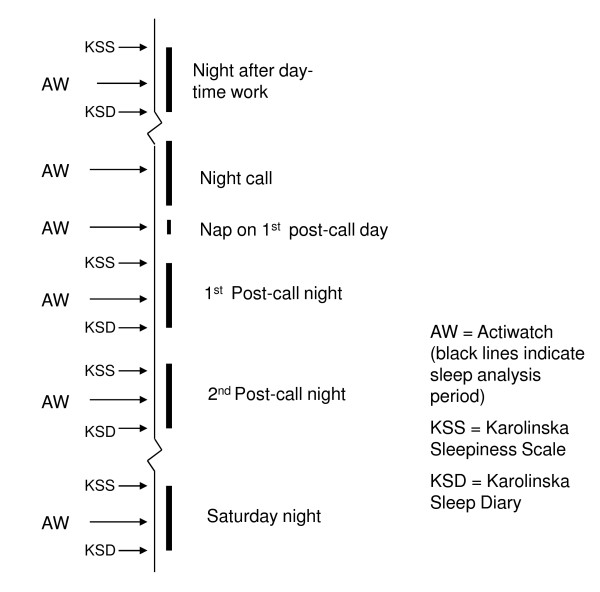
BACKGROUND: It is well known that physicians' night-call duty may cause impaired performance and adverse effects on subjective health, but there is limited knowledge about effects on sleep duration and recovery time. In recent years occupational stress and impaired well-being among anaesthesiologists have been frequently reported for in the scientific literature. Given their main focus on handling patients with life-threatening conditions, when on call, one might expect sleep and recovery to be negatively affected by work, especially in this specialist group. The aim of the present study was to examine whether a 16-hour night-call schedule allowed for sufficient recovery in anaesthesiologists compared with other physician specialists handling less life-threatening conditions, when on call. METHODS: Sleep, monitored by actigraphy and Karolinska Sleep Diary/Sleepiness Scale on one night after daytime work, one night call, the following first and second nights post-call, and a Saturday night, was compared between 15 anaesthesiologists and 17 paediatricians and ear, nose, and throat surgeons. RESULTS: Recovery patterns over the days after night call did not differ between groups, but between days. Mean night sleep for all physicians was 3 hours when on call, 7 h both nights post-call and Saturday, and 6 h after daytime work (p < 0.001). Scores for mental fatigue and feeling well rested were poorer post-call, but returned to Sunday morning levels after two nights' sleep. CONCLUSIONS: Despite considerable sleep loss during work on night call, and unexpectedly short sleep after ordinary day work, the physicians' self-reports indicate full recovery after two nights' sleep. We conclude that these 16-hour night duties were compatible with a short-term recovery in both physician groups, but the limited sleep duration in general still implies a long-term health concern. These results may contribute to the establishment of safe working hours for night-call duty in physicians and other health-care workers.
Overview
The claims and statistics of this paper haven’t been checked yet.
Free: it reads the open-access text and checks the first 5 claims that cite a source we can check. Create a free account to check every claim.
Integrity signals
Registry
Cites
Statistics
Figures
Verification
Claims the paper makes
The claims and statistics of this paper haven’t been checked yet.
Free: it reads the open-access text and checks the first 5 claims that cite a source we can check. Create a free account to check every claim.
Claims other papers make about this one
Each is checked against this paper’s own text: does it say what the citing paper says it does?
The cited source says what the claim attributes to it.
In the citing paper
“Actigraphy is a well-established method for sleep–wake measurement23 that has been used to study sleep patterns in physicians.13,24”
From Sleep and Alertness in a Duty-Hour Flexibility Trial in Internal Medicine (2019) · cites this paper as [24]
Self-check
Percentages, sums and reported differences re-computed from the paper’s own numbers.
The self-check needs the paper’s full text.
Citations
Cites
Subjective and objective sleepiness in the active individual
Åkerstedt, T., & Gillberg, M. (1990) · International Journal of Neuroscience · doi:10.3109/00207459008994241 · Cited by 3,088 · cited 1×
“This scale has been used in many studies and has been validated against EEG parameters [20].”
Simulation Study of Confounder-Selection Strategies
Maldonado, G., & Greenland, S. (1993) · American Journal of Epidemiology · doi:10.1093/oxfordjournals.aje.a116813 · Cited by 2,491 · cited 1×
“For this reason age was included as a covariate when analysing the AW measures [29,30].”
THE IMPACT OF CONFOUNDER SELECTION CRITERIA ON EFFECT ESTIMATION
MICKEY, R. M., & GREENLAND, S. (1989) · American Journal of Epidemiology · doi:10.1093/oxfordjournals.aje.a115101 · Cited by 2,362 · cited 1×
“For this reason age was included as a covariate when analysing the AW measures [29,30].”
RE:“;THE IMPACT OF CONFOUNDER SELECTION CRITERIA ON EFFECT ESTIMATION”
Greenland, S., & Mickey, R. M. (1989) · American Journal of Epidemiology · doi:10.1093/oxfordjournals.aje.a115409 · Cited by 2,108
Effect of Reducing Interns' Work Hours on Serious Medical Errors in Intensive Care Units
Landrigan, C. P., Rothschild, J. M., Cronin, J. W., Kaushal, R., Burdick, E., Katz, J. T., Lilly, C. M., Stone, P. H., Lockley, S. W., Bates, D. W., et al. (2004) · New England Journal of Medicine · doi:10.1056/nejmoa041406 · Cited by 1,760 · cited 2×
“It has been well documented that night shifts of 24 hours or longer are, in most cases, detrimental to both subjective health and performance [1,3,5,8].”
BackgroundThe impact of sleep deprivation on decision making: A review.
Harrison, Y., & Horne, J. A. (2000) · Journal of Experimental Psychology: Applied · doi:10.1037/1076-898x.6.3.236 · Cited by 1,238 · cited 1×
“Studies of physicians have shown that night-call duty with long work hours, restricted sleep, stress, time pressure, and high demands may cause impaired performance and adverse effects on subjective health [1-4].”
BackgroundEffect of Reducing Interns' Weekly Work Hours on Sleep and Attentional Failures
Lockley, S. W., Cronin, J. W., Evans, E. E., Cade, B. E., Lee, C. J., Landrigan, C. P., Rothschild, J. M., Katz, J. T., Lilly, C. M., Stone, P. H., et al. (2004) · New England Journal of Medicine · doi:10.1056/nejmoa041404 · Cited by 913 · cited 2×
“Studies of physicians have shown that night-call duty with long work hours, restricted sleep, stress, time pressure, and high demands may cause impaired performance and adverse effects on subjective health [ 1-4 ].”
BackgroundThe role of actigraphy in sleep medicine
Sadeh, A., & Acebo, C. (2002) · Sleep Medicine Reviews · doi:10.1053/smrv.2001.0182 · Cited by 720 · cited 1×
“Actigraphy was used to record sleeping and waking activity (Actiwatch, Cambridge Neurotechnology Ltd, UK) [26].”
Comparison between subjective and actigraphic measurement of sleep and sleep rhythms
Lockley, S. W., Skene, D. J., & Arendt, J. (1999) · Journal of Sleep Research · doi:10.1046/j.1365-2869.1999.00155.x · Cited by 622 · cited 1×
“sleep scores have a high correspondence with polysomnographically recorded sleep and are also validated for documenting longitudinal changes in sleep patterns [27,28].”
Sleep Duration as a Risk Factor for Diabetes Incidence in a Large US Sample
Gangwisch, J. E., Heymsfield, S. B., Boden-Albala, B., Buijs, R. M., Kreier, F., Pickering, T. G., Rundle, A. G., Zammit, G. K., & Malaspina, D. (2007) · Sleep · doi:10.1093/sleep/30.12.1667 · Cited by 573
Research works printed but not linked: 1
- Soderstrom M Ingre M Kecklund G Akerstedt T Kecklund L Train drivers workload - effects on sleep, fatigue and performance (internal report in Swedish) 2001 Stockholm: Institute for Psychosocial Medicine, IPM, Stockholm, Sweden 1 47
Cited by
Immune, inflammatory and cardiovascular consequences of sleep restriction and recovery
Faraut, B., Boudjeltia, K. Z., Vanhamme, L., & Kerkhofs, M. (2012) · Sleep Medicine Reviews · doi:10.1016/j.smrv.2011.05.001 · Cited by 418
Karolinska Sleepiness Scale (KSS)
Shahid, A., Wilkinson, K., Marcu, S., & Shapiro, C. M. (2011) · STOP, THAT and One Hundred Other Sleep Scales · doi:10.1007/978-1-4419-9893-4_47 · Cited by 187
Boudreau, P., Dumont, G. A., & Boivin, D. B. (2013) · PLoS ONE · doi:10.1371/journal.pone.0070813 · Cited by 128
Basner, M., Dinges, D. F., Shea, J. A., Small, D. S., Zhu, J., Norton, L., Ecker, A. J., Novak, C., Bellini, L. M., & Volpp, K. G. (2017) · Sleep · doi:10.1093/sleep/zsx027 · Cited by 96
“Actigraphy is a well-established method for rest-activity measurement(14) and has been used previously to successfully study sleep patterns in physicians.(15,16) Study participants were also asked to complete a validated 3-minute Psychomotor Vigilance Test (PVT)(17,18) each morning they were in the hospital on laptops…”
MethodPhotic Resetting in Night-Shift Work: Impact on Nurses' Sleep
Boivin, D. B., Boudreau, P., James, F. O., & Kin, N. M. K. N. Y. (2012) · Chronobiology International · doi:10.3109/07420528.2012.675257 · Cited by 95
“Analysis of continuous actigraphy data (Baulk et al., 2009; Ferguson et al., 2010; Malmberg et al., 2010; Park et al., 2000) and daytime polysomnography (PSG) (Mitler et al.”
BackgroundInfluentialBonnet, M. H., & Arand, D. L. (2013) · Elsevier eBooks · doi:10.1016/b978-0-12-378610-4.00036-x · Cited by 92
Sleep and Alertness in a Duty-Hour Flexibility Trial in Internal Medicine
Basner, M., Asch, D. A., Shea, J. A., Bellini, L. M., Carlin, M., Ecker, A. J., Malone, S. K., Desai, S. V., Sternberg, A. L., Tonascia, J., et al. (2019) · New England Journal of Medicine · doi:10.1056/nejmoa1810641 · Cited by 69
The effect of working on-call on stress physiology and sleep: A systematic review
Hall, S. J., Ferguson, S. A., Turner, A. I., Robertson, S. J., Vincent, G. E., & Aisbett, B. (2016) · Sleep Medicine Reviews · doi:10.1016/j.smrv.2016.06.001 · Cited by 77
Volpp, K. G., Shea, J. A., Small, D. S., Basner, M., Zhu, J., Norton, L., Ecker, A., Novak, C., Bellini, L. M., Dine, C. J., et al. (2012) · JAMA · doi:10.1001/jama.2012.34490 · Cited by 44
“Similar actigraphy devices have been validated and applied to successfully studysleeppatterns inphysicians on night call.(10,11) Study participants were also asked to complete a validated 3-minute psychomotor vigilance test (PVT)(12,13) on designated laptops located throughout the service each morning between 6 AM and…”
MethodNonstandard working schedules and health: the systematic search for a comprehensive model
Merkus, S. L., Holte, K. A., Huysmans, M. A., van Mechelen, W., & van der Beek, A. J. (2015) · BMC Public Health · doi:10.1186/s12889-015-2407-9 · Cited by 55
“These schedules include shift work (6pm-6am), extended working hours (>8 hours), extended working weeks (>5 days), on-call duties, weekend work, and combinations thereof, for example found in health care, and the trucking, airline, mining, and offshore industries (1-6).”
BackgroundWorking night shifts affects surgeons' biological rhythm
Amirian, I., Andersen, L. T., Rosenberg, J., & Gögenür, I. (2015) · The American Journal of Surgery · doi:10.1016/j.amjsurg.2014.09.035 · Cited by 43
Heart rate variability changes in physicians working on night call
Malmberg, B., Persson, R., Flisberg, P., & Ørbæk, P. (2010) · International Archives of Occupational and Environmental Health · doi:10.1007/s00420-010-0593-4 · Cited by 35
Self-citationKalkanis, A., Demolder, S., Papadopoulos, D., Testelmans, D., & Buyse, B. (2023) · Frontiers in Neurology · doi:10.3389/fneur.2023.1270043 · Cited by 43
Shea, J. A., Dinges, D. F., Small, D. S., Basner, M., Zhu, J., Norton, L., Ecker, A. J., Novak, C., Bellini, L. M., Dine, C. J., et al. (2014) · Academic Medicine · doi:10.1097/acm.0000000000000144 · Cited by 25
Karhula, K., Koskinen, A., Ervasti, J. M., Hakola, T., Isoviita, V., Kivimäki, I., Puttonen, S., Oksanen, T., & Härmä, M. (2022) · BMC Health Services Research · doi:10.1186/s12913-022-08336-0 · Cited by 29
Self-Reported Recovery from 2-Week 12-Hour Shift Work Schedules: A 14-Day Follow-Up
Merkus, S. L., Holte, K. A., Huysmans, M. A., van de Ven, P. M., van Mechelen, W., & van der Beek, A. J. (2015) · Safety and Health at Work · doi:10.1016/j.shaw.2015.07.003 · Cited by 25
“The results are consistent with findings of several other studies on offshore workers and other working populations, showing that recovery is needed directly following night work [13,18,38,39].”
The impact of sleep deprivation on surgeons' performance during night shifts.
Amirian, I. (2014) · PubMed · Cited by 37
Neurobehavioral alterations in a mouse model of chronic partial sleep deprivation
Arora, S., Dharavath, R. N., Bansal, Y., Bishnoi, M., Kondepudi, K. K., & Chopra, K. (2021) · Metabolic Brain Disease · doi:10.1007/s11011-021-00693-9 · Cited by 27
Bonnet, M. H. (2011) · Elsevier eBooks · doi:10.1016/b978-1-4160-6645-3.00005-0 · Cited by 32
Tucker, P., & Byrne, A. J. (2013) · Anaesthesia · doi:10.1111/anae.12447 · Cited by 23
“One of the very few fatigue-related field studies to compare anaesthetists with other medical specialities (in this case, paediatricians and ENT surgeons) found that the anaesthetists had more disrupted sleep [34, 35].”
BackgroundShea, J. A., Silber, J. H., Desai, S. V., Dinges, D. F., Bellini, L. M., Tonascia, J., Sternberg, A. L., Small, D. S., Shade, D. M., Katz, J. T., et al. (2018) · BMJ Open · doi:10.1136/bmjopen-2018-021711 · Cited by 18
Sickness certification of patients--a work environment problem among physicians?
Ljungquist, T., Hinas, E., Arrelöv, B., Lindholm, C., Wilteus, A. L., Nilsson, G. H., & Alexanderson, K. A. E. (2013) · Occupational Medicine · doi:10.1093/occmed/kqs080 · Cited by 18
“ENT surgeons have been found to have less signs of stress related to night-call duties, compared with anaesthetists [24].”
ResultNashiro, K., Yoo, H. J., Cho, C., Kim, A. J., Nasseri, P., Min, J., Dahl, M. J., Mercer, N., Choupan, J., Choi, P., et al. (2024) · Trials · doi:10.1186/s13063-024-07943-y · Cited by 15
How post‐call resident doctors perform, feel and are perceived in out‐patient clinics
Liu, C., & Wissow, L. S. (2011) · Medical Education · doi:10.1111/j.1365-2923.2010.03912.x · Cited by 10
Sleep and Work in ICU Physicians During a Randomized Trial of Nighttime Intensivist Staffing*
Bakhru, R. N., Basner, M., Kerlin, M. P., Halpern, S. D., Hansen-Flaschen, J. H., Rosen, I. M., Dinges, D. F., & Schweickert, W. D. (2019) · Critical Care Medicine · doi:10.1097/ccm.0000000000003773 · Cited by 13
Huizinga, C. R. H., Tummers, F. H. M. P., de Mheen, P. J. M., Cohen, A. F., & van der Bogt, K. E. A. (2019) · Sleep Medicine Reviews · doi:10.1016/j.smrv.2019.04.007 · Cited by 15
Working while sleep-deprived: not just a problem for residents
MacDonald, N. E., Hébert, P. C., Flegel, K., & Stanbrook, M. B. (2011) · Canadian Medical Association Journal · doi:10.1503/cmaj.110402 · Cited by 11
Arbetstider, hälsa och säkerhet - en uppdatering av aktuell forskning
Kecklund, G., Ingre, M., & Åkerstedt, T. (2010) · Cited by 96
Self-citationPerception of Fatigue Among Surgeons During Night Shifts
Amirian, I., Danielsen, A. K., & Rosenberg, J. (2013) · Bulletin of The Royal College of Surgeons of England · doi:10.1308/147363513x13690603821026 · Cited by 8
Daher, A. M., Burud, I. A. S., Subair, M., Mushahar, L., & Xin, L. J. (2024) · PLoS ONE · doi:10.1371/journal.pone.0306574 · Cited by 9
Student Midwives’ Duty Hours: Risks, Standards, and Recommendations
Lawrence, R., Kantrowitz‐Gordon, I., & Landis, A. M. (2014) · Journal of Midwifery & Women s Health · doi:10.1111/jmwh.12053 · Cited by 9
Evaluation of pharmacy resident alertness in an overnight on-call program
Knauss, M. D., Bonner, C. L., Patka, J., & Abraham, P. (2015) · American Journal of Health-System Pharmacy · doi:10.2146/ajhp140338 · Cited by 7
Evaluating Sleep Characteristics in Intensive Care Unit and Non-Intensive Care Unit Physicians
Ok, G., Yılmaz, H., Tok, D., Erbüyün, K., Çoban, S., & Dinç, G. (2011) · Anaesthesia and Intensive Care · doi:10.1177/0310057x1103900614 · Cited by 5
Hotta, S., Ashida, K., & Tanaka, M. (2024) · Journal of Multidisciplinary Healthcare · doi:10.2147/jmdh.s454578 · Cited by 4
“60 An increased number of night shifts poses risks to adequate physical and mental recovery through sleep, and these effects may impact effective collaboration and communication with other healthcare professionals for patient safety.”
BackgroundCo-ordination of research on working hours and health in the Nordic countries
Møller, S. V., Axelsson, J., Bjorvatn, B., Hansen, J., Hansen, A. M., Harris, A., Hjarsbech, P. U., Härmä, M., Ingre, M., Jensen, M. A., et al. (2014) · doi:10.6027/tn2014-530 · Cited by 6
Self-citationButtiġieġ, S. C., Azzopardi, E.-A., & Cassar, V. (2019) · Emerald Group Publishing Limited eBooks · doi:10.1108/s1474-823120190000018005 · Cited by 3
Shortening shift’s length—Should we ask the residents if this is what they want?
Hershkovitz, Y., Rasco, A. F., & Tal, O. (2022) · PLoS ONE · doi:10.1371/journal.pone.0272548 · Cited by 1
“In Sweden, it was found that even a 16-hour night-call schedule required two nights sleep recovery [12].”
BackgroundAdvancing Equity and Inclusion
Guillow, R., Nemergut, E. C., & Dragan, K. (2024) · Anesthesiology Clinics · doi:10.1016/j.anclin.2024.07.006 · Cited by 1
Loh, L. W. W., Lee, J. S. E., & Goy, R. (2019) · Trends in Anaesthesia and Critical Care · doi:10.1016/j.tacc.2019.03.003 · Cited by 1
", S. I., Bobko, N. A., & Dovgopola, S. P. (2022) · Ukrainian Journal of Occupational Health · doi:10.33573/ujoh2022.01.029 · Cited by 1
Assessment of the quality of sleep of medical interns
de Menezes, M. B., & Pimentel, D. M. M. (2023) · International Journal of Health Science · doi:10.22533/at.ed.1593412301069 · Cited by 1
The Impact of Sleep Deprivation on Orthopaedic Surgeons: A Systematic Review
Lipps, C., Lawson, M. M., McKibben, N. S., Brady, J. M., & Working, Z. M. (2025) · Journal of Sleep Research · doi:10.1111/jsr.70025 · Cited by 1
“Most surgical specialties take frequent call shifts that further disturb sleep, and it could take up to three nights post-call to return to baseline sleep parameters (Coleman et al. 2019; Malmberg et al. 2010).”
Studies of Fatigue and Human Performance in the Field
Rose, M. W. (2018) · Springer eBooks · doi:10.1007/978-1-4939-8607-1_4 · Cited by 1
Should Interventionalist Work Hours Be Restricted After a Night on Call?
Garratt, K. N. (2015) · JACC: Cardiovascular Interventions · doi:10.1016/j.jcin.2014.10.006 · Cited by 1
“Physicians may recover fully from a working call night or night shift after just 2 days of normal sleep (11), so 2 call nights over 7 days, the definition used in the current report, seems to reflect relativelymild long-term sleep deprivation.”
BackgroundPhysiological recovery from night-call duty - a field study of physicians
Malmberg, B. (2011) · Lund University Publications (Lund University)
Self-citationSleep Quality Among First-Year Internal Medicine Residents in Siriraj Hospital
Chierakul, N. (2014) · DOAJ (DOAJ: Directory of Open Access Journals)
Lifestyle Medicine Assessment Scores in Family Medicine Providers
Nguyen, C. Q., Mosquera‐Moscoso, J., Clapp, A. D. M., Arciniegas, N., & Wight, J. T. (2025) · American Journal of Lifestyle Medicine · doi:10.1177/15598276251375401
Karhula, K., Koskinen, A., Ervasti, J. M., Hakola, T., Isoviita, V.-M., Kivimäki, I., Puttonen, S., Oksanen, T., & Härmä, M. (2022) · Figshare · doi:10.6084/m9.figshare.20364132
Nashiro, K., Yoo, H. J., Cho, C., Kim, A. J., Nasseri, P., Min, J., Dahl, M. J., Mercer, N., Choupan, J., Choi, P., et al. (2024) · Figshare · doi:10.6084/m9.figshare.25422333
Payne, S. R., Purchase, N., Wezyk, A. B., Greville-Harris, M., Thomas, K., & Turner, K. (2025) · Journal of Clinical Urology · doi:10.1177/20514158251395867
“While some argue that merely being ‘on call’ disrupts rest, 27,46,47 our findings suggest that actual call frequency is the stronger driver of fatigue and stress.”
Mdhluli, N. I. (2026) · Frontiers in Human Dynamics · doi:10.3389/fhumd.2026.1962159
Affektprofiler och deras relation till adaptationsproblem
Jangerud, M., & Strand, S. (2013) · KTH Publication Database DiVA (KTH Royal Institute of Technology)
Metadata
- Authors
- Malmberg, B., Kecklund, G., Karlson, B., Persson, R., Flisberg, P., & Ørbaek, P.
- Affiliations
- Lund University (SE)
- Stockholm University (SE)
- National Research Centre for the Working Environment (DK)
- Skåne University Hospital (SE)
- Corresponding author
- Malmberg, Birgitta
- Venue
- BMC Health Services Research
- Published
- 2010-08-15
- Volume
- 10
- Issue
- 1
- Pages
- 239-239
- ISSN
- 1472-6963 (ISSN-L)
- PMC
- PMC2928216
- OpenAlex
- W2106314488
- Cited by
- 52
- References
- 45
- Citations by year
- 2026: 1 · 2025: 3 · 2024: 5 · 2023: 2 · 2022: 4 · 2021: 1 · 2019: 5 · 2018: 2 · 2017: 1 · 2016: 1 · 2015: 5 · 2014: 5 · 2013: 6 · 2012: 2
- FWCI
- 7.08
- Type
- journal article
- Language
- en
- Open access
- gold
- doi.org
- Licence
- cc-by
- creativecommons.org/licenses/by/2.0 (tdm)
- Locations
- BMC Health Services Research (publishedVersion, cc-by)
- PubMed Central (publishedVersion, cc-by)
- PubMed (publishedVersion)
- UWA Profiles and Research Repository (UWA) (submittedVersion, other-oa)
- DOAJ (DOAJ: Directory of Open Access Journals) (submittedVersion)
- Lund University Publications (Lund University) (submittedVersion, other-oa)
- Funders
- Forskningsrådet för Arbetsliv och Socialvetenskap
- Lunds Universitet
- Topics
- Social Sciences › Psychology › Experimental and Cognitive Psychology › Sleep and Work-Related Fatigue
- Health Sciences › Health Professions › General Health Professions › Healthcare professionals’ stress and burnout
- Health Sciences › Nursing › Leadership and Management › Hospital Admissions and Outcomes
- Keywords
- night call, sleep duration, anesthesiologists, pediatricians, mental fatigue, occupational stress, sleep deprivation, working hours, physician well-being, actigraphy
- MeSH terms
- Adult, Female, Humans, Longitudinal Studies, Male, Medicine, Middle Aged, Motor Activity, Night Care, Physicians, Surveys and Questionnaires, Sleep Deprivation, Work Schedule Tolerance
About these checks
Registry, retraction, Cites and statistics results are computed, not judged, with one exception: a printed reference that no index lists is read once by a model before it counts as a citation error. Claims are extracted by a model and kept only when their quote appears verbatim in the text; each cited source is then checked, with a model’s help, for whether it says what the claim relies on. Those verdicts can be wrong — read the claim’s quote and the cited source before relying on one.
Statistics and arithmetic are recomputed, not judged.
Confidence bands are shown only for fields calibrated on our annotated test set. None is calibrated yet, so no band is shown.
What counts as a claim ›How we measure confidence ›How we check this ›
Are you an author, or do you see a problem with this page? Request a review
Data sources
Bibliographic data: Semantic Scholar, OpenAlex, Crossref.
Contains information from the Semantic Scholar Academic Graph Datasets, made available under the ODC Attribution License (ODC-BY 1.0).
Semantic Scholar’s data is described in: Kinney, R., et al. (2023). The Semantic Scholar Open Data Platform. arXiv:2301.10140.
