

Development and Evaluation of a Psychosocial Intervention for Children and Teenagers Experiencing Diabetes (DEPICTED): a protocol for a cluster randomised controlled trial of the effectiveness of a communication skills training programme for healthcare professionals working with young people with type 1 diabetes
Open accessThe DOI matches its Crossref record; 50 of the 50 references it cites were found in a registry or an index.
Abstract
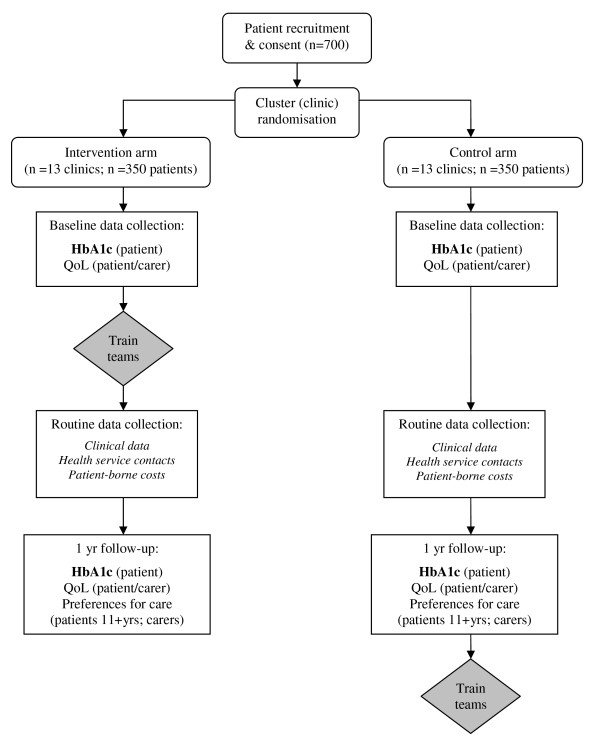
BACKGROUND: Diabetes is the third most common chronic condition in childhood and poor glycaemic control leads to serious short-term and life-limiting long-term complications. In addition to optimal medical management, it is widely recognised that psychosocial and educational factors play a key role in improving outcomes for young people with diabetes. Recent systematic reviews of psycho-educational interventions recognise the need for new methods to be developed in consultation with key stakeholders including patients, their families and the multidisciplinary diabetes healthcare team. METHODS/DESIGN: Following a development phase involving key stakeholders, a psychosocial intervention for use by paediatric diabetes staff and not requiring input from trained psychologists has been developed, incorporating a communication skills training programme for health professionals and a shared agenda-setting tool. The effectiveness of the intervention will be evaluated in a cluster-randomised controlled trial (RCT). The primary outcome, to be measured in children aged 4-15 years diagnosed with type 1 diabetes for at least one year, is the effect on glycaemic control (HbA1c) during the year after training of the healthcare team is completed. Secondary outcomes include quality of life for patients and carers and cost-effectiveness. Patient and carer preferences for service delivery will also be assessed. Twenty-six paediatric diabetes teams are participating in the trial, recruiting a total of 700 patients for evaluation of outcome measures. Half the participating teams will be randomised to receive the intervention at the beginning of the trial and remaining centres offered the training package at the end of the one year trial period. DISCUSSION: The primary aim of the trial is to determine whether a communication skills training intervention for specialist paediatric diabetes teams will improve clinical and psychological outcomes for young people with type 1 diabetes. Previous research indicates the effectiveness of specialist psychological interventions in achieving sustained improvements in glycaemic control. This trial will evaluate an intervention which does not require the involvement of trained psychologists, maximising the potential feasibility of delivery in a wider NHS context. TRIAL REGISTRATION: Current Controlled Trials ISRCTN61568050.
Overview
The claims and statistics of this paper haven’t been checked yet.
Free: it reads the open-access text and checks the first 5 claims that cite a source we can check. Create a free account to check every claim.
Integrity signals
Registry
Cites
Statistics
Figures
Verification
Claims the paper makes
The claims and statistics of this paper haven’t been checked yet.
Free: it reads the open-access text and checks the first 5 claims that cite a source we can check. Create a free account to check every claim.
Claims other papers make about this one
Each is checked against this paper’s own text: does it say what the citing paper says it does?
The source backs part of the claim, not all of it — or backs it for a different population, condition or comparison.
In the citing paper
“HbA1c data were collected through the GPs and were assessed primarily with the Siemens DCA Vantage Analyzer a maximum of 2 weeks before or after the follow-up to reduce measurement bias [30,33].”
From A Mobile Health Intervention for Self-Management and Lifestyle Change for Persons With Type 2 Diabetes, Part 2: One-Year Results From the Norwegian Randomized Controlled Trial RENEWING HEALTH (2014) · cites this paper as [33]
Experimental — accuracy not yet measured
Self-check
Percentages, sums and reported differences re-computed from the paper’s own numbers.
The self-check needs the paper’s full text.
Citations
Cites
Methods for the Economic Evaluation of Health Care Programmes
Drummond, M. E., Sculpher, M. J., Torrance, G. W., O’Brien, B. J., & Stoddart, G. L. (2005) · doi:10.1093/oso/9780198529446.001.0001 · Cited by 13,648
Developing and evaluating complex interventions: the new Medical Research Council guidance
Craig, P., Dieppe, P., Macintyre, S., Michie, S., Nazareth, I., & Petticrew, M. (2008) · BMJ · doi:10.1136/bmj.a1655 · Cited by 10,995
Motivational interviewing: preparing people for change.
Miller, W. R., & Rollnick, S. (2002) · Guilford Press eBooks · Cited by 7,915
Self-citationDeveloping and Evaluating Complex Interventions: New Guidance
Craig, P., Dieppe, P. A., MacIntyre, S., Michie, S., Nazareth, I., & Petticrew, M. P. (2006) · UCL Discovery (University College London) · Cited by 1,989
The efficacy of motivational interviewing: a meta-analysis of controlled clinical trials
Burke, B. L., Arkowitz, H., & Menchola, M. (2003) · Journal of Consulting and Clinical Psychology · doi:10.1037/0022-006x.71.5.843 · Cited by 1,575
Assessment of Diabetes-Related Distress
Polonsky, W. H., Anderson, B. J., Lohrer, P. A., Welch, G., Jacobson, A. M., Aponte, J. E., & Schwartz, C. E. (1995) · Diabetes Care · doi:10.2337/diacare.18.6.754 · Cited by 1,497
Supporting Autonomy to Motivate Patients With Diabetes for Glucose Control
Williams, G. C., Freedman, Z. R., & Deci, E. L. (1998) · Diabetes Care · doi:10.2337/diacare.21.10.1644 · Cited by 1,134
Impaired Insulin Action in Puberty
Amiel, S. A., Sherwin, R. S., Simonson, D. C., Lauritano, A. A., & Tamborlane, W. V. (1986) · New England Journal of Medicine · doi:10.1056/nejm198607243150402 · Cited by 958
Quality-of-life measures in chronic diseases of childhood
Eiser, C., & Morse, R. (2001) · Health Technology Assessment · doi:10.3310/hta5040 · Cited by 872
Using Discrete Choice Experiments to Value Health and Health Care
(2008) · The Economics of Non-Market Goods and Resources · doi:10.1007/978-1-4020-5753-3 · Cited by 765
Research works printed but not linked: 3
- Byard AJ Murphy HR Skinner TC Wadham C Rayman G The development, evaluation and evolution of a pediatric carbohydrate counting programme from families, adolescents and children teamwork study (FACTS) Diab Med 2004 21 A86
- Jepson R The effectiveness of interventions to change health-related behaviours: a review of reviews, (Occasional paper No 3.) 2000 Glasgow: MRC Social and Public Health Sciences Unit 3
- Medical Research Council A framework for the development and evaluation of RCTs for complex interventions to improve health 2000 London: Medical Research Council
Cited by
Michie, S., Wood, C. E., Johnston, M., Abraham, C., Francis, J. J., & Hardeman, W. (2015) · Health Technology Assessment · doi:10.3310/hta19990 · Cited by 680
Diabetes distress among adolescents with type 1 diabetes: a systematic review
Hagger, V., Hendrieckx, C., Sturt, J., Skinner, T. C., & Speight, J. (2016) · Current Diabetes Reports · doi:10.1007/s11892-015-0694-2 · Cited by 338
Holmen, H., Torbjørnsen, A., Wahl, A. K., Jenum, A. K., Småstuen, M. C., Årsand, E., & Ribu, L. (2014) · JMIR mHealth and uHealth · doi:10.2196/mhealth.3882 · Cited by 294
Christie, D., & Channon, S. (2014) · Diabetes, Obesity and Metabolism · doi:10.1111/dom.12195 · Cited by 180
Self-citationTorbjørnsen, A., Jenum, A. K., Småstuen, M. C., Årsand, E., Holmen, H., Wahl, A. K., & Ribu, L. (2014) · JMIR mHealth and uHealth · doi:10.2196/mhealth.3535 · Cited by 117
Robling, M., McNamara, R., Bennert, K., Butler, C. C., Channon, S., Cohen, D., Crowne, E., Hambly, H., Hawthorne, K., Hood, K., et al. (2012) · BMJ · doi:10.1136/bmj.e2359 · Cited by 68
Self-citationReliability of Identification of Behavior Change Techniques in Intervention Descriptions
Abraham, C., Wood, C. E., Johnston, M., Francis, J., Hardeman, W., Richardson, M., & Michie, S. (2015) · Annals of Behavioral Medicine · doi:10.1007/s12160-015-9727-y · Cited by 71
Ribu, L., Holmen, H., Torbjørnsen, A., Wahl, A. K., Grøttland, A., Småstuen, M. C., Elind, E., Bergmo, T. S., Breivik, E., & Årsand, E. (2013) · JMIR Research Protocols · doi:10.2196/resprot.2768 · Cited by 45
Cluster size variability and imbalance in cluster randomized controlled trials
Carter, B. (2010) · Statistics in Medicine · doi:10.1002/sim.4050 · Cited by 33
Hawthorne, K., Bennert, K., Lowes, L., Channon, S., Robling, M. R., Gregory, J. W., & on behalf of the DEPICTED Study team (2011) · Diabetic Medicine · doi:10.1111/j.1464-5491.2011.03292.x · Cited by 39
Self-citationGregory, J. W., Robling, M. R., Bennert, K., Channon, S., Cohen, D. R., Crowne, E. C., Hambly, H., Hawthorne, K., Hood, K., Longo, M., et al. (2011) · Health Technology Assessment · doi:10.3310/hta15290 · Cited by 34
Self-citationAbdelmaksoud, A. A., Sharara, S. M., Nanda, A. S., & Khouzam, R. N. (2019) · Annals of Translational Medicine · doi:10.21037/atm.2019.08.65 · Cited by 22
A CRIANÇA E O ADOLESCENTE COM DIABETES MELLITUS TIPO 1: DESDOBRAR DO CUIDADO FAMILIAR
Malaquias, T. D. S. M., Marques, C. D. C., Faria, A. C. D. P., Pupulim, J. S. L., Marcon, S. S., & Higarashi, I. H. (2016) · Cogitare Enfermagem · doi:10.5380/ce.v21i4.42010 · Cited by 16
Noyes, J. P., Williams, A., Allen, D. A., Brocklehurst, P., Carter, C., Gregory, J. W., Jackson, C., Lewis, M., Lowes, L., Russell, I. T., et al. (2010) · BMC Pediatrics · doi:10.1186/1471-2431-10-70 · Cited by 16
Self-citationCoping among adolescents with long-term health conditions: a mixed-methods study
Al‐Yateem, N., Subu, M. A., Al-Shujairi, A., Alrimawi, I., Ali, H. M., Hasan, K., Dad, N. P., & Brenner, M. (2020) · British Journal of Nursing · doi:10.12968/bjon.2020.29.13.762 · Cited by 14
An online tool for obesity intervention and public health
Su, J. G. (2015) · BMC Public Health · doi:10.1186/s12889-016-2797-3 · Cited by 11
Meeting the psychosocial needs of children with diabetes within routine clinical practice
Channon, S., Hambly, H., Robling, M. R., Bennert, K., Gregory, J. W., & the DEPICTED Study Team (2010) · Diabetic Medicine · doi:10.1111/j.1464-5491.2010.03071.x · Cited by 9
Self-citationNuari, N. A., & Kartikasari, M. (2015) · Jurnal NERS · doi:10.20473/jn.v10i2.1349 · Cited by 10
Gregory, J. W. (2011) · Archives of Disease in Childhood · doi:10.1136/adc.2011.300710 · Cited by 8
Self-citationSelf-Instructional Training Application on Diabetic Patients' Self-Care Behaviors
Wahyuni, S., Prasetyowati, C. D., Pratiwi, W. N., & Alfiadi, K. (2021) · Nurse Media Journal of Nursing · doi:10.14710/nmjn.v11i2.29360 · Cited by 7
Akbar, H., Langingi, A. R. C., Darmin, D., Hamzah, B., Sibua, S. N., & Soleman, S. R. (2021) · Infokes · Cited by 4
Metode Self Instructional Training untuk Menurunkan Kadar Gula Darah Pasien DM Tipe 2
Nuari, N. A. (2017) · Jurnal Ners dan Kebidanan (Journal of Ners and Midwifery) · doi:10.26699/jnk.v4i1.art.p006-011 · Cited by 4
Opoku, F. K., Narcotey, I., Kwao, I. T., & Antwi, B. O. (2024) · Journal of Business and Enterprise Development (JOBED) · doi:10.47963/jobed.v11i.1211 · Cited by 2
Liu, Q., & Zhu, H. (2016) · Experimental and Therapeutic Medicine · doi:10.3892/etm.2016.3876 · Cited by 2
Большова, О. В., Антропова, О. В., Lukashuk, І. V., Muz, V. A., & Музь, Н. Н. (2013) · INTERNATIONAL JOURNAL OF ENDOCRINOLOGY (Ukraine) · doi:10.22141/2224-0721.4.52.2013.84387 · Cited by 1
Mental health of adolescents with type I diabetes: A case report
Marini, E., Giannakopoulos, G., Charitaki, S., Belivanaki, M., Salavou, V., Liakopoulou, M., & Kolaitis, G. A. (2013) · Health · doi:10.4236/health.2013.58172 · Cited by 1
Efeitos de instrução e de automonitoramento no seguimento de regras ao tratamento do diabetes Tipo 1
Moreira, A. D. A., Ferreira, E. A. P., & Gomes, D. L. (2021) · Acta comportamentalia. · doi:10.32870/ac.v29i3.80292 · Cited by 1
Allen, J. V. (2013) · KU ScholarWorks (The University of Kansas)
Nuari, N. A. (2018) · INDONESIAN NURSING JOURNAL OF EDUCATION AND CLINIC (INJEC) · doi:10.24990/injec.v2i1.9 · Cited by 1
Psychological care for type 1 diabetic adolescents: designing a new model of integrated care
Young, S. (2014) · Pepperdine Digital Commons (Pepperdine University)
Evaluierung des Trainingserfolgs von off-the-job Trainings für ApothekerInnen in Österreich
Kobinger, G. M. (2021) · Unipub UB Graz (Universität Graz)
Hvordan kan sykepleier forberede ungdom med nyoppstått diabetes på utfordringer etter utskrivelse?
Foss, E. H., & Plassen, E. R. (2019) · NORA - Norwegian Open Research Archives
Metadata
- Authors
- McNamara, R., Robling, M., Hood, K., Bennert, K., Channon, S., Cohen, D., Crowne, E., Hambly, H., Hawthorne, K., Longo, M., Lowes, L., Playle, R., Rollnick, S., & Gregory, J. W.
- Affiliations
- Cardiff University (GB)
- University of Bristol (GB)
- University of Glamorgan (GB)
- Bristol Royal Hospital for Children (GB)
- Frenchay Hospital (GB)
- Corresponding author
- McNamara, Rachel
- ORCID
- Venue
- BMC Health Services Research
- Published
- 2010-02-09
- Volume
- 10
- Issue
- 1
- Pages
- 36-36
- ISSN
- 1472-6963 (ISSN-L)
- PMC
- PMC2829553
- OpenAlex
- W2102076197
- Cited by
- 22
- References
- 49
- Citations by year
- 2021: 1 · 2020: 1 · 2019: 1 · 2016: 3 · 2015: 2 · 2014: 2 · 2013: 5 · 2012: 1
- FWCI
- 2.90
- Type
- journal article
- Language
- en
- Open access
- gold
- doi.org
- Licence
- cc-by
- creativecommons.org/licenses/by/2.0 (tdm)
- Locations
- BMC Health Services Research (publishedVersion, cc-by)
- Europe PMC (PubMed Central) (publishedVersion, cc-by)
- PubMed Central (publishedVersion, cc-by)
- PubMed (publishedVersion)
- ORCA Online Research @Cardiff (Cardiff University) (acceptedVersion)
- DOAJ (DOAJ: Directory of Open Access Journals) (submittedVersion, cc-by-sa)
- Funders
- Office of Research and Development
- National Institute for Health and Care Research
- Novo Nordisk
- Health Technology Assessment Programme
- Topics
- Health Sciences › Medicine › Endocrinology, Diabetes and Metabolism › Diabetes Management and Education
- Health Sciences › Medicine › Endocrinology, Diabetes and Metabolism › Diabetes Management and Research
- Life Sciences › Biochemistry, Genetics and Molecular Biology › Genetics › Diabetes and associated disorders
- Keywords
- type 1 diabetes, children and adolescents, psychosocial interventions, communication skills training, healthcare workers, glycemic control, HbA1c, quality of life, caregivers, cost-effectiveness
- MeSH terms
- Adolescent, Adolescent Behavior, Child, Child Behavior, Child, Preschool, Clinical Competence, Communication, Diabetes Mellitus, Type 1, Education, Medical, Continuing, Education, Nursing, Continuing, Female, Glycated Hemoglobin, Humans, Interprofessional Relations, Male, Patient Care Team, Pediatrics, Physician-Patient Relations, Quality of Life, Comparative Effectiveness Research
About these checks
Registry, retraction, Cites and statistics results are computed, not judged, with one exception: a printed reference that no index lists is read once by a model before it counts as a citation error. Claims are extracted by a model and kept only when their quote appears verbatim in the text; each cited source is then checked, with a model’s help, for whether it says what the claim relies on. Those verdicts can be wrong — read the claim’s quote and the cited source before relying on one.
Statistics and arithmetic are recomputed, not judged.
Confidence bands are shown only for fields calibrated on our annotated test set. None is calibrated yet, so no band is shown.
What counts as a claim ›How we measure confidence ›How we check this ›
Are you an author, or do you see a problem with this page? Request a review
Data sources
Bibliographic data: Semantic Scholar, OpenAlex, Crossref.
Contains information from the Semantic Scholar Academic Graph Datasets, made available under the ODC Attribution License (ODC-BY 1.0).
Semantic Scholar’s data is described in: Kinney, R., et al. (2023). The Semantic Scholar Open Data Platform. arXiv:2301.10140.
