

Impact of a large-scale educational intervention program on venous blood specimen collection practices
Open accessThe DOI matches its Crossref record; 49 of the 49 references it cites were found in a registry or an index.
Abstract
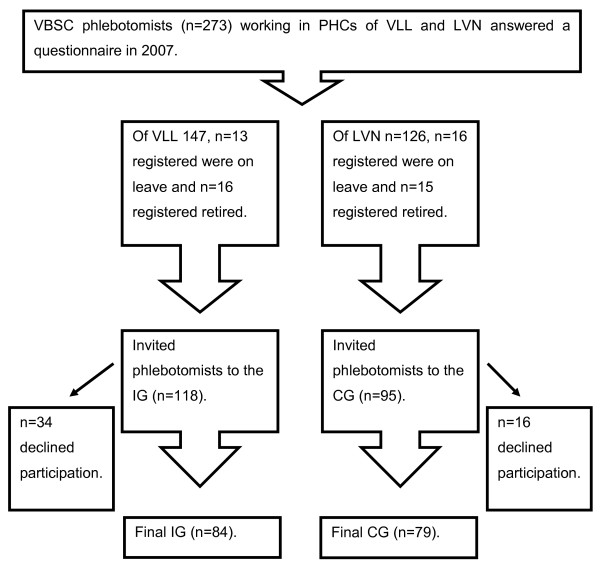
BACKGROUND: Phlebotomy performed with poor adherence to venous blood specimen collection (VBSC) guidelines jeopardizes patient safety and may lead to patient suffering and adverse events. A first questionnaire study demonstrated low compliance to VBSC guidelines, motivating an educational intervention of all phlebotomists within a county council. The aim was to evaluate the impact of a large-scale educational intervention program (EIP) on primary health care phlebotomists' adherence to VBSC guidelines. We hypothesised that the EIP would improve phlebotomists' VBSC practical performance. METHODS: The present study comprise primary health care centres (n = 61) from two county councils in northern Sweden. The final selected study group consisted of phlebotomists divided into an intervention group (n = 84) and a corresponding control group (n = 79). Both groups responded to a validated self-reported VBSC questionnaire twice. The EIP included three parts: guideline studies, an oral presentation, and an examination. Non-parametric statistics were used for comparison within and between the groups. RESULTS: Evaluating the EIP, we found significant improvements in the intervention group compared to the control group on self-reported questionnaire responses regarding information search (ES = 0.23-0.33, p < 0.001-0.003), and patient rest prior to phlebotomy (ES = 0.27, p = 0.004). Test request management, patient identity control, release of venous stasis, and test tube labelling had significantly improved in the intervention group but did not significantly differ from the control group (ES = 0.22- 0.49, p = < 0.001- 0.006). The control group showed no significant improvements at all (ES = 0-0.39, p = 0.016-0.961). CONCLUSIONS: The present study demonstrated several significant improvements on phlebotomists' adherence to VBSC practices. Still, guideline adherence improvement to several crucial phlebotomy practices is needed. We cannot conclude that the improvements are solely due to the EIP and suggest future efforts to improve VBSC. The program should provide time for reflections and discussions. Furthermore, a modular structure would allow directed educational intervention based on the specific VBSC guideline flaws existing at a specific unit. Such an approach is probably more effective at improving and sustaining adherence to VBSC guidelines than an EIP containing general pre-analytical practices.
Overview
The claims and statistics of this paper haven’t been checked yet.
Free: it reads the open-access text and checks the first 5 claims that cite a source we can check. Create a free account to check every claim.
Integrity signals
Registry
Cites
Statistics
Figures
Verification
Claims the paper makes
The claims and statistics of this paper haven’t been checked yet.
Free: it reads the open-access text and checks the first 5 claims that cite a source we can check. Create a free account to check every claim.
Self-check
Percentages, sums and reported differences re-computed from the paper’s own numbers.
The self-check needs the paper’s full text.
Citations
Cites
SPSS survival manual : a step by step guide to data analysis using SPSS
Pallant, J. (2010) · Cited by 6,888
SPSS Survival Manual: A Step by Step Guide to Data Analysis using IBM SPSS
Pallant, J. (2020) · Routledge eBooks · doi:10.4324/9781003117407 · Cited by 5,201
From best evidence to best practice: effective implementation of change in patients' care
Grol, R., & Grimshaw, J. (2003) · The Lancet · doi:10.1016/s0140-6736(03)14546-1 · Cited by 4,531
(2009) · US Department of Education · Cited by 3,654
(2007) · Cited by 3,005
Francke, A. L., Smit, M. C., de Veer, A. J., & Mistiaen, P. (2008) · BMC Medical Informatics and Decision Making · doi:10.1186/1472-6947-8-38 · Cited by 1,134 · cited 4×
“Multiple components such as the lack of awareness, agreement with, or limited familiarity with guidelines [27], lack of support from the clinic or superiors, and time constraints or understaffing appear to be the main impediments for successful implementation of guidelines [27,34].”
BackgroundInfluentialErrors in clinical laboratories or errors in laboratory medicine?
Plebani, M. (2006) · Clinical Chemistry and Laboratory Medicine (CCLM) · doi:10.1515/cclm.2006.123 · Cited by 734 · cited 8×
“Common specimen handling errors include incorrect test tube labelling [2,15,20,21], incorrect test request management, missing tubes, and transport errors [2,8,10,14,22].”
BackgroundInfluentialErrors in a Stat Laboratory: Types and Frequencies 10 Years Later
Carraro, P., & Plebani, M. (2007) · Clinical Chemistry · doi:10.1373/clinchem.2007.088344 · Cited by 670 · cited 6×
“Common specimen handling errors include incorrect test tube labelling [2,15,20,21], incorrect test request management, missing tubes, and transport errors [2,8,10,14,22].”
BackgroundInfluentialHow can we improve guideline use? A conceptual framework of implementability
Gagliardi, A. R., Brouwers, M. C., Palda, V. A., Lemieux-Charles, L., & Grimshaw, J. M. (2011) · Implementation Science · doi:10.1186/1748-5908-6-26 · Cited by 472 · cited 4×
“There are few evaluations of how guidelines should be effectively implemented, and it is often unclear who is responsible for implementing and sustaining guideline knowledge and practices [34].”
BackgroundInfluentialHaemolysis: an overview of the leading cause of unsuitable specimens in clinical laboratories
Lippi, G., Blanckaert, N., Bonini, P., Green, S., Kitchen, S., Palicka, V., Vassault, A. J., & Plebani, M. (2008) · Clinical Chemistry and Laboratory Medicine · doi:10.1515/cclm.2008.170 · Cited by 466 · cited 2×
“During the 2-hours lecture, emphasis was put on how to avoid haemolysis as well [19,31].”
BackgroundPloeg, J., Davies, B., Edwards, N., Gifford, W., & Miller, P. E. (2007) · Worldviews on Evidence-Based Nursing · doi:10.1111/j.1741-6787.2007.00106.x · Cited by 321 · cited 1×
“If personnel believe that following guidelines would result in improved patient outcomes and improved working conditions, they probably would be more likely to change behaviours [44].”
BackgroundExploring the iceberg of errors in laboratory medicine
Plebani, M. (2009) · Clinica Chimica Acta · doi:10.1016/j.cca.2009.03.022 · Cited by 289 · cited 2×
“It is a basis for diagnosis and treatments [2,3].”
BackgroundCohen, D. J., Crabtree, B. F., Etz, R. S., Balasubramanian, B. A., Donahue, K. E., Leviton, L. C., Clark, E. C., Isaacson, N. F., Stange, K. C., & Green, L. W. (2008) · American Journal of Preventive Medicine · doi:10.1016/j.amepre.2008.08.005 · Cited by 248 · cited 1×
“Implementation and translation of VBSC guidelines can be managed through a research team fostering intervention and practice assimilation by providing personal influence, motivation, retraining and instrumental assistance [51,52].”
BackgroundLeape, L. L. (2009) · Clinica Chimica Acta · doi:10.1016/j.cca.2009.03.020 · Cited by 220
Medical errors: impact on clinical laboratories and other critical areas
Kalra, J. (2004) · Clinical Biochemistry · doi:10.1016/j.clinbiochem.2004.08.009 · Cited by 168 · cited 2×
“The majority of errors within the total testing process occur in the pre-analytical phase, meaning before the sample is analysed in a laboratory [1-3,10-13].”
BackgroundPreanalytical phase – a continuous challenge for laboratory professionals
Simundic, A.-M., & Lippi, G. (2012) · Biochemia Medica · doi:10.11613/bm.2012.017 · Cited by 154 · cited 2×
“There is still lack of universal consensus due to conflicting reports [43].”
BackgroundAn international study of the performance of sample collection from patients
Dzik, S., Murphy, M. F., Andreu, G., Heddle, N. M., Högman, C. F., Kekomäki, R., Murphy, S., Shimizu, M., Smit‐Sibinga, C. T., & the Biomedical Excellence for Safer Transfusion (BEST) Working Party of the International Society for Blood Transfusion (2003) · Vox Sanguinis · doi:10.1046/j.1423-0410.2003.00313.x · Cited by 152 · cited 4×
“As test results are compared with previous results or reference intervals, samples must be taken following the same procedures [20,37].”
BackgroundResultInfluentialUsing research to inform quality programmes
Øvretveit, J., & Gustafson, D. (2003) · BMJ · doi:10.1136/bmj.326.7392.759 · Cited by 120 · cited 4×
“Large-scale intervention programs are difficult to evaluate as they include a number of activities and are difficult to standardize to suit whole organizations such as all the PHCs in a specific county council [30].”
BackgroundInfluentialRedistribution of body fluids during postural manipulations
MAW, G. J., MACKENZIE, I. L., & TAYLOR, N. A. S. (1995) · Acta Physiologica Scandinavica · doi:10.1111/j.1748-1716.1995.tb09960.x · Cited by 115 · cited 1×
“As test results are compared with previous results or reference intervals, samples must be taken following the same procedures [20,37].”
ResultKirchner, M., Funes, V. Á., Biosca, C., Clar, M. V. D., Ibarz, M., Girona, J. M., Pastor, R. M., Perich, C., Ricós, C., Isern, G. T., et al. (2007) · Clinical Chemistry and Laboratory Medicine (CCLM) · doi:10.1515/cclm.2007.122 · Cited by 94 · cited 2×
“Common specimen handling errors include incorrect test tube labelling [2,15,20,21], incorrect test request management, missing tubes, and transport errors [2,8,10,14,22].”
BackgroundWalter, N. (2009) · Bulletin of the World Health Organization · doi:10.2471/blt.08.050740 · Cited by 90 · cited 1×
“Some reasons for the low compliance to guidelines have been found to be due to personnel disagreeing with recommended guidelines and considering them unnecessary [26].”
BackgroundInfluence of short-term venous stasis on clinical chemistry testing
Lippi, G., Salvagno, G. L., Montagnana, M., Brocco, G., & Guidi, G. C. (2005) · Clinical Chemistry and Laboratory Medicine (CCLM) · doi:10.1515/cclm.2005.146 · Cited by 81 · cited 2×
“Prolonged venous stasis has been shown to influence test results and, for example, increase the potassium concentration [38,39].”
BackgroundWallin, O., Söderberg, J., Guelpen, B. R. V., Stenlund, H. C., Grankvist, K., & Brulin, C. (2008) · Clinica Chimica Acta · doi:10.1016/j.cca.2008.02.016 · Cited by 74 · cited 5×
“Common specimen handling errors include incorrect test tube labelling [2,15,20,21], incorrect test request management, missing tubes, and transport errors [2,8,10,14,22].”
BackgroundMethodInfluentialSelf-citationHaemolysis index – an estimate of preanalytical quality in primary health care
Söderberg, J., Jonsson, P. A., Wallin, O., Grankvist, K., & Hultdin, J. (2009) · Clinical Chemistry and Laboratory Medicine (CCLM) · doi:10.1515/cclm.2009.227 · Cited by 70 · cited 2×
“A self-reported questionnaire was administered in 2007, revealing flaws in pre-analytical practices [14-17,21,29].”
BackgroundMethodSelf-citationA content validated questionnaire for assessment of self reported venous blood sampling practices
Bölenius, K., Brulin, C., Grankvist, K., Lindkvist, M., & Söderberg, J. (2012) · BMC Research Notes · doi:10.1186/1756-0500-5-39 · Cited by 69 · cited 4×
“The validated VBSC questionnaire [28] consisted of questions about background characteristics, patient identification, specimen collection, sample storage, information search procedures, test request management, and testtube labelling.”
BackgroundMethodInfluentialSelf-citationLima-Oliveira, G., Lippi, G., Salvagno, G. L., Montagnana, M., Picheth, G., & Guidi, G. C. (2012) · Biochemia Medica · doi:10.11613/bm.2012.036 · Cited by 66 · cited 2×
“In contrast to Lima-Oliveira and his co-workers [40], we found no improvement in test tube inversion practices.”
MethodResultSöderberg, J., Brulin, C., Grankvist, K., & Wallin, O. (2009) · Clinical Chemistry and Laboratory Medicine · doi:10.1515/cclm.2009.048 · Cited by 64 · cited 6×
“Common specimen handling errors include incorrect test tube labelling [2,15,20,21], incorrect test request management, missing tubes, and transport errors [2,8,10,14,22].”
BackgroundMethodInfluentialSelf-citationLIMA‐OLIVEIRA, G., LIPPI, G., SALVAGNO, G. L., MONTAGNANA, M., SCARTEZINI, M., GUIDI, G. C., & PICHETH, G. (2011) · International Journal of Laboratory Hematology · doi:10.1111/j.1751-553x.2011.01305.x · Cited by 46 · cited 3×
“A comparison between use of tourniquet and trans illumination showed no differences if using tourniquet as recommended by guidelines [38].”
BackgroundMethodWallin, O., Söderberg, J., Van Guelpen, B., Stenlund, H., Grankvist, K., & Brulin, C. (2010) · Scandinavian Journal of Caring Sciences · doi:10.1111/j.1471-6712.2009.00753.x · Cited by 44 · cited 5×
“Some examples of the pre-analytical errors encountered are incorrect analysis ordered [14], incorrect patient identification procedures, incorrect patient preparation procedures such as insufficient patient rest, using information from outdated sources [15,16], and wrong type of collection tube [2,10].”
BackgroundMethodInfluentialSelf-citationWallin, O., Söderberg, J., Guelpen, B. R. V., Brulin, C., & Grankvist, K. (2007) · Scandinavian Journal of Clinical and Laboratory Investigation · doi:10.1080/00365510701370675 · Cited by 38 · cited 2×
“A self-reported questionnaire was administered in 2007, revealing flaws in pre-analytical practices [14-17,21,29].”
MethodSelf-citationAn Overview of Patient Safety and Accreditation: A Literature Review Study
Al-Awa, B., Wever, A. D., Mélot, C., & Devreux, I. (2011) · Research Journal of Medical Sciences · doi:10.3923/rjmsci.2011.200.223 · Cited by 38 · cited 1×
“Accreditation of healthcare and clinical laboratories has been increasingly utilized as a tool to try to enhance healthcare quality [49]; we used a similar approach to our completed EIP, providing all VBSC personnel who passed the exam with a competence certificate hopefully increasing the personnel’s motivation.”
MethodReducing blood sample hemolysis at a tertiary hospital emergency department
Ong, M. E. H., Chan, Y. H., & Lim, C. S. (2009) · The American Journal of Medicine · doi:10.1016/j.amjmed.2009.04.024 · Cited by 37 · cited 1×
“During the 2-hours lecture, emphasis was put on how to avoid haemolysis as well [19,31].”
BackgroundCollecting factors related to the haemolysis of blood specimens
Fang, L., Fang, S., Chung, Y., & Chien, S. (2008) · Journal of Clinical Nursing · doi:10.1111/j.1365-2702.2006.02057.x · Cited by 37 · cited 4×
“Test tubes are at higher risk of haemolysis if reversed more than 12 times [1,11].”
BackgroundInfluentialLaboratory sampling. Does the process affect the outcome?
Becan-McBride, K. (1999) · PubMed · Cited by 34
Söderberg, J., Wallin, O., Grankvist, K., & Brulin, C. (2010) · Journal of Evaluation in Clinical Practice · doi:10.1111/j.1365-2753.2009.01179.x · Cited by 33 · cited 6×
“Common specimen handling errors include incorrect test tube labelling [2,15,20,21], incorrect test request management, missing tubes, and transport errors [2,8,10,14,22].”
BackgroundMethodInfluentialSelf-citationAppropriate labelling of blood collection tubes: a step ahead towards patient’s safety
Lippi, G., Sonntag, O., & Plebani, M. (2011) · Clinical Chemistry and Laboratory Medicine (CCLM) · doi:10.1515/cclm.2011.736 · Cited by 33 · cited 1×
“This would be a quite new procedure in health care and solve the problem whether blood tubes should be labelled before or after VBSC [47].”
BackgroundEffects of vigorous mixing of blood vacuum tubes on laboratory test results
Lima-Oliveira, G., Lippi, G., Salvagno, G. L., Montagnana, M., Gelati, M., Volanski, W., Boritiza, K. C., Picheth, G., & Guidi, G. C. (2013) · Clinical Biochemistry · doi:10.1016/j.clinbiochem.2012.10.033 · Cited by 33 · cited 2×
“Research and evidence on the importance of reversing specimens is disputed [41,42], and this may influence the phlebotomists’ adoption of guidelines [34].”
BackgroundEffect of ethanol administration on the metabolism of aflatoxin B1
Obidoa, O. O., & Okolo, T. C. (1979) · Biochemical Medicine · doi:10.1016/0006-2944(79)90047-4 · Cited by 29
Education of Phlebotomy Teams Improves Blood Volume in Blood Culture Bottles
van Ingen, J., Hilt, N., & Bosboom, R. W. (2012) · Journal of Clinical Microbiology · doi:10.1128/jcm.03068-12 · Cited by 26 · cited 1×
“Long-term effects were not measured [36].”
Evaluation of different mixing procedures for K2 EDTA primary samples on hematological testing
Lippi, G., Salvagno, G. L., Montagnana, M., Banfi, G., & Guidi, G. C. (2007) · Laboratory Medicine · doi:10.1309/95r8a56bdn10auuh · Cited by 24 · cited 1×
“Research and evidence on the importance of reversing specimens is disputed [41,42], and this may influence the phlebotomists’ adoption of guidelines [34].”
BackgroundModel of practical skill performance as an instrument for supervision and formative assessment
Nielsen, C. M., Sommer, I., Larsén, K., & Bjørk, I. T. (2012) · Nurse Education in Practice · doi:10.1016/j.nepr.2012.08.014 · Cited by 24
Patient safety ethics and human error management in ED contexts
Johnstone, M. (2006) · Australasian Emergency Nursing Journal · doi:10.1016/j.aenj.2006.09.002 · Cited by 22 · cited 1×
“Injuries related to VBSC errors are caused most often by human mistakes and relatively few are related to technical errors [5].”
BackgroundBölenius, K., Söderberg, J., Hultdin, J., Lindkvist, M., Brulin, C., & Grankvist, K. (2013) · Clinical Chemistry and Laboratory Medicine (CCLM) · doi:10.1515/cclm-2012-0159 · Cited by 22 · cited 1×
“Haemolysis reflects a blood specimen’s quality and is caused most often by improper specimen collection [48].”
BackgroundSelf-citationHow can we make laboratory testing safer?
Boone, D. J. (2007) · Clinical Chemistry and Laboratory Medicine (CCLM) · doi:10.1515/cclm.2007.169 · Cited by 21 · cited 1×
“The majority of errors within the total testing process occur in the pre-analytical phase, meaning before the sample is analysed in a laboratory [1-3,10-13].”
BackgroundWhat Constitutes a Nursing Practical Skill?
Bjørk, I. T., & Romyn, D. M. (1999) · Western Journal of Nursing Research · doi:10.1177/01939459922043703 · Cited by 18
Preanalytical errors in hospitals : implications for quality improvement of blood sample collection
Wallin, O. (2008) · DiVA at Umeå University (Umeå University) · Cited by 15
The suitability of hemolyzed specimens for compatibility testing using automated technology
Laga, A. C., Cheves, T. A., Maroto, S., Coutts, M., & Sweeney, J. D. (2008) · Transfusion · doi:10.1111/j.1537-2995.2008.01741.x · Cited by 8 · cited 1×
“A common reason for specimen rejection and renewed sampling is specimen haemolysis, which most often is due to incorrect specimen collection including prolonged venous stasis and not sufficiently filled tubes [1,10,17-19].”
BackgroundDie adsorption der mucoproteide des blutserums an filterpapier
Ledvina, M., & Coufalová, S. (1961) · Clinica Chimica Acta · doi:10.1016/0009-8981(61)90029-8 · Cited by 4
成人回盲部肠系膜坏死增生性淋巴结病误诊为急性阑尾炎15例分析
曹亮, 胡祥, & 王长淼 (2006) · doi:10.3760/cma.j.issn.1671-7368.2006.12.025 · Cited by 1
Research works printed but not linked: 2
- Clinical and Laboratory Standards Institute Procedures for the collection of diagnostic blood specimens by venipuncture. Approved Standard 2007 6 Wayne: CLSI document H3-A6
- Cohen J Statistical power analysis for the behavioural sciences 1988 Hillsdale: L. Erlbaum Associates
Cited by
Joint EFLM-COLABIOCLI Recommendation for venous blood sampling
Simundic, A.-M., Bölenius, K., Cadamuro, J., Church, S., Cornes, M. P., van Dongen-Lases, E. C., Eker, P., Erdeljanovic, T., Grankvist, K., Guimaraes, J. T., et al. (2018) · Clinical Chemistry and Laboratory Medicine (CCLM) · doi:10.1515/cclm-2018-0602 · Cited by 240
Self-citationCauses, consequences and management of sample hemolysis in the clinical laboratory
Heireman, L., Geel, P. V., Musger, L., Heylen, E., Uyttenbroeck, W., & Mahieu, B. (2017) · Clinical Biochemistry · doi:10.1016/j.clinbiochem.2017.09.013 · Cited by 174
Bölenius, K., Brulin, C., & Graneheim, U. H. (2014) · Nursing Research and Practice · doi:10.1155/2014/538704 · Cited by 52
“These results are confirmed by our previous study showing that phlebotomy personnel significantly improved control of patients’ photo identification [25].”
BackgroundMethodResultInfluentialSelf-citationThe preanalytical phase – Past, present and future
Cornes, M. P. (2019) · Annals of Clinical Biochemistry International Journal of Laboratory Medicine · doi:10.1177/0004563219867989 · Cited by 36
Approaching sustainability in Laboratory Medicine
Thakur, A., Mukhopadhyay, T., & Ahirwar, A. K. (2024) · Clinical Chemistry and Laboratory Medicine (CCLM) · doi:10.1515/cclm-2023-0973 · Cited by 26
“Best phlebotomy practices ensure the right site preparation, selection of the correct blood collection container fi lled in the right sequence up till the recommended volume with adequate mixing [18, 19].”
Background
Metadata
- Authors
- Bölenius, K., Lindkvist, M., Brulin, C., Grankvist, K., Nilsson, K., & Söderberg, J.
- Affiliations
- Umeå University (SE)
- Corresponding author
- Bölenius, Karin
- Venue
- BMC Health Services Research
- Published
- 2013-11-05
- Volume
- 13
- Issue
- 1
- Pages
- 463-463
- ISSN
- 1472-6963 (ISSN-L)
- PMC
- PMC4228245
- OpenAlex
- W2102897327
- Semantic Scholar
- 0a85f15a0ce76b641c882af10a7957ccc31251dd
- Cited by
- 30
- References
- 49
- Citations by year
- 2026: 1 · 2024: 2 · 2023: 1 · 2022: 3 · 2021: 3 · 2020: 4 · 2019: 3 · 2018: 3 · 2017: 5 · 2016: 1 · 2015: 3 · 2014: 1
- FWCI
- 1.16
- Type
- journal article
- Language
- en
- Open access
- gold
- doi.org
- Licence
- Locations
- BMC Health Services Research (publishedVersion, cc-by)
- Europe PMC (PubMed Central) (publishedVersion, cc-by)
- PubMed Central (publishedVersion, cc-by)
- PubMed (publishedVersion)
- KTH Publication Database DiVA (KTH Royal Institute of Technology) (submittedVersion, other-oa)
- Funders
- Umeå Universitet
- Socialstyrelsen
- Medicinska fakulteten, Umeå Universitet
- Topics
- Health Sciences › Health Professions › Medical Laboratory Technology › Clinical Laboratory Practices and Quality Control
- Health Sciences › Medicine › Public Health, Environmental and Occupational Health › Patient Safety and Medication Errors
- Social Sciences › Education › Innovations in Medical Education
- Keywords
- phlebotomy, guideline adherence, educational intervention, phlebotomists, primary care, pre-analytical quality, patient safety, venous stasis, information search, self-reported practices, northern Sweden, pre-analytical variability
- MeSH terms
- Adult, Aged, Blood Specimen Collection, Female, Humans, Male, Middle Aged, Surveys and Questionnaires, Program Evaluation, Medical Laboratory Personnel, Phlebotomy, Guideline Adherence
About these checks
Registry, retraction, Cites and statistics results are computed, not judged, with one exception: a printed reference that no index lists is read once by a model before it counts as a citation error. Claims are extracted by a model and kept only when their quote appears verbatim in the text; each cited source is then checked, with a model’s help, for whether it says what the claim relies on. Those verdicts can be wrong — read the claim’s quote and the cited source before relying on one.
Statistics and arithmetic are recomputed, not judged.
Confidence bands are shown only for fields calibrated on our annotated test set. None is calibrated yet, so no band is shown.
What counts as a claim ›How we measure confidence ›How we check this ›
Are you an author, or do you see a problem with this page? Request a review
Data sources
Bibliographic data: Semantic Scholar, OpenAlex, Crossref.
Contains information from the Semantic Scholar Academic Graph Datasets, made available under the ODC Attribution License (ODC-BY 1.0).
Semantic Scholar’s data is described in: Kinney, R., et al. (2023). The Semantic Scholar Open Data Platform. arXiv:2301.10140.
