

The DOI matches its Crossref record; 54 of the 55 references it cites were found in a registry or an index.
Increased proportions of outdoor feeding among residual malaria vector populations following increased use of insecticide-treated nets in rural Tanzania
Open accessAbstract
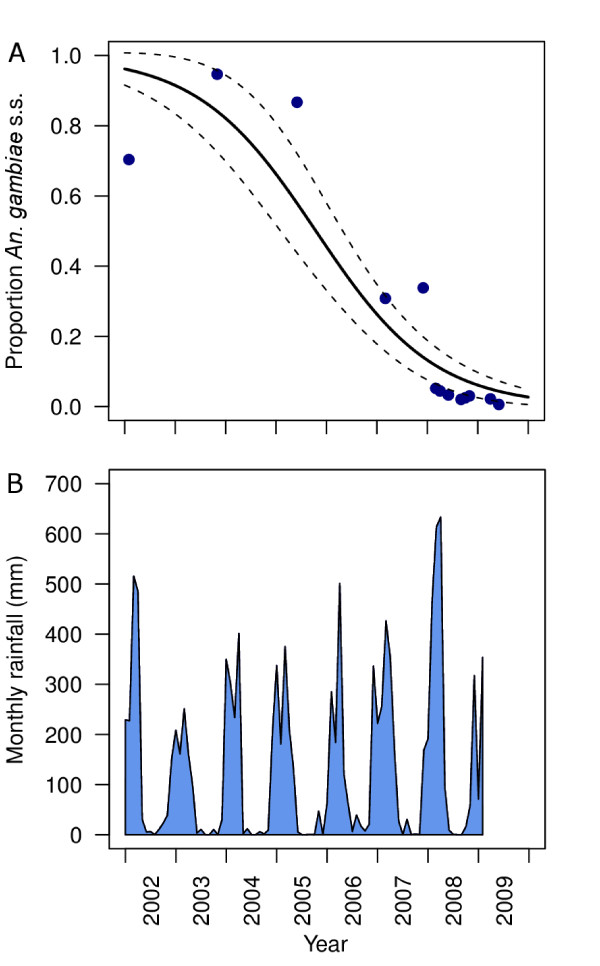
BACKGROUND: Insecticide-treated nets (ITNs) and indoor residual spraying (IRS) represent the front-line tools for malaria vector control globally, but are optimally effective where the majority of baseline transmission occurs indoors. In the surveyed area of rural southern Tanzania, bed net use steadily increased over the last decade, reducing malaria transmission intensity by 94%. METHODS: Starting before bed nets were introduced (1997), and then after two milestones of net use had been reached-75% community-wide use of untreated nets (2004) and then 47% use of ITNs (2009)-hourly biting rates of malaria vectors from the Anopheles gambiae complex and Anopheles funestus group were surveyed. RESULTS: In 1997, An. gambiae s.l. and An. funestus mosquitoes exhibited a tendency to bite humans inside houses late at night. For An. gambiae s.l., by 2009, nocturnal activity was less (p = 0.0018). At this time, the sibling species composition of the complex had shifted from predominantly An. gambiae s.s. to predominantly An. arabiensis. For An. funestus, by 2009, nocturnal activity was less (p = 0.0054) as well as the proportion biting indoors (p < 0.0001). At this time, An. funestus s.s. remained the predominant species within this group. As a consequence of these altered feeding patterns, the proportion (mean ± standard error) of human contact with mosquitoes (bites per person per night) occurring indoors dropped from 0.99 ± 0.002 in 1997 to 0.82 ± 0.008 in 2009 for the An. gambiae complex (p = 0.0143) and from 1.00 ± <0.001 to only 0.50 ± 0.048 for the An. funestus complex (p = 0.0004) over the same time period. CONCLUSIONS: High usage of ITNs can dramatically alter African vector populations so that intense, predominantly indoor transmission is replaced by greatly lowered residual transmission, a greater proportion of which occurs outdoors. Regardless of the underlying mechanism, the residual, self-sustaining transmission will respond poorly to further insecticidal measures within houses. Additional vector control tools which target outdoor biting mosquitoes at the adult or immature stages are required to complement ITNs and IRS.
Overview
The claims and statistics of this paper haven’t been checked yet.
Run the check — free, no account needed. It reads the open-access text and checks the sources it cites.
Integrity signals
Registry
Cites
Statistics
Figures
Verification
Claims the paper makes
The claims and statistics of this paper haven’t been checked yet.
Run the check — free, no account needed. It reads the open-access text and checks the sources it cites.
Claims other papers make about this one
Each is checked against this paper’s own text: does it say what the citing paper says it does?
The source backs part of the claim, not all of it — or backs it for a different population, condition or comparison.
In the citing paper
“Some investigators attribute this to a behavioural response by vectors to the protracted use of pyrethroid-treated bed nets [15, 16].”
From Sibling species of the major malaria vector Anopheles gambiae display divergent preferences for aquatic breeding sites in southern Nigeria (2024) · cites this paper as [16]
Experimental — accuracy not yet measuredThe source backs part of the claim, not all of it — or backs it for a different population, condition or comparison.
In the citing paper
“When one considers the human population at risk of transmission outdoors, the niche for spatial repellents becomes increasingly evident due to the lack of current control products for those humans becoming infected in these areas [34,35] (Figure 3).”
From Spatial repellents: from discovery and development to evidence-based validation (2012) · cites this paper as [35]
Experimental — accuracy not yet measuredThe cited source says what the claim attributes to it.
In the citing paper
“ecological shifts in vector composition and shifts in vector behaviour have been reported [19, 20].”
From Spatial temporal distribution of Anopheles mosquitoes in different ecological zones of Ghana (2026) · cites this paper as [19]
The cited source says what the claim attributes to it.
In the citing paper
“The observation of An. gambiae s.s in the sahel zone, where more outdoor mosquitoes fed on humans, may suggest potential shifts in biting behaviour in Anopheles gambiae mosquitoes, as reported in other studies [19, 20, 33].”
From Spatial temporal distribution of Anopheles mosquitoes in different ecological zones of Ghana (2026) · cites this paper as [19]
Self-check
Percentages, sums and reported differences re-computed from the paper’s own numbers.
The self-check needs the paper’s full text.
Citations
Cites
Insecticide-treated bed nets and curtains for preventing malaria
Lengeler, C. (2004) · Cochrane Database of Systematic Reviews · doi:10.1002/14651858.cd000363.pub2 · Cited by 1,700
Identification of Single Specimens of the Anopheles Gambiae Complex by the Polymerase Chain Reaction
Scott, J. A., Brogdon, W. G., & Collins, F. H. (1993) · American Journal of Tropical Medicine and Hygiene · doi:10.4269/ajtmh.1993.49.520 · Cited by 1,634
Silver, J. B. (2007) · Springer eBooks · doi:10.1007/978-1-4020-6666-5 · Cited by 1,005
A supplement to the Anophelinae of Africa south of the Sahara (Afrotropical Region).
Gillies, M. T., & Coetzee, M. (1987) · IHI Repository · Cited by 812
The Anophelinae of Africa south of the Sahara (Ethiopian Zoogeographical Region).
Gillies, M. T., & Meillon, B. D. (1968) · Cited by 776
Habicht, J. (1999) · International Journal of Epidemiology · doi:10.1093/ije/28.1.10 · Cited by 729
Koekemoer, L. L., Kamau, L., Hunt, R. H., & Coetzee, M. (2002) · The American journal of tropical medicine and hygiene · doi:10.4269/ajtmh.2002.66.804 · Cited by 641
HAWLEY, W. A., PHILLIPS-HOWARD, P. A., TER KUILE, F. O., TERLOUW, D. J., VULULE, J. M., OMBOK, M., NAHLEN, B. L., GIMNIG, J. E., KARIUKI, S. K., KOLCZAK, M. S., et al. (2003) · The American Journal of Tropical Medicine and Hygiene · doi:10.4269/ajtmh.2003.68.121 · Cited by 613
Griffin, J. T., Hollingsworth, T. D., Okell, L. C., Churcher, T. S., White, M., Hinsley, W., Bousema, T., Drakeley, C. J., Ferguson, N. M., Basáñez, M.-G., et al. (2010) · PLoS Medicine · doi:10.1371/journal.pmed.1000324 · Cited by 595
Self-citationChanges in the burden of malaria in sub-Saharan Africa
O’Meara, W. P., Mangeni, J. N., Steketee, R. W., & Greenwood, B. M. (2010) · The Lancet Infectious Diseases · doi:10.1016/s1473-3099(10)70096-7 · Cited by 517
Cited by
Sorted by citations
Items 301–400 of 686
Vector control for malaria elimination in Botswana: progress, gaps and opportunities
Kgoroebutswe, T. K., Makate, N., Fillinger, U., Mpho, M., Segoea, G., Sangoro, O. P., Mutero, C. M., Chanda, E., Ntebela, D., Mogopa, M., et al. (2020) · Malaria Journal · doi:10.1186/s12936-020-03375-6 · Cited by 24
Musiime, A. K., Smith, D. L., Kilama, M., Otto, G., Kyagamba, P., Rek, J. C., Conrad, M. D., Nankabirwa, J. I., Arinaitwe, E., Akol, A. M., et al. (2020) · Malaria Journal · doi:10.1186/s12936-020-03304-7 · Cited by 23
Self-citationNicolas, P., Kiuru, C., Wagah, M. G., Muturi, M., Duthaler, U., Hammann, F., Maia, M. F., & Chaccour, C. (2021) · Parasites & Vectors · doi:10.1186/s13071-021-04675-9 · Cited by 23
Bionomics and ecology of Anopheles merus along the East and Southern Africa coast
Bartilol, B., Omedo, I., Mbogo, C. N. M., MWANGANGI, J. M., & Rono, M. K. (2021) · Parasites & Vectors · doi:10.1186/s13071-021-04582-z · Cited by 23
Bamou, R., Kopya, E., Nkahe, D. L., Menze, B. D., Awono‐Ambene, P., Tchuinkam, T., Njiokou, F., Wondji, C. S., & Antonio‐Nkondjio, C. (2021) · Parasite · doi:10.1051/parasite/2021003 · Cited by 23
Keïta, M., Doumbia, S., Sissoko, I. M., Touré, M., Diawara, S. I., Konate, D. S., Sodio, A. B., Traore, S. F., Diakité, M., Doumbia, S., et al. (2021) · Malaria Journal · doi:10.1186/s12936-021-03650-0 · Cited by 23
Bokore, G., Svenberg, L., Tamre, R., Onyango, P. O., Bukhari, T., Emmer, Å., & Fillinger, U. (2021) · Parasites & Vectors · doi:10.1186/s13071-021-04939-4 · Cited by 24
Kawada, H., Ohashi, K., Dida, G. O., Sonye, G. O., Njenga, S. M., Mwandawiro, C. S., & Minakawa, N. (2014) · Parasites & Vectors · doi:10.1186/1756-3305-7-383 · Cited by 23
Sougoufara, S., Sokhna, C., Diagne, N., Doucouré, S., Sembène, P. M., & Harry, M. (2017) · Malaria Journal · doi:10.1186/s12936-017-1992-8 · Cited by 23
Ryan, S. J., Lippi, C. A., Boersch‐Supan, P. H., Heydari, N., Silva, M., Adrian, J., Noblecilla, L. F., Ayala, E. B., Encalada, M. D., Larsen, D. A., et al. (2017) · Malaria Journal · doi:10.1186/s12936-017-2121-4 · Cited by 23
Commentary: Does a mosquito bite when no one is around to hear it?
Lindblade, K. A. (2013) · International Journal of Epidemiology · doi:10.1093/ije/dyt004 · Cited by 23
Moiroux, N., Bio-Bangana, A. S., Djènontin, A., Chandre, F., Corbel, V., & Guis, H. (2013) · Parasites & Vectors · doi:10.1186/1756-3305-6-71 · Cited by 22
Mmbando, A. S., Ngowo, H. S., Kilalangongono, M., Abbas, S., Matowo, N. S., Moore, S., & Okumu, F. O. (2017) · Wellcome Open Research · doi:10.12688/wellcomeopenres.13006.1 · Cited by 22
Human and vector behaviors determine exposure to Anopheles in Namibia
Mwema, T., Lukubwe, O., Joseph, R. N., Maliti, D. F., Iitula, I., Katokele, S. T., Uusiku, P., Walusimbi, D., Ogoma, S. B., Tambo, M., et al. (2022) · Parasites & Vectors · doi:10.1186/s13071-022-05563-6 · Cited by 22
Katusi, G. C., Hermy, M. R. G., Makayula, S. M., Ignell, R., Govella, N. J., Hill, S. R., & Mnyone, L. L. (2022) · Parasites & Vectors · doi:10.1186/s13071-022-05586-z · Cited by 22
Self-citationRath, A., Prusty, M. R., Das, M., Mahapatra, N., Tripathy, H., & Hazra, R. K. (2015) · Transactions of the Royal Society of Tropical Medicine and Hygiene · doi:10.1093/trstmh/trv081 · Cited by 22
Matowo, N. S., Koekemoer, L. L., Moore, S., Mmbando, A. S., Mapua, S. A., Coetzee, M., & Okumu, F. O. (2016) · PLoS ONE · doi:10.1371/journal.pone.0145653 · Cited by 23
Newer Approaches for Malaria Vector Control and Challenges of Outdoor Transmission
Beier, J. C., Wilke, A. B. B., & Benelli, G. (2018) · InTech eBooks · doi:10.5772/intechopen.75513 · Cited by 22
Study of the epidemiological behavior of malaria in the Darien Region, Panama. 2015–2017
Cáceres, L., Victoria, C., Ramirez, J. L., Jackman, C., Calzada, J. E., & Torres, R. (2019) · PLoS ONE · doi:10.1371/journal.pone.0224508 · Cited by 22
Zhou, G., Lee, M., Atieli, H., Githure, J. I., Githeko, A. K., Kazura, J. W., & Yan, G. (2020) · Trials · doi:10.1186/s13063-020-04573-y · Cited by 25
Phylogenetic Complexity of Morphologically Identified Anopheles squamosus in Southern Zambia
Hoffman, J., Ciubotariu, I. I., Simubali, L., Mudenda, T., Moss, W. J., Carpi, G., Norris, D. E., & Stevenson, J. C. (2021) · Insects · doi:10.3390/insects12020146 · Cited by 21
Machani, M. G., Ochomo, E., Amimo, F., Mukabana, W. R., Githeko, A. K., Yan, G., & Afrane, Y. A. (2022) · PLoS ONE · doi:10.1371/journal.pone.0266420 · Cited by 21
Mponzi, W. P., Swai, J. K., Kaindoa, E. W., Kifungo, K., Eiras, Á. E., Batista, E. P. A., Matowo, N. S., Sangoro, O. P., Finda, M. F., Mmbando, A. S., et al. (2022) · PLoS ONE · doi:10.1371/journal.pone.0271833 · Cited by 21
Impact of different mosquito collection methods on indicators of Anopheles malaria vectors in Uganda
Mawejje, H. D., Rwatooro, J. A., Kyagamba, P., Kamya, M. R., Rosenthal, P. J., Lines, J., Dorsey, G., & Staedke, S. G. (2022) · Malaria Journal · doi:10.1186/s12936-022-04413-1 · Cited by 21
Zhu, L., Qualls, W. A., Marshall, J. M., Arheart, K. L., Deangelis, D. L., McManus, J. W., Traore, S. F., Doumbia, S., Schlein, Y., Müller, G. C., et al. (2015) · Malaria Journal · doi:10.1186/s12936-015-0555-0 · Cited by 23
Development of a Gravid Trap for Collecting Live Malaria Vectors Anopheles gambiae s.l.
Dugassa, S., Lindh, J. M., Oyieke, F. A., Mukabana, W. R., Lindsay, S. W., & Fillinger, U. (2013) · PLoS ONE · doi:10.1371/journal.pone.0068948 · Cited by 21
Krajacich, B. J., Slade, J. R., Mulligan, R. T., Labrecque, B., Kobylinski, K. C., Gray, M., Kuklinski, W. S., Burton, T. A., Seaman, J. A., Sylla, M., et al. (2014) · Journal of Medical Entomology · doi:10.1603/me13090 · Cited by 20
Veterinary endectocides for malaria control and elimination: prospects and challenges
Chaccour, C. (2020) · Philosophical Transactions of the Royal Society B Biological Sciences · doi:10.1098/rstb.2019.0810 · Cited by 20
Zemene, E., Belay, D. B., Tiruneh, A., Lee, M., Yewhalaw, D., & Yan, G. (2021) · BMC Infectious Diseases · doi:10.1186/s12879-021-06592-9 · Cited by 20
Cleary, E., Hetzel, M. W., & Clements, A. (2022) · Frontiers in Epidemiology · doi:10.3389/fepid.2022.980795 · Cited by 20
Cost and quality of operational larviciding using drones and smartphone technology
Hardy, A., Haji, K. A., Abbas, F., Hassan, J., Ali, A., Yussuf, Y., Cook, J. A., Roșu, L., Houri-Yafin, A., Vigodny, A., et al. (2023) · Malaria Journal · doi:10.1186/s12936-023-04713-0 · Cited by 20
Mwalugelo, Y. A., Mponzi, W. P., Muyaga, L. L., Mahenge, H. H., Katusi, G. C., Muhonja, F. H., Omondi, D., Ochieng, A. O., Kaindoa, E. W., & Amimo, F. (2024) · Malaria Journal · doi:10.1186/s12936-024-05039-1 · Cited by 20
Yakob, L., Cameron, M., & Lines, J. (2017) · Malaria Journal · doi:10.1186/s12936-017-1748-5 · Cited by 21
Airs, P. M., Kudrna, K. E., & Bartholomay, L. C. (2019) · Acta Tropica · doi:10.1016/j.actatropica.2019.01.005 · Cited by 20
Degefa, T., Yewhalaw, D., Zhou, G., Lee, M., Atieli, H., Githeko, A. K., & Yan, G. (2019) · Parasites & Vectors · doi:10.1186/s13071-019-3535-3 · Cited by 20
Vantaux, A., Yao, F. A., Hien, D. F. D. S., Guissou, E., Yaméogo, B. K., Gouagna, L., Fontenille, D., Renaud, F., Simard, F., Costantini, C., et al. (2021) · Peer Community Journal · doi:10.24072/pcjournal.13 · Cited by 22
Ouattara, A. F., Dagnogo, M., Constant, E. A., Koné, M., Raso, G., Tanner, M., Olliaro, P. L., Utzinger, J., & Koudou, B. G. (2014) · Malaria Journal · doi:10.1186/1475-2875-13-109 · Cited by 19
Impact of Climate Variability and Interventions on Malaria Incidence and Forecasting in Burkina Faso
Traoré, N., Millogo, O., Sié, A., & Vounatsou, P. (2024) · International Journal of Environmental Research and Public Health · doi:10.3390/ijerph21111487 · Cited by 19
Using evolution to generate sustainable malaria control with spatial repellents
Lynch, P. A., & Boots, M. (2016) · eLife · doi:10.7554/elife.15416 · Cited by 19
Assessment of the Suna trap for sampling mosquitoes indoors and outdoors
Mburu, M. M., Zembere, K., Hiscox, A., Banda, J., Phiri, K. S., van den Berg, H., Mzilahowa, T., Takken, W., & McCann, R. S. (2019) · Malaria Journal · doi:10.1186/s12936-019-2680-7 · Cited by 19
O’Meara, W. P., Simmons, R., Bullins, P., Freedman, E., Abel, L., Mangeni, J. N., Taylor, S. M., & Obala, A. A. (2019) · The Journal of Infectious Diseases · doi:10.1093/infdis/jiz561 · Cited by 21
Lwetoijera, D. W., Harris, C. A., Kiware, S. S., Killeen, G. F., Dongus, S., Devine, G. J., & Majambere, S. (2014) · American Journal of Tropical Medicine and Hygiene · doi:10.4269/ajtmh.13-0550 · Cited by 19
Self-citationWolie, R. Z., Koffi, A. A., Ayuk-Taylor, L., Alou, L. P. A., Sternberg, E. D., N’Nan-Alla, O., N’Guessan, Y., Dahounto, A., Oumbouke, W. A., Tia, I. Z., et al. (2022) · Malaria Journal · doi:10.1186/s12936-022-04196-5 · Cited by 18
“It further highlights the need for novel strategies or tools to target outdoor malaria transmission [34, 35].”
BackgroundHakizimana, E., Ingabire, M. C., Rulisa, A., Kateera, F., van den Borne, B. H. P., Muvunyi, C. M., van Vugt, M., Mutesa, L., Bron, G. M., Takken, W., et al. (2022) · International Journal of Environmental Research and Public Health · doi:10.3390/ijerph19116699 · Cited by 18
Russell, T. L., Lwetoijera, D. W., Knols, B. G., Takken, W., Killeen, G. F., & Kelly‐Hope, L. A. (2013) · Malaria Journal · doi:10.1186/1475-2875-12-24 · Cited by 18
Self-citationModification ofAnopheles gambiaedistribution at high altitudes in Madagascar
Tantely, M. L., Rakotoniaina, J.-C., Tata, E., Andrianaivolambo, L., Fontenille, D., & Élissa, N. (2012) · Journal of Vector Ecology · doi:10.1111/j.1948-7134.2012.00244.x · Cited by 18
Musiba, R. M., Tarimo, B. B., Monroe, A. C., Msaky, D., Ngowo, H. S., Mihayo, K., Limwagu, A. J., Chila, G., Shubis, G. K., Ibrahim, A., et al. (2022) · Malaria Journal · doi:10.1186/s12936-022-04200-y · Cited by 19
Heterogeneity in malaria transmission: underlying factors and implications for disease control
Bousema, T., & Baidjoe, A. Y. (2013) · Wageningen Academic Publishers eBooks · doi:10.3920/978-90-8686-744-8_11 · Cited by 19
Biting patterns of malaria vectors of the lower Shire valley, southern Malawi
Mburu, M. M., Mzilahowa, T., Amoah, B., Chifundo, D., Phiri, K. S., van den Berg, H., Takken, W., & McCann, R. S. (2019) · Acta Tropica · doi:10.1016/j.actatropica.2019.105059 · Cited by 18
Relative contributions of various endogenous and exogenous factors to the mosquito microbiota
Bogale, H. N., Cannon, M. V., Keita, K., Camara, D., Barry, Y., Keïta, M., Coulibaly, D. M., Kone, A. K., Doumbo, O. K., Thera, M. A., et al. (2020) · Parasites & Vectors · doi:10.1186/s13071-020-04491-7 · Cited by 21
Tchumkam, C. A., Foko, L. P. K., Ndo, C., Essangui, E., Cheteug, G., Meva, F. E., Ayong, L. S., & Moukoko, C. E. E. (2023) · Scientific Reports · doi:10.1038/s41598-023-31791-6 · Cited by 17
Verhulst, N. O., Bakker, J. W., & Hiscox, A. (2015) · Journal of the American Mosquito Control Association · doi:10.2987/moco-31-03-223-232.1 · Cited by 17
Maliti, D. F., Ranson, H., Magesa, S., Kisinza, W. N., Mcha, J. H., Haji, K. A., Killeen, G. F., & Weetman, D. (2014) · PLoS ONE · doi:10.1371/journal.pone.0110910 · Cited by 17
Self-citationSoma, D. D., Zogo, B., Taconet, P., Somé, A. F., Coulibaly, S., Baba‐Moussa, L., Ouédraogo, G. A., Koffi, A. A., Pennetier, C., Dabiré, R. K., et al. (2021) · BMC Public Health · doi:10.1186/s12889-021-10304-y · Cited by 17
Stone, C., Chitnis, N., & Gross, K. (2015) · Evolutionary Applications · doi:10.1111/eva.12354 · Cited by 17
Microbial Pre-exposure and Vectorial Competence of Anopheles Mosquitoes
Dieme, C., Rotureau, B., & Mitri, C. (2017) · Frontiers in Cellular and Infection Microbiology · doi:10.3389/fcimb.2017.00508 · Cited by 16
Status of insecticide resistance in malaria vectors in Kwale County, Coastal Kenya
Kiuru, C., Oyieke, F. A., Mukabana, W. R., MWANGANGI, J. M., Kamau, L., & Muhia-Matoke, D. (2018) · Malaria Journal · doi:10.1186/s12936-017-2156-6 · Cited by 16
Omonijo, A., & Omonijo, A. O. (2019) · Journal of Parasitology Research · doi:10.1155/2019/1273714 · Cited by 16
Finney, M., McKenzie, B. A., Rabaovola, B., Sutcliffe, A. C., Dotson, E., & Zohdy, S. (2021) · Malaria Journal · doi:10.1186/s12936-020-03539-4 · Cited by 16
Stalin, A., Reegan, A. D., Gandhi, M. R., Saravanan, R. R., Balakrishna, K., Hesham, A. E., Savarimuthu Ignacimuthu, S. J., & Zhang, Y. (2022) · Computers in Biology and Medicine · doi:10.1016/j.compbiomed.2022.105535 · Cited by 16
Okal, M. N., Herrera-Varela, M., Ouma, P., Torto, B., Lindsay, S. W., Lindh, J. M., & Fillinger, U. (2015) · Parasites & Vectors · doi:10.1186/s13071-015-0916-0 · Cited by 16
Hodges, T. K., Athrey, G., Deitz, K. C., Overgaard, H. J., Matías, A., Caccone, A., & Slotman, M. A. (2013) · Evolutionary Applications · doi:10.1111/eva.12094 · Cited by 17
Kamau, A., MWANGANGI, J. M., Rono, M. K., Mogeni, P., Omedo, I., Midega, J. T., Scott, J. A. G., & Bejon, P. (2018) · Wellcome Open Research · doi:10.12688/wellcomeopenres.11073.4 · Cited by 17
Sangoro, O. P., Lweitojera, D., Simfukwe, E., Ngonyani, H., Mbeyela, E., Lugiko, D., Kihonda, J., Maia, M. F., & Moore, S. (2014) · Malaria Journal · doi:10.1186/1475-2875-13-159 · Cited by 16
Ebhodaghe, F. I., Sanchez-Vargas, I., Isaac, C., Foy, B. D., & Hemming-Schroeder, E. (2024) · Malaria Journal · doi:10.1186/s12936-024-04871-9 · Cited by 15
“Some investigators attribute this to a behavioural response by vectors to the protracted use of pyrethroid-treated bed nets [15, 16].”
BackgroundMwagira-Maina, S., Runo, S. M., Wachira, L., Kitur, S., Nyasende, S., Kemei, B. J., Ochomo, E., Matoke-Muhia, D., Mbogo, C. M., & Kamau, L. (2021) · Malaria Journal · doi:10.1186/s12936-021-03997-4 · Cited by 15
Evaluation of textile substrates for dispensing synthetic attractants for malaria mosquitoes
Mweresa, C. K., Mukabana, W. R., Omusula, P., Otieno, B., Gheysens, T., Takken, W., & van Loon, J. J. A. (2014) · Parasites & Vectors · doi:10.1186/1756-3305-7-376 · Cited by 15
Considerations for male fitness in successful genetic vector control programs
Helinski, M. E. H., & Harrington, L. C. (2013) · Wageningen Academic Publishers eBooks · doi:10.3920/978-90-8686-744-8_12 · Cited by 15
Sexual Selection and the Evolution of Mating Systems in Mosquitoes
South, A., & Catteruccia, F. (2016) · Advances in insect physiology · doi:10.1016/bs.aiip.2016.04.004 · Cited by 15
He, Z., Zhang, J., Shi, Z., Liu, J., Zhang, J., Yan, Z., & Chen, B. (2019) · Malaria Journal · doi:10.1186/s12936-019-2765-3 · Cited by 15
Topical repellents for malaria prevention
Gabaldón-Figueira, J. C., Wagah, M. G., Adipo, L. B., Wanjiku, C., & Maia, M. F. (2023) · Cochrane Database of Systematic Reviews · doi:10.1002/14651858.cd015422.pub2 · Cited by 17
Philbert, A., Lyantagaye, S., Pradel, G., Ngwa, C. J., & Nkwengulila, G. (2017) · Tropical Medicine & International Health · doi:10.1111/tmi.12850 · Cited by 15
Kamau, A., MWANGANGI, J. M., Rono, M. K., Mogeni, P., Omedo, I., Midega, J. T., Scott, J. A. G., & Bejon, P. (2017) · Wellcome Open Research · doi:10.12688/wellcomeopenres.11073.1 · Cited by 15
Eba, K., Habtewold, T., Asefa, L., Degefa, T., Yewhalaw, D., & Duchateau, L. (2023) · Malaria Journal · doi:10.1186/s12936-023-04440-6 · Cited by 14
Perugini, E., Guelbeogo, M. W., Guglielmo, F., Poggi, C., Gabrieli, E., Ranson, H., della Torre, A., & Pombi, M. (2023) · Parasites & Vectors · doi:10.1186/s13071-023-05710-7 · Cited by 14
Egyirifa, R. K., & Akorli, J. (2024) · Malaria Journal · doi:10.1186/s12936-024-04870-w · Cited by 14
Namango, I. H., Moore, S., Marshall, C., Saddler, A., Kaftan, D. J., Tenywa, F. C., Makungwa, N. O., Limwagu, A. J., Mapua, S. A., Odufuwa, O. G., et al. (2024) · PLOS Global Public Health · doi:10.1371/journal.pgph.0003864 · Cited by 15
Mosquito vector diversity and malaria transmission
Laurent, B. S. (2025) · Frontiers in Malaria · doi:10.3389/fmala.2025.1600850 · Cited by 14
Optimising systemic insecticide use to improve malaria control
Meredith, H. R., Furuya‐Kanamori, L., & Yakob, L. (2019) · BMJ Global Health · doi:10.1136/bmjgh-2019-001776 · Cited by 14
Zhou, G., Yu, L., Wang, X., Zhong, D., Lee, M., Kibret, S., & Yan, G. (2020) · PLoS ONE · doi:10.1371/journal.pone.0244447 · Cited by 16
Stromsky, V. E., Hajkazemian, M., Vaisbourd, E., Mozūraitis, R., & Emami, S. N. (2021) · Communications Biology · doi:10.1038/s42003-021-02689-8 · Cited by 14
Killeen, G. F., Kiware, S. S., Seyoum, A., Gimnig, J. E., Corliss, G. F., Stevenson, J. C., DRAKELEY, C. J., & Chitnis, N. (2014) · Malaria Journal · doi:10.1186/1475-2875-13-338 · Cited by 15
Self-citationLarval habitat stability and productivity in two sites in Southern Ghana
Forson, A. O., Hinne, I. A., Sraku, I. K., & Afrane, Y. A. (2023) · Malaria Journal · doi:10.1186/s12936-023-04498-2 · Cited by 13
Hamid‐Adiamoh, M., Jabang, A., Opondo, K., Ndiath, M. O., Assogba, B. S., & Amambua‐Ngwa, A. (2023) · Malaria Journal · doi:10.1186/s12936-023-04518-1 · Cited by 13
Zembere, K. (2024) · Malaria Journal · doi:10.1186/s12936-024-05161-0 · Cited by 13
Haines, L. R., Trett, A., Rose, C., García, N., Sterkel, M., McGuinness, D., Regnault, C., Barrett, M. P., Leroy, D., Burrows, J. N., et al. (2025) · Science Translational Medicine · doi:10.1126/scitranslmed.adr4827 · Cited by 13
Innovative approaches to exploit host plant metabolites in malaria control
Torto, B. (2019) · Pest Management Science · doi:10.1002/ps.5460 · Cited by 13
Challenges in Understanding the Bionomics of Indian Malaria Vectors
Kumar, G., Gupta, S. K., Rahi, M., & Sharma, A. K. (2022) · American Journal of Tropical Medicine and Hygiene · doi:10.4269/ajtmh.22-0137 · Cited by 13
Nocturnal man biting habits of mosquito species in Serian, Sarawak, Malaysia
Ahmad, R., Zamree, I., Ali, W. N. W. M., Azahari, A. H., Matusop, A., Lubim, D., Nor, Z. M., & Lim, L. H. (2013) · Advances in Entomology · doi:10.4236/ae.2013.12009 · Cited by 13
Obembe, A., Oduola, A. O., Popoola, K. O. K., & Ajao, A. M. (2014) · Asian Pacific Journal of Tropical Disease · doi:10.1016/s2222-1808(14)60683-6 · Cited by 13
Application of loop analysis for evaluation of malaria control interventions
Yasuoka, J., Jimba, M., & Levins, R. (2014) · Malaria Journal · doi:10.1186/1475-2875-13-140 · Cited by 13
Tungu, P., Malima, R., Mosha, F. W., Lyimo, I. N., Maxwell, C. A., Kaur, H., Kisinza, W. N., Magesa, S., Kirby, M. J., & Rowland, M. (2015) · Malaria Journal · doi:10.1186/s12936-015-0742-z · Cited by 13
Yalwala, S., Kollars, J. W., Kasembeli, G., Barasa, C., Senessie, C., Kollars, P. G., & Kollars, T. M. (2016) · Journal of Medical Entomology · doi:10.1093/jme/tjw075 · Cited by 13
Finda, M. F., Okumu, F. O., Minja, E. G., Njalambaha, R. M., Mponzi, W. P., Tarimo, B. B., Chaki, P., Lezaun, J., Kelly, A. H., & Christofides, N. J. (2021) · Malaria Journal · doi:10.1186/s12936-021-03663-9 · Cited by 13
Helinski, M. E. H., Nuwa, A., Protopopoff, N., Feldman, M., Ojuka, P., Oguttu, D., Abeku, T. A., & Meek, S. (2015) · Parasites & Vectors · doi:10.1186/s13071-015-1060-6 · Cited by 13
Komazawa, O., Kaneko, S., K’opiyo, J., Kiche, I., Muuo, S., Shimada, M., & Karama, M. (2012) · PLoS ONE · doi:10.1371/journal.pone.0049604 · Cited by 13
Main, B. J., Lee, Y., Ferguson, H. M., Kreppel, K. S., Kihonda, A., Govella, N. J., Collier, T. C., Cornel, A. J., Eskin, E., Kang, E. Y., et al. (2016) · bioRxiv (Cold Spring Harbor Laboratory) · doi:10.1101/044701 · Cited by 13
Self-citationSynergistic and antagonistic interactions between bednets and vaccines in the control of malaria
Artzy‐Randrup, Y., Dobson, A. P., & Pascual, M. (2015) · Proceedings of the National Academy of Sciences · doi:10.1073/pnas.1409467112 · Cited by 12
Kahamba, N. F., Tarimo, F. S., Kifungo, K., Mponzi, W. P., Kinunda, S. A., Simfukwe, A. J., Mapua, S. A., Msugupakulya, B. J., Baldini, F., Ferguson, H. M., et al. (2024) · Malaria Journal · doi:10.1186/s12936-024-05154-z · Cited by 12
Attractive Toxic Sugar Baits (ATSB): A Novel Vector Management Tool
Kline, D. L., Müller, G. C., Junnila, A., & Xue, R. (2018) · ACS symposium series · doi:10.1021/bk-2018-1289.ch005 · Cited by 13
Metadata
- Authors
- Russell, T. L., Govella, N. J., Azizi, S., Drakeley, C. J., Kachur, S. P., & Killeen, G. F.
- Affiliations
- Ifakara Health Institute (TZ)
- Centers for Disease Control and Prevention (US)
- Corresponding author
- Russell, Tanya L
- Venue
- Malaria Journal
- Published
- 2011-04-09
- Volume
- 10
- Issue
- 1
- Pages
- 80-80
- ISSN
- 1475-2875 (ISSN-L)
- PMC
- PMC3084176
- OpenAlex
- W2103610338
- Cited by
- 698
- References
- 55
- Citations by year
- 2026: 14 · 2025: 34 · 2024: 52 · 2023: 44 · 2022: 60 · 2021: 69 · 2020: 56 · 2019: 51 · 2018: 43 · 2017: 53 · 2016: 54 · 2015: 41 · 2014: 35 · 2013: 50 · 2012: 33
- FWCI
- 39.63
- Type
- journal article
- Language
- en
- Open access
- gold
- doi.org
- Licence
- Locations
- Malaria Journal (publishedVersion, cc-by)
- Europe PMC (PubMed Central) (publishedVersion, cc-by)
- PubMed Central (publishedVersion, cc-by)
- PubMed (publishedVersion)
- LSTM Online Archive (Liverpool School of Tropical Medicine) (acceptedVersion)
- IHI Repository (acceptedVersion)
- LSHTM Research Online (London School of Hygiene and Tropical Medicine) (acceptedVersion)
- ResearchOnline at James Cook University (James Cook University) (submittedVersion)
- DOAJ (DOAJ: Directory of Open Access Journals) (submittedVersion)
- Funders
- Bill and Melinda Gates Foundation (45114, 51431)
- Wellcome Trust (076806)
- Topics
- Health Sciences › Medicine › Public Health, Environmental and Occupational Health › Malaria Research and Control
- Health Sciences › Medicine › Public Health, Environmental and Occupational Health › Mosquito-borne diseases and control
- Life Sciences › Immunology and Microbiology › Parasitology › Bird parasitology and diseases
- Keywords
- insecticide-treated nets, malaria vector control, Anopheles gambiae s.l., Anopheles funestus, Anopheles arabiensis, indoor biting, residual malaria transmission, bed net use, rural Tanzania, indoor residual spraying, malaria transmission intensity
- MeSH terms
- Animals, Anopheles, Feeding Behavior, Humans, Human Activities, Insect Vectors, Malaria, Mosquito Control, Rural Population, Tanzania, Insecticide-Treated Bednets
About these checks
Registry, retraction, Cites and statistics results are computed, not judged, with one exception: a printed reference that no index lists is read once by a model before it counts as a citation error. Claims are extracted by a model and kept only when their quote appears verbatim in the text; each cited source is then checked, with a model’s help, for whether it says what the claim relies on. Those verdicts can be wrong — read the claim’s quote and the cited source before relying on one.
Statistics and arithmetic are recomputed, not judged.
Confidence bands are shown only for fields calibrated on our annotated test set. None is calibrated yet, so no band is shown.
What counts as a claim ›How we measure confidence ›How we check this ›
Are you an author, or do you see a problem with this page? Request a review
