

The DOI matches its Crossref record; 54 of the 55 references it cites were found in a registry or an index.
Increased proportions of outdoor feeding among residual malaria vector populations following increased use of insecticide-treated nets in rural Tanzania
Open accessAbstract
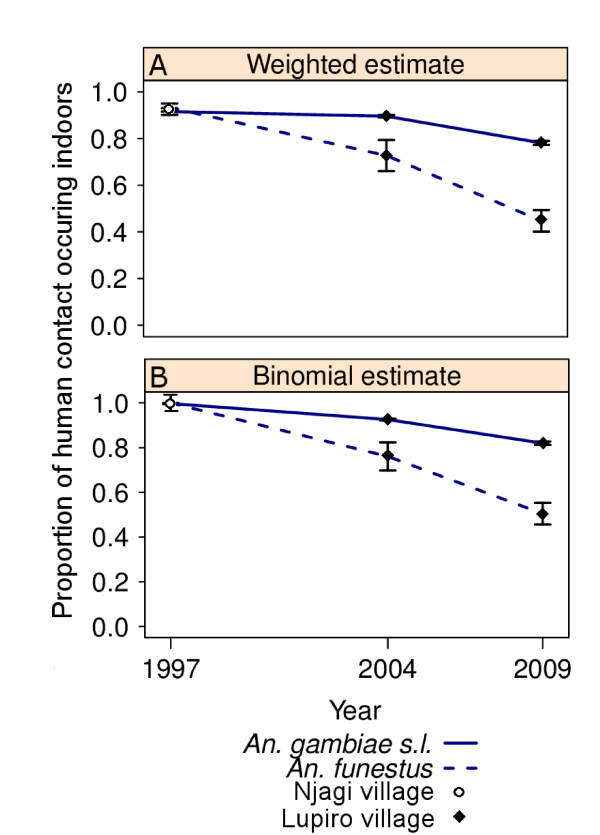
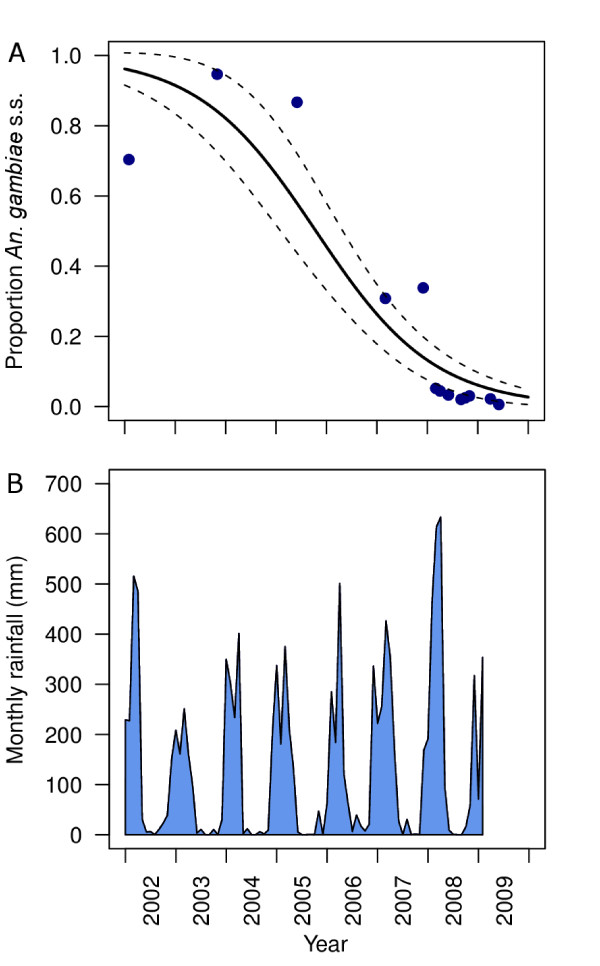
BACKGROUND: Insecticide-treated nets (ITNs) and indoor residual spraying (IRS) represent the front-line tools for malaria vector control globally, but are optimally effective where the majority of baseline transmission occurs indoors. In the surveyed area of rural southern Tanzania, bed net use steadily increased over the last decade, reducing malaria transmission intensity by 94%. METHODS: Starting before bed nets were introduced (1997), and then after two milestones of net use had been reached-75% community-wide use of untreated nets (2004) and then 47% use of ITNs (2009)-hourly biting rates of malaria vectors from the Anopheles gambiae complex and Anopheles funestus group were surveyed. RESULTS: In 1997, An. gambiae s.l. and An. funestus mosquitoes exhibited a tendency to bite humans inside houses late at night. For An. gambiae s.l., by 2009, nocturnal activity was less (p = 0.0018). At this time, the sibling species composition of the complex had shifted from predominantly An. gambiae s.s. to predominantly An. arabiensis. For An. funestus, by 2009, nocturnal activity was less (p = 0.0054) as well as the proportion biting indoors (p < 0.0001). At this time, An. funestus s.s. remained the predominant species within this group. As a consequence of these altered feeding patterns, the proportion (mean ± standard error) of human contact with mosquitoes (bites per person per night) occurring indoors dropped from 0.99 ± 0.002 in 1997 to 0.82 ± 0.008 in 2009 for the An. gambiae complex (p = 0.0143) and from 1.00 ± <0.001 to only 0.50 ± 0.048 for the An. funestus complex (p = 0.0004) over the same time period. CONCLUSIONS: High usage of ITNs can dramatically alter African vector populations so that intense, predominantly indoor transmission is replaced by greatly lowered residual transmission, a greater proportion of which occurs outdoors. Regardless of the underlying mechanism, the residual, self-sustaining transmission will respond poorly to further insecticidal measures within houses. Additional vector control tools which target outdoor biting mosquitoes at the adult or immature stages are required to complement ITNs and IRS.
Overview
The claims and statistics of this paper haven’t been checked yet.
Run the check — free, no account needed. It reads the open-access text and checks the sources it cites.
Integrity signals
Registry
Cites
Statistics
Figures
Verification
Claims the paper makes
The claims and statistics of this paper haven’t been checked yet.
Run the check — free, no account needed. It reads the open-access text and checks the sources it cites.
Claims other papers make about this one
Each is checked against this paper’s own text: does it say what the citing paper says it does?
The source backs part of the claim, not all of it — or backs it for a different population, condition or comparison.
In the citing paper
“Some investigators attribute this to a behavioural response by vectors to the protracted use of pyrethroid-treated bed nets [15, 16].”
From Sibling species of the major malaria vector Anopheles gambiae display divergent preferences for aquatic breeding sites in southern Nigeria (2024) · cites this paper as [16]
Experimental — accuracy not yet measuredThe source backs part of the claim, not all of it — or backs it for a different population, condition or comparison.
In the citing paper
“When one considers the human population at risk of transmission outdoors, the niche for spatial repellents becomes increasingly evident due to the lack of current control products for those humans becoming infected in these areas [34,35] (Figure 3).”
From Spatial repellents: from discovery and development to evidence-based validation (2012) · cites this paper as [35]
Experimental — accuracy not yet measuredThe cited source says what the claim attributes to it.
In the citing paper
“ecological shifts in vector composition and shifts in vector behaviour have been reported [19, 20].”
From Spatial temporal distribution of Anopheles mosquitoes in different ecological zones of Ghana (2026) · cites this paper as [19]
The cited source says what the claim attributes to it.
In the citing paper
“The observation of An. gambiae s.s in the sahel zone, where more outdoor mosquitoes fed on humans, may suggest potential shifts in biting behaviour in Anopheles gambiae mosquitoes, as reported in other studies [19, 20, 33].”
From Spatial temporal distribution of Anopheles mosquitoes in different ecological zones of Ghana (2026) · cites this paper as [19]
Self-check
Percentages, sums and reported differences re-computed from the paper’s own numbers.
The self-check needs the paper’s full text.
Citations
Cites
Insecticide-treated bed nets and curtains for preventing malaria
Lengeler, C. (2004) · Cochrane Database of Systematic Reviews · doi:10.1002/14651858.cd000363.pub2 · Cited by 1,700
Identification of Single Specimens of the Anopheles Gambiae Complex by the Polymerase Chain Reaction
Scott, J. A., Brogdon, W. G., & Collins, F. H. (1993) · American Journal of Tropical Medicine and Hygiene · doi:10.4269/ajtmh.1993.49.520 · Cited by 1,634
Silver, J. B. (2007) · Springer eBooks · doi:10.1007/978-1-4020-6666-5 · Cited by 1,005
A supplement to the Anophelinae of Africa south of the Sahara (Afrotropical Region).
Gillies, M. T., & Coetzee, M. (1987) · IHI Repository · Cited by 812
The Anophelinae of Africa south of the Sahara (Ethiopian Zoogeographical Region).
Gillies, M. T., & Meillon, B. D. (1968) · Cited by 776
Habicht, J. (1999) · International Journal of Epidemiology · doi:10.1093/ije/28.1.10 · Cited by 729
Koekemoer, L. L., Kamau, L., Hunt, R. H., & Coetzee, M. (2002) · The American journal of tropical medicine and hygiene · doi:10.4269/ajtmh.2002.66.804 · Cited by 641
HAWLEY, W. A., PHILLIPS-HOWARD, P. A., TER KUILE, F. O., TERLOUW, D. J., VULULE, J. M., OMBOK, M., NAHLEN, B. L., GIMNIG, J. E., KARIUKI, S. K., KOLCZAK, M. S., et al. (2003) · The American Journal of Tropical Medicine and Hygiene · doi:10.4269/ajtmh.2003.68.121 · Cited by 613
Griffin, J. T., Hollingsworth, T. D., Okell, L. C., Churcher, T. S., White, M., Hinsley, W., Bousema, T., Drakeley, C. J., Ferguson, N. M., Basáñez, M.-G., et al. (2010) · PLoS Medicine · doi:10.1371/journal.pmed.1000324 · Cited by 595
Self-citationChanges in the burden of malaria in sub-Saharan Africa
O’Meara, W. P., Mangeni, J. N., Steketee, R. W., & Greenwood, B. M. (2010) · The Lancet Infectious Diseases · doi:10.1016/s1473-3099(10)70096-7 · Cited by 517
Cited by
Sorted by citations
Items 501–600 of 686
Application of Infrared Techniques for Characterisation of Vector-Borne Disease Vectors
Sikulu-Lord, M. T., & Maciel‐de‐Freitas, R. (2022) · IntechOpen eBooks · doi:10.5772/intechopen.106941 · Cited by 3
Using fruit flies to delve into mosquito insecticide resistance
Hossain, K. F. B., Vimal, D., & Owusu-Ansah, E. (2023) · Frontiers in Malaria · doi:10.3389/fmala.2023.1073761 · Cited by 3
de Castro, D. P., Genta, F. A., & Rogers, M. E. (2025) · PLoS neglected tropical diseases · doi:10.1371/journal.pntd.0013888 · Cited by 3
Chakim, I., & Pumpaibool, T. (2020) · F1000Research · doi:10.12688/f1000research.19341.4 · Cited by 3
Chakim, I., & Pumpaibool, T. (2019) · F1000Research · doi:10.12688/f1000research.19341.1 · Cited by 3
Kessy, S. T., Mnyone, L. L., Nyundo, B. A., & Lyimo, I. N. (2020) · The Scientific World JOURNAL · doi:10.1155/2020/4801068 · Cited by 3
A statistical calibration tool for methods used to sample outdoor-biting mosquitoes
Ngowo, H. S., Limwagu, A. J., Ferguson, H. M., Matthiopoulos, J., Okumu, F. O., & Nelli, L. (2022) · Parasites & Vectors · doi:10.1186/s13071-022-05403-7 · Cited by 3
Iga, J., Ochaya, S., Echodu, R., Opiyo, E. A., Musiime, A. K., Nakamaanya, A., & Malinga, G. M. (2023) · Journal of Parasitology Research · doi:10.1155/2023/2225233 · Cited by 3
Evolution of Resistance to Insecticides in Disease Vectors
Nwane, P. B., Binyang, A., Mbakop, L. R., & Etang, J. (2024) · Elsevier eBooks · doi:10.1016/b978-0-443-28818-0.00006-9 · Cited by 3
Hakizimana, E. (2019) · doi:10.18174/464552 · Cited by 3
Moiroux, N. (2012) · theses.fr (ABES) · doi:10.70675/3b2b9ed2z324dz4452zac5fz79065a78ca30 · Cited by 3
John Ravindran, K., & Eapen, A. (2024) · Mosquitoes · doi:10.1007/978-981-97-4163-2_8 · Cited by 2
Subahar, R., Susanto, L., Dwira, S., Astuty, H., Firmansyah, N. E., Bayani, G. F. E., Adugna, T., Dewi, S., & Fadillah, F. (2025) · Acta Tropica · doi:10.1016/j.actatropica.2025.107691 · Cited by 2
Novel techniques for disrupting malaria transmission
Wilde, M., Farrell, S. N., Goodman, C. D., & McFadden, G. I. (2025) · Trends in Parasitology · doi:10.1016/j.pt.2025.06.005 · Cited by 2
Odor repellency and neuronal responses of commercial products towards Anopheles mosquitoes
Nguyen, M. N., Johnson, J. M., Olaleye, I., & Potter, C. J. (2025) · Malaria Journal · doi:10.1186/s12936-025-05730-x · Cited by 2
Traore, I., Cisse, M. B., Traoré, D. F., Dansoko, Y., Sinayoko, T., Diakité, A., Konaté, L., Sangaré, A., Sanou, J. M., Dembelé, A., et al. (2025) · Malaria Journal · doi:10.1186/s12936-025-05677-z · Cited by 2
Potential for Utilization of Spatial Repellents in Mosquito Control Interventions
Kline, D. L., & Urban, J. (2018) · ACS symposium series · doi:10.1021/bk-2018-1289.ch013 · Cited by 2
Lacy, K., Schaefer, K. A., Scheitrum, D. P., & Klein, E. Y. (2021) · Biotechnology Journal · doi:10.1002/biot.202100373 · Cited by 2
AsOBP1 is required for bioallethrin repellency in the malaria vector mosquito Anopheles sinensis
Zhang, Y., He, S., He, C., Zhou, L., Xu, O., Qiao, L., Chen, B., Cao, Y., & He, Z. (2024) · Insect Science · doi:10.1111/1744-7917.13332 · Cited by 2
Abong’o, B., Agumba, S., Moshi, V., Simwero, J., Otima, J., & Ochomo, E. (2024) · PubMed Central · doi:10.5281/zenodo.10567424 · Cited by 2
Arthropod repellents in public health
Debboun, M., & Goodyer, L. I. (2021) · Elsevier eBooks · doi:10.1016/b978-0-323-85411-5.00016-9 · Cited by 2
Kouadio, K. W. U., Amara, M. F., Soma, D. D., Dabiré, R. K., Diabaté, A., Gnankiné, O., & Namountougou, M. (2025) · Acta Tropica · doi:10.1016/j.actatropica.2025.107824 · Cited by 2
Li, K. J., Cai, S. X., Lin, W., Xia, J., Pi, Q., Hu, L., Huang, G. Q., Pei, S., & Zhang, H. X. (2015) · Journal of Parasitology · doi:10.1645/15-717.1 · Cited by 2
Chapitre 10. Les anophèles (Diptera : Culicidae : Anophelinae)
Robert, V., Ayala, D., & Simard, F. (2017) · IRD Éditions eBooks · doi:10.4000/books.irdeditions.22031 · Cited by 4
Meza, F. C., Muyaga, L. L., Limwagu, A. J., & Lwetoijera, D. W. (2023) · Wellcome Open Research · doi:10.12688/wellcomeopenres.18242.3 · Cited by 2
A GIS Architecture for Medical Disaster Management to Support Modern Healthcare Management System
Ali, A., Changazi, S. A., Rizwan, H. M. A., Shehzad, K., Nazir, M. U., & Naz, M. I. (2022) · doi:10.1109/icai55435.2022.9773460 · Cited by 2
Can repellents prevent malaria in Tanzania
Sangoro, O. P. (2015) · LSHTM Research Online (London School of Hygiene and Tropical Medicine) · doi:10.17037/pubs.02374474 · Cited by 2
Engdahl, C. (2017) · DiVA at Umeå University (Umeå University) · Cited by 2
Citizen science for malaria vector surveillance in Rwanda
Murindahabi, M. M. (2020) · doi:10.18174/521433 · Cited by 2
Sanou, A., Nelli, L., Guelbeogo, M. W., Cissé, F., Tapsoba, M., Ouédraogo, P., Sagnon, N., Ranson, H., Matthiopoulos, J., & Ferguson, H. M. (2021) · Research Square · doi:10.21203/rs.3.rs-267583/v1 · Cited by 2
Bérubé, S., Freedman, E., Menya, D., Kipkoech, J., Abel, L., Lapp, Z., Taylor, S. M., O’Meara, W. P., Obala, A. A., & Wesolowski, A. (2022) · bioRxiv (Cold Spring Harbor Laboratory) · doi:10.1101/2022.12.23.521802 · Cited by 2
Kroko-Djahouri, N. W. M., Guindo-Coulibaly, N., Assouho, K. F., Zoh, D. D., Tia, E., Sadia-Kacou, A. M. C., Azongnibo, K. R. M., Kpan, M. D. S., Kouadio, A. M. N., & Adja, A. M. (2024) · International Journal of Tropical Insect Science · doi:10.1007/s42690-024-01351-0 · Cited by 2
“Similar results have already been reported in southern Benin, in Tanzania and recently in Côte d’Ivoire mainly in Logokaha, Kaforo and Assekro (Russell et al. 2011; Corbel et al. 2012; Adja et al. 2022).”
Spatial temporal distribution of Anopheles mosquitoes in different ecological zones of Ghana
Abdulai, A., Owusu-Asenso, C. M., Mohammed Sabtiu, A. R., Sraku, I. K., Akuamoah-Boateng, Y., Ebuako, A. A., Awotwe, L. E., Doe, R. T., Boadu, E. N., Appiah, A. A., et al. (2026) · Gigabyte · doi:10.46471/gigabyte.175 · Cited by 1
“The observation of An. gambiae s.s in the sahel zone, where more outdoor mosquitoes fed on humans, may suggest potential shifts in biting behaviour in Anopheles gambiae mosquitoes, as reported in other studies [19, 20, 33].”
Know your enemy: understanding mosquito biology to advance malaria elimination in Africa
Zembere, K., Kalonde, P. K., & Bickton, F. M. (2025) · Parasitology Research · doi:10.1007/s00436-025-08534-9 · Cited by 1
Is outdoor-resting behaviour in malaria vectors consistent? Short report from northern Ghana
Hamid‐Adiamoh, M., Nwakanma, D. C., Sraku, I. K., Amambua‐Ngwa, A., & Afrane, Y. A. (2021) · AAS Open Research · doi:10.12688/aasopenres.13317.1 · Cited by 1
Insecticidal Resistance and Counter Mechanism in Mosquitoes: A Coevolutionary Trade-off
Mukhiya, I. A., & Das, A. (2024) · Springer eBooks · doi:10.1007/978-981-97-4163-2_15 · Cited by 1
Accelerating the fight towards malaria elimination: Bridging gaps to achieve health equity in India
Chalageri, V. H., Shrinivasa, B., Nath, N. S., Nandish, P., & Anvikar, A. R. (2024) · Journal of Vector Borne Diseases · doi:10.4103/jvbd.jvbd_92_24 · Cited by 1
Okunlola, O. A., Okewole, D. M., & Oyeyemi, O. T. (2025) · BMC Public Health · doi:10.1186/s12889-025-25360-x · Cited by 1
An underestimated risk? Analysis of outdoor malaria transmission in an urban area of Southern Benin
Konkon, A. K., Zoungbédji, D. M., Sovi, A., Hoyochi, I., Salako, A. S., Konkon, C., Dangnon, B., Yahoue, G., Lokossou, A. S., Adjovi, R. V., et al. (2026) · BMC Infectious Diseases · doi:10.1186/s12879-025-12492-z · Cited by 1
Ngaffo, K. L., Hien, A. S., Soma, D. D., Maiga, S., Sougue, E., Ouédraogo, C. O. W., Delphine, K. O., Kaboré, D. P. A., Namountougou, M., Diabaté, A., et al. (2026) · Parasites & Vectors · doi:10.1186/s13071-025-07210-2 · Cited by 1
Emidi, B. (2025) · Tanzania journal of health research/Tanzania Journal of Health Research · doi:10.4314/thrb.v26i3.27 · Cited by 1
Life Cycle and Cytogenetic Study of Mosquitoes (Diptera: Culicidae)
Abd, S. (2020) · IntechOpen eBooks · doi:10.5772/intechopen.93219 · Cited by 1
Ombugadu, A. (2021) · Biomedical Journal of Scientific & Technical Research · doi:10.26717/bjstr.2021.37.005975 · Cited by 1
Rashkov, P. (2022) · Mathematical Biosciences & Engineering · doi:10.3934/mbe.2022185 · Cited by 1
Kamau, A., MWANGANGI, J. M., Rono, M. K., Mogeni, P., Omedo, I., Midega, J. T., Scott, J. A. G., & Bejon, P. (2018) · Wellcome Open Research · doi:10.12688/wellcomeopenres.11073.3 · Cited by 1
Julius, A., & Mgonja, F. R. (2022) · Journal of Public Health and Epidemiology · doi:10.5897/jphe2022.1377 · Cited by 1
Mosquito Population Modification for Malaria Control
Carballar‐Lejarazú, R., Tushar, T., Pham, T. B., & James, A. A. (2022) · IntechOpen eBooks · doi:10.5772/intechopen.104907 · Cited by 1
Magaço, A., Cane, R. M., Nhassengo, P. P., Pedro, S., Botão, C., & Chicumbe, S. (2023) · Journal of Public Health in Africa · doi:10.4081/jphia.2023.2256 · Cited by 1
Deforestation changes the effectiveness of bed nets for malaria control
Estifanos, T. K., Fisher, B., & Ricketts, T. H. (2024) · People and Nature · doi:10.1002/pan3.10753 · Cited by 1
Mangeni, J. N., Ongore, D., Mwangi, A., VULULE, J. M., Obala, A. A., & O’Meara, W. P. (2017) · East African Medical Journal · Cited by 1
Kessy, S. T., Nyundo, B. A., Mnyone, L. L., & Lyimo, I. N. (2020) · The Scientific World JOURNAL · doi:10.1155/2020/8938309 · Cited by 1
13. Global Vector Control Response – supporting the pillars
Takken, W., Koenraadt, C. J. M., Spitzen, J., & Velayudhan, R. (2021) · Ecology and control of vector-borne diseases · doi:10.3920/978-90-8686-895-7_13 · Cited by 1
Community-based surveillance and control of malaria vectors in urban Dar es Salaam, Tanzania
Chaki, P. (2013) · doi:10.17638/00007933 · Cited by 1
Monitoring malaria vector densities and behaviours in Tanzania
Govella, N. J. (2011) · doi:10.17638/00003153 · Cited by 1
Self-citationHost-seeking behaviour in the malaria vector Anopheles Gambiae
Hawkes, F. M. (2013) · Greenwich Academic Literature Archive (University of Greenwich) · Cited by 1
Onyango, S. A. (2013) · Kenyatta University Institutional Repository (Kenyatta University) · Cited by 1
Opondo, K. (2012) · University of Nairobi Research Archive (University of Nairobi) · Cited by 1
Kweka, E. J. (2016) · Malaria Journal · doi:10.1186/s12936-016-1607-9 · Cited by 2
Genetic components of insecticide resistance in Anopheles arabiensis
Howell, P. I. (2018) · University of Liverpool · doi:10.17638/03027687 · Cited by 1
Mwingira, V. S. (2020) · doi:10.18174/518498 · Cited by 1
Mnyone, L. L., & Mwamundela, B. E. (2020) · doi:10.21203/rs.3.rs-41901/v1 · Cited by 1
Hien, A. S., Soma, D. D., Sawadogo, S. P., Poda, S. B., Namountougou, M., Ouédraogo, G. A., Diabaté, A., & Dabiré, R. K. (2020) · doi:10.21203/rs.3.rs-20419/v2 · Cited by 1
Stalled malaria control – root causes and possible remediesPreprint
Hargrove, J. W., & Vale, G. A. (2022) · medRxiv · doi:10.1101/2022.07.09.22277454 · Cited by 1
Nambunga, I. H., Shirima, G. S., Mbarawa, A., Ferguson, H. M., Okumu, F. O., Viana, M., & Kiware, S. S. (2023) · Research Square · doi:10.21203/rs.3.rs-2914174/v1 · Cited by 1
Kavishe, D. R., Tarimo, L. J., Msoffe, R. V., Walsh, K. A., Duggan, L. M., Butler, F., Kaindoa, E. W., & Killeen, G. F. (2025) · bioRxiv (Cold Spring Harbor Laboratory) · doi:10.1101/2025.10.24.684313 · Cited by 1
Self-citationWoyessa, D., & Yewhalaw, D. (2024) · Research Square · doi:10.21203/rs.3.rs-3307406/v2 · Cited by 1
Kiware, S. S. (2014) · e-Publications@Marquette (Marquette University)
Sikaala, C. (2015) · University of Liverpool · doi:10.17638/02006479
Influence of health systems in malaria case management as part of malaria control in Tanzania
Masanja, I. M. (2013) · edoc (University of Basel) · doi:10.5451/unibas-006167037
Modelling the control of mosquito-borne diseases
North, A. R., & Hancock, P. A. (2013) · Wageningen Academic Publishers eBooks · doi:10.3920/978-90-8686-744-8_10
Killeen, G. F. (2016)
Self-citationErlangung der Würde eines Doktors der Philosophie
Huho, B. (2013)
Ndula, M. (2016) · University of Liverpool · doi:10.17638/02027219
Mallott, M. (2016) · International Congress of Entomology (ICE) · doi:10.1603/ice.2016.113537
A second chance to tackle African malaria vector mosquitoes that avoid houses and don't take drugs
Killeen, G. F. (2016) · International Congress of Entomology (ICE) · doi:10.1603/ice.2016.95103
Self-citationin the major African malaria vector, Anopheles
Main, B. J., Lee, Y., Ferguson, H. M., Kreppel, K. S., Anicet, Govella, N. J., Collier, T. C., Cornel, A. J., Eskin, E., Kang, Y. H., et al. (2016)
Self-citationEvaluating Multi-level Risk Factors for Malaria and Arboviral Infections in Regions of Tanzania
Homenauth, E. (2016) · uO Research (University of Ottawa) · doi:10.20381/ruor-590
Kiuru, C. (2016) · University of Nairobi Research Archive (University of Nairobi)
Chromosomal Evolution of Malaria Vectors
Peery, A. (2016) · VTechWorks (Virginia Tech)
Microorganism-mediated behaviour of malaria mosquitoes
Busula, A. O. (2017) · doi:10.18174/407874
Malaria control dynamics may explain inconsistent outcomes from bednet trials: a modeling studyPreprint
Orsborne, J., Walker, T., & Yakob, L. (2018) · bioRxiv (Cold Spring Harbor Laboratory) · doi:10.1101/435438
A slow-release organophosphate-filled trilayer polyolefin film
Madzorera, T. P. (2017) · UpSpace Institutional Repository (University of Pretoria)
Élimination du paludisme, un objectif envisageable ? Coordonner les actions
Buffet, P. A., & Danis, M. (2016) · Bulletin de l Académie Nationale de Médecine · doi:10.1016/s0001-4079(19)30727-7
Attribution of reductions in malaria prevalence in Dar es Salaam, Tanzania – Authors' reply
Killeen, G. F., Govella, N. J., Mlacha, Y. P., & Chaki, P. (2019) · The Lancet Planetary Health · doi:10.1016/s2542-5196(19)30086-5
Self-citationHarris, E., & Carrillo, F. A. B. (2020) · Cambridge University Press eBooks · doi:10.1017/9781108778497.006
When worlds collide: where and when anophelines and humans interact
Pollard, E. J. M. (2019) · ResearchOnline at James Cook University (James Cook University) · doi:10.25903/5e7947004d999
Large-time behavior of matured population in an age-structured model
Li, L., & Aïnseba, B. (2020) · Discrete and Continuous Dynamical Systems - B · doi:10.3934/dcdsb.2020195
Hien, A. S., Soma, D. D., Sawadogo, S. P., Poda, S. B., Namountougou, M., Ouédraogo, G. A., Diabaté, A., & Dabiré, R. K. (2020) · doi:10.21203/rs.3.rs-19216/v1
Efficacy Of Clarias Alluaudi As A Biocontrol Agent For Anopheles Mosquitoes
Wamukota, P. S. N. (2020)
Meireles, S. D. F., da Silva, G. T. B., da Cruz, R. K. B., & Pinheiro, F. G. (2021) · Editora Poisson eBooks · doi:10.36229/978-65-5866-129-0.cap.10
Atuação multidisciplinar no aconselhamento genético em predisposição hereditária ao câncer
Bacha, T. D. J., Meireles, S. D. F., & de Lima, F. T. (2021) · Editora Poisson eBooks · doi:10.36229/978-65-5866-129-0.cap.07
Kemibala, E. E., Mafra‐Neto, A., Dekker, T., Saroli, J., Silva, R. O. S., Philbert, A., Ng’habi, K. R., & Mboera, L. E. G. (2020) · doi:10.21203/rs.2.22062/v1
Sanou, R., Maïga, H., Sow, B. B. D., Ouema, A., Millogo, A. A., Bayili, K., Hien, A. S., Sawadogo, S. P., Millogo, S. A., Bélem, A. M. G., et al. (2021) · Research Square · doi:10.21203/rs.3.rs-1160256/v1
Li, L. L., Ferreira, C. P., & Aïnseba, B. (2022) · Applied Mathematics and Computation · doi:10.1016/j.amc.2022.127025
Metadata
- Authors
- Russell, T. L., Govella, N. J., Azizi, S., Drakeley, C. J., Kachur, S. P., & Killeen, G. F.
- Affiliations
- Ifakara Health Institute (TZ)
- Centers for Disease Control and Prevention (US)
- Corresponding author
- Russell, Tanya L
- Venue
- Malaria Journal
- Published
- 2011-04-09
- Volume
- 10
- Issue
- 1
- Pages
- 80-80
- ISSN
- 1475-2875 (ISSN-L)
- PMC
- PMC3084176
- OpenAlex
- W2103610338
- Cited by
- 698
- References
- 55
- Citations by year
- 2026: 14 · 2025: 34 · 2024: 52 · 2023: 44 · 2022: 60 · 2021: 69 · 2020: 56 · 2019: 51 · 2018: 43 · 2017: 53 · 2016: 54 · 2015: 41 · 2014: 35 · 2013: 50 · 2012: 33
- FWCI
- 39.63
- Type
- journal article
- Language
- en
- Open access
- gold
- doi.org
- Licence
- Locations
- Malaria Journal (publishedVersion, cc-by)
- Europe PMC (PubMed Central) (publishedVersion, cc-by)
- PubMed Central (publishedVersion, cc-by)
- PubMed (publishedVersion)
- LSTM Online Archive (Liverpool School of Tropical Medicine) (acceptedVersion)
- IHI Repository (acceptedVersion)
- LSHTM Research Online (London School of Hygiene and Tropical Medicine) (acceptedVersion)
- ResearchOnline at James Cook University (James Cook University) (submittedVersion)
- DOAJ (DOAJ: Directory of Open Access Journals) (submittedVersion)
- Funders
- Bill and Melinda Gates Foundation (45114, 51431)
- Wellcome Trust (076806)
- Topics
- Health Sciences › Medicine › Public Health, Environmental and Occupational Health › Malaria Research and Control
- Health Sciences › Medicine › Public Health, Environmental and Occupational Health › Mosquito-borne diseases and control
- Life Sciences › Immunology and Microbiology › Parasitology › Bird parasitology and diseases
- Keywords
- insecticide-treated nets, malaria vector control, Anopheles gambiae s.l., Anopheles funestus, Anopheles arabiensis, indoor biting, residual malaria transmission, bed net use, rural Tanzania, indoor residual spraying, malaria transmission intensity
- MeSH terms
- Animals, Anopheles, Feeding Behavior, Humans, Human Activities, Insect Vectors, Malaria, Mosquito Control, Rural Population, Tanzania, Insecticide-Treated Bednets
About these checks
Registry, retraction, Cites and statistics results are computed, not judged, with one exception: a printed reference that no index lists is read once by a model before it counts as a citation error. Claims are extracted by a model and kept only when their quote appears verbatim in the text; each cited source is then checked, with a model’s help, for whether it says what the claim relies on. Those verdicts can be wrong — read the claim’s quote and the cited source before relying on one.
Statistics and arithmetic are recomputed, not judged.
Confidence bands are shown only for fields calibrated on our annotated test set. None is calibrated yet, so no band is shown.
What counts as a claim ›How we measure confidence ›How we check this ›
Are you an author, or do you see a problem with this page? Request a review
