

Integrated vector management for malaria control
Open accessThe DOI matches its Crossref record; 62 of the 64 references it cites were found in a registry or an index.
Abstract
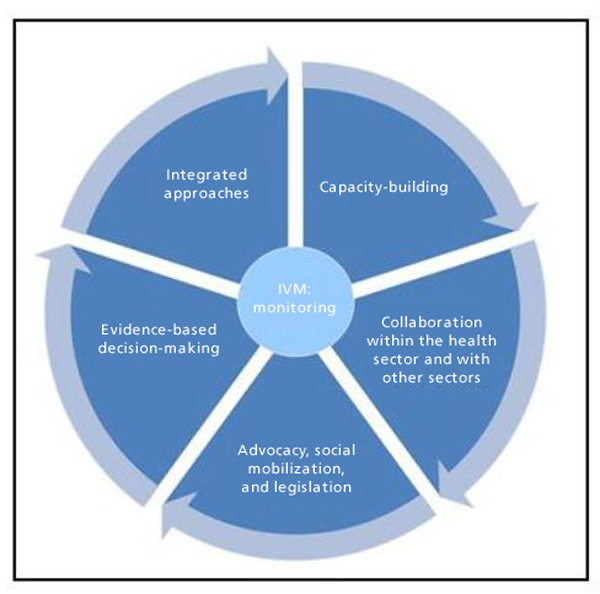
Integrated vector management (IVM) is defined as "a rational decision-making process for the optimal use of resources for vector control" and includes five key elements: 1) evidence-based decision-making, 2) integrated approaches 3), collaboration within the health sector and with other sectors, 4) advocacy, social mobilization, and legislation, and 5) capacity-building. In 2004, the WHO adopted IVM globally for the control of all vector-borne diseases. Important recent progress has been made in developing and promoting IVM for national malaria control programmes in Africa at a time when successful malaria control programmes are scaling-up with insecticide-treated nets (ITN) and/or indoor residual spraying (IRS) coverage. While interventions using only ITNs and/or IRS successfully reduce transmission intensity and the burden of malaria in many situations, it is not clear if these interventions alone will achieve those critical low levels that result in malaria elimination. Despite the successful employment of comprehensive integrated malaria control programmes, further strengthening of vector control components through IVM is relevant, especially during the "end-game" where control is successful and further efforts are required to go from low transmission situations to sustained local and country-wide malaria elimination. To meet this need and to ensure sustainability of control efforts, malaria control programmes should strengthen their capacity to use data for decision-making with respect to evaluation of current vector control programmes, employment of additional vector control tools in conjunction with ITN/IRS tactics, case-detection and treatment strategies, and determine how much and what types of vector control and interdisciplinary input are required to achieve malaria elimination. Similarly, on a global scale, there is a need for continued research to identify and evaluate new tools for vector control that can be integrated with existing biomedical strategies within national malaria control programmes. This review provides an overview of how IVM programmes are being implemented, and provides recommendations for further development of IVM to meet the goals of national malaria control programmes in Africa.
Overview
The claims and statistics of this paper haven’t been checked yet.
Free: it reads the open-access text and checks the first 5 claims that cite a source we can check. Create a free account to check every claim.
Integrity signals
Registry
Cites
Statistics
Figures
Verification
Claims the paper makes
The claims and statistics of this paper haven’t been checked yet.
Free: it reads the open-access text and checks the first 5 claims that cite a source we can check. Create a free account to check every claim.
Claims other papers make about this one
Each is checked against this paper’s own text: does it say what the citing paper says it does?
The cited source says what the claim attributes to it.
In the citing paper
“An IVM approach is important to sustain achievements and reduce transmission to critical low levels needed to eliminate malaria (Beier et al. 2009).”
From Global Status of DDT and Its Alternatives for Use in Vector Control to Prevent Disease (2009) · cites this paper as Beier et al. 2009
Self-check
Percentages, sums and reported differences re-computed from the paper’s own numbers.
The self-check needs the paper’s full text.
Citations
Cites
Disease control priorities in developing countries
(2006) · Choice Reviews Online · doi:10.5860/choice.44-0343 · Cited by 3,628
Macroeconomics and health: investing in health for economic development
Sachs, J. D. (2002) · Revista Panamericana de Salud Pública · doi:10.1590/s1020-49892002000800017 · Cited by 1,830
Disease control priorities in developing countries
Frenk, J. (2006) · Salud Pública de México · doi:10.1590/s0036-36342006000600011 · Cited by 1,599
Disease Control Priorities in Developing Countries
Mosley, W. H. (1993) · World Bank, Washington, DC eBooks · doi:10.1596/0-1952-0990-7 · Cited by 1,400
Handbook of Pesticide Toxicology
(2001) · Elsevier eBooks · doi:10.1016/b978-0-12-426260-7.x5000-9 · Cited by 1,322
Ross, R. (2010) · Cited by 940
Introduction to insect pest management
(1994) · Choice Reviews Online · doi:10.5860/choice.32-2128 · Cited by 539
Measuring the Burden of Neglected Tropical Diseases: The Global Burden of Disease Framework
Mathers, C. D., Ezzati, M., & Lopez, A. D. (2007) · PLoS Neglected Tropical Diseases · doi:10.1371/journal.pntd.0000114 · Cited by 510 · cited 1×
“Malaria and other vector-borne diseases contribute substantially to the global burden of diseases and disproportionately affect poor and under-served populations living in tropical and sub-tropical regions [1-5].”
BackgroundWALKER, K., & LYNCH, M. (2007) · Medical and Veterinary Entomology · doi:10.1111/j.1365-2915.2007.00674.x · Cited by 279 · cited 2×
“Recent reviews of environmental management [37,39] and larval control [26] contain additional examples.”
BackgroundEradication of Anopheles gambiae from Brazil: lessons for malaria control in Africa?
Killeen, G. F., Fillinger, U., Kiche, I., Gouagna, L. C., & Knols, B. G. (2002) · The Lancet Infectious Diseases · doi:10.1016/s1473-3099(02)00397-3 · Cited by 272 · cited 1×
“remaining low-levels of transmission? There is also a strong case for implementing larval control to target immature stages of anopheline mosquitoes to reduce malaria transmission [21-27], but further field trials are needed to show how these additional measures, beyond ITNs and IRS, have a substantial impact on malar…”
Background
Research works printed but not linked: 7
- Hatch CL Williams JW Jarinko PA Guidelines for measuring proficiency as an aid in mosquito abatement program assessment Mosq News 1973 33 228 233
- WHO Global strategic framework for integrated vector management World Health Organization 2004 10 1 12 WHO/CDS/CPE/PVC/2004
- WHO Report of the global partners' meeting on neglected tropical diseases: 2007 – a turning point: Geneva, Swizerland, 17–18 April 2007 2007 Geneva: World Health Organization
- Rafatjah HA Prospects and Progress on IPM in World-wide Malaria control Mosq News 1982 42 491 498
- Hinman EH The management of water for malaria control Symposium on Human Malaria: 1941; Philadelphia 1941 324 332
- Berg H van den Das PK von Hildebrand A Ragunathan V Evaluation of the Integrated Pest and Vector Management (IPVM) project in Sri Lanka 2006 New Dehli: World Health Organization, South East Asia Regional Office 1 46
- Manga L Toure A Shililu J Implementation of Integrated Vector Management in the WHO-African Region: Progress Report 2000–2003 2004 Washington, DC: Environmental Health Project, U.S. Agency for International Development 1 26
Cited by
Items 301–400 of 411
Safiya, I. O., Olayinka, M. D., Umbugala, T. A., Eke, S. S., Ombugadu, R. J., Abdullahi, M. M., & Tongjura, J. D. C. (2022) · Asian Journal of Biology · doi:10.9734/ajob/2022/v16i2299 · Cited by 1
“The World Health Organization’s Global report on insecticide resistance in malaria vectors (2010-2016) showed that resistance to the 4 commonly used insecticide classes – pyrethroid, organochlorines, carbamates and organophosphates is widespread in all major malaria vectors across the WHO regions of Africa, the Americ…”
BackgroundInfluentialMaharaj, R., Abdelatif, N., Máquina, M., Seocharan, I., Lakan, V., Paaijmans, K. P., Maartens, F., Aíde, P., & Saúte, F. (2025) · Malaria Journal · doi:10.1186/s12936-025-05258-0 · Cited by 1
“Now it needs to be combined with other tools and used in an integrated way [12].”
A power analysis framework to aid the design of robust semi-field vector control experiments
Kipingu, A. M., Lwetoijera, D. W., Ng’habi, K. R., Kiware, S. S., Viana, M., & Johnson, P. (2025) · Malaria Journal · doi:10.1186/s12936-025-05454-y · Cited by 1
Insidensi Malaria di Kota Ambon: Pengaruh Faktor Iklim, Program Pengendalian, dan Risiko Tambahan
Latuny, C. A., Rahardjo, D., & Prakasita, V. C. (2025) · SCISCITATIO · doi:10.21460/sciscitatio.2025.62.210 · Cited by 1
Know your enemy: understanding mosquito biology to advance malaria elimination in Africa
Zembere, K., Kalonde, P. K., & Bickton, F. M. (2025) · Parasitology Research · doi:10.1007/s00436-025-08534-9 · Cited by 1
“It aims at contributing to achievement of the global malaria control targets by using local evidence and easily available resources, making vector control more efficient, cost-effective, and sustainable (Beier et al. 2008; WHO 2012c).”
Reigoto, L., Maciel‐de‐Freitas, R., Sikulu-Lord, M. T., Garcia, G. A., Araújo, G., & Lima, A. A. D. (2025) · Tropical Medicine and Infectious Disease · doi:10.3390/tropicalmed10110308 · Cited by 1
“In this context, integrated vector management (IVM) strategies that align ento-mological surveillance with tailored control measures represent a promising paradigm for sustainable arbovirus control [22,23].”
Kihwele, F., Gavana, T., Kailembo, D., Kasagama, E., Mwalimu, C. D., Bernard, J., Yoram, B., Ndekuka, L., Kajange, S., Lazaro, S., et al. (2025) · Frontiers in Malaria · doi:10.3389/fmala.2025.1693543 · Cited by 1
Field evaluation of drone and AI assisted larval source management in Ghana
Bokpin, G. A., Adzei, F. A., Dadzie, S., Umeda, M., & Kim, J. (2026) · PLoS ONE · doi:10.1371/journal.pone.0340690 · Cited by 1
“Global efforts to control malaria have long relied on integrated vector management strategies, including long-lasting insecticidal nets (LLINs), indoor residual spraying (IRS), and prompt treatment of clinical cases [1–3].”
Impact of climate change on malaria vector control efforts in Tanzania: a review
Nkya, T. E. (2025) · Tanzania journal of health research/Tanzania Journal of Health Research · doi:10.4314/thrb.v26i4.16 · Cited by 1
Cheng, N. I., Dibbasey, M., Chu, C. E., Ndang, N. H., Amambua-Ngwa, B. N., Baah, C. A., Adu, G. A., Owusu, D., Naabil, D. T., Etoketim, B. N., et al. (2026) · Malaria Journal · doi:10.1186/s12936-026-06166-7 · Cited by 1
Rock, A., Nazaire, A., Osse, R. A., Frdric, O.-A., Oussou, O., Renaud, G., Arthur, S., & Martin, A. (2014) · Journal of Entomology and Nematology · doi:10.5897/jen2013.0085 · Cited by 1
Exploiting the Potential of Integrated Vector Management for Combating Malaria in Africa
Chanda, E. (2016) · InTech eBooks · doi:10.5772/65467 · Cited by 1
“Prompted by fragmentary empirical evidence to inform policy formulation for rational vector control, malaria control programmes are encouraged to adopt the WHO-led IVM strategy [49] underpinned by evidence-based decision-making process and a coherent monitoring and evaluation component [13].”
Nwaneli, E. I. (2022) · Nigerian Journal of Paediatrics · doi:10.4314/njp.v49i1.8 · Cited by 1
“This finding was also reported in Nigeria and other African countries.(6,26,27) It higher use in younger children may be due to the usual perception that the younger age groups were at a higher risk of the disease.”
ResultREASSESSING MULTIPLE‐INTERVENTION MALARIA CONTROL PROGRAMS OF THE PAST
Singer, B. H., & Castro, M. C. (2018) · Wiley eBooks · doi:10.1002/9781119415961.ch18 · Cited by 1
Narrative Review: Quintuple Helixs Model for Malaria Elimination in Indonesia
Firmansyah, Y. W., Ramadhansyah, M. F., Fuadi, M. F., Widyantoro, W., Rizqullah, D. A. R., Putro, A. N. N. P., Nurhidayati, S., Lestyorini, H., Rahayu, W. I., Chodir, A., et al. (2022) · Jurnal Kesehatan Mahardika · doi:10.54867/jkm.v9i2.104 · Cited by 1
The adaptation health gap: a global overview
Sanchez Martinez, G., & Berry, P. (2018) · Technical University of Denmark, DTU Orbit (Technical University of Denmark, DTU) · Cited by 1
Kamanda, J. S. (2024) · Vidhyayana · doi:10.58213/ggkz4t07 · Cited by 1
MMV Malaria Box Activity Screening in Dormant Plasmodium falciparum Phenotypes
Galusic, S. (2015) · Digital Commons - University of South Florida (University of South Florida) · Cited by 1
Kloke, R. G. (2010) · University of the Witwatersrand, Johannesburg Institutional Repository on DSpace (University of the Witwatersrand, Johannesburg) · Cited by 1
Opondo, K. (2012) · University of Nairobi Research Archive (University of Nairobi) · Cited by 1
Ondari, P. N. (2013) · Kenyatta University Institutional Repository (Kenyatta University) · Cited by 1
Hadfield, K. (2013) · The Atrium (University of Guelph) · Cited by 1
Plant-based pesticides: Potential of apiaceae essential oils
Sousa, R. M. O. F. (2016) · Portuguese National Funding Agency for Science, Research and Technology (RCAAP Project by FCT) · Cited by 1
Human Ecology of Malaria in a Rural Highland Region of South-West Kenya
Githinji, S. W. (2009) · bonndoc (University of Bonn) · Cited by 1
Birhanie, S. K., Wilson, G. G., & Ryder, D. (2017) · RUNE (Research UNE) · Cited by 1
Blanco, S. M. (2020) · Research Square · doi:10.21203/rs.3.rs-73072/v1 · Cited by 1
“In a more complex version of the model it is possible to implement Integrated Vector Management (IVM) interventions [32] https and see what the outcome is.”
Esterase Mediated Insecticide Resistance in the Southern House Mosquito, Culex quinquefasciatus
Pokhrel, V. (2022) · Louisiana State University · doi:10.31390/gradschool_dissertations.5990 · Cited by 1
Kummer, A. G., Wilke, A. B. B., Ventura, P. C., Vasquez, C., Medina, J., Ünlü, I., Gonzalez, Y., Ejima, K., & Ajelli, M. (2023) · Research Square · doi:10.21203/rs.3.rs-3446804/v1 · Cited by 1
Optimal mosquito release strategies for vector-borne disease control
Arnau, J. B. (2022) · theses.fr (ABES) · doi:10.70675/fc674b49zf1f8z4970zbd90z086435aa42dd · Cited by 1
Community-based surveillance and control of malaria vectors in urban Dar es Salaam, Tanzania
Chaki, P. (2013) · University of Liverpool · doi:10.17638/00007933 · Cited by 1
(2021) · UpSpace Institutional Repository (University of Pretoria) · Cited by 1
Redmond, S. N. (2015) · theses.fr (ABES) · doi:10.70675/b284d1d6zafbfz4ed8z9570za9323034ff5f · Cited by 1
Iv, S. (2024) · theses.fr (ABES) · doi:10.70675/7f9b45b5zb866z47f8z8defz5f70ce5a7551 · Cited by 1
Integrating fungal entomopathogens in malaria vector control
Farenhorst, M. (2010) · doi:10.18174/156404
Natural products for malaria vector control: flora, fish and fungi
Howard, A. F. (2010) · doi:10.18174/148836
Jacobson, K. B., Danforth, D., Lin, J. A., Merjavy, S., Milliner, B. H. A., Ooka, K., & Hennig, N. (2014) · Malaria Reports · doi:10.4081/malaria.2014.1823
A Review of Malaria Prevention and Control in War Areas
Najafipour, F., Norozi, A., & Darejeh, M. (2015) · Journal of Archives in Military Medicine · doi:10.5812/jamm.28959
Multini, L. C. (2016) · Digital Library of Theses and Dissertations (Universidade de São Paulo) · doi:10.11606/d.99.2016.tde-12042016-113624
Ribeiro, F. C. B. (2015) · Portuguese National Funding Agency for Science, Research and Technology (RCAAP Project by FCT)
Vector Control: Need for an Integrated and Eco-based Approach
Sharma, V. P. (2017) · Springer eBooks · doi:10.1007/978-81-322-3745-7_15
MALARIA AND OFFICIER'S PHARMACISTS OF BAMAKO, MALI: KNOWLEDGE, ATTITUDES AND, PRACTICES
Diallo, T., Dénou, A., Coulibaly, B., Dakouo, B., Coulibaly, B., & Loup-Rey, J. (2017) · Revue Malienne d Infectiologie et de Microbiologie · doi:10.53597/remim.v0i9.924
Insecticide resistance monitoring : a review of current methology
Owusu, H. F. (2016) · edoc (University of Basel) · doi:10.5451/unibas-006812592
Mwendera, C. A. (2017) · UpSpace Institutional Repository (University of Pretoria)
Kibe, L. W., Habluetzel, A., Kamau, A., Gachigi, J. K., MWANGANGI, J. M., Mutero, C. M., & Mbogo, C. M. (2019) · Journal of Public Health and Diseases · doi:10.31248/jphd2018.020
“Despite this realization, community participation is only sporadically implemented in IVM or completely overlooked (WHO, 2004; Beier et al., 2008).”
BackgroundManilal, Y. Y. (2018) · ResearchSpace (University of KwaZulu-Natal)
Akinsemolu, A. A. (2020) · Springer eBooks · doi:10.1007/978-981-15-2493-6_5
Bhat, R. A., & Agrawal, O. (2020) · Journal of Entomology and Zoology Studies · doi:10.22271/j.ento.2020.v8.i1u.6312
Multini, L. C. (2020) · Digital Library of Theses and Dissertations (Universidade de São Paulo) · doi:10.11606/t.6.2020.tde-24092020-113859
Eckermann, K. N. (2020) · eDiss (Georg-August-Universität Göttingen) · doi:10.53846/goediss-8321
Relative Efficacy of Common Larvicides on Aedes albopictus (Diptera: Culicidae)
Jimmerson, M. C., Medrano, D., Shao, S., Stahr, J., Torres, D., & Whaley, R. (2019) · Instars: A Journal of Student Research
Kandyata, A., Mbata, K. J., Shinondo, C. J., Katongo, C., Kamuliwo, R., Nyirenda, F., & Chanda, E. (2014) · University of Zambia Journal of Agricultural and Biomedical Sciences · doi:10.53974/unza.jabs.2.1.341
High burden to high impact: Strengthening services for malaria elimination
Shrivastava, S. R., & Shrivastava, P. (2021) · Environmental Disease · doi:10.4103/ed.ed_10_21
Ochieng, A. O., Amimo, F., Oludhe, C., Nyamongo, I. K., & Estambale, B. B. A. (2022) · International Journal of Mosquito Research · doi:10.22271/23487941.2022.v9.i1a.578
Molecular Modelling of Anopheles Stephensi Acetylcholinesterase
Parmar, R. M., Highland, H. N., & George, L.-B. (2018) · Research Journal of Life Sciences Bioinformatics Pharmaceutical and Chemical Sciences · doi:10.26479/2018.0403.04
Vector control and malaria in humanitarian emergencies: the limitations and the needs
Boëte, C. (2023) · The Lancet Global Health · doi:10.1016/s2214-109x(23)00127-4
Sadik, M., Raj, A. S., Sahani, G., Prakash, A., Mohammed, F. A., & Allam, R. (2024) · International Journal of Mosquito Research · doi:10.22271/23487941.2024.v11.i1a.738
Steck, M. R., Arheart, K. L., Xue, R., Aryaprema, V. S., Peper, S. T., & Qualls, W. A. (2024) · Journal of the American Mosquito Control Association · doi:10.2987/23-7121
Oluyide, O. P., Odu, O. O., Salami, S. K., Omoyele, O. O., Oyinlola, F. F., Deji, S. A., Usman, A., Balogun, M., & Bamgboye, E. A. (2024) · Research Journal of Health Sciences · doi:10.4314/rejhs.v12i4.8
Rising Stars in Insect Physiology
(2024) · Frontiers research topics · doi:10.3389/978-2-8325-5435-7
Al-Mekhlafi, F. A., Almohssin, A. Z. M., Abutaha, N., Al-Qahtni, A. H., Wadaan, M. A., & Al-Khalifa, M. S. (2024) · Revista Colombiana de Entomología · doi:10.25100/socolen.v50i2.13350
Farooq, M. U., Bukhari, S. A. T., Akram, W., Tahir, A. H., Alam, M. S., Atta, M. M., & ZILL-E-REHMAN, H. (2025) · Zoo botanica. · doi:10.55627/zoobotanica.003.01.0944
Population genetics and ecology of regional malaria vectors in Amazonian Brazil
McKeon, S. N. (2013) · Scholars Archive - University at Albany (University at Albany, State University of New York) · doi:10.54014/8d9p-jqr6
The effects of landscape on malaria vectors of the neotropics
Lainhart, W. (2015) · Scholars Archive - University at Albany (University at Albany, State University of New York) · doi:10.54014/g7eh-mfbx
Becker, N., Petrić, D. V., Zgomba, M., Rahola, N., Boase, C., Schmidt‐Chanasit, J., & Kaiser, A. (2025) · Springer eBooks · doi:10.1007/978-3-662-69125-0_11
Hydropower development and malaria transmission: A geospatial econometric study
Thomas, C. J. (2025) · Journal of Public Health in Africa · doi:10.4102/jphia.v16i1.1397
Mondal, S., Pramanik, M., & Roy, P. (2025) · doi:10.52756/lbsopf.2025.v04.004
Rahim, F. A. A., Md Yatim, M. F., Mutalip, M. H. A., & Mahmud, M. A. F. (2023) · Figshare · doi:10.6084/m9.figshare.24130275
NG'ANG'A, P. N., Okoyo, C. O., Mbogo, C., & Mutero, C. M. (2020) · Figshare · doi:10.6084/m9.figshare.12980265
Alcântara, J. A., de Araújo, F. S. A., da Costa Paz, A., Alencar, R. M., de Albuquerque Caldas, B. Y., Godoy, R. S. M., Lacerda, M. V. G., de Melo, G. C., Monteiro, W. M., Sampaio, V. D. S., et al. (2024) · Figshare · doi:10.6084/m9.figshare.26637126
Alcântara, J. A., de Araújo, F. S. A., da Costa Paz, A., Alencar, R. M., de Albuquerque Caldas, B. Y., Godoy, R. S. M., Lacerda, M. V. G., de Melo, G. C., Monteiro, W. M., Sampaio, V. D. S., et al. (2024) · Figshare · doi:10.6084/m9.figshare.26637120
Alcântara, J. A., de Araújo, F. S. A., da Costa Paz, A., Alencar, R. M., de Albuquerque Caldas, B. Y., Godoy, R. S. M., Lacerda, M. V. G., de Melo, G. C., Monteiro, W. M., Sampaio, V. D. S., et al. (2024) · Figshare · doi:10.6084/m9.figshare.26637129
Vigodny, A., Aharon, M. B., Wharton–Smith, A., Fialkoff, Y., Houri-Yafin, A., Bragança, F., Soares Da Graça, F., Gluck, D., Alcântara Viegas D’Abreu, J., & Rompão, H. (2023) · Figshare · doi:10.6084/m9.figshare.22618138
Vigodny, A., Aharon, M. B., Wharton–Smith, A., Fialkoff, Y., Houri-Yafin, A., Bragança, F., Soares Da Graça, F., Gluck, D., Alcântara Viegas D’Abreu, J., & Rompão, H. (2023) · Figshare · doi:10.6084/m9.figshare.22618141
Boëte, C., Burza, S., Lasry, E., Moriana, S., & Robertson, W. (2021) · Figshare · doi:10.6084/m9.figshare.17304779
Alcântara, J. A., de Araújo, F. S. A., da Costa Paz, A., Alencar, R. M., de Albuquerque Caldas, B. Y., Godoy, R. S. M., Lacerda, M. V. G., de Melo, G. C., Monteiro, W. M., Sampaio, V. D. S., et al. (2024) · Figshare · doi:10.6084/m9.figshare.26637123
Boëte, C., Burza, S., Lasry, E., Moriana, S., & Robertson, W. (2021) · Figshare · doi:10.6084/m9.figshare.17304776
Alcântara, J. A., de Araújo, F. S. A., da Costa Paz, A., Alencar, R. M., de Albuquerque Caldas, B. Y., Godoy, R. S. M., Lacerda, M. V. G., de Melo, G. C., Monteiro, W. M., Sampaio, V. D. S., et al. (2024) · Figshare · doi:10.6084/m9.figshare.26637114
Alcântara, J. A., de Araújo, F. S. A., da Costa Paz, A., Alencar, R. M., de Albuquerque Caldas, B. Y., Godoy, R. S. M., Lacerda, M. V. G., de Melo, G. C., Monteiro, W. M., Sampaio, V. D. S., et al. (2024) · Figshare · doi:10.6084/m9.figshare.26637111
Alcântara, J. A., de Araújo, F. S. A., da Costa Paz, A., Alencar, R. M., de Albuquerque Caldas, B. Y., Godoy, R. S. M., Lacerda, M. V. G., de Melo, G. C., Monteiro, W. M., Sampaio, V. D. S., et al. (2024) · Figshare · doi:10.6084/m9.figshare.26637117
(2018) · UpSpace Institutional Repository (University of Pretoria)
Escalating Dengue in Bangladesh: An Analytical Assessment of Environmental and Socioeconomic DriversPreprint
Mohiuddin, A. K. (2026) · Preprints.org · doi:10.20944/preprints202512.2526.v2
Testing the Efficacy of Different Fruit Juices as Attractants for Anopheles pulcherrimus
Hussain, I., Tariq, M., Gulzar, A., & Raza, A. (2024) · Pothohar Journal of Animals and Plants · doi:10.71317/pjap.001.01.0001
Zembere, K., Coleman, S., Chirombo, J., Mbewe, R. B., & Tangena, J.-A. A. (2026) · PLoS ONE · doi:10.1371/journal.pone.0344351
“This has, in part, been attributed to the increased level of insecticide resistance and behavioural shifts in vectors and the focus of vector control tools on only indoor biting and resting vectors [7,8].”
Mahinda, M. A. (2026) · IAA Journal of Biological Sciences · doi:10.59298/iaajb/2026/1411221
Adde, A. (2016) · theses.fr (ABES) · doi:10.70675/65acdca5zc79fz4d06za02bzca98dd439562 · Cited by 1
Porciani, A. (2016) · theses.fr (ABES) · doi:10.70675/e64f5307z014bz4444zacb4zd9fe25ee64fa
Mfangnia, C. N. T., Pedercini, M., Tonnang, H. E. Z., & Herren, J. K. (2026) · Scientific Reports · doi:10.1038/s41598-026-47368-y
Determining the Life Expectancy of Malaria Infectious MosquitoesPreprint
Blanco, S. M. (2026) · Research Square · doi:10.21203/rs.3.rs-9404405/v1
Fogging and the illusion of dengue control: Science, politics, and urban public health
Biswas, D. (2026) · The Pharma Innovation · doi:10.22271/tpi.2026.v15.i5a.26468
Climate Change: A Growing Threat to Malaria Control and Elimination
Herrera-Arévalo, S. M., Recht, J., & Herrera, S. V. (2026) · Springer eBooks · doi:10.1007/978-3-032-21237-5_12
Metadata
- Authors
- Beier, J. C., Keating, J., Githure, J. I., Macdonald, M. B., Impoinvil, D. E., & Novak, R. J.
- Affiliations
- University of Miami (US)
- Tulane University (US)
- International Centre of Insect Physiology and Ecology (KE)
- United States Agency for International Development (US)
- University of Liverpool (GB)
- University of Alabama at Birmingham (US)
- Corresponding author
- Beier, John C
- Venue
- Malaria Journal
- Published
- 2008-12
- Volume
- 7
- Issue
- S1
- Pages
- S4-S4
- ISSN
- 1475-2875 (ISSN-L)
- PMC
- PMC2604879
- OpenAlex
- W2024349624
- Cited by
- 355
- References
- 64
- Citations by year
- 2026: 12 · 2025: 25 · 2024: 26 · 2023: 18 · 2022: 14 · 2021: 24 · 2020: 23 · 2019: 25 · 2018: 16 · 2017: 21 · 2016: 19 · 2015: 20 · 2014: 21 · 2013: 26 · 2012: 21
- FWCI
- 2.21
- Type
- journal article
- Language
- en
- Open access
- gold
- doi.org
- Licence
- cc-by
- creativecommons.org/licenses/by/2.0 (tdm)
- Locations
- Malaria Journal (publishedVersion, cc-by)
- PubMed Central (publishedVersion, cc-by)
- PubMed (publishedVersion)
- DOAJ (DOAJ: Directory of Open Access Journals) (submittedVersion, cc-by-sa)
- Funders
- Foundation for the National Institutes of Health
- University of Miami
- Wellcome Trust
- National Institutes of Health
- U.S. Public Health Service (U01 A1054889)
- National Center for Research Resources (P20RR020770)
- Topics
- Health Sciences › Medicine › Public Health, Environmental and Occupational Health › Malaria Research and Control
- Health Sciences › Medicine › Public Health, Environmental and Occupational Health › Mosquito-borne diseases and control
- Health Sciences › Medicine › Public Health, Environmental and Occupational Health › Dengue and Mosquito Control Research
- Keywords
- integrated vector management, malaria control, malaria elimination, insecticide-treated nets, indoor residual spraying, vector control, evidence-based decision making, capacity building, social mobilization, advocacy, interdisciplinary collaboration, Africa
- MeSH terms
- Africa, Animals, Community Participation, Decision Making, Health Plan Implementation, Humans, Insect Vectors, Malaria, Mosquito Control, World Health Organization, Health Care Sector
About these checks
Registry, retraction, Cites and statistics results are computed, not judged, with one exception: a printed reference that no index lists is read once by a model before it counts as a citation error. Claims are extracted by a model and kept only when their quote appears verbatim in the text; each cited source is then checked, with a model’s help, for whether it says what the claim relies on. Those verdicts can be wrong — read the claim’s quote and the cited source before relying on one.
Statistics and arithmetic are recomputed, not judged.
Confidence bands are shown only for fields calibrated on our annotated test set. None is calibrated yet, so no band is shown.
What counts as a claim ›How we measure confidence ›How we check this ›
Are you an author, or do you see a problem with this page? Request a review
Data sources
Bibliographic data: Semantic Scholar, OpenAlex, Crossref.
Contains information from the Semantic Scholar Academic Graph Datasets, made available under the ODC Attribution License (ODC-BY 1.0).
Semantic Scholar’s data is described in: Kinney, R., et al. (2023). The Semantic Scholar Open Data Platform. arXiv:2301.10140.
