

Comparison of high protein and high fiber weight-loss diets in women with risk factors for the metabolic syndrome: a randomized trial
Open accessThe DOI matches its Crossref record; 55 of the 56 references it cites were found in a registry or an index.
Abstract
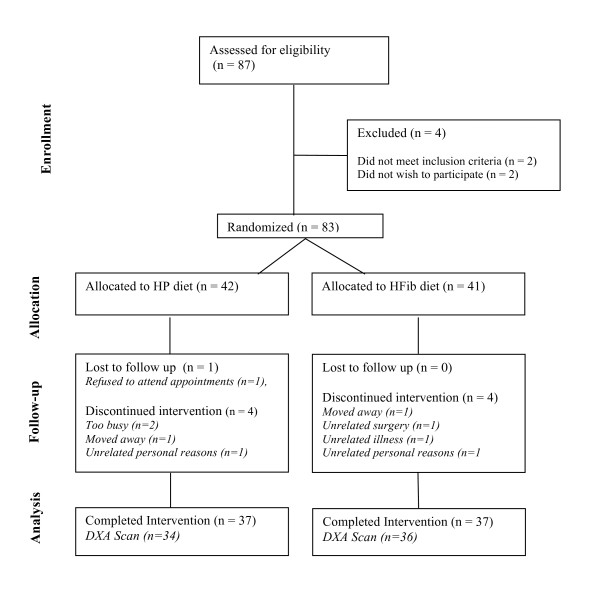
BACKGROUND: Studies have suggested that moderately high protein diets may be more appropriate than conventional low-fat high carbohydrate diets for individuals at risk of developing the metabolic syndrome and type 2 diabetes. However in most such studies sources of dietary carbohydrate may not have been appropriate and protein intakes may have been excessively high. Thus, in a proof-of-concept study we compared two relatively low-fat weight loss diets - one high in protein and the other high in fiber-rich, minimally processed cereals and legumes - to determine whether a relatively high protein diet has the potential to confer greater benefits. METHODS: Eighty-three overweight or obese women, 18-65 years, were randomized to either a moderately high protein (30% protein, 40% carbohydrate) diet (HP) or to a high fiber, relatively high carbohydrate (50% carbohydrate, > 35 g total dietary fiber, 20% protein) diet (HFib) for 8 weeks. Energy intakes were reduced by 2000 - 4000 kJ per day in order to achieve weight loss of between 0.5 and 1 kg per week. RESULTS: Participants on both diets lost weight (HP: -4.5 kg [95% confidence interval (CI):-3.7, -5.4 kg] and HFib: -3.3 kg [95% CI: -4.2, -2.4 kg]), and reduced total body fat (HP: -4.0 kg [5% CI:-4.6, -3.4 kg] and HFib: -2.5 kg [95% CI: -3.5, -1.6 kg]), and waist circumference (HP: -5.4 cm [95% CI: -6.3, -4.5 cm] and HFib: -4.7 cm [95% CI: -5.8, -3.6 cm]), as well as total and LDL cholesterol, triglycerides, fasting plasma glucose and blood pressure. However participants on HP lost more body weight (-1.3 kg [95% CI: -2.5, -0.1 kg; p = 0.039]) and total body fat (-1.3 kg [95% CI: -2.4, -0.1; p = 0.029]). Diastolic blood pressure decreased more on HP (-3.7 mm Hg [95% CI: -6.2, -1.1; p = 0.005]). CONCLUSIONS: A realistic high protein weight-reducing diet was associated with greater fat loss and lower blood pressure when compared with a high carbohydrate, high fiber diet in high risk overweight and obese women.
Overview
The claims and statistics of this paper haven’t been checked yet.
Free: it reads the open-access text and checks the first 5 claims that cite a source we can check. Create a free account to check every claim.
Integrity signals
Registry
Cites
Statistics
Figures
Verification
Claims the paper makes
The claims and statistics of this paper haven’t been checked yet.
Free: it reads the open-access text and checks the first 5 claims that cite a source we can check. Create a free account to check every claim.
Claims other papers make about this one
Each is checked against this paper’s own text: does it say what the citing paper says it does?
The cited source doesn’t support the claim as written.
In the citing paper
“These results indicated that the subjects following the high protein diet lost more weight and body fat than those on the higher fiber diet, but they still lost LBM [28].”
From Body Composition Changes in Weight Loss: Strategies and Supplementation for Maintaining Lean Body Mass, a Brief Review (2018) · cites this paper as [28]
Checked by a reasoning model — may be wrong.
Experimental — accuracy not yet measuredThe cited source says what the claim attributes to it.
In the citing paper
“A comparison of energy-reduced diets with a high protein or high fiber/carbohydrate focus found significantly greater weight and body fat decreases with the high protein-focused diet but reductions in LBM between groups was minimal.”
From Body Composition Changes in Weight Loss: Strategies and Supplementation for Maintaining Lean Body Mass, a Brief Review (2018) · cites this paper as [28]
The check wasn’t confident either way, so it gives no verdict — never disputed.
In the citing paper
“which highlights a risk of bias in studies where substitutes are provided to the intervention group but not to the control group [33,68,70,71].”
From Are Dietary Proteins the Key to Successful Body Weight Management? A Systematic Review and Meta-Analysis of Studies Assessing Body Weight Outcomes after Interventions with Increased Dietary Protein (2021) · cites this paper as [68]
Experimental — accuracy not yet measured
Self-check
Percentages, sums and reported differences re-computed from the paper’s own numbers.
The self-check needs the paper’s full text.
Citations
Cites
1 retracted
Dietary advice for the prevention of type 2 diabetes mellitus in adults
Nield, L., Summerbell, C. D., Hooper, L., Whittaker, V., & Moore, H. (2008) · Cochrane Database of Systematic Reviews · doi:10.1002/14651858.cd005102.pub2 · Cited by 85 · cited 1×
“Debate continues regarding the most appropriate macronutrient composition for achieving weight loss and improvement in risk factors for cardiovascular disease (CVD) and diabetes in overweight and obese individuals [1,2].”
BackgroundRetractedFriedewald, W. T., Levy, R. I., & Fredrickson, D. S. (1972) · Clinical Chemistry · doi:10.1093/clinchem/18.6.499 · Cited by 32,423 · cited 1×
“LDL-cholesterol was calculated using the Friedwald equation [23].”
MethodThe metabolic syndrome—a new worldwide definition
Alberti, K. G. M., Zimmet, P., & Shaw, J. (2005) · The Lancet · doi:10.1016/s0140-6736(05)67402-8 · Cited by 9,352 · cited 1×
“Presence of the metabolic syndrome (MS) was assessed for each subject based on International Diabetes Federation (IDF) cutoffs [27].”
MethodAntihyperlipidemic and Biochemical Activities of Mcy Protein in Streptozotocin Induced Diabetic Rats
Marella, S., Maddirela, D. R., Badri, K. R., Jyothi Kumar, M. V., & Chippada, A. (2015) · Cellular Physiology and Biochemistry · doi:10.1159/000373954 · Cited by 5,938
Weight Loss with a Low-Carbohydrate, Mediterranean, or Low-Fat Diet
Shai, I., Schwarzfuchs, D., Henkin, Y., Shahar, D. R., Witkow, S., Greenberg, I., Golan, R., Fraser, D., Bolotin, A., Vardi, H., et al. (2008) · New England Journal of Medicine · doi:10.1056/nejmoa0708681 · Cited by 2,143 · cited 1×
“There is evidence to suggest that macronutrient composition may have a greater influence on metabolic responses in individuals with certain metabolic risk factors compared t ot hose without such risk factors [ 50 ,51].”
BackgroundCorrect Homeostasis Model Assessment (HOMA) Evaluation Uses the Computer Program
Levy, J. C., Matthews, D. R., & Hermans, M. P. (1998) · Diabetes Care · doi:10.2337/diacare.21.12.2191 · Cited by 2,013 · cited 1×
“Insulin sensitivity was estimated by the homeostatic model assessment (HOMA-IR 2) using the HOMA-IR 2 calculator [25] and by the McAuley index [26].”
MethodA biometric study of human basal metabolism
Harris, J. A., & Benedict, F. G. (1918) · Proceedings of the National Academy of Sciences · doi:10.1073/pnas.4.12.370 · Cited by 1,980 · cited 1×
“Basal metabolic rate was calculated using HarrisBenedict equations [24].”
MethodComparison of Weight-Loss Diets with Different Compositions of Fat, Protein, and Carbohydrates
Sacks, F. M., Bray, G. A., Carey, V. J., Smith, S. R., Ryan, D. H., Anton, S. D., McManus, K., Champagne, C. M., Bishop, L. M., Laranjo, N., et al. (2009) · New England Journal of Medicine · doi:10.1056/nejmoa0804748 · Cited by 1,966 · cited 2×
“Longer-term studies indicate that short-term benefits associated with reduced carbohydrate intakes are not sustained over the longer-term but this is largely explained by subjects reverting to their usual dietary patterns [30,32,54].”
BackgroundPrinciples Of Nutritional Assessment
Gibson, R. S. (2005) · doi:10.1093/oso/9780195171693.001.0001 · Cited by 1,887
Influence of Weight Reduction on Blood Pressure: A Meta-Analysis of Randomized Controlled Trials
Neter, J. E., Stam, B. E., Kok, F. J., Grobbee, D. E., & Geleijnse, J. M. (2003) · Hypertension · doi:10.1161/01.hyp.0000094221.86888.ae · Cited by 1,391 · cited 1×
“A meta-analysis of studies lasting more than 8 weeks examining the effect of weight loss on blood pressure estimated that a 1 kg reduction in weight was associated with reductions of 1.05 mm Hg reduction for SBP and 0.92 mm Hg for DBP [ 42 ].”
Influential
Research works printed but not linked: 2
- Atkins RC Atkins' new diet revolution 2002 New York, NY 10017: M. Evans & Co Revised
- Sears B Lawren B The Zone: A Dietary Road Map to Lose Weight Permanently: Reset Your Genetic Code: Prevent Disease: Achieve Maximum Physical Performance 1995 1 New York, NY 10022: HarperCollins
Cited by
Naude, C. E., Schoonees, A., Senekal, M., Young, T., Garner, P., & Volmink, J. (2014) · PLoS ONE · doi:10.1371/journal.pone.0100652 · Cited by 252
Willoughby, D., Hewlings, S., & Kalman, D. (2018) · Nutrients · doi:10.3390/nu10121876 · Cited by 221
“the high protein diet lost more weight and body fat than those on the higher fiber diet, but they still lost LBM [28].”
BackgroundNew Insights and Potential Therapeutic Interventions in Metabolic Diseases
Clemente‐Suárez, V. J., Martín-Rodríguez, A., Redondo-Flórez, L., López-Mora, C., Sepulveda, R. A. Y., & Tornero-Aguilera, J. F. (2023) · International Journal of Molecular Sciences · doi:10.3390/ijms241310672 · Cited by 202
Zhang, X., Qi, Q., Zhang, C., Smith, S. R., Hu, F. B., Sacks, F. M., Bray, G. A., & Qi, L. (2012) · Diabetes · doi:10.2337/db11-1799 · Cited by 161
Gibbs, J., Gaskin, E., Ji, C., Miller, M. A., & Cappuccio, F. P. (2021) · Journal of Hypertension · doi:10.1097/hjh.0000000000002604 · Cited by 150
Certain dietary patterns are beneficial for the metabolic syndrome: reviewing the evidence
Calton, E. K., James, A. P., Pannu, P. K., & Soares, M. J. (2014) · Nutrition Research · doi:10.1016/j.nutres.2014.06.012 · Cited by 144
Champagne, C. M., Broyles, S. T., Moran, L. D., Cash, K. C., Levy, E. J., Lin, P.-H., Batch, B. C., Lien, L. F., Funk, K. L., Dalcin, A., et al. (2011) · Journal of the American Dietetic Association · doi:10.1016/j.jada.2011.09.014 · Cited by 97
Pasiakos, S. M., Lieberman, H. R., & Fulgoni, V. L. I. (2015) · Journal of Nutrition · doi:10.3945/jn.114.205203 · Cited by 115
Hansen, T. T., Astrup, A., & Sjödin, A. (2021) · Nutrients · doi:10.3390/nu13093193 · Cited by 77
“isons of dietary protein with fiber (two papers) [67,68], with fat (one paper) [69], or with”
BackgroundInfluentialFoerster, J., Maskarinec, G., Reichardt, N., Tett, A., Narbad, A., Blaut, M., & Boeing, H. (2014) · PLoS ONE · doi:10.1371/journal.pone.0109606 · Cited by 75
“Similar effects of WG intake on anthropometry have been observed in cohort studies as well as in previous intervention studies [36,37].”
ResultPadhi, E. M. T., & Ramdath, D. D. (2017) · Journal of Functional Foods · doi:10.1016/j.jff.2017.03.043 · Cited by 82
Dietary Protein Affects Gene Expression and Prevents Lipid Accumulation in the Liver in Mice
Schwarz, J., Tomé, D., Baars, A., Hooiveld, G. J. E. J., & Müller, M. (2012) · PLoS ONE · doi:10.1371/journal.pone.0047303 · Cited by 72
“These results are in line with previous observations in which dietary protein reduced adiposity in rats [23,30] and humans [31,32] during short term interventions.”
ResultThe Effects of Increased Protein Intake on Fullness: A Meta-Analysis and Its Limitations
Dhillon, J., Craig, B. Α., Leidy, H. J., Amankwaah, A. F., Anguah, K. O.-B., Jacobs, A., Jones, B. L., Jones, J. B., Keeler, C. L., Keller, C. E. M., et al. (2016) · Journal of the Academy of Nutrition and Dietetics · doi:10.1016/j.jand.2016.01.003 · Cited by 86
Sylvetsky, A. C., Edelstein, S. L., Walford, G., Boyko, E. J., Horton, E. S., Ibebuogu, U. N., Knowler, W. C., Montez, M. G., Temprosa, M. G., Hoskin, M. A., et al. (2017) · Journal of Nutrition · doi:10.3945/jn.117.252395 · Cited by 77
Fechner, E., Smeets, E., Schrauwen, P., & Mensink, R. (2020) · Nutrients · doi:10.3390/nu12040991 · Cited by 64
Hu, X., Gao, J., Zhang, Q., Fu, Y., Li, K., Zhu, S., & Li, D. (2013) · Molecular Nutrition & Food Research · doi:10.1002/mnfr.201300159 · Cited by 71
Magrans-Courtney, T., Wilborn, C., Rasmussen, C. J., Ferreira, M. P., Greenwood, L. D., Campbell, B. I., Kerksick, C. M., Nassar, E., Li, R., Iosia, M., et al. (2011) · Journal of the International Society of Sports Nutrition · doi:10.1186/1550-2783-8-8 · Cited by 64
“In addition, higher protein diets have been reported to promote greater improvement in several markers of health particularly in populations at risk to cardiovascular disease due to elevated glucose and/ or triglyceride levels [17-19].”
BackgroundTadesse, D., Masresha, G., Lulekal, E., & Wondafrash, M. (2024) · Scientific Reports · doi:10.1038/s41598-024-67421-y · Cited by 66
Boushey, C. J., Ard, J. D., Bazzano, L., Heymsfield, S. B., Mayer‐Davis, E. J., Sabaté, J., Snetselaar, L., Horn, L. V., Schneeman, B. O., English, L., et al. (2020) · doi:10.52570/nesr.dgac2020.sr0101 · Cited by 65
A high‐fibre bean‐rich diet versus a low‐carbohydrate diet for obesity
Tonstad, S., Malik, N., & Haddad, E. (2014) · Journal of Human Nutrition and Dietetics · doi:10.1111/jhn.12118 · Cited by 48
The role of dietary protein in blood pressure regulation
Teunissen-Beekman, K. F. M., & van Baak, M. A. (2012) · Current Opinion in Lipidology · doi:10.1097/mol.0b013e32835b4645 · Cited by 54
The role of high-protein diets in body weight management and health
Morenga, L. T., & Mann, J. I. (2012) · British Journal Of Nutrition · doi:10.1017/s0007114512002437 · Cited by 58
“Recent research conducted by our group has addressed this issue((39)).”
Self-citationPlant bioactive compounds from Mediterranean diet improve risk factors for metabolic syndrome
Farias‐Pereira, R., Zuk, J. B., & Khavaran, H. (2023) · International Journal of Food Sciences and Nutrition · doi:10.1080/09637486.2023.2232949 · Cited by 54
Sex-Specific Variation in Metabolic Responses to Diet
Andrews, R. R., Anderson, K. R., & Fry, J. L. (2024) · Nutrients · doi:10.3390/nu16172921 · Cited by 49
Insulin Resistance of Protein Metabolism in Type 2 Diabetes and Impact on Dietary Needs: A Review
Gougeon, R. (2013) · Canadian Journal of Diabetes · doi:10.1016/j.jcjd.2013.01.007 · Cited by 39
Dietary protein in weight management: a review proposing protein spread and change theories
Bosse, J. D., & Dixon, B. M. (2012) · Nutrition & Metabolism · doi:10.1186/1743-7075-9-81 · Cited by 31
Fisher, E., Meidtner, K., Ängquist, L. H., Holst, C., Hansen, R. D., Halkjœr, J., Masala, G., Østergaard, J. N., Overvad, K., Palli, D., et al. (2012) · American Journal of Clinical Nutrition · doi:10.3945/ajcn.111.014670 · Cited by 29
The Role of Pulses in Cardiovascular Disease Risk for Adults With Diabetes
Lukus, P. K., Doma, K. M., & Duncan, A. M. (2020) · American Journal of Lifestyle Medicine · doi:10.1177/1559827620916698 · Cited by 30
“more with the moderately high-protein diet.(71) Finally, a parallel-arm intervention study of 5 weekly meals with or without 750 mL of pulses for 16 weeks did not significantly affect circulating lipids, glucose, blood pressure, or inflammatory biomarkers in 134 overweight or obese women with components of metabolic s…”
BackgroundFlores-Hernández, M. N., Martínez-Coria, H., López-Valdés, H. E., Arteaga-Silva, M., Arrieta-Cruz, I., & Gutiérrez-Juárez, R. (2024) · International Journal of Molecular Sciences · doi:10.3390/ijms252010959 · Cited by 20
Dietary Adherence and Satisfaction with a Bean-Based High-Fiber Weight Loss Diet: A Pilot Study
Turner, T. F., Nance, L. M., Strickland, W. D., Malcolm, R. J., Pechon, S. M., & O'Neil, P. M. (2013) · ISRN Obesity · doi:10.1155/2013/915415 · Cited by 21
“Hindawi Publishing Corporation ISRN Obesity Volume 2013, Article ID 915415, 5 pages http://dx.doi.org/10.1155/2013/915415”
BackgroundInfluentialPalizban, A., Rezaei, M., Khanahmad, H., & Fazilati, M. (2017) · Journal of Research in Medical Sciences · doi:10.4103/1735-1995.202141 · Cited by 22
“[10] Several studies have shown that people with MetSyn, suffered from heart attacks more than those who have not MetSyn between three and five times.[11] The etiology of MetSyn is complex and determined by the interaction of environmental factors and genetic.”
BackgroundLi, J., Gower, B. A., McLain, A., & Yarar‐Fisher, C. (2022) · Physiological Reports · doi:10.14814/phy2.15501 · Cited by 19
“The study duration was chosen because it is commonly used in dietary intervention efficacy studies (Bozzetto et al., 2012; Bradley et al., 2009; Brooking et al., 2012; Lopez- Legarrea et al., 2013; Tay et al., 2008; Te Morenga et al., 2011).”
MethodTeunissen-Beekman, K. F. M., Dopheide, J., Geleijnse, J. M., Bakker, S. J. L., Brink, E. J., de Leeuw, P. W., Schalkwijk, C. G., & van Baak, M. A. (2015) · British Journal Of Nutrition · doi:10.1017/s0007114515003530 · Cited by 19
“Thus, we may conclude that increased protein intake has no effect on the levels of markers of LGI under fasting conditions, which is in agreement with several studies((9,12,19,27)) but contrasts with findings of two food-based interventions((8,28)).”
BackgroundResultPandita, D., Pandita, A., Pamuru, R. R., & Nayik, G. A. (2020) · Springer eBooks · doi:10.1007/978-981-15-7470-2_3 · Cited by 18
Huffman, F. G., Nusrath, N. U. S., & Zarini, G. G. (2011) · Journal of Nutrition & Food Sciences · doi:10.4172/2155-9600.1000106 · Cited by 15
“In a randomized 8-week trial, for obese women, diastolic blood pressure was reduced more with a high protein diet than the high-fiber, high-carbohydrate diet [36].”
BackgroundThe Reactobiome Unravels a New Paradigm in Human Gut Microbiome MetabolismPreprint
Bidkhori, G., Lee, S., Edwards, L. A., Chatelier, E. L., Almeida, M., Ezzamouri, B., Oñate, F. P., Ponte, N., Shawcross, D. L., Proctor, G., et al. (2021) · bioRxiv (Cold Spring Harbor Laboratory) · doi:10.1101/2021.02.01.428114 · Cited by 16
Cannata, F., Laudisio, A., Russo, F., Ambrosio, L., Vadalà, G., Cardinale, M. E., Bartolomei, C., Iannone, G., Napoli, N., & Papalia, R. (2021) · Journal of Clinical Medicine · doi:10.3390/jcm10184203 · Cited by 16
“Moreover, besides having a statistically significant effect on body weight or comparable to the latter, it has shown an important association with a reduction in blood pressure [39].”
BackgroundGhiasvand, R., Amini, P., Maghsoudi, Z., Feizi, A., & Askari, G. (2016) · International Journal of Preventive Medicine · doi:10.4103/2008-7802.190608 · Cited by 14
“Te Morenga et al.[27] demonstrated that both an HP diet (30% PRO, 40% CHO) and an HC‐high fiber regime (50% CHO, >35 g total dietary fiber, and 20% PRO) were associated with reduction in LDL‐C and TG levels.”
Dietary Patterns and Risk of Type 2 Diabetes: A Systematic Review
Boushey, C. J., Ard, J. D., Bazzano, L., Heymsfield, S. B., Mayer‐Davis, E. J., Sabaté, J., Snetselaar, L., Horn, L. V., Schneeman, B. O., English, L., et al. (2020) · doi:10.52570/nesr.dgac2020.sr0103 · Cited by 20
Tayyem, R., AL-QAWASMEH, R. H., & Khawaja, N. M. (2019) · Nutrition & Food Science · doi:10.1108/nfs-05-2019-0147 · Cited by 11
Islam, M. A., Ravandi, A., & Aukema, H. M. (2018) · The Journal of Nutritional Biochemistry · doi:10.1016/j.jnutbio.2018.07.015 · Cited by 11
[Measurement units used in treatments to reduce weight and obesity. Systematic review].
Gutiérrez-Hervás, A., García-Galbis, M. R., Baeza, M. R., Cortés‐Castell, E., Villar, N. M., & Cordero, M. J. A. (2014) · PubMed · doi:10.3305/nh.2014.30.3.7619 · Cited by 7
Correlation between hyperlipidemia and serum vitamin D levels in an adult Chinese cohort
Wang, J., Shi, T., Xu, L., Li, Y., Wei, M., Wang, C., Lu, P., Li, L., Liu, Z., & Hu, Z. (2024) · Frontiers in Nutrition · doi:10.3389/fnut.2024.1302260 · Cited by 8
Nutritional Approaches for Prevantion and Treatment of Metabolic Syndrome in Adults
Ebrahimof, S., & Mirmiran, P. (2013) · Archives of Advances in Biosciences · doi:10.22037/jps.v4i2.4206 · Cited by 8
“These effects include reducing serum TG, increasing HDL cholesterol, increasing LDL particle size, and reducing blood pressure [69-71].”
BackgroundDietary Strategies for Metabolic Syndrome: A Review
Castro‐Barquero, S., Am, R.-L., Sadurní, M., Estruch, R., & Casas, R. M. (2017) · Cited by 6
Pungjung, S., Kencharaddi, H. G., Chaurasiya, A. K., Passah, B., Teli, S. B., & Dinesha, S. (2025) · Discover Plants. · doi:10.1007/s44372-025-00380-4 · Cited by 4
Diet Tinggi Serat Menurunkan Berat Badan pada Obesitas
Zaki, I., Wati, T. W., Kurniawati, T. F., Putri, W. P., & Khansa, I. (2022) · Jurnal Gizi dan Kuliner (Journal of Nutrition and Culinary) · doi:10.24114/jnc.v2i2.36756 · Cited by 25
Lin, T., Liao, P., Ting, M., & Hsu, K. (2018) · Biomedical Journal · doi:10.1016/j.bj.2018.09.002 · Cited by 7
“[39] Morenga LAT, Levers M, Williams S, Brown R, Jim M.”
BackgroundRazak, A., & Isaacs, A. (2017) · South African Family Practice · doi:10.1080/20786190.2017.1329490 · Cited by 4
Ehrentraut, J. L. (2011) · OpenCommons - UConn (University of Connecticut) · Cited by 4
Lou, Y., Wang, H., Wang, L., Huang, S., Xie, Y., Song, F., Lu, Z., Wang, F., Jiang, Q., & Cao, S. (2025) · Nutrients · doi:10.3390/nu17162683 · Cited by 3
Componentes clínicos del Síndrome Metabólico
García, V. E. B., Barragán, M. D. R. R., Olivares, M. D. C. V. S., López, G. B., & Valdés, L. D. C. R. (2015) · Revista Médica de la Universidad Veracruzana · Cited by 6
Shivappa, N. (2014) · Scholar Commons (University of South Carolina) · Cited by 4
Macronutrient Recommendations: Protein, Carbohydrate, and Fat
Litchford, M. D. (2014) · Springer eBooks · doi:10.1007/978-1-4939-1197-4_11 · Cited by 4
Rezaei, M., Palizban, A., Zamani-Doabi, S., & Shojaee, M. (2016) · Journal of Biology and Today s World · doi:10.15412/j.jbtw.01050703 · Cited by 2
Mackintosh, J. E., Mistry, J. P., Ali, S. N., & Patel, V. (2020) · British Journal of Diabetes · doi:10.15277/bjd.2020.245 · Cited by 2
The Relationship between Protein Consumption and Abdominal Obesity
Kayar, D., & Percinci, N. B. (2021) · International Journal of Scientific and Technological Research · doi:10.7176/jstr/7-10-07 · Cited by 1
Brief Review of the Role of High-intensity Interval Training in the Battle Against Type II Diabetes
Boutagy, A., & Luff, R. (2013) · USC Research Bank (University of the Sunshine Coast) · Cited by 3
de Souza, F. D., Fidale, T. M., Pereira, T. C. R., Mantovani, M. M., Deconte, S. R., Moreira‐Silva, D., de Moura, F. B. R., Martins, L. D. Q., dos Santos, L. A., Medeiros, R. D. S., et al. (2023) · Experimental Physiology · doi:10.1113/ep090638 · Cited by 4
Sharifi‐Zahabi, E., Entezari, M. H., Maracy, M. R., & Yaran, M. (2015) · Majallah-i dānishgāh-i ̒ulūm-i pizishkī-i Kirmānshāh · doi:10.22110/jkums.v18i12.2203
Phillips, D. L. (2014) · Cited by 1
Clark, J. L., Taylor, C. G., Guérin‐Deremaux, L., Lefranc‐Millot, C., & Zahradka, P. C. (2021) · Clinical Research and Trials · doi:10.15761/crt.1000354
“High protein diets have been effective for improving metabolic parameters during obesity with and without affecting changes in body weight and/or composition [57,58].”
Mix of Allegedly Functional Components Improves Metabolic Syndrome Risk Factors
Barbalho, S. M., de Souza, M. D. S. S., Bueno, P. C. D. S., Guiguer, É. L., Farinazzi-Machado, F. M. V., Araújo, A. C., dos Santos, F. A., dos Santos, G. C., Adad, R. H., dos Santos, M. F., et al. (2015) · Journal of Endocrinology and Metabolism · doi:10.14740/jem292w
Ding, M., & Liu, L. (2024) · Iranian Journal of Public Health · doi:10.18502/ijph.v53i8.16275 · Cited by 1
The Diabetes Excess Weight Loss (DEWL) Trial: High Protein vs Low Fat Diets
Parry‐Strong, A. (2012) · Otago University Research Archive (University of Otago)
Protein in the Treatment of Type 2 Diabetes Mellitus
Parry‐Strong, A., & Krebs, J. D. (2014) · Elsevier eBooks · doi:10.1016/b978-0-12-800093-9.00030-2
Fadli, M., & Pamungkas, H. D. (2026) · The International Journal of Medical Science and Health Research · doi:10.70070/ps95av64
Metadata
- Authors
- Te Morenga, L. A., Levers, M. T., Williams, S. M., Brown, R. C., & Mann, J.
- Affiliations
- University of Otago (NZ)
- Riddet Institute (NZ)
- Venue
- Nutrition Journal
- Published
- 2011-04-28
- Volume
- 10
- Issue
- 1
- Pages
- 40-40
- ISSN
- 1475-2891 (ISSN-L)
- PMC
- PMC3105953
- OpenAlex
- W2112472429
- Cited by
- 64
- References
- 56
- Citations by year
- 2025: 2 · 2024: 5 · 2023: 3 · 2022: 1 · 2021: 5 · 2020: 5 · 2019: 1 · 2018: 3 · 2017: 6 · 2016: 3 · 2015: 5 · 2014: 8 · 2013: 6 · 2012: 7
- FWCI
- 5.46
- Type
- journal article
- Language
- en
- Open access
- gold
- doi.org
- Licence
- Locations
- Nutrition Journal (publishedVersion, cc-by)
- PubMed Central (publishedVersion, cc-by)
- PubMed (publishedVersion)
- DOAJ (DOAJ: Directory of Open Access Journals) (submittedVersion)
- Topics
- Health Sciences › Medicine › Physiology (medical) › Diet and metabolism studies
- Health Sciences › Medicine › Public Health, Environmental and Occupational Health › Nutritional Studies and Diet
- Health Sciences › Medicine › Endocrinology, Diabetes and Metabolism › Diet, Metabolism, and Disease
- Keywords
- high-protein diet, high-fiber diet, weight loss, metabolic syndrome, type 2 diabetes prevention, overweight women, obesity, dietary fat reduction, dietary fiber, Fabaceae, cereals, fat mass, waist circumference, blood pressure, cholesterol, triglycerides, fasting blood glucose, caloric restriction, women's health, cardiovascular risk factors, diabetes risk factors
- MeSH terms
- Adolescent, Adult, Aged, Blood Glucose, Blood Pressure, Energy Intake, Cholesterol, Diabetes Mellitus, Type 2, Diet, Reducing, Dietary Carbohydrates, Dietary Fiber, Dietary Proteins, Female, Humans, Middle Aged, Obesity, Risk Factors, Triglycerides, Weight Loss, Single-Blind Method, Diet, Fat-Restricted, Metabolic Syndrome, Young Adult
About these checks
Registry, retraction, Cites and statistics results are computed, not judged, with one exception: a printed reference that no index lists is read once by a model before it counts as a citation error. Claims are extracted by a model and kept only when their quote appears verbatim in the text; each cited source is then checked, with a model’s help, for whether it says what the claim relies on. Those verdicts can be wrong — read the claim’s quote and the cited source before relying on one.
Statistics and arithmetic are recomputed, not judged.
Confidence bands are shown only for fields calibrated on our annotated test set. None is calibrated yet, so no band is shown.
What counts as a claim ›How we measure confidence ›How we check this ›
Are you an author, or do you see a problem with this page? Request a review
Data sources
Bibliographic data: Semantic Scholar, OpenAlex, Crossref.
Contains information from the Semantic Scholar Academic Graph Datasets, made available under the ODC Attribution License (ODC-BY 1.0).
Semantic Scholar’s data is described in: Kinney, R., et al. (2023). The Semantic Scholar Open Data Platform. arXiv:2301.10140.
