

Gut microbiota, probiotics and diabetes
Open accessThe DOI matches its Crossref record; 124 of the 124 references it cites were found in a registry or an index.
Abstract
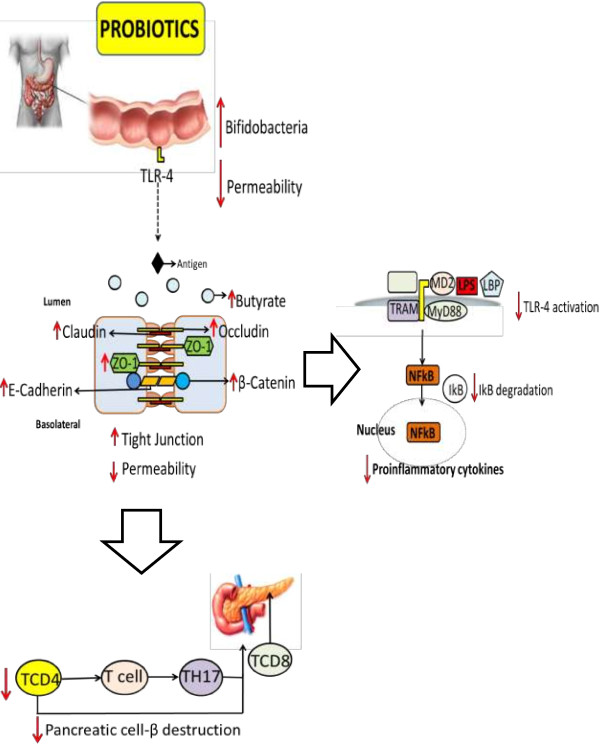
Diabetes is a condition of multifactorial origin, involving several molecular mechanisms related to the intestinal microbiota for its development. In type 2 diabetes, receptor activation and recognition by microorganisms from the intestinal lumen may trigger inflammatory responses, inducing the phosphorylation of serine residues in insulin receptor substrate-1, reducing insulin sensitivity. In type 1 diabetes, the lowered expression of adhesion proteins within the intestinal epithelium favours a greater immune response that may result in destruction of pancreatic β cells by CD8+ T-lymphocytes, and increased expression of interleukin-17, related to autoimmunity. Research in animal models and humans has hypothesized whether the administration of probiotics may improve the prognosis of diabetes through modulation of gut microbiota. We have shown in this review that a large body of evidence suggests probiotics reduce the inflammatory response and oxidative stress, as well as increase the expression of adhesion proteins within the intestinal epithelium, reducing intestinal permeability. Such effects increase insulin sensitivity and reduce autoimmune response. However, further investigations are required to clarify whether the administration of probiotics can be efficiently used for the prevention and management of diabetes.
Overview
The claims and statistics of this paper haven’t been checked yet.
Free: it reads the open-access text and checks the first 5 claims that cite a source we can check. Create a free account to check every claim.
Integrity signals
Registry
Cites
Statistics
Figures
Verification
Claims the paper makes
The claims and statistics of this paper haven’t been checked yet.
Free: it reads the open-access text and checks the first 5 claims that cite a source we can check. Create a free account to check every claim.
Claims other papers make about this one
Each is checked against this paper’s own text: does it say what the citing paper says it does?
The source backs part of the claim, not all of it — or backs it for a different population, condition or comparison.
In the citing paper
“The gut flora mediates three pathways connected to the pathogenesis of obesity and diabetes: low-grade inflammation, raised blood levels of lipopolysaccharides (endotoxemia), and increased energy harvest.”
From A critical review on diabetes mellitus type 1 and type 2 management approaches: from lifestyle modification to current and novel targets and therapeutic agents. (2024) · cites this paper as [110]
Experimental — accuracy not yet measuredThe check wasn’t confident either way, so it gives no verdict — never disputed.
In the citing paper
“Quirós et al. (76) found that kefir is able to inhibit the activity of angiotensin-converting enzyme (ACE) through the action of bioactive peptides generated from casein during the milk fermentation process.”
From Milk kefir : nutritional, microbiological and health benefits (2017) · cites this paper as [76]
Experimental — accuracy not yet measured
Self-check
Percentages, sums and reported differences re-computed from the paper’s own numbers.
The self-check needs the paper’s full text.
Citations
Cites
1 retracted
RETRACTED: Colonic flora, Probiotics, Obesity and Diabetes
Marik, P. E. (2012) · Frontiers in Endocrinology · doi:10.3389/fendo.2012.00087 · Cited by 38
RetractedHuman gut microbes associated with obesity
Ley, R. E., Turnbaugh, P. J., Klein, S., & Gordon, J. I. (2006) · Nature · doi:10.1038/4441022a · Cited by 8,785 · cited 1×
“Studies have shown the intestinal microbiota is associated with the development of metabolic diseases, as obese and diabetic subjects present perturbations in the proportions of Firmicutes, Bacteroidetes and Proteobacterias [4,12].”
BackgroundInterleukin-10 and the Interleukin-10 Receptor
Moore, K. W., de Waal Malefyt, R., Coffman, R. L., & O'Garra, A. (2001) · Annual Review of Immunology · doi:10.1146/annurev.immunol.19.1.683 · Cited by 6,737 · cited 1×
“IL-10 is an anti-inflammatory cytokine which inhibits antigen presentation and proinflammatory cytokine production [107], whereas depletion of hepatic natural killer cells is linked to the development of hepatic insulin resistance [108].”
BackgroundMetabolic Endotoxemia Initiates Obesity and Insulin Resistance
Cani, P. D., Amar, J., Iglesias, M. A., Poggi, M., Knauf, C., Bastelica, D., Neyrinck, A. M., Fava, F., Tuohy, K. M., Chabo, C., et al. (2007) · Diabetes · doi:10.2337/db06-1491 · Cited by 6,638
Origin and physiological roles of inflammation
Medzhitov, R. (2008) · Nature · doi:10.1038/nature07201 · Cited by 6,618 · cited 2×
“However, TLRs also stimulate adaptive immunity, once they induce the secretion of inflammatory cytokines [36].”
BackgroundInsulin signalling and the regulation of glucose and lipid metabolism
Saltiel, A. R., & Kahn, C. R. (2001) · Nature · doi:10.1038/414799a · Cited by 5,326 · cited 3×
“AGE: Advanced glycation end products; AKT: Protein kinase B; AP-1: Activating protein 1; BB: BioBreeding diabetes-prone; BBR: BioBreeding diabetes-resistant; CFU: Colony-forming units; CLRs: C-type lectin receptors; CREB: CRE binding protein; DAMPS: Damage-associated molecular pattern molecules; FFA: Free fatty acid;…”
BackgroundCani, P. D., Bibiloni, R., Knauf, C., Waget, A., Neyrinck, A. M., Delzenne, N. M., & Burcelin, R. (2008) · Diabetes · doi:10.2337/db07-1403 · Cited by 4,819 · cited 2×
“Increased intestinal permeability is a result of reduced expression of tight junction proteins, eventually favouring the translocation of bacterial lipopolysaccharide (LPS), which may result in metabolic endotoxemia and insulin resistance [5,6].”
BackgroundToll-like receptors and innate immunity
Medzhitov, R. (2001) · Nature Reviews Immunology · doi:10.1038/35100529 · Cited by 4,308
Gut Microbiota in Human Adults with Type 2 Diabetes Differs from Non-Diabetic Adults
Larsen, N., Vogensen, F. K., van den Berg, F. W. J., Nielsen, D. S., Andreasen, A. S., Pedersen, B. K., Al-Soud, W. A., Sørensen, S. J., Hansen, L. H., & Jakobsen, M. (2010) · PLoS ONE · doi:10.1371/journal.pone.0009085 · Cited by 2,952 · cited 2×
“Studies have shown the intestinal microbiota is associated with the development of metabolic diseases, as obese and diabetic subjects present perturbations in the proportions of Firmicutes, Bacteroidetes and Proteobacterias [4,12].”
BackgroundA microbial symbiosis factor prevents intestinal inflammatory disease
Mazmanian, S. K., Round, J. L., & Kasper, D. L. (2008) · Nature · doi:10.1038/nature07008 · Cited by 2,340
Research works printed but not linked: 2
- WHO - World Health Organization World Health Statistics WHO/FAO 2012 Geneva: WHO
- WHO - World Health Organization Evaluation of Health and Nutritional Properties of Probiotics in Food Including Powder Milk with Live Lactic Acid Bacteria Joint WHO/FAO Expert Consultation on Geneva 2001 Cordoba, Argentina: WHO
Cited by
Items 301–362 of 362
Azaz, Z. (2024) · Advances in Pharmacology & Clinical Trials · doi:10.23880/apct-16000243 · Cited by 1
Nurliyani, N., Harmayani, E., & Sunarti, S. (2015) · doi:10.12691/jfnr-3-6-5 · Cited by 2
Sharaf, L. K., Sharma, M., & Shukla, G. (2018) · International Journal of Pharma and Bio Sciences · doi:10.22376/ijpbs.2018.9.4.b197-205 · Cited by 1
Effects of Probiotics on Improvement of Metabolic Factors in Pregnant Women
Sun, J., Gajurel, D., Buys, N. J., & Yin, C. (2019) · Elsevier eBooks · doi:10.1016/b978-0-12-815249-2.00017-8 · Cited by 1
Liu, Y.-K., Xu, X., & Zhou, X. (2019) · PubMed Central · doi:10.7518/hxkq.2019.05.020 · Cited by 2
Dissecting genome-wide studies for microbiome-related metabolic diseases
Awany, D., Allali, I., & Chimusa, E. R. (2020) · Human Molecular Genetics · doi:10.1093/hmg/ddaa105 · Cited by 1
Jainata, D., Utama, B. I., & Desmawati, D. (2022) · Jurnal Ilmu Kesehatan Indonesia · doi:10.25077/jikesi.v2i4.487 · Cited by 5
Role of Probiotics in Diabetes Mellitus
Yadav, A. R. (2021) · Journal of Infectious Diseases & Travel Medicine · doi:10.23880/jidtm-16000154
Lazarenko, L. M., Melnykova, O., Babenko, L. P., Bubnov, R. V., Beregova, T. V., Falalyeyeva, T. M., & Spivak, M. Y. (2023) · Advances in predictive, preventive and personalised medicine · doi:10.1007/978-3-031-19564-8_14 · Cited by 1
Development Of Gi Sustainable Probiotic Beads Using Microencapsulation
Cui, J. (2017) · Human Biology · Cited by 1
Cao, H., Li, C.-N., Lei, L., Wang, X., Liu, S., Liu, Q., Huan, Y., Sun, S., & Shen, Z. (2020) · doi:10.21203/rs.3.rs-30055/v1 · Cited by 1
NUTRITION THERAPY IN THE TREATMENT OF OVERWEIGHT AND OBESE ADULTS WITH TYPE 2 DIABETES
Vasilescu, R. (2015) · Romanian Medical Journal · doi:10.37897/rmj.2015.2.14 · Cited by 1
Microbiologic evaluation of efficacy of probiotic for correction intestinal disbiosis
Bissenova, N., Yergaliyeva, A., Махамбетов, К. О., & Talgatbekova, N. (2016) · Journal of Clinical Medicine of Kazakhstan · doi:10.23950/1812-2892-2016-2-36-42
Surgical management of diabetes mellitus: future outlook (part 2)
Sazhin, A. V., Khusyainova, A. I., & Petukhov, V. A. (2017) · Endoscopic Surgery · doi:10.17116/endoskop201723250-60
Neurological Responses to a Glucose Diet in Caenorhabditis elegans
Dumesnil, D. R. (2017) · University of North Texas Digital Library (University of North Texas) · doi:10.12794/metadc1011786
Demırci, M., Keskin, F. E., Taner, Z., Özyazar, M., Kocazeybek, B., & Tokman, H. B. (2019) · Journal of Academic Research in Medicine · doi:10.5152/jarem.2018.2122
GASTROINTESTINAL MICROBIOTA AND OBESITY. APPROVING PROBIOTICS AS DRUGS FOR TREATMENT OF OBESITY
Karamzin, A. M., & Tereshin, N. M. (2018) · Journal of microbiology epidemiology immunobiology · doi:10.36233/0372-9311-2018-1-112-119
Gut Microbiota as Signatures in Non-communicable Diseases and Mucosal Immunity
Behera, S. K., Praharaj, A. B., Chalikonda, G., Srivani, G., & Mahapatra, N. (2020) · Diagnostics and therapeutic advances in GI malignancies · doi:10.1007/978-981-15-2017-4_11 · Cited by 1
Mavzyutov, A. R., Bondarenko, K. R., Mavzyutova, G. A., & Glazutdinova, L. R. (2020) · Russian Clinical Laboratory Diagnostics · doi:10.18821/0869-2084-2020-65-1-29-36
Hou, Y., Lai, C., Cheng, C., Lin, Y., Hsieh, T.-H. J., Wu, J. H., Tzeng, I., & Kuo, C. (2020) · Journal of Clinical Laboratory Analysis · doi:10.1002/jcla.23490
Human Gut Microbiota: Friend or Foe?
Pliszka, M., & Szablewski, L. (2020) · OBM Hepatology and Gastroenterology · doi:10.21926/obm.hg.2003050 · Cited by 1
Efeitos da suplementação de probióticos em portadores de diabetes
Pereira, S. E., & Cintra, B. M. (2022) · Mérida Publishers eBooks · doi:10.4322/mp.978-65-84548-09-1.c6
Efeito da interleucina 17 na regulação hipotalâmica da homeostase energética
Nogueira, G. A. S. (2019) · doi:10.47749/t/unicamp.2019.1157283
Braga, R. A. M., Nogueira, M. D. D. A., Sousa, F. I. D. S. E., Pinheiro, A. D. V., Lima, M. R. D. S., Sousa, A. R., Batista, A. C. V., & Hoefel, A. L. (2022) · Research Society and Development · doi:10.33448/rsd-v11i5.28199
The role of diet and physical activity in influencing the microbiota/microbiome
Murphy, E. A., & Velázquez, K. T. (2022) · Elsevier eBooks · doi:10.1016/b978-0-12-822130-3.00017-x · Cited by 1
Intestinal Microbiota Modulation for Type 1 and Type 2 Diabetes Prevention
Kushwaha, K. K., Sharma, R., Subramani, S. K., & Raghuwanshi, S. (2022) · Springer eBooks · doi:10.1007/978-981-16-8444-9_5
Evaluation of the synergistic effect of cinnamon and probiotic filtrate against UTI
Aljeboury, G. H. (2022) · International Journal of Health Sciences · doi:10.53730/ijhs.v6ns4.10447 · Cited by 1
Fauziyyah, F., Setiawan, B. I., & Marliyati, S. A. (2022) · Amerta Nutrition · doi:10.20473/amnt.v6i3.2022.282-291 · Cited by 5
Torre, G. L. T. D., & Bungay, A. A. C. (2022) · Anais da Academia Brasileira de Ciências · doi:10.1590/0001-3765202220210766
(2022) · Al-Azhar Journal of Pediatrics · doi:10.21608/azjp.2022.274057
Probiotics and women health: clinical perspective
AlJadir, S. J. (2023) · Obstetrics & Gynecology International Journal · doi:10.15406/ogij.2022.13.00684 · Cited by 1
Winarsi, H., Ramadhan, G. R., Dewi, I. A., & Hernayanti, H. (2022) · Jurnal Gizi dan Pangan Soedirman · doi:10.20884/1.jgipas.2022.6.2.6976 · Cited by 3
Microbiota intestinal e diabetes mellitus
Guedes, G., Thamy, L., Junqueira, L., & da Rocha, B. A. (2022) · Revista Omnia Saúde · doi:10.29327/4185494
Epidemiology and Genetics of Type 1 Diabetes Mellitus
ÇÖL, B. N., & Alphan, M. E. (2023) · Wiley eBooks · doi:10.1002/9781119983347.ch6
dos Santos, C. L. R., Souza, V. R. D. N., & Ferreira, P. A. (2023) · Research Society and Development · doi:10.33448/rsd-v12i13.44385
Uso de probióticos no tratamento da obesidade: perspectivas
Batista, J. S., Chagas, A. P., Ignácio, M. C. R., & de-Campos, T. A. (2022) · Brasília Médica · doi:10.5935/2236-5117.2022v59a61
"Hypoglycemic Effect of Aguamiel Sweetener with Probiotic Additives"
Belmares, M. C. R. (2023) · Biomedical Journal of Scientific & Technical Research · doi:10.26717/bjstr.2023.52.008261
Adjuvant Effect of Probiotics in the Treatment of Periodontal and Peri-Implant Diseases
Barbagallo, G., Monaca, G., Gregorio, F. D., Alì, G., Porto, V., & Assenza, G. (2024) · Dentistry · doi:10.5772/intechopen.1005784
Métodos moleculares na caracterização da disbiose intestinal associado ao diabetes mellitus tipo 2
Cavalcanti, T. M. L., Filho, I. C., Messias, I. M. D. O., & Messias, J. B. (2024) · Peer Review · doi:10.53660/prw-2491-4522
Rocha, R. D. S., Pereira, A. S. S., Goulart, M. O. F., de Mendonça, E. L. S. S., & de Oliveira, A. C. M. (2024) · Revista Contemporânea · doi:10.56083/rcv4n9-048
Designer Probiotics and Postbiotics
Singh, B., Mal, G., Kalra, R. S., & Marotta, F. (2024) · Springer eBooks · doi:10.1007/978-3-031-65459-6_25
Syndrome of increased intestinal permeability in type 1 and type 2 diabetes mellitus
Dvoryanchikov, Y. V., Deunezhewa, S., Beloglazov, V. A., & Yatskov, I. A. (2024) · Obesity and metabolism · doi:10.14341/omet13027
Synbiotics: Combination delivery of prebiotics and probiotics
Sri Bagavathi Perumal, R. B., Hariprakash, S., Sherin, A. L., Ankamreddy, H., Vaidyanathan, V. K., Sarwar, M. T., Ravichandran, V., Mohan, D., & Rajasekharan, S. K. (2025) · Elsevier eBooks · doi:10.1016/b978-0-443-27594-4.00008-5
Dubey, V. P., Kansagra, J. J., Kamani, B. K., & Sureja, V. P. (2025) · World Journal of Experimental Medicine · doi:10.5493/wjem.v15.i3.108467
Manaer, T., Yu, L., 新华·那比, Dilidaxi, D., Liu, L., & Sailike, J. (2021) · Figshare · doi:10.6084/m9.figshare.14471715
Manaer, T., Yu, L., 新华·那比, Dilidaxi, D., Liu, L., & Sailike, J. (2021) · Figshare · doi:10.6084/m9.figshare.14471700
Manaer, T., Yu, L., 新华·那比, Dilidaxi, D., Liu, L., & Sailike, J. (2021) · Figshare · doi:10.6084/m9.figshare.14471706
Manaer, T., Yu, L., 新华·那比, Dilidaxi, D., Liu, L., & Sailike, J. (2021) · Figshare · doi:10.6084/m9.figshare.14471721
Talebi, S., Shab-Bidar, S., Mohammadi, H., Moini, A., & Djafarian, K. (2024) · Figshare · doi:10.6084/m9.figshare.26632147
Manaer, T., Yu, L., 新华·那比, Dilidaxi, D., Liu, L., & Sailike, J. (2021) · Figshare · doi:10.6084/m9.figshare.14471712
Manaer, T., Yu, L., 新华·那比, Dilidaxi, D., Liu, L., & Sailike, J. (2021) · Figshare · doi:10.6084/m9.figshare.14471703
Manaer, T., Yu, L., 新华·那比, Dilidaxi, D., Liu, L., & Sailike, J. (2021) · Figshare · doi:10.6084/m9.figshare.14471718
Manaer, T., Yu, L., 新华·那比, Dilidaxi, D., Liu, L., & Sailike, J. (2021) · Figshare · doi:10.6084/m9.figshare.14471709
Manaer, T., Yu, L., 新华·那比, Dilidaxi, D., Liu, L., & Sailike, J. (2021) · Figshare · doi:10.6084/m9.figshare.14471697
Alzahrani, N. S., Alshammari, G. M., Yagoub, A. E. A., Krishnamoorthy, R., Alshuniaber, M. A., Moubayed, N., & Yahya, M. A. (2026) · Natural Product Communications · doi:10.1177/1934578x261431451
Tas, G. G., Ergin, F., Küçükçetin, A., & Satı, L. (2026) · Scientific Reports · doi:10.1038/s41598-026-54536-7
Chang, W.-L., Chen, C.-Y., Wu, J., & Hou, Y. C. (2026) · Cureus · doi:10.7759/cureus.111964
Ермоленко, Е. И., Sitkin, S. I., Alferova, L. S., Novikova, N. S., Сергеевич, Г. Н., Orlova, V. V., Karaseva, A. B., Demchenko, E. A., Ergashev, O., & Suvorov, A. N. (2026) · Nutrients · doi:10.3390/nu18142324 · Cited by 2
Huang, X., Yang, X., Yu, Y., Huang, J., Tao, W., Yu, R., & Liu, X. (2026) · Frontiers in Nutrition · doi:10.3389/fnut.2026.1863111
Koutsogeorgopoulou, G., Liapis, I., Chatzakis, C., Sotiriadis, A., & Karachalios, C. (2026) · The Egyptian Journal of Internal Medicine · doi:10.1186/s43162-026-00747-3
Khan, M. F., & Wang, H. (2026) · Antioxidants · doi:10.3390/antiox15111388
Metadata
- Authors
- Gomes, A. C., Bueno, A. A., de Souza, R. G. M., & Mota, J. F.
- Affiliations
- Universidade Federal de Goiás (BR)
- University of Worcester (GB)
- Corresponding author
- Mota, João Felipe
- Venue
- Nutrition Journal
- Published
- 2014-06-17
- Volume
- 13
- Issue
- 1
- Pages
- 60-60
- ISSN
- 1475-2891 (ISSN-L)
- PMC
- PMC4078018
- OpenAlex
- W2125446896
- Cited by
- 363
- References
- 124
- Citations by year
- 2026: 9 · 2025: 21 · 2024: 33 · 2023: 34 · 2022: 44 · 2021: 39 · 2020: 41 · 2019: 35 · 2018: 32 · 2017: 28 · 2016: 26 · 2015: 20 · 2014: 1
- FWCI
- 3.12
- Type
- journal article
- Language
- en
- Open access
- gold
- doi.org
- Licence
- Locations
- Nutrition Journal (publishedVersion, cc-by)
- PubMed Central (publishedVersion, cc-by)
- PubMed (publishedVersion)
- Americanae (AECID Library) (publishedVersion, other-oa)
- Worcester Research and Publications (University of Worcester) (acceptedVersion)
- LA Referencia (Red Federada de Repositorios Institucionales de Publicaciones Científicas) (submittedVersion, other-oa)
- Funders
- University of Worcester
- Fundação de Amparo à Pesquisa do Estado de Goiás
- Universidade de São Paulo
- Universidade Estadual Paulista
- Directorate for Biological Sciences
- Topics
- Life Sciences › Agricultural and Biological Sciences › Food Science › Probiotics and Fermented Foods
- Life Sciences › Biochemistry, Genetics and Molecular Biology › Molecular Biology › Gut microbiota and health
- Health Sciences › Dentistry › Periodontics › Oral microbiology and periodontitis research
- Keywords
- gut microbiota, probiotics, type 2 diabetes, type 1 diabetes, insulin sensitivity, intestinal inflammation, oxidative stress, intestinal permeability, islet autoimmunity, IL-17, IRS-1, diabetes prevention
- MeSH terms
- Animals, Clinical Trials as Topic, Diabetes Mellitus, Type 1, Diabetes Mellitus, Type 2, Humans, Inflammation, Insulin Resistance, Probiotics, Gastrointestinal Tract, Toll-Like Receptor 4, Microbiota
About these checks
Registry, retraction, Cites and statistics results are computed, not judged, with one exception: a printed reference that no index lists is read once by a model before it counts as a citation error. Claims are extracted by a model and kept only when their quote appears verbatim in the text; each cited source is then checked, with a model’s help, for whether it says what the claim relies on. Those verdicts can be wrong — read the claim’s quote and the cited source before relying on one.
Statistics and arithmetic are recomputed, not judged.
Confidence bands are shown only for fields calibrated on our annotated test set. None is calibrated yet, so no band is shown.
What counts as a claim ›How we measure confidence ›How we check this ›
Are you an author, or do you see a problem with this page? Request a review
Data sources
Bibliographic data: Semantic Scholar, OpenAlex, Crossref.
Contains information from the Semantic Scholar Academic Graph Datasets, made available under the ODC Attribution License (ODC-BY 1.0).
Semantic Scholar’s data is described in: Kinney, R., et al. (2023). The Semantic Scholar Open Data Platform. arXiv:2301.10140.
