

Antiobesity and lipid-lowering effects of Bifidobacterium spp. in high fat diet-induced obese rats
Open accessThe DOI matches its Crossref record; 45 of the 45 references it cites were found in a registry or an index.
Abstract
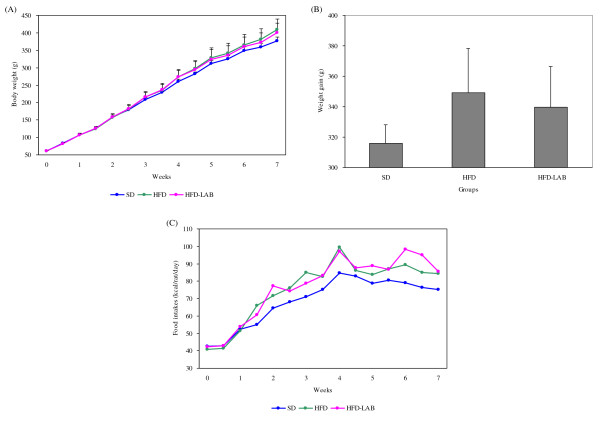
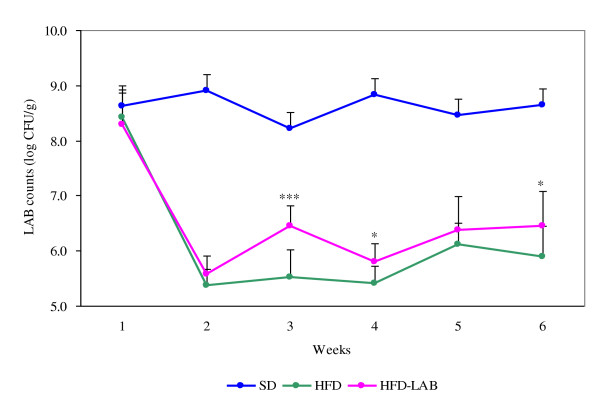
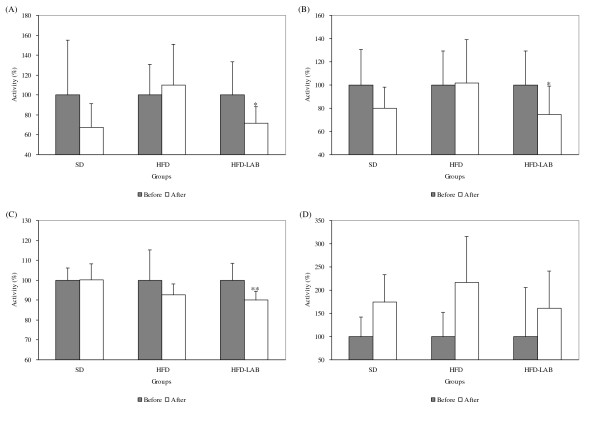
BACKGROUND: Recent studies have reported the preventive effects of probiotics on obesity. Among commensal bacteria, bifidobacteria is one of the most numerous probiotics in the mammalian gut and are a type of lactic acid bacteria. The aim of this study was to assess the antiobesity and lipid-lowering effects of Bifidobacterium spp. isolated from healthy Korean on high fat diet-induced obese rats. METHODS: Thirty-six male Sprague-Dawley rats were divided into three groups as follows: (1) SD group, fed standard diet; (2) HFD group, fed high fat diet; and (3) HFD-LAB group, fed high fat diet supplemented with LAB supplement (B. pseudocatenulatum SPM 1204, B. longum SPM 1205, and B. longum SPM 1207; 108 ~ 109 CFU). After 7 weeks, the body, organ, and fat weights, food intake, blood serum levels, fecal LAB counts, and harmful enzyme activities were measured. RESULTS: Administration of LAB reduced body and fat weights, blood serum levels (TC, HDL-C, LDL-C, triglyceride, glucose, leptin, AST, ALT, and lipase levels), and harmful enzyme activities (β-glucosidase, β-glucuronidase, and tryptophanase), and significantly increased fecal LAB counts. CONCLUSION: These data suggest that Bifidobacterium spp. used in this study may have beneficial antiobesity effects.
Overview
The claims and statistics of this paper haven’t been checked yet.
Free: it reads the open-access text and checks the first 5 claims that cite a source we can check. Create a free account to check every claim.
Integrity signals
Registry
Cites
Statistics
Figures
Verification
Claims the paper makes
The claims and statistics of this paper haven’t been checked yet.
Free: it reads the open-access text and checks the first 5 claims that cite a source we can check. Create a free account to check every claim.
Claims other papers make about this one
Each is checked against this paper’s own text: does it say what the citing paper says it does?
In the citing paper
“Moreover, certain Lactobacillus and Bifidobacteria species have been associated with increased muscle strength, weight loss, and reduced obesogenic environments in humans and rodents [173,174,175,176].”
From Impact of Protein Intake in Older Adults with Sarcopenia and Obesity: A Gut Microbiota Perspective (2020) · cites this paper as [173]
In the citing paper
“Similarly, in obese rats fed a high-fat diet, Bifidobacterium spp. decreased levels of circulating triglycerides and LDL and increased levels of HDL [35].”
From Dietary lipids, gut microbiota and lipid metabolism (2019) · cites this paper as [35]
Self-check
Percentages, sums and reported differences re-computed from the paper’s own numbers.
The self-check needs the paper’s full text.
Citations
Cites
Serum Immunoreactive-Leptin Concentrations in Normal-Weight and Obese Humans
Considine, R. V., Sinha, M. K., Heiman, M. L., Kriauciunas, A., Stephens, T. W., Nyce, M. R., Ohannesian, J. P., Marco, C. C., McKee, L. J., Bauer, T. L., et al. (1996) · New England Journal of Medicine · doi:10.1056/nejm199602013340503 · Cited by 6,326 · cited 2×
“Thus, leptin levels are closely related to the percentage of body fat; markedly higher serum leptin levels have been found in obese individuals compared with non-obese individuals [31,32].”
BackgroundResultAFRC, R. F. (1989) · Journal of Applied Bacteriology · doi:10.1111/j.1365-2672.1989.tb05105.x · Cited by 4,149
Cani, P. D., Neyrinck, A. M., Fava, F., Knauf, C., Burcelin, R. G., Tuohy, K. M., Gibson, G. R., & Delzenne, N. M. (2007) · Diabetologia · doi:10.1007/s00125-007-0791-0 · Cited by 1,774 · cited 1×
“with improved glucose-tolerance, glucose-induced insulin-secretion, and normalized inflammatory tone (decreased endotoxemia, plasma and adipose tissue proinflammatory cytokine) [ 7 ].”
BackgroundFrederich, R. C., Hamann, A., Anderson, S., Löllmann, B., Lowell, B. B., & Flier, J. S. (1995) · Nature Medicine · doi:10.1038/nm1295-1311 · Cited by 1,660 · cited 1×
“Leptin has been identified as an antiobesity hormone that regulates body weight by controlling food intake and energy expenditure via the hypothalamic-pituitarygonadal axis [28-30].”
BackgroundProbiotics in man and animals.
Fuller, R. (1989) · PubMed · Cited by 1,292
Signals That Regulate Food Intake and Energy Homeostasis
Woods, S. C., Seeley, R. J., Porte, D., & Schwartz, M. W. (1998) · Science · doi:10.1126/science.280.5368.1378 · Cited by 1,169
Early differences in fecal microbiota composition in children may predict overweight
Kalliomäki, M., Carmen Collado, M., Salminen, S., & Isolauri, E. (2008) · The American Journal of Clinical Nutrition · doi:10.1093/ajcn/87.3.534 · Cited by 1,062 · cited 1×
“[39] also observed that fecal Bifidobacterium spp.”
Leptin Signaling, Adiposity, and Energy Balance
JÉQUIER, E. (2002) · Annals of the New York Academy of Sciences · doi:10.1111/j.1749-6632.2002.tb04293.x · Cited by 789 · cited 1×
“Leptin has been identified as an antiobesity hormone that regulates body weight by controlling food intake and energy expenditure via the hypothalamic-pituitarygonadal axis [28-30].”
BackgroundIncreased obese mRNA expression in omental fat cells from massively obese humans
Hamilton, B. S., Paglia, D., Kwan, A. Y. M., & Deitel, M. (1995) · Nature Medicine · doi:10.1038/nm0995-953 · Cited by 526 · cited 1×
“Thus, leptin levels are closely related to the percentage of body fat; markedly higher serum leptin levels have been found in obese individuals compared with non-obese individuals [31,32].”
BackgroundThe Function of Leptin in Nutrition, Weight, and Physiology
Friedman, J. M. (2002) · Nutrition Reviews · doi:10.1301/002966402320634878 · Cited by 508 · cited 1×
“Leptin has been identified as an antiobesity hormone that regulates body weight by controlling food intake and energy expenditure via the hypothalamic-pituitarygonadal axis [28-30].”
Background
Research works printed but not linked: 1
- Scardovi V Krieg NR, Holt JG Genus Bifidobacterium Bergey's Manual of Systemic Bacteriology 1986 2 Williams & Willikins, MD 1418 143421718174
Cited by
Cross-talk between Akkermansia muciniphila and intestinal epithelium controls diet-induced obesity
Everard, A., Belzer, C., Geurts, L., Ouwerkerk, J. P., Druart, C., Bindels, L. B., Guiot, Y., Derrien, M., Muccioli, G. G., Delzenne, N. M., et al. (2013) · Proceedings of the National Academy of Sciences · doi:10.1073/pnas.1219451110 · Cited by 4,511
“, Lactobacillus spp (30, 31), Bifidobacterium spp (32, 33), and Bacteroides uniformis CECTT 7771 (34)] on fat mass development during diet-induced obesity, but the aims of these studies were different from that of the present study.”
ResultDietary lipids, gut microbiota and lipid metabolism
Schoeler, M., & Caesar, R. (2019) · Reviews in Endocrine and Metabolic Disorders · doi:10.1007/s11154-019-09512-0 · Cited by 1,163
“The capacity of HDL to bind LPS may protect against inflammation.”
BackgroundInfluentialWang, J., Tang, H., Zhang, C., Zhao, Y., Derrien, M., Rocher, E., van-Hylckama Vlieg, J. E. T., Strissel, K., Zhao, L., Obin, M., et al. (2015) · The ISME Journal · doi:10.1038/ismej.2014.99 · Cited by 836
“…subjects with MS have used culture-based or targeted molecular analyses (for example, quantitative PCR, microarray) to evaluate a limited number of gut microbiota components (for example, Bifidobacterium and Lactobacillus) (An et al., 2011; Chen et al., 2011; Xu et al., 2012; Everard et al., 2013).”
BackgroundResultInfluentialThe gut microbiota, obesity and insulin resistance
Shen, J., Obin, M. S., & Zhao, L. (2013) · Molecular Aspects of Medicine · doi:10.1016/j.mam.2012.11.001 · Cited by 599
“More recent studies (An et al., 2011) evaluated the effects of a combination of three species of Bifidobacterium isolated from the gut of healthy Koreans on obese, HFD-fed rats.”
BackgroundGut microbiota and metabolic syndrome
Festi, D., Schiumerini, R., Eusebi, L. H., Marasco, G., Taddia, M., & Colecchia, A. (2014) · World Journal of Gastroenterology · doi:10.3748/wjg.v20.i43.16079 · Cited by 534
Metadata
- Authors
- An, H. M., Park, S. Y., Lee, D. K., Kim, J. R., Cha, M. K., Lee, S. W., Lim, H. T., Kim, K. J., & Ha, N. J.
- Affiliations
- Sahmyook University (KR)
- Corresponding author
- Ha, Nam Joo
- Venue
- Lipids in Health and Disease
- Published
- 2011-07-12
- Volume
- 10
- Issue
- 1
- Pages
- 116-116
- ISSN
- 1476-511X (ISSN-L)
- PMC
- PMC3146849
- OpenAlex
- W2170559209
- Cited by
- 320
- References
- 45
- Citations by year
- 2026: 13 · 2025: 16 · 2024: 15 · 2023: 15 · 2022: 30 · 2021: 29 · 2020: 26 · 2019: 27 · 2018: 32 · 2017: 26 · 2016: 16 · 2015: 21 · 2014: 20 · 2013: 25 · 2012: 9
- FWCI
- 25.24
- Type
- journal article
- Language
- en
- Open access
- gold
- doi.org
- Licence
- cc-by
- Locations
- Lipids in Health and Disease (publishedVersion, cc-by)
- Europe PMC (PubMed Central) (publishedVersion, cc-by)
- PubMed Central (publishedVersion, cc-by)
- PubMed (publishedVersion)
- DOAJ (DOAJ: Directory of Open Access Journals) (submittedVersion, cc-by-sa)
- Funders
- Sahmyook University
- Topics
- Life Sciences › Agricultural and Biological Sciences › Food Science › Probiotics and Fermented Foods
- Life Sciences › Biochemistry, Genetics and Molecular Biology › Molecular Biology › Gut microbiota and health
- Health Sciences › Nursing › Nutrition and Dietetics › Microbial Metabolites in Food Biotechnology
- Keywords
- Bifidobacterium, probiotics, anti-obesity, hypolipidemic effect, high-fat diet-induced obesity, lactic acid bacteria, Bifidobacterium pseudocatenulatum, Bifidobacterium longum, serum lipids, gut commensal bacteria, leptin, liver enzymes
- MeSH terms
- Alanine Transaminase, alpha-Amylases, Animals, Hypolipidemic Agents, Aspartate Aminotransferases, beta-Glucosidase, Bifidobacterium, Blood Glucose, Dietary Fats, Feces, Glucuronidase, Lipase, Lipids, Male, Obesity, Tryptophanase, Urease, Weight Gain, Rats, Sprague-Dawley, Anti-Obesity Agents, Probiotics, Leptin, Rats
About these checks
Registry, retraction, Cites and statistics results are computed, not judged, with one exception: a printed reference that no index lists is read once by a model before it counts as a citation error. Claims are extracted by a model and kept only when their quote appears verbatim in the text; each cited source is then checked, with a model’s help, for whether it says what the claim relies on. Those verdicts can be wrong — read the claim’s quote and the cited source before relying on one.
Statistics and arithmetic are recomputed, not judged.
Confidence bands are shown only for fields calibrated on our annotated test set. None is calibrated yet, so no band is shown.
What counts as a claim ›How we measure confidence ›How we check this ›
Are you an author, or do you see a problem with this page? Request a review
Data sources
Bibliographic data: Semantic Scholar, OpenAlex, Crossref.
Contains information from the Semantic Scholar Academic Graph Datasets, made available under the ODC Attribution License (ODC-BY 1.0).
Semantic Scholar’s data is described in: Kinney, R., et al. (2023). The Semantic Scholar Open Data Platform. arXiv:2301.10140.
