

International regulatory landscape and integration of corrective genome editing into in vitro fertilization
Open accessThe DOI matches its Crossref record; 82 of the 82 references it cites were found in a registry or an index.
Abstract
Genome editing technology, including zinc finger nucleases (ZFNs), transcription activator-like effector nucleases (TALENs), and clustered regularly interspaced short palindromic repeat (CRISPR)/Cas, has enabled far more efficient genetic engineering even in non-human primates. This biotechnology is more likely to develop into medicine for preventing a genetic disease if corrective genome editing is integrated into assisted reproductive technology, represented by in vitro fertilization. Although rapid advances in genome editing are expected to make germline gene correction feasible in a clinical setting, there are many issues that still need to be addressed before this could occur. We herein examine current status of genome editing in mammalian embryonic stem cells and zygotes and discuss potential issues in the international regulatory landscape regarding human germline gene modification. Moreover, we address some ethical and social issues that would be raised when each country considers whether genome editing-mediated germline gene correction for preventive medicine should be permitted.
Overview
The claims and statistics of this paper haven’t been checked yet.
Free: it reads the open-access text and checks the first 5 claims that cite a source we can check. Create a free account to check every claim.
Integrity signals
Registry
Cites
Statistics
Figures
Verification
Claims the paper makes
The claims and statistics of this paper haven’t been checked yet.
Free: it reads the open-access text and checks the first 5 claims that cite a source we can check. Create a free account to check every claim.
Claims other papers make about this one
Each is checked against this paper’s own text: does it say what the citing paper says it does?
The source backs part of the claim, not all of it — or backs it for a different population, condition or comparison.
In the citing paper
“About 30 nations currently have legislation that directly or indirectly bars all clinical uses of germline editing 1 , and they might choose to continue the morato rium indefinitely or implement a permanent ban.”
From Adopt a moratorium on heritable genome editing (2019) · cites this paper as [1]
Experimental — accuracy not yet measuredThe cited source says what the claim attributes to it.
In the citing paper
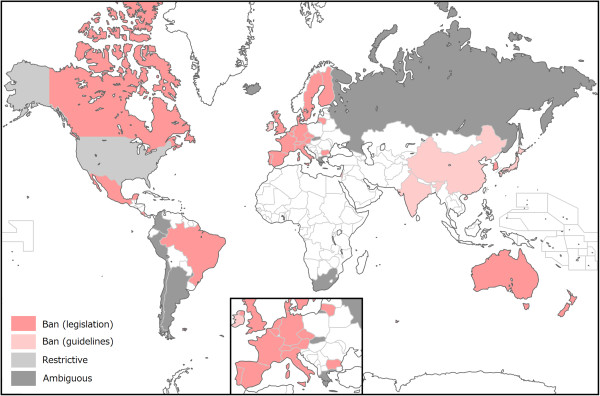
“Their review of 39 countries identified 29 that banned heritable human genome modification (by legisla-tion or guidelines), and one country-the United Statesas having restrictive guidelines.Nine countries were said to have policies that were ambiguous.”
From Human Germline and Heritable Genome Editing: The Global Policy Landscape (2020) · cites this paper as [16]
Self-check
Percentages, sums and reported differences re-computed from the paper’s own numbers.
The self-check needs the paper’s full text.
Citations
Cites
ZFN, TALEN, and CRISPR/Cas-based methods for genome engineering
Gaj, T., Gersbach, C. A., & Barbas, C. F. (2013) · Trends in Biotechnology · doi:10.1016/j.tibtech.2013.04.004 · Cited by 3,820
Wang, H., Yang, H., Shivalila, C. S., Dawlaty, M. M., Cheng, A. W., Zhang, F., & Jaenisch, R. (2013) · Cell · doi:10.1016/j.cell.2013.04.025 · Cited by 3,495
Double nicking by RNA-guided CRISPR Cas9 for enhanced genome editing specificity
Ran, F. A., Hsu, P. D., Lin, C.-Y., Gootenberg, J. S., Konermann, S., Trevino, A. E., Scott, D. A., Inoue, A., Matoba, S., Zhang, Y., et al. (2013) · Cell · doi:10.1016/j.cell.2013.08.021 · Cited by 3,299 · cited 27×
“Most notably, two reports emerged in 2014, demonstrating that the microinjection of Cas9 or TALENs into one-cell-stage embryos led to efficient generation of targeted gene-modified non-human primates (NHPs) [33,34].”
BackgroundInfluentialCRISPR-Cas systems for editing, regulating and targeting genomes
Sander, J. D., & Joung, J. K. (2014) · Nature Biotechnology · doi:10.1038/nbt.2842 · Cited by 3,153 · cited 1×
“Present-day genome editing technology, such as zinc finger nucleases (ZFNs), transcription activator-like effector nucleases (TALENs), and clustered regularly interspaced short palindromic repeat (CRISPR)/Cas system, have achieved far more efficient genetic engineering in higher organisms than the older techniques [20…”
BackgroundGenome editing with engineered zinc finger nucleases
Urnov, F. D., Rebar, E. J., Holmes, M. C., Zhang, H. S., & Gregory, P. D. (2010) · Nature Reviews Genetics · doi:10.1038/nrg2842 · Cited by 2,285 · cited 1×
“Present-day genome editing technology, such as zinc finger nucleases (ZFNs), transcription activator-like effector nucleases (TALENs), and clustered regularly interspaced short palindromic repeat (CRISPR)/Cas system, have achieved far more efficient genetic engineering in higher organisms than the older techniques [20…”
BackgroundImproving CRISPR-Cas nuclease specificity using truncated guide RNAs
Fu, Y., Sander, J. D., Reyon, D., Cascio, V. M., & Joung, J. K. (2014) · Nature Biotechnology · doi:10.1038/nbt.2808 · Cited by 1,993 · cited 1×
“However, Cas9 has been rapidly improved, demonstrating that the combination of a Cas9 nickase mutant and paired gRNAs, the truncation of gRNAs, or the fusion of inactive Cas9 to Fok I nuclease can improve the specificity of targeted gene modification [42,77,78].”
BackgroundTALENs: A widely applicable technology for targeted genome editing
Joung, J. K., & Sander, J. D. (2013) · Nature Reviews Molecular Cell Biology · doi:10.1038/nrm3486 · Cited by 1,650 · cited 1×
“Present-day genome editing technology, such as zinc finger nucleases (ZFNs), transcription activator-like effector nucleases (TALENs), and clustered regularly interspaced short palindromic repeat (CRISPR)/Cas system, have achieved far more efficient genetic engineering in higher organisms than the older techniques [20…”
BackgroundHighly efficient endogenous human gene correction using designed zinc-finger nucleases
Urnov, F. D., Miller, J. C., Lee, Y.-L., Beausejour, C. M., Rock, J. M., Augustus, S., Jamieson, A. C., Porteus, M. H., Gregory, P. D., & Holmes, M. C. (2005) · Nature · doi:10.1038/nature03556 · Cited by 1,641 · cited 1×
“ZFN-mediated homologydirected repair has achieved correction of the mutations associated with X-linked severe combined immune deficiency (SCID) and haemostasis in somatic cells [25,26].”
BackgroundYang, H., Wang, H., Shivalila, C. S., Cheng, A. W., Shi, L., & Jaenisch, R. (2013) · Cell · doi:10.1016/j.cell.2013.08.022 · Cited by 1,596
Schwank, G., Koo, B.-K., Sasselli, V., Dekkers, J. F., Heo, I., Demircan, T., Sasaki, N., Boymans, S., Cuppen, E., van der Ent, C. K., et al. (2013) · Cell Stem Cell · doi:10.1016/j.stem.2013.11.002 · Cited by 1,424 · cited 1×
“With regard to CRISPR/Cas9, it was demonstrated that those engineered nucleases can correct a mutation in intestinal stem cells derived from patients with cystic fibrosis [31].”
Background
Research works printed but not linked: 1
- Lokody I: Genetic therapies: Correcting genetic defects with CRISPRCas9. Nat Rev Genet 2013, 15:63-63.
Cited by
Items 101–150 of 150
CRISPR accelerates the cancer drug discovery
Yan, R., Wang, J., LIU, M., & Zhou, K. (2022) · Biocell · doi:10.32604/biocell.2022.021107 · Cited by 1
Ethics of mitochondrial gene replacement therapy
Dimond, R. (2023) · Elsevier eBooks · doi:10.1016/b978-0-443-19045-2.00018-0 · Cited by 1
Anari, E., Anari, R., & Pazoki–Toroudi, H. (2025) · Discover Oncology · doi:10.1007/s12672-025-02180-4 · Cited by 1
Deliverable transgenics & gene therapy possibilities for the testes
Darbey, A. L., & Smith, L. B. (2017) · Molecular and Cellular Endocrinology · doi:10.1016/j.mce.2017.11.023 · Cited by 4
Dimond, R., & Stephens, N. (2018) · Springer eBooks · doi:10.1007/978-3-319-74645-6_7 · Cited by 1
Application of Gene-Editing Technologies in Embryos and Their Potential for Gene Therapy
Eguizábal, C., Montserrat, N., & Belmonte, J. C. I. (2018) · Elsevier eBooks · doi:10.1016/b978-0-12-813570-9.00030-9 · Cited by 2
Implications of CRISPR-Based Germline Engineering for Cancer Survivors
Katz, G., & Pitts, P. J. (2017) · Therapeutic Innovation & Regulatory Science · doi:10.1177/2168479017723401 · Cited by 2
“While the ethical debate has revealed a relative consensus on the use of CRISPR on somatic cells for scientific or therapeutic purposes, no such common ground has been reached on the issue of modifying human germlines.(40,41) Countries such as Japan, China, and India forbid it through declarations that are legally non…”
BackgroundLegal and Ethical Concerns Regarding Gene EditingPreprint
Stanciu, S. A. (2020) · RePEc: Research Papers in Economics · doi:10.5281/zenodo.3751224 · Cited by 1
Deep learning-based algorithm for predicting the live birth potential of mouse embryosPreprint
Tokuoka, Y., Yamada, T., Mashiko, D., Ikeda, Z., Kobayashi, T. J., Yamagata, K., & Funahashi, A. (2021) · bioRxiv (Cold Spring Harbor Laboratory) · doi:10.1101/2021.08.19.456065 · Cited by 1
“For example, human, bovine, and mouse embryos have been used for infertility treatment [1, 2], livestock production [3, 4], and genetic modification and genome editing technologies [5, 6], respectively.”
MethodDefining public attitudes and understanding of human gene therapy in Australia
Watson, M. (2021) · ANU Open Research (Australian National University) · doi:10.25911/hpsw-sj81 · Cited by 3
Selita, F. (2023) · OSF Preprints (OSF Preprints) · doi:10.31219/osf.io/avuq4 · Cited by 1
Considering genetic modification
Winter, G. F. (2015) · British Journal of Midwifery · doi:10.12968/bjom.2015.23.11.772
CRISPR-Cas9 y … ¿Bebés a la carta?
Bastida, A. M. (2016) · MoleQla: revista de Ciencias de la Universidad Pablo de Olavide
Die Genveränderung von Embryonen bürdet Kindern eine unzumutbare Last auf
Haker, H. (2017) · Bioethica Forum · doi:10.24894/bf.2017.10012
Human dignity and new genetic technologies: Opportunities and challenges of legal protection
Milinković, I. (2018) · Zbornik radova Pravnog fakulteta Nis · doi:10.5937/zrpfni1880237m
Modifications du génome des cellules germinales et de l’embryon humains
Jouannet, P., Adolphe, M., Allilaire, J., Ardaillou, R., Esper, C. B., Chapuis, Y., Galibert, F., Fischer, A., Jouannet, P., Gall, J. Y. L., et al. (2016) · Bulletin de l Académie Nationale de Médecine · doi:10.1016/s0001-4079(19)30691-0 · Cited by 4
Sequencing the Regulations on Human Germline Editing Research
Geringer, N. (2019) · doi:10.22186/jyi.37.2.22-23
Emerging Technologies and Health
Palazzani, L. (2019) · Springer eBooks · doi:10.1007/978-3-030-16733-2_3
THE FIRST CASE OF HUMAN GENOME EDITING: CRIMINAL LAW PERSPECTIVE
Sergeev, D. N. (2019) · BRICS Law Journal · doi:10.21684/2412-2343-2019-6-4-114-133
Opinion on the Legal Framework Concerning Interventions in Human Germline Genes in Belgium
Nys, H. (2019) · Veröffentlichungen des Instituts für Deutsches, Europäisches und Internationales Medizinrecht, Gesundheitsrecht und Bioethik der Universitäten Heidelberg und Mannheim · doi:10.1007/978-3-662-59028-7_4
The Legal Framework of New Zealand Concerning Germline Interventions
Sargent, A. (2019) · Veröffentlichungen des Instituts für Deutsches, Europäisches und Internationales Medizinrecht, Gesundheitsrecht und Bioethik der Universitäten Heidelberg und Mannheim · doi:10.1007/978-3-662-59028-7_11
Heritable Genome Editing: Technological Innovation for Future Perspectives in Healthcare
Lofft, M. (2017) · Health Science Inquiry · doi:10.29173/hsi236
Kerr, R. H. (2018) · UWA Profiles and Research Repository (UWA) · doi:10.26182/5b5a7faca20eb
The First Barriers in the Human Genetic Engineering Debate
Evans, J. H. (2020) · Oxford University Press eBooks · doi:10.1093/oso/9780197519561.003.0002
The CRISPR Era, the National Academies Report, and the Median Trait Barrier
Evans, J. H. (2020) · Oxford University Press eBooks · doi:10.1093/oso/9780197519561.003.0003
Possible Barriers Further Down the Slope
Evans, J. H. (2020) · Oxford University Press eBooks · doi:10.1093/oso/9780197519561.003.0004
Shaver, L. G., Sundly, A., & Saif, A. O. (2020) · Journal of Public Health and Primary Care · doi:10.4103/jphpc.jphpc_21_20
Ferraro, A. V., Pereira, A. G. D., & Casciano, A. (2021) · Revista Direitos Fundamentais & Democracia · doi:10.25192/issn.1982-0496.rdfd.v26i12193
Macintosh, K. L. (2018) · Cambridge University Press eBooks · doi:10.1017/9781108557818.009
Nikolova, B. (2019) · Wiley eBooks · doi:10.1002/9781119616122.refs
Evans, J. H. (2020) · Oxford University Press eBooks · doi:10.1093/oso/9780197519561.003.0001
Evans, J. H. (2020) · Oxford University Press eBooks · doi:10.1093/oso/9780197519561.003.0005
Regulation of Genome Editing in Human iPS Cells: Switzerland
Schweizer, R. J., Bernhard, H. P., & Straden, A. S. (2022) · Springer eBooks · doi:10.1007/978-3-030-93023-3_5
El debate ético y de regulación sobre el uso de CRISPR-Cas9 en la línea germinal humana
Amado, E. D., & Angulo, A. M. G. (2021) · Universitas Médica · doi:10.11144/javeriana.umed62-4.derc · Cited by 1
“La posición del Reino Unido sobre la edición genética difiere de la estadounidense.”
BackgroundInfluentialRisk Management of Human Genome Editing: Ethical and Islamic Perspectives
Amin, A. R., Darwish, S., & AlDweri, K. (2022) · Lecture notes in networks and systems · doi:10.1007/978-3-031-17746-0_28
Tang, N. (2023) · H2R working paper · doi:10.33058/wpuzh.2023.7227
Evans, J. H. (2020) · Oxford University Press eBooks · doi:10.1093/oso/9780197519561.002.0003
Evans, J. H. (2020) · Oxford University Press eBooks · doi:10.1093/oso/9780197519561.002.0007
Criminal Protection of Human Genome “Human Gene Editing as a Model”
Najar, S. F. M. A. (2024) · مجلة العلوم القانونية · doi:10.35246/fcs6yg41
GENOM DÜZENLEME KONUSUNA BİYOETİK, SOSYOLOJİK VE HUKUKİ AÇIDAN BİR BAKIŞ
Berberoğlu, N., & Bilge, Y. (2025) · Ombudsman Akademik · doi:10.32002/ombudsmanakademik.1529431
Ogwu, M. C., & Izah, S. C. (2025) · Health information science · doi:10.1007/978-3-031-82622-1_13 · Cited by 2
Innovation and Interdependence: Evidence from Gene-Editing Technology
O’Brien-Udry, C., & Pratt, T. (2025) · International Studies Quarterly · doi:10.1093/isq/sqaf032 · Cited by 1
Five principles that should guide future DNA ‘editing’ in South Africa
Shozi, B., & Botes, M. (2021) · doi:10.64628/aaj.xdgd4munn
Safe and ethical ways to edit the human genome
Castro, R. (2017) · doi:10.64628/aai.6enhjunr4
The Bioethics of Inheritance: Exploring Justice, Autonomy, and Risk in Embryonic Gene Editing
Waglawala, S. F., Singh, D. K., & Das, S. (2025) · Advances in computational intelligence and robotics book series · doi:10.4018/979-8-3373-5646-4.ch014
Legal and Ethical Repercussions of CRISPR-CAS9 in India
Banerjee, R., & Pal, K. (2025) · IGI Global eBooks · doi:10.4018/979-8-3373-0066-5.ch006
CRISPR/Cas9: the future of human gene editing
Zulkifli, N. D., Sani, S. B. M., Wong, C. H., Mahadzan, M., Suhimi, M. H. A., Zulkifli, N., & Das, K. T. (2025) · Elsevier eBooks · doi:10.1016/b978-0-443-33947-9.00009-8
A case against a moratorium on germline gene editing
Schaefer, G. (2019) · The Conversation · doi:10.64628/aai.rk4fsu9t5
Kordowitzki, P., Ratajewska, K., & Azab, S. (2026) · Biomedicine & Pharmacotherapy · doi:10.1016/j.biopha.2026.119507
Genome research: Basic concept and recent advances
Goulart, D. B., Hussain, M. B., Abegunde, M. O., Ogundimu, T., Rostami, S., & Hussain, N. (2026) · Elsevier eBooks · doi:10.1016/b978-0-443-42857-9.00004-9
Metadata
- Authors
- Araki, M., & Ishii, T.
- Affiliations
- Hokkaido University (JP)
- Corresponding author
- Ishii, Tetsuya
- ORCID
- Ishii, Tetsuya
- Venue
- Reproductive Biology and Endocrinology
- Published
- 2014
- Volume
- 12
- Issue
- 1
- Pages
- 108
- ISSN
- 1477-7827 (ISSN-L)
- PMC
- PMC4251934
- OpenAlex
- W2160704433
- Semantic Scholar
- 795dca0858e06d4f80a817f3426da9fa20b0abd8
- Cited by
- 150
- References
- 82
- Citations by year
- 2026: 3 · 2025: 11 · 2024: 2 · 2023: 7 · 2022: 16 · 2021: 13 · 2020: 23 · 2019: 22 · 2018: 17 · 2017: 15 · 2016: 13 · 2015: 8
- FWCI
- 1.13
- Type
- journal article
- Language
- en
- Open access
- gold
- doi.org
- Licence
- cc-by
- Locations
- Reproductive Biology and Endocrinology (publishedVersion, cc-by)
- PubMed Central (publishedVersion, cc-by)
- PubMed (publishedVersion)
- Institutional Repositories DataBase (IRDB) (submittedVersion, cc-by)
- Hokkaido University Collection of Scholarly and Academic Papers (Hokkaido University) (submittedVersion, cc-by)
- Funders
- Japan Society for the Promotion of Science (26460586)
- Topics
- Life Sciences › Biochemistry, Genetics and Molecular Biology › Molecular Biology › CRISPR and Genetic Engineering
- Health Sciences › Nursing › Issues, ethics and legal aspects › Biomedical Ethics and Regulation
- Life Sciences › Biochemistry, Genetics and Molecular Biology › Genetics › Animal Genetics and Reproduction
- Keywords
- genome editing, in vitro fertilization, assisted reproduction, CRISPR-Cas, zinc finger nucleases, TALEN, zygote, genetic disease prevention, social problems
- MeSH terms
- Animals, Fertilization in Vitro, Genetic Engineering, Health Policy, Humans, Global Health, Genome, Human, Genomics, Genetic Diseases, Inborn, Targeted Gene Repair, Translational Research, Biomedical, Stem Cell Research
About these checks
Registry, retraction, Cites and statistics results are computed, not judged, with one exception: a printed reference that no index lists is read once by a model before it counts as a citation error. Claims are extracted by a model and kept only when their quote appears verbatim in the text; each cited source is then checked, with a model’s help, for whether it says what the claim relies on. Those verdicts can be wrong — read the claim’s quote and the cited source before relying on one.
Statistics and arithmetic are recomputed, not judged.
Confidence bands are shown only for fields calibrated on our annotated test set. None is calibrated yet, so no band is shown.
What counts as a claim ›How we measure confidence ›How we check this ›
Are you an author, or do you see a problem with this page? Request a review
Data sources
Bibliographic data: Semantic Scholar, OpenAlex, Crossref.
Contains information from the Semantic Scholar Academic Graph Datasets, made available under the ODC Attribution License (ODC-BY 1.0).
Semantic Scholar’s data is described in: Kinney, R., et al. (2023). The Semantic Scholar Open Data Platform. arXiv:2301.10140.
