

Exercise, physical activity, and self-determination theory: A systematic review
Open accessThe DOI matches its Crossref record; 108 of the 110 references it cites were found in a registry or an index; 6 of the 97 sources its claims cite were checked for support.
Abstract
Systematic review of 66 empirical studies on self-determination theory constructs and exercise outcomes.
Overview
CoChat Summary
## TL;DR
This systematic review synthesized 66 empirical studies on self-determination theory (SDT) and exercise/physical activity published up to June 2011. It found the most consistent support for autonomous motivation—especially identified and intrinsic regulation—and for competence satisfaction and intrinsic motives as positive predictors of exercise participation.
## Key findings
- Across 66 studies comprising 72 independent samples, the review found consistent positive associations between more autonomous forms of motivation and exercise; for example, 37 of 42 cross-sectional studies, 10 prospective studies, 7 experimental studies, and 2 mixed designs were represented among the regulation studies.
- Identified regulation showed positive associations with exercise in 28 samples (74%) in multivariate analyses and 22 samples (85%) in bivariate analyses; intrinsic motivation was positively associated in 23 or 22 samples (62% or 92%) depending on analysis type, and no study reported negative associations for intrinsic motivation.
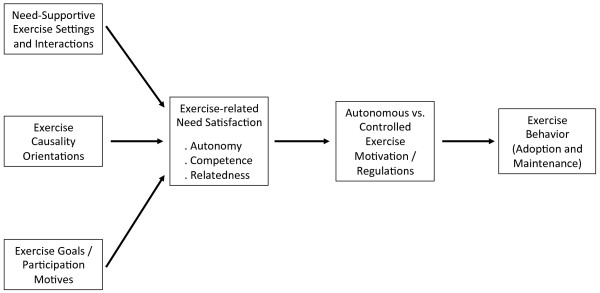
- Competence satisfaction was the most frequently assessed basic need and was positively associated with physical activity in 56% of independent samples in multivariate analysis and 92% in correlational analysis; relatedness showed no positive multivariate association with exercise (K = 4, 100% no association).
- In SDT-based interventions, 7 interventions were identified and 6 (86%) found significant differences favoring the SDT group for perceived autonomy support, need satisfaction, autonomous and introjected regulations, and self-reported exercise; in the longest trial, only autonomous regulations mediated long-term exercise effects.
## Methods
- Systematic review of empirical SDT–exercise studies published up to June 2011; searches were run in PsycINFO and SportDiscus for studies from 1960 to June 2011, limited to English-language, peer-reviewed journal articles on adult, non-athletic samples.
- Included 66 studies / 72 independent samples with experimental, cross-sectional, prospective, and mixed designs; outcomes included actual or self-reported exercise/physical activity, attendance, relapse, dropout, and stages of change.
- Evidence was summarized quantitatively by counting independent samples showing significant positive, negative, or null associations; the unit of analysis was the independent sample, and significance was set at 0.05.
## Limitations
- The paper states that it was limited to English-language, peer-reviewed articles and excluded gray literature, unpublished studies, non-English publications, non-adult samples, adolescents/children, and competitive athletic samples.
- The authors state that classifying and quantifying results was “somewhat arbitrary,” that only direct paths were evaluated, and that lumping together self-report and direct measures, attendance, and stages of change is “clearly not without reproach.”
- Evident from the text: most included studies were descriptive/non-experimental and many samples were mixed, so causal inference and subgroup-specific conclusions are limited.
Model-written summary. Check it against the paper before relying on it.
Integrity signals
Registry
Cites
Statistics
Figures
Verification
Claims the paper makes
3 Valid · 5 Not valid · 58 Not checked · 143 Own results and interpretations
The cited sources support only part of this claim — read each source’s verdict below.
In the paper
“Satisfaction of these basic needs results in increased feelings of vitality and well-being [15].”
§ Exercise, physical activity, and self-determination theory: A systematic review > Introduction
What the sources say
- Partly supportedcites [15] matched to “Testing a self‐determination theory‐based teaching style intervention in the exercise domain” (2008) sourceExperimental — accuracy not yet measured
The discussion of basic psychological need satisfaction (p. 5) says that satisfying needs, together with more autonomous motivation, is expected to produce adaptive affective responses. The findings (p. 24) link competence need satisfaction to less negative affect. Neither passage establishes that need satisfaction results in increased vitality or well-being specifically, and the claim states the relationship more definitively than the paper does. (LLM, conf=0.84)
plainstates a cause- Asserted: passes — The authors put it forward as true.
- Checkable: passes — It can be checked against evidence.
- Load-bearing: passes — The paper’s conclusions depend on it.
- Based: passes — The paper gives a reason why it holds.
- Partly supported
The cited sources support only part of this claim — read each source’s verdict below.
In the paper
“Relations from perceived autonomy support to exercise behavior, via psychological needs and regulatory styles have been tested (in part or all) in several studies and in general these confirm the proposed sequences [17,44,43,77,76,38,33].”
§ Exercise, physical activity, and self-determination theory: A systematic review > Discussion > Need satisfaction and exercise
What the sources say
- Supportedcites [17] matched to “Exercise motivation: a cross-sectional analysis examining its relationships with frequency, intensity, and duration of exercise” (2010) source
The Background (page unavailable) says the study tested relationships between behavioral regulations and exercise frequency, intensity, and duration—one part of the proposed sequence. The Results (page unavailable) report that all three exercise indices correlated more strongly with autonomous than controlling regulations, broadly supporting the sequence. The citing sentence expressly allows studies to have tested it only “in part.” (LLM, conf=0.87)
- Partly supportedcites [44] matched to “Mediators of physical activity behaviour change among adult non-clinical populations: a review update” (2010) sourceExperimental — accuracy not yet measured
The Results section (‘Evidence of Mediation by Theory’; page not provided) reports support in one study for a link between autonomy support and physical activity. But the other self-determination-theory study found no changes in its constructs or behavior, and neither established the proposed sequence through psychological needs and regulatory styles. The review therefore does not support saying that the studies generally confirmed that sequence. (LLM, conf=0.88)
- Not checked — no full text of the sourcecites [43] matched to “The Independent Effects of Goal Contents and Motives on Well-Being: It’s Both What You Pursue and Why You Pursue It” (2004) source
- Not matchedcites [77]
The reference list we hold has no entry [77].
- Not matchedcites [76]
The reference list we hold has no entry [76].
- Not checked — no full text of the sourcecites [38] matched to “Body image and body shape ideals in magazines: exposure, awareness, and internalization” (1997) source
- Not checked — no full text of the sourcecites [33] matched to “Go Figure? Body-Shape Motives are Associated with Decreased Physical Activity Participation Among Midlife Women” (2006) source
plainstates an association- Asserted: passes — The authors put it forward as true.
- Checkable: passes — It can be checked against evidence.
- Load-bearing: passes — The paper’s conclusions depend on it.
- Based: passes — The paper gives a reason why it holds.
- Supported
A result the paper reports from its own data — it cites no other source for it, so there is none to check. The quote shows it is in the paper.
In the paper
“The literature is also consistent in that competence satisfaction and more intrinsic motives positively predict exercise participation across a range of samples and settings.”
§ Exercise, physical activity, and self-determination theory: A systematic review > Abstract > Results
boostedstates an association- Asserted: passes — The authors put it forward as true.
- Checkable: passes — It can be checked against evidence.
- Load-bearing: passes — The paper’s conclusions depend on it.
- Based: passes — The paper gives a reason why it holds.
A result the paper reports from its own data — it cites no other source for it, so there is none to check. The quote shows it is in the paper.
In the paper
“and intrinsic motivation being more predictive of long-term exercise adherence”
§ Exercise, physical activity, and self-determination theory: A systematic review > Abstract > Results
plainstates an association- Asserted: passes — The authors put it forward as true.
- Checkable: passes — It can be checked against evidence.
- Load-bearing: passes — The paper’s conclusions depend on it.
- Based: passes — The paper gives a reason why it holds.
A result the paper states — it cites no source for it, so there is none to check. The quote shows it is in the paper.
In the paper
“but similar results are found across cross-sectional, prospective, and experimental designs”
§ Exercise, physical activity, and self-determination theory: A systematic review > Abstract > Results
plain- Asserted: passes — The authors put it forward as true.
- Checkable: passes — It can be checked against evidence.
- Load-bearing: passes — The paper’s conclusions depend on it.
- Based: passes — The paper gives a reason why it holds.
99 more claims
Create a free account to see all 209 claims and to verify the 2 references still open.
- It may state two separate claims as one. 74
- Probably not a substantial claim. 39
Claims other papers make about this one
Each is checked against this paper’s own text: does it say what the citing paper says it does?
The source backs part of the claim, not all of it — or backs it for a different population, condition or comparison.
In the citing paper
“As of today, merely one systematic review in the exercise context (Teixeira et al., 2012), having SDT as theoretical background, has analyzed the satisfaction (although not frustration) of basic psychological needs, the motivational regulation, and the way these can predict different physiological outcomes (i.e., energy expenditure, body mass index).”
From Can Interpersonal behavior influence the persistence and adherence to physical exercise practice in adults? A systematic review (2018) · cites this paper as Teixeira et al., 2012
Experimental — accuracy not yet measuredThe source backs part of the claim, not all of it — or backs it for a different population, condition or comparison.
In the citing paper
“which might be justified by the fact that most of them so far cannot yet distinguish this regulation from identified regulation, given that both share the same principles”
From Can Interpersonal behavior influence the persistence and adherence to physical exercise practice in adults? A systematic review (2018) · cites this paper as Teixeira et al., 2012
Experimental — accuracy not yet measuredThe source backs part of the claim, not all of it — or backs it for a different population, condition or comparison.
In the citing paper
“Conversely, structured exercise programs foster intrinsic motivation (65), self-regulation, and a positive relationship with the body, promoting sustained engagement even after pharmacotherapy discontinuation.”
From GLP-1 agonists and exercise: the future of lifestyle prioritization (2025) · cites this paper as [65]
Experimental — accuracy not yet measuredThe source backs part of the claim, not all of it — or backs it for a different population, condition or comparison.
In the citing paper
“a study by Teixeira et al. [31] highlights that exercise not only improves physical health but also promotes a positive self-image and resilience”
From Sociodemographic influences on Student Mental Health and their association with activation-regulating functional impairments (2026) · cites this paper as [31]
Experimental — accuracy not yet measuredThe cited source says what the claim attributes to it.
In the citing paper
“The instruments described herein have been used in various contexts, for example to assess to what extent a medical professional (Williams et al., 2009), healthcare intervention (Williams et al., 2011; Teixeira et al., 2012) or a procedure (Ng et al., 2012) supports autonomy.”
From Designing for Motivation, Engagement and Wellbeing in Digital Experience (2018) · cites this paper as Teixeira et al., 2012
9 more claims about this paper
Create a free account to see every claim other papers make about this one.
Self-check
Percentages, sums and reported differences re-computed from the paper’s own numbers.
Rated minor: it would not touch a result — a value no result rests on, a p-value that stays on the same side of the significance level, or a conflict that is clerical, resolved elsewhere in the paper, or outside its own findings.
In the paper
“A total of 57 samples (53 studies) analyzed associations between regulations and exercise behavior. Of these, 37 were used in cross-sectional designs, 10 in prospective designs, 7 in experimental studies, and 2 in mixed designs.”
§ Exercise, physical activity, and self-determination theory: A systematic review > Results > Motivational predictors of exercise-related outcomes
Reported 57 · recomputed 56
Citations
Cites
Ryan, R. M., & Deci, E. L. (2000) · American Psychologist · doi:10.1037//0003-066x.55.1.68 · Cited by 54,599
Self-citationThe "what" and "why" of goal pursuits: Human needs and the self-determination of behavior
Deci, E. L., & Ryan, R. M. (2000) · Psychological Inquiry · doi:10.1207/s15327965pli1104_01 · Cited by 34,210 · cited 5×
“determination and volition with respect to the target behavior [12].”
BackgroundInfluentialSelf-citationIntrinsic Motivation and Self-Determination in Human Behavior
Deci, E. L., & Ryan, R. M. (1985) · doi:10.1007/978-1-4899-2271-7 · Cited by 26,772
Self-citationIntrinsic Motivation and Self-Determination in Human Behavior
Miller, K. A., Deci, E. L., & Ryan, R. M. (1988) · Contemporary Sociology · doi:10.2307/2070638 · Cited by 15,312
Self-citationMediation in experimental and nonexperimental studies: New procedures and recommendations.
Shrout, P. E., & Bolger, N. (2002) · Psychological Methods · doi:10.1037/1082-989x.7.4.422 · Cited by 11,335 · cited 1×
“, mediated) effects between them [75].”
Garber, C. E., Blissmer, B., Deschenes, M. R., Franklin, B. A., Lamonte, M. J., Lee, I.-M., Nieman, D. C., & Swain, D. P. (2011) · Medicine & Science in Sports & Exercise · doi:10.1249/mss.0b013e318213fefb · Cited by 9,319
A simple method to assess exercise behavior in the community.
Godin, G., & Shephard, R. J. (1985) · PubMed · Cited by 4,760
Moral Identity and Developmental Theory
Lapsley, D. (2015) · Human Development · doi:10.1159/000435926 · Cited by 3,819
Perceived locus of causality and internalization: Examining reasons for acting in two domains.
Ryan, R. M., & Connell, J. P. (1989) · Journal of Personality and Social Psychology · doi:10.1037/0022-3514.57.5.749 · Cited by 3,311 · cited 2×
“Autonomous motivation includes the identified regulation and intrinsic motivation subscales of the Exercise Self-Regulation Questionnaire [84].”
Self-citation(2002) · Cited by 3,047
Self-citation
Research works printed but not linked: 1
- Koestner R Losier GF In Handbook of self-determination research Distinguishing three ways of being internally motivated: a closer look at introjection, identification, and intrinsic motivation 2002 Edited by Deci EL, Ryan RM, Rochester, NY: University of Rochester Press 101 121
Cited by
Items 2,501–2,600 of 2,926
Liu, J., Hu, T., & Yin, J. (2025) · Frontiers in Psychology · doi:10.3389/fpsyg.2025.1633094 · Cited by 1
Lattari, E., Oliveira, B. R. R., de Oliveira, F. F. S., & de Oliveira, A. J. (2025) · Clinical Practice and Epidemiology in Mental Health · doi:10.2174/0117450179404629250913050647 · Cited by 1
Şahin, K., Akgül, B. M., & TÜRKMEN, E. (2025) · Gazi Beden Eğitimi ve Spor Bilimleri Dergisi · doi:10.53434/gbesbd.1700039
“While the effects of fitness on health and motivation have been widely explored in the existing literature (Kilpatrick et al., 2005; Teixeira et al., 2012; Liu et al., 2023), studies specifically focusing on the leisure benefits of fitness participants remain limited (Ertüzün et al., 2020).”
Farmer, A., Kumar, S., Truong, H., & Brinsley, J. (2025) · Musculoskeletal Science and Practice · doi:10.1016/j.msksp.2025.103424
Wang, X. (., Ash, G. I., Hernández, E., Stults‐Kolehmainen, M., & Griggs, S. A. (2025) · medRxiv · doi:10.1101/2025.10.01.25336446
“Intrinsic motivation can lead to sustained engagement in physical activity, whereas extrinsic motivational factors, such as social pressure or health mandates, may not have the same long-term effects (13).”
Energy expenditure and enjoyment of instructor-led exercise videos for children ages 7–13
Habring, M. A., Friday, P. J., Schwartz, A. E., Abbas, H., Beemer, L. R., & Hasson, R. E. (2025) · PLoS ONE · doi:10.1371/journal.pone.0333283 · Cited by 1
“Limited autonomy may therefore have contributed to lower enjoyment among older children compared to their younger peers [64–66].”
Yang, Y., & MacIntosh, E. W. (2025) · Managing Sport and Leisure · doi:10.1080/23750472.2025.2561978
Hancox, J. E., Lorito, C. D., van der Wardt, V., Pollock, K., Vedhara, K., & Harwood, R. (2025) · medRxiv · doi:10.1101/2025.10.07.25337231
Exercising With Others, Motivation, and 1-Year Maintenance of Exercise Behavior Among Workers
Harada, K., Izawa, S., Nakamura‐Taira, N., Yoshikawa, T., Akamatsu, R., Ikeda, H., & Kubo, T. (2025) · Journal of Physical Activity and Health · doi:10.1123/jpah.2025-0404
Caldo‐Silva, A., Palotino-Ferreira, B. M., Pereira, D. M., Maculeve, L., Daca, T., Rocha, S. V., Ferreira, J. P., & Furtado, G. E. (2025) · Lecture notes in bioengineering · doi:10.1007/978-3-031-77282-5_18
Kovalenko, A. G., Denford, S., van Beurden, S. B., Cockcroft, E., Coxhead, V., Tomlinson, O. W., Powell, E. A., & Williams, C. A. (2025) · BMJ Open · doi:10.1136/bmjopen-2024-093843
“In accordance with our, and others’ previous work, 33 46 we used the COM-B framework to self-determination theory.”
Puolamäki, M., Palsola, M., Renko, E., Kilponen, A., Haerens, L. L., Potthoff, S., Saurio, K. J., Absetz, P., Lintunen, T., Kohonen, K., et al. (2026) · Psychology and Health · doi:10.31234/osf.io/g45zp_v2 · Cited by 2
Li, S., Liu, G., Qiao, L., Yu, H., Zhang, Y.-Y., Pei, R., Lin, Y.-T., Ma, H., & Piao, M. (2025) · doi:10.2196/preprints.86793
Impact of 6-Week Combined Gym and Climbing Training on Handgrip Strength and Arm Size—GRIP-6 Study
Chomiuk, T., Męczyński, A., Kasiak, P. S., Mamcarz, A., & Śliż, D. (2025) · Journal of Functional Morphology and Kinesiology · doi:10.3390/jfmk10040427
Brunet, J., Price, J., Gillison, F., Standage, M., Taljaard, M., Beauchamp, M. R., Reed, J. L., & Srikanthan, A. (2025) · Pilot and Feasibility Studies · doi:10.1186/s40814-025-01701-w
“In addition to its basis in motivational interviewing, the ACCESS intervention [44] is informed by self-deter-mination theory (SDT [45]), which has empirical support in relation to PA behavior change interventions for adults living with and without cancer [46–50].”
Jackson, E. A., Aldama, G., Spangler, E. L., Richman, J., Henderson, K., Dutton, G. R., Dempsey, D. M., Guzmán, A., & MYERS, J. N. (2025) · Contemporary Clinical Trials · doi:10.1016/j.cct.2025.108139 · Cited by 1
Jo, S., Fry, M. D., Brown, T. C., & Skorupski, W. P. (2025) · Journal of Prevention · doi:10.1007/s10935-025-00882-7
Bertuol, C., Tozetto, W. R., Bandeira, A. C. N., Alves, D. K., Vargas, P., Matias, T. S., & Duca, G. F. D. (2025) · Psychology of sport and exercise · doi:10.1016/j.psychsport.2025.103020
Zhang, T., & Li, B. (2025) · International Journal of Sport and Exercise Psychology · doi:10.1080/1612197x.2025.2584538
Wang, H., & Xi, L. (2025) · Frontiers in Psychology · doi:10.3389/fpsyg.2025.1650042
Jayeoba, M., Sohn, R., Weiss, A. L., Stanič, A., Mazzetta, R., Pham, A., Scanlan, L., Garcia, M., Sidhu, A., Ho, E. E., et al. (2026) · Journal of Medical Internet Research · doi:10.2196/87514
“Interventions grounded in this theory have proven effective in fostering adoption (initial uptake) and facilitating actual engagement (active participation) in health behaviors among diverse groups, settings, and behavioral activities [61,63,84-86 , 90].”
Effect of acute MIIT on behavioral and neuroelectric indices of inhibition in middle adulthood
Ai, J., Lin, C., Hillman, C. H., Brazaitis, M., Cheng, Y.-T., Hung, T., & Chang, Y. (2025) · International Journal of Sport and Exercise Psychology · doi:10.1080/1612197x.2025.2584533
Bertuol, C., Schuch, F. B., Tozetto, W. R., Alves, D. K., & Duca, G. F. D. (2025) · International Journal of Sport and Exercise Psychology · doi:10.1080/1612197x.2025.2590493 · Cited by 1
Chang, M. J., & Lee, S. (2025) · Sport Business and Management An International Journal · doi:10.1108/sbm-06-2025-0158 · Cited by 1
Bujnowska–Fedak, M. M., Sobieski, M., Pałys, M., & Waligóra, J. (2025) · Research Square · doi:10.21203/rs.3.rs-7830163/v1
Exploring the Role of Physical Exercise in the Treatment of PTSD Among Military Veterans
Alder, J. (2025) · Palgrave studies in masculinity, sport and exercise · doi:10.1007/978-3-032-08957-1_5
Examining PTSD and Exercise in Military Veterans
Alder, J. (2025) · Palgrave studies in masculinity, sport and exercise · doi:10.1007/978-3-032-08957-1_6
Binxin, L. I., Weibin, K. O. N. G., & Chen, H. (2025) · Chinese Journal of Analytical Chemistry · doi:10.1016/j.cjac.2025.100675
Chen, D., Gong, L., & He, Z. (2025) · Finance Research Letters · doi:10.1016/j.frl.2025.109104
Fasold, F., Lukac, F., & Klatt, S. (2025) · Frontiers in Sports and Active Living · doi:10.3389/fspor.2025.1711508 · Cited by 2
“…of children increasing the probability of ongoing participation in sports activities [e.g., ( 7)], and as factors in fostering an active lifestyle (8). the aim of our explorative study is to evaluate, for the first time, the effects of an adjusted game structure (multi-set structure) of a…”
Pettersson, B., Lundell, S., Audulv, Å., Lundin‐Olsson, L., & Sandlund, M. (2025) · BMC Geriatrics · doi:10.1186/s12877-025-06776-x
“…motivational regulations where the activity is externally regulated but still holds high personal value can play a greater role in sustaining physical activity than intrinsic motivation does, especially when the physical activity and exercise may not be inherently enjoyable in the short term [32].”
Kwon, G., Jeon, W.-J., & Gwon, H. (2025) · Frontiers in Public Health · doi:10.3389/fpubh.2025.1675612 · Cited by 1
Santos, A., Falkenhain, K., Little, J. P., Patel, N., Singer, J., Halperin, F. A., Pistawka, K. J., & Jung, M. E. (2025) · Translational Exercise Biomedicine · doi:10.1515/teb-2025-0026
“…SDT, Basic Psychological Needs (BPN) postulates that fostering three basic psychological needs of autonomy, competence, and relatedness leads to better autonomous motivation regulation, more positive a ff ect towards physical activity, and improved long-term physical activity engagement [10 – 13].”
Sun, Z., Yang, Y., Zhong, X., Dang, J., Cai, S., Liu, Y. F., Li, J., Huang, T., Zhang, X., Mei, X., et al. (2025) · Nutrients · doi:10.3390/nu17233760
“Secondly, from the perspective of Self-Determination Theory, the individual PA environment reflects intrinsic motivation [38].”
Validity and Reliability Study of the Exercise Motivation Barriers Scale (EMBAR)Preprint
Turhan, F. H., Özkeskin, M., NACAR, E., Öztürk, M. A., Tüfekçi, Ş., & Balcı, V. (2025) · Research Square · doi:10.21203/rs.3.rs-8048587/v1
Görgülü, R., Işık, U., Urfa, O., & KIRIK, F. A. Ş. (2025) · Spor Bilimleri Dergisi · doi:10.17644/sbd.1752087
Ke, W., & Sun, B. (2025) · Frontiers in Psychology · doi:10.3389/fpsyg.2025.1653545 · Cited by 1
Muscle-Strengthening Activity and Motivating Factors by Age Group and Cancer History
Bae, M., Seals, S., & Gell, N. (2025) · Translational Journal of the American College of Sports Medicine · doi:10.1249/tjx.0000000000000339
Ingram, T. A., Sengupta, R., Standage, M., Clift, B. C., & Rouse, P. C. (2025) · Psychology and Health · doi:10.1080/08870446.2025.2598043 · Cited by 1
Restrepo, J. E., Quirama, T. C., & Casadiego-Alzate, R. (2025) · Seminars in Medical Writing and Education · doi:10.56294/mw2025884
Yermakhanov, B. (2025) · Physical Activity in Children · doi:10.61882/pach.2025.527178.1051 · Cited by 2
Fernandez, A. M., & White, G. (2025) · Current Psychology · doi:10.1007/s12144-025-08886-6 · Cited by 1
“Exercise is a key activity aligning with this framework and has been consistently associated with psychological benefits relevant to relationship quality (Gunnell et al., 2014; Teixeira et al., 2012 ).”
Motivation for weight management behaviours : a self-determination theory perspective
Ng, Y. Y. J. (2013) · University of Birmingham Institutional Research Archive (University of Birmingham) · Cited by 1
Gut, V., Schmid, J., & Conzelmann, A. (2020) · Figshare · doi:10.6084/m9.figshare.12211301
Huang, W., Shi, X., Wang, Y., Li, X., Gao, P., Lu, J., & Zhuang, J. (2021) · Figshare · doi:10.6084/m9.figshare.14228434
Kinnafick, F., Brinkley, A., Bailey, S. J., & Adams, E. J. (2021) · Figshare · doi:10.6084/m9.figshare.16834960
Gut, V., Schmid, J., & Conzelmann, A. (2020) · Figshare · doi:10.6084/m9.figshare.12211325
De Man, J., Kasujja, F. X., Delobelle, P., Annerstedt, K. S., Alvesson, H. M., Absetz, P., Wouters, E., Daivadanam, M., Guwatudde, D., Puoane, T. R., et al. (2022) · Figshare · doi:10.6084/m9.figshare.19029491
Evans, H. E. L., Forbes, C. C., Galvão, D. A., Vandelanotte, C., Newton, R. U., Wittert, G., Chambers, S. K., Vincent, A. D., Kichenadasse, G., Brook, N. R., et al. (2021) · Figshare · doi:10.6084/m9.figshare.13558815
Skogen, I. B., & Høydal, K. (2021) · Figshare · doi:10.6084/m9.figshare.14396958
Liu, Y., Zhai, X., Zhang, Y., Jiang, C., Zeng, J., Yang, M., Xie, X., Zhou, F., & Xiang, B. (2024) · Figshare · doi:10.6084/m9.figshare.26639638
Additional file 1 of Translation and validation of the Breastfeeding Motivation Scale in China
Yu, Y., Zhang, L., Liu, Y., Zhang, L., & 郭娜菲 (2024) · Figshare · doi:10.6084/m9.figshare.26661029
Knudsen, S. D. P., Roland, C. B., Alomairah, S. A., Jessen, A. D., Maindal, H. T., Bendix, J. M., Clausen, T. D., Løkkegaard, E., Stallknecht, B. M., & Mølsted, S. (2024) · Figshare · doi:10.6084/m9.figshare.26661218
Gómez-Redondo, P., Valenzuela, P. L., Martínez‐de‐Quel, Ó., Sánchez-Martín, C., Cerezo-Arroyo, M., Moreno-Manzanaro, D., Alegre, L. M., Guadalupe‐Grau, A., Ara, I., & Mañas, A. (2024) · Figshare · doi:10.6084/m9.figshare.26695845
Cederström, N., Granér, S., Nilsson, G., Dahan, R., & Ageberg, E. (2021) · Figshare · doi:10.6084/m9.figshare.16851033
Kinnafick, F., Brinkley, A., Bailey, S. J., & Adams, E. J. (2021) · Figshare · doi:10.6084/m9.figshare.16834969
Singh, H., Kolschen, J., Samkange-Zeeb, F., Brand, T., Zeeb, H., & Schüz, B. (2022) · Figshare · doi:10.6084/m9.figshare.20408461
Fang, Y., Yang, J., Liang, X., Wu, J., Xie, M., Zhang, K., & Su, C. (2024) · Figshare · doi:10.6084/m9.figshare.26750027
Murdoch, J., Varley, A., McCulloch, J., et al. (2021) · Figshare · doi:10.6084/m9.figshare.16863906
Svenningsen, A., Söderström, S., Sandbakk, S. B., Gullestad, L. L., Bønaa, K. H., Wisløff, U., & Hollekim-Strand, S. M. (2024) · Figshare · doi:10.6084/m9.figshare.27123730
Additional file 2 of Translation and validation of the Breastfeeding Motivation Scale in China
Yu, Y., Zhang, L., Liu, Y., Zhang, L., & 郭娜菲 (2024) · Figshare · doi:10.6084/m9.figshare.26661032
Bell, O. J., Flynn, D., Clifford, T., West, D., Stevenson, E., & Avery, L. (2023) · Figshare · doi:10.6084/m9.figshare.22626133
Gut, V., Schmid, J., & Conzelmann, A. (2020) · Figshare · doi:10.6084/m9.figshare.12211307
Kinnafick, F., Brinkley, A., Bailey, S. J., & Adams, E. J. (2021) · Figshare · doi:10.6084/m9.figshare.16834966
Ris, I., Broholm, D., Hartvigsen, J., Andersen, T. E., & Kongsted, A. (2021) · Figshare · doi:10.6084/m9.figshare.14650932
Cederström, N., Granér, S., Nilsson, G., Dahan, R., & Ageberg, E. (2021) · Figshare · doi:10.6084/m9.figshare.16851027
Padmapriya, N., Fogel, A., Tan, S. Y. X., Goh, C. M. J. L., Tan, S. L., Chia, A., Chu, A. H. Y., Chong, Y. S., Tan, K. H., Chan, S.-Y., et al. (2024) · Figshare · doi:10.6084/m9.figshare.26688731
Lima, C. V. P., Ywgne, J., Thuany, M., Araújo, R. H. D. O., Silva, E. C. M., Melo, J. C. N., Bandeira, P. F. R., Luz, L. G. D. O., & Silva, D. R. (2024) · Figshare · doi:10.6084/m9.figshare.26651460
Kinnafick, F., Brinkley, A., Bailey, S. J., & Adams, E. J. (2021) · Figshare · doi:10.6084/m9.figshare.16834975
Ritter, Y., Pfister, D., Steckhan, G. M., Voelter‐Mahlknecht, S., Weber, B., Ellegast, R., Koch, C., Bausch, F., Gruber, M., & Schwenk, M. (2024) · Figshare · doi:10.6084/m9.figshare.26758297
Cederström, N., Granér, S., Nilsson, G., Dahan, R., & Ageberg, E. (2021) · Figshare · doi:10.6084/m9.figshare.16851036
Nicholson, M., Thompson, C., Poulus, D., Pavey, T., Robergs, R., Kelly, V. G., & McNulty, C. R. (2024) · Figshare · doi:10.6084/m9.figshare.26707583
Liu, Y., Zhai, X., Zhang, Y., Jiang, C., Zeng, J., Yang, M., Xie, X., Zhou, F., & Xiang, B. (2024) · Figshare · doi:10.6084/m9.figshare.26639644
Liu, Y., Zhai, X., Zhang, Y., Jiang, C., Zeng, J., Yang, M., Xie, X., Zhou, F., & Xiang, B. (2024) · Figshare · doi:10.6084/m9.figshare.26639641
Cowley, E. S., Watson, P. M., Paterson, C., Wagenmakers, A. J. M., Thompson, A., Belton, S., Thijssen, D., & Foweather, L. (2024) · Figshare · doi:10.6084/m9.figshare.26490513
Evans, H. E. L., Forbes, C. C., Galvão, D. A., Vandelanotte, C., Newton, R. U., Wittert, G., Chambers, S. K., Vincent, A. D., Kichenadasse, G., Brook, N. R., et al. (2021) · Figshare · doi:10.6084/m9.figshare.13558812
Murdoch, J., Varley, A., McCulloch, J., et al. (2021) · Figshare · doi:10.6084/m9.figshare.16863903
Knudsen, S. D. P., Roland, C. B., Alomairah, S. A., Jessen, A. D., Maindal, H. T., Bendix, J. M., Clausen, T. D., Løkkegaard, E., Stallknecht, B. M., & Mølsted, S. (2024) · Figshare · doi:10.6084/m9.figshare.26661215
Singh, H., Kolschen, J., Samkange‐Zeeb, F., Brand, T., Zeeb, H., & Schüz, B. (2022) · Figshare · doi:10.6084/m9.figshare.20408464
Additional file 1 of Factors influencing physical activity in adults with cystic fibrosis
Hurley, N. R., Moyna, N. M., Kehoe, B., et al. (2021) · Figshare · doi:10.6084/m9.figshare.14368859
Singh, H., Kolschen, J., Samkange‐Zeeb, F., Brand, T., Zeeb, H., & Schüz, B. (2022) · Figshare · doi:10.6084/m9.figshare.20408455
Carraça, E. V., Rodrigues, B., Franco, S. F., Nobre, I., Jerónimo, F., Ilharco, V., Gabriel, F., Ribeiro, L., Palmeira, A. L., & Silva, M. N. (2023) · Figshare · doi:10.6084/m9.figshare.23632548
Self-citationBell, O. J., Flynn, D., Clifford, T., West, D., Stevenson, E., & Avery, L. (2023) · Figshare · doi:10.6084/m9.figshare.22626130
Lima, C. V. P., Ywgne, J., Thuany, M., Araújo, R. H. D. O., Silva, E. C. M., Melo, J. C. N., Bandeira, P. F. R., Luz, L. G. D. O., & Silva, D. R. (2024) · Figshare · doi:10.6084/m9.figshare.26651463
Jekauc, D., Rayling, S., Klopp, S., Schmidt, D., Rittmann, L.-M., & Fritsch, J. (2021) · Figshare · doi:10.6084/m9.figshare.14451006
Singh, H., Kolschen, J., Samkange-Zeeb, F., Brand, T., Zeeb, H., & Schüz, B. (2022) · Figshare · doi:10.6084/m9.figshare.20408458
Gut, V., Schmid, J., & Conzelmann, A. (2020) · Figshare · doi:10.6084/m9.figshare.12211316
Cederström, N., Granér, S., Nilsson, G., Dahan, R., & Ageberg, E. (2021) · Figshare · doi:10.6084/m9.figshare.16851030
Knudsen, S. D. P., Roland, C. B., Alomairah, S. A., Jessen, A. D., Maindal, H. T., Bendix, J. M., Clausen, T. D., Løkkegaard, E., Stallknecht, B. M., & Mølsted, S. (2024) · Figshare · doi:10.6084/m9.figshare.26661212
Kinnafick, F., Brinkley, A., Bailey, S. J., & Adams, E. J. (2021) · Figshare · doi:10.6084/m9.figshare.16834972
Kennard, A. L., Rainsford, S., Hamilton, K., Glasgow, N., Pumpa, K. L., Douglas, A. M., & Talaulikar, G. S. (2024) · Figshare · doi:10.6084/m9.figshare.27019430
Gómez-Redondo, P., Valenzuela, P. L., Martínez‐de‐Quel, Ó., Sánchez-Martín, C., Cerezo-Arroyo, M., Moreno-Manzanaro, D., Alegre, L. M., Guadalupe‐Grau, A., Ara, I., & Mañas, A. (2024) · Figshare · doi:10.6084/m9.figshare.26695851
Stevenson, R. D. M., Chowdhury, E. A., Inza, V. B., Western, M. J., Walsh, N. E., Jones, S., & Bilzon, J. (2024) · Figshare · doi:10.6084/m9.figshare.25330840
Kinnafick, F., Brinkley, A., Bailey, S. J., & Adams, E. J. (2021) · Figshare · doi:10.6084/m9.figshare.16834957
Jekauc, D., Rayling, S., Klopp, S., Schmidt, D., Rittmann, L.-M., & Fritsch, J. (2021) · Figshare · doi:10.6084/m9.figshare.14451009
Gómez-Redondo, P., Valenzuela, P. L., Martínez‐de‐Quel, Ó., Sánchez-Martín, C., Cerezo-Arroyo, M., Moreno-Manzanaro, D., Alegre, L. M., Guadalupe‐Grau, A., Ara, I., & Mañas, A. (2024) · Figshare · doi:10.6084/m9.figshare.25448986
Lima, C. V. P., Ywgne, J., Thuany, M., Araújo, R. H. D. O., Silva, E. C. M., Melo, J. C. N., Bandeira, P. F. R., Luz, L. G. D. O., & Silva, D. R. (2024) · Figshare · doi:10.6084/m9.figshare.26651457
Padmapriya, N., Fogel, A., Tan, S. Y. X., Goh, C. M. J. L., Tan, S. L., Chia, A., Chu, A. H. Y., Chong, Y. S., Tan, K. H., Chan, S.-Y., et al. (2024) · Figshare · doi:10.6084/m9.figshare.25341427
Metadata
- Authors
- Teixeira, P. J., Carraça, E. V., Markland, D., Silva, M. N., & Ryan, R. M.
- Affiliations
- Universidade Técnica de Lisboa (PT)
- Bangor University (GB)
- University of Rochester (US)
- Corresponding author
- Teixeira, Pedro J
- Venue
- International Journal of Behavioral Nutrition and Physical Activity
- Published
- 2012
- Volume
- 9
- Issue
- 1
- Pages
- 78
- ISSN
- 1479-5868 (ISSN-L)
- PMC
- PMC3441783
- OpenAlex
- W2120612383
- Semantic Scholar
- 91c1a302b1ba3d78f18d769090d5c285c36d9567
- Cited by
- 2,963
- References
- 110
- Citations by year
- 2026: 399 · 2025: 332 · 2024: 260 · 2023: 244 · 2022: 242 · 2021: 279 · 2020: 256 · 2019: 215 · 2018: 202 · 2017: 162 · 2016: 141 · 2015: 100 · 2014: 66 · 2013: 59 · 2012: 3
- FWCI
- 10.23
- Type
- journal article
- Language
- en
- Open access
- gold
- doi.org
- Licence
- cc-by
- Locations
- International Journal of Behavioral Nutrition and Physical Activity (publishedVersion, cc-by)
- Europe PMC (PubMed Central) (publishedVersion, cc-by)
- PubMed Central (publishedVersion, cc-by)
- PubMed (publishedVersion)
- DOAJ (DOAJ: Directory of Open Access Journals) (submittedVersion)
- Topics
- Social Sciences › Psychology › Social Psychology › Motivation and Self-Concept in Sports
- Social Sciences › Psychology › Applied Psychology › Behavioral Health and Interventions
- Health Sciences › Medicine › Public Health, Environmental and Occupational Health › Physical Activity and Health
- Keywords
- self-determination theory, exercise motivation, physical activity, autonomous motivation, intrinsic motivation, identified regulation, introjected regulation, competence satisfaction, need satisfaction, exercise adherence, exercise self-regulation, exercise intervention, exercise behavior
- MeSH terms
- Health Promotion, Humans, Motor Activity, Personal Satisfaction, Health Behavior, Exercise, Databases, Factual, Personal Autonomy, Empirical Research
About these checks
Registry, retraction, Cites and statistics results are computed, not judged, with one exception: a printed reference that no index lists is read once by a model before it counts as a citation error. Claims are extracted by a model and kept only when their quote appears verbatim in the text; each cited source is then checked, with a model’s help, for whether it says what the claim relies on. Those verdicts can be wrong — read the claim’s quote and the cited source before relying on one.
The claim verdicts this report counts are experimental: their accuracy is not yet measured.
A language model drew the claims from the paper on 2026-10-10, under version 3 of the claim definition (model deepseek-v4.1-flash, prompt extract-v3).
A second model labelled each claim on 2026-10-10 (model jev-1.13-20260917, definition revision gold-guideline-v0.2).
Cited sources are checked with a language model’s help (gpt-6-sol).
Statistics and arithmetic are recomputed, not judged.
Confidence bands are shown only for fields calibrated on our annotated test set. None is calibrated yet, so no band is shown.
What counts as a claim ›How we measure confidence ›How we check this ›
Are you an author, or do you see a problem with this page? Request a review
Data sources
Bibliographic data: Semantic Scholar, OpenAlex, Crossref.
Contains information from the Semantic Scholar Academic Graph Datasets, made available under the ODC Attribution License (ODC-BY 1.0).
Semantic Scholar’s data is described in: Kinney, R., et al. (2023). The Semantic Scholar Open Data Platform. arXiv:2301.10140.
