

Exercise, physical activity, and self-determination theory: A systematic review
Open accessThe DOI matches its Crossref record; 108 of the 110 references it cites were found in a registry or an index; 6 of the 97 sources its claims cite were checked for support.
Abstract
Systematic review of 66 empirical studies on self-determination theory constructs and exercise outcomes.
Overview
CoChat Summary
## TL;DR
This systematic review synthesized 66 empirical studies on self-determination theory (SDT) and exercise/physical activity published up to June 2011. It found the most consistent support for autonomous motivation—especially identified and intrinsic regulation—and for competence satisfaction and intrinsic motives as positive predictors of exercise participation.
## Key findings
- Across 66 studies comprising 72 independent samples, the review found consistent positive associations between more autonomous forms of motivation and exercise; for example, 37 of 42 cross-sectional studies, 10 prospective studies, 7 experimental studies, and 2 mixed designs were represented among the regulation studies.
- Identified regulation showed positive associations with exercise in 28 samples (74%) in multivariate analyses and 22 samples (85%) in bivariate analyses; intrinsic motivation was positively associated in 23 or 22 samples (62% or 92%) depending on analysis type, and no study reported negative associations for intrinsic motivation.
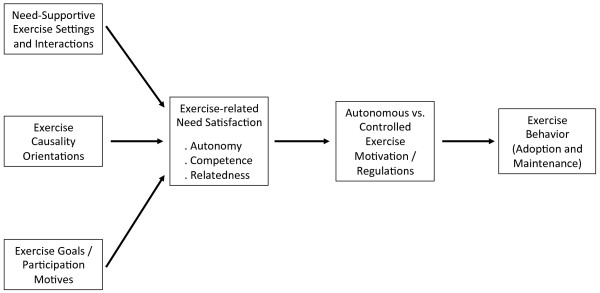
- Competence satisfaction was the most frequently assessed basic need and was positively associated with physical activity in 56% of independent samples in multivariate analysis and 92% in correlational analysis; relatedness showed no positive multivariate association with exercise (K = 4, 100% no association).
- In SDT-based interventions, 7 interventions were identified and 6 (86%) found significant differences favoring the SDT group for perceived autonomy support, need satisfaction, autonomous and introjected regulations, and self-reported exercise; in the longest trial, only autonomous regulations mediated long-term exercise effects.
## Methods
- Systematic review of empirical SDT–exercise studies published up to June 2011; searches were run in PsycINFO and SportDiscus for studies from 1960 to June 2011, limited to English-language, peer-reviewed journal articles on adult, non-athletic samples.
- Included 66 studies / 72 independent samples with experimental, cross-sectional, prospective, and mixed designs; outcomes included actual or self-reported exercise/physical activity, attendance, relapse, dropout, and stages of change.
- Evidence was summarized quantitatively by counting independent samples showing significant positive, negative, or null associations; the unit of analysis was the independent sample, and significance was set at 0.05.
## Limitations
- The paper states that it was limited to English-language, peer-reviewed articles and excluded gray literature, unpublished studies, non-English publications, non-adult samples, adolescents/children, and competitive athletic samples.
- The authors state that classifying and quantifying results was “somewhat arbitrary,” that only direct paths were evaluated, and that lumping together self-report and direct measures, attendance, and stages of change is “clearly not without reproach.”
- Evident from the text: most included studies were descriptive/non-experimental and many samples were mixed, so causal inference and subgroup-specific conclusions are limited.
Model-written summary. Check it against the paper before relying on it.
Integrity signals
Registry
Cites
Statistics
Figures
Verification
Claims the paper makes
3 Valid · 5 Not valid · 58 Not checked · 143 Own results and interpretations
The cited sources support only part of this claim — read each source’s verdict below.
In the paper
“Satisfaction of these basic needs results in increased feelings of vitality and well-being [15].”
§ Exercise, physical activity, and self-determination theory: A systematic review > Introduction
What the sources say
- Partly supportedcites [15] matched to “Testing a self‐determination theory‐based teaching style intervention in the exercise domain” (2008) sourceExperimental — accuracy not yet measured
The discussion of basic psychological need satisfaction (p. 5) says that satisfying needs, together with more autonomous motivation, is expected to produce adaptive affective responses. The findings (p. 24) link competence need satisfaction to less negative affect. Neither passage establishes that need satisfaction results in increased vitality or well-being specifically, and the claim states the relationship more definitively than the paper does. (LLM, conf=0.84)
plainstates a cause- Asserted: passes — The authors put it forward as true.
- Checkable: passes — It can be checked against evidence.
- Load-bearing: passes — The paper’s conclusions depend on it.
- Based: passes — The paper gives a reason why it holds.
- Partly supported
The cited sources support only part of this claim — read each source’s verdict below.
In the paper
“Relations from perceived autonomy support to exercise behavior, via psychological needs and regulatory styles have been tested (in part or all) in several studies and in general these confirm the proposed sequences [17,44,43,77,76,38,33].”
§ Exercise, physical activity, and self-determination theory: A systematic review > Discussion > Need satisfaction and exercise
What the sources say
- Supportedcites [17] matched to “Exercise motivation: a cross-sectional analysis examining its relationships with frequency, intensity, and duration of exercise” (2010) source
The Background (page unavailable) says the study tested relationships between behavioral regulations and exercise frequency, intensity, and duration—one part of the proposed sequence. The Results (page unavailable) report that all three exercise indices correlated more strongly with autonomous than controlling regulations, broadly supporting the sequence. The citing sentence expressly allows studies to have tested it only “in part.” (LLM, conf=0.87)
- Partly supportedcites [44] matched to “Mediators of physical activity behaviour change among adult non-clinical populations: a review update” (2010) sourceExperimental — accuracy not yet measured
The Results section (‘Evidence of Mediation by Theory’; page not provided) reports support in one study for a link between autonomy support and physical activity. But the other self-determination-theory study found no changes in its constructs or behavior, and neither established the proposed sequence through psychological needs and regulatory styles. The review therefore does not support saying that the studies generally confirmed that sequence. (LLM, conf=0.88)
- Not checked — no full text of the sourcecites [43] matched to “The Independent Effects of Goal Contents and Motives on Well-Being: It’s Both What You Pursue and Why You Pursue It” (2004) source
- Not matchedcites [77]
The reference list we hold has no entry [77].
- Not matchedcites [76]
The reference list we hold has no entry [76].
- Not checked — no full text of the sourcecites [38] matched to “Body image and body shape ideals in magazines: exposure, awareness, and internalization” (1997) source
- Not checked — no full text of the sourcecites [33] matched to “Go Figure? Body-Shape Motives are Associated with Decreased Physical Activity Participation Among Midlife Women” (2006) source
plainstates an association- Asserted: passes — The authors put it forward as true.
- Checkable: passes — It can be checked against evidence.
- Load-bearing: passes — The paper’s conclusions depend on it.
- Based: passes — The paper gives a reason why it holds.
- Supported
A result the paper reports from its own data — it cites no other source for it, so there is none to check. The quote shows it is in the paper.
In the paper
“The literature is also consistent in that competence satisfaction and more intrinsic motives positively predict exercise participation across a range of samples and settings.”
§ Exercise, physical activity, and self-determination theory: A systematic review > Abstract > Results
boostedstates an association- Asserted: passes — The authors put it forward as true.
- Checkable: passes — It can be checked against evidence.
- Load-bearing: passes — The paper’s conclusions depend on it.
- Based: passes — The paper gives a reason why it holds.
A result the paper reports from its own data — it cites no other source for it, so there is none to check. The quote shows it is in the paper.
In the paper
“and intrinsic motivation being more predictive of long-term exercise adherence”
§ Exercise, physical activity, and self-determination theory: A systematic review > Abstract > Results
plainstates an association- Asserted: passes — The authors put it forward as true.
- Checkable: passes — It can be checked against evidence.
- Load-bearing: passes — The paper’s conclusions depend on it.
- Based: passes — The paper gives a reason why it holds.
A result the paper states — it cites no source for it, so there is none to check. The quote shows it is in the paper.
In the paper
“but similar results are found across cross-sectional, prospective, and experimental designs”
§ Exercise, physical activity, and self-determination theory: A systematic review > Abstract > Results
plain- Asserted: passes — The authors put it forward as true.
- Checkable: passes — It can be checked against evidence.
- Load-bearing: passes — The paper’s conclusions depend on it.
- Based: passes — The paper gives a reason why it holds.
99 more claims
Create a free account to see all 209 claims and to verify the 2 references still open.
- It may state two separate claims as one. 74
- Probably not a substantial claim. 39
Claims other papers make about this one
Each is checked against this paper’s own text: does it say what the citing paper says it does?
The source backs part of the claim, not all of it — or backs it for a different population, condition or comparison.
In the citing paper
“As of today, merely one systematic review in the exercise context (Teixeira et al., 2012), having SDT as theoretical background, has analyzed the satisfaction (although not frustration) of basic psychological needs, the motivational regulation, and the way these can predict different physiological outcomes (i.e., energy expenditure, body mass index).”
From Can Interpersonal behavior influence the persistence and adherence to physical exercise practice in adults? A systematic review (2018) · cites this paper as Teixeira et al., 2012
Experimental — accuracy not yet measuredThe source backs part of the claim, not all of it — or backs it for a different population, condition or comparison.
In the citing paper
“which might be justified by the fact that most of them so far cannot yet distinguish this regulation from identified regulation, given that both share the same principles”
From Can Interpersonal behavior influence the persistence and adherence to physical exercise practice in adults? A systematic review (2018) · cites this paper as Teixeira et al., 2012
Experimental — accuracy not yet measuredThe source backs part of the claim, not all of it — or backs it for a different population, condition or comparison.
In the citing paper
“Conversely, structured exercise programs foster intrinsic motivation (65), self-regulation, and a positive relationship with the body, promoting sustained engagement even after pharmacotherapy discontinuation.”
From GLP-1 agonists and exercise: the future of lifestyle prioritization (2025) · cites this paper as [65]
Experimental — accuracy not yet measuredThe source backs part of the claim, not all of it — or backs it for a different population, condition or comparison.
In the citing paper
“a study by Teixeira et al. [31] highlights that exercise not only improves physical health but also promotes a positive self-image and resilience”
From Sociodemographic influences on Student Mental Health and their association with activation-regulating functional impairments (2026) · cites this paper as [31]
Experimental — accuracy not yet measuredThe cited source says what the claim attributes to it.
In the citing paper
“The instruments described herein have been used in various contexts, for example to assess to what extent a medical professional (Williams et al., 2009), healthcare intervention (Williams et al., 2011; Teixeira et al., 2012) or a procedure (Ng et al., 2012) supports autonomy.”
From Designing for Motivation, Engagement and Wellbeing in Digital Experience (2018) · cites this paper as Teixeira et al., 2012
9 more claims about this paper
Create a free account to see every claim other papers make about this one.
Self-check
Percentages, sums and reported differences re-computed from the paper’s own numbers.
Rated minor: it would not touch a result — a value no result rests on, a p-value that stays on the same side of the significance level, or a conflict that is clerical, resolved elsewhere in the paper, or outside its own findings.
In the paper
“A total of 57 samples (53 studies) analyzed associations between regulations and exercise behavior. Of these, 37 were used in cross-sectional designs, 10 in prospective designs, 7 in experimental studies, and 2 in mixed designs.”
§ Exercise, physical activity, and self-determination theory: A systematic review > Results > Motivational predictors of exercise-related outcomes
Reported 57 · recomputed 56
Citations
Cites
Ryan, R. M., & Deci, E. L. (2000) · American Psychologist · doi:10.1037//0003-066x.55.1.68 · Cited by 54,599
Self-citationThe "what" and "why" of goal pursuits: Human needs and the self-determination of behavior
Deci, E. L., & Ryan, R. M. (2000) · Psychological Inquiry · doi:10.1207/s15327965pli1104_01 · Cited by 34,210 · cited 5×
“determination and volition with respect to the target behavior [12].”
BackgroundInfluentialSelf-citationIntrinsic Motivation and Self-Determination in Human Behavior
Deci, E. L., & Ryan, R. M. (1985) · doi:10.1007/978-1-4899-2271-7 · Cited by 26,772
Self-citationIntrinsic Motivation and Self-Determination in Human Behavior
Miller, K. A., Deci, E. L., & Ryan, R. M. (1988) · Contemporary Sociology · doi:10.2307/2070638 · Cited by 15,312
Self-citationMediation in experimental and nonexperimental studies: New procedures and recommendations.
Shrout, P. E., & Bolger, N. (2002) · Psychological Methods · doi:10.1037/1082-989x.7.4.422 · Cited by 11,335 · cited 1×
“, mediated) effects between them [75].”
Garber, C. E., Blissmer, B., Deschenes, M. R., Franklin, B. A., Lamonte, M. J., Lee, I.-M., Nieman, D. C., & Swain, D. P. (2011) · Medicine & Science in Sports & Exercise · doi:10.1249/mss.0b013e318213fefb · Cited by 9,319
A simple method to assess exercise behavior in the community.
Godin, G., & Shephard, R. J. (1985) · PubMed · Cited by 4,760
Moral Identity and Developmental Theory
Lapsley, D. (2015) · Human Development · doi:10.1159/000435926 · Cited by 3,819
Perceived locus of causality and internalization: Examining reasons for acting in two domains.
Ryan, R. M., & Connell, J. P. (1989) · Journal of Personality and Social Psychology · doi:10.1037/0022-3514.57.5.749 · Cited by 3,311 · cited 2×
“Autonomous motivation includes the identified regulation and intrinsic motivation subscales of the Exercise Self-Regulation Questionnaire [84].”
Self-citation(2002) · Cited by 3,047
Self-citation
Research works printed but not linked: 1
- Koestner R Losier GF In Handbook of self-determination research Distinguishing three ways of being internally motivated: a closer look at introjection, identification, and intrinsic motivation 2002 Edited by Deci EL, Ryan RM, Rochester, NY: University of Rochester Press 101 121
Cited by
Items 2,701–2,800 of 2,926
AYDIN, İ., Akay, B., Ceylan, M., & Yaşartürk, F. (2026) · Humanities and Social Sciences Communications · doi:10.1057/s41599-026-07285-x
“SDT argues that individuals ’ motivation to sustain behaviors, particularly in areas requiring long-term effort like PA, is strengthened by ful fi lling three fundamental psychological needs such as autonomy, competence, and relatedness (Ryan et al. 2009; Teixeira et al. 2012).”
Burton, A., & Biber, D. (2026) · International Journal of Kinesiology in Higher Education · doi:10.1080/24711616.2026.2669047
Affect and exercise adherence: an integrative framework with the aerial yoga example
DUMAN, D., Tammela, A., Natarajan, N., & Danso, A. (2026) · International Journal of Sport and Exercise Psychology · doi:10.1080/1612197x.2026.2665668
Rogel, G., Gogolin, I., Molina, M. D., Abdullah, S., & Deka, P. (2026) · ACM Transactions on Computing for Healthcare · doi:10.1145/3808225
Zakiyah, S. N. (2025) · COMPETITOR Jurnal Pendidikan Kepelatihan Olahraga · doi:10.26858/cpjok.v17i3.450
Yermakova, T., Vypasniak, I., Zakharkevych, T., & Jagiełło, M. (2026) · Pedagogy of Health · doi:10.15561/health.2026.0203
Use of Large Language Models by U.S. Adults to Support Exercise: A Survey StudyPreprint
McVay, M. A., Willfort, S., Jake‐Schoffman, D. E., Dorr, B. J., Sheer, A., & Henry, K. (2026) · medRxiv · doi:10.64898/2026.05.01.26352211
Choi, S. J. S., Gesierich, C., Klasnja, P., Resnicow, K., Nallamothu, B. K., & Golbus, J. R. (2026) · doi:10.2196/preprints.53934
Barry, C. M., Livingston, M. D., Atkinson, E., Skinner, J. R., & Komro, K. A. (2026) · Journal of Child & Adolescent Substance Use · doi:10.1080/29973368.2026.2667173
“Autonomous motivations predict healthier and more sustained behavioral outcomes, while controlled motivations have shown to be less protective or even maladaptive (Li et al., 2013; Ng et al., 2012; Owen et al., 2014; Teixeira et al., 2012).”
Factores psicológicos en la alta adherencia y sentido de comunidad en quienes practican CROSSFIT
CORTÉS, J. C. A., Castorena, G. M. O., Alarcón, S. N., et al. (2026) · Revista Mexicana de Ciencias de la Cultura Física · doi:10.54167/rmccf.v6i12.2218
Romdhani, A., Ghorbel, A., Regaieg, G., Geantă, V. A., IACOBINI, A. R., Băltean, A. I., Zghibi, M., & Trabelsi, O. (2026) · Sports · doi:10.3390/sports14050193 · Cited by 1
“Autonomous forms of motivation are consistently associated with greater engagement, performance quality, and psychological well-being [9], while controlled motivation, although capable of producing short-term effort, is generally less stable and may be linked to anxiety and reduced enjoyment [10].”
Theodorakis, Y., Κrommidas, C., Karamitrou, A., Violatzi, A., Angeli, M., Galanis, E., Hassandra, M., & Comoutos, N. (2026) · BMC Psychology · doi:10.1186/s40359-026-04694-0 · Cited by 2
“In the physical activity domain, need satisfaction is consistently associated with more autonomous motivation, greater enjoyment, and more sustained engagement in active lifestyles [10].”
Motivating Patients to Engage in Evidence-Based Strategies to Prevent Diabetes: An RCT
Kullgren, J. T., STOLL, S. C., Carter, E. W., Vadari, H. S., Resnicow, K., Herman, W. H., Kim, H. M., McEwen, L. N., Volpp, K. G. M., & Heisler, M. (2026) · American Journal of Preventive Medicine · doi:10.1016/j.amepre.2026.108407
Sun, Q., Liping, D., Zhu, H., He, M., Shen, D., Zhu, Y., & Zhu, D. (2026) · Frontiers in Psychology · doi:10.3389/fpsyg.2026.1815407
“…long been guided by theories such as the Theory of Planned Behavior (TPB), Self-Determination Theory (SDT), and Social Cognitive Theory (SCT), which explain motivation, intention formation, and psychosocial influences (Bandura, 2004; Teixeira et al., 2012; Wang and Hagger, 2023; Xu et al., 2025a).”
Bertuol, C., Alves, D. K., & Duca, G. F. D. (2026) · Trials · doi:10.1186/s13063-026-09771-8 · Cited by 3
“A systematic review with the aim of investigating the relationships between constructs based on Self-Determination Theory and the behavioral outcomes of exercise and physical activity revealed a positive association between more autonomous forms of motivation and exercise [48].”
Klamm, M. M. (2026) · International Journal of Cardiology · doi:10.1016/j.ijcard.2026.134556
Arsh, A., Afaq, S., Carswell, C., & Siddiqi, N. (2026) · Global Implementation Research and Applications · doi:10.1007/s43477-026-00239-0
Kargı, G., Günel, İ., ÇELİK, A., & Kazakkaya, A. (2026) · ROL Spor Bilimleri Dergisi · doi:10.70736/jrolss.2207
“Consequently, increases in physical activity levels are expected to reinforce sport participation motivation, particularly through enhanced perceptions of competence and relatedness (Teixeira et al., 2012).”
Boarini, M., Banchelli, F., Scognamiglio, D., Farella, G. M., Platano, D., Rizzo, S., Cavina, U., Rogati, G., Amadasi, R. R., Villa, G., et al. (2026) · BMJ Open · doi:10.1136/bmjopen-2025-114628
“25 26 Successfully managing challenges provides mastery experiences strengthening self-efficacy and reducing kinesiophobia.”
Wendi, C., Li, H., Tang, Q.-K., Fauzi, N. F. M., & Ludin, A. F. M. (2026) · Frontiers in Public Health · doi:10.3389/fpubh.2026.1754702
“Research has shown that exercise participation is strongly influenced by individuals’ motivation, perceived barriers, and personal preferences (17).”
Balogh, R., & Bába, É. B. (2026) · Közgazdasági Szemle · doi:10.18414/ksz.2026.5.544
“…szerepe a sportfogyasztás - ban kiemelkedő, mivel az autonóm, belső indíttatásból fakadó részvétel erősebb és tartósabb elköteleződéssel jár (teixeira et al., 2012). a belső motivációs faktorok a csapathoz való lojalitás és a vele való azonosulás, továbbá a közösségi szórakozás, a…”
Ramos, S. R., Boerger, L. L., Restar, A., Phadke, M. A., Jeon, S., Johnson, C., Melkus, G. D., Kershaw, T. C., Reynolds, H., & Vorderstrasse, A. A. (2026) · Journal of Medical Internet Research · doi:10.2196/91145
GameFit: An AI-Powered Gamification for Enhancing User Retention in Mobile Fitness Applications
Al-Rajab, M. M., Loucif, S., Yalkapov, M., Ishnazarov, A. A. U., & Odeh, S. M. (2026) · Lecture notes in networks and systems · doi:10.1007/978-3-032-23883-2_13
Samet, I., Ridene, F., Arous, M. S., & Saidane, M. (2026) · IEEE International Conference on Complex Systems and Intelligent Computing (ICCSIC) · doi:10.1109/iccsic69301.2026.11521693
Jiang, J., Huang, Y., Sang, Y., Zhou, X., 侯少飞, & Li, L. (2026) · Frontiers in Psychology · doi:10.3389/fpsyg.2026.1755715
“The formation and maintenance of exercise behavior require persistent motivation, perseverance, and identification with exercise goals (Teixeira et al., 2012).”
Yang, G., Junhui, Z., Chen, Z., & Zhu, L. (2026) · Research Square · doi:10.21203/rs.3.rs-9619608/v1
Zhu, Y., Yang, Y., Gao, W., Tian, H., Yan, P., & Zhang, C. (2026) · Frontiers in Psychology · doi:10.3389/fpsyg.2026.1807146
“Self-Determination Theory (SDT) emphasizes the importance of motivation (e.g., pleasure, excitement, interest, and fun) in maintaining health behaviors, such as physical activity (Teixeira et al., 2012).”
Tavares, B. F. D. S., da Silva, E. Q., da Silva, G. C., Bertolini, S. M. M. G., Júnior, J. R. A. D. N., & de Oliveira, D. V. (2026) · Journal of Cross-Cultural Gerontology · doi:10.1007/s10823-026-09580-1 · Cited by 1
“These findings suggest that structural limitations (e.g., outdated equipment, overcrowded facilities, or lack of personalization) may undermine feel - ings of competence and autonomy (Teixeira et al., 2012).”
InfluentialSoutukorva, S., Suikkanen, S., Saaranen, T., & Kähkönen, O. (2026) · International Journal of Applied Positive Psychology · doi:10.1007/s41042-026-00296-8
Røynesdal, Ø. B., Smith, O. R. F., Roberts, G. C., van Nassau, F., Jelsma, J. G. M., Wyke, S., Gray, C. M., Pereira, H. V., Andersen, E., Silva, M. N., et al. (2026) · Psychology and Health · doi:10.1080/08870446.2026.2677081
“However, as we also used motivational regulations for PA as mediator, this could potentially explain the null finding as other studies have found positive associations between introjected regulation and short-term PA behaviours (Teixeira et al., 2012).”
Self-citationCancer-related fatigue in adolescents and young adults
Moghaddamfar, F., Lahaye, M., Libert, Y., Merckaert, I., & Grégoire, C. (2026) · Current Opinion in Oncology · doi:10.1097/cco.0000000000001241
Motivation in combat sports: a cross-cultural study on judokas from Brazil, India, and Poland
Rawat, K., Pujszo, R., Detanico, D., & Kons, R. L. (2026) · Health Psychology Report · doi:10.5114/hpr/219222
“External regulation is influenced by national sport policies, funding systems, coaching expectations, and societal attitudes toward athletic success, all of which vary considerably between countries (Mageau & Vallerand, 2003; Sakalidis et al., 2023; Teixeira et al., 2012).”
Pila, E., Sick, K., & Bailey, J. A. (2026) · Psychology of sport and exercise · doi:10.1016/j.psychsport.2026.103178
Do We Need Motivation to Sit Less? Thoughts on a Psychology of Sedentary Lifestyles
Biddle, S. (2020) · Emerald Group Publishing Limited eBooks · doi:10.1108/978-1-64802-264-720251006
Lu, G., & 袁克炳 (2026) · Research Square · doi:10.21203/rs.3.rs-9705505/v1
Zhu, D., Ma, X., Fan, H., & Yuan, Q. (2026) · Frontiers in Public Health · doi:10.3389/fpubh.2026.1844179
“Moreover, the habit-building process not only stabilizes behavioral enactment but also enriches subjective experience (e.g., enjoyment, competence perception), thereby indirectly strengthening exercise self-efficacy and willingness to engage (12).”
Wang, W.-J., Hsu, S.-H., Huang, S.-H., Tsai, C.-C., Keller, J. J., Wang, L.-H., & Tang, K.-P. (2026) · Research in Social and Administrative Pharmacy · doi:10.1016/j.sapharm.2026.06.001
Wang, W., Yang, H., Chen, X., Ma, W., Li, Y., Zhang, K., Yang, J., & Chang, Q. (2026) · Journal of Multidisciplinary Healthcare · doi:10.2147/jmdh.s588577
“For instance, Teixeira et al’s systematic review 38 of 66 predominantly Western studies found autonomous motivation explained 36% variance in exercise behaviors, while Liu et al 39 reported that among Chinese university students, social factors explained 45% of variance compared to 28% for…”
Students' Interest in Football Participation at the Elementary School Level
Iwan, M. (2026) · Multidisciplinary Journal of Tourism, Hospitality, Sport and Physical Education · doi:10.37251/jthpe.v1i2.3373
“Additionally, the study provides empirical evidence from an Indonesian elementary school context, thereby enriching current knowledge regarding the factors shaping football participation among young students [32].”
González-Devesa, D., Blanco-Martínez, N., Ayán, C., & Delgado‐Lobete, L. (2026) · International Journal of Sport and Exercise Psychology · doi:10.1080/1612197x.2026.2674614 · Cited by 1
Smurzynska, Z., LeRolland, E., & Siedlecki, K. L. (2026) · Memory · doi:10.1080/09658211.2026.2680911 · Cited by 1
“To be consistent with Biondolillo and Pillemer (2015), only the autonomous motivation composite scores were included in the analyses (due to their greater association with exercise than controlled motivation; Teixeira et al., 2012).”
Gao, X., Song, Y.-G., Shu, Y., et al. (2026) · Behavioral Sciences · doi:10.3390/bs16060882
“…frameworks: self-efficacy as perceived capability, groupness/cohesion and social support/relatedness as social opportunity and belonging, instructor behavior as a social-contextual determinant, and enjoyment/affective response as affective motivation (Rhodes & Kates, 2015; Teixeira et al., 2012).”
InfluentialLi, P. W. C., & Chan, B. S. Y. (2026) · Geriatric Nursing · doi:10.1016/j.gerinurse.2026.104119
Tsumura, K., Iwasaki, S., Ogasawara, I., Konda, S., & Nakata, K. (2026) · SSRN Electronic Journal · doi:10.2139/ssrn.6884122
신체활동유지이론과 사회인지이론을 활용한 피트니스 센터 이용자의 운동 참가 행동예측
김, 수., 홍, 금., & 리우, 씨. (2026) · 한국체육학회지 · doi:10.23949/kjpe.2026.3.65.2.28
Cai, Y., Dai, J., Gan, Y., & Zhao, Z. (2026) · BMC Psychology · doi:10.1186/s40359-026-04953-0
“Their exercise participation may depend more on situational and motivational fac-tors—such as group atmosphere and goal setting—rather than on intensity itself [3, 49].”
Wang, Y., Li, G., Shi, Z., Zhang, Y., Xia, B., Huang, L., & Huang, C. (2026) · Frontiers in Psychology · doi:10.3389/fpsyg.2026.1834318 · Cited by 1
“From the perspective of self-determination theory (SDT), helicopter parenting–characterized by excessive control, intrusion, and limited autonomy support– is likely to undermine emerging adults’ intrinsic motivation for physical activity (Hagger and Chatzisarantis, 2008; Teixeira et al., 2012).”
Gamification elements and their impacts on physical activity: a systematic review
Hidayat, A., Prabandari, Y. S., Agustiningsih, D., & Sabirin, R. M. (2026) · Sport Sciences for Health · doi:10.1007/s11332-026-01798-3
“SDT proposes that motivation is sustained when an intervention satisfies three basic psychological needs, including competence, autonomy, and relatedness [39].”
Shen, R., Linehan, C., & Mevlevioğlu, D. (2026) · ACM International Conference on Interactive Media Experiences · doi:10.1145/3788851.3815989
“This research adopts a multi-phase, mixed methods, and experience-centred design approach to investigate how AR gamified systems, grounded in psychological theory, can be designed to support sustained motivation and participation in everyday physical activity [24, 30, 34].”
Lola, A. C., Bassa, E. I., Symeonidou, S., Stavropoulou, G., Dalamitros, A. A., & Kontaxakis, E. (2026) · Youth · doi:10.3390/youth6020073
“Recent evidence further highlights the influence of perceived competence and self-concept in shaping adolescents’ emotional responses to such evaluative experiences (Teixeira et al., 2012).”
Association Between Physical Activity and Anxiety in A Rural Chinese Middle-Aged and Older Cohort
Ding, Z., Liu, Z., Liu, C., Yan, Z., & Yan, J. (2026) · Journal of Multidisciplinary Healthcare · doi:10.2147/jmdh.s613184 · Cited by 1
Lin, J., Wang, P., Wu, J., Liu, W., & Guan, Y. (2026) · Frontiers in Public Health · doi:10.3389/fpubh.2026.1821869
Blacket, C., Skejø, S. D., Nielsen, R. O., Fuller, J. T., Bennett, H., Crozier, A., & Arnold, J. B. (2026) · Journal of science and medicine in sport · doi:10.1016/j.jsams.2026.06.004
Boira-Nacher, B., Clavero‐Jimeno, A., Camacho-Cardeñosa, A., Hernández, E. G., Martín-Olmedo, J. J., Fernández, M. M., Cortés‐Martín, A., Vázquez, A. L., Alejandro De la, O., Pérez-Comino, F. J., et al. (2026) · Research Square · doi:10.21203/rs.3.rs-9574573/v1
An Examination of TikTok Fitness Content and Its Motivational Impact on University Students
Brin, H. N., Smith, M., Montney, J. L., Streetman, A. E., & Mailey, E. L. (2026) · Journal of Health Communication · doi:10.1080/10810730.2026.2687797 · Cited by 1
AbuDujain, N. M., Alharbi, N. N., Alobaysi, O. S., Almsari, A. M., Alqifari, M. K., Almutairi, J. S., Alsadhan, K. F., Almigbal, T. H., & Alomar, A. Z. (2026) · Healthcare · doi:10.3390/healthcare14121750
“Autonomous forms of motivation have consistently been associated with greater adherence and sustained physical activity [8,9].”
Cognitive Weighting of Constraints on Exercise Participation: A Conjoint Analysis
Jang, W.-Y., & Choi, E.-Y. (2026) · Behavioral Sciences · doi:10.3390/bs16060976
“These findings are also consistent with empirical evidence from Teixeira et al. (2012), which identified autonomous motivation—specifically intrinsic motivation—as a significant predictor of long-term physical activity adherence.”
Alamri, A. A. H. (2026) · Acta Psychologica · doi:10.1016/j.actpsy.2026.107266
Wang, X., & Wang, X. (2026) · Research Square · doi:10.21203/rs.3.rs-9984763/v1
Wang, F. (2026) · Frontiers in Psychology · doi:10.3389/fpsyg.2026.1866338 · Cited by 1
Social psychological dimensions of physical activity: a state-of-the-art review of reviews
Rhodes, R. E., McKinnon, K., Barton, J., & Beauchamp, M. R. (2026) · Health Psychology Review · doi:10.1080/17437199.2026.2681583 · Cited by 1
Aragão-Santos, J. C., de Sousa, T. F., Fonseca, S. A., Pereira, K. M., Júnior, J. F., & Jiménez‐Pavón, D. (2026) · Sport Sciences for Health · doi:10.1007/s11332-026-01815-5
“One possible explanation is that individuals who engage in sport may be more likely to adhere to regular practice over extended periods (e.g., months or years) because of the intrinsic enjoyment associated with such activities [32, 33].”
Song, J., Li, J., & Li, D. (2026) · Frontiers in Sports and Active Living · doi:10.3389/fspor.2026.1877847 · Cited by 1
“A systematic review in the exercise domain further identifies autonomous motivation as one of the most reliable predictors of sustained participation in physical activity [18].”
Mamiyev, N., Рожко, Г., Mamasharipov, A., & Kuntugan, B. (2026) · Eurasian Journal of Current Research in Psychology and Pedagogy · doi:10.46914/2959-3999-2026-1-2-46-57
Jing, Y., Peng, Y., Li, C., Pang, Y., Dong, D., Zhao, J. L., & Liu, Y. (2026) · Current Psychology · doi:10.1007/s12144-026-09597-2
“Furthermore, Self-determination Theory posits that intrinsic motivation enhances individuals’ persistence in physical activity (Teixeira et al., 2012).”
Kształtowanie ciała, kształtowanie umysłu: samoocena ciała i emocje w treningu siłowym
Wołpiuk‐Ochocińska, A. (2026) · Przegląd Psychologiczny · doi:10.31648/przegldpsychologiczny.12893
Self‐Determined Motivation and Physical Activity in Chronic Obstructive Pulmonary Disease
Paiva, L. G., de Souza, N. B., Lima, V. L. D. O., Lima, V. L. D. O., Karloh, M., dos Santos, J., Oliveira, C. C., Alberto, K. C., de Almeida, D. P. D. R., José, A., et al. (2026) · The Clinical Respiratory Journal · doi:10.1111/crj.70209
Joseph, C., Balogun, O. J., Kasser, S. L., & Escorpizo, R. S. (2026) · Disability and Rehabilitation · doi:10.1080/09638288.2026.2694102 · Cited by 2
The role of physical activity in the management of obesity
Creel, D. B. (2026) · Advances in pharmacology · doi:10.1016/bs.apha.2026.06.006
Hu, C., Liu, W., Wang, X., Li, X., & Xu, K. (2026) · Frontiers in Psychology · doi:10.3389/fpsyg.2026.1805256 · Cited by 1
“…satisfy the basic psychological needs of autonomy, competence, and relatedness: adolescents gain a sense of control through self-directed engagement, develop competence via skill improvement, and fulfill relatedness through peer interaction and teamwork (Li et al., 2024a,b; Teixeira et al., 2012).”
Li, C., & Shi, Y. (2026) · Frontiers in Psychology · doi:10.3389/fpsyg.2026.1860956
“A systematic review by Teixeira et al. (2012) concluded that exercise driven by controlled motivation and external appraisal is significantly less sustainable than that driven by autonomous factors.”
Tang, Y., Su, W., Zhang, Y., Lv, Y., He, L., & Yu, L. (2026) · Journal of the American Medical Directors Association · doi:10.1016/j.jamda.2026.106351
Jones, C. S., Spring, K. E., & Wadsworth, D. D. (2026) · International Journal of Environmental Research and Public Health · doi:10.3390/ijerph23070867
“Theoretical Frameworks such as the Social Cognitive Theory (SCT) and the Self-Determination Theory (SDT) have been shown to increase adherence to physical activity and exercise [32–36], yet target distinct, complementary pathways for behavior change.”
Gordy, L. P., Juliano, J. M., Goerke, T. B., Hubbard, S. M., Shehata, A. A., & Dankel, S. J. (2026) · Journal of Trainology · doi:10.17338/trainology.15.1_9 · Cited by 1
John, T., Mohanraj, S., Nawshin, T., Mehta, T. S., & Thirumalai, M. (2026) · JMIR Diabetes · doi:10.2196/81441
Ma, R., Li, H., & Zhu, Q. (2026) · Behavioral Sciences · doi:10.3390/bs16071108
“Even modest perceived improvements can provide mastery experiences, which may buffer feelings of helplessness and reinforce more active engagement with daily life (Bandura, 1977; Teixeira et al., 2012).”
Jeftic, I., Jackson, B., Rebar, A. L., Furzer, B. J., Dimmock, J. A., Budden, T., Wright, K. E., Boyd, C., Rosenberg, M., Sabiston, C. M., et al. (2026) · Journal of Applied Sport Psychology · doi:10.1080/10413200.2026.2686714
KosmoWalker: Evaluating a Space-Themed Mobile Game to Encourage Physical Activity
Imran, M., Chan, G., Oyebode, O., Moyer, R. F., & Orji, R. (2026) · Lecture notes in computer science · doi:10.1007/978-3-032-30405-6_20
Poláková¹, M., Vašíčková², J., & Pernicová, H. (2026) · Research Square · doi:10.21203/rs.3.rs-10065073/v1
Gråstén, A., Gabor, B., Handouk, G., & Alnuaimi, J. (2026) · Frontiers in Sports and Active Living · doi:10.3389/fspor.2026.1855203
“Based on previously established associations between motivation and health outcomes, it was expected that higher MVPA (10, 13, 20), greater muscle mass (28 – 32), and stronger handgrip strength would be positively associated with greater self-determined motivational regulation.”
InfluentialSwinney, K. B., Barr‐Anderson, D. J., Antunovic, D., Slaughter-Acey, J. C., Harris, V., Fairley, K., Seay, T., & Lewis, B. A. (2026) · BMC Women s Health · doi:10.1186/s12905-026-04616-7
“Other physical activity studies with Black women have found similar percentages, ranging from 56% to 90% retention [6, 7, 45].”
Han, Z., & Xu, T. (2026) · Frontiers in Public Health · doi:10.3389/fpubh.2026.1872650
Kara, E. (2026) · Frontiers in Psychology · doi:10.3389/fpsyg.2026.1855925
“Sports environments offer important opportunities for the satisfaction of these needs and can enhance individuals’ motivation, performance, and well-being levels (Teixeira et al., 2012).”
Exploring wearable device use in relation to eating habitsPreprint
Warner, A., Kimble, R., & Brown, D. (2026) · Research Square · doi:10.21203/rs.3.rs-9887124/v1
Silva, B., Gonçalves, S., Gonçalves, R., Zamith, J., & Lima, R. (2026) · Journal of Adventure Education & Outdoor Learning · doi:10.1080/14729679.2026.2697854
CrossFit practitioners' motivation in Penafiel
Silva, S., Batista, A., Malheiro, A., Leal, M., Flores, P., & Ribeiro, J. (2026) · Sports, Performance and Wellbeing. · doi:10.21595/spw.2026.25257
“Although the QME is multidimensional, the use of an aggregated index has been adopted in previous studies as a proxy for overall exercise motivation [12, 15].”
Brunet, J., Hussien, J., Bond, D. S., Asselin, M., Romain, A. J., & Baillot, A. (2026) · Psychology of sport and exercise · doi:10.1016/j.psychsport.2026.103217
Cohal, D. C. (2026) · International conference KNOWLEDGE-BASED ORGANIZATION · doi:10.2478/kbo-2026-0047
“Conscientiousness is expected to function as a robust predictor of consistent engagement and performance, through superior organization, self - discipline, and goal orientation [7, 16].”
Sharp, T., Wallace, D. L., Marques, C. D., Higham, S. M., Coutts, A. J., & Slattery, K. (2026) · Journal of science and medicine in sport · doi:10.1016/j.jsams.2026.07.005
Zhang, Y., Hadier, S. G., Liu, Y., & Yanlan, G. (2026) · Behavioral Sciences · doi:10.3390/bs16071173 · Cited by 1
“Self-determination theory similarly suggests that sustained engagement depends on autonomy, competence, and relatedness, and empirical reviews have applied these principles to exercise and health behavior change (Ryan & Deci, 2000, 2020; Teixeira et al., 2012; Ntoumanis et al., 2021).”
Rákó, E., Lengyel, A., Szerdahelyi, Z., & Müller, A. (2026) · Frontiers in Public Health · doi:10.3389/fpubh.2026.1898956
“This is consistent with research on autonomous regulation in health behavior: individuals who endorse health-related activities because they value them and find them personally meaningful show better psychological outcomes than those engaging in identical behaviors for external reasons (9, 10).”
InfluentialA structural causal model for robot-assisted upper-limb neurorehabilitation
Balasubramanian, S. (2026) · Frontiers in Rehabilitation Sciences · doi:10.3389/fresc.2026.1819379 · Cited by 1
Du, Y., Justine, M., Gao, S., & Wang, Q. (2026) · Balneo and PRM Research Journal · doi:10.12680/balneo.2026.1058 · Cited by 1
Wu, M., Li, Z., Li, N., & Guo, T. (2026) · Acta Psychologica · doi:10.1016/j.actpsy.2026.107404
Bomans, S., Michotte, N., M’Rabet, I. E., Garcia, B. G. J., Leemans, L., Janssens, P., Hanon, S., Waele, E. D., & Beckwée, D. (2026) · PLoS ONE · doi:10.1371/journal.pone.0353132
Wackström, N., Engberg, E., Aaltonen, S., Ray, J., Björkqvist, J., & Simonsen, N. (2026) · Health Promotion International · doi:10.1093/heapro/daag094 · Cited by 1
“2025), PA occurring within OE has been suggested to be characterized by self-determined motivation, which in turn is key to engagement, enjoyment, and continued participation in PA (Teixeira et al .”
A Pilot Table Tennis-Based Neurorehabilitation Program to Improve Parkinson's Disease Symptoms
Barbera, A., Woodward, M., Buard, I., Sillau, S., Montes, R. O., & Feuerstein, J. (2026) · Neurorehabilitation · doi:10.1177/10538135261468787
“Exercise and socially engaging activities have been shown to positively in fl uence mood and psychological well-being in this population (Teixeira et al., 2012).”
Fondacaro, D. V., Borg, J., Camilleri, N., & Bonello, A. (2026) · Case Studies in Sport and Performance Psychology · doi:10.1123/csspp.2025-0040
Metadata
- Authors
- Teixeira, P. J., Carraça, E. V., Markland, D., Silva, M. N., & Ryan, R. M.
- Affiliations
- Universidade Técnica de Lisboa (PT)
- Bangor University (GB)
- University of Rochester (US)
- Corresponding author
- Teixeira, Pedro J
- Venue
- International Journal of Behavioral Nutrition and Physical Activity
- Published
- 2012
- Volume
- 9
- Issue
- 1
- Pages
- 78
- ISSN
- 1479-5868 (ISSN-L)
- PMC
- PMC3441783
- OpenAlex
- W2120612383
- Semantic Scholar
- 91c1a302b1ba3d78f18d769090d5c285c36d9567
- Cited by
- 2,963
- References
- 110
- Citations by year
- 2026: 399 · 2025: 332 · 2024: 260 · 2023: 244 · 2022: 242 · 2021: 279 · 2020: 256 · 2019: 215 · 2018: 202 · 2017: 162 · 2016: 141 · 2015: 100 · 2014: 66 · 2013: 59 · 2012: 3
- FWCI
- 10.23
- Type
- journal article
- Language
- en
- Open access
- gold
- doi.org
- Licence
- cc-by
- Locations
- International Journal of Behavioral Nutrition and Physical Activity (publishedVersion, cc-by)
- Europe PMC (PubMed Central) (publishedVersion, cc-by)
- PubMed Central (publishedVersion, cc-by)
- PubMed (publishedVersion)
- DOAJ (DOAJ: Directory of Open Access Journals) (submittedVersion)
- Topics
- Social Sciences › Psychology › Social Psychology › Motivation and Self-Concept in Sports
- Social Sciences › Psychology › Applied Psychology › Behavioral Health and Interventions
- Health Sciences › Medicine › Public Health, Environmental and Occupational Health › Physical Activity and Health
- Keywords
- self-determination theory, exercise motivation, physical activity, autonomous motivation, intrinsic motivation, identified regulation, introjected regulation, competence satisfaction, need satisfaction, exercise adherence, exercise self-regulation, exercise intervention, exercise behavior
- MeSH terms
- Health Promotion, Humans, Motor Activity, Personal Satisfaction, Health Behavior, Exercise, Databases, Factual, Personal Autonomy, Empirical Research
About these checks
Registry, retraction, Cites and statistics results are computed, not judged, with one exception: a printed reference that no index lists is read once by a model before it counts as a citation error. Claims are extracted by a model and kept only when their quote appears verbatim in the text; each cited source is then checked, with a model’s help, for whether it says what the claim relies on. Those verdicts can be wrong — read the claim’s quote and the cited source before relying on one.
The claim verdicts this report counts are experimental: their accuracy is not yet measured.
A language model drew the claims from the paper on 2026-10-10, under version 3 of the claim definition (model deepseek-v4.1-flash, prompt extract-v3).
A second model labelled each claim on 2026-10-10 (model jev-1.13-20260917, definition revision gold-guideline-v0.2).
Cited sources are checked with a language model’s help (gpt-6-sol).
Statistics and arithmetic are recomputed, not judged.
Confidence bands are shown only for fields calibrated on our annotated test set. None is calibrated yet, so no band is shown.
What counts as a claim ›How we measure confidence ›How we check this ›
Are you an author, or do you see a problem with this page? Request a review
Data sources
Bibliographic data: Semantic Scholar, OpenAlex, Crossref.
Contains information from the Semantic Scholar Academic Graph Datasets, made available under the ODC Attribution License (ODC-BY 1.0).
Semantic Scholar’s data is described in: Kinney, R., et al. (2023). The Semantic Scholar Open Data Platform. arXiv:2301.10140.
