

Sequential super-stereotypy of an instinctive fixed action pattern in hyper-dopaminergic mutant mice: a model of obsessive compulsive disorder and Tourette’s
Open accessThe DOI matches its Crossref record; 97 of the 97 references it cites were found in a registry or an index.
Abstract
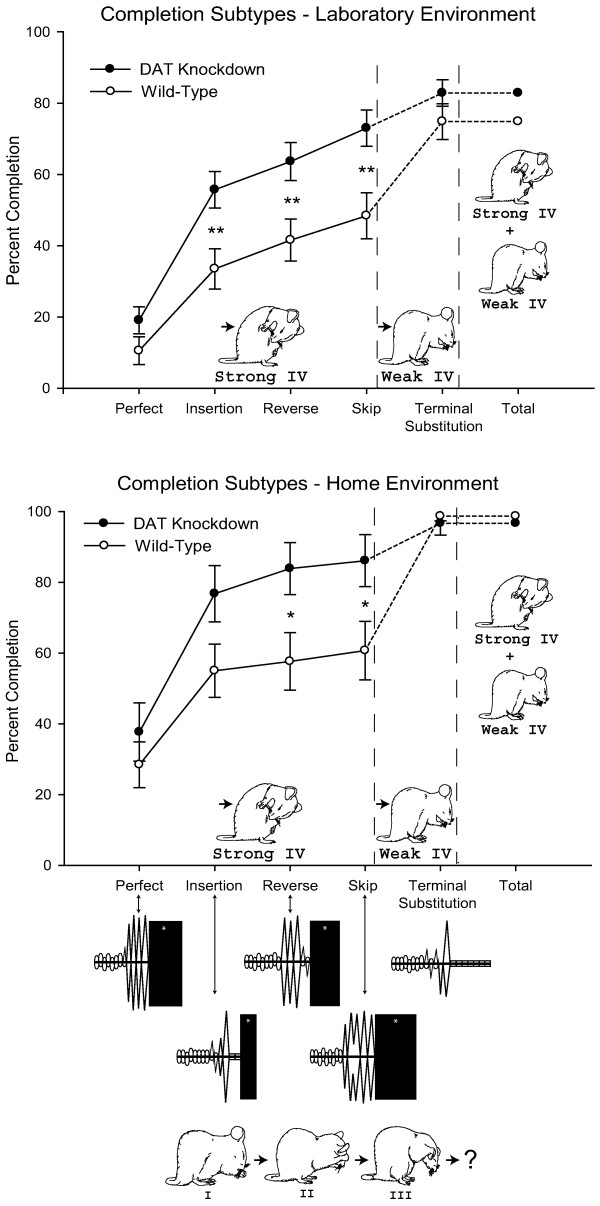
Background: Excessive sequential stereotypy of behavioral patterns (sequential super-stereotypy) in Tourette's syndrome and obsessive compulsive disorder (OCD) is thought to involve dysfunction in nigrostriatal dopamine systems. In sequential super-stereotypy, patients become trapped in overly rigid sequential patterns of action, language, or thought. Some instinctive behavioral patterns of animals, such as the syntactic grooming chain pattern of rodents, have sufficiently complex and stereotyped serial structure to detect potential production of overly-rigid sequential patterns. A syntactic grooming chain is a fixed action pattern that serially links up to 25 grooming movements into 4 predictable phases that follow 1 syntactic rule. New mutant mouse models allow gene-based manipulation of brain function relevant to sequential patterns, but no current animal model of spontaneous OCD-like behaviors has so far been reported to exhibit sequential super-stereotypy in the sense of a whole complex serial pattern that becomes stronger and excessively rigid. Here we used a hyper-dopaminergic mutant mouse to examine whether an OCD-like behavioral sequence in animals shows sequential super-stereotypy. Knockdown mutation of the dopamine transporter gene (DAT) causes extracellular dopamine levels in the neostriatum of these adult mutant mice to rise to 170% of wild-type control levels. Results: We found that the serial pattern of this instinctive behavioral sequence becomes strengthened as an entire entity in hyper-dopaminergic mutants, and more resistant to interruption. Hyper-dopaminergic mutant mice have stronger and more rigid syntactic grooming chain patterns than wild-type control mice. Mutants showed sequential super-stereotypy in the sense of having more stereotyped and predictable syntactic grooming sequences, and were also more likely to resist disruption of the pattern en route, by returning after a disruption to complete the pattern from the appropriate point in the sequence. By contrast, wild-type mice exhibited weaker forms of the fixed action pattern, and often failed to complete the full sequence. Conclusions: Sequential super-stereotypy occurs in the complex fixed action patterns of hyper-dopaminergic mutant mice. Elucidation of the basis for sequential super-stereotypy of instinctive behavior in DAT knockdown mutant mice may offer insights into neural mechanisms of overly-rigid sequences of action or thought in human patients with disorders such as Tourette's or OCD.
Overview
The claims and statistics of this paper haven’t been checked yet.
Free: it reads the open-access text and checks the first 5 claims that cite a source we can check. Create a free account to check every claim.
Integrity signals
Registry
Cites
Statistics
Figures



Verification
Claims the paper makes
The claims and statistics of this paper haven’t been checked yet.
Free: it reads the open-access text and checks the first 5 claims that cite a source we can check. Create a free account to check every claim.
Claims other papers make about this one
Each is checked against this paper’s own text: does it say what the citing paper says it does?
The source backs part of the claim, not all of it — or backs it for a different population, condition or comparison.
In the citing paper
“DAT knockout mice exhibit complex restricted patterns of stereotyped movements similar to the sequential super-stereotypy seen in TA [508].”
From Reward circuitry dysfunction in psychiatric and neurodevelopmental disorders and genetic syndromes: animal models and clinical findings (2012) · cites this paper as [508]
Experimental — accuracy not yet measuredIn the citing paper
“Knockdown of the dopamine transporter leads to excessive grooming in rodents (Berridge et al., 2005)”
From A framework for understanding the emerging role of corticolimbic-ventral striatal networks in OCD-associated repetitive behaviors (2015) · cites this paper as Berridge et al., 2005
In the citing paper
“The DAT knockout mice also have stronger and more rigid self-grooming patterns, with mutants displaying sequential super-stereotypy, evidenced by having more stereotyped and predictable self-grooming sequences [508].”
From Reward circuitry dysfunction in psychiatric and neurodevelopmental disorders and genetic syndromes: animal models and clinical findings (2012) · cites this paper as [508]
Self-check
Percentages, sums and reported differences re-computed from the paper’s own numbers.
The self-check needs the paper’s full text.
Citations
Cites
The faculty of language: what is it, who has it, and how did it evolve?
Hauser, M. D., Chomsky, N., & Fitch, W. T. (2002) · Science · doi:10.1126/science.298.5598.1569 · Cited by 5,189
The problem of serial order in behavior
Lashley, K. S. (1951) · MPG.PuRe (Max Planck Society) · Cited by 2,734
A neostriatal habit learning system in humans
Knowlton, B. J., Mangels, J. A., & Squire, L. R. (1996) · Science · doi:10.1126/science.273.5280.1399 · Cited by 1,777
Learning and Memory Functions of the Basal Ganglia
Packard, M. G., & Knowlton, B. J. (2002) · Annual Review of Neuroscience · doi:10.1146/annurev.neuro.25.112701.142937 · Cited by 1,717 · cited 1×
“Nigrostriatal mechanisms for sequencing instinctive action may have been co-opted in subsequent mammalian and human evolution into use in sequencing learned and cognitive psychological elements [67-69].”
BackgroundThe Basal Ganglia and Chunking of Action Repertoires
Graybiel, A. M. (1998) · Neurobiology of Learning and Memory · doi:10.1006/nlme.1998.3843 · Cited by 1,042 · cited 1×
“In that way, the same basal ganglia mechanisms used for movement syntax may participate in sequential habits that result from learning [20,29,70-72].”
BackgroundCerebral mechanisms in behavior.
indicated, N. A. (1952) · Journal of Consulting Psychology · doi:10.1037/h0051344 · Cited by 913
Toward a neurobiology of obsessive-compulsive disorder
Graybiel, A. M., & Rauch, S. L. (2000) · Neuron · doi:10.1016/s0896-6273(00)00113-6 · Cited by 864 · cited 3×
“They represent precisely the sort of sequencing function that ancestral basal ganglia systems might originally have evolved to perform [2, 9 ,14,15,24,29-31].”
BackgroundInfluentialAnimal Behaviour: A Synthesis of Ethology and Comparative Psychology
Cullen, J. M., & Hinde, R. A. (1968) · The Journal of Animal Ecology · doi:10.2307/3093 · Cited by 843
Decreased expression of striatal signaling genes in a mouse model of Huntington's disease
Luthi-Carter, R. (2000) · Human Molecular Genetics · doi:10.1093/hmg/9.9.1259 · Cited by 720 · cited 1×
“Basal ganglia are believed to be involved in generating such pathologically-strong and complex sequential stereotypies [1,2,8,9,74,78-85].”
BackgroundThe representation of temporal information in perception and motor control
Ivry, R. B. (1996) · Current Opinion in Neurobiology · doi:10.1016/s0959-4388(96)80037-7 · Cited by 635 · cited 2×
“For example, Marsden proposed that "The sequencing of motor action and the sequencing of thought could be a uniform function carried out by the basal ganglia" [15], and a variety of computational models have been proposed to carry out the general sequencing functions of basal ganglia [16-19].”
BackgroundResult
Research works printed but not linked: 1
- Rapoport JL: Le "spectre obsessionnel-compulsif": Un concept utile?. Encephale. 1994, 20 Spec No 4: 677-680.
Cited by
The debate over dopamine’s role in reward: the case for incentive salience
Berridge, K. C. (2007) · Psychopharmacology · doi:10.1007/s00213-006-0578-x · Cited by 2,347
“Dopamine agonists and antagonists also modulate the strength of instinctive chains of 25 or so grooming movements that all rodents show, apparently by acting on dorsolateral striatum (Berridge et al. 2005; Cromwell and Berridge 1996; Deveney and Waddington 1997).”
BackgroundSelf-citationHabits, Rituals, and the Evaluative Brain
Graybiel, A. M. (2008) · Annual Review of Neuroscience · doi:10.1146/annurev.neuro.29.051605.112851 · Cited by 1,697
Oxytocin: The Great Facilitator of Life
Lee, H.-J., Macbeth, A. H., Pagani, J., & Young, W. S. (2009) · Progress in Neurobiology · doi:10.1016/j.pneurobio.2009.04.001 · Cited by 1,037
“Recently, an Oxt-induced hypergrooming model of OCD was developed by Oxt administration to the CeA (Marroni et al., 2007).”
InfluentialNeurobiology of rodent self-grooming and its value for translational neuroscience
Kalueff, A. V., Stewart, A. M., Song, C., Berridge, K. C., Graybiel, A. M., & Fentress, J. C. (2016) · Nature Reviews Neuroscience · doi:10.1038/nrn.2015.8 · Cited by 852
Self-citationRecent advances in Tourette syndrome research
Albin, R. L., & Mink, J. W. (2006) · Trends in Neurosciences · doi:10.1016/j.tins.2006.01.001 · Cited by 478
Metadata
- Authors
- Berridge, K. C., Aldridge, J. W., Houchard, K. R., & Zhuang, X.
- Affiliations
- University of Michigan (US)
- Wayne State University (US)
- University of Chicago (US)
- Corresponding author
- Berridge, Kent C
- Venue
- BMC Biology
- Published
- 2005-02-14
- Volume
- 3
- Issue
- 1
- Pages
- 4-4
- ISSN
- 1741-7007 (ISSN-L)
- PMC
- PMC552313
- OpenAlex
- W1882556075
- Cited by
- 309
- References
- 96
- Citations by year
- 2026: 8 · 2025: 8 · 2024: 22 · 2023: 14 · 2022: 12 · 2021: 16 · 2020: 13 · 2019: 13 · 2018: 9 · 2017: 16 · 2016: 19 · 2015: 16 · 2014: 21 · 2013: 13 · 2012: 14
- FWCI
- 16.20
- Type
- journal article
- Language
- en
- Open access
- gold
- doi.org
- Licence
- cc-by
- creativecommons.org/licenses/by/2.0/ (tdm)
- creativecommons.org/licenses/by/2.0/ (vor)
- Locations
- BMC Biology (publishedVersion, cc-by)
- PubMed Central (publishedVersion, cc-by)
- PubMed (publishedVersion)
- Human Biology (submittedVersion)
- Deep Blue (University of Michigan) (submittedVersion)
- DOAJ (DOAJ: Directory of Open Access Journals) (submittedVersion, cc-by-sa)
- Funders
- National Science Foundation (0091661)
- National Alliance for Research on Schizophrenia and Depression
- National Institutes of Health
- National Institute of Mental Health (MH-63649, R01MH063649)
- National Institute on Drug Abuse (DA015188, R01DA015188)
- Topics
- Social Sciences › Psychology › Clinical Psychology › Obsessive-Compulsive Spectrum Disorders
- Life Sciences › Neuroscience › Cellular and Molecular Neuroscience › Neurotransmitter Receptor Influence on Behavior
- Life Sciences › Neuroscience › Endocrine and Autonomic Systems › Neuroendocrine regulation and behavior
- Keywords
- fixed action patterns, obsessive-compulsive disorder, Tourette syndrome, nigrostriatal dopamine system, innate behavior, behavioral rigidity
- MeSH terms
- Animals, Disease Models, Animal, Tourette Syndrome, Male, Mice, Neurologic Mutants, Obsessive-Compulsive Disorder, Stereotyped Behavior, Dopamine Plasma Membrane Transport Proteins, Mice
About these checks
Registry, retraction, Cites and statistics results are computed, not judged, with one exception: a printed reference that no index lists is read once by a model before it counts as a citation error. Claims are extracted by a model and kept only when their quote appears verbatim in the text; each cited source is then checked, with a model’s help, for whether it says what the claim relies on. Those verdicts can be wrong — read the claim’s quote and the cited source before relying on one.
Statistics and arithmetic are recomputed, not judged.
Confidence bands are shown only for fields calibrated on our annotated test set. None is calibrated yet, so no band is shown.
What counts as a claim ›How we measure confidence ›How we check this ›
Are you an author, or do you see a problem with this page? Request a review
How to cite
Cite CoChat for the checks on this page, and the paper for its own findings.
- This page
- CoChat. (2026). Citation check: Sequential super-stereotypy of an instinctive fixed action pattern in hyper-dopaminergic mutant mice: a model of obsessive compulsive disorder and Tourette’s. https://app.cochat.ai/papers/10.1186/1741-7007-3-4
- The paper
- Berridge, K. C., Aldridge, J. W., Houchard, K. R., & Zhuang, X. (2005). Sequential super-stereotypy of an instinctive fixed action pattern in hyper-dopaminergic mutant mice: a model of obsessive compulsive disorder and Tourette’s. BMC Biology. https://doi.org/10.1186/1741-7007-3-4
Data sources
Bibliographic data: Semantic Scholar, OpenAlex, Crossref.
Contains information from the Semantic Scholar Academic Graph Datasets, made available under the ODC Attribution License (ODC-BY 1.0).
Semantic Scholar’s data is described in: Kinney, R., et al. (2023). The Semantic Scholar Open Data Platform. arXiv:2301.10140.
