

Sequential super-stereotypy of an instinctive fixed action pattern in hyper-dopaminergic mutant mice: a model of obsessive compulsive disorder and Tourette’s
Open accessThe DOI matches its Crossref record; 96 of the 96 references it cites were found in a registry or an index.
Abstract
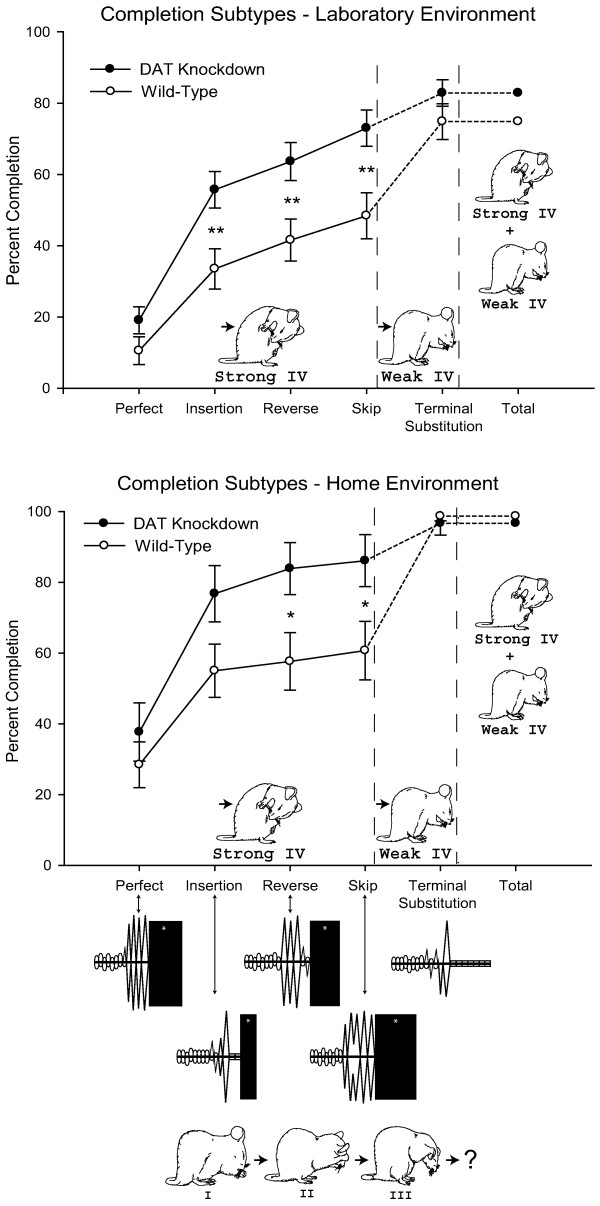
Background: Excessive sequential stereotypy of behavioral patterns (sequential super-stereotypy) in Tourette's syndrome and obsessive compulsive disorder (OCD) is thought to involve dysfunction in nigrostriatal dopamine systems. In sequential super-stereotypy, patients become trapped in overly rigid sequential patterns of action, language, or thought. Some instinctive behavioral patterns of animals, such as the syntactic grooming chain pattern of rodents, have sufficiently complex and stereotyped serial structure to detect potential production of overly-rigid sequential patterns. A syntactic grooming chain is a fixed action pattern that serially links up to 25 grooming movements into 4 predictable phases that follow 1 syntactic rule. New mutant mouse models allow gene-based manipulation of brain function relevant to sequential patterns, but no current animal model of spontaneous OCD-like behaviors has so far been reported to exhibit sequential super-stereotypy in the sense of a whole complex serial pattern that becomes stronger and excessively rigid. Here we used a hyper-dopaminergic mutant mouse to examine whether an OCD-like behavioral sequence in animals shows sequential super-stereotypy. Knockdown mutation of the dopamine transporter gene (DAT) causes extracellular dopamine levels in the neostriatum of these adult mutant mice to rise to 170% of wild-type control levels. Results: We found that the serial pattern of this instinctive behavioral sequence becomes strengthened as an entire entity in hyper-dopaminergic mutants, and more resistant to interruption. Hyper-dopaminergic mutant mice have stronger and more rigid syntactic grooming chain patterns than wild-type control mice. Mutants showed sequential super-stereotypy in the sense of having more stereotyped and predictable syntactic grooming sequences, and were also more likely to resist disruption of the pattern en route, by returning after a disruption to complete the pattern from the appropriate point in the sequence. By contrast, wild-type mice exhibited weaker forms of the fixed action pattern, and often failed to complete the full sequence. Conclusions: Sequential super-stereotypy occurs in the complex fixed action patterns of hyper-dopaminergic mutant mice. Elucidation of the basis for sequential super-stereotypy of instinctive behavior in DAT knockdown mutant mice may offer insights into neural mechanisms of overly-rigid sequences of action or thought in human patients with disorders such as Tourette's or OCD.
Overview
The claims and statistics of this paper haven’t been checked yet.
Free: it reads the open-access text and checks the first 5 claims that cite a source we can check. Create a free account to check every claim.
Integrity signals
Registry
Cites
Statistics
Figures



Verification
Claims the paper makes
The claims and statistics of this paper haven’t been checked yet.
Free: it reads the open-access text and checks the first 5 claims that cite a source we can check. Create a free account to check every claim.
Claims other papers make about this one
Each is checked against this paper’s own text: does it say what the citing paper says it does?
The source backs part of the claim, not all of it — or backs it for a different population, condition or comparison.
In the citing paper
“DAT knockout mice exhibit complex restricted patterns of stereotyped movements similar to the sequential super-stereotypy seen in TA [508].”
From Reward circuitry dysfunction in psychiatric and neurodevelopmental disorders and genetic syndromes: animal models and clinical findings (2012) · cites this paper as [508]
Experimental — accuracy not yet measuredIn the citing paper
“Knockdown of the dopamine transporter leads to excessive grooming in rodents (Berridge et al., 2005)”
From A framework for understanding the emerging role of corticolimbic-ventral striatal networks in OCD-associated repetitive behaviors (2015) · cites this paper as Berridge et al., 2005
In the citing paper
“The DAT knockout mice also have stronger and more rigid self-grooming patterns, with mutants displaying sequential super-stereotypy, evidenced by having more stereotyped and predictable self-grooming sequences [508].”
From Reward circuitry dysfunction in psychiatric and neurodevelopmental disorders and genetic syndromes: animal models and clinical findings (2012) · cites this paper as [508]
Self-check
Percentages, sums and reported differences re-computed from the paper’s own numbers.
The self-check needs the paper’s full text.
Citations
Cites
The faculty of language: what is it, who has it, and how did it evolve?
Hauser, M. D., Chomsky, N., & Fitch, W. T. (2002) · Science · doi:10.1126/science.298.5598.1569 · Cited by 5,189
The problem of serial order in behavior
Lashley, K. S. (1951) · MPG.PuRe (Max Planck Society) · Cited by 2,734
A neostriatal habit learning system in humans
Knowlton, B. J., Mangels, J. A., & Squire, L. R. (1996) · Science · doi:10.1126/science.273.5280.1399 · Cited by 1,777
Learning and Memory Functions of the Basal Ganglia
Packard, M. G., & Knowlton, B. J. (2002) · Annual Review of Neuroscience · doi:10.1146/annurev.neuro.25.112701.142937 · Cited by 1,717 · cited 1×
“Nigrostriatal mechanisms for sequencing instinctive action may have been co-opted in subsequent mammalian and human evolution into use in sequencing learned and cognitive psychological elements [67-69].”
BackgroundThe Basal Ganglia and Chunking of Action Repertoires
Graybiel, A. M. (1998) · Neurobiology of Learning and Memory · doi:10.1006/nlme.1998.3843 · Cited by 1,042 · cited 1×
“In that way, the same basal ganglia mechanisms used for movement syntax may participate in sequential habits that result from learning [20,29,70-72].”
BackgroundCerebral mechanisms in behavior.
indicated, N. A. (1952) · Journal of Consulting Psychology · doi:10.1037/h0051344 · Cited by 913
Toward a neurobiology of obsessive-compulsive disorder
Graybiel, A. M., & Rauch, S. L. (2000) · Neuron · doi:10.1016/s0896-6273(00)00113-6 · Cited by 864 · cited 3×
“They represent precisely the sort of sequencing function that ancestral basal ganglia systems might originally have evolved to perform [2, 9 ,14,15,24,29-31].”
BackgroundInfluentialAnimal Behaviour: A Synthesis of Ethology and Comparative Psychology
Cullen, J. M., & Hinde, R. A. (1968) · The Journal of Animal Ecology · doi:10.2307/3093 · Cited by 843
Decreased expression of striatal signaling genes in a mouse model of Huntington's disease
Luthi-Carter, R. (2000) · Human Molecular Genetics · doi:10.1093/hmg/9.9.1259 · Cited by 720 · cited 1×
“Basal ganglia are believed to be involved in generating such pathologically-strong and complex sequential stereotypies [1,2,8,9,74,78-85].”
BackgroundThe representation of temporal information in perception and motor control
Ivry, R. B. (1996) · Current Opinion in Neurobiology · doi:10.1016/s0959-4388(96)80037-7 · Cited by 635 · cited 2×
“For example, Marsden proposed that "The sequencing of motor action and the sequencing of thought could be a uniform function carried out by the basal ganglia" [15], and a variety of computational models have been proposed to carry out the general sequencing functions of basal ganglia [16-19].”
BackgroundResultBuilding action repertoires: memory and learning functions of the basal ganglia
Graybiel, A. M. (1995) · Current Opinion in Neurobiology · doi:10.1016/0959-4388(95)80100-6 · Cited by 559
Hyperdopaminergic mutant mice have higher "wanting" but not "liking" for sweet rewards
Peciña, S., Cagniard, B., Berridge, K. C., Aldridge, J. W., & Zhuang, X. (2003) · The Journal of Neuroscience · doi:10.1523/jneurosci.23-28-09395.2003 · Cited by 551 · cited 1×
“They tend to be hyperactive, to walk in perseverative straight paths, and to overpursue certain incentive stimuli [58-60].”
BackgroundSelf-citationBasal Ganglia Volumes in Patients With Gilles de la Tourette Syndrome
Peterson, B. S., Thomas, P., Kane, M. J., Scahill, L., Zhang, H., Bronen, R., King, R. A., Leckman, J. F., & Staib, L. (2003) · Archives of General Psychiatry · doi:10.1001/archpsyc.60.4.415 · Cited by 527 · cited 1×
“For example, pathological repetitions of spoken words in Tourette's syndrome, and the tormenting habits and thoughts of obsessive-compulsive disorder (OCD), involve overly rigid sequential patterns of action, language or thought [1-9], which in part may be influenced by genetic factors [10-13].”
BackgroundActor–critic models of the basal ganglia: new anatomical and computational perspectives
Joel, D., Niv, Y., & Ruppin, E. (2002) · Neural Networks · doi:10.1016/s0893-6080(02)00047-3 · Cited by 500 · cited 2×
“For example, Marsden proposed that "The sequencing of motor action and the sequencing of thought could be a uniform function carried out by the basal ganglia" [15], and a variety of computational models have been proposed to carry out the general sequencing functions of basal ganglia [16-19].”
BackgroundResultHyperactivity and impaired response habituation in hyperdopaminergic mice
Zhuang, X., Oosting, R. S., Jones, S. R., Gainetdinov, R. R., Miller, G. W., Caron, M. G., & Hen, R. (2001) · Proceedings of the National Academy of Sciences · doi:10.1073/pnas.98.4.1982 · Cited by 499 · cited 6×
“DAT knockdown reduces adult DAT expression to 10% of wild-type levels and raises extracellular dopamine levels in neostriatum to 170% (wild-type control = 100%) [58].”
BackgroundMethodInfluentialSelf-citationAnimal models of neurological deficits: how relevant is the rat?
Cenci, M. A., Whishaw, I. Q., & Schallert, T. (2002) · Nature Reviews Neuroscience · doi:10.1038/nrn877 · Cited by 456 · cited 1×
“Neuroethological studies of natural behavior in animals have shown that neostriatum, substantia nigra, and their connecting dopamine projections are critical to sequential stereotypy for complex serial patterns of instinctive behavior [26-35].”
BackgroundHoxb8 Is Required for Normal Grooming Behavior in Mice
Greer, J. M., & Capecchi, M. R. (2002) · Neuron · doi:10.1016/s0896-6273(01)00564-5 · Cited by 401 · cited 3×
“It also would be of interest for future studies to examine if other animal models of perseverant grooming behavior, such as Hoxb8lox and D1CT mutant mice, also show any exaggerated serial rigidity features in their fixed action patterns similar to those found here [13,51,53-55,57,65].”
BackgroundResultThe functional anatomy of disorders of the basal ganglia
Albin, R. L., Young, A. B., & Penney, J. B. (1995) · Trends in Neurosciences · doi:10.1016/0166-2236(95)80020-3 · Cited by 381 · cited 1×
“Basal ganglia are believed to be involved in generating such pathologically-strong and complex sequential stereotypies [1,2,8,9,74,78-85].”
BackgroundObsessive-Compulsive Disorder as a Disturbance of Security Motivation.
Szechtman, H., & Woody, E. (2004) · Psychological Review · doi:10.1037/0033-295x.111.1.111 · Cited by 370 · cited 5×
“Finally, while highly speculative, it is at least conceivable that an evolutionary specialization of dopamine-related neural mechanisms for self-grooming sequences, suggested by our current results, might also influence the theme or content, as well as the syntactic stereotypy, of some human super-stereotypies involvi…”
BackgroundInfluentialTHE BEHAVIOR OF THE LABORATORY RAT A Handbook with Tests
Wishaw, I. Q., & Kolb, B. E. (2004) · University of Groningen research database (University of Groningen / Centre for Information Technology) · Cited by 290
Grooming analysis algorithm for neurobehavioural stress research
Kalueff, A. V., & Tuohimaa, P. (2004) · Brain Research Protocols · doi:10.1016/j.brainresprot.2004.04.002 · Cited by 290 · cited 1×
“This difference suggests that stress may promote the initiation of stereotyped sequences, but impede their lawful completion, and is consistent with reports that stress disrupts completion of syntactic chain sequences [62].”
ResultThe psychology of perseverative and stereotyped behaviour
Ridley, R. M. (1994) · Progress in Neurobiology · doi:10.1016/0301-0082(94)90039-6 · Cited by 286
Implementation of Action Sequences by a Neostriatal Site: A Lesion Mapping Study of Grooming Syntax
Cromwell, H. C., & Berridge, K. C. (1996) · The Journal of Neuroscience · doi:10.1523/jneurosci.16-10-03444.1996 · Cited by 284 · cited 2×
“For example, after lesions of neostriatum, rats lose the ability to complete the 4-phase pattern properly (especially after lesions of anterior dorsolateral neostriatum, which contains the neurons that particularly code the syntactic pattern), even though the lesions do not impair constituent grooming movements [27,36…”
BackgroundSelf-citationBeyond the serotonin hypothesis: a role for dopamine in some forms of obsessive compulsive disorder?
Goodman, W. K., McDougle, C. J., Price, L. H., Riddle, M. A., Pauls, D. L., & Leckman, J. F. (1990) · PubMed · Cited by 283
Human language and our reptilian brain: the subcortical bases of speech, syntax, and thought
(2000) · Choice Reviews Online · doi:10.5860/choice.38-2156 · Cited by 282
Sensory and cognitive functions of the basal ganglia
Brown, L. L., Schneider, J. S., & Lidsky, T. I. (1997) · Current Opinion in Neurobiology · doi:10.1016/s0959-4388(97)80003-7 · Cited by 278 · cited 1×
“In that way, the same basal ganglia mechanisms used for movement syntax may participate in sequential habits that result from learning [20,29,70-72].”
BackgroundCoding of Serial Order by Neostriatal Neurons: A “Natural Action” Approach to Movement Sequence
Aldridge, J. W., & Berridge, K. C. (1998) · The Journal of Neuroscience · doi:10.1523/jneurosci.18-07-02777.1998 · Cited by 263 · cited 6×
“For example, after lesions of neostriatum, rats lose the ability to complete the 4-phase pattern properly (especially after lesions of anterior dorsolateral neostriatum, which contains the neurons that particularly code the syntactic pattern), even though the lesions do not impair constituent grooming movements [27,36…”
BackgroundInfluentialSelf-citationModel of Cortical-Basal Ganglionic Processing: Encoding the Serial Order of Sensory Events
Beiser, D. G., & Houk, J. C. (1998) · Journal of Neurophysiology · doi:10.1152/jn.1998.79.6.3168 · Cited by 238 · cited 2×
“For example, Marsden proposed that "The sequencing of motor action and the sequencing of thought could be a uniform function carried out by the basal ganglia" [15], and a variety of computational models have been proposed to carry out the general sequencing functions of basal ganglia [16-19].”
BackgroundResultA Computational Model of How the Basal Ganglia Produce Sequences
Berns, G. S., & Sejnowski, T. J. (1998) · Journal of Cognitive Neuroscience · doi:10.1162/089892998563815 · Cited by 232 · cited 2×
“For example, Marsden proposed that "The sequencing of motor action and the sequencing of thought could be a uniform function carried out by the basal ganglia" [15], and a variety of computational models have been proposed to carry out the general sequencing functions of basal ganglia [16-19].”
BackgroundResultCortex, striatum and cerebellum: control of serial order in a grooming sequence
Berridge, K., & Whishaw, I. (1992) · Experimental Brain Research · doi:10.1007/bf00227239 · Cited by 224 · cited 1×
“Neuroethological studies of natural behavior in animals have shown that neostriatum, substantia nigra, and their connecting dopamine projections are critical to sequential stereotypy for complex serial patterns of instinctive behavior [26-35].”
BackgroundSelf-citationActivity in the caudate nucleus of monkey during spatial sequencing
Kermadi, I., & Joseph, J. P. (1995) · Journal of Neurophysiology · doi:10.1152/jn.1995.74.3.911 · Cited by 219 · cited 2×
“They represent precisely the sort of sequencing function that ancestral basal ganglia systems might originally have evolved to perform [2,9,14,15,24,29-31].”
BackgroundNatural syntax rules control action sequence of rats
Berridge, K. C., Fentress, J. C., & Parr, H. (1987) · Behavioural Brain Research · doi:10.1016/0166-4328(87)90242-7 · Cited by 202 · cited 2×
“We also made choreograph diagrams of syntactic chains from each mouse to compare details of their form and sequential pattern [61].”
BackgroundMethodSelf-citationIs Language the Key to Human Intelligence?
Premack, D. (2004) · Science · doi:10.1126/science.1093993 · Cited by 201 · cited 1×
“Human language has real syntax, as the prototypical example, complete with recursive generative rules [14,21, 22 ].”
BackgroundFrontal-striatal circuit functions: Context, sequence, and consequence
SAINT-CYR, J. A. (2003) · Journal of the International Neuropsychological Society · doi:10.1017/s1355617703910125 · Cited by 200 · cited 1×
“Nigrostriatal mechanisms for sequencing instinctive action may have been co-opted in subsequent mammalian and human evolution into use in sequencing learned and cognitive psychological elements [67-69].”
BackgroundDelfs, J. M., & Kelley, A. E. (1990) · Neuroscience · doi:10.1016/0306-4522(90)90221-o · Cited by 198 · cited 1×
“which the same movement is repeated over and over again [46-50].”
BackgroundDoyon, J., Laforce, R., Bouchard, G., Gaudreau, D., Roy, J., Poirier, M., BÉdard, P. J., BÉdard, F., & Bouchard, J.-P. (1998) · Neuropsychologia · doi:10.1016/s0028-3932(97)00168-1 · Cited by 194 · cited 1×
“Nigrostriatal mechanisms for sequencing instinctive action may have been co-opted in subsequent mammalian and human evolution into use in sequencing learned and cognitive psychological elements [67-69].”
BackgroundA transgenic model of comorbid Tourette's syndrome and obsessive-compulsive disorder circuitry
Nordstrom, E. J., & Burton, F. H. (2002) · Molecular Psychiatry · doi:10.1038/sj.mp.4001144 · Cited by 184
Obsessive-compulsive disorder: evidence for basal ganglia dysfunction.
Jl, R., & Sp, W. (1988) · PubMed · Cited by 176
Schmitzer-Torbert, N., & Redish, A. D. (2004) · Journal of Neurophysiology · doi:10.1152/jn.00687.2003 · Cited by 175
Human Language and Our Reptilian Brain: The Subcortical Bases of Speech, Syntax, and Thought
Lieberman, P. (2001) · Perspectives in Biology and Medicine · doi:10.1353/pbm.2001.0011 · Cited by 171 · cited 6×
“Normal sequential patterns of action, language and thought also have been suggested to depend on proper basal ganglia function [14,15].”
BackgroundInfluentialCampbell, K. M., de Lecea, L., Severynse, D. M., Caron, M. G., McGrath, M. J., Sparber, S. B., Sun, L.-Y., & Burton, F. H. (1999) · The Journal of Neuroscience · doi:10.1523/jneurosci.19-12-05044.1999 · Cited by 170 · cited 4×
“However, it is notable that there is a consistent trend of D1 circuit-activation inducing OCD-like behavioral persistence in D1 agonisttreated rodents, D1-circuit potentiated D1CT mice, and hyperdopaminergic DAT-KD mice [43-45, 53 ,55,57,64].”
BackgroundResultInfluentialIncreased ventral striatal monoaminergic innervation in Tourette syndrome
Albin, R. L., Koeppe, R. A., Bohnen, N. I., Nichols, T. E., Meyer, P., Wernette, K., Minoshima, S., Kilbourn, M. R., & Frey, K. A. (2003) · Neurology · doi:10.1212/01.wnl.0000076181.39162.fc · Cited by 150 · cited 2×
“For example, pathological repetitions of spoken words in Tourette's syndrome, and the tormenting habits and thoughts of obsessive-compulsive disorder (OCD), involve overly rigid sequential patterns of action, language or thought [1-9], which in part may be influenced by genetic factors [10-13].”
BackgroundFunctions of the basal ganglia
Bruyn, G. W. (1985) · Journal of the Neurological Sciences · doi:10.1016/0022-510x(85)90193-5 · Cited by 142
Repetitive Behaviors in Monkeys Are Linked to Specific Striatal Activation Patterns
Saka, E., Goodrich, C., Harlan, P., Madras, B. K., & Graybiel, A. M. (2004) · The Journal of Neuroscience · doi:10.1523/jneurosci.1072-04.2004 · Cited by 139 · cited 1×
“which the same movement is repeated over and over again [46-50].”
BackgroundBerridge, K. C. (1990) · Behaviour · doi:10.1163/156853990x00428 · Cited by 136 · cited 8×
“In mice, Phase I ellipses are often slightly asymmetrical and alternating, in the sense that the 'major paw' makes a slightly larger stroke than the 'minor paw' [37].”
BackgroundMethodInfluentialSelf-citationRauch, S. L., Whalen, P. J., Curran, T., Shin, L. M., Coffey, B. J., Savage, C. R., McInerney, S. C., Baer, L., & Jenike, M. A. (2001) · PubMed · Cited by 133
Ralph, R. J., Paulus, M. P., Zhuang, X., Hen, R., & Geyer, M. A. (2003) · Biological Psychiatry · doi:10.1016/s0006-3223(02)01489-0 · Cited by 125 · cited 1×
“They tend to be hyperactive, to walk in perseverative straight paths, and to overpursue certain incentive stimuli [58-60].”
BackgroundSelf-citationGrammar of a Movement Sequence in Inbred Mice
Fentress, J. C., & STILWELL, F. P. (1973) · Nature · doi:10.1038/244052a0 · Cited by 116 · cited 1×
“But other behavior can be described as having properties of syntax too, if the behavioral flow is governed by lawful sequential patterns that follow normative rules to produce a complex serial order [14,20,23-26].”
BackgroundThe functional anatomy of disorders of the basal ganglia
Albin, R. L. (1995) · Trends in Neurosciences · doi:10.1016/0166-2236(95)93872-u · Cited by 116
Capper-Loup, C., Canales, J. J., Kadaba, N., & Graybiel, A. M. (2002) · The Journal of Neuroscience · doi:10.1523/jneurosci.22-14-06218.2002 · Cited by 108 · cited 1×
“which the same movement is repeated over and over again [46-50].”
BackgroundBasal ganglia neural mechanisms of natural movement sequences
Aldridge, J. W., Berridge, K. C., & Rosen, A. R. (2004) · Canadian Journal of Physiology and Pharmacology · doi:10.1139/y04-061 · Cited by 107 · cited 5×
“But other behavior can be described as having properties of syntax too, if the behavioral flow is governed by lawful sequential patterns that follow normative rules to produce a complex serial order [14,20,23-26].”
BackgroundInfluentialSelf-citationGenetics of obsessive-compulsive disorders: new findings and challenges
Grados, M. A., Walkup, J. T., & Walford, S. (2003) · Brain and Development · doi:10.1016/s0387-7604(03)90010-6 · Cited by 104 · cited 1×
“For example, pathological repetitions of spoken words in Tourette's syndrome, and the tormenting habits and thoughts of obsessive-compulsive disorder (OCD), involve overly rigid sequential patterns of action, language or thought [1-9], which in part may be influenced by genetic factors [10-13].”
BackgroundGrooming in Norway Rats: the Development and Adult Expression of a Complex Motor Pattern
Richmond, G., & Sachs, B. D. (1980) · Behaviour · doi:10.1163/156853980x00573 · Cited by 104 · cited 1×
“05, Bonferroni), consistent with prolongation of the later components of cephalocaudal grooming bouts in that home environment [63].”
Background[Functions of the basal ganglia].
MARSDEN, C. D. (1982) · Rinsho Shinkeigaku · Cited by 103
Díaz-Anzaldúa, A., Joober, R., Rivière, J.-B., Dion, Y., Lespérance, P., Richer, F., Chouinard, S., Rouleau, G. A., & and the Montreal Tourette Syndrome Study Group (2004) · Molecular Psychiatry · doi:10.1038/sj.mp.4001411 · Cited by 97 · cited 1×
“For example, pathological repetitions of spoken words in Tourette's syndrome, and the tormenting habits and thoughts of obsessive-compulsive disorder (OCD), involve overly rigid sequential patterns of action, language or thought [1-9], which in part may be influenced by genetic factors [10-13].”
BackgroundPathophysiology of Tourette's syndrome: striatal pathways revisited
Saka, E., & Graybiel, A. M. (2003) · Brain and Development · doi:10.1016/s0387-7604(03)90002-7 · Cited by 97
Super-stereotypy I: Enhancement of a complex movement sequence by systemic dopamine D1 agonists
Berridge, K. C., & Aldridge, J. W. (2000) · Synapse · doi:10.1002/1098-2396(20000901)37:3<194::aid-syn3>3.0.co;2-a · Cited by 96 · cited 5×
“In a state of sequential superstereotypy, the stereotyped pattern becomes even more predictable than normal, which is evident as an increase in the probability that all four phases will be completed in syntactic order [43,44].”
BackgroundMethodInfluentialSelf-citationMcGrath, M. J., Campbell, K. M., Parks, C. R., & Burton, F. H. (2000) · Brain Research · doi:10.1016/s0006-8993(00)02646-9 · Cited by 95 · cited 4×
“mouse, caused by transgenic potentiation of D1-associated brain circuits, shows OCD-like persistence of grooming, as well as persistence of other behaviors such as digging, climbing, and tics [3, 53-57 ].”
BackgroundResultInfluentialA Genetic Basis for Obsessive Grooming
Graybiel, A. M., & Saka, E. (2002) · Neuron · doi:10.1016/s0896-6273(01)00575-x · Cited by 91
Expressive Contexts, Fine Structure, and Central Mediation of Rodent Groominga
Fentress, J. C. (1988) · Annals of the New York Academy of Sciences · doi:10.1111/j.1749-6632.1988.tb38592.x · Cited by 91 · cited 1×
“Grooming behavior of rodents is sensitive to environmental contexts, both in quantity and in fine structure, and stressors in particular can either suppress or increase grooming behavior depending on type [88].”
BackgroundFoundations of Animal Behavior: Classic Papers with Commentaries
Houck, L. D., & Drickamer, L. C. (1996) · Cited by 90
Sequential control of navigation by locale and taxon cues in the Morris water task
Hamilton, D. A., Rosenfelt, C. S., & Whishaw, I. Q. (2004) · Behavioural Brain Research · doi:10.1016/j.bbr.2004.03.005 · Cited by 88 · cited 1×
“But other behavior can be described as having properties of syntax too, if the behavioral flow is governed by lawful sequential patterns that follow normative rules to produce a complex serial order [14,20,23-26].”
BackgroundWhich Motor Disorder in Parkinson's Disease Indicates the True Motor Function of the Basal Ganglia?
Marsden, C. D. (1984) · Novartis Foundation Symposia · doi:10.1002/9780470720882.ch12 · Cited by 83
Kim, C.-H., Koo, M.-S., Cheon, K.-A., Ryu, Y.-H., Lee, J.-D., & Lee, H.-S. (2003) · European Journal of Nuclear Medicine and Molecular Imaging · doi:10.1007/s00259-003-1245-7 · Cited by 82 · cited 1×
“For example, pathological repetitions of spoken words in Tourette's syndrome, and the tormenting habits and thoughts of obsessive-compulsive disorder (OCD), involve overly rigid sequential patterns of action, language or thought [1-9], which in part may be influenced by genetic factors [10-13].”
BackgroundUpdate on pharmacologic management of OCD: agents and augmentation.
McDougle, C. J. (1997) · PubMed · Cited by 82
Action sequencing is impaired in D1A‐deficient mutant mice
Cromwell, H. C., Berridge, K. C., Drago, J., & Levine, M. S. (1998) · European Journal of Neuroscience · doi:10.1046/j.1460-9568.1998.00250.x · Cited by 81 · cited 7×
“Syntactic grooming chains by DAT-KD mice had virtually all the typical features of wild-type chains and of syntactic chains previously reported for outbred mice and D1 receptor knockout mice [37,41] (Figures 1 &3; see Additional movie file 1).”
BackgroundMethodInfluentialSelf-citationThe Pharmacotherapy of Obsessive-Compulsive Disorder
McDougle, C., Goodman, W., & Price, L. (1993) · Pharmacopsychiatry · doi:10.1055/s-2007-1014373 · Cited by 78
Mittleman, G., LeDuc, P. A., & Whishaw, I. Q. (1993) · Behavioural Brain Research · doi:10.1016/0166-4328(93)90121-6 · Cited by 77
Role of the paleostriatum in species-typical display behavior of the lizard (Anolis carolinensis)
Greenberg, N. L., MacLean, P. D., & Ferguson, J. L. (1979) · Brain Research · doi:10.1016/0006-8993(79)90535-3 · Cited by 75 · cited 1×
“In that way, the same basal ganglia mechanisms used for movement syntax may participate in sequential habits that result from learning [20,29,70-72].”
BackgroundBasal ganglia systems in ritualistic social displays: reptiles and humans; function and illness
Baxter, L. R. (2003) · Physiology & Behavior · doi:10.1016/s0031-9384(03)00164-1 · Cited by 60 · cited 2×
“They represent precisely the sort of sequencing function that ancestral basal ganglia systems might originally have evolved to perform [2,9,14,15,24,29-31].”
BackgroundNeurobiology of basal ganglia and Tourette syndrome: striatal and dopamine function.
Albin, R. L. (2006) · PubMed · Cited by 60
Berridge, K. C., & Aldridge, J. W. (2000) · Synapse · doi:10.1002/1098-2396(20000901)37:3<205::aid-syn4>3.0.co;2-a · Cited by 60
Self-citationDopamine receptor agonists: No response: case report
(2020) · Reactions Weekly · doi:10.1007/s40278-020-83779-4 · Cited by 55
Meyer‐Luehmann, M., Thompson, J. F., Berridge, K. C., & Aldridge, J. W. (2002) · European Journal of Neuroscience · doi:10.1046/j.1460-9568.2002.02210.x · Cited by 54 · cited 5×
“The firing of some basal ganglia neurons in neostriatum and in substantia nigra codes the serial pattern of syntactic grooming chains as an entire sequence in rats [27,28].”
BackgroundInfluentialSelf-citationSpektor, B., Miller, D. W., Hollingsworth, Z. R., Kaneko, Y. A., Solano, S. M., Johnson, J. M., Penney, J. B., Young, A. B., & Luthi‐Carter, R. (2002) · Molecular Brain Research · doi:10.1016/s0169-328x(02)00216-4 · Cited by 53 · cited 1×
“Basal ganglia are believed to be involved in generating such pathologically-strong and complex sequential stereotypies [1,2,8,9,74,78-85].”
BackgroundBerridge, K. C. (1989) · Psychobiology · doi:10.3758/bf03337797 · Cited by 51 · cited 1×
“Similar deficits in grooming syntax are caused by disruption of dopamine neurotransmission in mice lacking dopamine D1 receptors [41], and in normal rats with neostriatal dopamine depletion caused by 6-hydroxydopamine lesions of nigrostriatal projections [42].”
BackgroundSelf-citationAnxiety in a transgenic mouse model of cortical-limbic neuropotentiated compulsive behavior
McGrath, M. J., Campbell, K. M., Veldman, M. B., & Burton, F. H. (1999) · Behavioural Pharmacology · doi:10.1097/00008877-199909000-00001 · Cited by 49 · cited 1×
“mouse, caused by transgenic potentiation of D1-associated brain circuits, shows OCD-like persistence of grooming, as well as persistence of other behaviors such as digging, climbing, and tics [3,53-57].”
BackgroundRecent findings in the genetics of OCD.
Pato, M. T., Pato, C. N., & Pauls, D. L. (2002) · PubMed · Cited by 47
De La Garza, R., & Madras, B. K. (2000) · Synapse · doi:10.1002/1098-2396(20000901)37:3<232::aid-syn7>3.0.co;2-7 · Cited by 44
Self-citationGoal-directed, serial and synchronous activation of neurons in the primate striatum
Kimura, M., Matsumoto, N., Okahashi, K., Ueda, Y., Satoh, T., Minamimoto, T., Sakamoto, M., & Yamada, H. (2003) · NeuroReport · doi:10.1097/00001756-200305060-00004 · Cited by 41 · cited 1×
“Neuroethological studies of natural behavior in animals have shown that neostriatum, substantia nigra, and their connecting dopamine projections are critical to sequential stereotypy for complex serial patterns of instinctive behavior [26-35].”
BackgroundKuczenski, R. T., & Segal, D. S. (1999) · Brain Research · doi:10.1016/s0006-8993(99)01149-x · Cited by 36
Psychopharmacological Distinction Between Novel Full-Efficacy “D1-like” Dopamine Receptor Agonists
Deveney, A. M., & Waddington, J. L. (1997) · Pharmacology Biochemistry and Behavior · doi:10.1016/s0091-3057(97)00248-7 · Cited by 35 · cited 3×
“Indeed, in rats, pharmacological boosting by dopamine D1 agonists administered systemically or into brain ventricles produces sequential super-stereotypy of syntactic grooming chains [ 43-45 ].”
BackgroundInfluentialMcNamara, F. N., Clifford, J. J., Tighe, O., Kinsella, A., Drago, J., Fuchs, S., Croke, D. T., & Waddington, J. L. (2002) · Synapse · doi:10.1002/syn.10108 · Cited by 34
Sequence Heterogeneity in Parkinsonian Speech
Ho, A. K., Bradshaw, J. L., Cunnington, R., Phillips, J. G., & Iansek, R. (1998) · Brain and Language · doi:10.1006/brln.1998.1959 · Cited by 33 · cited 1×
“A clinical implication of the embeddedness of basal ganglia in sequencing function may be a vulnerability to sequential dysfunction in some human disorders involving nigrostriatal systems [74,75].”
BackgroundKrause, K., Dresel, S. H. J., Krause, J., Kung, H. F., Tatsch, K., & Lochmüller, H. (2002) · Journal of Neurology · doi:10.1007/s00415-002-0746-9 · Cited by 33 · cited 1×
“For example, pathological repetitions of spoken words in Tourette's syndrome, and the tormenting habits and thoughts of obsessive-compulsive disorder (OCD), involve overly rigid sequential patterns of action, language or thought [1-9], which in part may be influenced by genetic factors [10-13].”
BackgroundEmergence of obsessive--compulsive symptoms and tics during clozapine withdrawal.
Poyurovsky, M., Bergman, Y., Shoshani, D., Schneidman, M., & Weizman, A. (1998) · PubMed · Cited by 32
Neurological dysfunction expressed in the grooming behavior of developing weaver mutant mice
Coscia, E. M., & Fentress, J. C. (1993) · Behavior Genetics · doi:10.1007/bf01068144 · Cited by 32 · cited 3×
“The genetic sensitivity of the pattern may explain why evolutionary selection exploited it for use by California ground squirrels, and also explain why knockdown of a single gene can change the strength of the entire complex sequential pattern in studies such as ours [41,65,66].”
BackgroundResultBehavioral effects of cocaine on a transgenic mouse model of cortical–limbic compulsion
Campbell, K. M., McGrath, M. J., & Burton, F. H. (1999) · Brain Research · doi:10.1016/s0006-8993(99)01544-9 · Cited by 29 · cited 2×
“It also would be of interest for future studies to examine if other animal models of perseverant grooming behavior, such as Hoxb8lox and D1CT mutant mice, also show any exaggerated serial rigidity features in their fixed action patterns similar to those found here [13,51,53-55,57,65].”
BackgroundResultSeparation of activation and pattern in grooming development of weaver mice
Bolivar, V. J., Danilchuk, W., & Fentress, J. C. (1996) · Behavioural Brain Research · doi:10.1016/0166-4328(96)00156-8 · Cited by 26 · cited 2×
“The genetic sensitivity of the pattern may explain why evolutionary selection exploited it for use by California ground squirrels, and also explain why knockdown of a single gene can change the strength of the entire complex sequential pattern in studies such as ours [41,65,66].”
BackgroundConceptual and methodological issues in studies of obsessive-compulsive and Tourette's disorders.
Hollander, E., Liebowitz, M. R., & DeCaria, C. M. (1989) · PubMed · Cited by 26
McGrath, M. J., Campbell, K. M., & Burton, F. H. (1999) · Behavioral Neuroscience · doi:10.1037//0735-7044.113.6.1249 · Cited by 26 · cited 4×
“These perseverative features of DAT-KD mutant grooming in the home cage therefore may overlap with perseverative body grooming tendencies reported for other genetic animal models of compulsive behavior, such as Hoxb8 lox and D1CT mutant mice [13,51-53, 55 ,57].”
BackgroundResultInfluentialBursten, S. N., Berridge, K. C., & Owings, D. H. (2000) · Journal of comparative psychology · doi:10.1037/0735-7036.114.3.281 · Cited by 21 · cited 6×
“Syntactic grooming chain displays appear to be communicative, in that they are emitted in conjunction with other territorial displays, such as scent-marking of objects, and have the social consequence of subsequently reducing the likelihood of a physical fight between the two adversaries [38].”
BackgroundInfluentialSelf-citationZohar, J., Sasson, Y., Chopra, M., Amiaz, R., & Nakash, N. (2002) · Wiley eBooks · doi:10.1002/9780470986844.ch6 · Cited by 11
Obsessive Compulsive Disorder (OCD)
(2012) · SpringerReference · doi:10.1007/springerreference_70044 · Cited by 7
Reilly, C. E. (2002) · Journal of Neurology · doi:10.1007/s004150200052 · Cited by 7 · cited 2×
“For example, the Hoxb8lox mutant model has been reported to exhibit OCD-like increased persistence of self-directed grooming and body-licking, and even mutual grooming of other mice [13,51,52].”
Background[The "obsessive-compulsive spectrum": a useful concept?].
Jl, R. (1994) · PubMed · Cited by 4
Research works printed but not linked: 1
- Rapoport JL Le "spectre obsessionnel-compulsif": Un concept utile? Encephale 1994 20 Spec No 4 677 680 7895635
Cited by
The debate over dopamine’s role in reward: the case for incentive salience
Berridge, K. C. (2007) · Psychopharmacology · doi:10.1007/s00213-006-0578-x · Cited by 2,347
“Dopamine agonists and antagonists also modulate the strength of instinctive chains of 25 or so grooming movements that all rodents show, apparently by acting on dorsolateral striatum (Berridge et al. 2005; Cromwell and Berridge 1996; Deveney and Waddington 1997).”
BackgroundSelf-citationHabits, Rituals, and the Evaluative Brain
Graybiel, A. M. (2008) · Annual Review of Neuroscience · doi:10.1146/annurev.neuro.29.051605.112851 · Cited by 1,697
Oxytocin: The Great Facilitator of Life
Lee, H.-J., Macbeth, A. H., Pagani, J., & Young, W. S. (2009) · Progress in Neurobiology · doi:10.1016/j.pneurobio.2009.04.001 · Cited by 1,037
“Recently, an Oxt-induced hypergrooming model of OCD was developed by Oxt administration to the CeA (Marroni et al., 2007).”
InfluentialNeurobiology of rodent self-grooming and its value for translational neuroscience
Kalueff, A. V., Stewart, A. M., Song, C., Berridge, K. C., Graybiel, A. M., & Fentress, J. C. (2016) · Nature Reviews Neuroscience · doi:10.1038/nrn.2015.8 · Cited by 852
Self-citationRecent advances in Tourette syndrome research
Albin, R. L., & Mink, J. W. (2006) · Trends in Neurosciences · doi:10.1016/j.tins.2006.01.001 · Cited by 478
Metadata
- Authors
- Berridge, K. C., Aldridge, J. W., Houchard, K. R., & Zhuang, X.
- Affiliations
- University of Michigan (US)
- Wayne State University (US)
- University of Chicago (US)
- Corresponding author
- Berridge, Kent C
- Venue
- BMC Biology
- Published
- 2005-02-14
- Volume
- 3
- Issue
- 1
- Pages
- 4-4
- ISSN
- 1741-7007 (ISSN-L)
- PMC
- PMC552313
- OpenAlex
- W1882556075
- Cited by
- 309
- References
- 96
- Citations by year
- 2026: 8 · 2025: 8 · 2024: 22 · 2023: 14 · 2022: 12 · 2021: 16 · 2020: 13 · 2019: 13 · 2018: 9 · 2017: 16 · 2016: 19 · 2015: 16 · 2014: 21 · 2013: 13 · 2012: 14
- FWCI
- 16.20
- Type
- journal article
- Language
- en
- Open access
- gold
- doi.org
- Licence
- cc-by
- creativecommons.org/licenses/by/2.0/ (tdm)
- creativecommons.org/licenses/by/2.0/ (vor)
- Locations
- BMC Biology (publishedVersion, cc-by)
- PubMed Central (publishedVersion, cc-by)
- PubMed (publishedVersion)
- Human Biology (submittedVersion)
- Deep Blue (University of Michigan) (submittedVersion)
- DOAJ (DOAJ: Directory of Open Access Journals) (submittedVersion, cc-by-sa)
- Funders
- National Science Foundation (0091661)
- National Alliance for Research on Schizophrenia and Depression
- National Institutes of Health
- National Institute of Mental Health (MH-63649, R01MH063649)
- National Institute on Drug Abuse (DA015188, R01DA015188)
- Topics
- Social Sciences › Psychology › Clinical Psychology › Obsessive-Compulsive Spectrum Disorders
- Life Sciences › Neuroscience › Cellular and Molecular Neuroscience › Neurotransmitter Receptor Influence on Behavior
- Life Sciences › Neuroscience › Endocrine and Autonomic Systems › Neuroendocrine regulation and behavior
- Keywords
- fixed action patterns, obsessive-compulsive disorder, Tourette syndrome, nigrostriatal dopamine system, innate behavior, behavioral rigidity
- MeSH terms
- Animals, Disease Models, Animal, Tourette Syndrome, Male, Mice, Neurologic Mutants, Obsessive-Compulsive Disorder, Stereotyped Behavior, Dopamine Plasma Membrane Transport Proteins, Mice
About these checks
Registry, retraction, Cites and statistics results are computed, not judged, with one exception: a printed reference that no index lists is read once by a model before it counts as a citation error. Claims are extracted by a model and kept only when their quote appears verbatim in the text; each cited source is then checked, with a model’s help, for whether it says what the claim relies on. Those verdicts can be wrong — read the claim’s quote and the cited source before relying on one.
Statistics and arithmetic are recomputed, not judged.
Confidence bands are shown only for fields calibrated on our annotated test set. None is calibrated yet, so no band is shown.
What counts as a claim ›How we measure confidence ›How we check this ›
Are you an author, or do you see a problem with this page? Request a review
Data sources
Bibliographic data: Semantic Scholar, OpenAlex, Crossref.
Contains information from the Semantic Scholar Academic Graph Datasets, made available under the ODC Attribution License (ODC-BY 1.0).
Semantic Scholar’s data is described in: Kinney, R., et al. (2023). The Semantic Scholar Open Data Platform. arXiv:2301.10140.
