

The DOI matches its Crossref record; 64 of the 64 references it cites were found in a registry or an index.
Nucleus accumbens corticotropin-releasing factor increases cue-triggered motivation for sucrose reward: paradoxical positive incentive effects in stress?
Open accessAbstract
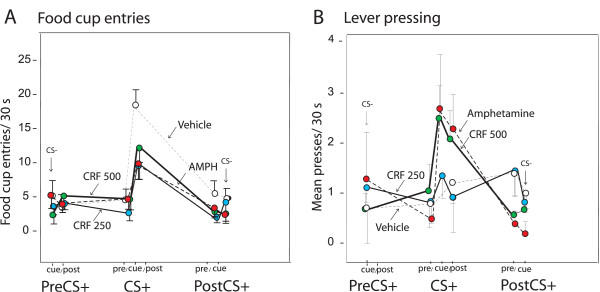
Background: Corticotropin-releasing factor (CRF) is typically considered to mediate aversive aspects of stress, fear and anxiety. However, CRF release in the brain is also elicited by natural rewards and incentive cues, raising the possibility that some CRF systems in the brain mediate an independent function of positive incentive motivation, such as amplifying incentive salience. Here we asked whether activation of a limbic CRF subsystem magnifies the increase in positive motivation for reward elicited by incentive cues previously associated with that reward, in a way that might exacerbate cue-triggered binge pursuit of food or other incentives? We assessed the impact of CRF microinjections into the medial shell of nucleus accumbens using a pure incentive version of Pavlovian-Instrumental transfer, a measure specifically sensitive to the incentive salience of reward cues (which it separates from influences of aversive stress, stress reduction, frustration and other traditional explanations for stress-increased behavior). Rats were first trained to press one of two levers to obtain sucrose pellets, and then separately conditioned to associate a Pavlovian cue with free sucrose pellets. On test days, rats received microinjections of vehicle, CRF (250 or 500 ng/0.2 μl) or amphetamine (20 μg/0.2 μl). Lever pressing was assessed in the presence or absence of the Pavlovian cues during a half-hour test. Results: Microinjections of the highest dose of CRF (500 ng) or amphetamine (20 μg) selectively enhanced the ability of Pavlovian reward cues to trigger phasic peaks of increased instrumental performance for a sucrose reward, each peak lasting a minute or so before decaying after the cue. Lever pressing was not enhanced by CRF microinjections in the baseline absence of the Pavlovian cue or during the presentation without a cue, showing that the CRF enhancement could not be explained as a result of generalized motor arousal, frustration or stress, or by persistent attempts to ameliorate aversive states. Conclusion: We conclude that CRF in nucleus accumbens shell amplifies positive motivation for cued rewards, in particular by magnifying incentive salience that is attributed to Pavlovian cues previously associated with those rewards. CRF-induced magnification of incentive salience provides a novel explanation as to why stress may produce cue-triggered bursts of binge eating, drug addiction relapse, or other excessive pursuits of rewards.
Overview
The claims and statistics of this paper haven’t been checked yet.
Run the check — free, no account needed. It reads the open-access text and checks the sources it cites.
Integrity signals
Registry
Cites
Statistics
Figures
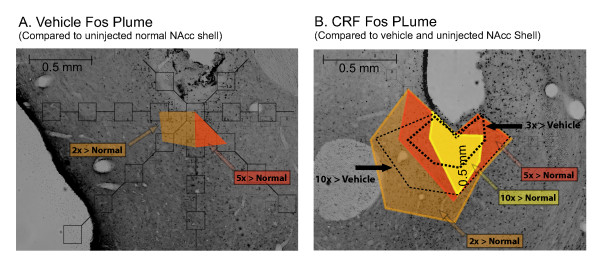
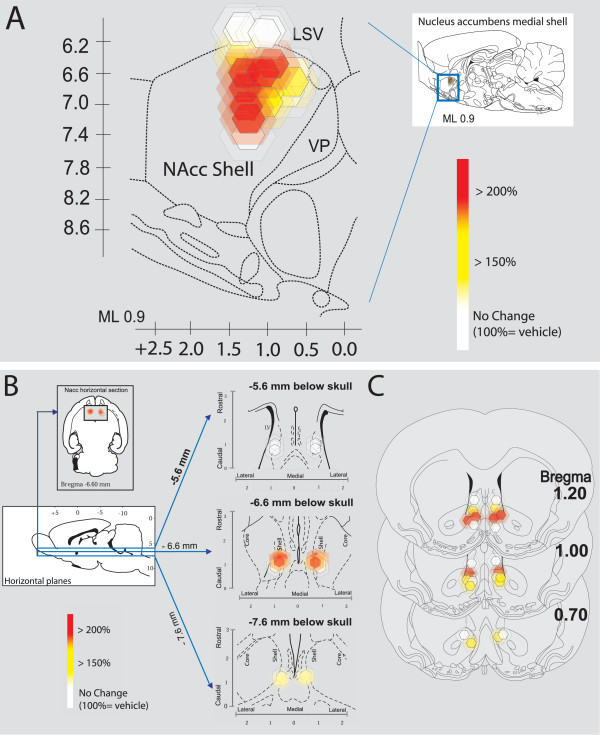
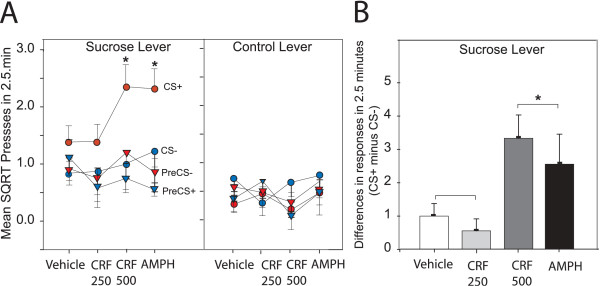
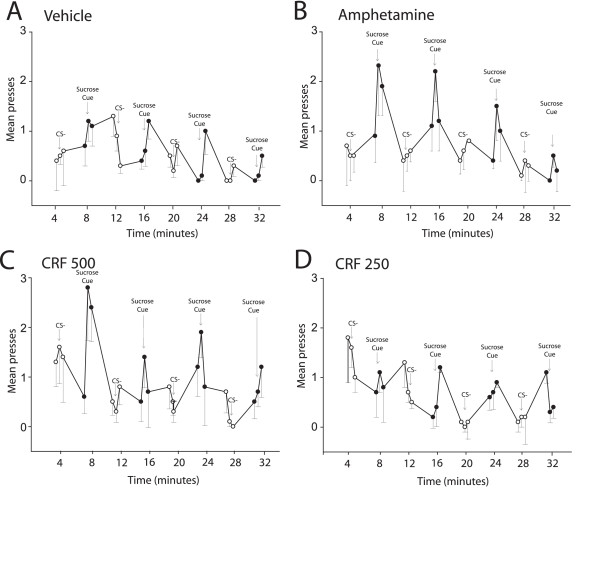
Verification
Claims the paper makes
The claims and statistics of this paper haven’t been checked yet.
Run the check — free, no account needed. It reads the open-access text and checks the sources it cites.
Claims other papers make about this one
Each is checked against this paper’s own text: does it say what the citing paper says it does?
The source backs part of the claim, not all of it — or backs it for a different population, condition or comparison.
In the citing paper
“This and related studies (Wyvell and Berridge, 2000; 2001; Pecina et al., 2006) demonstrate that increased activity of intra-shell dopamine does not merely enhance motor-habits, but also enhances motivation for rewards, a finding consistent with the notion of action-arousal or drive.”
From Dopamine reward circuitry: Two projection systems from the ventral midbrain to the nucleus accumbens–olfactory tubercle complex (2007) · cites this paper as Pecina et al., 2006
Experimental — accuracy not yet measuredThe source backs part of the claim, not all of it — or backs it for a different population, condition or comparison.
In the citing paper
“At the same time, it increases the sensitivity of the excitatory dopaminergic pathway (Peciña et al., 2006).”
From A motivation model of sex addiction – Relevance to the controversy over the concept (2022) · cites this paper as Peciña et al., 2006
Experimental — accuracy not yet measuredIn the citing paper
“CRF in the NAC shell can also enhance the positive motivational value and salience of incentive cues (Pecina et al 2006; Kreibich et al 2009).”
From The behavioral, anatomical and pharmacological parallels between social attachment, love and addiction (2012) · cites this paper as Pecina et al 2006
In the citing paper
“In turn, administration of CRF, has been shown to elevate the value of Pavlovian associated reward cues (Peciña et al., 2006).”
From Cued for Risk: Evidence for an Incentive Sensitization Framework to Explain the Interplay between Stress and Anxiety, Substance Abuse, and Reward Uncertainty in Disordered Gambling Behavior (2019) · cites this paper as Peciña et al., 2006
Self-check
Percentages, sums and reported differences re-computed from the paper’s own numbers.
The self-check needs the paper’s full text.
Citations
Cites
The rat brain in stereotaxic coordinates
Palkovits, M. (1983) · Neuropeptides · doi:10.1016/0143-4179(83)90049-5 · Cited by 28,959
The Rat Brain in Stereotaxic Coordinates
Paxinos, G., & Watson, C. (1983) · Elsevier eBooks · doi:10.1016/c2009-0-63235-9 · Cited by 28,585 · cited 4×
“Cannulae were aimed at the caudal half of the accumbens: 2.8-2.2 mm anterior to bregma, 0.9 mm lateral to the midline, and 5.7 mm ventral to the skull surface (2.0 mm above the injection site), based on the atlas of Paxinos and Watson (1996).”
InfluentialAChE-stained horizontal sections of the rat brain in stereotaxic coordinates
Paxinos, G., WATSON, C. R. R., & Emson, P. C. (1980) · Journal of Neuroscience Methods · doi:10.1016/0165-0270(80)90021-7 · Cited by 4,514
Classical conditioning II: Current research and theory.
Black, A. H., & Prokasy, W. F. (1972) · Appleton-Century-Crofts eBooks · Cited by 4,449
What is the role of dopamine in reward: hedonic impact, reward learning, or incentive salience?
Berridge, K. C., & Robinson, T. E. (1998) · Brain Research Reviews · doi:10.1016/s0165-0173(98)00019-8 · Cited by 4,127
Self-citationDrug Addiction, Dysregulation of Reward, and Allostasis
Koob, G. (2001) · Neuropsychopharmacology · doi:10.1016/s0893-133x(00)00195-0 · Cited by 2,953 · cited 3×
“For example, cocaine administration also activates CRF expression in CRH-producing neurons in hypothalamus and amygdala [13] and CRF given intracerebroventricularly (ICV) or into the ventrolateral BNST can induce reinstatement of drug self-administration behavior in the absence of external stressors (though this last…”
Swanson, L. W., Sawchenko, P. E., Rivier, J., & Vale, W. W. (2008) · Neuroendocrinology · doi:10.1159/000123454 · Cited by 1,953 · cited 1×
“The medial shell of nucleus accumbens also contains substantial distributions of CRF-immunoreactive and fibers, which might arise in part from hypothalamic CRF systems linked to stress, as well as cell bodies (particularly in its caudal half, and thus we focused on caudal shell here) [26].”
An opponent-process theory of motivation. I. Temporal dynamics of affect
Solomon, R. L., & Corbit, J. D. (1974) · Psychological Review · doi:10.1037/h0036128 · Cited by 1,704 · cited 2×
“Such appetitive behaviors have often been viewed as attempts to reduce or avoid unpleasant stress or as overflow from general motor arousal or frustration ([ 12-14 ] but see [8-11]).”
Herman, J. P., Figueiredo, H., Mueller, N. K., Ulrich-Lai, Y., Ostrander, M. M., Choi, D. C., & Cullinan, W. E. (2003) · Frontiers in Neuroendocrinology · doi:10.1016/j.yfrne.2003.07.001 · Cited by 1,586 · cited 2×
“Corticotropin-releasing factor (CRF) is involved in mediating the physiological and behavioral responses to stress [ 1-5 ].”
Robinson, T. E., & Berridge, K. C. (2003) · Annual Review of Psychology · doi:10.1146/annurev.psych.54.101601.145237 · Cited by 1,509
Self-citation
Research works printed but not linked: 1
- Toates FM: Motivational Systems. 1986, Cambridge: Cambridge University Press
Cited by
Sorted by citations
The debate over dopamine’s role in reward: the case for incentive salience
Berridge, K. C. (2007) · Psychopharmacology · doi:10.1007/s00213-006-0578-x · Cited by 2,347
Self-citationIkemoto, S. (2007) · Brain Research Reviews · doi:10.1016/j.brainresrev.2007.05.004 · Cited by 1,477
“Liking” and “wanting” food rewards: Brain substrates and roles in eating disorders
Berridge, K. C. (2009) · Physiology & Behavior · doi:10.1016/j.physbeh.2009.02.044 · Cited by 1,147
Self-citationThe tempted brain eats: Pleasure and desire circuits in obesity and eating disorders
Berridge, K. C., Ho, C.-Y., Richard, J. M., & DiFeliceantonio, A. G. (2010) · Brain Research · doi:10.1016/j.brainres.2010.04.003 · Cited by 873
Self-citationReward mechanisms in obesity: new insights and future directions
Kenny, P. J. (2011) · Neuron · doi:10.1016/j.neuron.2011.02.016 · Cited by 748
Metadata
- Authors
- Peciña, S., Schulkin, J., & Berridge, K. C.
- Affiliations
- University of Michigan (US)
- Georgetown University (US)
- Corresponding author
- Peciña, Susana
- Venue
- BMC Biology
- Published
- 2006-04-13
- Volume
- 4
- Issue
- 1
- Pages
- 8-8
- ISSN
- 1741-7007 (ISSN-L)
- PMC
- PMC1459217
- OpenAlex
- W1789705209
- Cited by
- 194
- References
- 64
- Citations by year
- 2026: 4 · 2025: 8 · 2024: 8 · 2023: 5 · 2022: 13 · 2021: 8 · 2020: 5 · 2019: 12 · 2018: 14 · 2017: 6 · 2016: 7 · 2015: 8 · 2014: 14 · 2013: 9 · 2012: 17
- FWCI
- 4.18
- Type
- journal article
- Language
- en
- Open access
- gold
- doi.org
- Licence
- cc-by
- Locations
- BMC Biology (publishedVersion, cc-by)
- PubMed Central (publishedVersion)
- PubMed (publishedVersion)
- Deep Blue (University of Michigan) (submittedVersion)
- DOAJ (DOAJ: Directory of Open Access Journals) (submittedVersion, cc-by-sa)
- Funders
- National Institutes of Health
- National Institute of Mental Health (MH-63649, R01MH063649)
- National Institute on Drug Abuse (DA015188, R01DA015188)
- Topics
- Life Sciences › Neuroscience › Cellular and Molecular Neuroscience › Neurotransmitter Receptor Influence on Behavior
- Life Sciences › Neuroscience › Behavioral Neuroscience › Stress Responses and Cortisol
- Life Sciences › Neuroscience › Cellular and Molecular Neuroscience › Neuropeptides and Animal Physiology
- Keywords
- corticotropin-releasing factor, nucleus accumbens shell, incentive salience, Pavlovian-to-instrumental transfer, sucrose reward, incentive motivation, stress, binge eating, amphetamine, reward cues
- MeSH terms
- Animals, Corticotropin-Releasing Hormone, Cues, Male, Microinjections, Motivation, Nucleus Accumbens, Reinforcement, Psychology, Reward, Stress, Physiological, Sucrose, Rats, Sprague-Dawley, Rats
About these checks
Registry, retraction, Cites and statistics results are computed, not judged, with one exception: a printed reference that no index lists is read once by a model before it counts as a citation error. Claims are extracted by a model and kept only when their quote appears verbatim in the text; each cited source is then checked, with a model’s help, for whether it says what the claim relies on. Those verdicts can be wrong — read the claim’s quote and the cited source before relying on one.
Statistics and arithmetic are recomputed, not judged.
Confidence bands are shown only for fields calibrated on our annotated test set. None is calibrated yet, so no band is shown.
What counts as a claim ›How we measure confidence ›How we check this ›
Are you an author, or do you see a problem with this page? Request a review
