

The DOI matches its Crossref record; 60 of the 60 references it cites were found in a registry or an index.
School-based mental health intervention for children in war-affected Burundi: a cluster randomized trial
Open accessAbstract
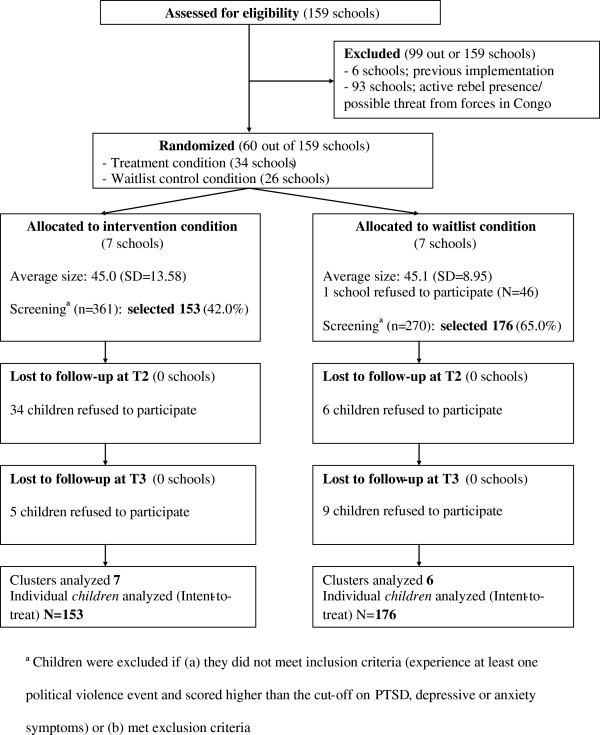
BACKGROUND: Armed conflicts are associated with a wide range of impacts on the mental health of children and adolescents. We evaluated the effectiveness of a school-based intervention aimed at reducing symptoms of posttraumatic stress disorder, depression, and anxiety (treatment aim); and improving a sense of hope and functioning (preventive aim). METHODS: We conducted a cluster randomized trial with 329 children in war-affected Burundi (aged 8 to 17 (mean 12.29 years, standard deviation 1.61); 48% girls). One group of children (n = 153) participated in a 15-session school-based intervention implemented by para-professionals, and the remaining 176 children formed a waitlist control condition. Outcomes were measured before, one week after, and three months after the intervention. RESULTS: No main effects of the intervention were identified. However, longitudinal growth curve analyses showed six favorable and two unfavorable differences in trajectories between study conditions in interaction with several moderators. Children in the intervention condition living in larger households showed decreases on depressive symptoms and function impairment, and those living with both parents showed decreases on posttraumatic stress disorder and depressive symptoms. The groups of children in the waitlist condition showed increases in depressive symptoms. In addition, younger children and those with low levels of exposure to traumatic events in the intervention condition showed improvements on hope. Children in the waitlist condition who lived on their original or newly bought land showed improvements in hope and function impairment, whereas children in the intervention condition showed deterioration on these outcomes. CONCLUSIONS: Given inconsistent effects across studies, findings do not support this school-based intervention as a treatment for posttraumatic stress disorder and depressive symptoms in conflict-affected children. The intervention appears to have more consistent preventive benefits, but these effects are contingent upon individual (for example, age, gender) and contextual (for example, family functioning, state of conflict, displacement) variables. Results suggest the potential benefit of school-based preventive interventions particularly in post-conflict settings. TRIAL REGISTRATION: The study was registered as ISRCTN42284825.
Overview
The claims and statistics of this paper haven’t been checked yet.
Run the check — free, no account needed. It reads the open-access text and checks the sources it cites.
Integrity signals
Registry
Cites
Statistics
Figures
Verification
Claims the paper makes
The claims and statistics of this paper haven’t been checked yet.
Run the check — free, no account needed. It reads the open-access text and checks the sources it cites.
Claims other papers make about this one
Each is checked against this paper’s own text: does it say what the citing paper says it does?
In the citing paper
“With regard to the second question, there is some evidence that treatments can be effective in situations of ongoing adversity [19],[20], whereas other studies have shown reduced treatment benefits for populations facing chronic adversity [21].”
From World Health Organization guidelines for management of acute stress, PTSD, and bereavement: key challenges on the road ahead (2014) · cites this paper as [21]
Self-check
Percentages, sums and reported differences re-computed from the paper’s own numbers.
The self-check needs the paper’s full text.
Citations
Cites
Skill formation and the economics of investing in disadvantaged children
Heckman, J. J. (2006) · Science · doi:10.1126/science.1128898 · Cited by 3,559
Consort 2010 statement: extension to cluster randomised trials
Campbell, M. K., Piaggio, G., Elbourne, D. R., Altman, D. G., & for the CONSORT Group (2012) · BMJ · doi:10.1136/bmj.e5661 · Cited by 3,510
BIRMAHER, B., KHETARPAL, S., BRENT, D., CULLY, M., BALACH, L., KAUFMAN, J., & NEER, S. M. (1997) · Journal of the American Academy of Child & Adolescent Psychiatry · doi:10.1097/00004583-199704000-00018 · Cited by 2,846
Mediators and Moderators of Treatment Effects in Randomized Clinical Trials
Kraemer, H. C., Wilson, G. T., Fairburn, C. G., & Agras, W. S. (2002) · Archives of General Psychiatry · doi:10.1001/archpsyc.59.10.877 · Cited by 2,562
CONSORT statement: extension to cluster randomised trials
Campbell, M. K., Elbourne, D. R., & Altman, D. G. (2004) · BMJ · doi:10.1136/bmj.328.7441.702 · Cited by 2,557
The development and validation of the children’s Hope scale
Snyder, C. R., Hoza, B., Pelham, W. E., Rapoff, M., Ware, L., Danovsky, M., Highberger, L., Ribinstein, H., & Stahl, K. J. (1997) · Journal of Pediatric Psychology · doi:10.1093/jpepsy/22.3.399 · Cited by 1,234
A Multisite, Randomized Controlled Trial for Children With Sexual Abuse–Related PTSD Symptoms
Cohen, J. A., Deblinger, E., Mannarino, A. P., & Steer, R. A. (2004) · Journal of the American Academy of Child & Adolescent Psychiatry · doi:10.1097/00004583-200404000-00005 · Cited by 1,123 · cited 1×
“78 for depressive symptoms [27,28], a twosided α equal to 0.”
The Child PTSD Symptom Scale: A Preliminary Examination of its Psychometric Properties
Foa, E. B., Johnson, K. M., Feeny, N. C., & Treadwell, K. R. H. (2001) · Journal of Clinical Child & Adolescent Psychology · doi:10.1207/s15374424jccp3003_9 · Cited by 1,103
Birleson, P. (1981) · Journal of Child Psychology and Psychiatry · doi:10.1111/j.1469-7610.1981.tb00533.x · Cited by 859
Betancourt, T. S., & Khan, K. T. (2008) · International Review of Psychiatry · doi:10.1080/09540260802090363 · Cited by 840
Research works printed but not linked: 2
- Human Rights Watch: Pursuit of Power: Political Violence and Repression in Burundi. 2009, New York: Human Rights Watch
- Muthen LK, Muthen BO: MPLUS User’s Guide: Fifth Edition. 2008, Los Angeles, CA: Muthen & Muthen
Cited by
Sorted by citations
Barnett, M. L., Gonzalez, A., Miranda, J., Chavira, D. A., & Lau, A. S. (2018) · Administration and Policy in Mental Health and Mental Health Services Research · doi:10.1007/s10488-017-0815-0 · Cited by 431
Mental health interventions in schools in low-income and middle-income countries
Fazel, M. S., Patel, V., Thomas, S., & Tol, W. A. (2014) · The Lancet Psychiatry · doi:10.1016/s2215-0366(14)70357-8 · Cited by 401
Self-citationKohrt, B. A., Asher, L., Bhardwaj, A., Fazel, M. S., Jordans, M. J. D., Mutamba, B. B., Nadkarni, A., Pedersen, G. A., Singla, D. R., & Patel, V. (2018) · International Journal of Environmental Research and Public Health · doi:10.3390/ijerph15061279 · Cited by 381
Self-citationDorsey, S., McLaughlin, K. A., Kerns, S. E. U., Harrison, J. P., Lambert, H. K., Briggs, E. C., Revillion Cox, J., & Amaya-Jackson, L. (2017) · Journal of Clinical Child & Adolescent Psychology · doi:10.1080/15374416.2016.1220309 · Cited by 296
Morina, N., Koerssen, R., & Pollet, T. V. (2016) · Clinical Psychology Review · doi:10.1016/j.cpr.2016.05.006 · Cited by 256
Metadata
- Authors
- Tol, W. A., Komproe, I. H., Jordans, M. J., Ndayisaba, A., Ntamutumba, P., Sipsma, H., Smallegange, E. S., Macy, R. D., & de Jong, J. T.
- Affiliations
- Johns Hopkins University (US)
- Utrecht University (NL)
- King's College London (GB)
- University of Illinois Chicago (US)
- University of Amsterdam (NL)
- Harvard University (US)
- Corresponding author
- Tol, Wietse A
- Venue
- BMC Medicine
- Published
- 2014-04-01
- Volume
- 12
- Issue
- 1
- Pages
- 56-56
- ISSN
- 1741-7015 (ISSN-L)
- PMC
- PMC3994237
- OpenAlex
- W2119900946
- Cited by
- 170
- References
- 60
- Citations by year
- 2026: 13 · 2025: 11 · 2024: 13 · 2023: 20 · 2022: 9 · 2021: 11 · 2020: 16 · 2019: 19 · 2018: 10 · 2017: 12 · 2016: 17 · 2015: 10 · 2014: 8
- FWCI
- 18.49
- Type
- journal article
- Language
- en
- Open access
- gold
- doi.org
- Licence
- Locations
- BMC Medicine (publishedVersion, cc-by)
- Europe PMC (PubMed Central) (publishedVersion, cc-by)
- PubMed Central (publishedVersion, cc-by)
- PubMed (publishedVersion)
- UvA-DARE (University of Amsterdam) (publishedVersion, other-oa)
- Digital Access to Scholarship at Harvard (DASH) (Harvard University) (submittedVersion, cc-by)
- UvA-DARE (University of Amsterdam) (submittedVersion, other-oa)
- Utrecht University Repository (Utrecht University) (submittedVersion, other-oa)
- Research Portal (King's College London) (submittedVersion, cc-by)
- Data Archiving and Networked Services (DANS) (submittedVersion, other-oa)
- Topics
- Social Sciences › Psychology › Clinical Psychology › Posttraumatic Stress Disorder Research
- Social Sciences › Psychology › Clinical Psychology › Migration, Health and Trauma
- Social Sciences › Psychology › Clinical Psychology › Child Therapy and Development
- Keywords
- school-based mental health programs, children and adolescents, post-traumatic stress disorder, depressive symptoms, anxiety, hope, war-affected children, children in armed conflict, paraprofessionals, post-conflict societies, household size, parental co-residence, trauma exposure, displacement, Burundi
- MeSH terms
- Adolescent, Anxiety, Anxiety Disorders, Burundi, Child, Depression, Depressive Disorder, Female, Humans, Male, Mental Health, School Health Services, Schools, Stress Disorders, Post-Traumatic, Warfare
About these checks
Registry, retraction, Cites and statistics results are computed, not judged, with one exception: a printed reference that no index lists is read once by a model before it counts as a citation error. Claims are extracted by a model and kept only when their quote appears verbatim in the text; each cited source is then checked, with a model’s help, for whether it says what the claim relies on. Those verdicts can be wrong — read the claim’s quote and the cited source before relying on one.
Statistics and arithmetic are recomputed, not judged.
Confidence bands are shown only for fields calibrated on our annotated test set. None is calibrated yet, so no band is shown.
What counts as a claim ›How we measure confidence ›How we check this ›
Are you an author, or do you see a problem with this page? Request a review
