

The DOI matches its Crossref record; 42 of the 43 references it cites were found in a registry or an index.
Muscle strength in adolescent men and risk of cardiovascular disease events and mortality in middle age: a prospective cohort study
Open accessAbstract
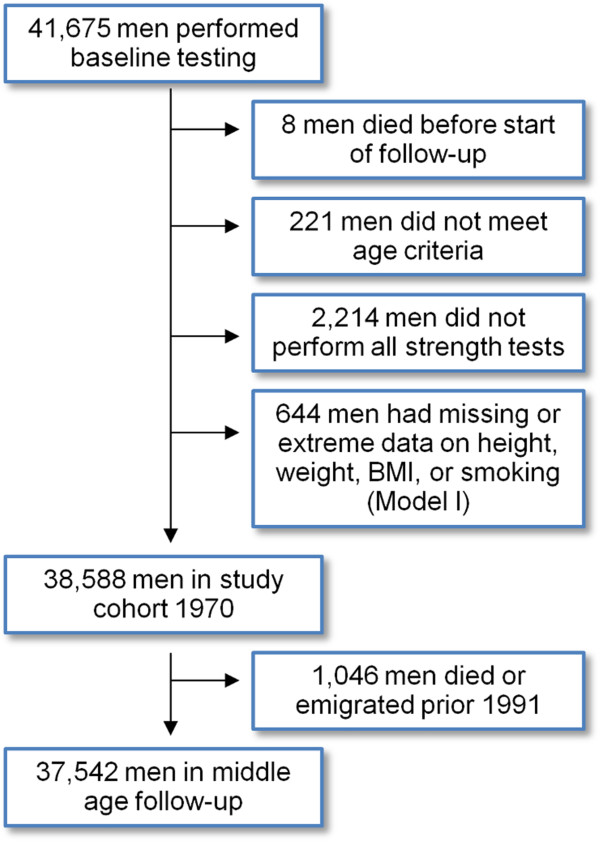
BACKGROUND: Ischemic heart disease and stroke are two severe types of cardiovascular disease (CVD), a major contributor to the global burden of disease. The preventive framework currently includes promotion of both adequate cardiorespiratory and muscular fitness. Although muscle fitness is established as an indicator of health, it is currently unknown whether muscle strength is associated with later CVD independently of cardiorespiratory fitness. METHODS: We studied 38,588 Swedish men who in 1969 to 1970 (typically aged 18 years) completed compulsory conscription. Using the mean standardized score of three isometric muscle strength tests performed at conscription (hand grip, elbow flexion and knee extension), we categorized the subjects into three groups with the 25th to 75th percentile defining the reference category. We followed the cohort until 2012 for diagnosed CVD events and mortality via national health care registers and the national cause of death register. To estimate hazard ratios (HR) for CVD events (coronary heart disease or stroke) and CVD mortality we used Cox proportional hazard models adjusted for body mass index, smoking, alcohol consumption, cardiorespiratory fitness and socioeconomic status. RESULTS: Men with high muscle strength in adolescence had a decreased risk of later CVD events (HR 0.88, 95% confidence interval 0.77 to 0.99), whereas we observed no increased risk in men with low muscle strength (0.99, 0.86 to 1.13). However, low muscle strength was associated with increased risk of CVD mortality during middle age (1.31, 1.02 to 1.67). CONCLUSIONS: Muscle strength in adolescent men is inversely associated with later CVD events and CVD mortality in middle age, independently of cardiorespiratory fitness and other important confounders. Thus, the role of muscle fitness in the prevention and pathogenesis of CVD warrants increased attention.
Overview
The claims and statistics of this paper haven’t been checked yet.
Run the check — free, no account needed. It reads the open-access text and checks the sources it cites.
Integrity signals
Registry
Cites
Statistics
Figures
Verification
Claims the paper makes
The claims and statistics of this paper haven’t been checked yet.
Run the check — free, no account needed. It reads the open-access text and checks the sources it cites.
Claims other papers make about this one
Each is checked against this paper’s own text: does it say what the citing paper says it does?
The source backs part of the claim, not all of it — or backs it for a different population, condition or comparison.
In the citing paper
“Low muscle strength is associated with lower functional capacity, and it has been shown that muscle strength is inversely related to the risk of mortality and cardiovascular disease [1].”
From Beneficial Effects of Asparagus officinalis Extract Supplementation on Muscle Mass and Strength following Resistance Training and Detraining in Healthy Males (2023) · cites this paper as [1]
Experimental — accuracy not yet measured
Self-check
Percentages, sums and reported differences re-computed from the paper’s own numbers.
The self-check needs the paper’s full text.
Citations
Cites
von Elm, E., Altman, D. G., Egger, M., Pocock, S. J., Gøtzsche, P. C., Vandenbroucke, J. P., & Initiative, F. T. S. (2007) · PLoS Medicine · doi:10.1371/journal.pmed.0040296 · Cited by 23,020
A Proportional Hazards Model for the Subdistribution of a Competing Risk
Fine, J. P., & Gray, R. J. (1999) · Journal of the American Statistical Association · doi:10.1080/01621459.1999.10474144 · Cited by 14,290
Elm, E. V., Altman, D. G., Egger, M., Pocock, S. J., Gøtzsche, P. C., & Vandenbroucke, J. P. (2007) · BMJ · doi:10.1136/bmj.39335.541782.ad · Cited by 10,766
Murray, C. J. L., Vos, T., Lozano, R., Naghavi, M., Flaxman, A. D., Michaud, C., Ezzati, M., Shibuya, K., Salomon, J. A., Abdalla, S., et al. (2012) · The Lancet · doi:10.1016/s0140-6736(12)61689-4 · Cited by 8,888
European Guidelines on cardiovascular disease prevention in clinical practice (version 2012)
Authors/Task Force Members:, Perk, J., De Backer, G., Gohlke, H., Graham, I., Reiner, Ž., Verschuren, M., Albus, C., Benlian, P., Boysen, G., et al. (2012) · European Heart Journal · doi:10.1093/eurheartj/ehs092 · Cited by 8,490
External review and validation of the Swedish national inpatient register
Ludvigsson, J. F., Andersson, E., Ekbom, A., Feychting, M., Kim, J.-L., Reuterwall, C., Heurgren, M., & Olausson, P. O. (2011) · BMC Public Health · doi:10.1186/1471-2458-11-450 · Cited by 5,055
European guidelines on cardiovascular disease prevention in clinical practice: executive summary
Graham, I., Atar, D., Borch‐Johnsen, K., Boysen, G., Burell, G. K., Cífková, R., Dallongeville, J., Backer, G. D., Ebrahim, S. B. J., Gjelsvik, B., et al. (2007) · European Heart Journal · doi:10.1093/eurheartj/ehm316 · Cited by 3,865
Age-predicted maximal heart rate revisited
Tanaka, H., Monahan, K. D., & Seals, D. R. (2001) · Journal of the American College of Cardiology · doi:10.1016/s0735-1097(00)01054-8 · Cited by 3,775 · cited 1×
“5) [22].”
Kodama, S. (2009) · JAMA · doi:10.1001/jama.2009.681 · Cited by 3,035
Physical Fitness and All-Cause Mortality: A Prospective Study of Healthy Men and Women
Blair, S. N. (1989) · JAMA · doi:10.1001/jama.1989.03430170057028 · Cited by 2,658
Research works printed but not linked: 3
- World Health Organization: Global recommendations on physical activity for health. 2010, Geneva, Switzerland: World Health Organization
- Nordesjo LO, Schéle R: Validity of ergometer cycle test and measures of isometric muscle strength when predicting some aspects of military performance. Swedish J Defence Med. 1974, 10: 11-23.
- Nordesjo LO: A comparison between the Thornvall maximal ergometer test, submaximal ergometer tests and maximal oxygen uptake. Swedish J Defence Med. 1974, 10: 3-10.
Cited by
Sorted by citations
Items 101–120 of 120
Queiroz, D. R., Lima, T. D. J. S., Carneiro, M., Veloso, T. S. M., Santos, V. R. D. L., & dos Santos, M. A. M. (2017) · Pensar a Prática · doi:10.5216/rpp.v20i4.43588 · Cited by 1
Ortega, J. A. F., Cuartas, L. A. H., & Arias, F. A. R. (2018) · Revista de la Facultad de Medicina · doi:10.15446/revfacmed.v66n4.66132 · Cited by 1
PHYSICAL ACTIVITY, PHYSICAL FITNESS AND ACADEMIC ACHIEVEMENTS OF PRIMARY SCHOOL CHILDREN
Klizienė, I., Kimantienė, L., Čižauskas, G., Daniusevičiūtė-Brazaitė, L., Cibulskas, G., & Janulevičienė, A. (2018) · Baltic Journal of Sport and Health Sciences · doi:10.33607/bjshs.v1i108.4 · Cited by 1
Weak Hand Grip Strength Is Associated with Alexithymia in Outpatients in a Mexican Population
Mendoza, A. D. G., Fresán, A., González‐Castro, T. B., Pool-García, S., Tovilla‐Zárate, C. A., Castillo-Ávila, R. G., Vázquez, P. I. A., López‐Narváez, M. L., & Nicolini, H. (2022) · Brain Sciences · doi:10.3390/brainsci12050576 · Cited by 1
Effect of exercise training and weight loss on arterial stiffness and pulsatile hemodynamics
Pierce, G. L., Heffernan, K. S., & Davy, K. P. (2022) · Elsevier eBooks · doi:10.1016/b978-0-323-91391-1.00052-2 · Cited by 1
Design and Implementation of an Online European Network for Monitoring Fitness in Youth
Chaldogeridis, A., Politopoulos, N., Apostolidis, H., Kotiou, E., Douka, S., Marques, A., Peralta, M., & Tsiatsos, Τ. (2022) · Lecture notes in networks and systems · doi:10.1007/978-3-030-96296-8_104 · Cited by 1
Prognostic Value of Measuring Handgrip Strength (HGS) for Stroke Patients
Razzaq, S., Kazmi, T. H., Khalid, ., Nasir, J. A., Saud, A. T., & Shahzad, S. (2021) · Pakistan Journal of Medicine and Dentistry · doi:10.36283/pjmd10-1/009 · Cited by 1
Fitness, cognition and cardiovascular disease. Epidemiological studies.
Lindgren, M. (2017) · Gothenburg University Publications Electronic Archive (Gothenburg University)
The Role and Promotion Prospect of Air Volleyball in National Fitness
Jingqiang, W. (2018) · International Social Sciences and Education Conference (ISSEC) · doi:10.25236/issec.2018.062
Rips, L., Toom, A., Kuik, R., Varblane, A., Mölder, H., Gapeyeva, H., Tammaru, M., Kull, M. M., Ööpik, V., Kartus, J., et al. (2021) · Research Square · doi:10.21203/rs.3.rs-660114/v1
Epigenetic change and different types of exercise
Hunter, D. J., James, L. S., Lindley, M. R., & Mastana, S. S. (2021) · Elsevier eBooks · doi:10.1016/b978-0-12-820682-9.00005-0
Mena, B. B., & Moral-González, S. (2021) · Lecture notes in bioengineering · doi:10.1007/978-3-030-81989-7_18
Seo, Y. B., & Yoon, Y. S. (2022) · The Korean Journal of Sports Medicine · doi:10.5763/kjsm.2022.40.1.1
Miežienė, B., Dilys, L., & Emeljanovas, A. (2024) · Physical Education Theory and Methodology · doi:10.17309/tmfv.2024.2.19
Physical Fitness and Health Profile of Adolescents Living in Amazonas
Miranda, L. P., Henriques‐Neto, D., Leitão, F. I., & de Lima, A. B. (2025) · American Journal of Human Biology · doi:10.1002/ajhb.70047
Actividad física y envejecimiento saludable
Rodulfo, J. I. A. (2025) · Medicina Interna · doi:10.71035/rsvmi.2025.41.2.7
Förändring av olika fysiologiska parametrar vid styrketräning hos äldre
Nienkerk, A. (2013) · Diva portal (Dalarna University Library)
Loe, H., Flemmen, G., Wisløff, U., Andersson, H. W., & Mosti, M. P. (2026) · PLoS ONE · doi:10.1371/journal.pone.0348707
Weyh, C., Größer, V., Minuzzi, L. G., Frech, T., Gebhardt, K., Nolte, S., Dombrowski, T. R., Böttrich, T., Hoffmann, M. A., Sommer, N., et al. (2026) · Immunity & Ageing · doi:10.1186/s12979-026-00588-2
Tian, X., Xiang, M., Zhang, Z., Huang, L. H., Zhang, J., Cao, W., Yang, T., Xu, J., Wang, H., Pan, H., et al. (2026) · Research Square · doi:10.21203/rs.3.rs-9878203/v1
Metadata
- Authors
- Timpka, S., Petersson, I. F., Zhou, C., & Englund, M.
- Affiliations
- Lund University (SE)
- Boston University (US)
- Corresponding author
- Timpka, Simon
- Venue
- BMC Medicine
- Published
- 2014-04-14
- Volume
- 12
- Issue
- 1
- Pages
- 62-62
- ISSN
- 1741-7015 (ISSN-L)
- PMC
- PMC4006633
- OpenAlex
- W2090650334
- Cited by
- 120
- References
- 42
- Citations by year
- 2026: 3 · 2025: 8 · 2024: 6 · 2023: 12 · 2022: 14 · 2021: 18 · 2020: 6 · 2019: 11 · 2018: 16 · 2017: 10 · 2016: 7 · 2015: 6 · 2014: 2
- FWCI
- 5.54
- Type
- journal article
- Language
- en
- Open access
- gold
- doi.org
- Licence
- Locations
- BMC Medicine (publishedVersion, cc-by)
- Europe PMC (PubMed Central) (publishedVersion, cc-by)
- PubMed Central (publishedVersion, cc-by)
- PubMed (publishedVersion)
- Lund University Publications (Lund University) (submittedVersion, other-oa)
- Funders
- Lunds Universitet
- Vetenskapsrådet
- Topics
- Health Sciences › Medicine › Public Health, Environmental and Occupational Health › Physical Activity and Health
- Health Sciences › Medicine › Physiology (medical) › Cardiovascular and exercise physiology
- Health Sciences › Medicine › Cardiology and Cardiovascular Medicine › Cardiovascular Health and Risk Factors
- Keywords
- muscle strength, muscular fitness, cardiovascular disease, cardiovascular mortality, coronary artery disease, stroke, adolescence, middle age (human life stage), cardiorespiratory fitness, grip strength, knee extension, elbow flexion, cardiovascular disease prevention
- MeSH terms
- Adolescent, Age Factors, Alcohol Drinking, Cardiovascular Diseases, Cardiovascular Physiological Phenomena, Coronary Disease, Health Status, Humans, Male, Middle Aged, Physical Fitness, Prospective Studies, Respiratory Physiological Phenomena, Risk, Smoking, Social Class, Socioeconomic Factors, Cohort Studies, Body Mass Index, Proportional Hazards Models, Hand Strength, Stroke, Muscle Strength
About these checks
Registry, retraction, Cites and statistics results are computed, not judged, with one exception: a printed reference that no index lists is read once by a model before it counts as a citation error. Claims are extracted by a model and kept only when their quote appears verbatim in the text; each cited source is then checked, with a model’s help, for whether it says what the claim relies on. Those verdicts can be wrong — read the claim’s quote and the cited source before relying on one.
Statistics and arithmetic are recomputed, not judged.
Confidence bands are shown only for fields calibrated on our annotated test set. None is calibrated yet, so no band is shown.
What counts as a claim ›How we measure confidence ›How we check this ›
Are you an author, or do you see a problem with this page? Request a review
