

The DOI matches its Crossref record; 42 of the 43 references it cites were found in a registry or an index.
Muscle strength in adolescent men and risk of cardiovascular disease events and mortality in middle age: a prospective cohort study
Open accessAbstract
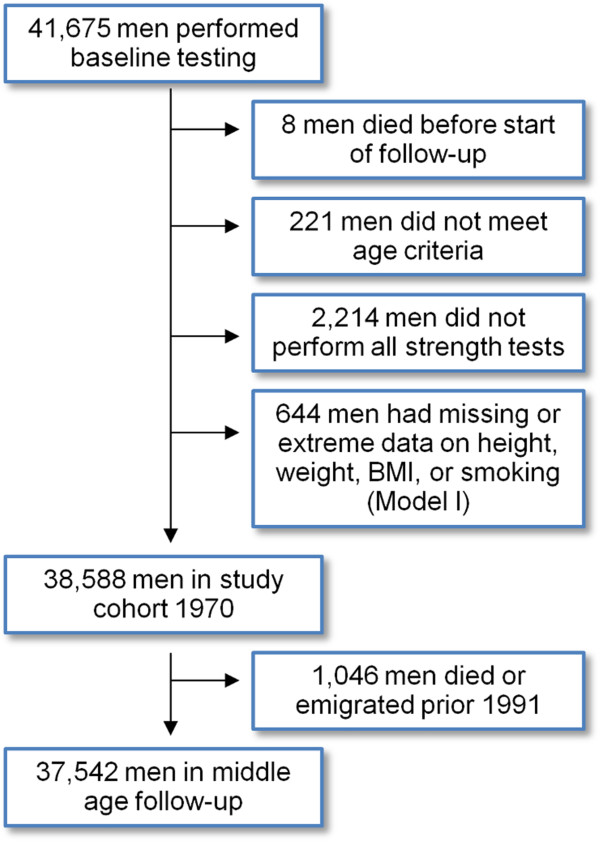
BACKGROUND: Ischemic heart disease and stroke are two severe types of cardiovascular disease (CVD), a major contributor to the global burden of disease. The preventive framework currently includes promotion of both adequate cardiorespiratory and muscular fitness. Although muscle fitness is established as an indicator of health, it is currently unknown whether muscle strength is associated with later CVD independently of cardiorespiratory fitness. METHODS: We studied 38,588 Swedish men who in 1969 to 1970 (typically aged 18 years) completed compulsory conscription. Using the mean standardized score of three isometric muscle strength tests performed at conscription (hand grip, elbow flexion and knee extension), we categorized the subjects into three groups with the 25th to 75th percentile defining the reference category. We followed the cohort until 2012 for diagnosed CVD events and mortality via national health care registers and the national cause of death register. To estimate hazard ratios (HR) for CVD events (coronary heart disease or stroke) and CVD mortality we used Cox proportional hazard models adjusted for body mass index, smoking, alcohol consumption, cardiorespiratory fitness and socioeconomic status. RESULTS: Men with high muscle strength in adolescence had a decreased risk of later CVD events (HR 0.88, 95% confidence interval 0.77 to 0.99), whereas we observed no increased risk in men with low muscle strength (0.99, 0.86 to 1.13). However, low muscle strength was associated with increased risk of CVD mortality during middle age (1.31, 1.02 to 1.67). CONCLUSIONS: Muscle strength in adolescent men is inversely associated with later CVD events and CVD mortality in middle age, independently of cardiorespiratory fitness and other important confounders. Thus, the role of muscle fitness in the prevention and pathogenesis of CVD warrants increased attention.
Overview
The claims and statistics of this paper haven’t been checked yet.
Run the check — free, no account needed. It reads the open-access text and checks the sources it cites.
Integrity signals
Registry
Cites
Statistics
Figures
Verification
Claims the paper makes
The claims and statistics of this paper haven’t been checked yet.
Run the check — free, no account needed. It reads the open-access text and checks the sources it cites.
Claims other papers make about this one
Each is checked against this paper’s own text: does it say what the citing paper says it does?
The source backs part of the claim, not all of it — or backs it for a different population, condition or comparison.
In the citing paper
“Low muscle strength is associated with lower functional capacity, and it has been shown that muscle strength is inversely related to the risk of mortality and cardiovascular disease [1].”
From Beneficial Effects of Asparagus officinalis Extract Supplementation on Muscle Mass and Strength following Resistance Training and Detraining in Healthy Males (2023) · cites this paper as [1]
Experimental — accuracy not yet measured
Self-check
Percentages, sums and reported differences re-computed from the paper’s own numbers.
The self-check needs the paper’s full text.
Citations
Cites
von Elm, E., Altman, D. G., Egger, M., Pocock, S. J., Gøtzsche, P. C., Vandenbroucke, J. P., & Initiative, F. T. S. (2007) · PLoS Medicine · doi:10.1371/journal.pmed.0040296 · Cited by 23,020
A Proportional Hazards Model for the Subdistribution of a Competing Risk
Fine, J. P., & Gray, R. J. (1999) · Journal of the American Statistical Association · doi:10.1080/01621459.1999.10474144 · Cited by 14,290
Elm, E. V., Altman, D. G., Egger, M., Pocock, S. J., Gøtzsche, P. C., & Vandenbroucke, J. P. (2007) · BMJ · doi:10.1136/bmj.39335.541782.ad · Cited by 10,766
Murray, C. J. L., Vos, T., Lozano, R., Naghavi, M., Flaxman, A. D., Michaud, C., Ezzati, M., Shibuya, K., Salomon, J. A., Abdalla, S., et al. (2012) · The Lancet · doi:10.1016/s0140-6736(12)61689-4 · Cited by 8,888
European Guidelines on cardiovascular disease prevention in clinical practice (version 2012)
Authors/Task Force Members:, Perk, J., De Backer, G., Gohlke, H., Graham, I., Reiner, Ž., Verschuren, M., Albus, C., Benlian, P., Boysen, G., et al. (2012) · European Heart Journal · doi:10.1093/eurheartj/ehs092 · Cited by 8,490
External review and validation of the Swedish national inpatient register
Ludvigsson, J. F., Andersson, E., Ekbom, A., Feychting, M., Kim, J.-L., Reuterwall, C., Heurgren, M., & Olausson, P. O. (2011) · BMC Public Health · doi:10.1186/1471-2458-11-450 · Cited by 5,055
European guidelines on cardiovascular disease prevention in clinical practice: executive summary
Graham, I., Atar, D., Borch‐Johnsen, K., Boysen, G., Burell, G. K., Cífková, R., Dallongeville, J., Backer, G. D., Ebrahim, S. B. J., Gjelsvik, B., et al. (2007) · European Heart Journal · doi:10.1093/eurheartj/ehm316 · Cited by 3,865
Age-predicted maximal heart rate revisited
Tanaka, H., Monahan, K. D., & Seals, D. R. (2001) · Journal of the American College of Cardiology · doi:10.1016/s0735-1097(00)01054-8 · Cited by 3,775 · cited 1×
“5) [22].”
Kodama, S. (2009) · JAMA · doi:10.1001/jama.2009.681 · Cited by 3,035
Physical Fitness and All-Cause Mortality: A Prospective Study of Healthy Men and Women
Blair, S. N. (1989) · JAMA · doi:10.1001/jama.1989.03430170057028 · Cited by 2,658
Research works printed but not linked: 3
- World Health Organization: Global recommendations on physical activity for health. 2010, Geneva, Switzerland: World Health Organization
- Nordesjo LO, Schéle R: Validity of ergometer cycle test and measures of isometric muscle strength when predicting some aspects of military performance. Swedish J Defence Med. 1974, 10: 11-23.
- Nordesjo LO: A comparison between the Thornvall maximal ergometer test, submaximal ergometer tests and maximal oxygen uptake. Swedish J Defence Med. 1974, 10: 3-10.
Cited by
Sorted by citations
García-Hermoso, A., Cavero-Redondo, I., Ramírez-Vélez, R., Ruiz, J. R., Ortega, F. B., Lee, D.-C., & Martínez-Vizcaíno, V. (2018) · Archives of Physical Medicine and Rehabilitation · doi:10.1016/j.apmr.2018.01.008 · Cited by 609
Associations of Fitness, Physical Activity, Strength, and Genetic Risk With Cardiovascular Disease
Tikkanen, E., Gustafsson, S., & Ingelsson, E. (2018) · Circulation · doi:10.1161/circulationaha.117.032432 · Cited by 265
Ahtiainen, J. P., Walker, S., Peltonen, H., Holviala, J., Sillanpää, E., Karavirta, L., Sallinen, J., Mikkola, J., Valkeinen, H., Mero, A., et al. (2016) · AGE · doi:10.1007/s11357-015-9870-1 · Cited by 231
Sarcopenic obesity in ageing: cardiovascular outcomes and mortality
Atkins, J. L., & Wannamathee, S. G. (2020) · British Journal of Nutrition · doi:10.1017/s0007114520002172 · Cited by 187
Muscular Strength and Cardiovascular Disease
Carbone, S., Kirkman, D. L., Garten, R. S., Rodriguez‐Miguelez, P., Artero, E. G., Lee, D.-C., & Lavie, C. J. (2020) · Journal of Cardiopulmonary Rehabilitation and Prevention · doi:10.1097/hcr.0000000000000525 · Cited by 151
Hand grip strength: Reference values for adults and elderly people of Rio Branco, Acre, Brazil
Amaral, C. D. A., Amaral, T. L. M., Monteiro, G. T. R., de Vasconcellos, M. T. L., & Portela, M. C. (2019) · PLoS ONE · doi:10.1371/journal.pone.0211452 · Cited by 135
Henriksson, H., Henriksson, P., Tynelius, P., Ekstedt, M., Berglind, D., Labayen, I., Ruiz, J. R., Lavie, C. J., & Ortega, F. B. (2019) · European Heart Journal · doi:10.1093/eurheartj/ehz774 · Cited by 131
Tomkinson, G. R., Kaster, T., Dooley, F. L., Fitzgerald, J. S., Annandale, M., Ferrar, K., Lang, J. J., & Smith, J. J. (2020) · Sports Medicine · doi:10.1007/s40279-020-01394-6 · Cited by 110
Venckūnas, T., Emeljanovas, A., Miežienė, B., & Volbekienė, V. (2016) · Journal of Epidemiology & Community Health · doi:10.1136/jech-2016-207307 · Cited by 101
Hagström, H., Tynelius, P., & Rasmussen, F. E. (2017) · Gut · doi:10.1136/gutjnl-2016-313622 · Cited by 98
Henriksson, H., Henriksson, P., Tynelius, P., & Ortega, F. B. (2018) · British Journal of Sports Medicine · doi:10.1136/bjsports-2017-098723 · Cited by 86
Role of dietary protein and muscular fitness on longevity and aging
Strasser, B., Volaklis, K., Fuchs, D., & Burtscher, M. (2018) · Aging and Disease · doi:10.14336/ad.2017.0202 · Cited by 78
van der Kooi, A.-L. L. F., Snijder, M. B., Peters, R. J. G., & van Valkengoed, I. G. M. (2015) · PLoS ONE · doi:10.1371/journal.pone.0137739 · Cited by 68
Lindgren, M., Åberg, M., Schaufelberger, M., Åberg, N. D., Schiöler, L., Torén, K., & Rosengren, A. (2017) · European Journal of Preventive Cardiology · doi:10.1177/2047487317689974 · Cited by 65
Development and validation of the short-form adolescent health promotion scale
Chen, M., Lai, L.-J., Chen, H.-C., & Gaete, J. (2014) · BMC Public Health · doi:10.1186/1471-2458-14-1106 · Cited by 64
Association between Resting Heart Rate and Health-Related Physical Fitness in Brazilian Adolescents
Silva, D. A. S., de Lima, T. R., & Tremblay, M. S. (2018) · BioMed Research International · doi:10.1155/2018/3812197 · Cited by 59
Frailty and risk of cardiovascular disease and mortality
Liu, X., Tou, N. X., Gao, Q., Gwee, X., Wee, S. L., & Ng, T. P. (2022) · PLoS ONE · doi:10.1371/journal.pone.0272527 · Cited by 59
Minn, Y., & Suk, S. (2017) · BMC Geriatrics · doi:10.1186/s12877-017-0433-4 · Cited by 57
Åberg, N. D., Kuhn, H. G., Nyberg, J., Wærn, M., Friberg, P., Svensson, J., Torén, K., Rosengren, A., Åberg, M., & Nilsson, M. (2015) · Stroke · doi:10.1161/strokeaha.115.009008 · Cited by 57
Muscle Fitness Cut Points for Early Assessment of Cardiovascular Risk in Children and Adolescents
Castro‐Piñero, J., Pérez‐Bey, A., Cuenca‐García, M., Cabanas-Sanchez, V., Gómez-Martínez, S., Veiga, O. L., Marcos, A., Ruiz, J. R., Marcos, A., Gomez-Martinez, S., et al. (2018) · The Journal of Pediatrics · doi:10.1016/j.jpeds.2018.10.026 · Cited by 54
Association of Body Shape Index (ABSI) with Hand Grip Strength
Krakauer, N. Y., & Krakauer, J. C. (2020) · International Journal of Environmental Research and Public Health · doi:10.3390/ijerph17186797 · Cited by 50
Kristensen, O. H., Stenager, E., & Dalgas, U. (2016) · Archives of Physical Medicine and Rehabilitation · doi:10.1016/j.apmr.2016.05.023 · Cited by 46
Secular Trends in the Physical Fitness of United States Army Recruits on Entry to Service, 1975–2013
Knapik, J. J., Sharp, M. A., & Steelman, R. A. (2017) · The Journal of Strength and Conditioning Research · doi:10.1519/jsc.0000000000001928 · Cited by 51
He, H., Li, P., Du, J., Liu, F., Jin, Y., Ma, J., Wang, L., Jia, P., Hu, Z., & Shan, G. (2019) · BMC Pediatrics · doi:10.1186/s12887-019-1477-8 · Cited by 42
Millward, D. J. (2021) · Nutrients · doi:10.3390/nu13030729 · Cited by 44
Landi, F., Calvani, R., Picca, A., Tosato, M., Martone, A. M., Ortolani, E., Salini, S., Pafundi, T., Savera, G., Pantanelli, C., et al. (2018) · European Journal of Public Health · doi:10.1093/eurpub/cky034 · Cited by 41
Xu, Y., Wen, Z., Deng, K., Li, R., Yu, Q. S., & Xiao, S. (2021) · PLoS ONE · doi:10.1371/journal.pone.0260521 · Cited by 41
Emeljanovas, A., Miežienė, B., Česnaitienė, V. J., Fjørtoft, I., & Kjønniksen, L. (2019) · The Journal of Strength and Conditioning Research · doi:10.1519/jsc.0000000000003387 · Cited by 39
May the Force Be with Youth: Foundational Strength for Lifelong Development
Faigenbaum, A. D., Ratamess, N. A., Kang, J., Bush, J. A., & Rebullido, T. R. (2023) · Current Sports Medicine Reports · doi:10.1249/jsr.0000000000001122 · Cited by 38
Unhjem, R., Flemmen, G., Hoff, J., & Wang, E. (2016) · BMC Sports Science Medicine and Rehabilitation · doi:10.1186/s13102-016-0032-2 · Cited by 38
Lee, K.-J., Noh, B., & An, K.-O. (2021) · International Journal of Environmental Research and Public Health · doi:10.3390/ijerph181910305 · Cited by 37
Active and strong: physical activity, muscular strength, and metabolic risk in children
Gomes, T. N., dos Santos, F. K., Katzmarzyk, P. T., & Maia, J. A. R. (2016) · American Journal of Human Biology · doi:10.1002/ajhb.22904 · Cited by 37
Secular trends in muscular fitness from 1983 to 2014 among Slovenian children and adolescents
Đurić, S., Sember, V., Starc, G., Sorić, M., Kovač, M., & Jurak, G. (2021) · Scandinavian Journal of Medicine and Science in Sports · doi:10.1111/sms.13981 · Cited by 34
Genetic Risk, Muscle Strength, and Incident Stroke: Findings From the UK Biobank Study
Kim, Y., Hwang, S., Sharp, S. J., Luo, S., Yeung, S. L. A., & Teerlink, C. C. (2021) · Mayo Clinic Proceedings · doi:10.1016/j.mayocp.2021.01.034 · Cited by 34
García‐Esquinas, E., & Rodríguez‐Artalejo, F. (2017) · Clinical Nutrition · doi:10.1016/j.clnu.2017.01.008 · Cited by 34
Díez‐Fernández, A., Martínez‐Vizcaíno, V., Torres-Costoso, A. I., García-Prieto, J. C., Morales, P. F., & Sánchez‐López, M. (2018) · Scandinavian Journal of Medicine and Science in Sports · doi:10.1111/sms.13077 · Cited by 33
Chaabène, H., Ramírez‐Campillo, R., Moran, J., Schega, L., Prieske, O., Sandau, I., Negra, Y., & Behrens, M. (2025) · Sports Medicine · doi:10.1007/s40279-025-02240-3 · Cited by 38
Kasović, M., Štefan, L., & Petrić, V. (2021) · Scientific Reports · doi:10.1038/s41598-021-90745-y · Cited by 29
Neidenbach, R. C., Oberhoffer, R., Pieper, L., Freilinger, S., Ewert, P., Kaemmerer, H. M., Nagdyman, N., Hager, A., & Müller, J. (2019) · Cardiovascular Diagnosis and Therapy · doi:10.21037/cdt.2019.09.16 · Cited by 28
Vilela, B. L., Benedito‐Silva, A. A., de Lira, C. A. B., & Andrade, M. S. (2015) · Journal of Occupational and Environmental Medicine · doi:10.1097/jom.0000000000000393 · Cited by 28
Drenowatz, C. J., & Greier, K. (2019) · Translational Pediatrics · doi:10.21037/tp.2019.09.03 · Cited by 25
Physical Activity and Exercise for Cardiorespiratory Health and Fitness in Chronic Kidney Disease
Gollie, J. M., Cohen, S. D., & Patel, S. S. (2022) · Reviews in Cardiovascular Medicine · doi:10.31083/j.rcm2308273 · Cited by 27
Ramírez‐Vélez, R., Correa‐Bautista, J. E., Ojeda-Pardo, M. L., Sandoval-Cuéllar, C., García‐Hermoso, A., Carrillo, H. A., González‐Ruíz, K., Prieto‐Benavides, D. H., Tordecilla‐Sanders, A., Martinkėnas, A., et al. (2018) · Nutrients · doi:10.3390/nu10040511 · Cited by 24
Trekking exercise promotes cardiovascular health and fitness benefits in older obese women
Kang, S.-J. (2014) · Journal of Exercise Rehabilitation · doi:10.12965/jer.140136 · Cited by 22
Temporal Trends in the Physical Fitness of Hong Kong Adolescents Between 1998 and 2015
Poon, E. T., Tomkinson, G. R., Huang, Y., & Wong, S. H. (2022) · International Journal of Sports Medicine · doi:10.1055/a-1738-2072 · Cited by 22
Calleja, M., Feitoza, N. C., Falk, B., Klentrou, P., Ward, W. E., Sullivan, P., & Josse, A. R. (2020) · Pediatric Obesity · doi:10.1111/ijpo.12690 · Cited by 23
Morikawa, S. Y., Fujihara, K., Hatta, M., OSAWA, T., Ishizawa, M., Yamamoto, M., Furukawa, K., Ishiguro, H., Matsunaga, S., Ogawa, Y., et al. (2017) · Pediatric Diabetes · doi:10.1111/pedi.12623 · Cited by 19
Knapik, J. J., Redmond, J. E., Grier, T., & Sharp, M. A. (2018) · Military Medicine · doi:10.1093/milmed/usx093 · Cited by 20
Paredes, L. L.-C., Valdés-Badilla, P. A., & Guzmán-Muñoz, E. (2021) · Retos · doi:10.47197/retos.v43i0.87756 · Cited by 19
FLEISZER, D. M., Hoover, M. L., Posel, N. H., Razek, T. S., & Bergman, S. (2017) · Journal of surgical education · doi:10.1016/j.jsurg.2017.08.024 · Cited by 19
Chinese Hukou Policy and Rural-to-Urban Migrants’ Health: Evidence from Matching Methods
Bengoa, M., & Rick, C. (2019) · Eastern Economic Journal · doi:10.1057/s41302-019-00158-z · Cited by 18
Noh, K.-W., Seo, E.-K., & Park, S. (2024) · Medicina · doi:10.3390/medicina60071186 · Cited by 15
Arazi, H., Jalali-Fard, A., & Abdinejad, H. (2016) · Physical Activity Review · doi:10.16926/par.2016.04.02 · Cited by 15
Post-natal muscle growth and protein turnover: a narrative review of current understanding
Millward, D. J. (2023) · Nutrition Research Reviews · doi:10.1017/s0954422423000124 · Cited by 15
Normal-weight obesity subtypes and 10-year risks of major vascular diseases in 0.3 million adults
Wang, M., Xu, K., Yang, J., Bennett, D., Du, H., & Liu, X. (2024) · Clinical Nutrition · doi:10.1016/j.clnu.2024.12.027 · Cited by 13
The relationship between serum folate and grip strength in American adults
Zhang, L., Sun, J., Li, Z., & Zhang, D. (2021) · Archives of Osteoporosis · doi:10.1007/s11657-021-00937-2 · Cited by 13
Huang, Z., Li, S., Lu, F., Tian, K., & Peng, L. (2023) · Preventive Medicine Reports · doi:10.1016/j.pmedr.2023.102460 · Cited by 13
Huang, Z., Wang, W., Huo, K., Wang, Y., & Tian, K. (2025) · BMC Public Health · doi:10.1186/s12889-025-22350-x · Cited by 13
DUCLOS, M., Lacomme, P., Lambert, C., Pereira, B., Ren, L., Fleury, G., OVIGNEUR, H., DESCHAMPS, T., FEARNBACH, N., Vanhelst, J., et al. (2022) · The Journal of Sports Medicine and Physical Fitness · doi:10.23736/s0022-4707.21.12203-0 · Cited by 12
Sushmitha, S., Kothari, R., Mittal, G. K., Gopani, M., Prashanth, A., Bokariya, P., Vemparala, S. S., Tamrakar, S., Abishek, S., & Bennita, A. (2023) · Cureus · doi:10.7759/cureus.40874 · Cited by 12
Relevance of Physical Fitness and Cardiovascular Disease Risk
Huang, C.-P., & Chen, W. (2021) · Circulation Journal · doi:10.1253/circj.cj-20-0510 · Cited by 12
(2018) · European Journal of Contemporary Education · doi:10.13187/ejced.2018.4.717 · Cited by 12
Leg strength and incidence of heart failure in patients with acute coronary syndrome
Ueno, K., Kamiya, K., Hamazaki, N., Nozaki, K., Ichikawa, T., Yamashita, M., Uchida, S., Noda, T., Miki, T., Hotta, K., et al. (2023) · European Journal of Preventive Cardiology · doi:10.1093/eurjpc/zwad406 · Cited by 11
MUSCLE STRENGTH TEST PERFORMANCE CHANGES OVER TIME IN SERBIAN CHILDREN
Kocić, J., Stojanović, D., Stanković, S., Petrović, L., Ignjatović, A., Savić, Z., Milenković, V., Stojanović, T., & Momčilović, Z. (2019) · Acta Medica Medianae · doi:10.5633/amm.2019.0223 · Cited by 11
Fitness Equals Longer Life Expectancy Regardless of Adiposity Levels
Laukkanen, J. A., & Kunutsor, S. K. (2019) · Mayo Clinic Proceedings · doi:10.1016/j.mayocp.2019.04.016 · Cited by 12
Phoemsapthawee, J., & Sriton, B. (2021) · The Journal of Sports Medicine and Physical Fitness · doi:10.23736/s0022-4707.20.11222-2 · Cited by 10
Valores de fuerza prensil por dinamometría manual en universitarios de Colombia
Vivas-Díaz, J. A., Ramírez‐Vélez, R., Correa‐Bautista, J. E., & Izquierdo, M. (2016) · Nutrición Hospitalaria · doi:10.20960/nh.113 · Cited by 10
Koh, I., Minn, Y., & Suk, S. (2019) · International Journal of Environmental Research and Public Health · doi:10.3390/ijerph16162840 · Cited by 10
Karabinus, J. A., DeBlois, J. P., Keller, A., Glasgow, A. C., Barreira, T. V., & Heffernan, K. S. (2020) · International Journal of Sports Medicine · doi:10.1055/a-1236-4063 · Cited by 11
Ferrari, G., Matsudo, V. K. R., & Fisberg, M. (2015) · Revista Paulista de Pediatria (English Edition) · doi:10.1016/j.rppede.2015.03.001 · Cited by 9
Noh, K.-W., & Park, S. (2023) · Physical Activity and Nutrition · doi:10.20463/pan.2023.0033 · Cited by 10
Ferrari, G., Matsudo, V. K. R., & Fisberg, M. (2015) · Revista Paulista de Pediatria · doi:10.1016/j.rpped.2015.03.008 · Cited by 9
Luo, L., Xu, J., Jiang, R., Yao, B., & Di, J. (2022) · Environmental Science and Pollution Research · doi:10.1007/s11356-022-23998-3 · Cited by 9
Wakeham, D. J., Pierce, G. L., & Heffernan, K. S. (2025) · Pulse · doi:10.1159/000543314 · Cited by 8
Shi, H., Li, J. P., Li, F., Yu, H., Zhang, F., Wu, T., Yang, L., Li, Y., Hu, R., Chen, M., et al. (2025) · Advanced Science · doi:10.1002/advs.202408912 · Cited by 8
Rips, L., Toom, A., Kuik, R., Varblane, A., Mölder, H., Tammaru, M., Kull, M., Ööpik, V., Kartus, J.-T., Gapeyeva, H., et al. (2022) · Journal of the International Society of Sports Nutrition · doi:10.1080/15502783.2022.2100718 · Cited by 8
Chulvi‐Medrano, I., Faigenbaum, A. D., & Cortell-Tormo, J. M. (2018) · Retos · doi:10.47197/retos.v0i33.52314 · Cited by 9
Physical Fitness Among Adolescents Who are Hispanic With Overweight or Obesity
Benzo, R. M., George, S. M. S., Messiah, S. E., Lovan, P., Leite, R. O., Patel, A., Lee, T. K., & Prado, G. J. (2023) · Pediatric Physical Therapy · doi:10.1097/pep.0000000000000997 · Cited by 7
Lee, K.-J., Seo, K.-W., & Lee, K. (2021) · Exercise Science · doi:10.15857/ksep.2021.30.2.229 · Cited by 7
C-Reactive Protein Is Associated with Physical Fitness in Breast Cancer Survivors
Romero-Elias, M., Álvarez‐Bustos, A., Cantos, B., Maximiano, C., Méndez, M., Méndez, M., de Pedro, C. G., Rosado, S., Sánchez, A., García-González, D., et al. (2022) · Journal of Clinical Medicine · doi:10.3390/jcm12010065 · Cited by 7
Denben, B., Sripinyowanich, S., Ruangthai, R., & Phoemsapthawee, J. (2023) · Sports · doi:10.3390/sports11090175 · Cited by 6
Resistance training effects on pubertal children with a risk of developing pediatric dynapenia
Ruas, C. V., Ratel, S., Nosaka, K., Castellano, G., & Pinto, R. S. (2024) · European Journal of Applied Physiology · doi:10.1007/s00421-024-05436-z · Cited by 6
Zhang, S., Hu, X., Liu, M., Jin, J., Liu, J., Li, G., Ou, Y., & Dong, H. (2025) · Aging Clinical and Experimental Research · doi:10.1007/s40520-025-03094-5 · Cited by 5
Madhanagopal, J., Singh, O. P., Mohan, V., Sathasivam, K. V., Omar, A. H., & Kadir, M. R. A. (2017) · Evaluation & the Health Professions · doi:10.1177/0163278717727568 · Cited by 5
Smidt, M. F.-D., Bergman, F., Grönlund, C., Hult, A., Norberg, M., Wennberg, M., & Wennberg, P. (2023) · European Journal of Preventive Cardiology · doi:10.1093/eurjpc/zwad007 · Cited by 5
Herranen, P., Waller, K. L., Joensuu, L., Palviainen, T., Laakkonen, E. K., Kaprio, J. A., & Sillanpää, E. (2025) · Journal of the American Heart Association · doi:10.1161/jaha.124.036941 · Cited by 3
Marques, A., Demetriou, Y., Popovic, S. R., Gardašević, J., Mašanović, B., Martins, J., Gouveia, É. R., Tsiatsos, Τ., Douka, S., Jarani, J., et al. (2023) · American Journal of Human Biology · doi:10.1002/ajhb.23989 · Cited by 3
Izquierdo‐Gómez, R., Esteban‐Cornejo, I., Cabanas‐Sánchez, V., Marcos, A., Gómez‐Martínez, S., Castro‐Piñero, J., Veiga, Ó. L., & on behalf of the UP&DOWN Study Group (2023) · Journal of Intellectual & Developmental Disability · doi:10.3109/13668250.2023.2188876 · Cited by 3
Risco cardiovascular e o papel da aptidão física para o bombeiro militar
Noqueira, R. N., Saint-Martin, D. R. F., Soares, E. D. M. K. V. K., Barbosa, J. P. A., Barreto, K. A., Silva, M. D. C., Segedi, L. C., da Cruz, C. J. G., Garcia, G. L., Barbosa, W. G., et al. (2021) · Revista do Sistema Único de Segurança Pública · doi:10.56081/2763-9940/revsusp.v1n1.a7 · Cited by 2
Músculo activo, una maquinaria compleja y eficiente. Revisión narrativa
Médico Cardiólogo, S. V. D. C., & Rodulfo, I. A. (2023) · Medicina Interna · doi:10.71035/rsvmi.2023.39.4.2 · Cited by 2
Kimura, T., Ushigome, E., Hashimoto, Y., Nakanishi, N., Hamaguchi, M., Asano, M., Yamazaki, M., & Fukui, M. (2021) · Journal of Clinical Medicine · doi:10.3390/jcm10091913 · Cited by 2
Loe, H., Mosti, M. P., Wisløff, U., Haberstroh, C., & Flemmen, G. (2022) · BMJ Open · doi:10.1136/bmjopen-2022-061014 · Cited by 4
Caballero, L. G. R., Mantilla, E. D. G., López, A. L. M., Bernal, M. A. P., & Llorente, L. L. I. (2024) · MHSALUD Revista en Ciencias del Movimiento Humano y Salud · doi:10.15359/mhs.21-1.16863 · Cited by 2
Samuel, C., & David, D. (2015) · CHRISMED Journal of Health and Research · doi:10.4103/2348-3334.158687 · Cited by 2
The effect of Hukou registration policy on rural-to-urban migrants' health
Bengoa, M., & Rick, C. (2018) · Working Paper Series · doi:10.35188/unu-wider/2018/470-4 · Cited by 2
The Diabetes Epidemic in the South Pacific: A Pilot Study Utilising Hand Grip Strength in Tonga
Zioupos, M. E. (2019) · Archives of Diabetes & Obesity · doi:10.32474/ado.2019.02.000129 · Cited by 2
Handgrip Strength-Related Factors in a Colombian Hypertensive Population: A Cross-Sectional Study
Rivas-Campo, Y., Laverde, E. P. M., Aibar‐Almazán, A., Jiménez‐García, J. D., Martínez‐Amat, A., García-Garro, P. A., Muñoz-Perete, J. M., García-Sillero, M., & Castellote‐Caballero, Y. (2022) · International Journal of Environmental Research and Public Health · doi:10.3390/ijerph19063726 · Cited by 2
Obesity and Health Risk Factors in Czech Artillery Soldiers
Simsa, J., Musálek, M., Sýkora, K. V., Kinkorová, I., Maleček, J., Vágner, M., & Wawrzacz, L. (2025) · Military Medicine · doi:10.1093/milmed/usaf600 · Cited by 1
Sun, J., Chen, Y., Zang, J., Xiao, F., Yuan, W., Wang, X., Wang, Z., Jurong, Z., Peng, X., Li, Y., et al. (2026) · Journal of the American Medical Directors Association · doi:10.1016/j.jamda.2025.106065 · Cited by 1
Lee, J., & Yoo, K.-H. (2022) · Journal of Men s Health · doi:10.22514/jomh.2022.009 · Cited by 1
Metadata
- Authors
- Timpka, S., Petersson, I. F., Zhou, C., & Englund, M.
- Affiliations
- Lund University (SE)
- Boston University (US)
- Corresponding author
- Timpka, Simon
- Venue
- BMC Medicine
- Published
- 2014-04-14
- Volume
- 12
- Issue
- 1
- Pages
- 62-62
- ISSN
- 1741-7015 (ISSN-L)
- PMC
- PMC4006633
- OpenAlex
- W2090650334
- Cited by
- 120
- References
- 42
- Citations by year
- 2026: 3 · 2025: 8 · 2024: 6 · 2023: 12 · 2022: 14 · 2021: 18 · 2020: 6 · 2019: 11 · 2018: 16 · 2017: 10 · 2016: 7 · 2015: 6 · 2014: 2
- FWCI
- 5.54
- Type
- journal article
- Language
- en
- Open access
- gold
- doi.org
- Licence
- Locations
- BMC Medicine (publishedVersion, cc-by)
- Europe PMC (PubMed Central) (publishedVersion, cc-by)
- PubMed Central (publishedVersion, cc-by)
- PubMed (publishedVersion)
- Lund University Publications (Lund University) (submittedVersion, other-oa)
- Funders
- Lunds Universitet
- Vetenskapsrådet
- Topics
- Health Sciences › Medicine › Public Health, Environmental and Occupational Health › Physical Activity and Health
- Health Sciences › Medicine › Physiology (medical) › Cardiovascular and exercise physiology
- Health Sciences › Medicine › Cardiology and Cardiovascular Medicine › Cardiovascular Health and Risk Factors
- Keywords
- muscle strength, muscular fitness, cardiovascular disease, cardiovascular mortality, coronary artery disease, stroke, adolescence, middle age (human life stage), cardiorespiratory fitness, grip strength, knee extension, elbow flexion, cardiovascular disease prevention
- MeSH terms
- Adolescent, Age Factors, Alcohol Drinking, Cardiovascular Diseases, Cardiovascular Physiological Phenomena, Coronary Disease, Health Status, Humans, Male, Middle Aged, Physical Fitness, Prospective Studies, Respiratory Physiological Phenomena, Risk, Smoking, Social Class, Socioeconomic Factors, Cohort Studies, Body Mass Index, Proportional Hazards Models, Hand Strength, Stroke, Muscle Strength
About these checks
Registry, retraction, Cites and statistics results are computed, not judged, with one exception: a printed reference that no index lists is read once by a model before it counts as a citation error. Claims are extracted by a model and kept only when their quote appears verbatim in the text; each cited source is then checked, with a model’s help, for whether it says what the claim relies on. Those verdicts can be wrong — read the claim’s quote and the cited source before relying on one.
Statistics and arithmetic are recomputed, not judged.
Confidence bands are shown only for fields calibrated on our annotated test set. None is calibrated yet, so no band is shown.
What counts as a claim ›How we measure confidence ›How we check this ›
Are you an author, or do you see a problem with this page? Request a review
