

The DOI matches its Crossref record; 42 of the 43 references it cites were found in a registry or an index.
Muscle strength in adolescent men and risk of cardiovascular disease events and mortality in middle age: a prospective cohort study
Open accessAbstract
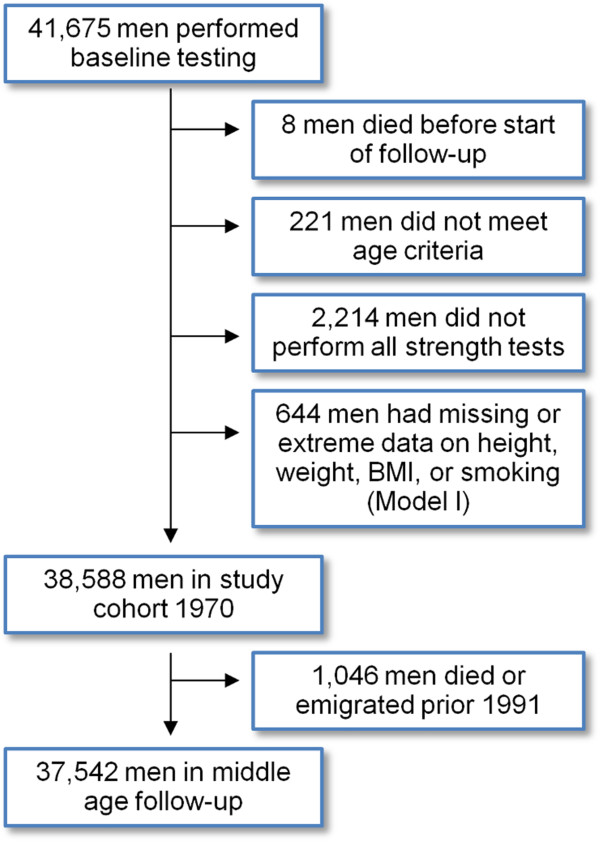
BACKGROUND: Ischemic heart disease and stroke are two severe types of cardiovascular disease (CVD), a major contributor to the global burden of disease. The preventive framework currently includes promotion of both adequate cardiorespiratory and muscular fitness. Although muscle fitness is established as an indicator of health, it is currently unknown whether muscle strength is associated with later CVD independently of cardiorespiratory fitness. METHODS: We studied 38,588 Swedish men who in 1969 to 1970 (typically aged 18 years) completed compulsory conscription. Using the mean standardized score of three isometric muscle strength tests performed at conscription (hand grip, elbow flexion and knee extension), we categorized the subjects into three groups with the 25th to 75th percentile defining the reference category. We followed the cohort until 2012 for diagnosed CVD events and mortality via national health care registers and the national cause of death register. To estimate hazard ratios (HR) for CVD events (coronary heart disease or stroke) and CVD mortality we used Cox proportional hazard models adjusted for body mass index, smoking, alcohol consumption, cardiorespiratory fitness and socioeconomic status. RESULTS: Men with high muscle strength in adolescence had a decreased risk of later CVD events (HR 0.88, 95% confidence interval 0.77 to 0.99), whereas we observed no increased risk in men with low muscle strength (0.99, 0.86 to 1.13). However, low muscle strength was associated with increased risk of CVD mortality during middle age (1.31, 1.02 to 1.67). CONCLUSIONS: Muscle strength in adolescent men is inversely associated with later CVD events and CVD mortality in middle age, independently of cardiorespiratory fitness and other important confounders. Thus, the role of muscle fitness in the prevention and pathogenesis of CVD warrants increased attention.
Overview
The claims and statistics of this paper haven’t been checked yet.
Run the check — free, no account needed. It reads the open-access text and checks the sources it cites.
Integrity signals
Registry
Cites
Statistics
Figures
Verification
Claims the paper makes
The claims and statistics of this paper haven’t been checked yet.
Run the check — free, no account needed. It reads the open-access text and checks the sources it cites.
Claims other papers make about this one
Each is checked against this paper’s own text: does it say what the citing paper says it does?
The source backs part of the claim, not all of it — or backs it for a different population, condition or comparison.
In the citing paper
“Low muscle strength is associated with lower functional capacity, and it has been shown that muscle strength is inversely related to the risk of mortality and cardiovascular disease [1].”
From Beneficial Effects of Asparagus officinalis Extract Supplementation on Muscle Mass and Strength following Resistance Training and Detraining in Healthy Males (2023) · cites this paper as [1]
Experimental — accuracy not yet measured
Self-check
Percentages, sums and reported differences re-computed from the paper’s own numbers.
The self-check needs the paper’s full text.
Citations
Cites
von Elm, E., Altman, D. G., Egger, M., Pocock, S. J., Gøtzsche, P. C., Vandenbroucke, J. P., & Initiative, F. T. S. (2007) · PLoS Medicine · doi:10.1371/journal.pmed.0040296 · Cited by 23,020
A Proportional Hazards Model for the Subdistribution of a Competing Risk
Fine, J. P., & Gray, R. J. (1999) · Journal of the American Statistical Association · doi:10.1080/01621459.1999.10474144 · Cited by 14,290
Elm, E. V., Altman, D. G., Egger, M., Pocock, S. J., Gøtzsche, P. C., & Vandenbroucke, J. P. (2007) · BMJ · doi:10.1136/bmj.39335.541782.ad · Cited by 10,766
Murray, C. J. L., Vos, T., Lozano, R., Naghavi, M., Flaxman, A. D., Michaud, C., Ezzati, M., Shibuya, K., Salomon, J. A., Abdalla, S., et al. (2012) · The Lancet · doi:10.1016/s0140-6736(12)61689-4 · Cited by 8,888
European Guidelines on cardiovascular disease prevention in clinical practice (version 2012)
Authors/Task Force Members:, Perk, J., De Backer, G., Gohlke, H., Graham, I., Reiner, Ž., Verschuren, M., Albus, C., Benlian, P., Boysen, G., et al. (2012) · European Heart Journal · doi:10.1093/eurheartj/ehs092 · Cited by 8,490
External review and validation of the Swedish national inpatient register
Ludvigsson, J. F., Andersson, E., Ekbom, A., Feychting, M., Kim, J.-L., Reuterwall, C., Heurgren, M., & Olausson, P. O. (2011) · BMC Public Health · doi:10.1186/1471-2458-11-450 · Cited by 5,055
European guidelines on cardiovascular disease prevention in clinical practice: executive summary
Graham, I., Atar, D., Borch‐Johnsen, K., Boysen, G., Burell, G. K., Cífková, R., Dallongeville, J., Backer, G. D., Ebrahim, S. B. J., Gjelsvik, B., et al. (2007) · European Heart Journal · doi:10.1093/eurheartj/ehm316 · Cited by 3,865
Age-predicted maximal heart rate revisited
Tanaka, H., Monahan, K. D., & Seals, D. R. (2001) · Journal of the American College of Cardiology · doi:10.1016/s0735-1097(00)01054-8 · Cited by 3,775 · cited 1×
“5) [22].”
Kodama, S. (2009) · JAMA · doi:10.1001/jama.2009.681 · Cited by 3,035
Physical Fitness and All-Cause Mortality: A Prospective Study of Healthy Men and Women
Blair, S. N. (1989) · JAMA · doi:10.1001/jama.1989.03430170057028 · Cited by 2,658
Objectively measured physical capability levels and mortality: systematic review and meta-analysis
Cooper, R., Kuh, D., Hardy, R., Mortality Review Group, & teams, O. B. O. T. F. A. H. S. (2010) · BMJ · doi:10.1136/bmj.c4467 · Cited by 1,166 · cited 1×
“With low muscle fitness being an established predictor of mortality and low health in older populations [4,5], there is also increasing epidemiological evidence that muscle strength is associated with all-cause mortality independently of CRF in adults [6-8].”
BackgroundSkeletal muscle metabolism is a major determinant of resting energy expenditure.
Zurlo, F., Larson, K., Bogardus, C., & Ravussin, E. (1990) · Journal of Clinical Investigation · doi:10.1172/jci114857 · Cited by 959
Association between muscular strength and mortality in men: prospective cohort study
Ruiz, J. R., Sui, X., Lobelo, F., Morrow, J. R., Jackson, A. W., Sjostrom, M., & Blair, S. N. (2008) · BMJ · doi:10.1136/bmj.a439 · Cited by 815
Leon, D. A., Lithell, H. O., Vågerö, D., Koupilová, I., Mohsen, R., Berglund, L., Lithell, U.-B., & McKeigue, P. M. (1998) · BMJ · doi:10.1136/bmj.317.7153.241 · Cited by 807
Muscle strength and body mass index as long-term predictors of mortality in initially healthy men
Rantanen, T., Harris, T., Leveille, S. G., Visser, M., Foley, D., Masaki, K., & Guralnik, J. M. (2000) · The Journals of Gerontology Series A: Biological Sciences and Medical Sciences · doi:10.1093/gerona/55.3.m168 · Cited by 647
Muscular strength in male adolescents and premature death: cohort study of one million participants
Ortega, F. B., Silventoinen, K., Tynelius, P., & Rasmussen, F. (2012) · BMJ · doi:10.1136/bmj.e7279 · Cited by 555
Muscle fiber type is associated with obesity and weight loss
Tanner, C. J., Barakat, H. A., Dohm, G. L., Pories, W. J., MacDonald, K. G., Cunningham, P. R. G., Swanson, M. S., & Houmard, J. A. (2002) · American Journal of Physiology-Endocrinology and Metabolism · doi:10.1152/ajpendo.00416.2001 · Cited by 493
Objective measures of physical capability and subsequent health: a systematic review
Cooper, R., Kuh, D. J., Cooper, C. C., Galé, C. R., Lawlor, D. A., Matthews, F. E., Hardy, R., & Teams, T. F. A. H. S. (2010) · Age and Ageing · doi:10.1093/ageing/afq117 · Cited by 473
Effects of Muscular Strength on Cardiovascular Risk Factors and Prognosis
Artero, E. G., Lee, D.-C., Lavie, C. J., España‐Romero, V., Sui, X., Church, T. S., & Blair, S. N. (2012) · Journal of Cardiopulmonary Rehabilitation and Prevention · doi:10.1097/hcr.0b013e3182642688 · Cited by 468
Hakkinen, K., Newton, R. U., Gordon, S. E., McCormick, M., Volek, J. S., Nindl, B. C., Gotshalk, L. A., Campbell, W. W., Evans, W. J., Hakkinen, A., et al. (1998) · The Journals of Gerontology Series A: Biological Sciences and Medical Sciences · doi:10.1093/gerona/53a.6.b415 · Cited by 423
Authors/Task Force Members:, Perk, J., Backer, G. D., Gohlke, H., Graham, I. D., Reiner, Ž., Verschuren, W. M. M., Albus, C., Benlian, P., Boysen, G., et al. (2012) · European Heart Journal · doi:10.1093/eurheartj/ehs254 · Cited by 390
Oberbach, A., Bossenz, Y., Lehmann, S., Niebauer, J., Adams, V., Paschke, R., Schön, M. R., Blüher, M., & Punkt, K. (2006) · Diabetes Care · doi:10.2337/diacare.29.04.06.dc05-1854 · Cited by 384
Epidemiology and Etiology of Ischemic Stroke in Young Adults Aged 18 to 44 Years in Northern Sweden
Kristensen, B. W., Malm, J., Carlberg, B., Stegmayr, B., Backman, C., Fagerlund, M., & Olsson, T. (1997) · Stroke · doi:10.1161/01.str.28.9.1702 · Cited by 328
Wilson, P. W. F., Garrison, R. J., Castelli, W. P., Feinleib, M., McNamara, P. M., & Kannel, W. B. (1980) · The American Journal of Cardiology · doi:10.1016/0002-9149(80)90516-0 · Cited by 316
Genetic determinism of fiber type proportion in human skeletal muscle
Simoneau, J., & Bouchard, C. (1995) · The FASEB Journal · doi:10.1096/fasebj.9.11.7649409 · Cited by 297
A Prospective Study of Muscular Strength and All-Cause Mortality in Men With Hypertension
Artero, E. G., Lee, D.-C., Ruiz, J. R., Sui, X., Ortega, F. B., Church, T. S., Lavie, C. J., Castillo, M. J., & Blair, S. N. (2011) · Journal of the American College of Cardiology · doi:10.1016/j.jacc.2010.12.025 · Cited by 247
Changes in physical activity and other lifeway patterns influencing longevity
Paffenbarger, R. S., Kampert, J. B., Lee, I.-M. M., Hyde, R. T., Leung, R., & Wing, A. L. (1994) · Medicine & Science in Sports & Exercise · doi:10.1249/00005768-199407000-00008 · Cited by 231
Silventoinen, K., Magnusson, P. K. E., Tynelius, P., Batty, G. D., & Rasmussen, F. E. (2008) · International Journal of Epidemiology · doi:10.1093/ije/dyn231 · Cited by 225
Alcohol and mortality among young men: longitudinal study of Swedish conscripts
Andréasson, S., Allebeck, P., & Romelsjö, A. (1988) · BMJ · doi:10.1136/bmj.296.6628.1021 · Cited by 223
Variability in training-induced skeletal muscle adaptation
Timmons, J. A. (2010) · Journal of Applied Physiology · doi:10.1152/japplphysiol.00934.2010 · Cited by 205
Musculoskeletal fitness and risk of mortality
Katzmarzyk, P. T., & Craig, C. L. (2002) · Medicine & Science in Sports & Exercise · doi:10.1097/00005768-200205000-00002 · Cited by 203
Birth weight and muscle strength: A systematic review and meta-analysis
Dodds, R. M., Denison, H. J., Ntani, G., Cooper, R., Cooper, C. C., Sayer, A. A., & Baird, J. (2012) · The journal of nutrition health & aging · doi:10.1007/s12603-012-0053-9 · Cited by 166
A New Method for Non-Invasive Estimation of Human Muscle Fiber Type Composition
Baguet, A., Everaert, I., Hespel, P., Petrović, M., Achten, E., & Derave, W. (2011) · PLoS ONE · doi:10.1371/journal.pone.0021956 · Cited by 131
ASSESSMENT OF PHYSICAL CAPABILITIES
Tornvall, G. (1963) · Cited by 93
Muscular Strength is Inversely Associated with Aortic Stiffness in Young Men
Fahs, C. A., Heffernan, K. S., Ranadive, S., Jae, S. Y., & Fernhall, B. (2010) · Medicine & Science in Sports & Exercise · doi:10.1249/mss.0b013e3181d8d834 · Cited by 78
Isometric strength performance and muscle fibre type distribution in man
Tesch, P. A., & Karlsson, J. (1978) · Acta Physiologica Scandinavica · doi:10.1111/j.1748-1716.1978.tb06189.x · Cited by 71
The rate of secretion and electrolyte content of normal gastric juice.
Nordgren, B. (1963) · PubMed · Cited by 54
Musculoskeletal Fitness and Weight Gain in Canada
Mason, C. E., Brien, S., Craig, C. L., Gauvin, L. I., & Katzmarzyk, P. T. (2007) · Medicine & Science in Sports & Exercise · doi:10.1249/01.mss.0000240325.46523.cf · Cited by 51
Nordesjö, L. (1974) · Upsala Journal of Medical Sciences · doi:10.3109/03009737409178389 · Cited by 18
The validity of four bicycle ergometer tests
Edgren, B., Marklund, G., Nordesjö, L., & Borg, G. A. V. (1976) · Medicine & Science in Sports & Exercise · doi:10.1249/00005768-197600830-00009 · Cited by 11
Blair, S. N. (1995) · JAMA · doi:10.1001/jama.1995.03520380029031 · Cited by 3
Farley, T. A., & Farley, T. A. (2007) · Medicine & Science in Sports & Exercise · doi:10.1249/01.mss.0000272283.51138.0e · Cited by 1
Research works printed but not linked: 3
- World Health Organization: Global recommendations on physical activity for health. 2010, Geneva, Switzerland: World Health Organization
- Nordesjo LO, Schéle R: Validity of ergometer cycle test and measures of isometric muscle strength when predicting some aspects of military performance. Swedish J Defence Med. 1974, 10: 11-23.
- Nordesjo LO: A comparison between the Thornvall maximal ergometer test, submaximal ergometer tests and maximal oxygen uptake. Swedish J Defence Med. 1974, 10: 3-10.
Cited by
Sorted by citations
García-Hermoso, A., Cavero-Redondo, I., Ramírez-Vélez, R., Ruiz, J. R., Ortega, F. B., Lee, D.-C., & Martínez-Vizcaíno, V. (2018) · Archives of Physical Medicine and Rehabilitation · doi:10.1016/j.apmr.2018.01.008 · Cited by 609
Associations of Fitness, Physical Activity, Strength, and Genetic Risk With Cardiovascular Disease
Tikkanen, E., Gustafsson, S., & Ingelsson, E. (2018) · Circulation · doi:10.1161/circulationaha.117.032432 · Cited by 265
Ahtiainen, J. P., Walker, S., Peltonen, H., Holviala, J., Sillanpää, E., Karavirta, L., Sallinen, J., Mikkola, J., Valkeinen, H., Mero, A., et al. (2016) · AGE · doi:10.1007/s11357-015-9870-1 · Cited by 231
Sarcopenic obesity in ageing: cardiovascular outcomes and mortality
Atkins, J. L., & Wannamathee, S. G. (2020) · British Journal of Nutrition · doi:10.1017/s0007114520002172 · Cited by 187
Muscular Strength and Cardiovascular Disease
Carbone, S., Kirkman, D. L., Garten, R. S., Rodriguez‐Miguelez, P., Artero, E. G., Lee, D.-C., & Lavie, C. J. (2020) · Journal of Cardiopulmonary Rehabilitation and Prevention · doi:10.1097/hcr.0000000000000525 · Cited by 151
Metadata
- Authors
- Timpka, S., Petersson, I. F., Zhou, C., & Englund, M.
- Affiliations
- Lund University (SE)
- Boston University (US)
- Corresponding author
- Timpka, Simon
- Venue
- BMC Medicine
- Published
- 2014-04-14
- Volume
- 12
- Issue
- 1
- Pages
- 62-62
- ISSN
- 1741-7015 (ISSN-L)
- PMC
- PMC4006633
- OpenAlex
- W2090650334
- Cited by
- 120
- References
- 42
- Citations by year
- 2026: 3 · 2025: 8 · 2024: 6 · 2023: 12 · 2022: 14 · 2021: 18 · 2020: 6 · 2019: 11 · 2018: 16 · 2017: 10 · 2016: 7 · 2015: 6 · 2014: 2
- FWCI
- 5.54
- Type
- journal article
- Language
- en
- Open access
- gold
- doi.org
- Licence
- Locations
- BMC Medicine (publishedVersion, cc-by)
- Europe PMC (PubMed Central) (publishedVersion, cc-by)
- PubMed Central (publishedVersion, cc-by)
- PubMed (publishedVersion)
- Lund University Publications (Lund University) (submittedVersion, other-oa)
- Funders
- Lunds Universitet
- Vetenskapsrådet
- Topics
- Health Sciences › Medicine › Public Health, Environmental and Occupational Health › Physical Activity and Health
- Health Sciences › Medicine › Physiology (medical) › Cardiovascular and exercise physiology
- Health Sciences › Medicine › Cardiology and Cardiovascular Medicine › Cardiovascular Health and Risk Factors
- Keywords
- muscle strength, muscular fitness, cardiovascular disease, cardiovascular mortality, coronary artery disease, stroke, adolescence, middle age (human life stage), cardiorespiratory fitness, grip strength, knee extension, elbow flexion, cardiovascular disease prevention
- MeSH terms
- Adolescent, Age Factors, Alcohol Drinking, Cardiovascular Diseases, Cardiovascular Physiological Phenomena, Coronary Disease, Health Status, Humans, Male, Middle Aged, Physical Fitness, Prospective Studies, Respiratory Physiological Phenomena, Risk, Smoking, Social Class, Socioeconomic Factors, Cohort Studies, Body Mass Index, Proportional Hazards Models, Hand Strength, Stroke, Muscle Strength
About these checks
Registry, retraction, Cites and statistics results are computed, not judged, with one exception: a printed reference that no index lists is read once by a model before it counts as a citation error. Claims are extracted by a model and kept only when their quote appears verbatim in the text; each cited source is then checked, with a model’s help, for whether it says what the claim relies on. Those verdicts can be wrong — read the claim’s quote and the cited source before relying on one.
Statistics and arithmetic are recomputed, not judged.
Confidence bands are shown only for fields calibrated on our annotated test set. None is calibrated yet, so no band is shown.
What counts as a claim ›How we measure confidence ›How we check this ›
Are you an author, or do you see a problem with this page? Request a review
